Business Process Re-engineering
Global Management Solutions
Learning outcome today
 Business Process Re-engineering
 Definition, need and scope
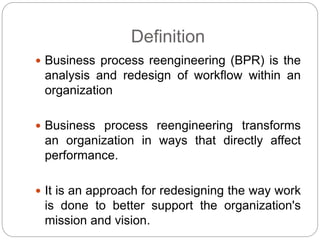
Definition
 Business process reengineering (BPR) is the
analysis and redesign of workflow within an
organization
 Business process reengineering transforms
an organization in ways that directly affect
performance.
 It is an approach for redesigning the way work
is done to better support the organization's
mission and vision.
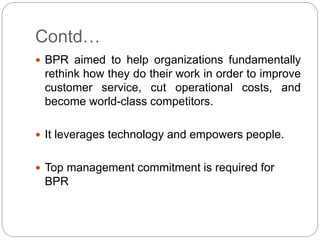
Contd…
 BPR aimed to help organizations fundamentally
rethink how they do their work in order to improve
customer service, cut operational costs, and
become world-class competitors.
 It leverages technology and empowers people.
 Top management commitment is required for
BPR
Business process re-engineering-
Objective
 Aims at:
- eliminating repetitive, paper-intensive,
bureaucratic tasks
-reducing costs significantly
-improving product/service quality.
BPR is Not?
 BPR may sometimes be mistaken for the following
tools:
1. Automation
2. Downsizing
3. Outsourcing
4. Continuous improvement
17
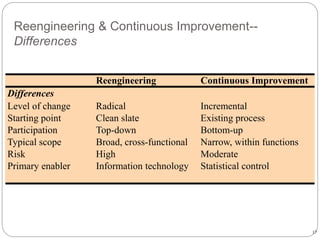
Reengineering & Continuous Improvement--
Differences
Reengineering Continuous Improvement
Differences
Level of change Radical Incremental
Starting point Clean slate Existing process
Participation Top-down Bottom-up
Typical scope Broad, cross-functional Narrow, within functions
Risk High Moderate
Primary enabler Information technology Statistical control
What is a Business Process?
 A business process is an activity or set of
activities that will accomplish a specific
organizational goal.
 E.g.: Procurement, product development,
customer service and sales.
 The business process is divided into a no. of
tasks, which often fall under different department.
Why Reengineer?
 Customers
 Demanding
 Changing Needs
 Competition
 Local
 Global
Issues- BPR
 Following issues are considered the biggest
obstacles in the success of reengineering
projects:
1) Lack of sustained management commitment
and leadership
2) Unrealistic scope and expectations
3) Resistance to change
4) Not helping people think in terms of business
processes.
5) Neglecting to align measures and rewards
Aspects of BPR
 Revolutionizing the way they were doing business
 Radically redesigning or reengineering key
business activities
 Exploiting IT to redesign the process
Development Methodology for
BPR
 1- Develop vision and objectives
 2- Identify process for redesign
 3- Understand and measure existing process
 4- Identify IT levels
 5- Pilot trial new process
 6- Develop supply solution
 7- Make new process operational
 8- On going continuous improvement
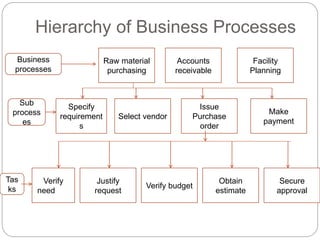
Hierarchy of Business Processes
Raw material
purchasing
Accounts
receivable
Facility
Planning
Specify
requirement
s
Select vendor
Issue
Purchase
order
Make
payment
Secure
approval
Verify
need
Obtain
estimate
Verify budget
Justify
request
Business
processes
Sub
process
es
Tas
ks
Categorization of BPR work Activities
 Value adding activities : Refers to work or activity
for which the customer is willing to pay
 Non-value adding activities: Refers to business
activities that create no value for customers but
are required in order to get the value adding
done.
for example: reporting, checking, controlling etc.
 Waste: Refers to the work that neither adds nor
enables value either to the customer or to the
organization.
Advantages
 BPR directly addresses non-value adding activities in
the form of administrative overheads.
 BPR directly addresses business processes which
are customer centric and non function centric
 BPR offers four R’s to the organization, namely:
- Revitalize
- Restructure
- Reposition
- Renew
Implementation Cost
 Its is moderate to High at the initial stage
 Then low once it is implemented
 Initial expenses mainly go towards data collection
and analysis activities.
 The second major cost is towards consultant’s
fees, expenses relating to IT and related issues.
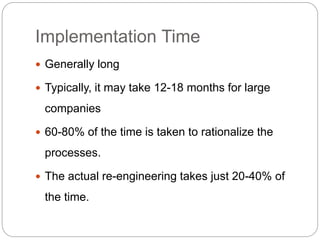
Implementation Time
 Generally long
 Typically, it may take 12-18 months for large
companies
 60-80% of the time is taken to rationalize the
processes.
 The actual re-engineering takes just 20-40% of
the time.
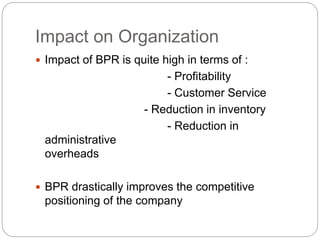
Impact on Organization
 Impact of BPR is quite high in terms of :
- Profitability
- Customer Service
- Reduction in inventory
- Reduction in
administrative
overheads
 BPR drastically improves the competitive
positioning of the company
Applicability/Adaptability

Business process re-engineering

  • 1.
  • 2.
    Learning outcome today Business Process Re-engineering  Definition, need and scope
  • 3.
    Definition  Business processreengineering (BPR) is the analysis and redesign of workflow within an organization  Business process reengineering transforms an organization in ways that directly affect performance.  It is an approach for redesigning the way work is done to better support the organization's mission and vision.
  • 4.
    Contd…  BPR aimedto help organizations fundamentally rethink how they do their work in order to improve customer service, cut operational costs, and become world-class competitors.  It leverages technology and empowers people.  Top management commitment is required for BPR
  • 5.
    Business process re-engineering- Objective Aims at: - eliminating repetitive, paper-intensive, bureaucratic tasks -reducing costs significantly -improving product/service quality.
  • 6.
    BPR is Not? BPR may sometimes be mistaken for the following tools: 1. Automation 2. Downsizing 3. Outsourcing 4. Continuous improvement
  • 7.
    17 Reengineering & ContinuousImprovement-- Differences Reengineering Continuous Improvement Differences Level of change Radical Incremental Starting point Clean slate Existing process Participation Top-down Bottom-up Typical scope Broad, cross-functional Narrow, within functions Risk High Moderate Primary enabler Information technology Statistical control
  • 8.
    What is aBusiness Process?  A business process is an activity or set of activities that will accomplish a specific organizational goal.  E.g.: Procurement, product development, customer service and sales.  The business process is divided into a no. of tasks, which often fall under different department.
  • 9.
    Why Reengineer?  Customers Demanding  Changing Needs  Competition  Local  Global
  • 10.
    Issues- BPR  Followingissues are considered the biggest obstacles in the success of reengineering projects: 1) Lack of sustained management commitment and leadership 2) Unrealistic scope and expectations 3) Resistance to change 4) Not helping people think in terms of business processes. 5) Neglecting to align measures and rewards
  • 11.
    Aspects of BPR Revolutionizing the way they were doing business  Radically redesigning or reengineering key business activities  Exploiting IT to redesign the process
  • 12.
    Development Methodology for BPR 1- Develop vision and objectives  2- Identify process for redesign  3- Understand and measure existing process  4- Identify IT levels  5- Pilot trial new process  6- Develop supply solution  7- Make new process operational  8- On going continuous improvement
  • 13.
    Hierarchy of BusinessProcesses Raw material purchasing Accounts receivable Facility Planning Specify requirement s Select vendor Issue Purchase order Make payment Secure approval Verify need Obtain estimate Verify budget Justify request Business processes Sub process es Tas ks
  • 14.
    Categorization of BPRwork Activities  Value adding activities : Refers to work or activity for which the customer is willing to pay  Non-value adding activities: Refers to business activities that create no value for customers but are required in order to get the value adding done. for example: reporting, checking, controlling etc.  Waste: Refers to the work that neither adds nor enables value either to the customer or to the organization.
  • 15.
    Advantages  BPR directlyaddresses non-value adding activities in the form of administrative overheads.  BPR directly addresses business processes which are customer centric and non function centric  BPR offers four R’s to the organization, namely: - Revitalize - Restructure - Reposition - Renew
  • 16.
    Implementation Cost  Itsis moderate to High at the initial stage  Then low once it is implemented  Initial expenses mainly go towards data collection and analysis activities.  The second major cost is towards consultant’s fees, expenses relating to IT and related issues.
  • 17.
    Implementation Time  Generallylong  Typically, it may take 12-18 months for large companies  60-80% of the time is taken to rationalize the processes.  The actual re-engineering takes just 20-40% of the time.
  • 18.
    Impact on Organization Impact of BPR is quite high in terms of : - Profitability - Customer Service - Reduction in inventory - Reduction in administrative overheads  BPR drastically improves the competitive positioning of the company
  • 19.