Implementing Business Process Reengineering
              (Example Model)

             U.S. Department of Transportation
        Office of Commercial Services Management

                      Version 1.0
Version 1.0 Notes

• Please remember that business process reengineering
  (BPR) efforts may lead to establishing a high performing
  organization (HPO); there is no requirement at present to
  designate an activity that undergoes BPR as a high
  performing organization.
• This example model may be modified as needed so long
  as results conform with the requirements contained in
  the attachment at
  http://www.whitehouse.gov/omb/procurement/comp_src/plans
Topics

•   What is Business Process Reengineering?
•   What is a High Performing Organization?
•   What is a Most Sustainable Organization?
•   BPR/HPO Implementation Steps and Tasks
•   Implementing BPR/HPO is a Team Effort
•   Additional Information


03/13/13                                       3
What is Business Process Reengineering?

• An organizational change method used to redesign an
  organization to drive improved efficiency, effectiveness,
  and economy.
• Organizational change tools may include:
      –    Activity based costing analysis
      –    Baselining and benchmarking studies
      –    Business case analysis
      –    Functionality assessment
      –    Industrial engineering techniques
      –    Organization analysis
      –    Productivity assessment
      –    Workforce analysis
      –    Others, as needed (e.g., human capital tools)

03/13/13                                                      4
What is a High Performing Organization?

• An organization that demonstrates and measures
      – improved operational performance (e.g., effectiveness and
        efficiency),
      – cost and manpower savings (e.g., economy), and
      – improved competency levels
    through evaluation and improvement of its business
    management and human capital practices.


03/13/13                                                            5
What is a High Performing Organization?
                         (continued)

• Applies to commercial activities (may also be applied to
  inherently governmental activities)
• May include existing contracted functions
• Requires a business case (including human capital
  assessment, if appropriate)
• Does not require public-private competition
• Operates as a Most Sustainable Organization


03/13/13                                                     6
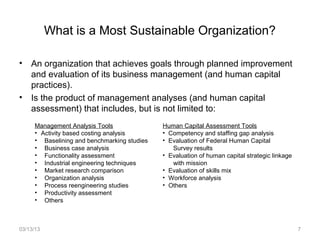
What is a Most Sustainable Organization?

• An organization that achieves goals through planned improvement
  and evaluation of its business management (and human capital
  practices).
• Is the product of management analyses (and human capital
  assessment) that includes, but is not limited to:
     Management Analysis Tools               Human Capital Assessment Tools
     • Activity based costing analysis       • Competency and staffing gap analysis
     • Baselining and benchmarking studies   • Evaluation of Federal Human Capital
     • Business case analysis                   Survey results
     • Functionality assessment              • Evaluation of human capital strategic linkage
     • Industrial engineering techniques        with mission
     • Market research comparison            • Evaluation of skills mix
     • Organization analysis                 • Workforce analysis
     • Process reengineering studies         • Others
     • Productivity assessment
     • Others


03/13/13                                                                                       7
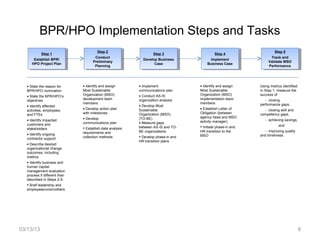
BPR/HPO Implementation Steps and Tasks
                                      Step 2 2
                                        Step                                                                          Step 5 5
                                                                                                                       Step
          Step 1 1
           Step                                                  Step 3 3
                                                                   Step                    Step 4 4
                                                                                            Step
                                     Conduct
                                       Conduct                                                                     Track and
                                                                                                                     Track and
      Establish BPR/
       Establish BPR/                                       Develop Business
                                                             Develop Business            Implement
                                                                                          Implement
                                    Preliminary
                                     Preliminary                                                                  Validate MSO
                                                                                                                   Validate MSO
     HPO Project Plan
      HPO Project Plan                                            Case
                                                                   Case                Business Case
                                                                                        Business Case
                                     Planning
                                      Planning                                                                    Performance
                                                                                                                   Performance


  • State the reason for      • Identify and assign       • Implement              • Identify and assign     Using metrics identified
  BPR/HPO nomination          Most Sustainable            communications plan      Most Sustainable          in Step 1, measure the
  • State the BPR/HPO’s       Organization (MSO)          • Conduct AS-IS          Organization (MSO)        success of
  objectives                  development team            organization analysis    implementation team          - closing
                              members                                              members                   performance gaps,
  • Identify affected                                     • Develop Most
                              • Develop action plan       Sustainable              • Establish Letter of       - closing skill and
  activities, employees,
  and FTEs                    with milestones             Organization (MSO)       Obligation (between       competency gaps,
                              • Develop                   (TO-BE)                  agency head and MSO
  • Identify impacted                                                              activity manager)            - achieving savings,
                              communications plan         • Measure gaps
  customers and                                                                                                         and
  stakeholders                • Establish data analysis   between AS-IS and TO-    • Initiate phase-in and
                              requirements and            BE organizations         HR transition to the         - improving quality
  • Identify ongoing                                                               MSO                       and timeliness.
  contractor support          collection methods          • Develop phase-in and
                                                          HR transition plans
  • Describe desired
  organizational change
  outcomes, including
  metrics
  • Identify business and
  human capital
  management evaluation
  process if different than
  described in Steps 2-5.
  • Brief leadership and
  employees/union/others


03/13/13                                                                                                                                8
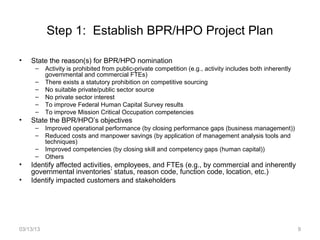
Step 1: Establish BPR/HPO Project Plan

•   State the reason(s) for BPR/HPO nomination
      –    Activity is prohibited from public-private competition (e.g., activity includes both inherently
           governmental and commercial FTEs)
      –    There exists a statutory prohibition on competitive sourcing
      –    No suitable private/public sector source
      –    No private sector interest
      –    To improve Federal Human Capital Survey results
      –    To improve Mission Critical Occupation competencies
•   State the BPR/HPO’s objectives
      –    Improved operational performance (by closing performance gaps (business management))
      –    Reduced costs and manpower savings (by application of management analysis tools and
           techniques)
      –    Improved competencies (by closing skill and competency gaps (human capital))
      –    Others
•   Identify affected activities, employees, and FTEs (e.g., by commercial and inherently
    governmental inventories’ status, reason code, function code, location, etc.)
•   Identify impacted customers and stakeholders


03/13/13                                                                                                     9
Step 1: Establish BPR/HPO Project Plan
                         (continued)
• Identify ongoing contractor support (if any)
• Describe desired organizational change outcomes, including metrics
      – Improved operational performance/customer satisfaction (increased
        service timeliness and quality)
      – Cost and manpower savings (e.g., reduced costs via process
        streamlining and automation, etc.)
        Improved workforce competency/sustainability (e.g., competency/
        staffing gap closure, reduced turnover, timely recruitment, etc.)
      – Improved Federal Human Capital Survey results (e.g., Leadership and
        Knowledge Management, results-oriented Performance Culture, Talent
        Management, etc.)
      – Others
• Identify business and human capital management evaluation
  process if different than described in Steps 2-5.
• Brief leadership and employees/union/others


03/13/13                                                                  10
Step 2: Conduct Preliminary Planning

• Identify and assign Most Sustainable Organization
  (MSO) development team members (e.g., program
  manager, project manager, Human Resource Advisor
  (HRA), AS-IS and TO-BE members, communications
  representative, etc.)
• Develop action plan with milestones
• Develop communications plan
• Establish data analysis requirements and collection
  methods (e.g., workload from interviews, Federal Human
  Capital Survey results, workforce statistics, etc.)


03/13/13                                               11
Step 3: Develop Business Case

• Implement communications plan
• Conduct AS-IS organization analysis
      – Develop Performance Work Statement
      – Collect data (e.g., workload, workforce statistics, competency,
        Federal Human Capital Survey, equipment, materials,
        performance, contractor support, etc.)
      – Identify and collect baseline data including costs
      – Identify industry and agency benchmarks/metrics for modeling
        TO-BE organization (e.g., professional association’s competency
        model, timeliness and quality standards, etc.)


03/13/13                                                             12
Step 3: Develop Business Case
                         (continued)

• Develop Most Sustainable Organization (MSO) (TO-BE)
      – Develop MSO proposal (e.g., organization, staffing plan, gap
        closure plan, workforce plan, equipment plan, contractor support
        plan, quality control plan, etc.)
      – Identify MSO proposed costs and enter them into COMPARE (or
        suitable spreadsheet
• Measure gaps between AS-IS and TO-BE organizations)
  (i.e., in terms of performance, competencies, staffing,
  operating cost, etc.)
• Develop phase-in and human resources (HR) transition
  plan


03/13/13                                                              13
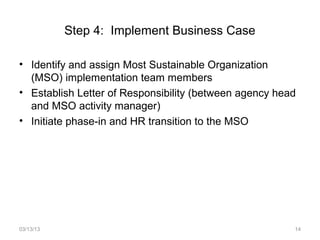
Step 4: Implement Business Case

• Identify and assign Most Sustainable Organization
  (MSO) implementation team members
• Establish Letter of Responsibility (between agency head
  and MSO activity manager)
• Initiate phase-in and HR transition to the MSO


03/13/13                                                14
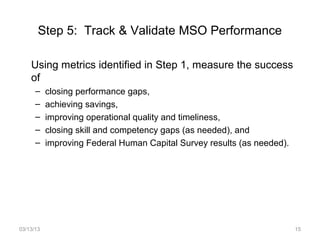
Step 5: Track & Validate MSO Performance

    Using metrics identified in Step 1, measure the success
    of
      –    closing performance gaps,
      –    achieving savings,
      –    improving operational quality and timeliness,
      –    closing skill and competency gaps (as needed), and
      –    improving Federal Human Capital Survey results (as needed).


03/13/13                                                                 15
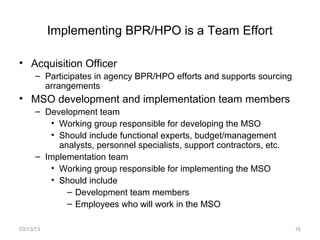
Implementing BPR/HPO is a Team Effort

• Acquisition Officer
      – Participates in agency BPR/HPO efforts and supports sourcing
        arrangements
• MSO development and implementation team members
      – Development team
         • Working group responsible for developing the MSO
         • Should include functional experts, budget/management
           analysts, personnel specialists, support contractors, etc.
      – Implementation team
         • Working group responsible for implementing the MSO
         • Should include
             – Development team members
             – Employees who will work in the MSO

03/13/13                                                                16
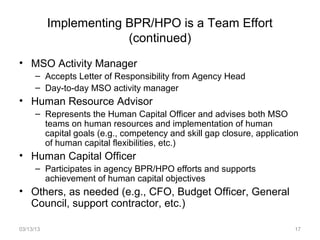
Implementing BPR/HPO is a Team Effort
                        (continued)
• MSO Activity Manager
      – Accepts Letter of Responsibility from Agency Head
      – Day-to-day MSO activity manager
• Human Resource Advisor
      – Represents the Human Capital Officer and advises both MSO
        teams on human resources and implementation of human
        capital goals (e.g., competency and skill gap closure, application
        of human capital flexibilities, etc.)
• Human Capital Officer
      – Participates in agency BPR/HPO efforts and supports
        achievement of human capital objectives
• Others, as needed (e.g., CFO, Budget Officer, General
  Council, support contractor, etc.)

03/13/13                                                                 17
Additional Information

    References
      – Memorandum to President’s Management Council, Subject:
        Plans for Commercial Services Management, July 11, 2008
        http://www.whitehouse.gov/omb/procurement/comp_src/plans_comme

      – Circular A-76, Performance of Commercial Activities, U.S. Office
        of Management and Budget
         • http://www.whitehouse.gov/omb/circulars/a076/a76_incl_tech_corr


03/13/13                                                            18

US DOT BPR Example Model

  • 1.
    Implementing Business ProcessReengineering (Example Model) U.S. Department of Transportation Office of Commercial Services Management Version 1.0
  • 2.
    Version 1.0 Notes •Please remember that business process reengineering (BPR) efforts may lead to establishing a high performing organization (HPO); there is no requirement at present to designate an activity that undergoes BPR as a high performing organization. • This example model may be modified as needed so long as results conform with the requirements contained in the attachment at http://www.whitehouse.gov/omb/procurement/comp_src/plans
  • 3.
    Topics • What is Business Process Reengineering? • What is a High Performing Organization? • What is a Most Sustainable Organization? • BPR/HPO Implementation Steps and Tasks • Implementing BPR/HPO is a Team Effort • Additional Information 03/13/13 3
  • 4.
    What is BusinessProcess Reengineering? • An organizational change method used to redesign an organization to drive improved efficiency, effectiveness, and economy. • Organizational change tools may include: – Activity based costing analysis – Baselining and benchmarking studies – Business case analysis – Functionality assessment – Industrial engineering techniques – Organization analysis – Productivity assessment – Workforce analysis – Others, as needed (e.g., human capital tools) 03/13/13 4
  • 5.
    What is aHigh Performing Organization? • An organization that demonstrates and measures – improved operational performance (e.g., effectiveness and efficiency), – cost and manpower savings (e.g., economy), and – improved competency levels through evaluation and improvement of its business management and human capital practices. 03/13/13 5
  • 6.
    What is aHigh Performing Organization? (continued) • Applies to commercial activities (may also be applied to inherently governmental activities) • May include existing contracted functions • Requires a business case (including human capital assessment, if appropriate) • Does not require public-private competition • Operates as a Most Sustainable Organization 03/13/13 6
  • 7.
    What is aMost Sustainable Organization? • An organization that achieves goals through planned improvement and evaluation of its business management (and human capital practices). • Is the product of management analyses (and human capital assessment) that includes, but is not limited to: Management Analysis Tools Human Capital Assessment Tools • Activity based costing analysis • Competency and staffing gap analysis • Baselining and benchmarking studies • Evaluation of Federal Human Capital • Business case analysis Survey results • Functionality assessment • Evaluation of human capital strategic linkage • Industrial engineering techniques with mission • Market research comparison • Evaluation of skills mix • Organization analysis • Workforce analysis • Process reengineering studies • Others • Productivity assessment • Others 03/13/13 7
  • 8.
    BPR/HPO Implementation Stepsand Tasks Step 2 2 Step Step 5 5 Step Step 1 1 Step Step 3 3 Step Step 4 4 Step Conduct Conduct Track and Track and Establish BPR/ Establish BPR/ Develop Business Develop Business Implement Implement Preliminary Preliminary Validate MSO Validate MSO HPO Project Plan HPO Project Plan Case Case Business Case Business Case Planning Planning Performance Performance • State the reason for • Identify and assign • Implement • Identify and assign Using metrics identified BPR/HPO nomination Most Sustainable communications plan Most Sustainable in Step 1, measure the • State the BPR/HPO’s Organization (MSO) • Conduct AS-IS Organization (MSO) success of objectives development team organization analysis implementation team - closing members members performance gaps, • Identify affected • Develop Most • Develop action plan Sustainable • Establish Letter of - closing skill and activities, employees, and FTEs with milestones Organization (MSO) Obligation (between competency gaps, • Develop (TO-BE) agency head and MSO • Identify impacted activity manager) - achieving savings, communications plan • Measure gaps customers and and stakeholders • Establish data analysis between AS-IS and TO- • Initiate phase-in and requirements and BE organizations HR transition to the - improving quality • Identify ongoing MSO and timeliness. contractor support collection methods • Develop phase-in and HR transition plans • Describe desired organizational change outcomes, including metrics • Identify business and human capital management evaluation process if different than described in Steps 2-5. • Brief leadership and employees/union/others 03/13/13 8
  • 9.
    Step 1: EstablishBPR/HPO Project Plan • State the reason(s) for BPR/HPO nomination – Activity is prohibited from public-private competition (e.g., activity includes both inherently governmental and commercial FTEs) – There exists a statutory prohibition on competitive sourcing – No suitable private/public sector source – No private sector interest – To improve Federal Human Capital Survey results – To improve Mission Critical Occupation competencies • State the BPR/HPO’s objectives – Improved operational performance (by closing performance gaps (business management)) – Reduced costs and manpower savings (by application of management analysis tools and techniques) – Improved competencies (by closing skill and competency gaps (human capital)) – Others • Identify affected activities, employees, and FTEs (e.g., by commercial and inherently governmental inventories’ status, reason code, function code, location, etc.) • Identify impacted customers and stakeholders 03/13/13 9
  • 10.
    Step 1: EstablishBPR/HPO Project Plan (continued) • Identify ongoing contractor support (if any) • Describe desired organizational change outcomes, including metrics – Improved operational performance/customer satisfaction (increased service timeliness and quality) – Cost and manpower savings (e.g., reduced costs via process streamlining and automation, etc.) Improved workforce competency/sustainability (e.g., competency/ staffing gap closure, reduced turnover, timely recruitment, etc.) – Improved Federal Human Capital Survey results (e.g., Leadership and Knowledge Management, results-oriented Performance Culture, Talent Management, etc.) – Others • Identify business and human capital management evaluation process if different than described in Steps 2-5. • Brief leadership and employees/union/others 03/13/13 10
  • 11.
    Step 2: ConductPreliminary Planning • Identify and assign Most Sustainable Organization (MSO) development team members (e.g., program manager, project manager, Human Resource Advisor (HRA), AS-IS and TO-BE members, communications representative, etc.) • Develop action plan with milestones • Develop communications plan • Establish data analysis requirements and collection methods (e.g., workload from interviews, Federal Human Capital Survey results, workforce statistics, etc.) 03/13/13 11
  • 12.
    Step 3: DevelopBusiness Case • Implement communications plan • Conduct AS-IS organization analysis – Develop Performance Work Statement – Collect data (e.g., workload, workforce statistics, competency, Federal Human Capital Survey, equipment, materials, performance, contractor support, etc.) – Identify and collect baseline data including costs – Identify industry and agency benchmarks/metrics for modeling TO-BE organization (e.g., professional association’s competency model, timeliness and quality standards, etc.) 03/13/13 12
  • 13.
    Step 3: DevelopBusiness Case (continued) • Develop Most Sustainable Organization (MSO) (TO-BE) – Develop MSO proposal (e.g., organization, staffing plan, gap closure plan, workforce plan, equipment plan, contractor support plan, quality control plan, etc.) – Identify MSO proposed costs and enter them into COMPARE (or suitable spreadsheet • Measure gaps between AS-IS and TO-BE organizations) (i.e., in terms of performance, competencies, staffing, operating cost, etc.) • Develop phase-in and human resources (HR) transition plan 03/13/13 13
  • 14.
    Step 4: ImplementBusiness Case • Identify and assign Most Sustainable Organization (MSO) implementation team members • Establish Letter of Responsibility (between agency head and MSO activity manager) • Initiate phase-in and HR transition to the MSO 03/13/13 14
  • 15.
    Step 5: Track& Validate MSO Performance Using metrics identified in Step 1, measure the success of – closing performance gaps, – achieving savings, – improving operational quality and timeliness, – closing skill and competency gaps (as needed), and – improving Federal Human Capital Survey results (as needed). 03/13/13 15
  • 16.
    Implementing BPR/HPO isa Team Effort • Acquisition Officer – Participates in agency BPR/HPO efforts and supports sourcing arrangements • MSO development and implementation team members – Development team • Working group responsible for developing the MSO • Should include functional experts, budget/management analysts, personnel specialists, support contractors, etc. – Implementation team • Working group responsible for implementing the MSO • Should include – Development team members – Employees who will work in the MSO 03/13/13 16
  • 17.
    Implementing BPR/HPO isa Team Effort (continued) • MSO Activity Manager – Accepts Letter of Responsibility from Agency Head – Day-to-day MSO activity manager • Human Resource Advisor – Represents the Human Capital Officer and advises both MSO teams on human resources and implementation of human capital goals (e.g., competency and skill gap closure, application of human capital flexibilities, etc.) • Human Capital Officer – Participates in agency BPR/HPO efforts and supports achievement of human capital objectives • Others, as needed (e.g., CFO, Budget Officer, General Council, support contractor, etc.) 03/13/13 17
  • 18.
    Additional Information References – Memorandum to President’s Management Council, Subject: Plans for Commercial Services Management, July 11, 2008 http://www.whitehouse.gov/omb/procurement/comp_src/plans_comme – Circular A-76, Performance of Commercial Activities, U.S. Office of Management and Budget • http://www.whitehouse.gov/omb/circulars/a076/a76_incl_tech_corr 03/13/13 18