
1
Building the Future:
Net Zero & Net Zero Ready
2016 PUBLIC SECTOR CLIMATE ACTION LEADERSHIP SYMPOSIUM
NOVEMBER 22, 2016
BRITTANY COUGHLIN | P.ENG, BEMP, CPHC
2
 What is net zero and net zero ready?
 Case study: Net Zero
 Case study: Net Zero Ready & Passive House
 Case study: Net Zero Ready Strategy Development
3
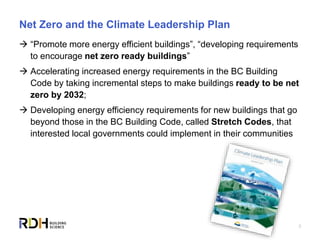
Net Zero and the Climate Leadership Plan
 “Promote more energy efficient buildings”, “developing requirements
to encourage net zero ready buildings”
 Accelerating increased energy requirements in the BC Building
Code by taking incremental steps to make buildings ready to be net
zero by 2032;
 Developing energy efficiency requirements for new buildings that go
beyond those in the BC Building Code, called Stretch Codes, that
interested local governments could implement in their communities
4
What is Net Zero? Net Zero Ready?
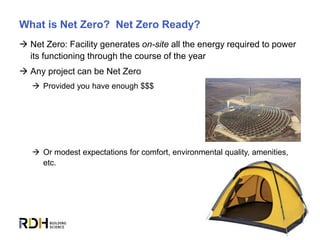
 Net Zero: Facility generates on-site all the energy required to power
its functioning through the course of the year
 Any project can be Net Zero
 Provided you have enough $$$
 Or modest expectations for comfort, environmental quality, amenities,
etc.
5
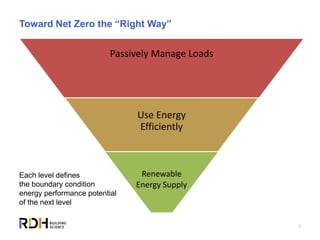
Toward Net Zero the “Right Way”
Passively Manage Loads
Use Energy
Efficiently
Renewable
Energy Supply
Each level defines
the boundary condition
energy performance potential
of the next level
6
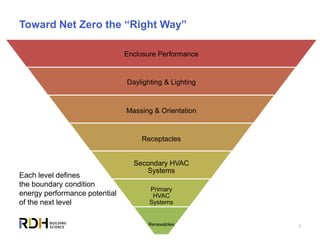
Enclosure Performance
Daylighting & Lighting
Massing & Orientation
Receptacles
Secondary HVAC
Systems
Primary
HVAC
Systems
Renewables
Each level defines
the boundary condition
energy performance potential
of the next level
Toward Net Zero the “Right Way”
7
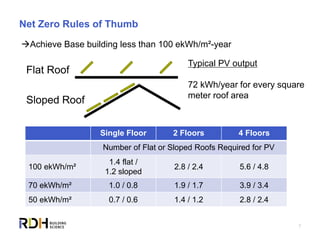
Net Zero Rules of Thumb
Achieve Base building less than 100 ekWh/m²-year
Single Floor 2 Floors 4 Floors
Number of Flat or Sloped Roofs Required for PV
100 ekWh/m²
1.4 flat /
1.2 sloped
2.8 / 2.4 5.6 / 4.8
70 ekWh/m² 1.0 / 0.8 1.9 / 1.7 3.9 / 3.4
50 ekWh/m² 0.7 / 0.6 1.4 / 1.2 2.8 / 2.4
Typical PV output
72 kWh/year for every square
meter roof area
Flat Roof
Sloped Roof
8
Net Zero Rules of Thumb
9
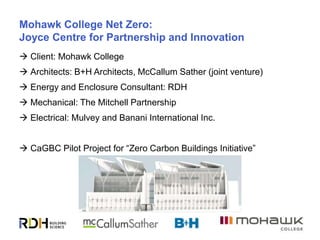
Mohawk College Net Zero:
Joyce Centre for Partnership and Innovation
 Client: Mohawk College
 Architects: B+H Architects, McCallum Sather (joint venture)
 Energy and Enclosure Consultant: RDH
 Mechanical: The Mitchell Partnership
 Electrical: Mulvey and Banani International Inc.
 CaGBC Pilot Project for “Zero Carbon Buildings Initiative”
10
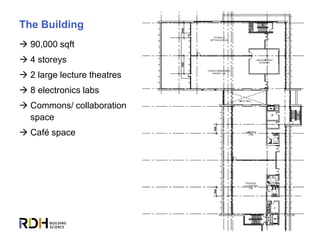
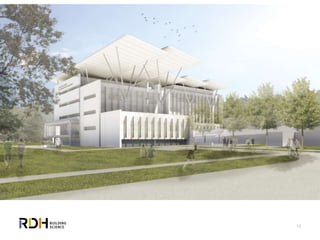
The Building
 90,000 sqft
 4 storeys
 2 large lecture theatres
 8 electronics labs
 Commons/ collaboration
space
 Café space
11
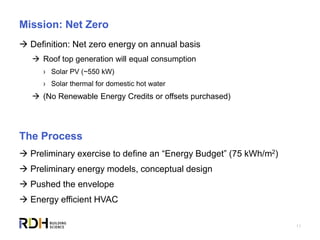
Mission: Net Zero
 Definition: Net zero energy on annual basis
 Roof top generation will equal consumption
› Solar PV (~550 kW)
› Solar thermal for domestic hot water
 (No Renewable Energy Credits or offsets purchased)
The Process
 Preliminary exercise to define an “Energy Budget” (75 kWh/m2)
 Preliminary energy models, conceptual design
 Pushed the envelope
 Energy efficient HVAC
12
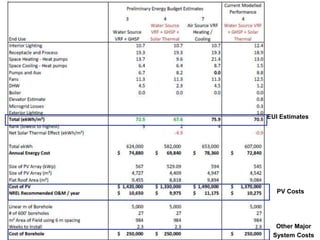
EUI Estimates
PV Costs
Other Major
System Costs
13
The Design
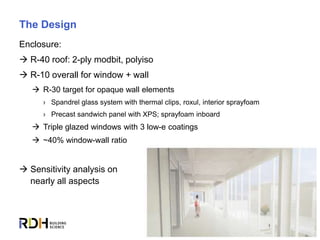
Enclosure:
 R-40 roof: 2-ply modbit, polyiso
 R-10 overall for window + wall
 R-30 target for opaque wall elements
› Spandrel glass system with thermal clips, roxul, interior sprayfoam
› Precast sandwich panel with XPS; sprayfoam inboard
 Triple glazed windows with 3 low-e coatings
 ~40% window-wall ratio
 Sensitivity analysis on
nearly all aspects
14
The Design
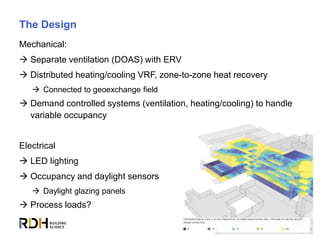
Mechanical:
 Separate ventilation (DOAS) with ERV
 Distributed heating/cooling VRF, zone-to-zone heat recovery
 Connected to geoexchange field
 Demand controlled systems (ventilation, heating/cooling) to handle
variable occupancy
Electrical
 LED lighting
 Occupancy and daylight sensors
 Daylight glazing panels
 Process loads?
15
The Building
16
The Energy Step Code and Net Zero Ready
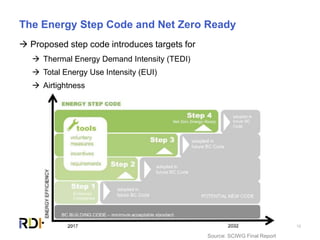
 Proposed step code introduces targets for
 Thermal Energy Demand Intensity (TEDI)
 Total Energy Use Intensity (EUI)
 Airtightness
 Source: SCIWG Final Report
17
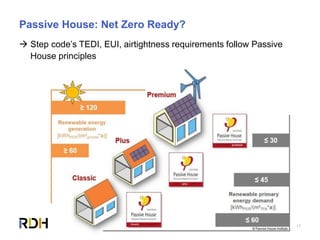
Passive House: Net Zero Ready?
 Step code’s TEDI, EUI, airtightness requirements follow Passive
House principles
18
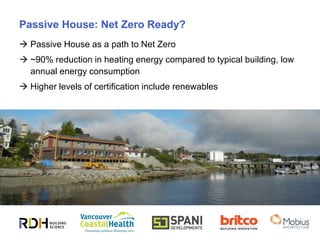
Passive House: Net Zero Ready?
 Passive House as a path to Net Zero
 ~90% reduction in heating energy compared to typical building, low
annual energy consumption
 Higher levels of certification include renewables
19
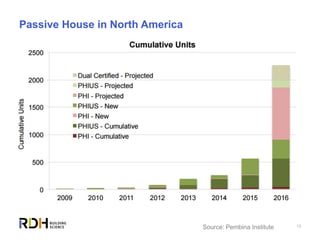
Passive House in North America
 Source: Pembina Institute
20
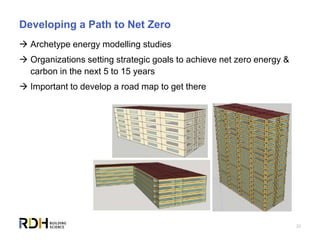
Developing a Path to Net Zero
 Archetype energy modelling studies
 Organizations setting strategic goals to achieve net zero energy &
carbon in the next 5 to 15 years
 Important to develop a road map to get there
21
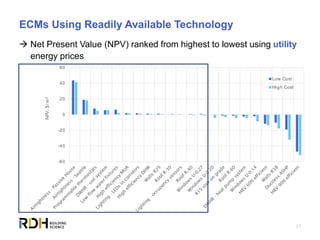
ECMs Using Readily Available Technology
 Net Present Value (NPV) ranked from highest to lowest using utility
energy prices
-60
-40
-20
0
20
40
60
NPV,$/m2
Low Cost
High Cost
22
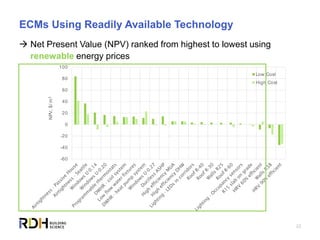
ECMs Using Readily Available Technology
 Net Present Value (NPV) ranked from highest to lowest using
renewable energy prices
-60
-40
-20
0
20
40
60
80
100
NPV,$/m2
Low Cost
High Cost
23
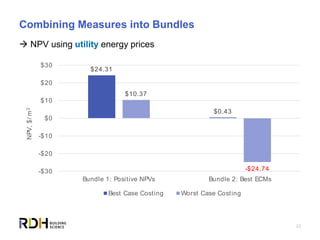
Combining Measures into Bundles
 NPV using utility energy prices
$24.31
$0.43
$10.37
-$24.74-$30
-$20
-$10
$0
$10
$20
$30
Bundle 1: Positive NPVs Bundle 2: Best ECMs
NPV,$/m2
Best Case Costing Worst Case Costing
24
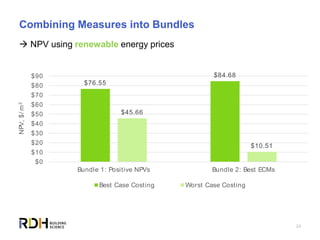
Combining Measures into Bundles
 NPV using renewable energy prices
$76.55
$84.68
$45.66
$10.51
$0
$10
$20
$30
$40
$50
$60
$70
$80
$90
Bundle 1: Positive NPVs Bundle 2: Best ECMs
NPV,$/m2
Best Case Costing Worst Case Costing
25
Developing a Path to Net Zero
 Energy conservation is typically more cost effective than renewable
supply
 Economics are good for long term building owners/operators
 Road map to zero energy & carbon new buildings
 Establish goals for 2020, 2025, 2030 and beyond
 Identify capacity building and market transformation needs
26
Discussion + Questions
BCOUGHLIN@RDH.COM
WWW.RDH.COM

Building the Future: Net Zero and Net Zero Ready

  • 1.
    1 Building the Future: NetZero & Net Zero Ready 2016 PUBLIC SECTOR CLIMATE ACTION LEADERSHIP SYMPOSIUM NOVEMBER 22, 2016 BRITTANY COUGHLIN | P.ENG, BEMP, CPHC
  • 2.
    2  What isnet zero and net zero ready?  Case study: Net Zero  Case study: Net Zero Ready & Passive House  Case study: Net Zero Ready Strategy Development
  • 3.
    3 Net Zero andthe Climate Leadership Plan  “Promote more energy efficient buildings”, “developing requirements to encourage net zero ready buildings”  Accelerating increased energy requirements in the BC Building Code by taking incremental steps to make buildings ready to be net zero by 2032;  Developing energy efficiency requirements for new buildings that go beyond those in the BC Building Code, called Stretch Codes, that interested local governments could implement in their communities
  • 4.
    4 What is NetZero? Net Zero Ready?  Net Zero: Facility generates on-site all the energy required to power its functioning through the course of the year  Any project can be Net Zero  Provided you have enough $$$  Or modest expectations for comfort, environmental quality, amenities, etc.
  • 5.
    5 Toward Net Zerothe “Right Way” Passively Manage Loads Use Energy Efficiently Renewable Energy Supply Each level defines the boundary condition energy performance potential of the next level
  • 6.
    6 Enclosure Performance Daylighting &Lighting Massing & Orientation Receptacles Secondary HVAC Systems Primary HVAC Systems Renewables Each level defines the boundary condition energy performance potential of the next level Toward Net Zero the “Right Way”
  • 7.
    7 Net Zero Rulesof Thumb Achieve Base building less than 100 ekWh/m²-year Single Floor 2 Floors 4 Floors Number of Flat or Sloped Roofs Required for PV 100 ekWh/m² 1.4 flat / 1.2 sloped 2.8 / 2.4 5.6 / 4.8 70 ekWh/m² 1.0 / 0.8 1.9 / 1.7 3.9 / 3.4 50 ekWh/m² 0.7 / 0.6 1.4 / 1.2 2.8 / 2.4 Typical PV output 72 kWh/year for every square meter roof area Flat Roof Sloped Roof
  • 8.
  • 9.
    9 Mohawk College NetZero: Joyce Centre for Partnership and Innovation  Client: Mohawk College  Architects: B+H Architects, McCallum Sather (joint venture)  Energy and Enclosure Consultant: RDH  Mechanical: The Mitchell Partnership  Electrical: Mulvey and Banani International Inc.  CaGBC Pilot Project for “Zero Carbon Buildings Initiative”
  • 10.
    10 The Building  90,000sqft  4 storeys  2 large lecture theatres  8 electronics labs  Commons/ collaboration space  Café space
  • 11.
    11 Mission: Net Zero Definition: Net zero energy on annual basis  Roof top generation will equal consumption › Solar PV (~550 kW) › Solar thermal for domestic hot water  (No Renewable Energy Credits or offsets purchased) The Process  Preliminary exercise to define an “Energy Budget” (75 kWh/m2)  Preliminary energy models, conceptual design  Pushed the envelope  Energy efficient HVAC
  • 12.
  • 13.
    13 The Design Enclosure:  R-40roof: 2-ply modbit, polyiso  R-10 overall for window + wall  R-30 target for opaque wall elements › Spandrel glass system with thermal clips, roxul, interior sprayfoam › Precast sandwich panel with XPS; sprayfoam inboard  Triple glazed windows with 3 low-e coatings  ~40% window-wall ratio  Sensitivity analysis on nearly all aspects
  • 14.
    14 The Design Mechanical:  Separateventilation (DOAS) with ERV  Distributed heating/cooling VRF, zone-to-zone heat recovery  Connected to geoexchange field  Demand controlled systems (ventilation, heating/cooling) to handle variable occupancy Electrical  LED lighting  Occupancy and daylight sensors  Daylight glazing panels  Process loads?
  • 15.
  • 16.
    16 The Energy StepCode and Net Zero Ready  Proposed step code introduces targets for  Thermal Energy Demand Intensity (TEDI)  Total Energy Use Intensity (EUI)  Airtightness  Source: SCIWG Final Report
  • 17.
    17 Passive House: NetZero Ready?  Step code’s TEDI, EUI, airtightness requirements follow Passive House principles
  • 18.
    18 Passive House: NetZero Ready?  Passive House as a path to Net Zero  ~90% reduction in heating energy compared to typical building, low annual energy consumption  Higher levels of certification include renewables
  • 19.
    19 Passive House inNorth America  Source: Pembina Institute
  • 20.
    20 Developing a Pathto Net Zero  Archetype energy modelling studies  Organizations setting strategic goals to achieve net zero energy & carbon in the next 5 to 15 years  Important to develop a road map to get there
  • 21.
    21 ECMs Using ReadilyAvailable Technology  Net Present Value (NPV) ranked from highest to lowest using utility energy prices -60 -40 -20 0 20 40 60 NPV,$/m2 Low Cost High Cost
  • 22.
    22 ECMs Using ReadilyAvailable Technology  Net Present Value (NPV) ranked from highest to lowest using renewable energy prices -60 -40 -20 0 20 40 60 80 100 NPV,$/m2 Low Cost High Cost
  • 23.
    23 Combining Measures intoBundles  NPV using utility energy prices $24.31 $0.43 $10.37 -$24.74-$30 -$20 -$10 $0 $10 $20 $30 Bundle 1: Positive NPVs Bundle 2: Best ECMs NPV,$/m2 Best Case Costing Worst Case Costing
  • 24.
    24 Combining Measures intoBundles  NPV using renewable energy prices $76.55 $84.68 $45.66 $10.51 $0 $10 $20 $30 $40 $50 $60 $70 $80 $90 Bundle 1: Positive NPVs Bundle 2: Best ECMs NPV,$/m2 Best Case Costing Worst Case Costing
  • 25.
    25 Developing a Pathto Net Zero  Energy conservation is typically more cost effective than renewable supply  Economics are good for long term building owners/operators  Road map to zero energy & carbon new buildings  Establish goals for 2020, 2025, 2030 and beyond  Identify capacity building and market transformation needs
  • 26.