MAKING THE BUSINESS CASE:
NET-ZERO-ENERGY BUILDINGS

SMACNA National Convention
October 21, 2013 — Maui, Hawaii
Jerry Yudelson, PE, LEED Fellow
Yudelson Associates
Tucson, Arizona
LEARNING OBJECTIVES:
NET-ZERO-ENERGY BUILDINGS

©2013 Yudelson Associates
1.
2.
3.
4.

Understand the concept of net-zero-energy buildings
Learn from examples what systems are being used in low-energy buildings
Become conversant with the business case for Net Zero buildings
Gather ideas for positioning your business to take advantage of this trend
LOOKING BACK
WHAT HAS CHANGED IN 5 YEARS?

©2013 Yudelson Associates

1.
2.
3.
4.
5.
6.

New HVAC technologies
Market demand for green buildings
Cost of green buildings
Financing for solar
Cost of solar
New goals – Net Zero
©2013 Yudelson Associates

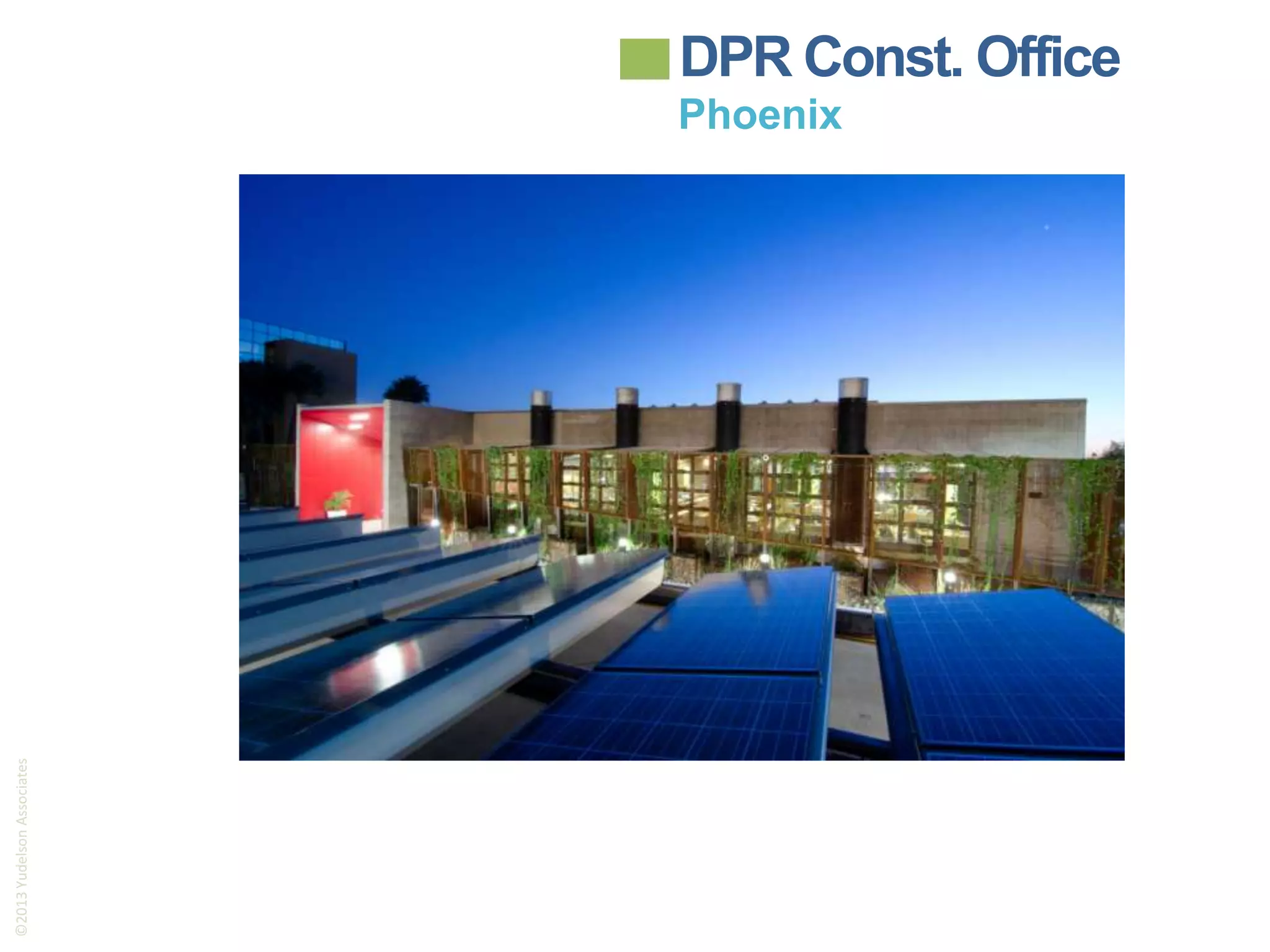
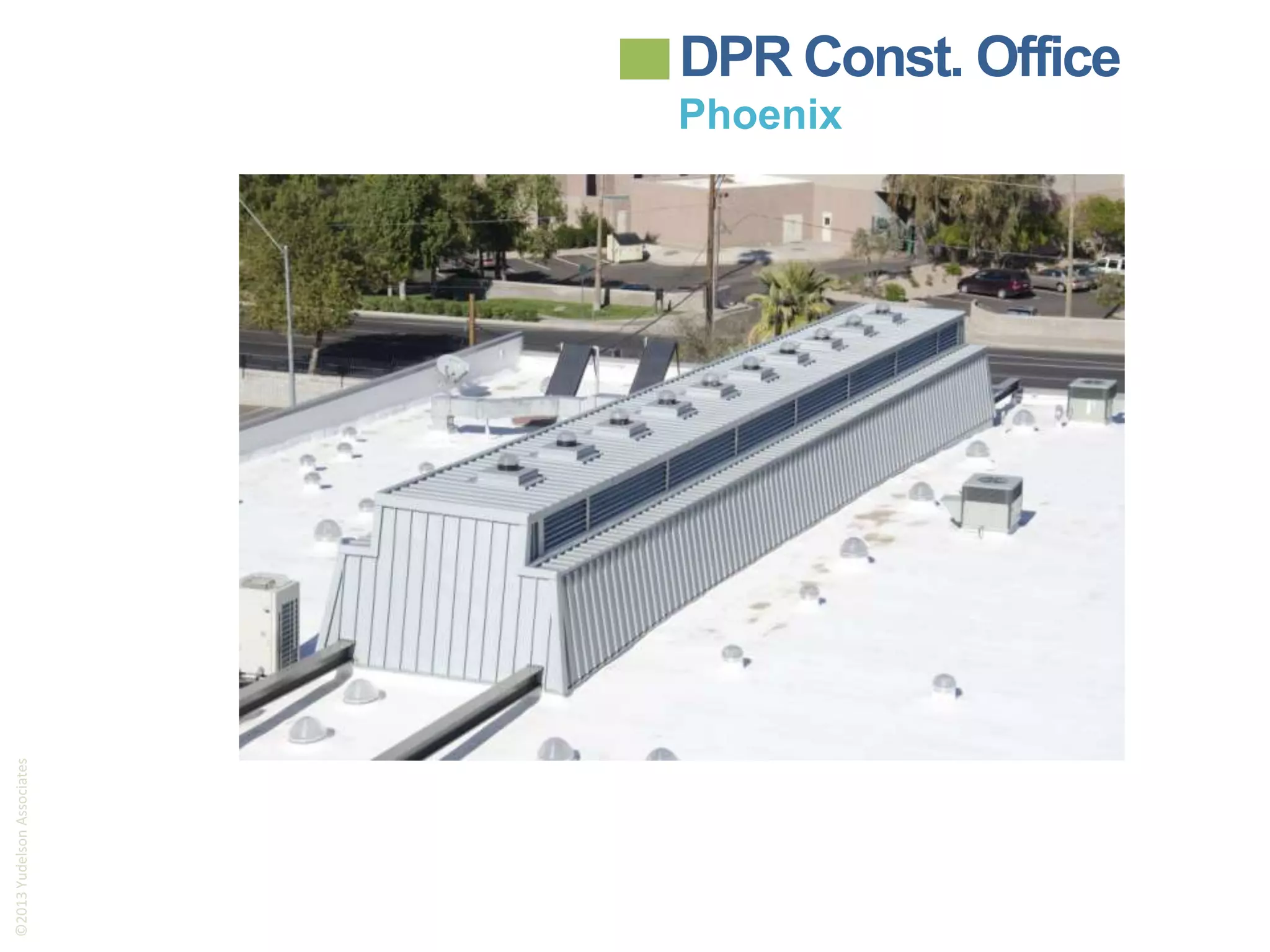
DPR Const. Office

Phoenix
©2013 Yudelson Associates

DPR Const. Office

Phoenix
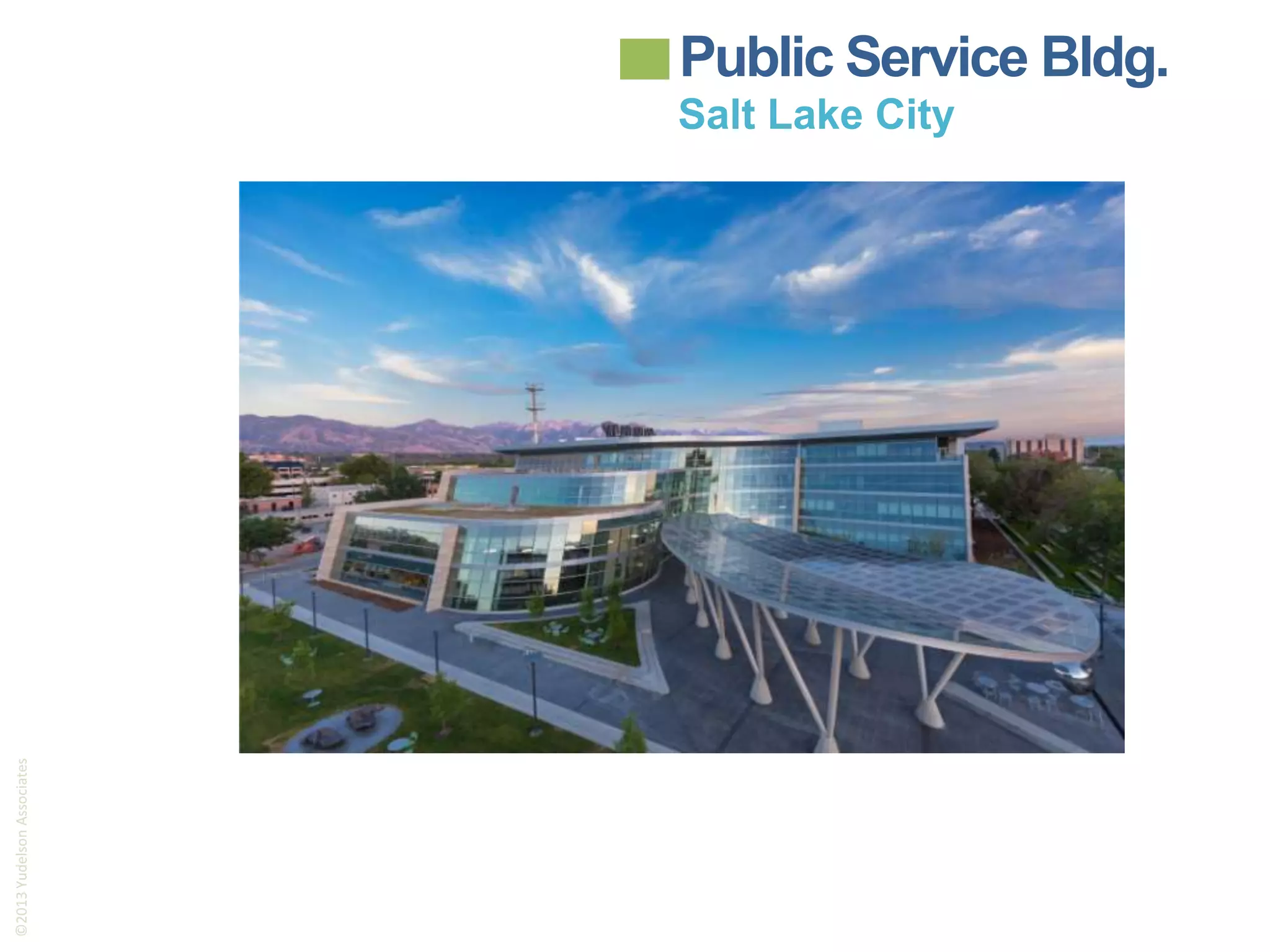
Public Service Bldg.

©2013 Yudelson Associates

Salt Lake City
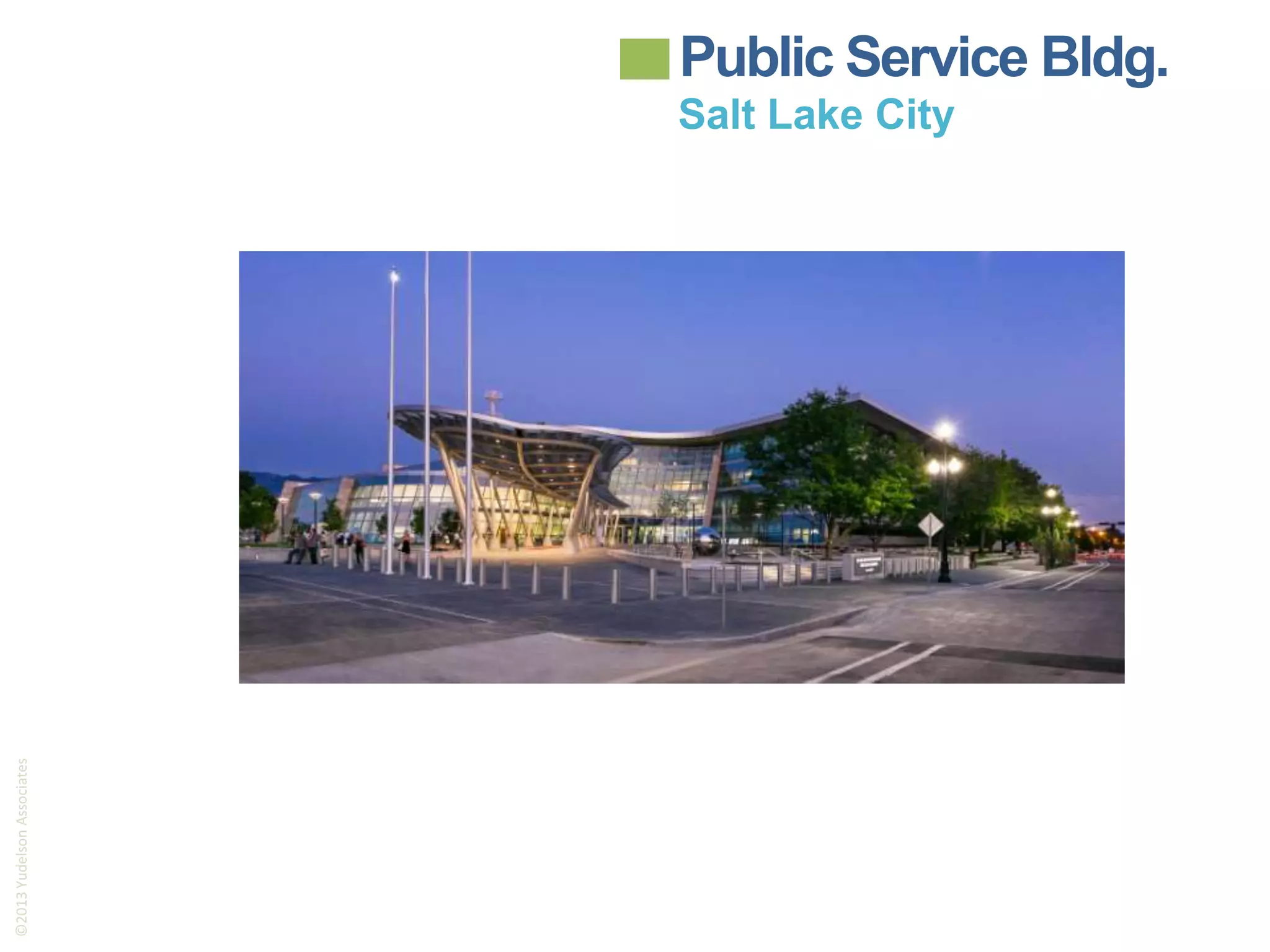
Public Service Bldg.

©2013 Yudelson Associates

Salt Lake City
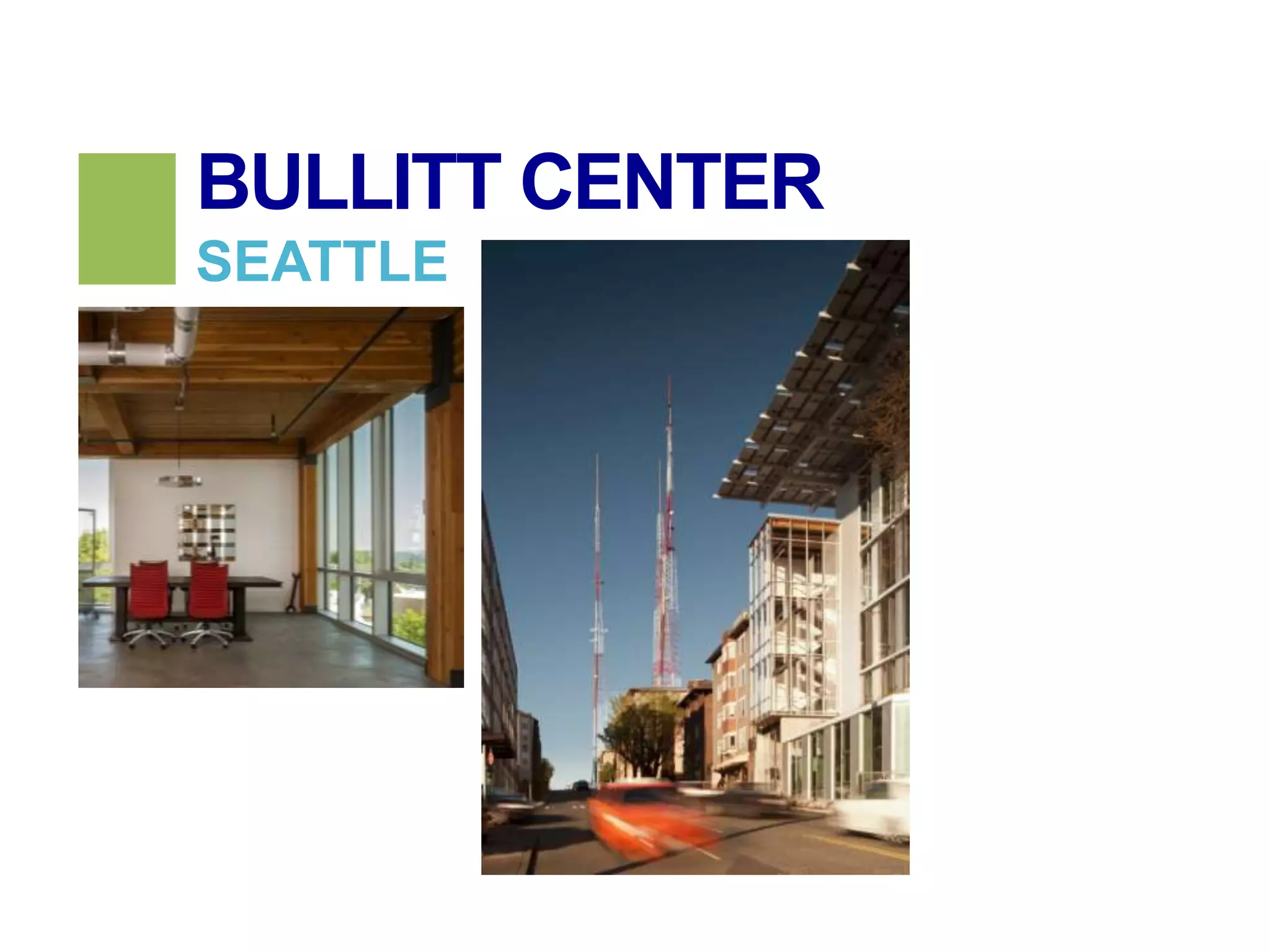
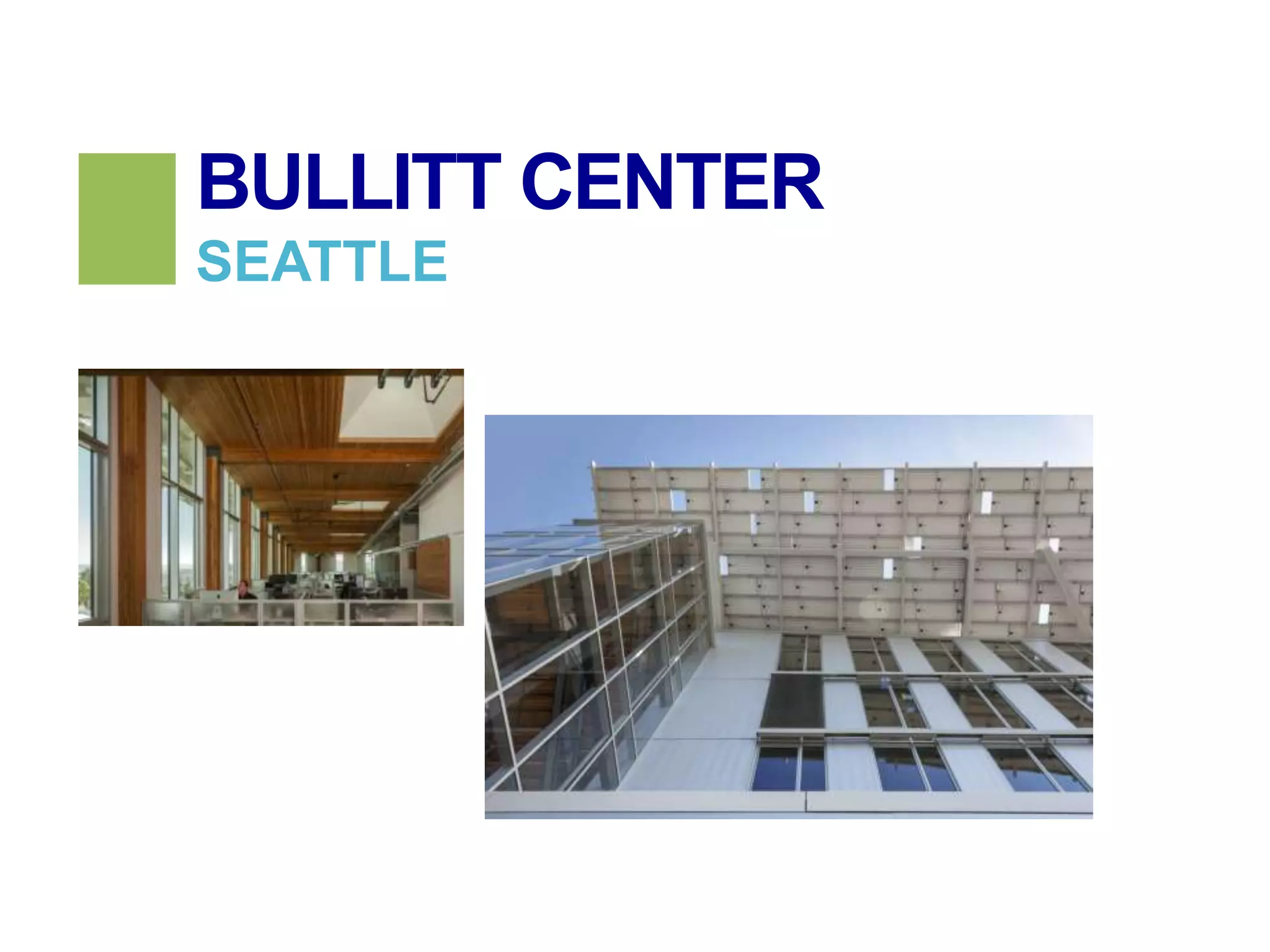
BULLITT CENTER
SEATTLE
BULLITT CENTER
SEATTLE
©2013 Yudelson Associates

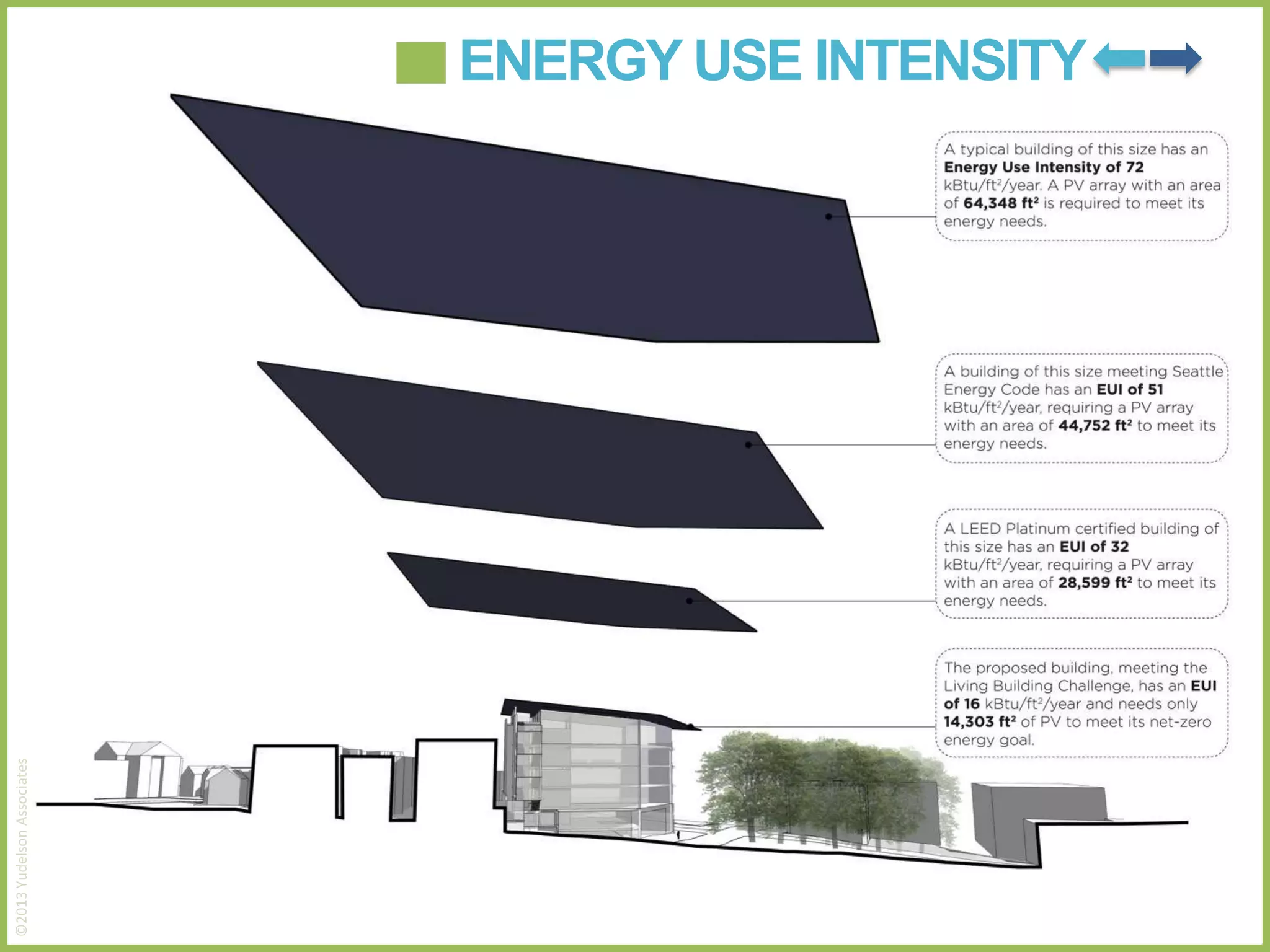
ENERGY USE INTENSITY
©2013 Yudelson Associates

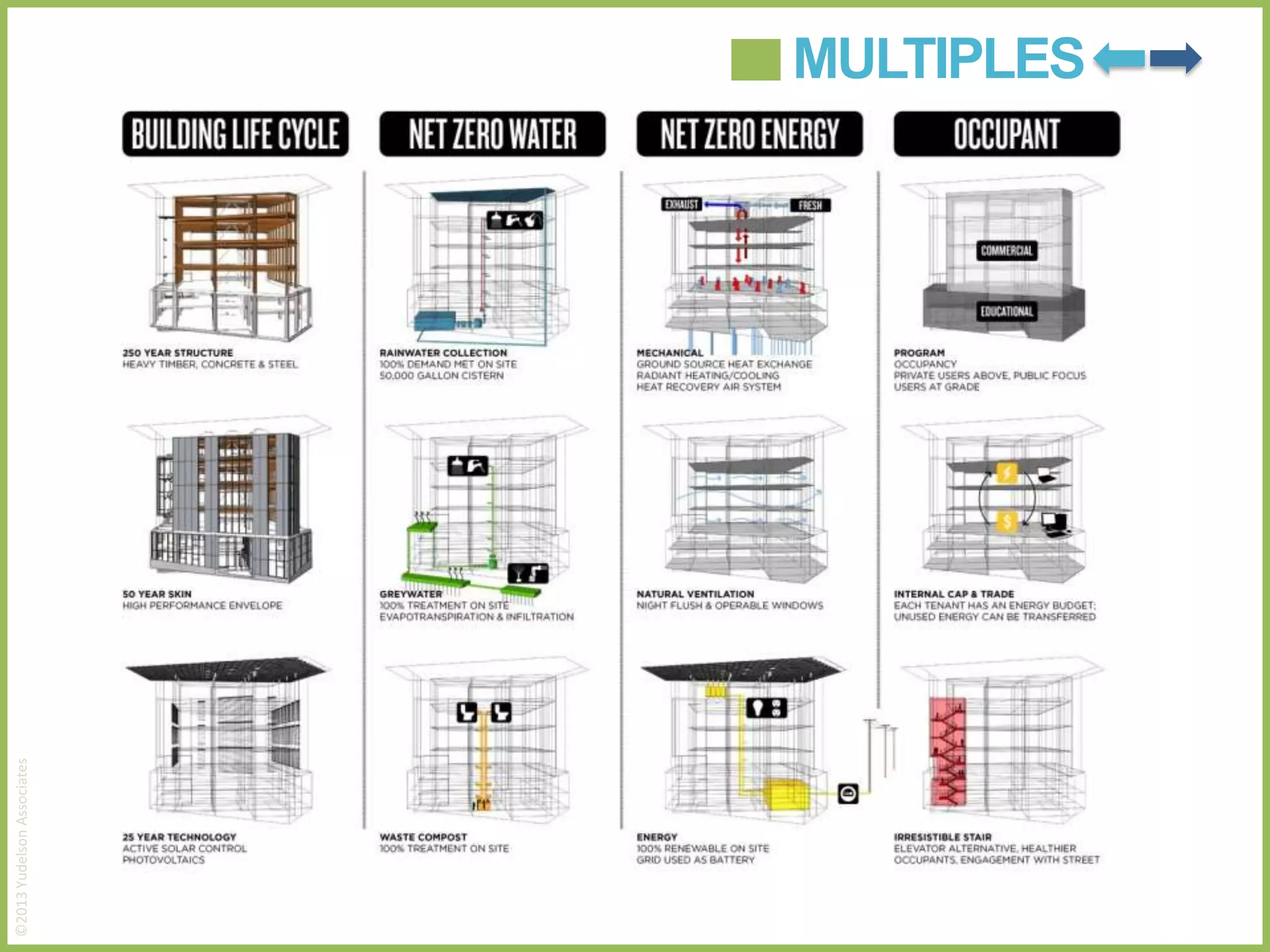
MULTIPLES
LOOKING FORWARD

©2013 Yudelson Associates

WHAT WILL CHANGE IN 5 YEARS?

1.
2.
3.
4.
5.
6.
7.

New HVAC technologies
ASHRAE design standards
Cost of solar (-)
Cost of energy (+)
Regulatory environment
Market demand
New technologies
©2013 Yudelson Associates

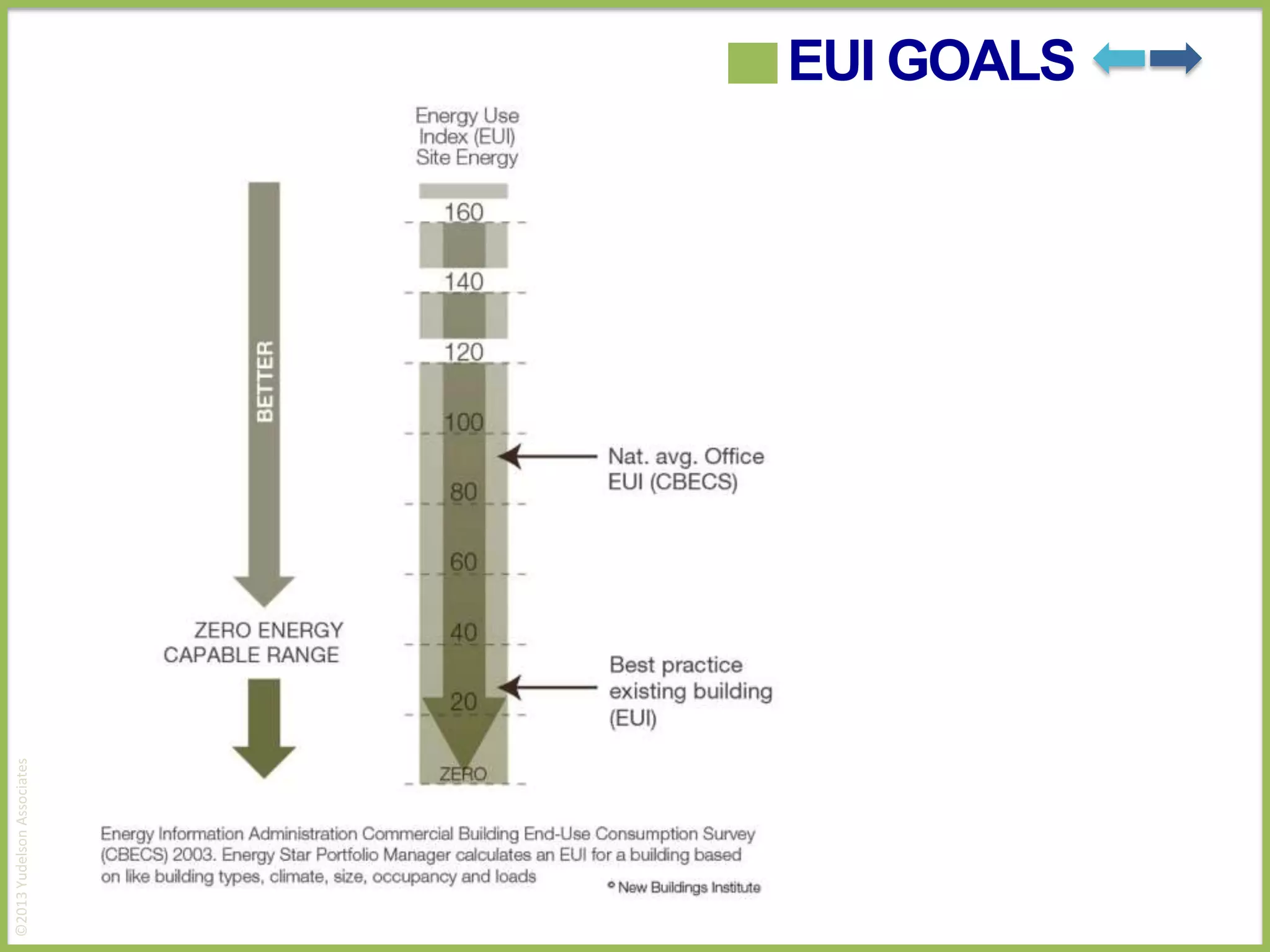
EUI GOALS
©2013 Yudelson Associates

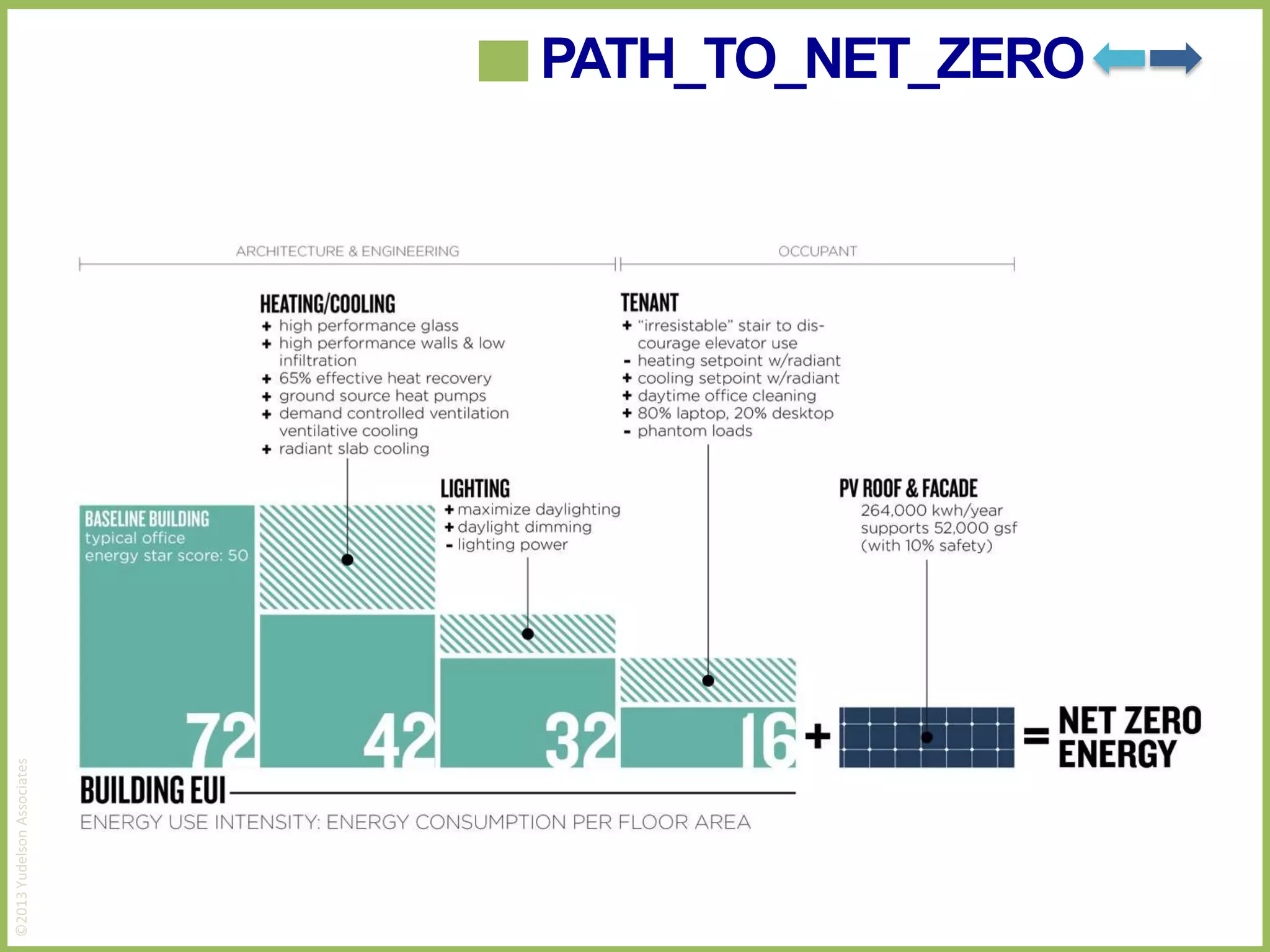
PATH_TO_NET_ZERO
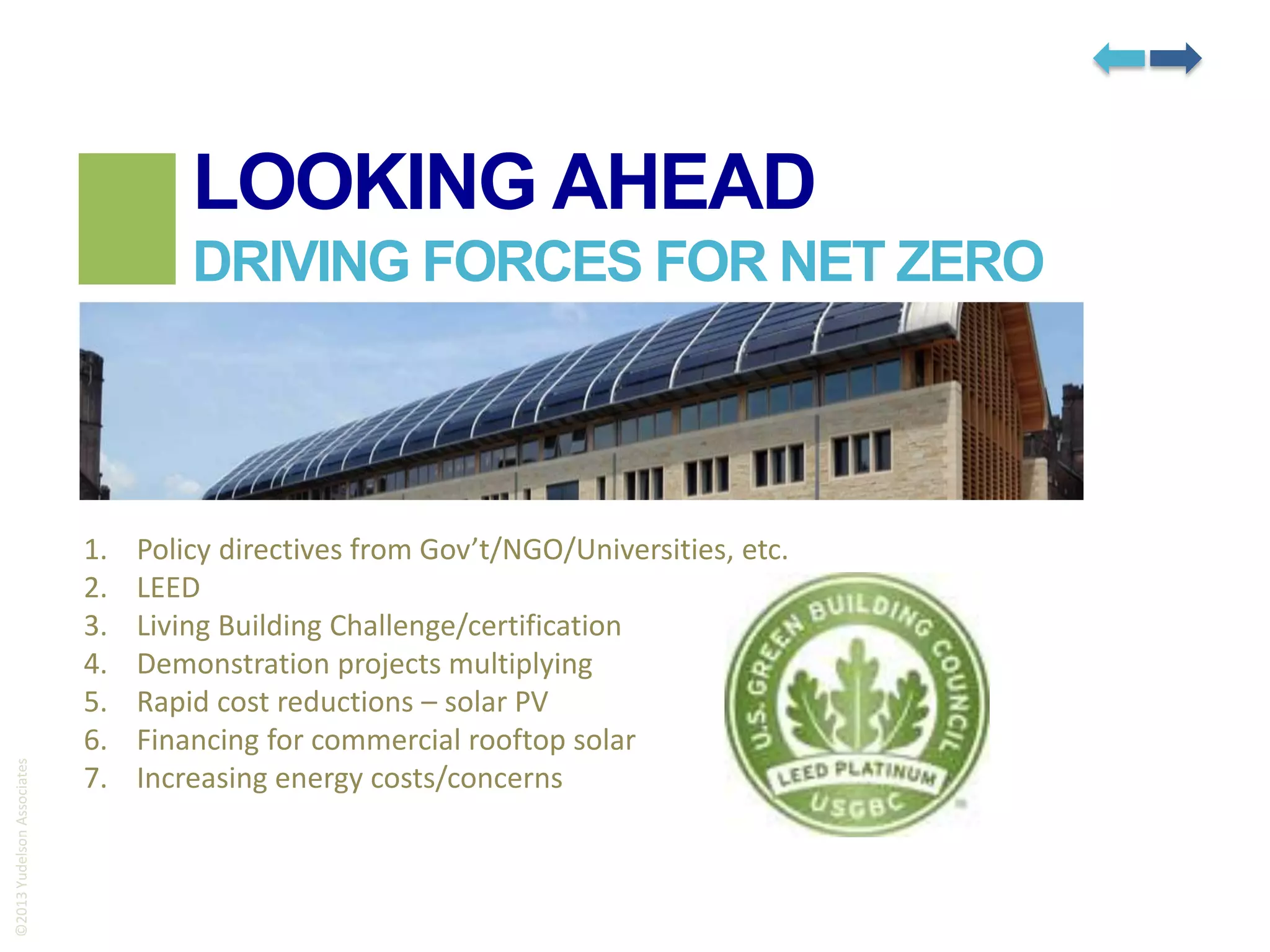
LOOKING AHEAD

©2013 Yudelson Associates

DRIVING FORCES FOR NET ZERO

1.
2.
3.
4.
5.
6.
7.

Policy directives from Gov’t/NGO/Universities, etc.
LEED
Living Building Challenge/certification
Demonstration projects multiplying
Rapid cost reductions – solar PV
Financing for commercial rooftop solar
Increasing energy costs/concerns
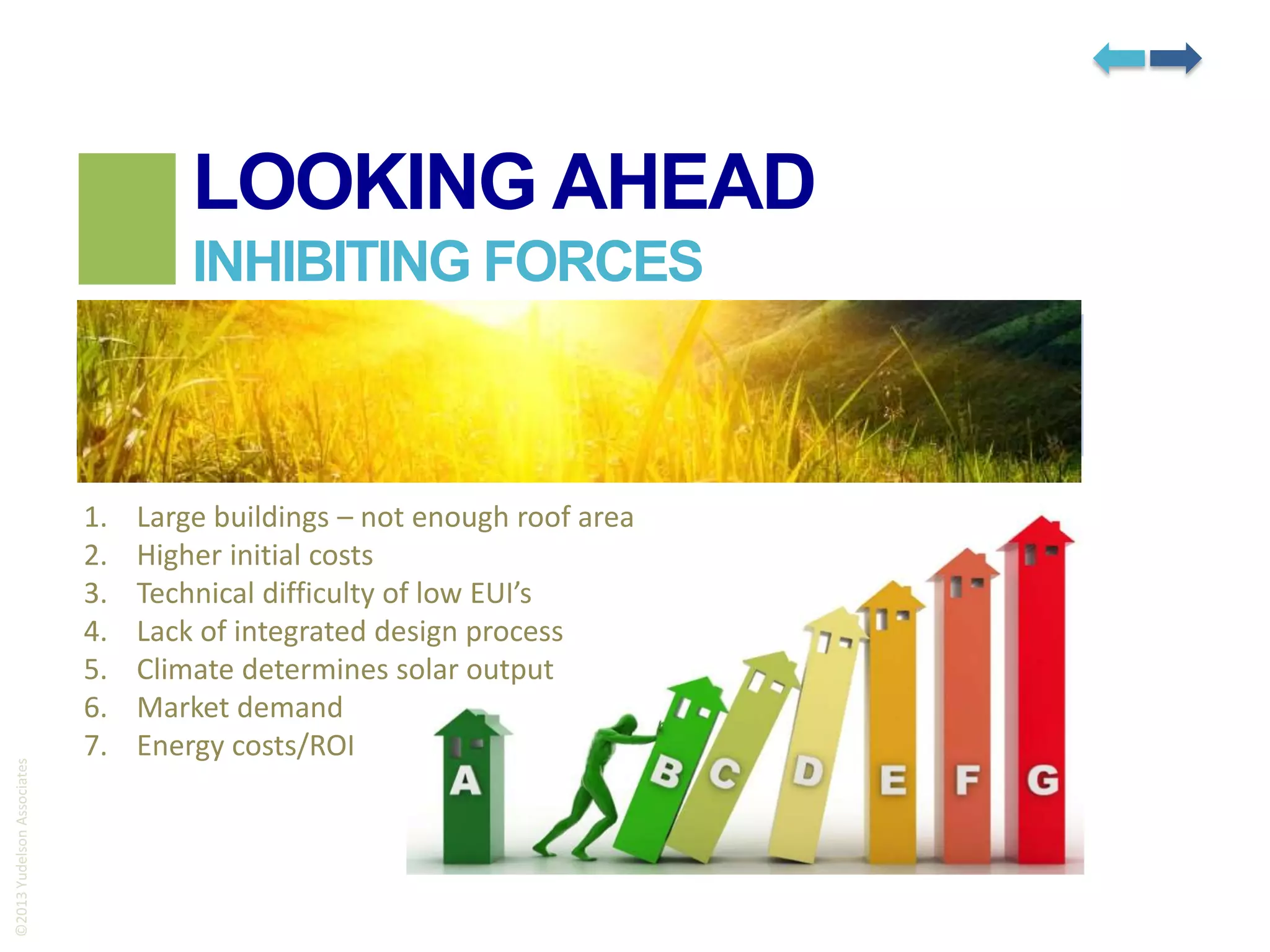
LOOKING AHEAD

©2013 Yudelson Associates

INHIBITING FORCES

1.
2.
3.
4.
5.
6.
7.

Large buildings – not enough roof area
Higher initial costs
Technical difficulty of low EUI’s
Lack of integrated design process
Climate determines solar output
Market demand
Energy costs/ROI
DEFINING

©2013 Yudelson Associates

ZERO ENERGY BUILDING (ZEB)

Generally, building energy use from all operating demands will be equal (or
less) on an annual basis than energy generated by on-site renewable sources.
HVAC
Electrical
Lighting
Water Heating
Plug and Process Loads
Buying power from green sources doesn’t count (much)!
Seasonally: in winter, buildings demand more power than they produce and
in summer, they generate more than they use.
ZEB

©2013 Yudelson Associates

DEFINITIONS

Net zero site energy building
Net zero source energy building
Net zero energy cost building
Net zero energy emissions building
HIERARCHY
ZONE DEFINITIONS

•

©2013 Yudelson Associates

•
•

Building energy use from all operating demands will be equal (or less)
on an annual basis than energy generated by on-site renewable
sources that are connected to the building’s energy systems
– Within building footprint (the best!)
– On the site but not all within building footprint (e.g., parking
structures, ground-mounted, etc.)
Generated from combustion of renewable sources (e.g., biomass)
and some on-site solar thermal/electric energy
Generated from off-site renewable sources (e.g., buy offsets)

Source: S. Pless and P. Torcellini, NREL/TP-550-44586, June 2010
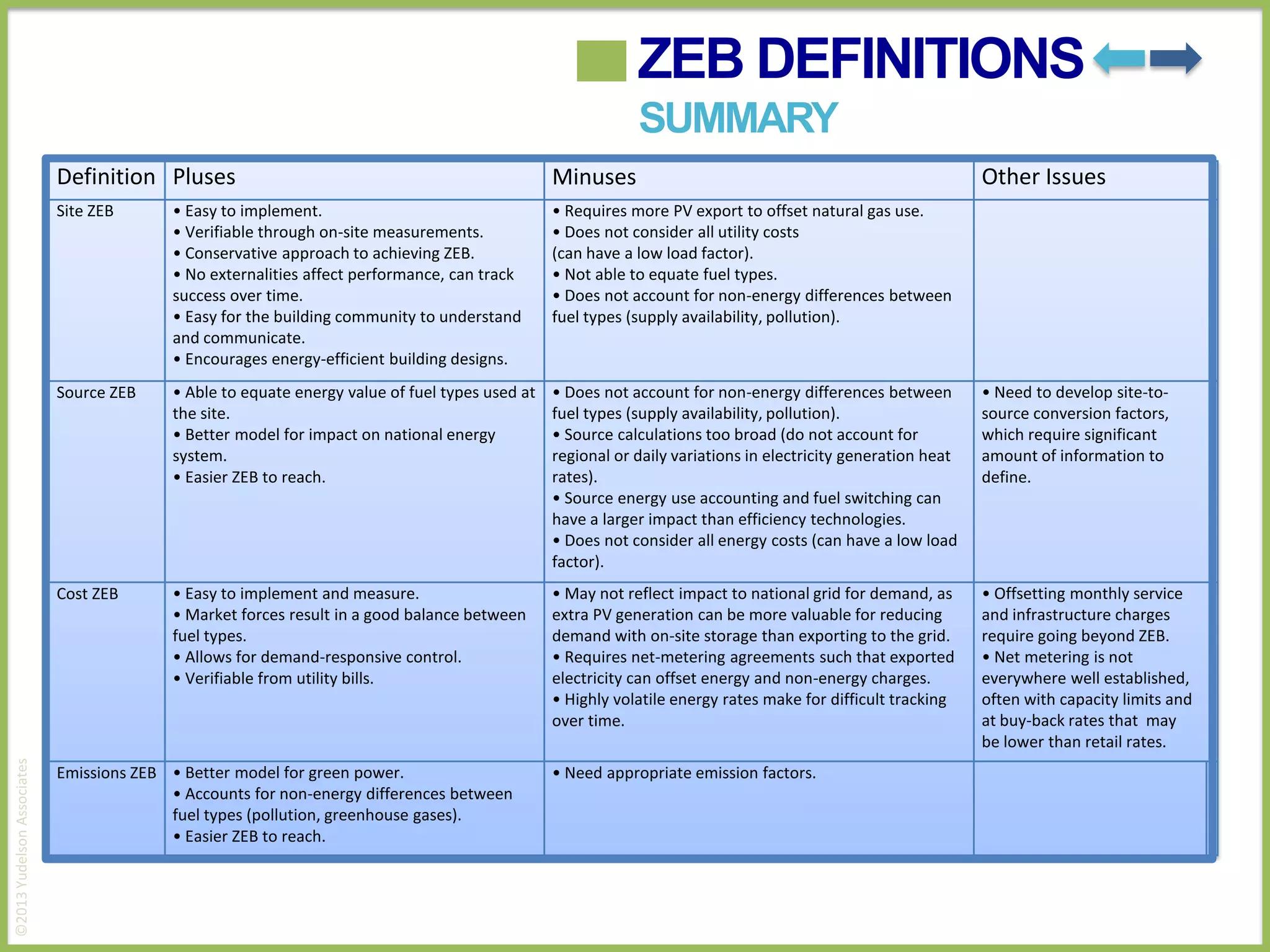
ZEB DEFINITIONS
SUMMARY
Minuses

Site ZEB

• Easy to implement.
• Verifiable through on-site measurements.
• Conservative approach to achieving ZEB.
• No externalities affect performance, can track
success over time.
• Easy for the building community to understand
and communicate.
• Encourages energy-efficient building designs.

• Requires more PV export to offset natural gas use.
• Does not consider all utility costs
(can have a low load factor).
• Not able to equate fuel types.
• Does not account for non-energy differences between
fuel types (supply availability, pollution).

Source ZEB

• Able to equate energy value of fuel types used at
the site.
• Better model for impact on national energy
system.
• Easier ZEB to reach.

• Does not account for non-energy differences between
fuel types (supply availability, pollution).
• Source calculations too broad (do not account for
regional or daily variations in electricity generation heat
rates).
• Source energy use accounting and fuel switching can
have a larger impact than efficiency technologies.
• Does not consider all energy costs (can have a low load
factor).

• Need to develop site-tosource conversion factors,
which require significant
amount of information to
define.

Cost ZEB

©2013 Yudelson Associates

Definition Pluses

• Easy to implement and measure.
• Market forces result in a good balance between
fuel types.
• Allows for demand-responsive control.
• Verifiable from utility bills.

• May not reflect impact to national grid for demand, as
extra PV generation can be more valuable for reducing
demand with on-site storage than exporting to the grid.
• Requires net-metering agreements such that exported
electricity can offset energy and non-energy charges.
• Highly volatile energy rates make for difficult tracking
over time.

• Offsetting monthly service
and infrastructure charges
require going beyond ZEB.
• Net metering is not
everywhere well established,
often with capacity limits and
at buy-back rates that may
be lower than retail rates.

Emissions ZEB • Better model for green power.
• Accounts for non-energy differences between
fuel types (pollution, greenhouse gases).
• Easier ZEB to reach.

• Need appropriate emission factors.

Other Issues
IS IT EVEN POSSIBLE?

©2013 Yudelson Associates

OF COURSE! BUT . . .

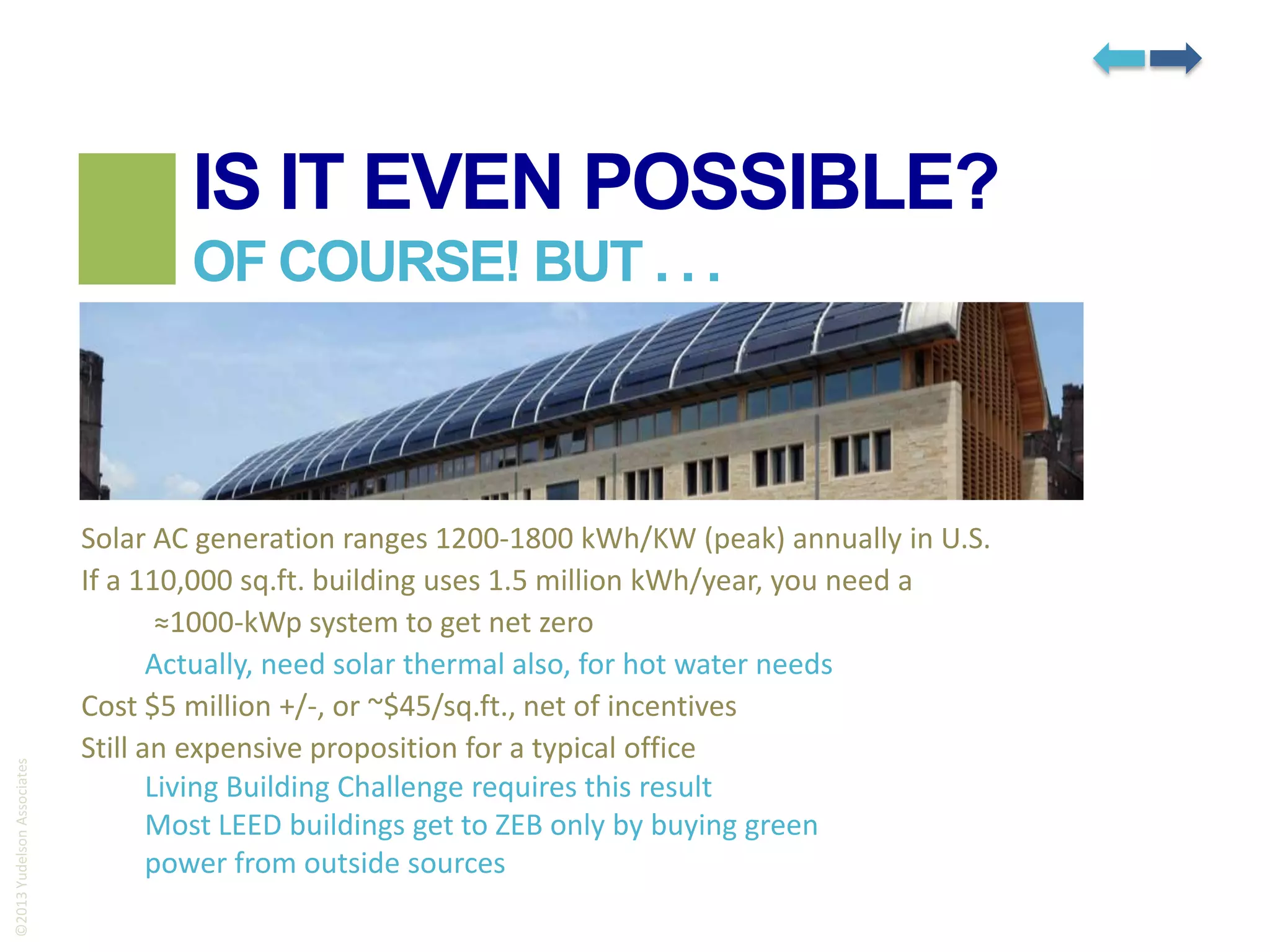
Solar AC generation ranges 1200-1800 kWh/KW (peak) annually in U.S.
If a 110,000 sq.ft. building uses 1.5 million kWh/year, you need a
≈1000-kWp system to get net zero
Actually, need solar thermal also, for hot water needs
Cost $5 million +/-, or ~$45/sq.ft., net of incentives
Still an expensive proposition for a typical office
Living Building Challenge requires this result
Most LEED buildings get to ZEB only by buying green
power from outside sources
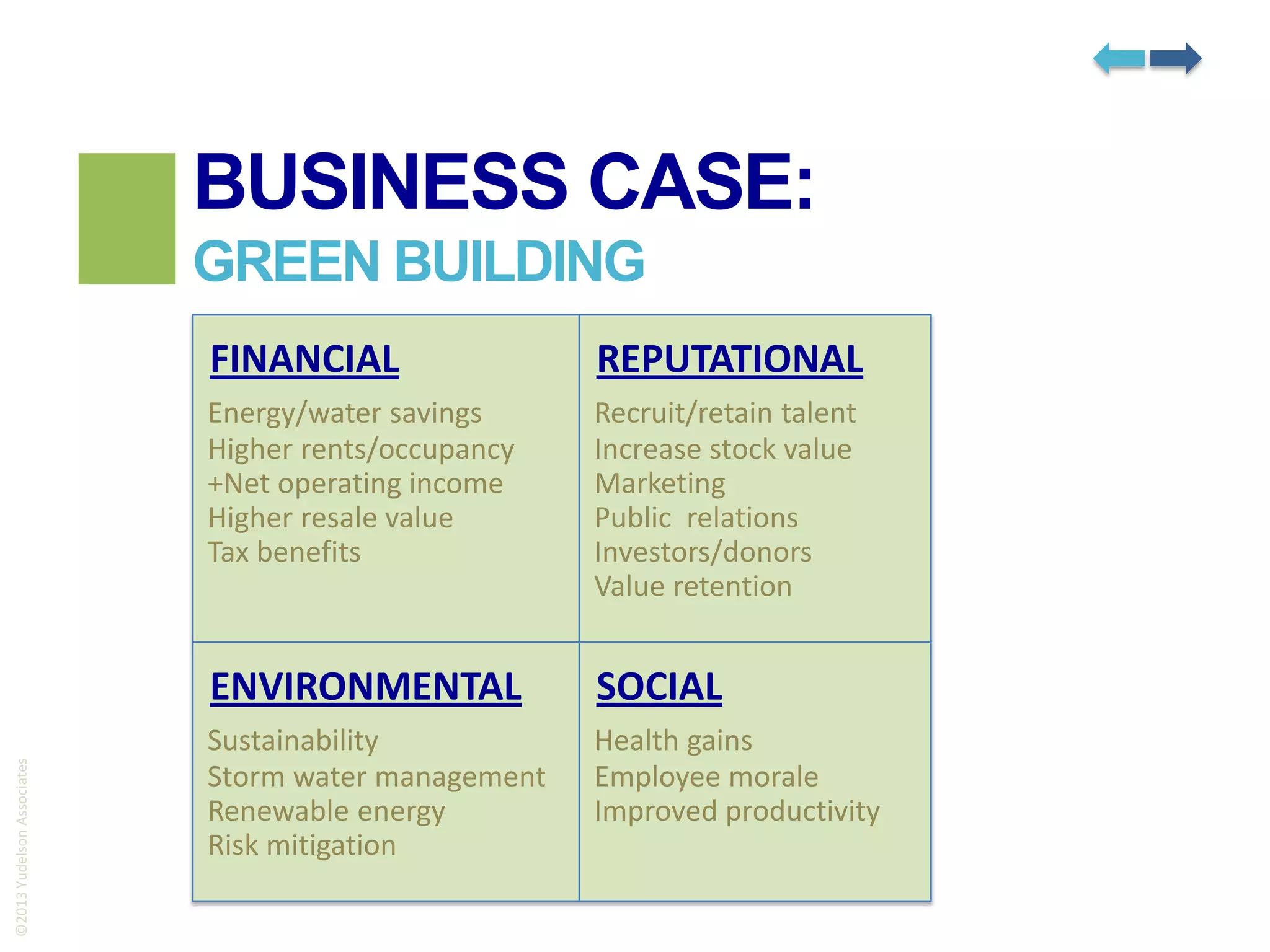
BUSINESS CASE:
GREEN BUILDING
REPUTATIONAL

Energy/water savings
Higher rents/occupancy
+Net operating income
Higher resale value
Tax benefits

Recruit/retain talent
Increase stock value
Marketing
Public relations
Investors/donors
Value retention

ENVIRONMENTAL
©2013 Yudelson Associates

FINANCIAL

SOCIAL

Sustainability
Storm water management
Renewable energy
Risk mitigation

Health gains
Employee morale
Improved productivity
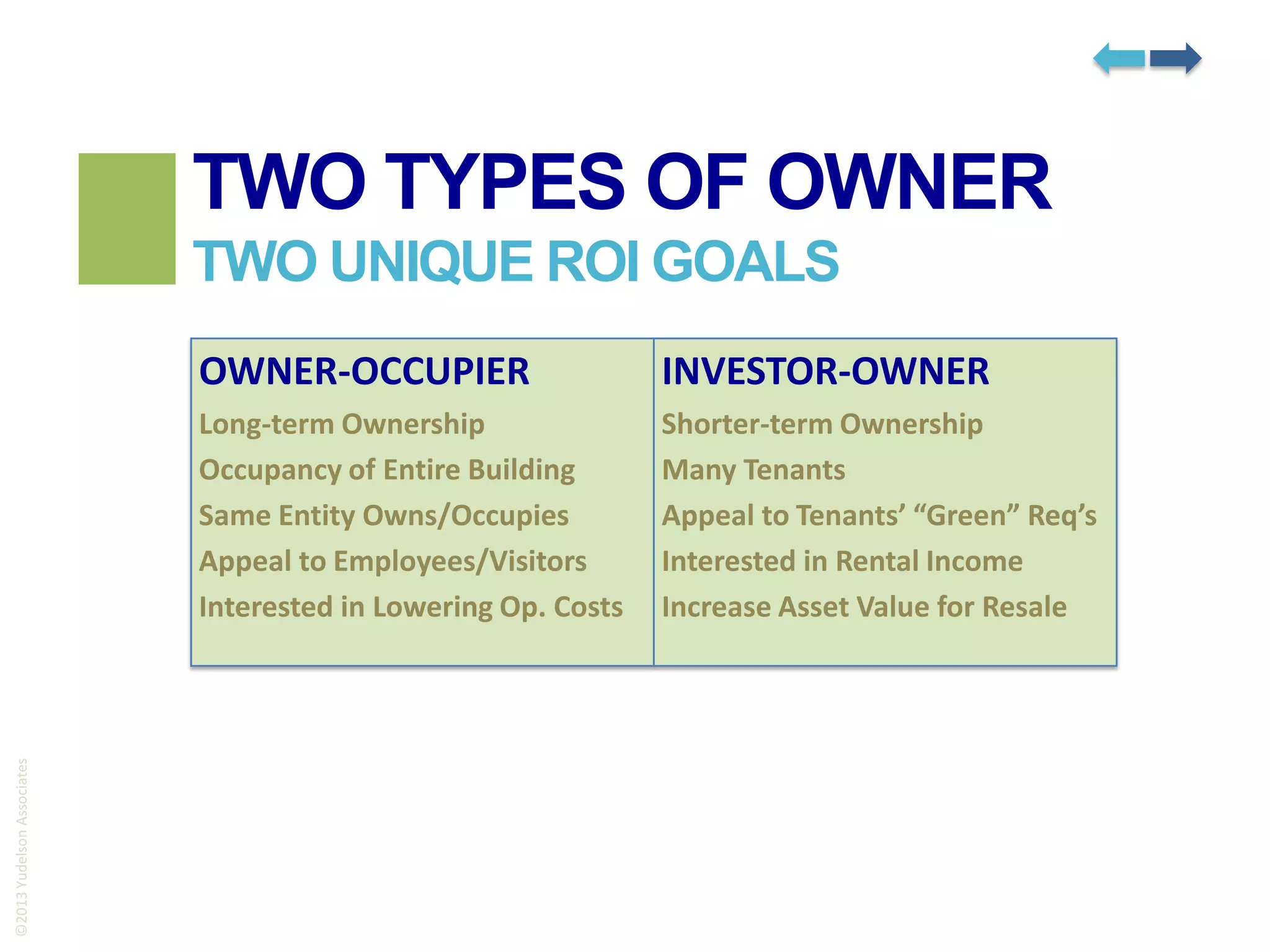
TWO TYPES OF OWNER
TWO UNIQUE ROI GOALS
INVESTOR-OWNER

Long-term Ownership
Occupancy of Entire Building
Same Entity Owns/Occupies
Appeal to Employees/Visitors
Interested in Lowering Op. Costs

©2013 Yudelson Associates

OWNER-OCCUPIER

Shorter-term Ownership
Many Tenants
Appeal to Tenants’ “Green” Req’s
Interested in Rental Income
Increase Asset Value for Resale
OWNER/OCCUPIER
ROI MOTIVATION

OWNER-OCCUPIER
ROI MOTIVATION

©2013 Yudelson Associates

MEETING SUSTAINABILITY OBJECTIVES
EMPLOYEES’ VIEW OF COMPANY
— Ranking against peers
— Ability to attract and retain
engaged employees
— GHG reporting; Energy Disclosures
— Corporate sustainability reporting
MAINTAINING PRODUCTIVE WORK ENVIRONMENT
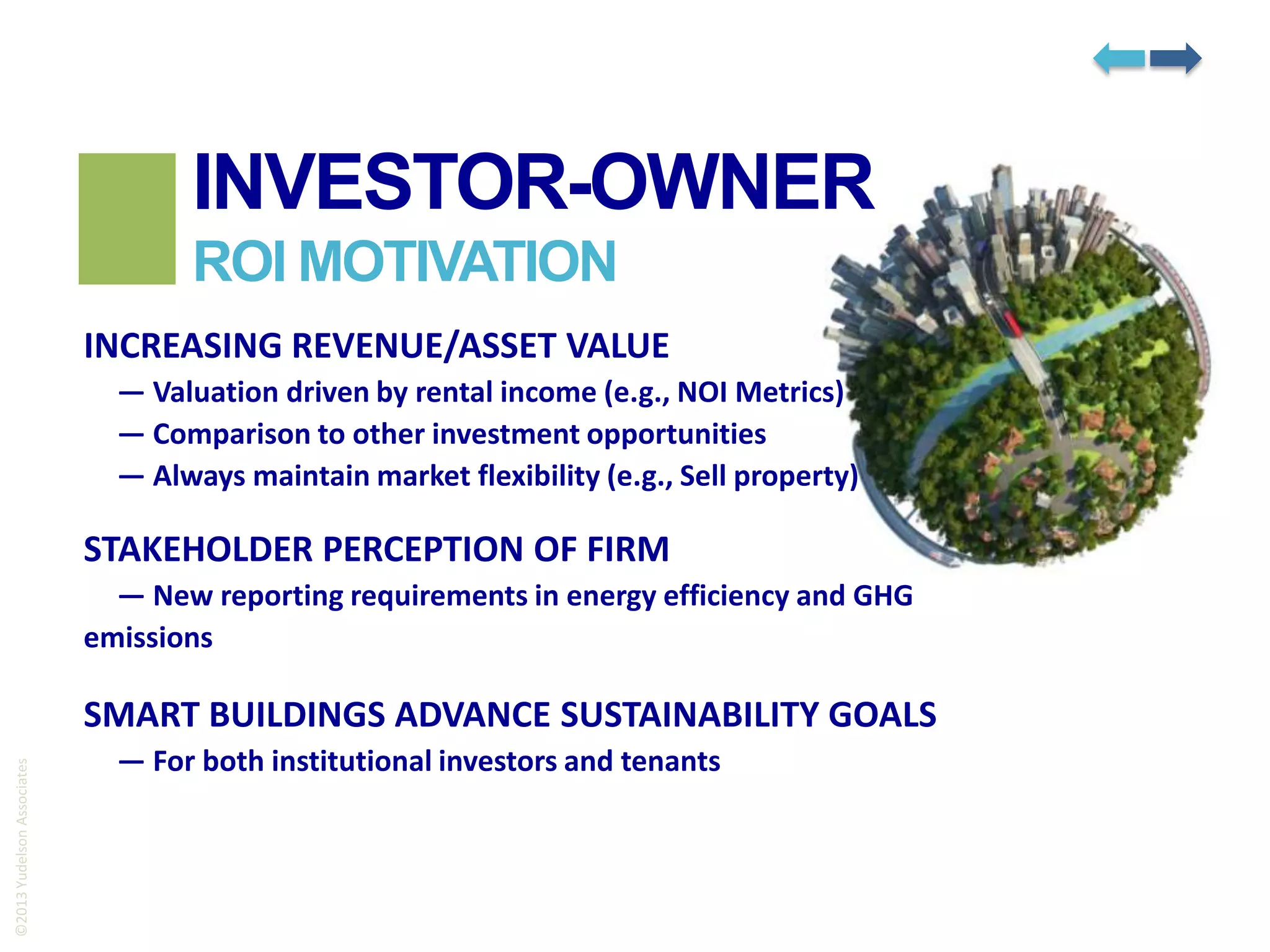
INVESTOR-OWNER
ROI MOTIVATION
INCREASING REVENUE/ASSET VALUE
— Valuation driven by rental income (e.g., NOI Metrics)
— Comparison to other investment opportunities
— Always maintain market flexibility (e.g., Sell property)

STAKEHOLDER PERCEPTION OF FIRM
— New reporting requirements in energy efficiency and GHG
emissions

©2013 Yudelson Associates

SMART BUILDINGS ADVANCE SUSTAINABILITY GOALS
— For both institutional investors and tenants
PERFORMANCE DISCLOSURE

©2013 Yudelson Associates

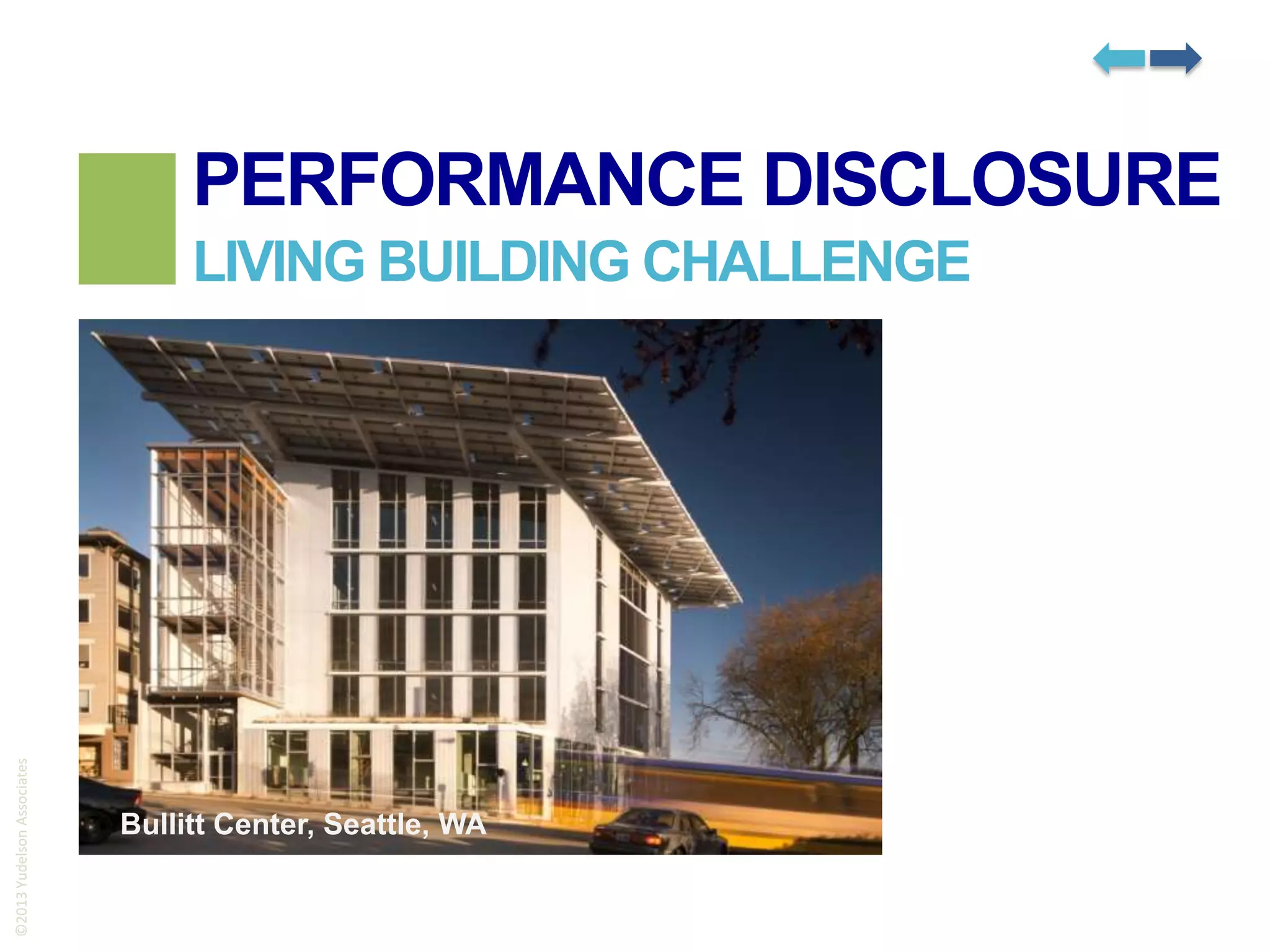
LIVING BUILDING CHALLENGE

Bullitt Center, Seattle, WA
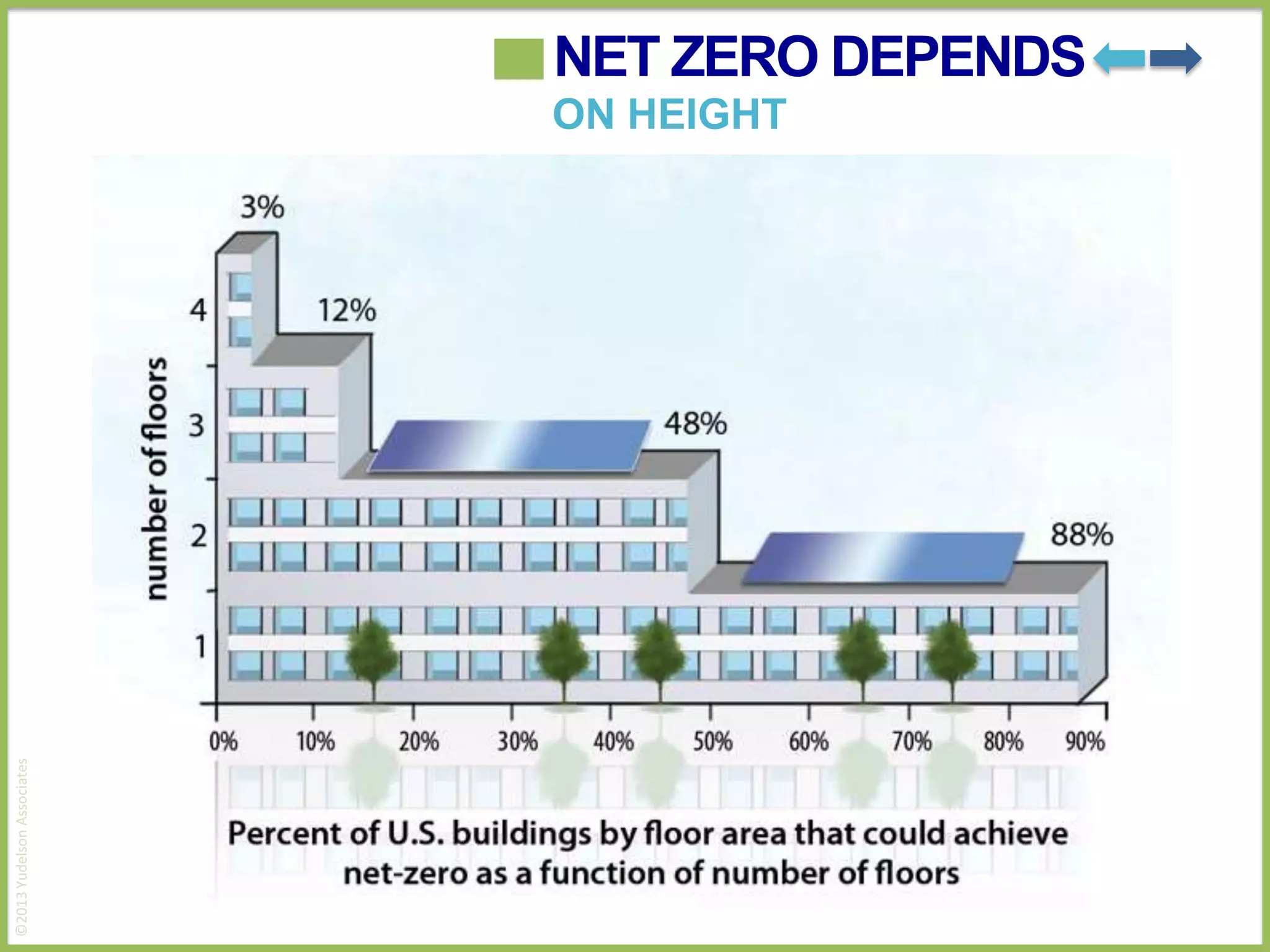
NET ZERO DEPENDS

©2013 Yudelson Associates

ON HEIGHT
©2013 Yudelson Associates

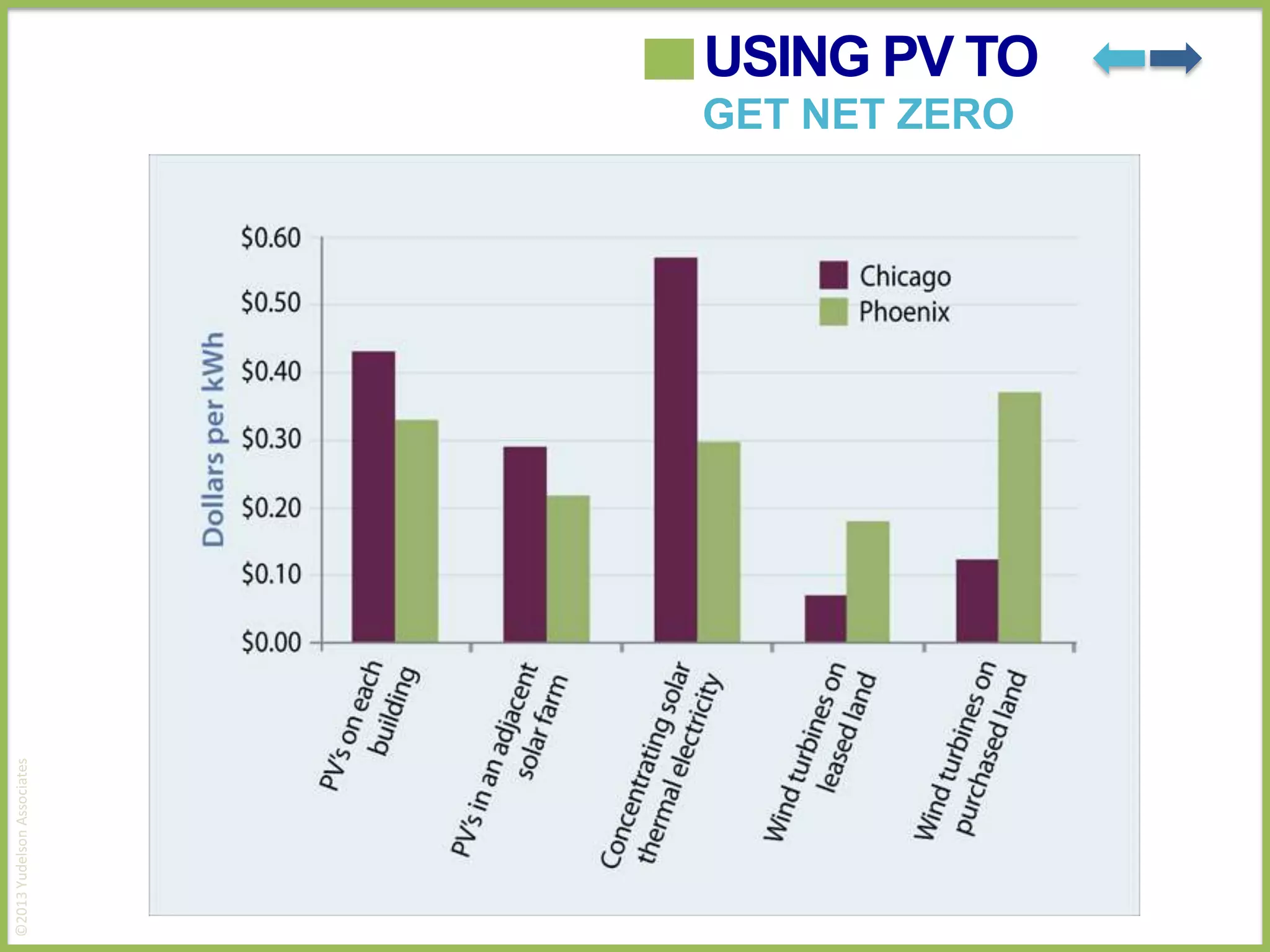
USING PV TO

GET NET ZERO
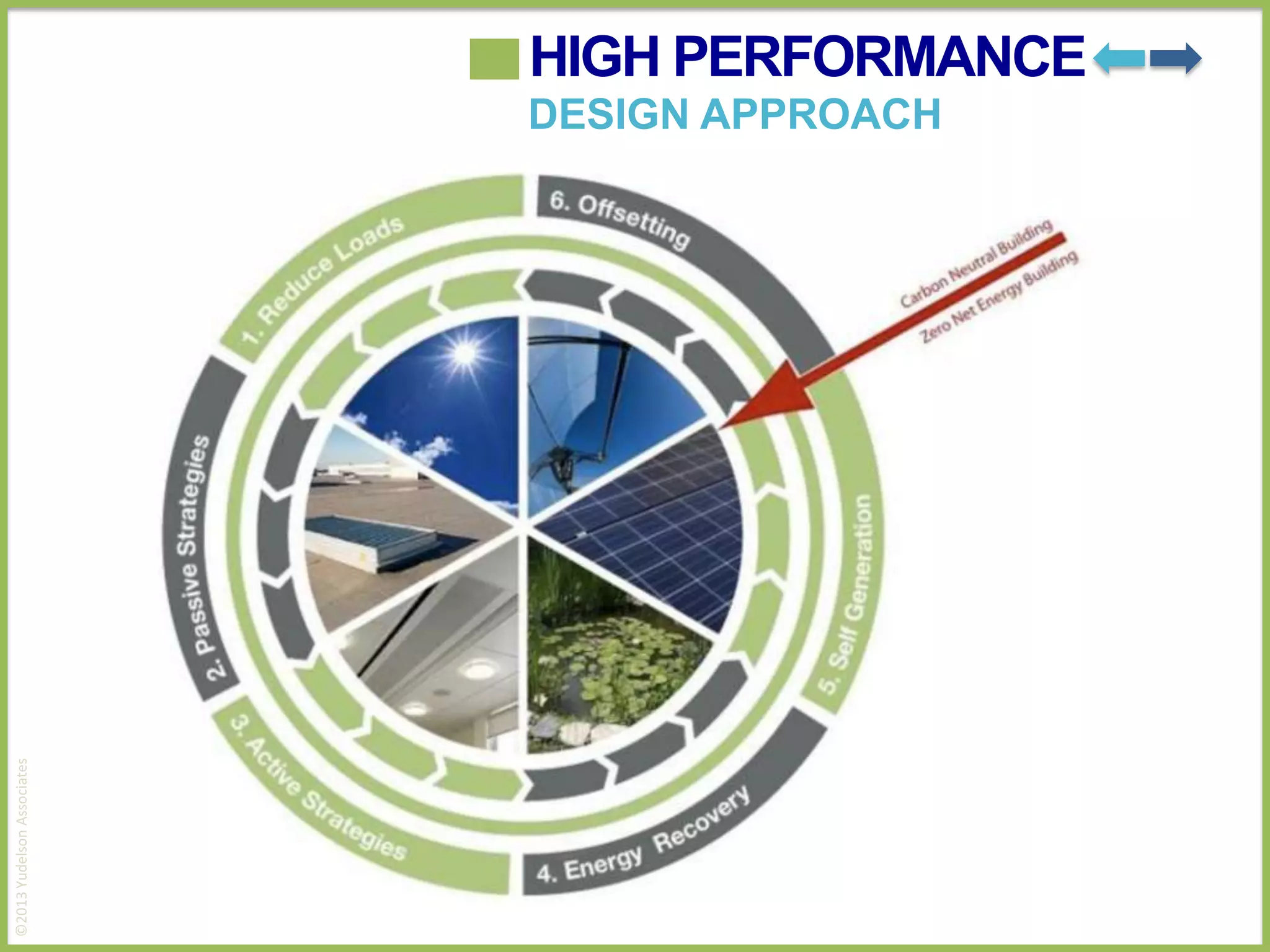
HIGH PERFORMANCE

©2013 Yudelson Associates

DESIGN APPROACH
INTEGRATED
DESIGN

©2013 Yudelson Associates

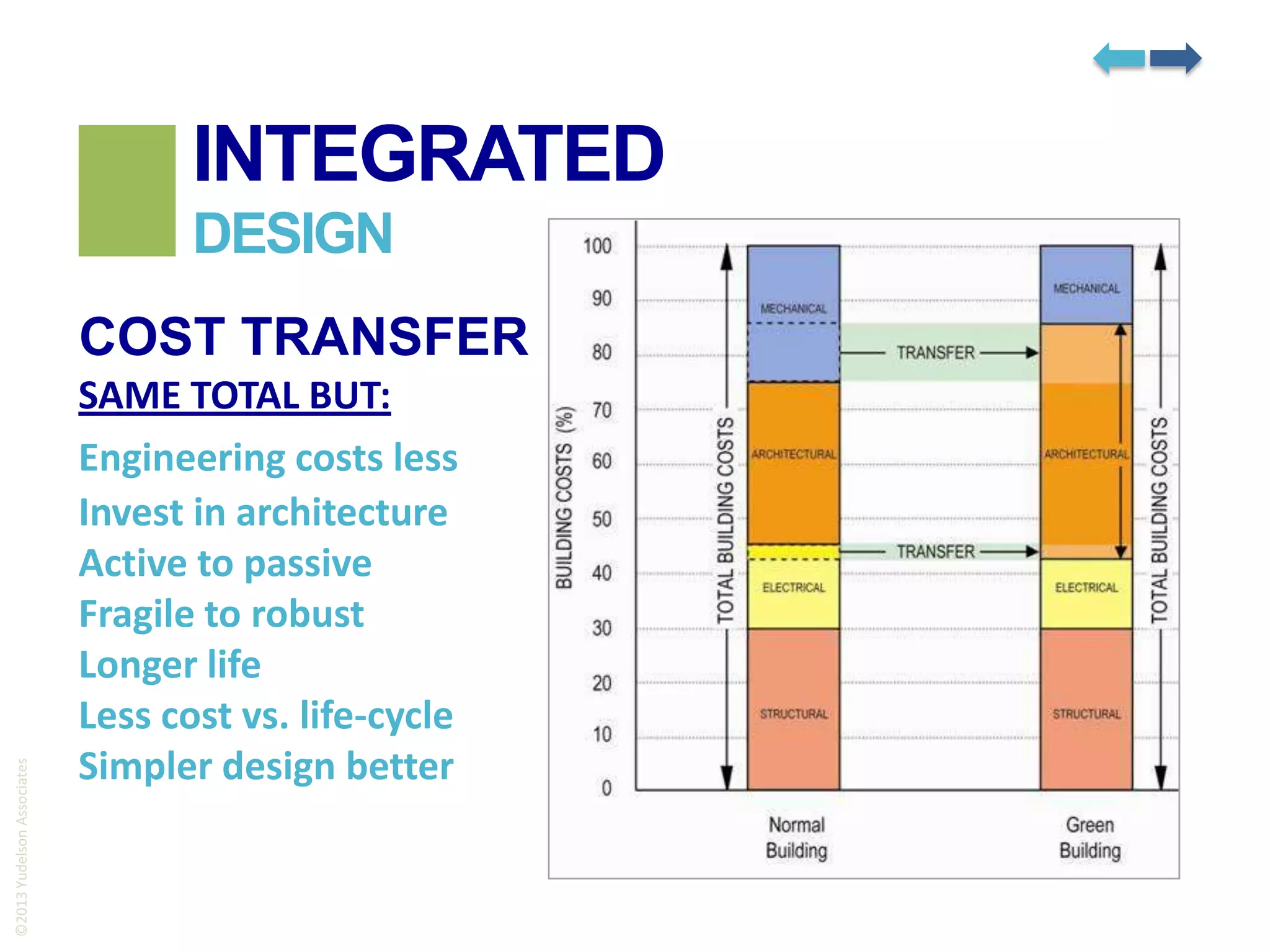
COST TRANSFER
SAME TOTAL BUT:
Engineering costs less
Invest in architecture
Active to passive
Fragile to robust
Longer life
Less cost vs. life-cycle
Simpler design better
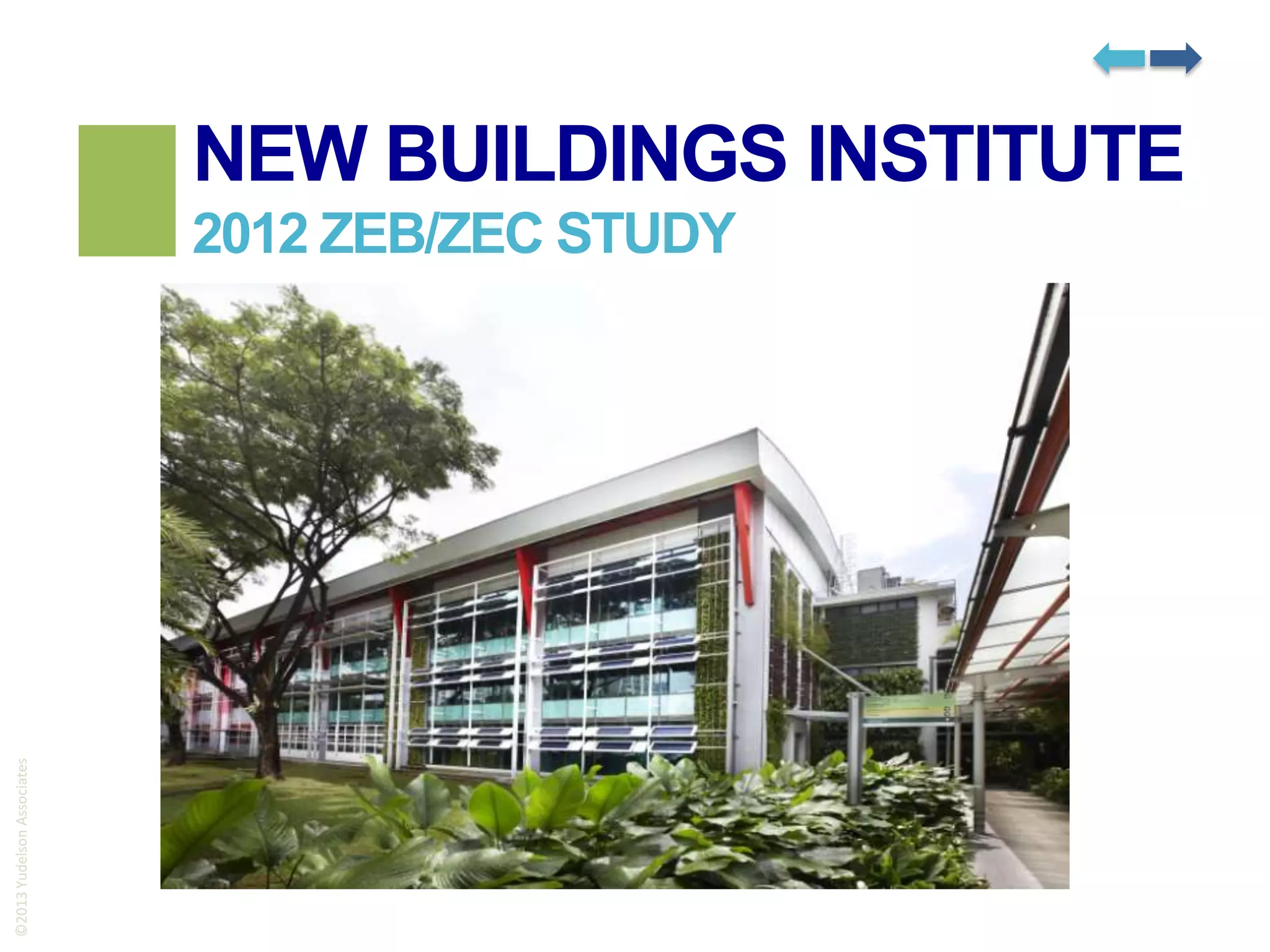
NEW BUILDINGS INSTITUTE

©2013 Yudelson Associates

2012 ZEB/ZEC STUDY
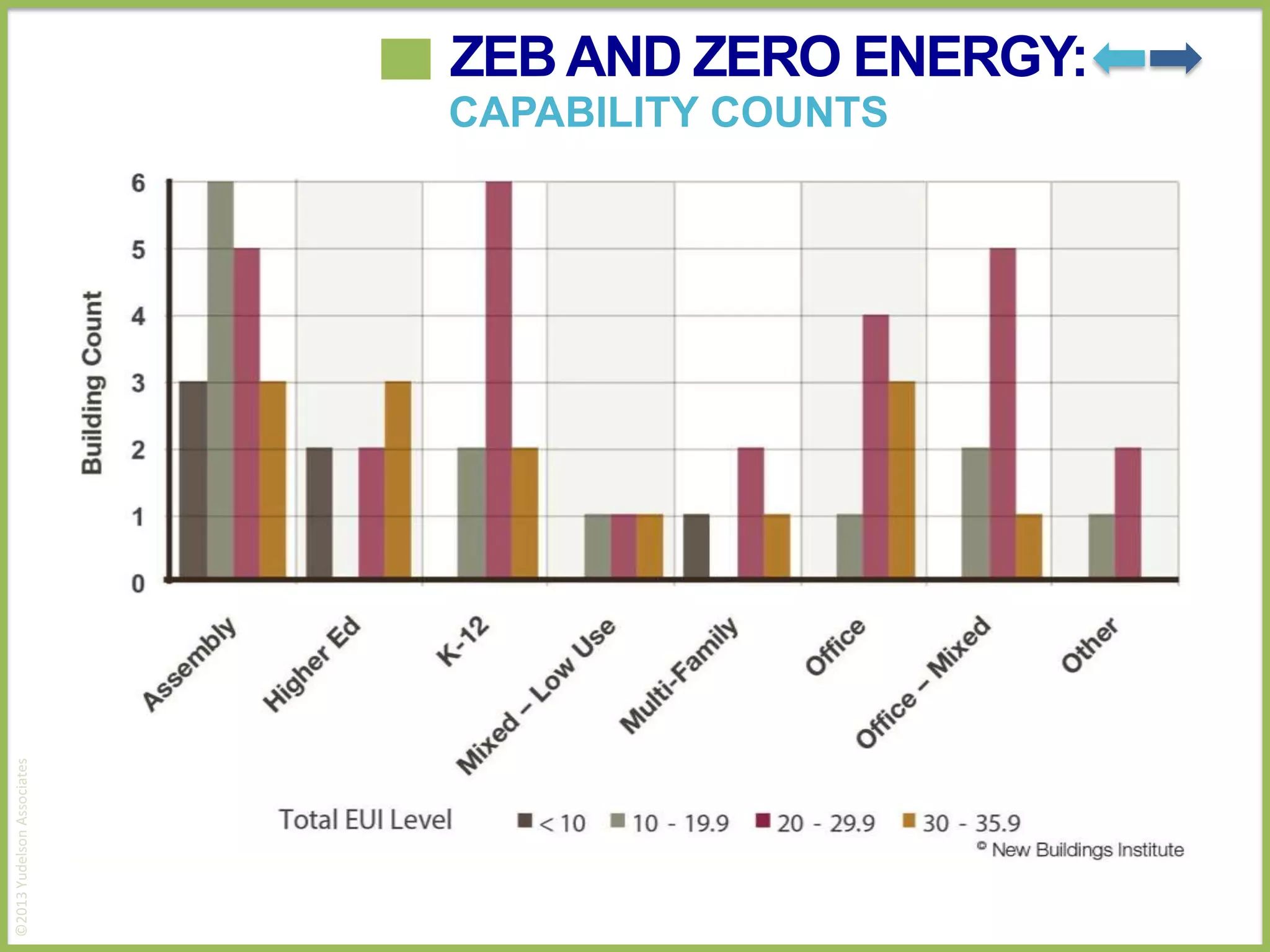
ZEB AND ZERO ENERGY:

©2013 Yudelson Associates

CAPABILITY COUNTS
©2013 Yudelson Associates

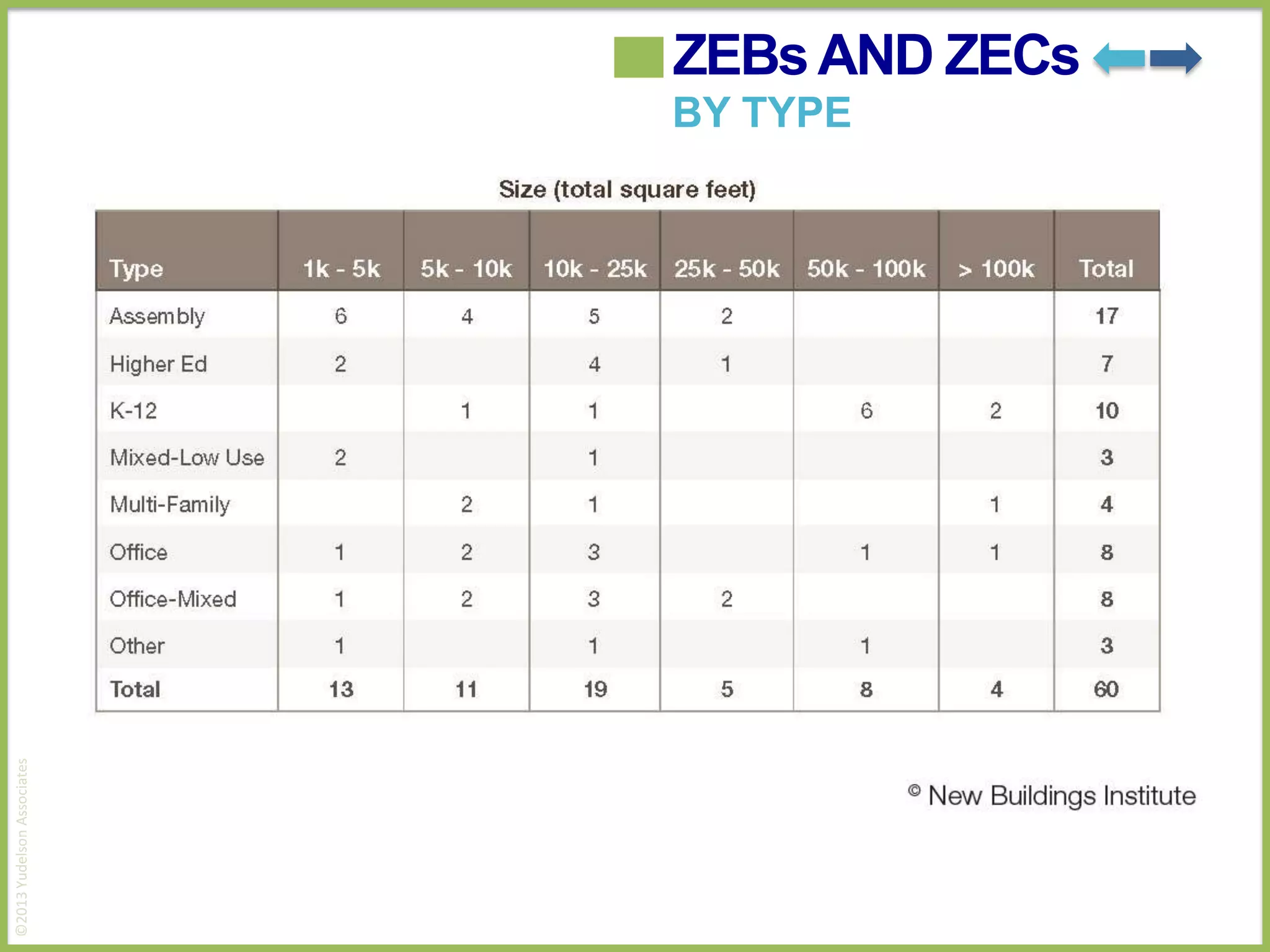
ZEBs AND ZECs

BY TYPE
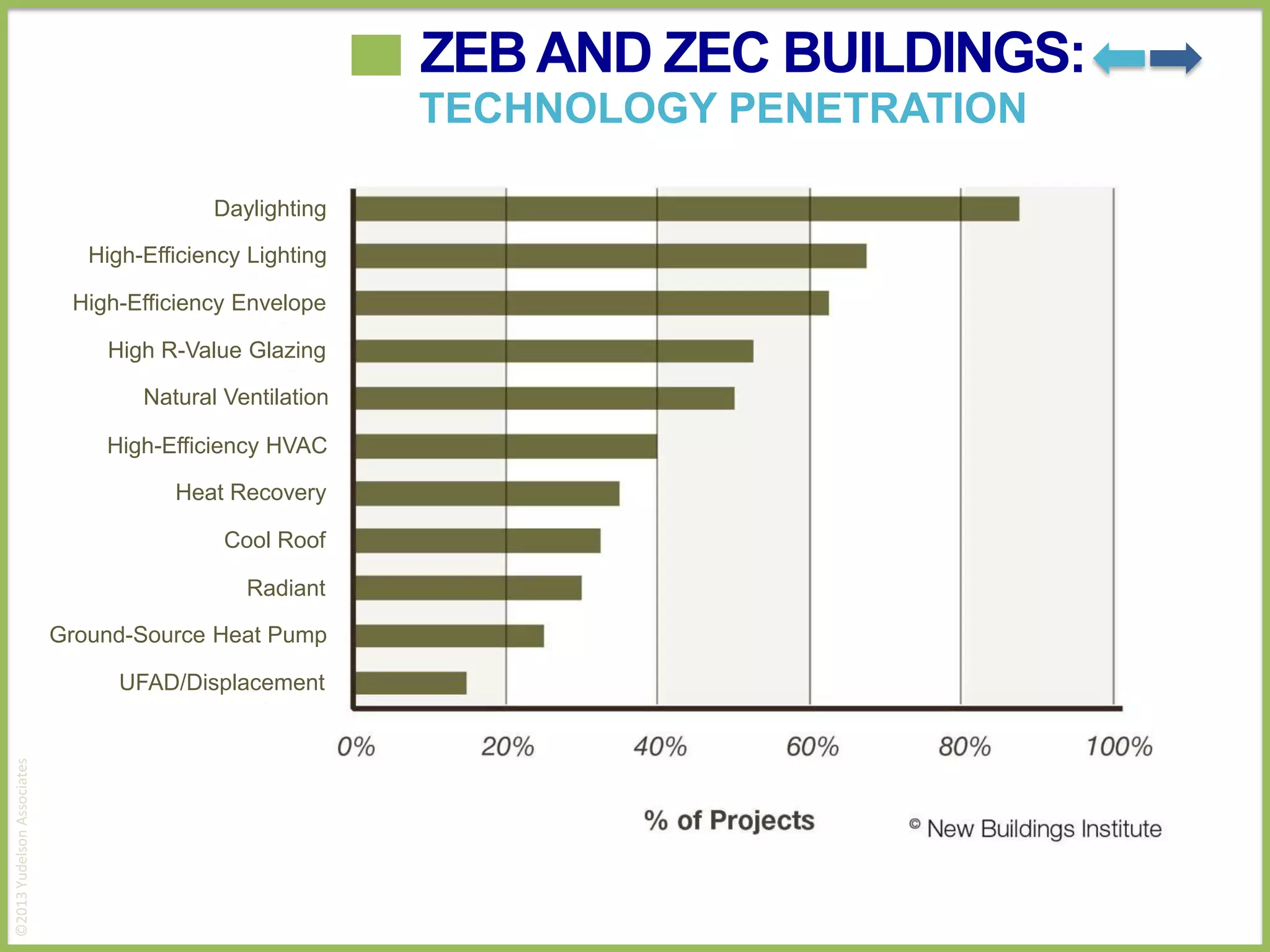
ZEB AND ZEC BUILDINGS:
TECHNOLOGY PENETRATION
Daylighting
High-Efficiency Lighting
High-Efficiency Envelope
High R-Value Glazing
Natural Ventilation
High-Efficiency HVAC

Heat Recovery
Cool Roof
Radiant
Ground-Source Heat Pump

©2013 Yudelson Associates

UFAD/Displacement
©2013 Yudelson Associates

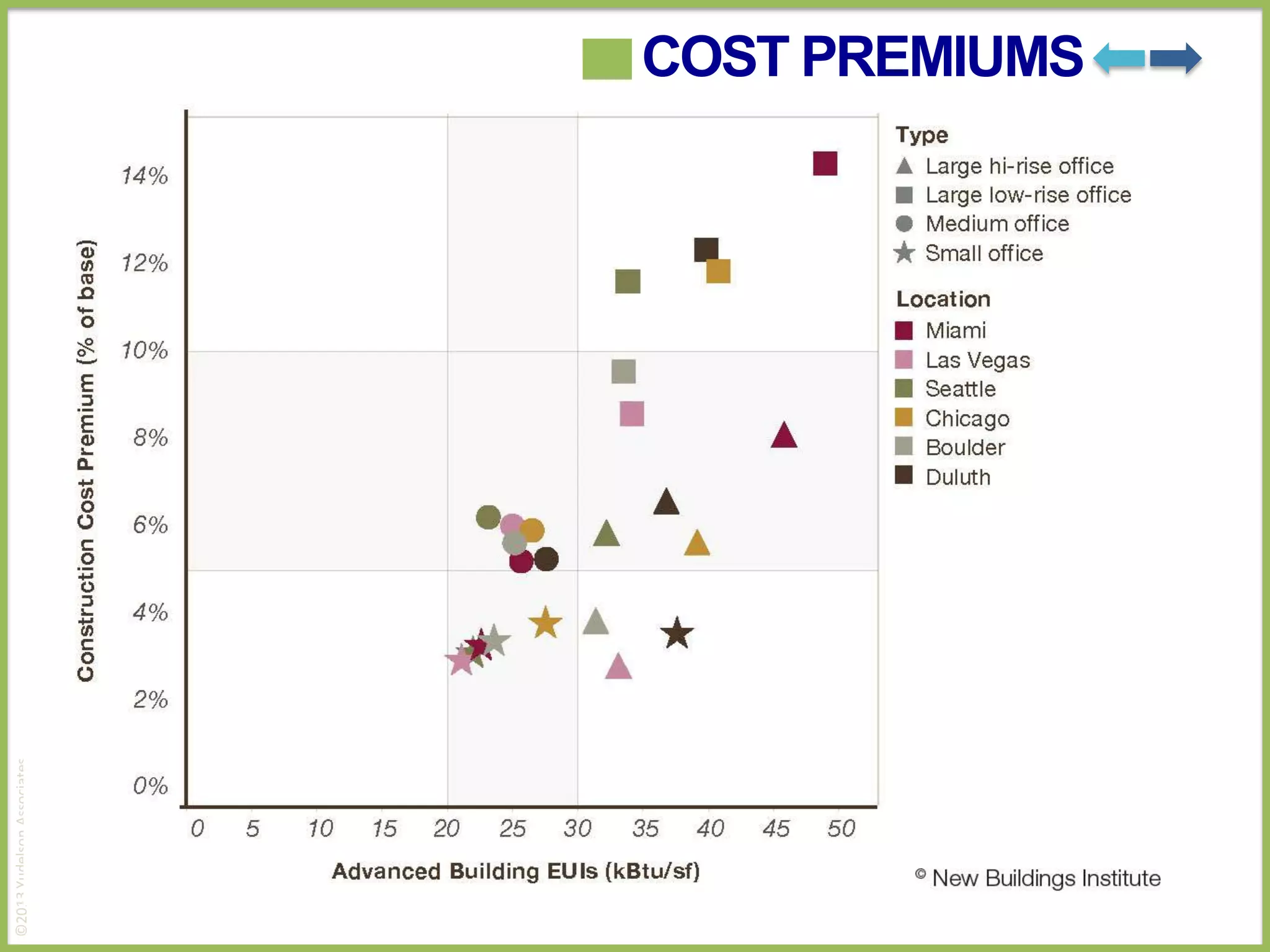
COST PREMIUMS

Fig.7
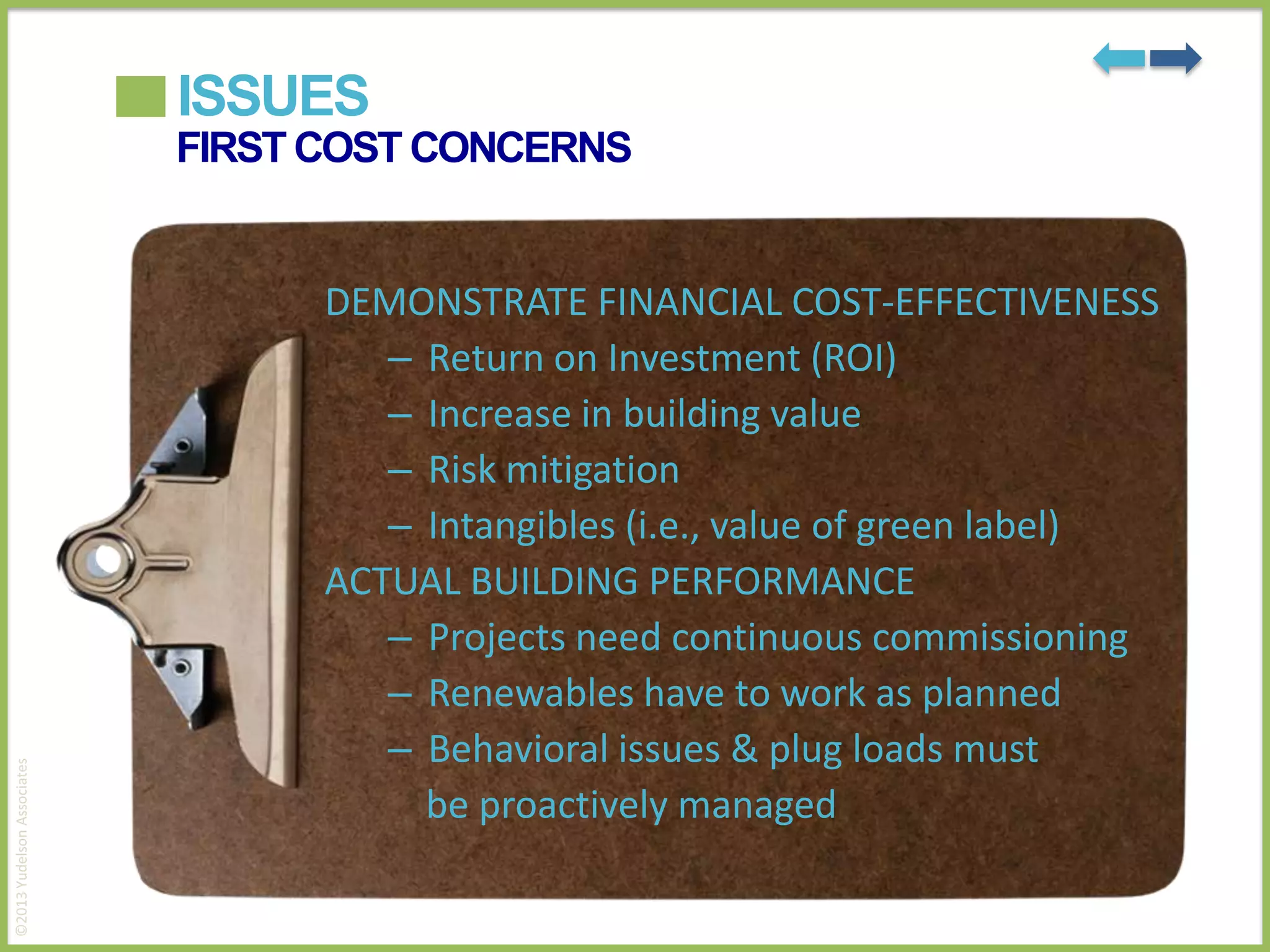
ISSUES

©2013 Yudelson Associates

FIRST COST CONCERNS

DEMONSTRATE FINANCIAL COST-EFFECTIVENESS
– Return on Investment (ROI)
– Increase in building value
– Risk mitigation
– Intangibles (i.e., value of green label)
ACTUAL BUILDING PERFORMANCE
– Projects need continuous commissioning
– Renewables have to work as planned
– Behavioral issues & plug loads must
be proactively managed
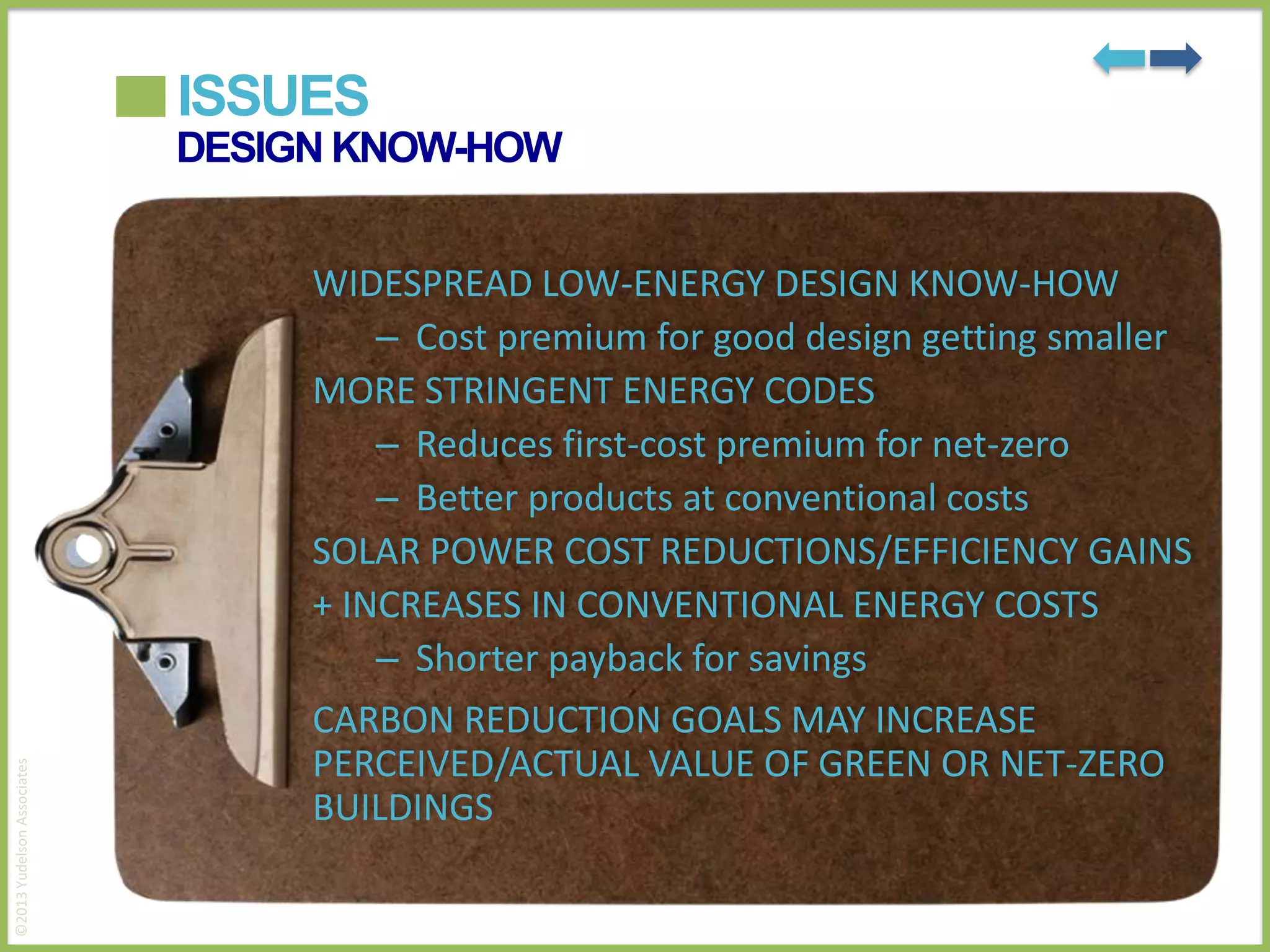
ISSUES
DESIGN KNOW-HOW

©2013 Yudelson Associates

WIDESPREAD LOW-ENERGY DESIGN KNOW-HOW
– Cost premium for good design getting smaller
MORE STRINGENT ENERGY CODES
– Reduces first-cost premium for net-zero
– Better products at conventional costs
SOLAR POWER COST REDUCTIONS/EFFICIENCY GAINS
+ INCREASES IN CONVENTIONAL ENERGY COSTS
– Shorter payback for savings
CARBON REDUCTION GOALS MAY INCREASE
PERCEIVED/ACTUAL VALUE OF GREEN OR NET-ZERO
BUILDINGS
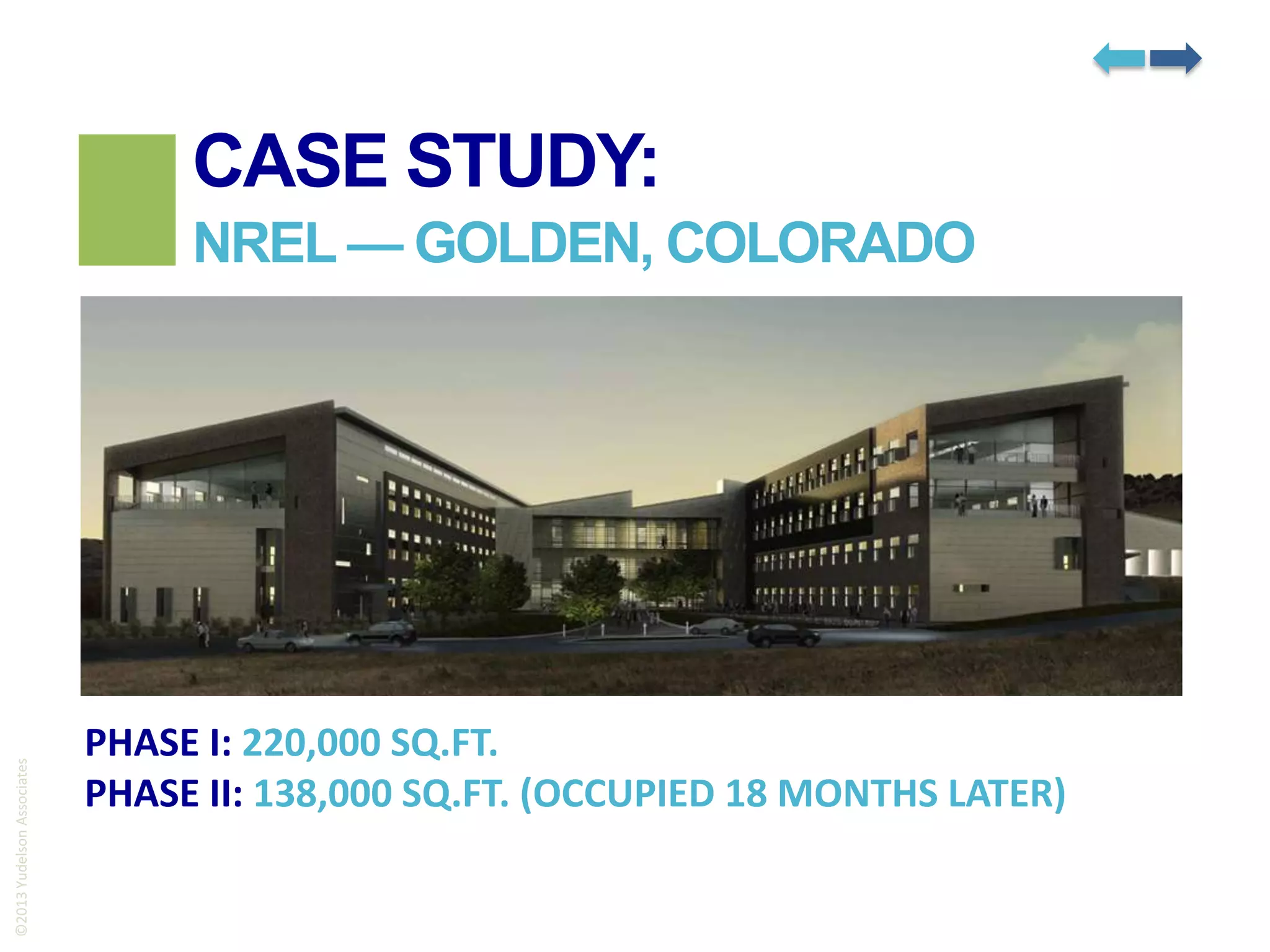
CASE STUDY:

©2013 Yudelson Associates

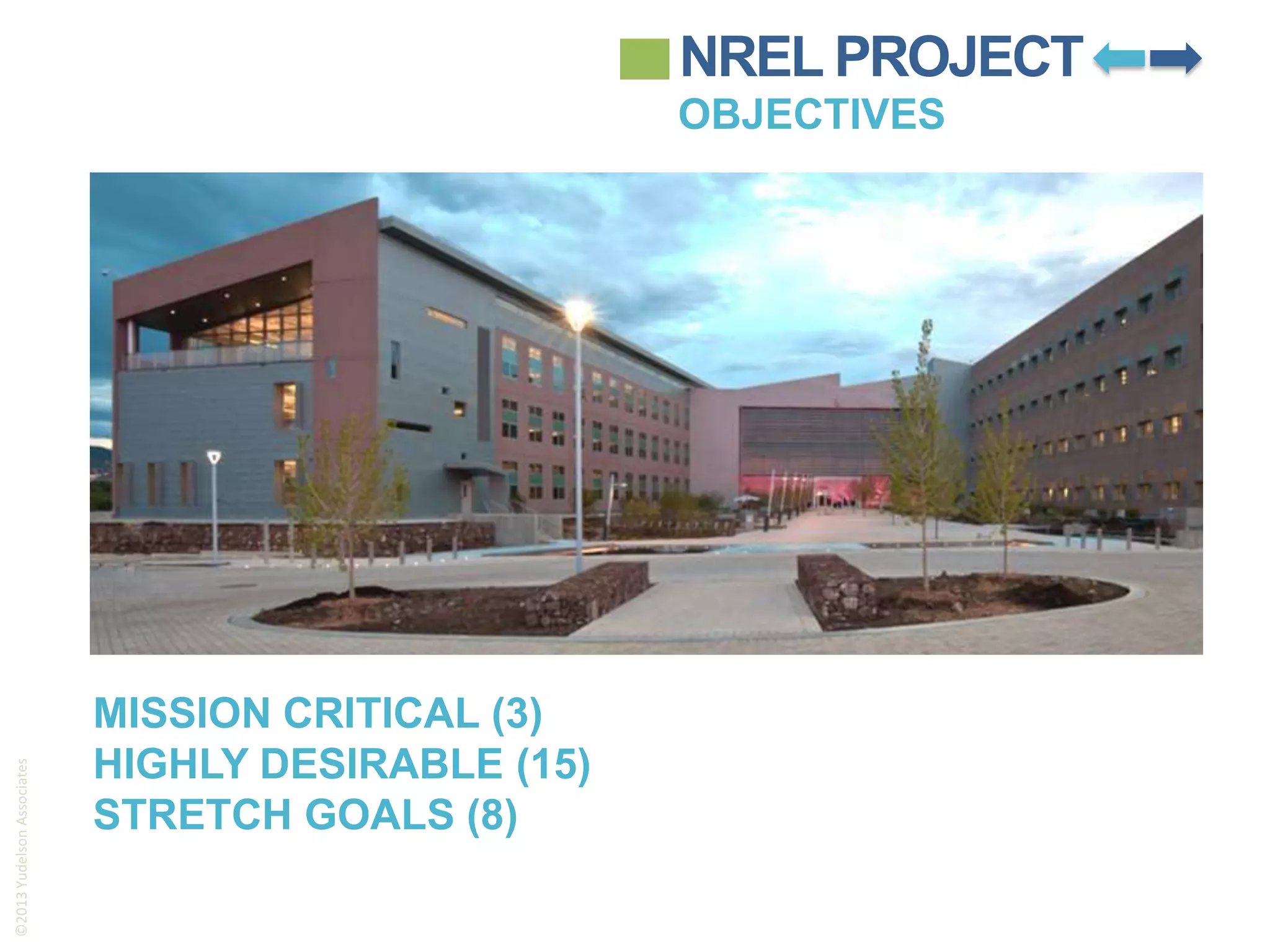
NREL — GOLDEN, COLORADO

PHASE I: 220,000 SQ.FT.
PHASE II: 138,000 SQ.FT. (OCCUPIED 18 MONTHS LATER)
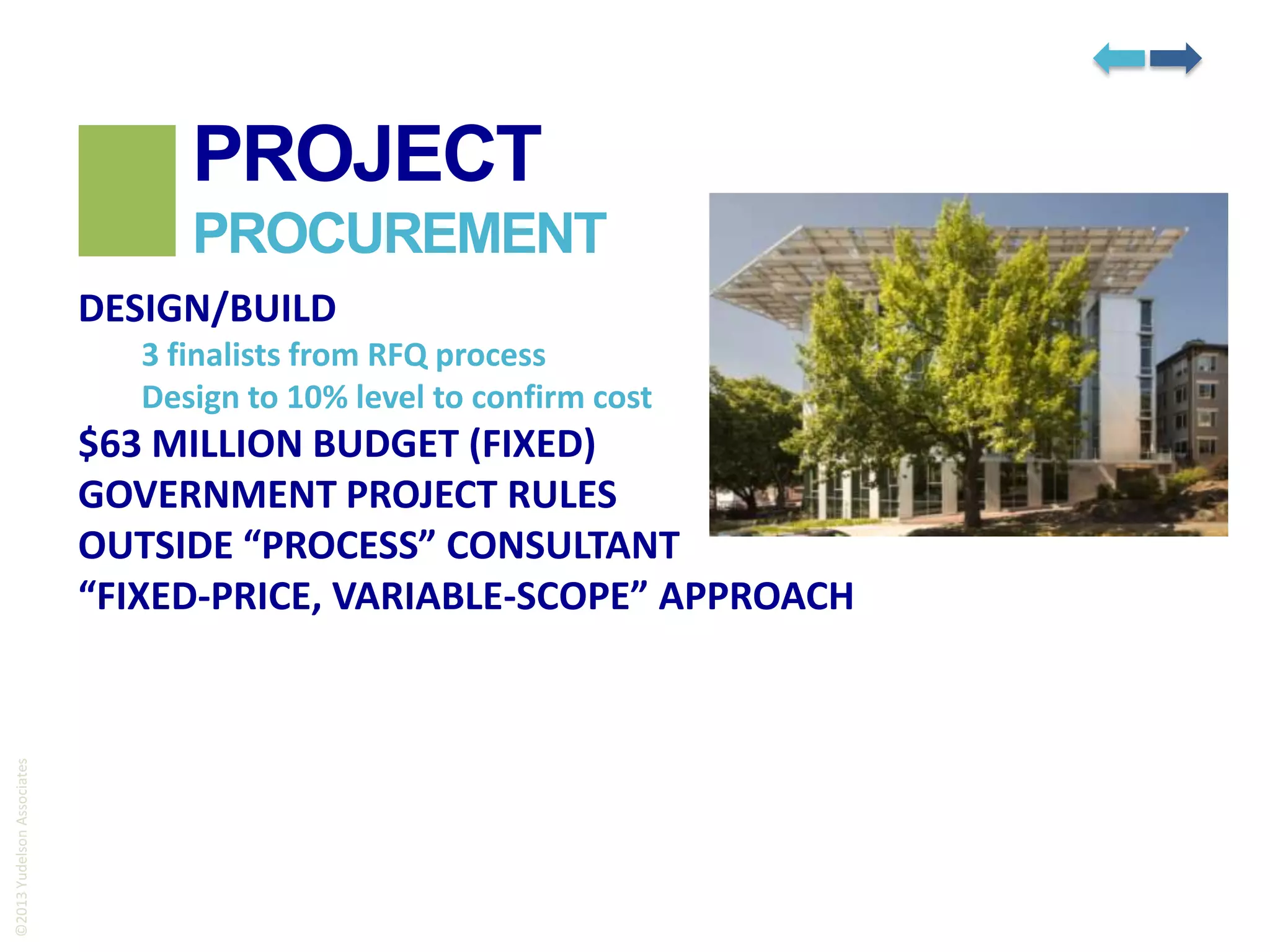
PROJECT
PROCUREMENT
DESIGN/BUILD
3 finalists from RFQ process
Design to 10% level to confirm cost

©2013 Yudelson Associates

$63 MILLION BUDGET (FIXED)
GOVERNMENT PROJECT RULES
OUTSIDE “PROCESS” CONSULTANT
“FIXED-PRICE, VARIABLE-SCOPE” APPROACH
NREL PROJECT

©2013 Yudelson Associates

OBJECTIVES

MISSION CRITICAL (3)
HIGHLY DESIRABLE (15)
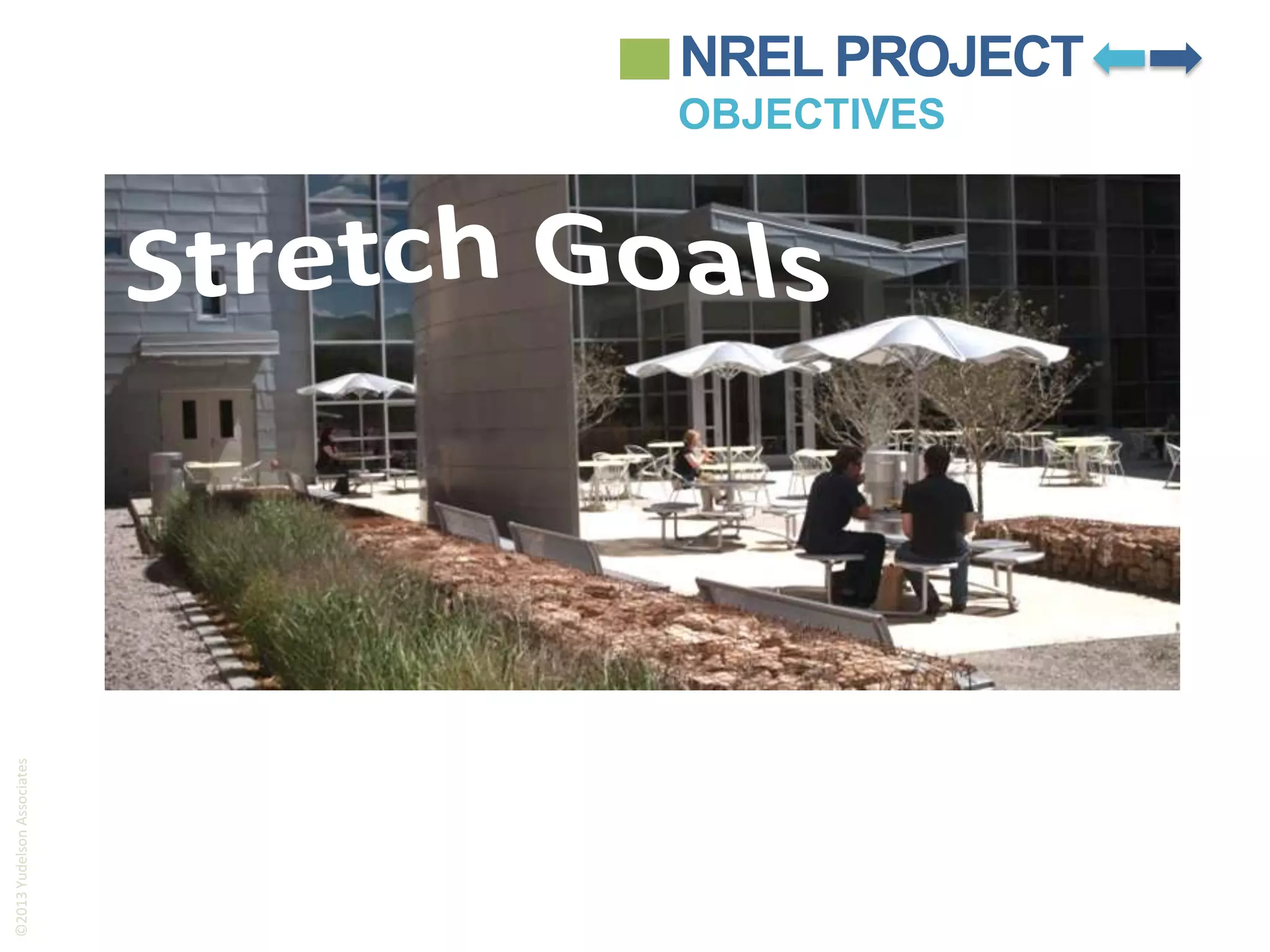
STRETCH GOALS (8)
NREL PROJECT

©2013 Yudelson Associates

OBJECTIVES

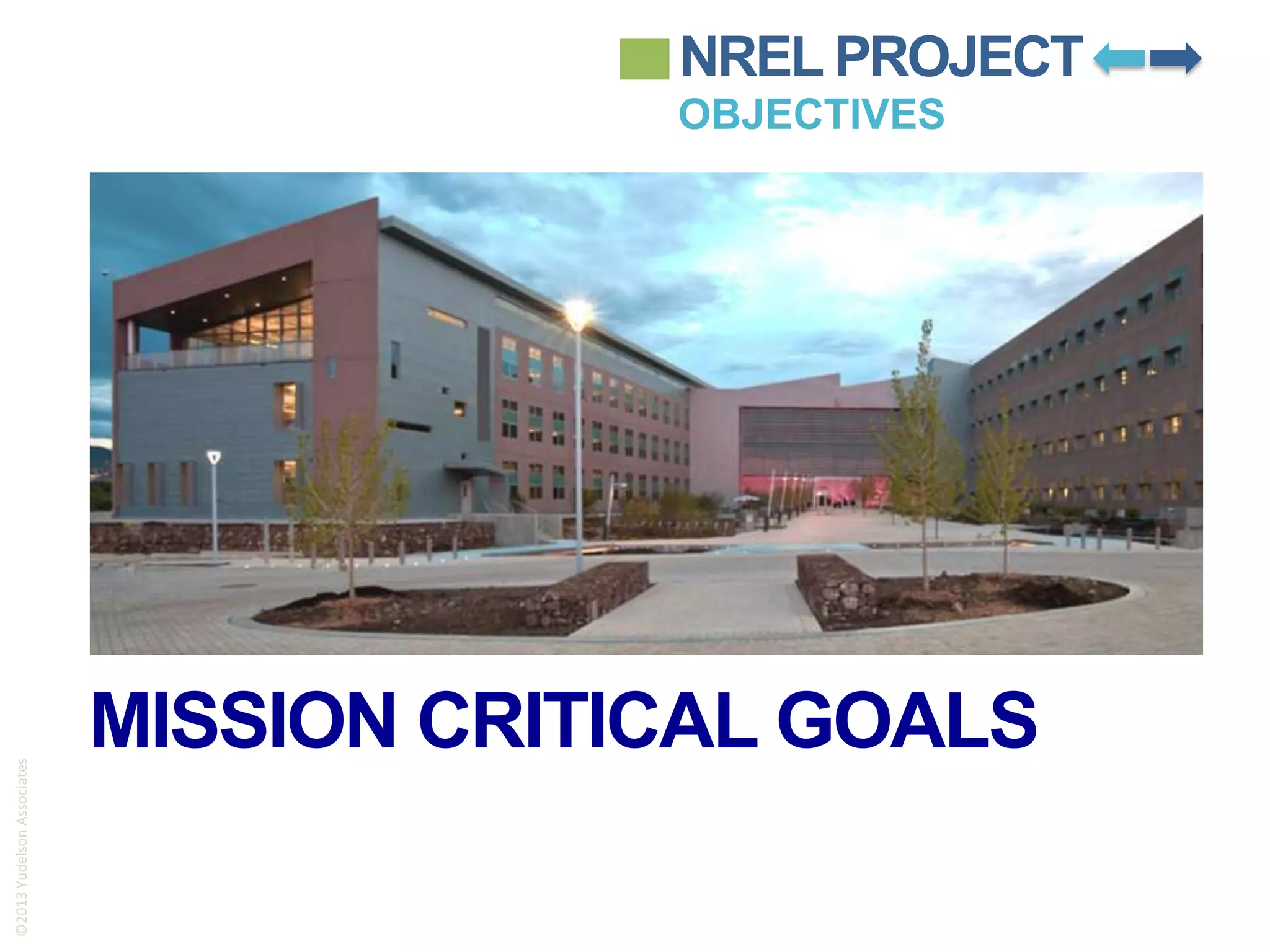
MISSION CRITICAL GOALS
PROJECT
OBJECTIVES

MISSION CRITICAL (3)

©2013 Yudelson Associates

Safety – Jobsite/At Work
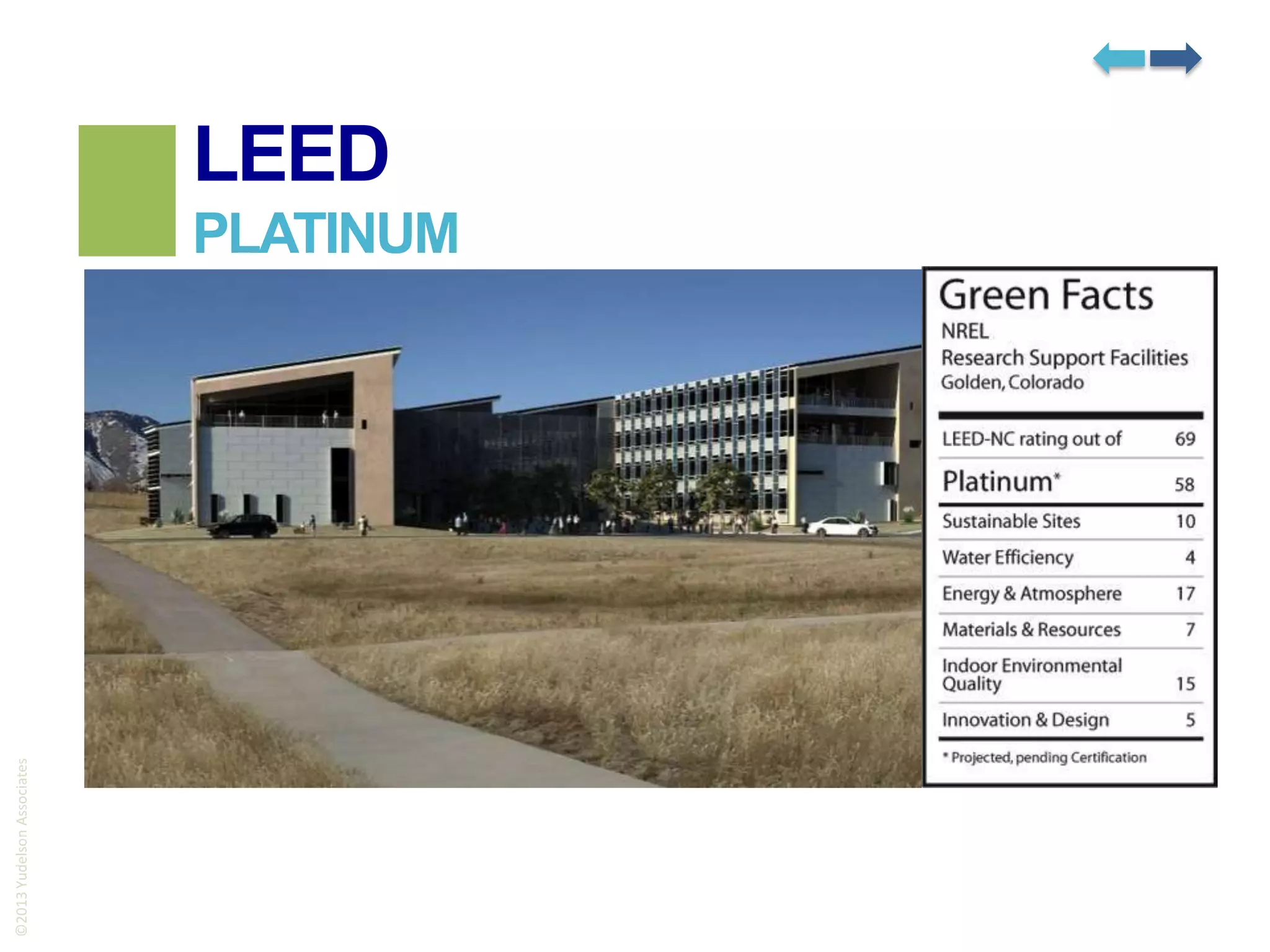
LEED Platinum
ENERGY STAR Label
NREL PROJECT
OBJECTIVES

©2013 Yudelson Associates

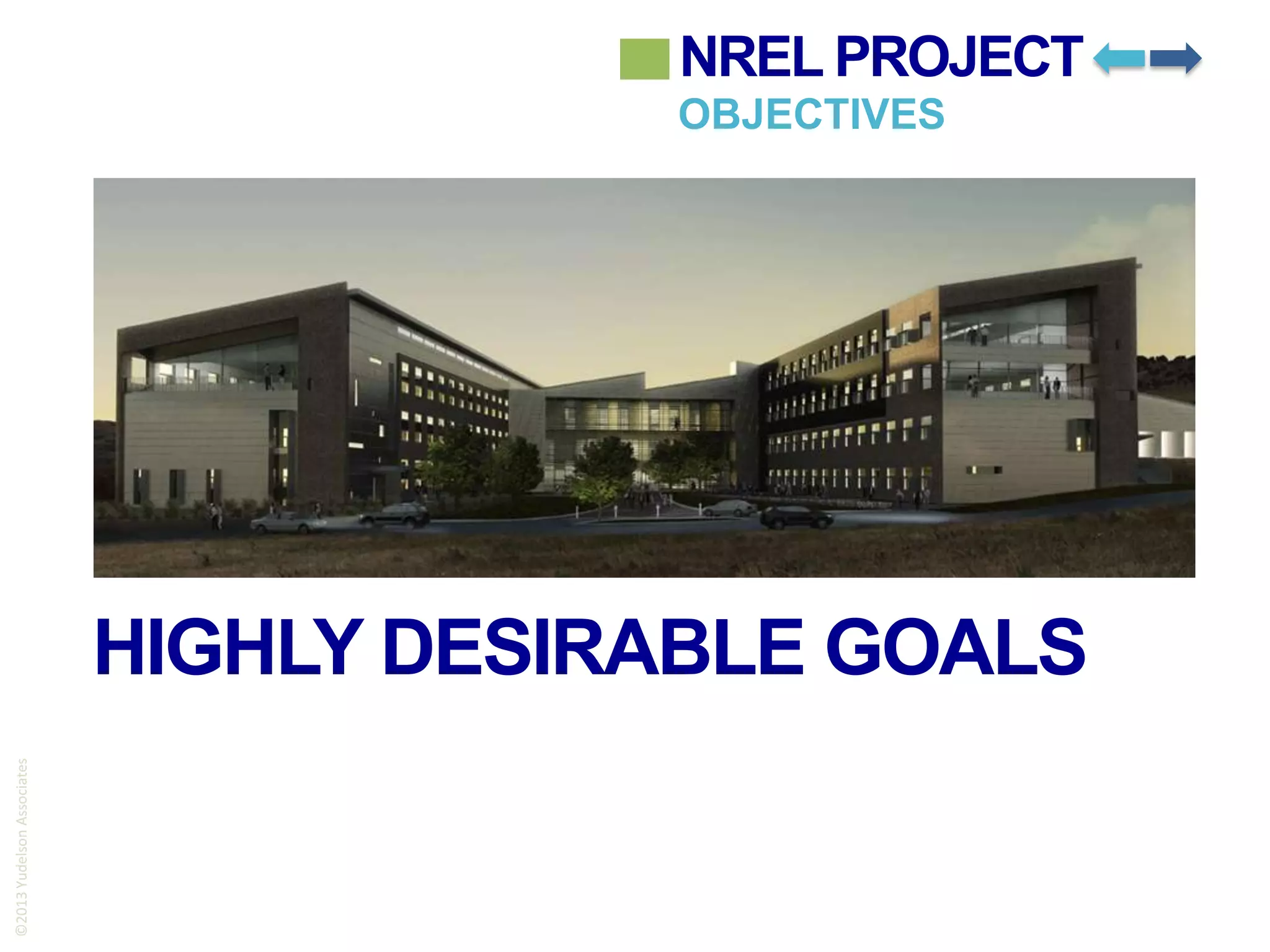
HIGHLY DESIRABLE GOALS
NREL PROJECT
OBJECTIVES

HIGHLY DESIRABLE (15)

©2013 Yudelson Associates

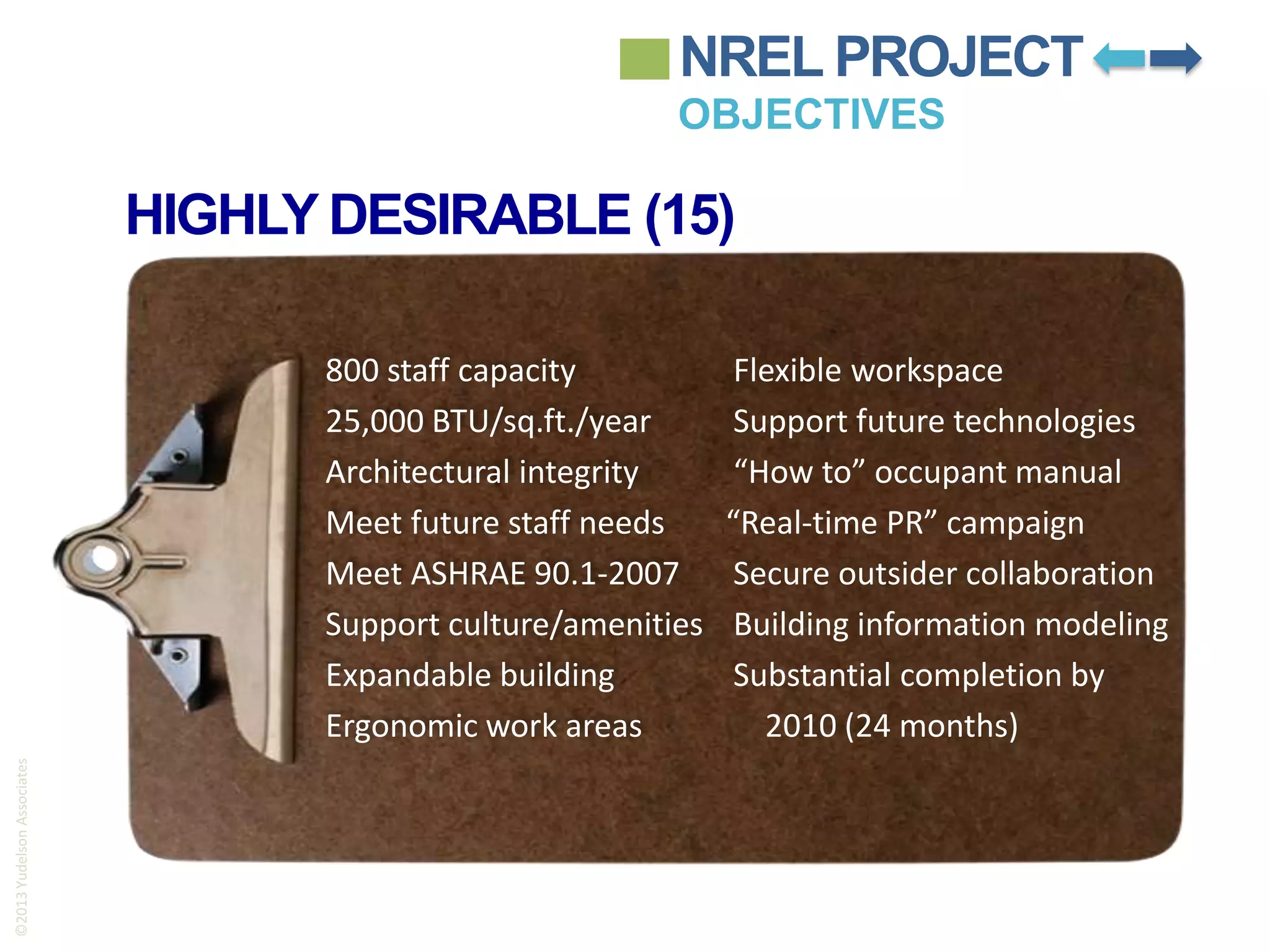
800 staff capacity
25,000 BTU/sq.ft./year
Architectural integrity
Meet future staff needs
Meet ASHRAE 90.1-2007
Support culture/amenities
Expandable building
Ergonomic work areas

Flexible workspace
Support future technologies
“How to” occupant manual
“Real-time PR” campaign
Secure outsider collaboration
Building information modeling
Substantial completion by
2010 (24 months)
©2013 Yudelson Associates

NREL PROJECT

OBJECTIVES
PROJECT OBJECTIVES
IF POSSIBLE (8)

©2013 Yudelson Associates

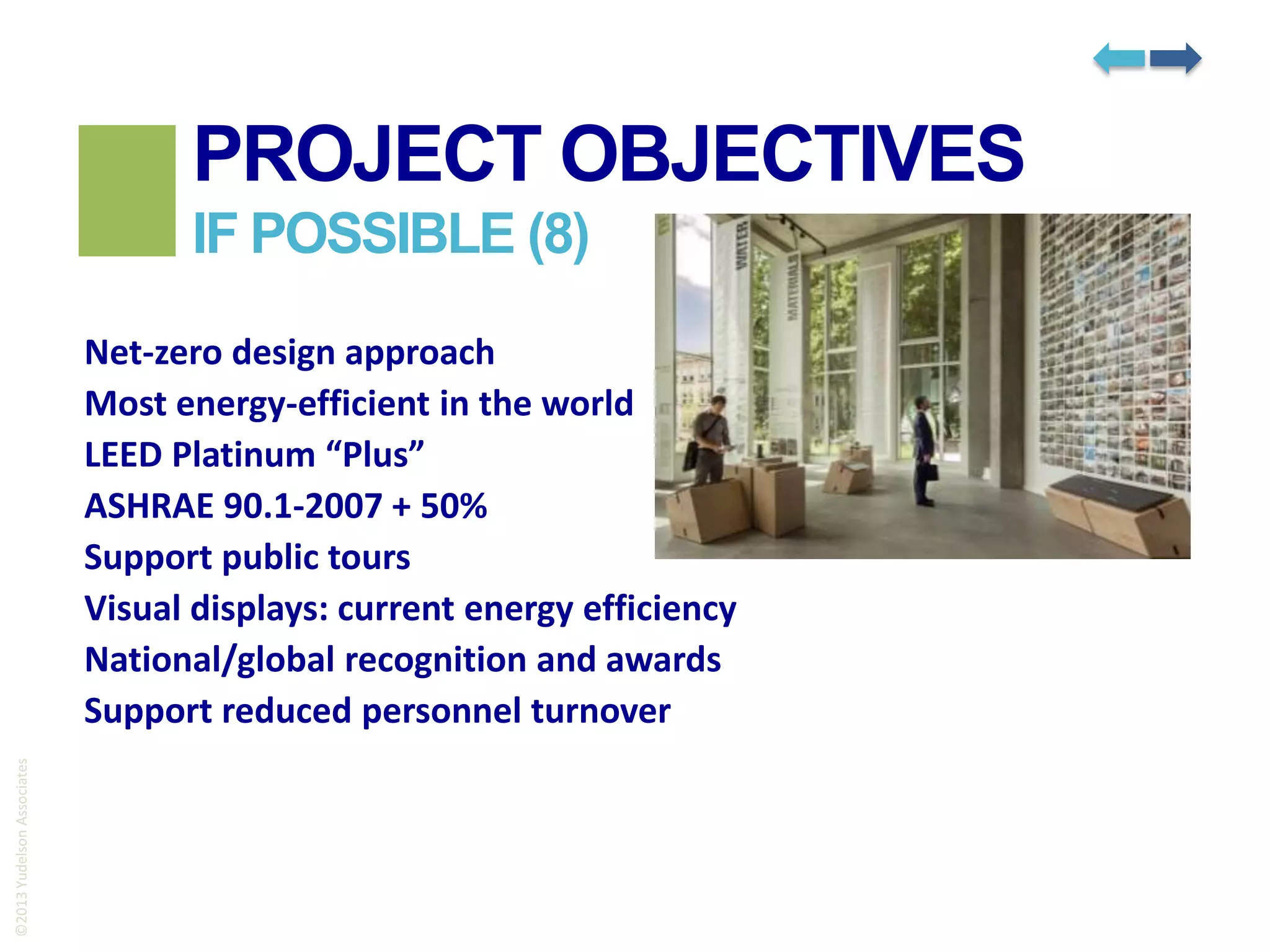
Net-zero design approach
Most energy-efficient in the world
LEED Platinum “Plus”
ASHRAE 90.1-2007 + 50%
Support public tours
Visual displays: current energy efficiency
National/global recognition and awards
Support reduced personnel turnover
©2013 Yudelson Associates

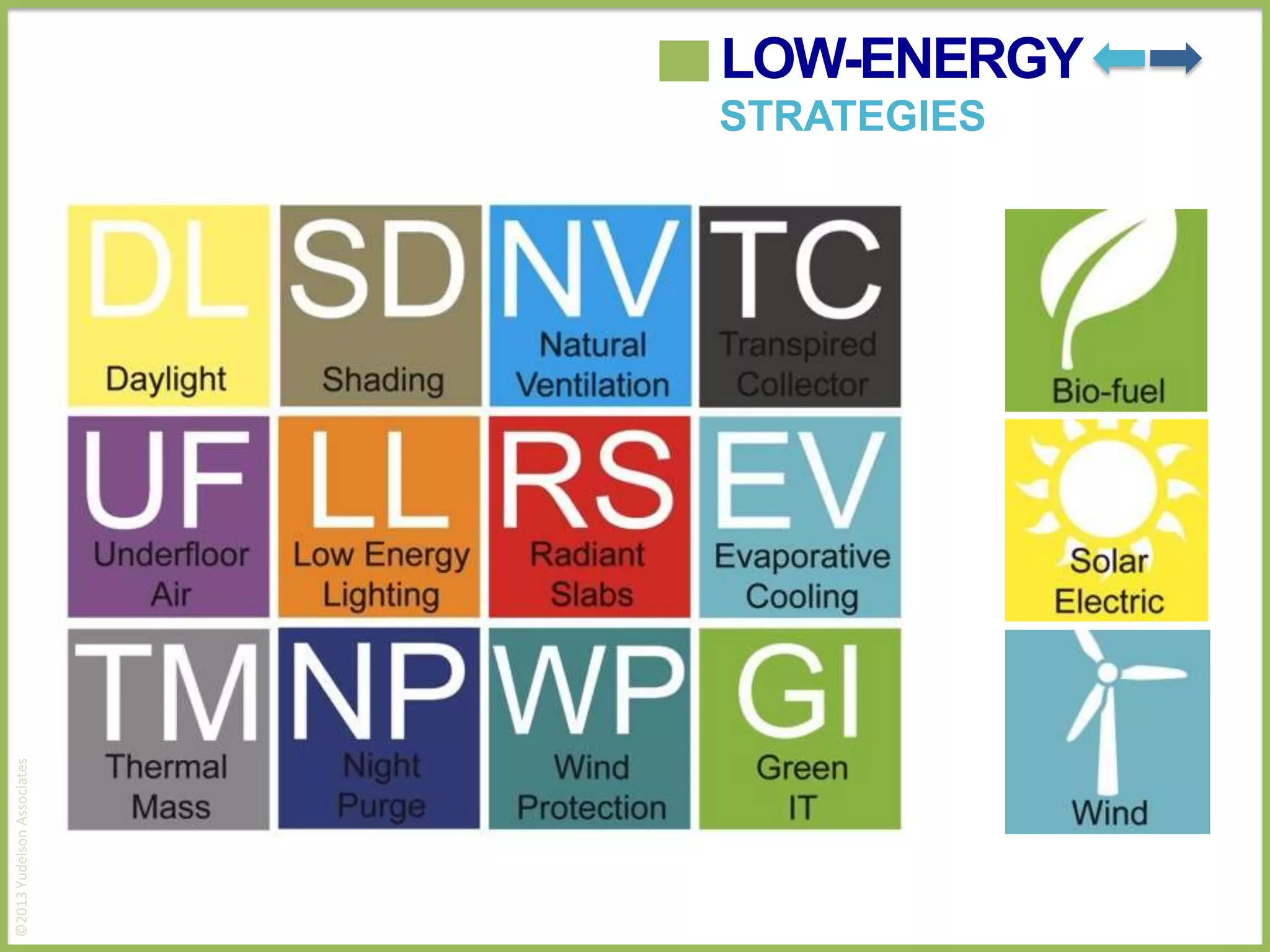
LOW-ENERGY

STRATEGIES
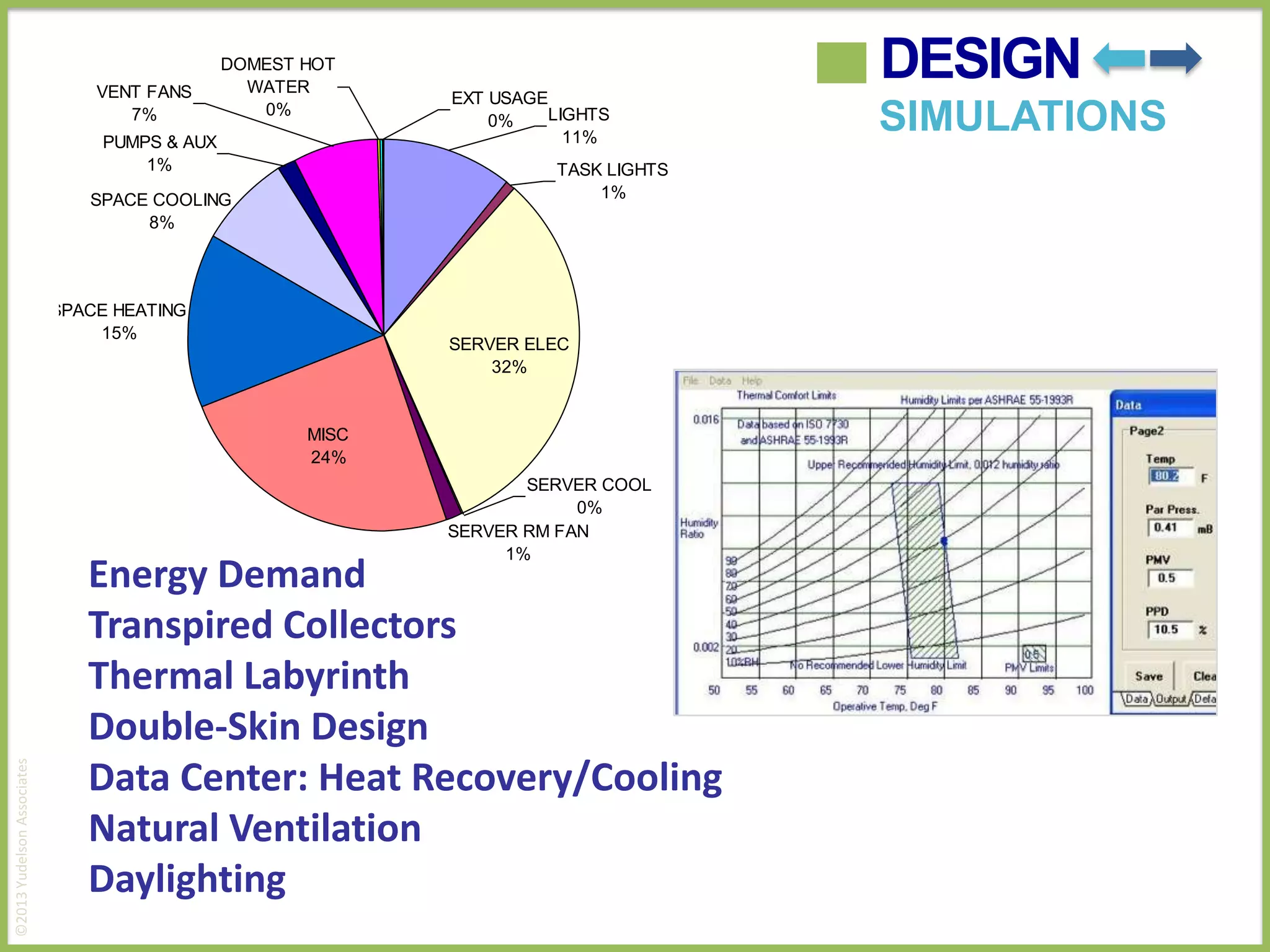
VENT FANS
7%

DOMEST HOT
WATER
0%

PUMPS & AUX
1%

DESIGN

NREL RSF ENERGY CONSUMPTION
EXT USAGE
LIGHTS
0%
11%
TASK LIGHTS
1%

SPACE COOLING
8%

SIMULATIONS
LIGHTS
TASK LIGHTS
SERVER ELEC
SERVER COOL
SERVER RM FAN
MISC

SPACE HEATING
15%

SPACE HEATING
SERVER ELEC
32%

SPACE COOLING
PUMPS & AUX
VENT FANS
DOMEST HOT WATER

MISC
24%

EXT USAGE

©2013 Yudelson Associates

SERVER COOL
0%
SERVER RM FAN
1%

Energy Demand
Transpired Collectors
Thermal Labyrinth
Double-Skin Design
Data Center: Heat Recovery/Cooling
Natural Ventilation
Daylighting
©2013 Yudelson Associates

LEED

PLATINUM
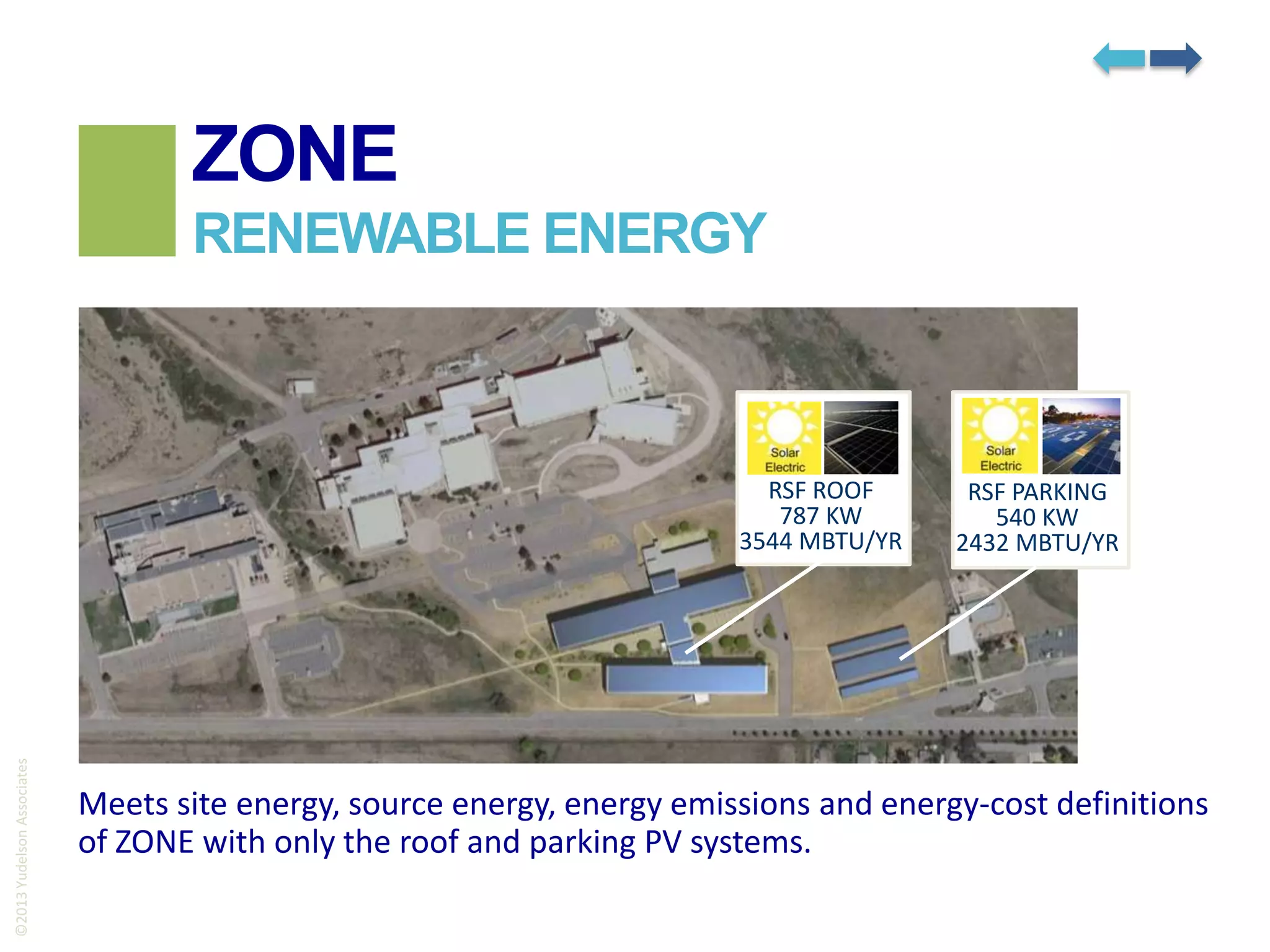
ZONE
RENEWABLE ENERGY

©2013 Yudelson Associates

RSF ROOF
787 KW
3544 MBTU/YR

RSF PARKING
540 KW
2432 MBTU/YR

Meets site energy, source energy, energy emissions and energy-cost definitions
of ZONE with only the roof and parking PV systems.
©2013 Yudelson Associates

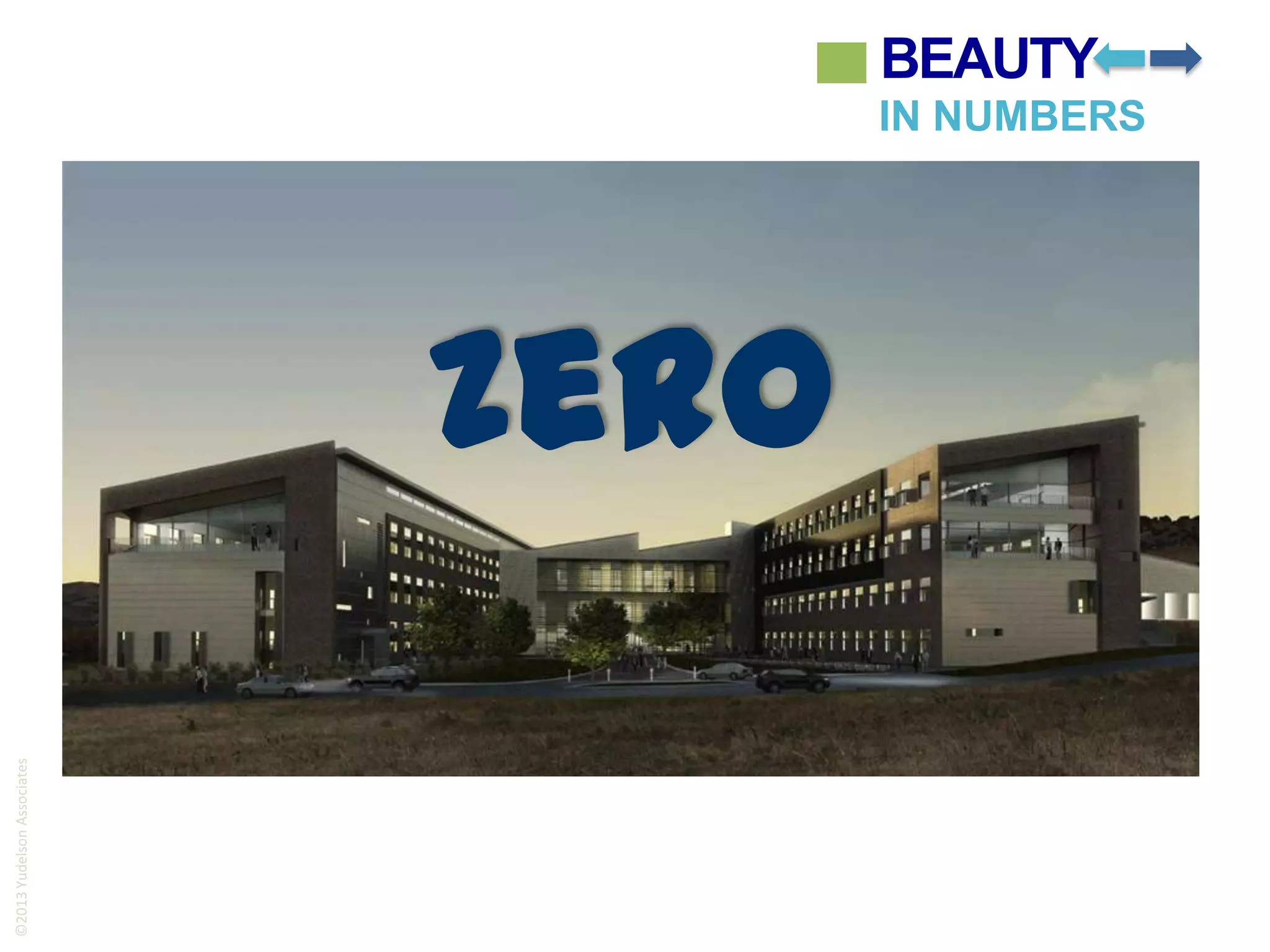
BEAUTY

IN NUMBERS

Zero
©2013 Yudelson Associates

WHERE DO WE

GO FROM HERE?
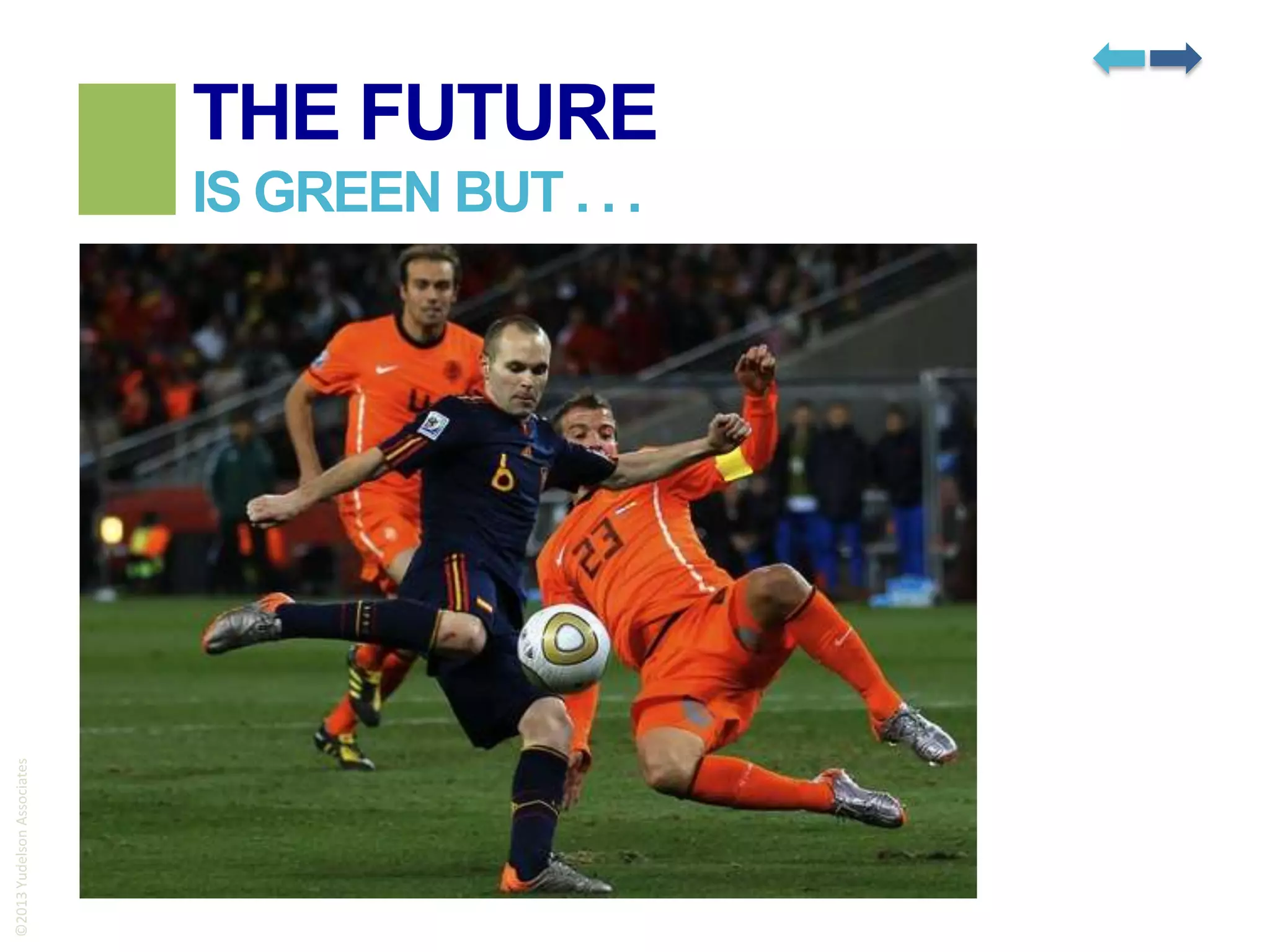
THE FUTURE

©2013 Yudelson Associates

IS GREEN BUT . . .
©2013 Yudelson Associates

IF IT DOESN’T PERFORM . . .
©2013 Yudelson Associates

IT CAN’T BE GREEN
©2013 Yudelson Associates

THANK YOU!
©2013 Yudelson Associates

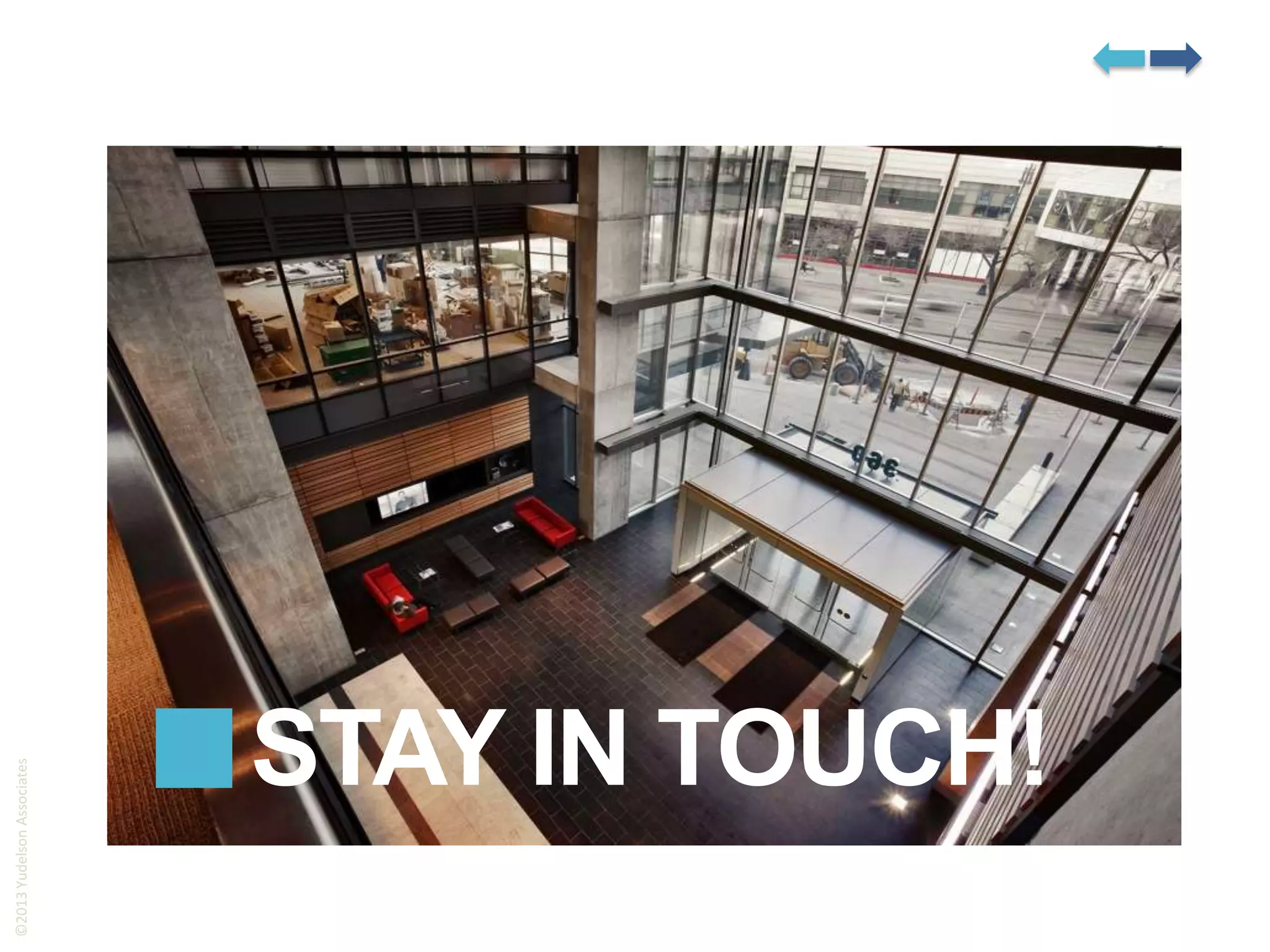
STAY IN TOUCH!
@jerryyudelson

greenbuildconsult.com/blog
jerry@greenbuildconsult.com
©2013 Yudelson Associates

DOWNLOAD

Slideshare.net/yudelson

Jerry Yudelson: The Business Case for Net Zero Energy Buildings

  • 1.
    MAKING THE BUSINESSCASE: NET-ZERO-ENERGY BUILDINGS SMACNA National Convention October 21, 2013 — Maui, Hawaii Jerry Yudelson, PE, LEED Fellow Yudelson Associates Tucson, Arizona
  • 2.
    LEARNING OBJECTIVES: NET-ZERO-ENERGY BUILDINGS ©2013Yudelson Associates 1. 2. 3. 4. Understand the concept of net-zero-energy buildings Learn from examples what systems are being used in low-energy buildings Become conversant with the business case for Net Zero buildings Gather ideas for positioning your business to take advantage of this trend
  • 3.
    LOOKING BACK WHAT HASCHANGED IN 5 YEARS? ©2013 Yudelson Associates 1. 2. 3. 4. 5. 6. New HVAC technologies Market demand for green buildings Cost of green buildings Financing for solar Cost of solar New goals – Net Zero
  • 4.
    ©2013 Yudelson Associates DPRConst. Office Phoenix
  • 5.
    ©2013 Yudelson Associates DPRConst. Office Phoenix
  • 6.
    Public Service Bldg. ©2013Yudelson Associates Salt Lake City
  • 7.
    Public Service Bldg. ©2013Yudelson Associates Salt Lake City
  • 8.
  • 9.
  • 10.
  • 11.
  • 12.
    LOOKING FORWARD ©2013 YudelsonAssociates WHAT WILL CHANGE IN 5 YEARS? 1. 2. 3. 4. 5. 6. 7. New HVAC technologies ASHRAE design standards Cost of solar (-) Cost of energy (+) Regulatory environment Market demand New technologies
  • 13.
  • 14.
  • 15.
    LOOKING AHEAD ©2013 YudelsonAssociates DRIVING FORCES FOR NET ZERO 1. 2. 3. 4. 5. 6. 7. Policy directives from Gov’t/NGO/Universities, etc. LEED Living Building Challenge/certification Demonstration projects multiplying Rapid cost reductions – solar PV Financing for commercial rooftop solar Increasing energy costs/concerns
  • 16.
    LOOKING AHEAD ©2013 YudelsonAssociates INHIBITING FORCES 1. 2. 3. 4. 5. 6. 7. Large buildings – not enough roof area Higher initial costs Technical difficulty of low EUI’s Lack of integrated design process Climate determines solar output Market demand Energy costs/ROI
  • 17.
    DEFINING ©2013 Yudelson Associates ZEROENERGY BUILDING (ZEB) Generally, building energy use from all operating demands will be equal (or less) on an annual basis than energy generated by on-site renewable sources. HVAC Electrical Lighting Water Heating Plug and Process Loads Buying power from green sources doesn’t count (much)! Seasonally: in winter, buildings demand more power than they produce and in summer, they generate more than they use.
  • 18.
    ZEB ©2013 Yudelson Associates DEFINITIONS Netzero site energy building Net zero source energy building Net zero energy cost building Net zero energy emissions building
  • 19.
    HIERARCHY ZONE DEFINITIONS • ©2013 YudelsonAssociates • • Building energy use from all operating demands will be equal (or less) on an annual basis than energy generated by on-site renewable sources that are connected to the building’s energy systems – Within building footprint (the best!) – On the site but not all within building footprint (e.g., parking structures, ground-mounted, etc.) Generated from combustion of renewable sources (e.g., biomass) and some on-site solar thermal/electric energy Generated from off-site renewable sources (e.g., buy offsets) Source: S. Pless and P. Torcellini, NREL/TP-550-44586, June 2010
  • 20.
    ZEB DEFINITIONS SUMMARY Minuses Site ZEB •Easy to implement. • Verifiable through on-site measurements. • Conservative approach to achieving ZEB. • No externalities affect performance, can track success over time. • Easy for the building community to understand and communicate. • Encourages energy-efficient building designs. • Requires more PV export to offset natural gas use. • Does not consider all utility costs (can have a low load factor). • Not able to equate fuel types. • Does not account for non-energy differences between fuel types (supply availability, pollution). Source ZEB • Able to equate energy value of fuel types used at the site. • Better model for impact on national energy system. • Easier ZEB to reach. • Does not account for non-energy differences between fuel types (supply availability, pollution). • Source calculations too broad (do not account for regional or daily variations in electricity generation heat rates). • Source energy use accounting and fuel switching can have a larger impact than efficiency technologies. • Does not consider all energy costs (can have a low load factor). • Need to develop site-tosource conversion factors, which require significant amount of information to define. Cost ZEB ©2013 Yudelson Associates Definition Pluses • Easy to implement and measure. • Market forces result in a good balance between fuel types. • Allows for demand-responsive control. • Verifiable from utility bills. • May not reflect impact to national grid for demand, as extra PV generation can be more valuable for reducing demand with on-site storage than exporting to the grid. • Requires net-metering agreements such that exported electricity can offset energy and non-energy charges. • Highly volatile energy rates make for difficult tracking over time. • Offsetting monthly service and infrastructure charges require going beyond ZEB. • Net metering is not everywhere well established, often with capacity limits and at buy-back rates that may be lower than retail rates. Emissions ZEB • Better model for green power. • Accounts for non-energy differences between fuel types (pollution, greenhouse gases). • Easier ZEB to reach. • Need appropriate emission factors. Other Issues
  • 21.
    IS IT EVENPOSSIBLE? ©2013 Yudelson Associates OF COURSE! BUT . . . Solar AC generation ranges 1200-1800 kWh/KW (peak) annually in U.S. If a 110,000 sq.ft. building uses 1.5 million kWh/year, you need a ≈1000-kWp system to get net zero Actually, need solar thermal also, for hot water needs Cost $5 million +/-, or ~$45/sq.ft., net of incentives Still an expensive proposition for a typical office Living Building Challenge requires this result Most LEED buildings get to ZEB only by buying green power from outside sources
  • 22.
    BUSINESS CASE: GREEN BUILDING REPUTATIONAL Energy/watersavings Higher rents/occupancy +Net operating income Higher resale value Tax benefits Recruit/retain talent Increase stock value Marketing Public relations Investors/donors Value retention ENVIRONMENTAL ©2013 Yudelson Associates FINANCIAL SOCIAL Sustainability Storm water management Renewable energy Risk mitigation Health gains Employee morale Improved productivity
  • 23.
    TWO TYPES OFOWNER TWO UNIQUE ROI GOALS INVESTOR-OWNER Long-term Ownership Occupancy of Entire Building Same Entity Owns/Occupies Appeal to Employees/Visitors Interested in Lowering Op. Costs ©2013 Yudelson Associates OWNER-OCCUPIER Shorter-term Ownership Many Tenants Appeal to Tenants’ “Green” Req’s Interested in Rental Income Increase Asset Value for Resale
  • 24.
    OWNER/OCCUPIER ROI MOTIVATION OWNER-OCCUPIER ROI MOTIVATION ©2013Yudelson Associates MEETING SUSTAINABILITY OBJECTIVES EMPLOYEES’ VIEW OF COMPANY — Ranking against peers — Ability to attract and retain engaged employees — GHG reporting; Energy Disclosures — Corporate sustainability reporting MAINTAINING PRODUCTIVE WORK ENVIRONMENT
  • 25.
    INVESTOR-OWNER ROI MOTIVATION INCREASING REVENUE/ASSETVALUE — Valuation driven by rental income (e.g., NOI Metrics) — Comparison to other investment opportunities — Always maintain market flexibility (e.g., Sell property) STAKEHOLDER PERCEPTION OF FIRM — New reporting requirements in energy efficiency and GHG emissions ©2013 Yudelson Associates SMART BUILDINGS ADVANCE SUSTAINABILITY GOALS — For both institutional investors and tenants
  • 26.
    PERFORMANCE DISCLOSURE ©2013 YudelsonAssociates LIVING BUILDING CHALLENGE Bullitt Center, Seattle, WA
  • 27.
    NET ZERO DEPENDS ©2013Yudelson Associates ON HEIGHT
  • 28.
  • 29.
    HIGH PERFORMANCE ©2013 YudelsonAssociates DESIGN APPROACH
  • 30.
    INTEGRATED DESIGN ©2013 Yudelson Associates COSTTRANSFER SAME TOTAL BUT: Engineering costs less Invest in architecture Active to passive Fragile to robust Longer life Less cost vs. life-cycle Simpler design better
  • 31.
    NEW BUILDINGS INSTITUTE ©2013Yudelson Associates 2012 ZEB/ZEC STUDY
  • 32.
    ZEB AND ZEROENERGY: ©2013 Yudelson Associates CAPABILITY COUNTS
  • 33.
  • 34.
    ZEB AND ZECBUILDINGS: TECHNOLOGY PENETRATION Daylighting High-Efficiency Lighting High-Efficiency Envelope High R-Value Glazing Natural Ventilation High-Efficiency HVAC Heat Recovery Cool Roof Radiant Ground-Source Heat Pump ©2013 Yudelson Associates UFAD/Displacement
  • 35.
  • 36.
    ISSUES ©2013 Yudelson Associates FIRSTCOST CONCERNS DEMONSTRATE FINANCIAL COST-EFFECTIVENESS – Return on Investment (ROI) – Increase in building value – Risk mitigation – Intangibles (i.e., value of green label) ACTUAL BUILDING PERFORMANCE – Projects need continuous commissioning – Renewables have to work as planned – Behavioral issues & plug loads must be proactively managed
  • 37.
    ISSUES DESIGN KNOW-HOW ©2013 YudelsonAssociates WIDESPREAD LOW-ENERGY DESIGN KNOW-HOW – Cost premium for good design getting smaller MORE STRINGENT ENERGY CODES – Reduces first-cost premium for net-zero – Better products at conventional costs SOLAR POWER COST REDUCTIONS/EFFICIENCY GAINS + INCREASES IN CONVENTIONAL ENERGY COSTS – Shorter payback for savings CARBON REDUCTION GOALS MAY INCREASE PERCEIVED/ACTUAL VALUE OF GREEN OR NET-ZERO BUILDINGS
  • 38.
    CASE STUDY: ©2013 YudelsonAssociates NREL — GOLDEN, COLORADO PHASE I: 220,000 SQ.FT. PHASE II: 138,000 SQ.FT. (OCCUPIED 18 MONTHS LATER)
  • 39.
    PROJECT PROCUREMENT DESIGN/BUILD 3 finalists fromRFQ process Design to 10% level to confirm cost ©2013 Yudelson Associates $63 MILLION BUDGET (FIXED) GOVERNMENT PROJECT RULES OUTSIDE “PROCESS” CONSULTANT “FIXED-PRICE, VARIABLE-SCOPE” APPROACH
  • 40.
    NREL PROJECT ©2013 YudelsonAssociates OBJECTIVES MISSION CRITICAL (3) HIGHLY DESIRABLE (15) STRETCH GOALS (8)
  • 41.
    NREL PROJECT ©2013 YudelsonAssociates OBJECTIVES MISSION CRITICAL GOALS
  • 42.
    PROJECT OBJECTIVES MISSION CRITICAL (3) ©2013Yudelson Associates Safety – Jobsite/At Work LEED Platinum ENERGY STAR Label
  • 43.
    NREL PROJECT OBJECTIVES ©2013 YudelsonAssociates HIGHLY DESIRABLE GOALS
  • 44.
    NREL PROJECT OBJECTIVES HIGHLY DESIRABLE(15) ©2013 Yudelson Associates 800 staff capacity 25,000 BTU/sq.ft./year Architectural integrity Meet future staff needs Meet ASHRAE 90.1-2007 Support culture/amenities Expandable building Ergonomic work areas Flexible workspace Support future technologies “How to” occupant manual “Real-time PR” campaign Secure outsider collaboration Building information modeling Substantial completion by 2010 (24 months)
  • 45.
  • 46.
    PROJECT OBJECTIVES IF POSSIBLE(8) ©2013 Yudelson Associates Net-zero design approach Most energy-efficient in the world LEED Platinum “Plus” ASHRAE 90.1-2007 + 50% Support public tours Visual displays: current energy efficiency National/global recognition and awards Support reduced personnel turnover
  • 47.
  • 48.
    VENT FANS 7% DOMEST HOT WATER 0% PUMPS& AUX 1% DESIGN NREL RSF ENERGY CONSUMPTION EXT USAGE LIGHTS 0% 11% TASK LIGHTS 1% SPACE COOLING 8% SIMULATIONS LIGHTS TASK LIGHTS SERVER ELEC SERVER COOL SERVER RM FAN MISC SPACE HEATING 15% SPACE HEATING SERVER ELEC 32% SPACE COOLING PUMPS & AUX VENT FANS DOMEST HOT WATER MISC 24% EXT USAGE ©2013 Yudelson Associates SERVER COOL 0% SERVER RM FAN 1% Energy Demand Transpired Collectors Thermal Labyrinth Double-Skin Design Data Center: Heat Recovery/Cooling Natural Ventilation Daylighting
  • 49.
  • 50.
    ZONE RENEWABLE ENERGY ©2013 YudelsonAssociates RSF ROOF 787 KW 3544 MBTU/YR RSF PARKING 540 KW 2432 MBTU/YR Meets site energy, source energy, energy emissions and energy-cost definitions of ZONE with only the roof and parking PV systems.
  • 51.
  • 52.
  • 53.
    THE FUTURE ©2013 YudelsonAssociates IS GREEN BUT . . .
  • 54.
    ©2013 Yudelson Associates IFIT DOESN’T PERFORM . . .
  • 55.
  • 56.
  • 57.
  • 58.

Editor's Notes

  • #5 Design Features 16,533-sq.ft. (one story, former retail store)79kVA of PV on adjacent parking structure Natural lighting on east and north facades, with horizontal shadingTarget EUI 25 kBtu/sq.ft./year Solatubes for interior light LEDs for exterior lighting 4 Evaporative cooling, “shower towers” made from 48” dia. Corrugated polyethylene storm pipe, each 28’ tall 87-foot-long, zinc-clad “solar chimney” Operable windows and roll-up doors 12 @ 8’-dia. Big Ass fans Vampire shut-off switch7PV has 140,000 kWh/year AC output Building dashboard system to engage occupants
  • #6 Design Features Thermal chimney, 85’ long, black zinc16,533-sq.ft. (one story, former retail store) Natural lighting on east and north facades, with horizontal shading Solatubes for interior light LEDs for exterior lighting 4 Evaporative cooling, “shower towers” with 87-foot-long, zinc-clad “solar chimney Operable windows and roll-up doors 12 @ 8’-dia. Big Ass fans Vampire shut-off switch79 kW of PV, 140,000 kWh/year AC output Building dashboard system to engage occupants
  • #7 Design Features Net zero was Mayor’s goal, introduced after budget was already set in stone175,500-sq.ft., $125 million (335,000-sq.ft. with structured parking) Built on a conventional budget (for this building type) – bond issue amount (balance 3 items: budget, quality, program all together with ‘net zero’) “Energy thermometer” presented at every project meeting when new issues came up; low lighting power density (LED task lights) LEED Platinum rating expected Radiant slab heating/cooling with chilled beam cooling (relatively few; dispatch center); improved comfort for stationary workers Downsized vents Space conditioning – find the right solution for each issue and to make them interactive 30-kW solar on building (30,000-sq.ft.); more at SLC Airport to meet Net Zero goal Four-story glass curtain wall with triple-pane glass
  • #8 Design Features Net zero was Mayor’s goal, introduced after budget was already set in stone175,500-sq.ft., $125 million (335,000-sq.ft. with structured parking) Built on a conventional budget (for this building type) – bond issue amount (balance 3 items: budget, quality, program all together with ‘net zero’) “Energy thermometer” presented at every project meeting when new issues came up; low lighting power density (LED task lights) LEED Platinum rating expected Radiant slab heating/cooling with chilled beam cooling (relatively few; dispatch center); improved comfort for stationary workers Downsized vents Space conditioning – find the right solution for each issue and to make them interactive 30-kW solar on building (30,000-sq.ft.); more at SLC Airport to meet Net Zero goal Four-story glass curtain wall with triple-pane glass
  • #9 50,000 SF16kBtu/SF/year goal6 stories30 kW PV systemOperable windowsLiving Building Challenge goals: Net Zero Energy/Net Zero Water
  • #27 “What gets measured, gets managed”Without reports, we are flying blind/can’t fixWhy should governments put their faith in green building without performance reports?
  • #32 Every building should be beautifulEvery building LEED PlatinumEvery building should aim at “BSAGs”Achieve measured 35 to 45 kBtu/sq.ft. (EUI) performanceDon’t settle for less!BE WILLING to SAY: If it doesn’t perform, it’s not a green building!
  • #33 60 buildings total in the study, EUI up to 36, 20% were above 50,000 sq.ft.
  • #41 Integrated Design Process Critical to SuccessStarted with the Procurement ProcessSet BSAGs – Big, Scary, Audacious Goals
  • #42 Mission CriticalAttain Safe Work Performance Record/Safe Design PracticesLEED® Platinum CertificationENERGY STAR First “Plus”Highly Desirable Goals (first page)Up to 800 Staff Capacity25,000 BTU/sq.ft./year energy use (79 kWh/sq.m./annum)Architectural IntegrityHonor “Future Staff” NeedsMeasurable 50% Reduction In Energy Use From ASHRAE 90.1-2007Support Culture And Amenities
  • #44 Highly Desirable (Continued)Expandable Building (To Add Another Wing)Ergonomic DesignFlexible WorkspaceSupport Future TechnologiesDocumentation to Produce a “How To” ManualPR Campaign Implemented in Real TimeAllow Secure Collaboration with OutsidersUse BIM (Building Information Modeling)Substantial Completion in 27 months
  • #46 If Possible (Stretch Goals, 8 total))Net-Zero-Energy Design ApproachMost Energy-Efficient Building in the WorldLEED Platinum “Plus”Measurable >50% Reduction in Energy Use from ASHRAE 90.1-2007Visual Displays of Current Energy EfficiencySupport Public ToursAchieve National and Global Recognition/AwardsSupport retention of personnel
  • #53 Every building should be beautifulEvery building LEED PlatinumEvery building should aim at “BSAGs”Achieve measured 35 to 45 kBtu/sq.ft. (EUI) performanceDon’t settle for less!BE WILLING to SAY: If it doesn’t perform, it’s not a green building!
  • #54 If you want to score, run to where the ball is headed, not to where it is.Ask yourself and your clients: how green will the built environment be in 2015 to 2020?Non-performing green buildings will pay a penalty in that market!2010 FIFA World CupIf you want to score, run to where the ball is headed, not to where it is.Ask yourself and your clients: how green will the built environment be in 2015 to 2020?What will be the competing buildings over the next 5-10 years?Non-performing green buildings will pay a penalty in that market!
  • #55 ARE YOU WILLING to SAY: If it doesn’t perform, it’s not a green building?