
1
High-Rise Passive House Feasibility
Study
ACHIEVING THE PASSIVE HOUSE CRITERIA ON A HIGH-RISE, CONCRETE
FRAMED BUILDING, LOCATED IN VANCOUVER
ERIC CATANIA, M.ENG., BEMP, CPHD, LEED AP BD+C,
PHI ACCREDITED PASSIVE HOUSE CERTIFIER
OCTOBER 7TH, 2016 – NAPHN CONFERENCE & EXPO 2017
SESSION: PASSIVE STANDS TALL: HIGH RISES IN NORTH AMERICA & EUROPE
2
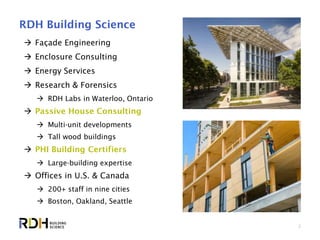
RDH Building Science
 Façade Engineering
 Enclosure Consulting
 Energy Services
 Research & Forensics
 RDH Labs in Waterloo, Ontario
 Passive House Consulting
 Multi-unit developments
 Tall wood buildings
 PHI Building Certifiers
 Large-building expertise
 Offices in U.S. & Canada
 200+ staff in nine cities
 Boston, Oakland, Seattle
3
 High-rise Passive Houses
 Building description
 Key concerns
 Enclosure
 Components
 PER
 Results
Outline
4
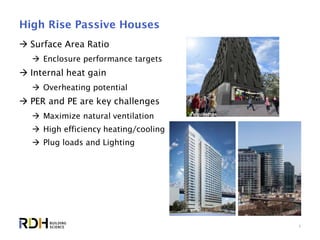
High Rise Passive Houses
 Surface Area Ratio
 Enclosure performance targets
 Internal heat gain
 Overheating potential
 PER and PE are key challenges
 Maximize natural ventilation
 High efficiency heating/cooling
 Plug loads and Lighting
5
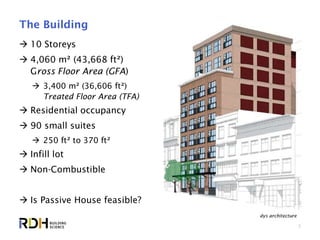
The Building
 10 Storeys
 4,060 m² (43,668 ft²)
Gross Floor Area (GFA)
 3,400 m² (36,606 ft²)
Treated Floor Area (TFA)
 Residential occupancy
 90 small suites
 250 ft² to 370 ft²
 Infill lot
 Non-Combustible
 Is Passive House feasible?
dys architecture
6
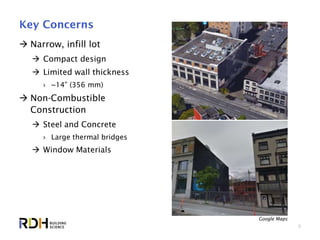
Key Concerns
 Narrow, infill lot
 Compact design
 Limited wall thickness
› ~14” (356 mm)
 Non-Combustible
Construction
 Steel and Concrete
› Large thermal bridges
 Window Materials
Google Maps
7
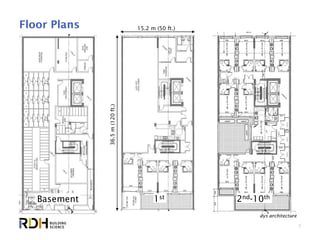
Floor Plans
Basement 1st 2nd-10th
36.5m(120ft.)
15.2 m (50 ft.)
dys architecture
8
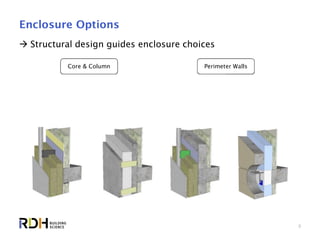
Enclosure Options
 Structural design guides enclosure choices
Core & Column
Exterior insulated
steel framed walls
Precast sandwich
panel walls
Perimeter Walls
Exterior insulated
mass walls
Interior insulated
mass walls w/slab
thermal breaks
9
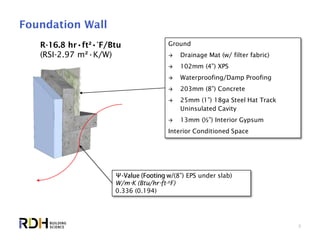
Foundation Wall
Ground
 Drainage Mat (w/ filter fabric)
 102mm (4”) XPS
 Waterproofing/Damp Proofing
 203mm (8”) Concrete
 25mm (1”) 18ga Steel Hat Track
Uninsulated Cavity
 13mm (½”) Interior Gypsum
Interior Conditioned Space
(8”) EPS under slab)
W/mK (Btu/hrft·oF)
0.336 (0.194)
R-16.8 hr•ft²•°F/Btu
(RSI-2.97 m²•K/W)
10
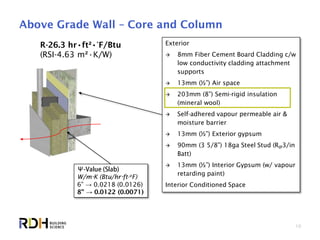
Above Grade Wall – Core and Column
R-26.3 hr•ft²•°F/Btu
(RSI-4.63 m²•K/W)
Exterior
 8mm Fiber Cement Board Cladding c/w
low conductivity cladding attachment
supports
 13mm (½”) Air space
 203mm (8”) Semi-rigid insulation
(mineral wool)
 Self-adhered vapour permeable air &
moisture barrier
 13mm (½”) Exterior gypsum
 90mm (3 5/8”) 18ga Steel Stud (RIP3/in
Batt)
 13mm (½”) Interior Gypsum (w/ vapour
retarding paint)
Interior Conditioned Space
W/mK (Btu/hrft·oF)
6” → 0.0218 (0.0126)
8” → 0.0122 (0.0071)
11
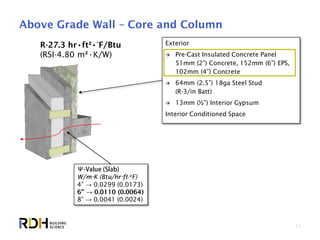
Above Grade Wall – Core and Column
R-27.3 hr•ft²•°F/Btu
(RSI-4.80 m²•K/W)
Exterior
 Pre-Cast Insulated Concrete Panel
51mm (2”) Concrete, 152mm (6”) EPS,
102mm (4”) Concrete
 64mm (2.5”) 18ga Steel Stud
(R-3/in Batt)
 13mm (½”) Interior Gypsum
Interior Conditioned Space
W/mK (Btu/hrft·oF)
4” → 0.0299 (0.0173)
6” → 0.0110 (0.0064)
8” → 0.0041 (0.0024)
12
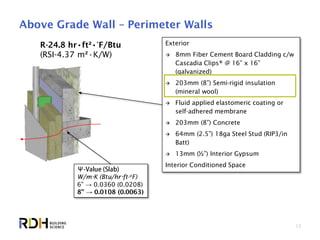
Above Grade Wall – Perimeter Walls
R-24.8 hr•ft²•°F/Btu
(RSI-4.37 m²•K/W)
Exterior
 8mm Fiber Cement Board Cladding c/w
Cascadia Clips® @ 16” x 16”
(galvanized)
 203mm (8”) Semi-rigid insulation
(mineral wool)
 Fluid applied elastomeric coating or
self-adhered membrane
 203mm (8”) Concrete
 64mm (2.5”) 18ga Steel Stud (RIP3/in
Batt)
 13mm (½”) Interior Gypsum
Interior Conditioned Space
W/mK (Btu/hrft·oF)
6” → 0.0360 (0.0208)
8” → 0.0108 (0.0063)
13
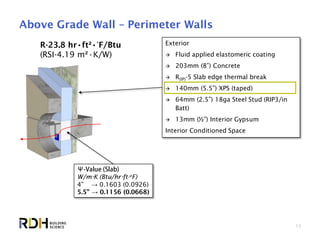
Above Grade Wall – Perimeter Walls
R-23.8 hr•ft²•°F/Btu
(RSI-4.19 m²•K/W)
Exterior
 Fluid applied elastomeric coating
 203mm (8”) Concrete
 R(IP)-5 Slab edge thermal break
 140mm (5.5”) XPS (taped)
 64mm (2.5”) 18ga Steel Stud (RIP3/in
Batt)
 13mm (½”) Interior Gypsum
Interior Conditioned Space
W/mK (Btu/hrft·oF)
4” → 0.1603 (0.0926)
5.5” → 0.1156 (0.0668)
14
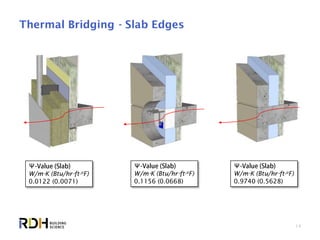
Thermal Bridging - Slab Edges
W/mK (Btu/hrft·oF)
0.0122 (0.0071)
W/mK (Btu/hrft·oF)
0.9740 (0.5628)
W/mK (Btu/hrft·oF)
0.1156 (0.0668)
15
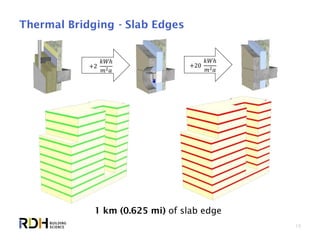
Thermal Bridging - Slab Edges
+2
𝑘𝑊ℎ
𝑚2 𝑎
+20
𝑘𝑊ℎ
𝑚2 𝑎
1 km (0.625 mi) of slab edge
16
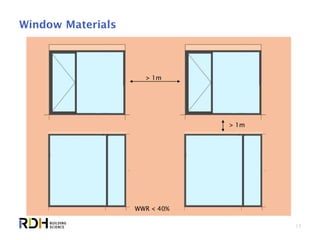
Window Materials
 BC Building Code 2012 – Division B – Part 3 — Fire Protection,
Occupant Safety and Accessibility - 3.1.5.4. (5)
 each window in an exterior wall face is an individual unit
separated by non-combustible wall construction from every other
opening in the wall,
 windows in exterior walls in contiguous storeys are separated by
not less than 1 m of non-combustible construction, and
 the aggregate area of openings in an exterior wall face of a fire
compartment is not more than 40% of the area of the wall face.
17
Window Materials
> 1m
> 1m
WWR < 40%
18
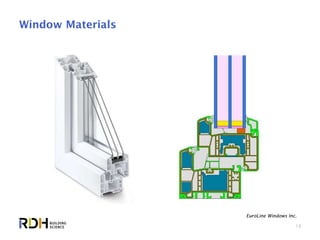
Window Materials
EuroLine Windows Inc.
19
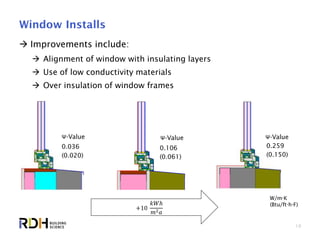
Window Installs
 Improvements include:
 Alignment of window with insulating layers
 Use of low conductivity materials
 Over insulation of window frames
0.106
(0.061)
W/mK
(Btu/fthF)
0.036
(0.020)
0.259
(0.150)
Ψ-ValueΨ-Value Ψ-Value
+10
𝑘𝑊ℎ
𝑚2 𝑎
20
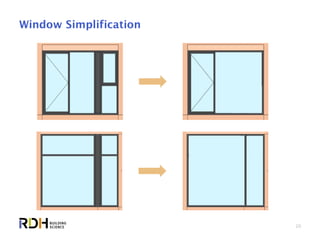
Window Simplification
21
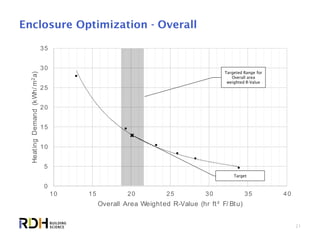
Enclosure Optimization - Overall
0
5
10
15
20
25
30
35
10 15 20 25 30 35 40
HeatingDemand(kWh/m2a)
Overall Area Weighted R-Value (hr ft² F/ Btu)
Targeted Range for
Overall area
weighted R-Value
Target
22
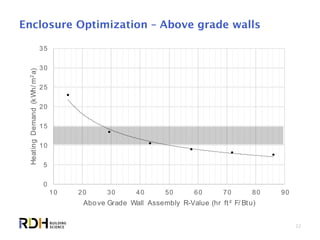
Enclosure Optimization – Above grade walls
0
5
10
15
20
25
30
35
10 20 30 40 50 60 70 80 90
HeatingDemand(kWh/m2a)
Above Grade Wall Assembly R-Value (hr ft² F/ Btu)
23
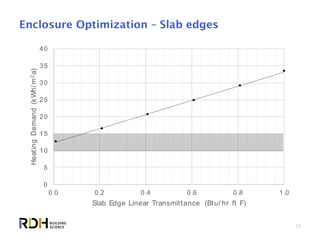
Enclosure Optimization – Slab edges
0
5
10
15
20
25
30
35
40
0.0 0.2 0.4 0.6 0.8 1.0
HeatingDemand(kWh/m2a)
Slab Edge Linear Transmittance (Btu/ hr ft F)
24
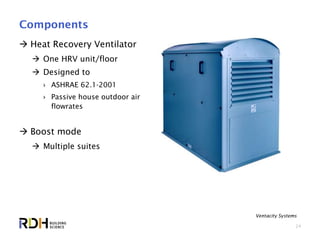
Components
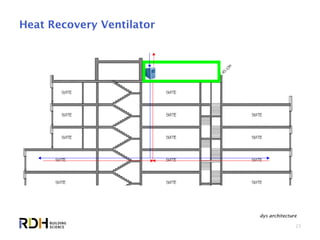
 Heat Recovery Ventilator
 One HRV unit/floor
 Designed to
› ASHRAE 62.1-2001
› Passive house outdoor air
flowrates
 Boost mode
 Multiple suites
Ventacity Systems
25
Heat Recovery Ventilator
dys architecture
26
Components
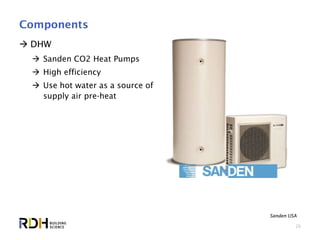
 DHW
 Sanden CO2 Heat Pumps
 High efficiency
 Use hot water as a source of
supply air pre-heat
Sanden USA
27
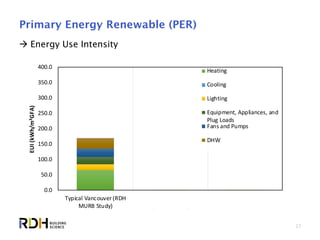
Primary Energy Renewable (PER)
 Energy Use Intensity
0.0
50.0
100.0
150.0
200.0
250.0
300.0
350.0
400.0
Typical Vancouver (RDH
MURB Study)
ASHRAE 90.1-2010 - MURB
(BC Code 2012)
Passive House Highrise
MURB
EUI(kWh/m²GFA)
Heating
Cooling
Lighting
Equipment, Appliances, and
Plug Loads
Fans and Pumps
DHW
28
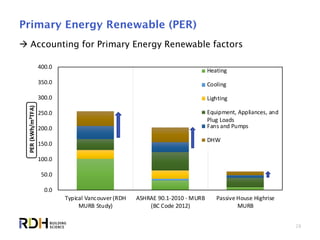
Primary Energy Renewable (PER)
 Accounting for Primary Energy Renewable factors
0.0
50.0
100.0
150.0
200.0
250.0
300.0
350.0
400.0
Typical Vancouver (RDH
MURB Study)
ASHRAE 90.1-2010 - MURB
(BC Code 2012)
Passive House Highrise
MURB
PER(kWh/m²TFA)
Heating
Cooling
Lighting
Equipment, Appliances, and
Plug Loads
Fans and Pumps
DHW
29
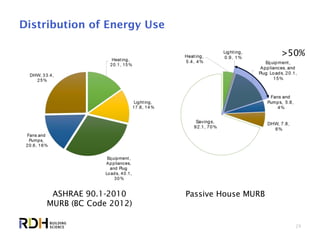
Distribution of Energy Use
ASHRAE 90.1-2010
MURB (BC Code 2012)
Passive House MURB
>50%
30
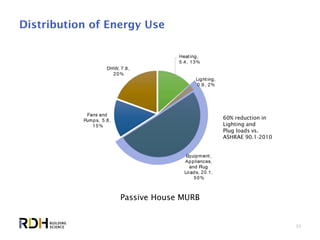
Distribution of Energy Use
Passive House MURB
60% reduction in
Lighting and
Plug loads vs.
ASHRAE 90.1-2010
31
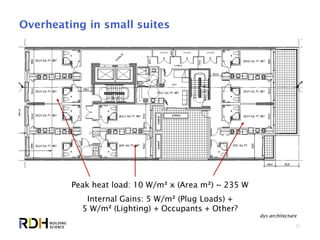
Overheating in small suites
Peak heat load: 10 W/m² x (Area m²) ~ 235 W
Internal Gains: 5 W/m² (Plug Loads) +
5 W/m² (Lighting) + Occupants + Other?
dys architecture
32
14.2
11.4
4
131
60
15
10
10
120
60
0 15 30 45 60 75 90 105 120 135 150
Heating Demand
Heating Load
Frequency of Overheating
Primary Energy
Primary Energy Renewable
kWh/ m2
Proposed Building Threshold
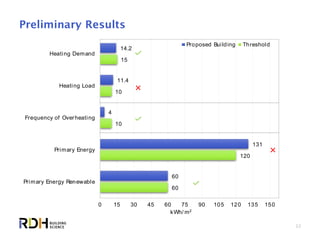
Preliminary Results
33
Conclusions
 Heating demand criteria can be achieved
 Heating load is exceeded
 Although overheating frequency is 4%, small suites on the
south side may be a concern
 Maximize natural ventilation
 Cooling may be required in some cases
 PER is achievable (adding PV would help to achieve targets)
 Lighting and plug load must be reduced where feasible
› Internal gains
› Energy consumption
34
Discussion + Questions
FOR FURTHER INFORMATION PLEASE VISIT
 www.rdh.com
 www.buildingsciencelabs.com
OR CONTACT ME AT
 ecatania@rdh.com

High-Rise Passive House Feasibility Study

  • 1.
    1 High-Rise Passive HouseFeasibility Study ACHIEVING THE PASSIVE HOUSE CRITERIA ON A HIGH-RISE, CONCRETE FRAMED BUILDING, LOCATED IN VANCOUVER ERIC CATANIA, M.ENG., BEMP, CPHD, LEED AP BD+C, PHI ACCREDITED PASSIVE HOUSE CERTIFIER OCTOBER 7TH, 2016 – NAPHN CONFERENCE & EXPO 2017 SESSION: PASSIVE STANDS TALL: HIGH RISES IN NORTH AMERICA & EUROPE
  • 2.
    2 RDH Building Science Façade Engineering  Enclosure Consulting  Energy Services  Research & Forensics  RDH Labs in Waterloo, Ontario  Passive House Consulting  Multi-unit developments  Tall wood buildings  PHI Building Certifiers  Large-building expertise  Offices in U.S. & Canada  200+ staff in nine cities  Boston, Oakland, Seattle
  • 3.
    3  High-rise PassiveHouses  Building description  Key concerns  Enclosure  Components  PER  Results Outline
  • 4.
    4 High Rise PassiveHouses  Surface Area Ratio  Enclosure performance targets  Internal heat gain  Overheating potential  PER and PE are key challenges  Maximize natural ventilation  High efficiency heating/cooling  Plug loads and Lighting
  • 5.
    5 The Building  10Storeys  4,060 m² (43,668 ft²) Gross Floor Area (GFA)  3,400 m² (36,606 ft²) Treated Floor Area (TFA)  Residential occupancy  90 small suites  250 ft² to 370 ft²  Infill lot  Non-Combustible  Is Passive House feasible? dys architecture
  • 6.
    6 Key Concerns  Narrow,infill lot  Compact design  Limited wall thickness › ~14” (356 mm)  Non-Combustible Construction  Steel and Concrete › Large thermal bridges  Window Materials Google Maps
  • 7.
    7 Floor Plans Basement 1st2nd-10th 36.5m(120ft.) 15.2 m (50 ft.) dys architecture
  • 8.
    8 Enclosure Options  Structuraldesign guides enclosure choices Core & Column Exterior insulated steel framed walls Precast sandwich panel walls Perimeter Walls Exterior insulated mass walls Interior insulated mass walls w/slab thermal breaks
  • 9.
    9 Foundation Wall Ground  DrainageMat (w/ filter fabric)  102mm (4”) XPS  Waterproofing/Damp Proofing  203mm (8”) Concrete  25mm (1”) 18ga Steel Hat Track Uninsulated Cavity  13mm (½”) Interior Gypsum Interior Conditioned Space (8”) EPS under slab) W/mK (Btu/hrft·oF) 0.336 (0.194) R-16.8 hr•ft²•°F/Btu (RSI-2.97 m²•K/W)
  • 10.
    10 Above Grade Wall– Core and Column R-26.3 hr•ft²•°F/Btu (RSI-4.63 m²•K/W) Exterior  8mm Fiber Cement Board Cladding c/w low conductivity cladding attachment supports  13mm (½”) Air space  203mm (8”) Semi-rigid insulation (mineral wool)  Self-adhered vapour permeable air & moisture barrier  13mm (½”) Exterior gypsum  90mm (3 5/8”) 18ga Steel Stud (RIP3/in Batt)  13mm (½”) Interior Gypsum (w/ vapour retarding paint) Interior Conditioned Space W/mK (Btu/hrft·oF) 6” → 0.0218 (0.0126) 8” → 0.0122 (0.0071)
  • 11.
    11 Above Grade Wall– Core and Column R-27.3 hr•ft²•°F/Btu (RSI-4.80 m²•K/W) Exterior  Pre-Cast Insulated Concrete Panel 51mm (2”) Concrete, 152mm (6”) EPS, 102mm (4”) Concrete  64mm (2.5”) 18ga Steel Stud (R-3/in Batt)  13mm (½”) Interior Gypsum Interior Conditioned Space W/mK (Btu/hrft·oF) 4” → 0.0299 (0.0173) 6” → 0.0110 (0.0064) 8” → 0.0041 (0.0024)
  • 12.
    12 Above Grade Wall– Perimeter Walls R-24.8 hr•ft²•°F/Btu (RSI-4.37 m²•K/W) Exterior  8mm Fiber Cement Board Cladding c/w Cascadia Clips® @ 16” x 16” (galvanized)  203mm (8”) Semi-rigid insulation (mineral wool)  Fluid applied elastomeric coating or self-adhered membrane  203mm (8”) Concrete  64mm (2.5”) 18ga Steel Stud (RIP3/in Batt)  13mm (½”) Interior Gypsum Interior Conditioned Space W/mK (Btu/hrft·oF) 6” → 0.0360 (0.0208) 8” → 0.0108 (0.0063)
  • 13.
    13 Above Grade Wall– Perimeter Walls R-23.8 hr•ft²•°F/Btu (RSI-4.19 m²•K/W) Exterior  Fluid applied elastomeric coating  203mm (8”) Concrete  R(IP)-5 Slab edge thermal break  140mm (5.5”) XPS (taped)  64mm (2.5”) 18ga Steel Stud (RIP3/in Batt)  13mm (½”) Interior Gypsum Interior Conditioned Space W/mK (Btu/hrft·oF) 4” → 0.1603 (0.0926) 5.5” → 0.1156 (0.0668)
  • 14.
    14 Thermal Bridging -Slab Edges W/mK (Btu/hrft·oF) 0.0122 (0.0071) W/mK (Btu/hrft·oF) 0.9740 (0.5628) W/mK (Btu/hrft·oF) 0.1156 (0.0668)
  • 15.
    15 Thermal Bridging -Slab Edges +2 𝑘𝑊ℎ 𝑚2 𝑎 +20 𝑘𝑊ℎ 𝑚2 𝑎 1 km (0.625 mi) of slab edge
  • 16.
    16 Window Materials  BCBuilding Code 2012 – Division B – Part 3 — Fire Protection, Occupant Safety and Accessibility - 3.1.5.4. (5)  each window in an exterior wall face is an individual unit separated by non-combustible wall construction from every other opening in the wall,  windows in exterior walls in contiguous storeys are separated by not less than 1 m of non-combustible construction, and  the aggregate area of openings in an exterior wall face of a fire compartment is not more than 40% of the area of the wall face.
  • 17.
  • 18.
  • 19.
    19 Window Installs  Improvementsinclude:  Alignment of window with insulating layers  Use of low conductivity materials  Over insulation of window frames 0.106 (0.061) W/mK (Btu/fthF) 0.036 (0.020) 0.259 (0.150) Ψ-ValueΨ-Value Ψ-Value +10 𝑘𝑊ℎ 𝑚2 𝑎
  • 20.
  • 21.
    21 Enclosure Optimization -Overall 0 5 10 15 20 25 30 35 10 15 20 25 30 35 40 HeatingDemand(kWh/m2a) Overall Area Weighted R-Value (hr ft² F/ Btu) Targeted Range for Overall area weighted R-Value Target
  • 22.
    22 Enclosure Optimization –Above grade walls 0 5 10 15 20 25 30 35 10 20 30 40 50 60 70 80 90 HeatingDemand(kWh/m2a) Above Grade Wall Assembly R-Value (hr ft² F/ Btu)
  • 23.
    23 Enclosure Optimization –Slab edges 0 5 10 15 20 25 30 35 40 0.0 0.2 0.4 0.6 0.8 1.0 HeatingDemand(kWh/m2a) Slab Edge Linear Transmittance (Btu/ hr ft F)
  • 24.
    24 Components  Heat RecoveryVentilator  One HRV unit/floor  Designed to › ASHRAE 62.1-2001 › Passive house outdoor air flowrates  Boost mode  Multiple suites Ventacity Systems
  • 25.
  • 26.
    26 Components  DHW  SandenCO2 Heat Pumps  High efficiency  Use hot water as a source of supply air pre-heat Sanden USA
  • 27.
    27 Primary Energy Renewable(PER)  Energy Use Intensity 0.0 50.0 100.0 150.0 200.0 250.0 300.0 350.0 400.0 Typical Vancouver (RDH MURB Study) ASHRAE 90.1-2010 - MURB (BC Code 2012) Passive House Highrise MURB EUI(kWh/m²GFA) Heating Cooling Lighting Equipment, Appliances, and Plug Loads Fans and Pumps DHW
  • 28.
    28 Primary Energy Renewable(PER)  Accounting for Primary Energy Renewable factors 0.0 50.0 100.0 150.0 200.0 250.0 300.0 350.0 400.0 Typical Vancouver (RDH MURB Study) ASHRAE 90.1-2010 - MURB (BC Code 2012) Passive House Highrise MURB PER(kWh/m²TFA) Heating Cooling Lighting Equipment, Appliances, and Plug Loads Fans and Pumps DHW
  • 29.
    29 Distribution of EnergyUse ASHRAE 90.1-2010 MURB (BC Code 2012) Passive House MURB >50%
  • 30.
    30 Distribution of EnergyUse Passive House MURB 60% reduction in Lighting and Plug loads vs. ASHRAE 90.1-2010
  • 31.
    31 Overheating in smallsuites Peak heat load: 10 W/m² x (Area m²) ~ 235 W Internal Gains: 5 W/m² (Plug Loads) + 5 W/m² (Lighting) + Occupants + Other? dys architecture
  • 32.
    32 14.2 11.4 4 131 60 15 10 10 120 60 0 15 3045 60 75 90 105 120 135 150 Heating Demand Heating Load Frequency of Overheating Primary Energy Primary Energy Renewable kWh/ m2 Proposed Building Threshold Preliminary Results
  • 33.
    33 Conclusions  Heating demandcriteria can be achieved  Heating load is exceeded  Although overheating frequency is 4%, small suites on the south side may be a concern  Maximize natural ventilation  Cooling may be required in some cases  PER is achievable (adding PV would help to achieve targets)  Lighting and plug load must be reduced where feasible › Internal gains › Energy consumption
  • 34.
    34 Discussion + Questions FORFURTHER INFORMATION PLEASE VISIT  www.rdh.com  www.buildingsciencelabs.com OR CONTACT ME AT  ecatania@rdh.com

Editor's Notes

  • #11 Clear Wall Performance m2K/W (hrft2·oF/Btu) 6” → 6.29 (35.7) 8” → 7.77 (44.1) W/mK (Btu/hrft·oF) 6” → 0.0218 (0.0126) 8” → 0.0122 (0.0071) W/K (Btu/hr·oF) 6” – 0.0147 (0.0279) 8” – 0.0131 (0.0248) 6” → RSI-3.81 (RIP-21.6) 8” → RSI-4.63 (RIP-26.3)
  • #12 Clear Wall Performance m2K/W (hrft2·oF/Btu) 4” → 3.77 (21.4) 6” → 5.18 (29.4) 8” → 6.59 (37.4) W/mK (Btu/hrft·oF) 4” → 0.0299 (0.0173) 6” → 0.0110 (0.0064) 8” → 0.0041 (0.0024) W/K (Btu/hr·oF) 4” → 0.0042 (0.0079) 6” → 0.0034 (0.0064) 8” → 0.0028 (0.0053) 4” → RSI-3.45 (RIP-19.6) 5.5” → RSI-4.80 (RIP-27.3) 8” → RSI-6.16 (RIP-35.0)
  • #13 Clear Wall Performance m2K/W (hrft2·oF/Btu) 6” → 5.60 (31.8) 8” → 7.09 (40.3) W/mK (Btu/hrft·oF) 6” → 0.0360 (0.0208) 8” → 0.0108 (0.0063) W/K (Btu/hr·oF) 6” → 0.0149 (0.0283) 8” → 0.0133 (0.0252)     6” → RSI-3.42 (RIP-19.4) 8” → RSI-4.37 (RIP-24.8)
  • #14 Clear Wall Performance m2K/W (hrft2·oF/Btu) 4” → 4.84 (27.5) 5.5” → 5.13 (29.1) 8” → 8.43 (47.8) W/mK (Btu/hrft·oF) 4” → 0.1603 (0.0926) 5.5” → 0.1156 (0.0668) 8” → 0.1735 (0.1003) 4” → RSI-3.74 (RIP-21.2) 5.5” → RSI-4.19 (RIP-23.8) 8” → RSI-5.43 (RIP-30.8)
  • #15 Other thermal bridges that were considered included: Parapets, transitions, footings etc.
  • #32 Overheating may prove to be a concern on thee small suites