Building Enclosure Airtightness Testing In Washington State 
LESSONS LEARNED ABOUT AIR BARRIER SYSTEMS 
AND LARGE BUILDING TESTING PROCEDURES 
JULY 1, 2014 
PRESENTED BY DENALIJONES, RDH BUILDING SCIENCES, SEATTLE 
ASHRAE 2014 Annual Conference 
Seattle WA
Overview 
Airtightness Testing 
What is it? 
Why test? 
2009 vs. 2012 energy codes 
Testing Procedures 
ASTM E779 and USACE 
Single-family vs. large building 
Challenges with large tests 
Test Results & Discussion 
Different air barrier types 
Common leakage areas 
Summary & Conclusion
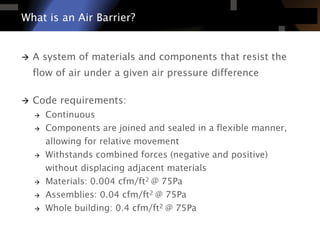
What is an Air Barrier? 
A system of materials and components that resist the flow of air under a given air pressure difference 
Code requirements: 
Continuous 
Components are joined and sealed in a flexible manner, allowing for relative movement 
Withstands combined forces (negative and positive) without displacing adjacent materials 
Materials: 0.004 cfm/ft2 @ 75Pa 
Assemblies: 0.04 cfm/ft2 @ 75Pa 
Whole building: 0.4 cfm/ft2 @ 75Pa
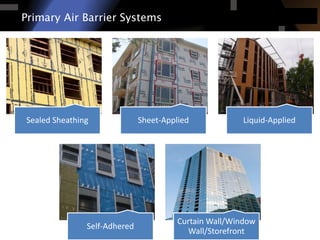
Primary Air Barrier Systems 
Sealed Sheathing 
Sheet-Applied 
Liquid-Applied 
Self-Adhered 
Curtain Wall/Window Wall/Storefront
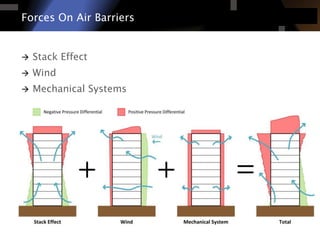
Forces On Air Barriers 
Stack Effect 
Wind 
Mechanical Systems
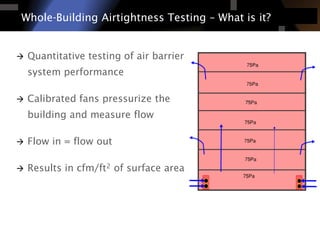
Quantitative testing of air barrier system performance 
Calibrated fans pressurize the building and measure flow 
Flow in = flow out 
Results in cfm/ft2of surface area 
Whole-Building Airtightness Testing –What is it?
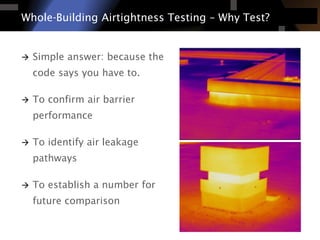
Simple answer: because the code says you have to. 
To confirm air barrier performance 
To identify air leakage pathways 
To establish a number for future comparison 
Whole-Building Airtightness Testing –Why Test?
2009 Energy Codes 
2009 Seattle Energy Code (SEC) 
All nonresidential and multifamily family residential buildings must be tested. 
Required* to achieve 0.4 cfm/ft2 
2009 Washington State Energy Code (WSEC) 
All nonresidential buildings > 5 stories must be tested. 
Required* to achieve 0.4 cfm/ft2 
*Requirement waived if air barrier has been inspected by a third party. 
Nonresidentialair leakage testing requirements:
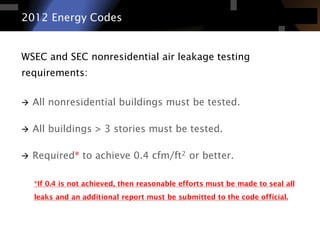
2012 Energy Codes 
All nonresidential buildings must be tested. 
All buildings > 3 stories must be tested. 
Required*to achieve 0.4 cfm/ft2or better. *If 0.4 is not achieved, then reasonable efforts must be made to seal all leaks and an additional report must be submitted to the code official. 
WSEC and SEC nonresidentialair leakage testing requirements:
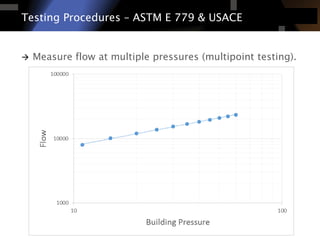
Testing Procedures –ASTM E 779 & USACE 
Measure flow at multiple pressures (multipoint testing).
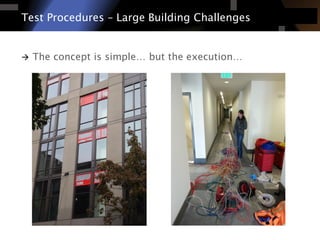
Test Procedures –Large Building Challenges 
The concept is simple… but the execution…
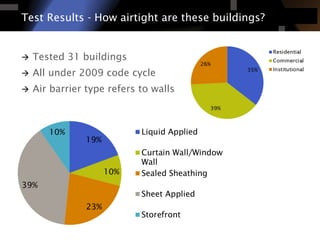
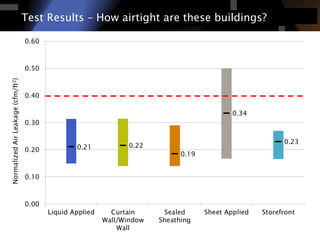
Test Results -How airtight are these buildings? 
Tested 31 buildings 
All under 2009 code cycle 
Air barrier type refers to walls
Test Results –How airtight are these buildings?
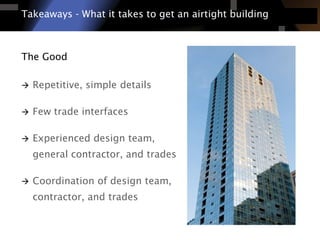
Takeaways -What it takes to get an airtight building 
The Good 
Repetitive, simple details 
Few trade interfaces 
Experienced design team, general contractor, and trades 
Coordination of design team, contractor, and trades
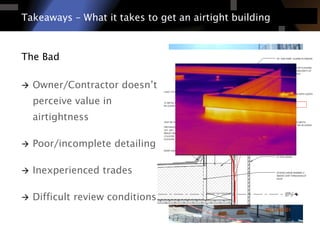
Takeaways –What it takes to get an airtight building 
The Bad 
Owner/Contractor doesn’t perceive value in airtightness 
Poor/incomplete detailing 
Inexperienced trades 
Difficult review conditions
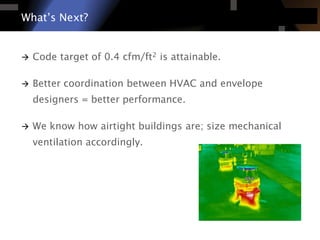
What’s Next? 
Code target of 0.4 cfm/ft2is attainable. 
Better coordination between HVAC and envelope designers = better performance. 
We know how airtight buildings are; size mechanical ventilation accordingly.
rdhbe.com 
Discussion + Questions 
FOR FURTHER INFORMATION PLEASE VISIT 
rdh.com

Presentation on Building Enclosure Airtightness Testing in Washington State

  • 1.
    Building Enclosure AirtightnessTesting In Washington State LESSONS LEARNED ABOUT AIR BARRIER SYSTEMS AND LARGE BUILDING TESTING PROCEDURES JULY 1, 2014 PRESENTED BY DENALIJONES, RDH BUILDING SCIENCES, SEATTLE ASHRAE 2014 Annual Conference Seattle WA
  • 2.
    Overview Airtightness Testing What is it? Why test? 2009 vs. 2012 energy codes Testing Procedures ASTM E779 and USACE Single-family vs. large building Challenges with large tests Test Results & Discussion Different air barrier types Common leakage areas Summary & Conclusion
  • 3.
    What is anAir Barrier? A system of materials and components that resist the flow of air under a given air pressure difference Code requirements: Continuous Components are joined and sealed in a flexible manner, allowing for relative movement Withstands combined forces (negative and positive) without displacing adjacent materials Materials: 0.004 cfm/ft2 @ 75Pa Assemblies: 0.04 cfm/ft2 @ 75Pa Whole building: 0.4 cfm/ft2 @ 75Pa
  • 4.
    Primary Air BarrierSystems Sealed Sheathing Sheet-Applied Liquid-Applied Self-Adhered Curtain Wall/Window Wall/Storefront
  • 5.
    Forces On AirBarriers Stack Effect Wind Mechanical Systems
  • 6.
    Quantitative testing ofair barrier system performance Calibrated fans pressurize the building and measure flow Flow in = flow out Results in cfm/ft2of surface area Whole-Building Airtightness Testing –What is it?
  • 7.
    Simple answer: becausethe code says you have to. To confirm air barrier performance To identify air leakage pathways To establish a number for future comparison Whole-Building Airtightness Testing –Why Test?
  • 8.
    2009 Energy Codes 2009 Seattle Energy Code (SEC) All nonresidential and multifamily family residential buildings must be tested. Required* to achieve 0.4 cfm/ft2 2009 Washington State Energy Code (WSEC) All nonresidential buildings > 5 stories must be tested. Required* to achieve 0.4 cfm/ft2 *Requirement waived if air barrier has been inspected by a third party. Nonresidentialair leakage testing requirements:
  • 9.
    2012 Energy Codes All nonresidential buildings must be tested. All buildings > 3 stories must be tested. Required*to achieve 0.4 cfm/ft2or better. *If 0.4 is not achieved, then reasonable efforts must be made to seal all leaks and an additional report must be submitted to the code official. WSEC and SEC nonresidentialair leakage testing requirements:
  • 10.
    Testing Procedures –ASTME 779 & USACE Measure flow at multiple pressures (multipoint testing).
  • 11.
    Test Procedures –LargeBuilding Challenges The concept is simple… but the execution…
  • 12.
    Test Results -Howairtight are these buildings? Tested 31 buildings All under 2009 code cycle Air barrier type refers to walls
  • 13.
    Test Results –Howairtight are these buildings?
  • 14.
    Takeaways -What ittakes to get an airtight building The Good Repetitive, simple details Few trade interfaces Experienced design team, general contractor, and trades Coordination of design team, contractor, and trades
  • 15.
    Takeaways –What ittakes to get an airtight building The Bad Owner/Contractor doesn’t perceive value in airtightness Poor/incomplete detailing Inexperienced trades Difficult review conditions
  • 16.
    What’s Next? Codetarget of 0.4 cfm/ft2is attainable. Better coordination between HVAC and envelope designers = better performance. We know how airtight buildings are; size mechanical ventilation accordingly.
  • 17.
    rdhbe.com Discussion +Questions FOR FURTHER INFORMATION PLEASE VISIT rdh.com