Presentation
on
Modelling and Simulation of Net Zero Energy Building
Date of Presentation: 24 Aug, 2022
Course Title: TERM PAPER/ INHOUSE
PRACTICAL TRAINING/INDUSTRY INTERNSHIP
Course Code: ETPT100
Programme: B. Tech. - EEE
Semester: V
Guided by: Dr. Rajkumar Viral
Presented by: Ricky Tongbram (A2324620004)
Shivansh Binani (A2324620012)
Table of Contents
• Literature Review
• Introduction
• Design Elements for NZEB
• Benefits of NZEB
• Modelling and Simulation
• Result and Discussion
• Conclusion
• References
2
LITERATURE REVIEW
• Buildings are responsible for approximately one-third of worldwide carbon emissions
• Currently, small scaled developers and investors are started to attempt and
understand how to reduce energy and CO2 in their buildings but there is a lack of
potential technologies and policies to help them understand if they are on track to
achieving such goals.
• The term Net Zero Energy Building "NZEB" is now widely used commercially in the
building and construction sector but without a clear definition and understanding.
• To understand more about NZEB, research on the same has been done.
3
Introduction
• Construction industries can play a
significant role in driving the majority of
energy use.
• Building sector accounts for between 33-45%
percent of the world's carbon emissions.
• Energy efficiency investments can be a
profitable strategy to reduce carbon
emissions [1].
4
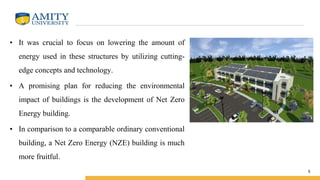
• It was crucial to focus on lowering the amount of
energy used in these structures by utilizing cutting-
edge concepts and technology.
• A promising plan for reducing the environmental
impact of buildings is the development of Net Zero
Energy building.
• In comparison to a comparable ordinary conventional
building, a Net Zero Energy (NZE) building is much
more fruitful.
5
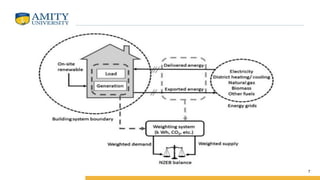
• In NZEB, a yearly amount of local renewable energy generation is equivalent
to their load demand.
• A Net Zero Energy building can be made possible by architectural features that
provide high levels of energy efficiency and renewable energy production [2].
• These structures are required in order to synchronize the power grid,
import power when it is needed from it, and export surplus power back to it.
• .It is obvious that a zero-energy building requires a significant investment
budget and high capital expenses, but both will pay off for the owners within
a set number of years [3].
6
7
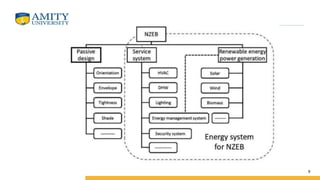
Design Elements for NZEB
• Passive building design – to reduce energy load.
• Active service equipment and facilities - to maintain the interior atmosphere and
resident comfort.
• Systems for generating renewable energy – to obtain renewable energy [4].
8
9
BENEFITS OF NZEB
• There will be a reduction in the annual cost of living.
• Renewable resources are more dependable and have longer lives.
• The owners of the buildings will not be affected by any energy austerity in the
electrical energy during peak loads or load shedding.
• The prices of the zero energy buildings still have high potential when it comes to re-
sales.
• The carbon dioxide emissions could be drastically reduced in the future [5][6].
10
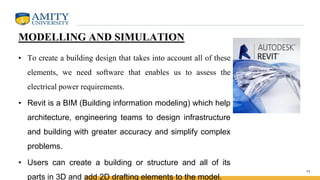
MODELLING AND SIMULATION
• To create a building design that takes into account all of these
elements, we need software that enables us to assess the
electrical power requirements.
• Revit is a BIM (Building information modeling) which help
architecture, engineering teams to design infrastructure
and building with greater accuracy and simplify complex
problems.
• Users can create a building or structure and all of its
parts in 3D and add 2D drafting elements to the model.
11
12
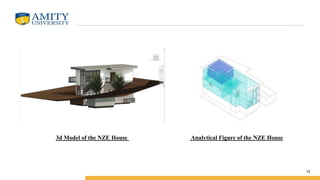
3d Model of the NZE House Analytical Figure of the NZE House
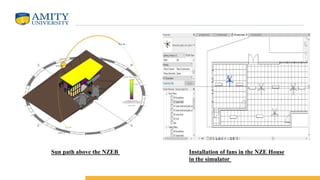
Sun path above the NZEB Installation of fans in the NZE House
in the simulator
14
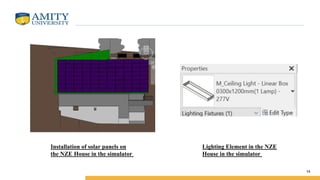
Installation of solar panels on
the NZE House in the simulator
Lighting Element in the NZE
House in the simulator
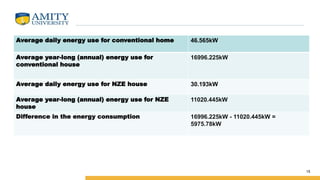
Average daily energy use for conventional home 46.565kW
Average year-long (annual) energy use for
conventional house
16996.225kW
Average daily energy use for NZE house 30.193kW
Average year-long (annual) energy use for NZE
house
11020.445kW
Difference in the energy consumption 16996.225kW - 11020.445kW =
5975.78kW
15
RESULT AND DISCUSSION
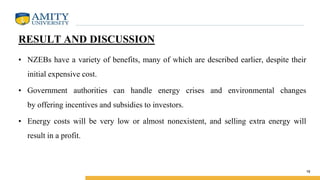
• NZEBs have a variety of benefits, many of which are described earlier, despite their
initial expensive cost.
• Government authorities can handle energy crises and environmental changes
by offering incentives and subsidies to investors.
• Energy costs will be very low or almost nonexistent, and selling extra energy will
result in a profit.
16
CONCLUSION
We can conclude that the NZE Building is better than the conventional buildings in
various ways as mentioned.
17
References
[1] S. Vora, Prof. M. Rajgor, Dr. J. Pitroda, “A Critical Review of Net Zero Energy
Efficient Design Strategies in Construction Sector”, ISSN NO: 2395-4396, Volume 3,
Issue-1, 2017
[2] “AIA 2030 Commitment 2015 PROGRESS REPORT” Report, The American Institute
of Architects, New York, 2015.
[3] Anet M. Smit and Frans du Toit, “Investigating the financial benefits of green
buildings”, Journal Article, Environmental Economics, 2015 .
[4] Deng, S., Wang, Z., & Dai, Y. J. (2014). How to evaluate the performance of net-zero
energy building - a literature research. Energy, 71, 1-16 .
18
[5] Reshmi Banerjee, “Importance of Net Zero Energy Building”, International Journal
of Innovative Research in Advanced Engineering (IJIRAE), ISSN: 2349-2163, Issue 5,
Volume 2, 2015.
[6] D O Nduka, A N Ede, K D Oyeyemi, and O M Olofinnade,” Awareness, benefits
and drawbacks of net zero energy building practices: construction industry
professional’s perceptions” Materials Science and Engineering, 1st International
Conference on Sustainable Infrastructural Development, IOP Publishing, 2019.
19
20

Modelling and simulation of nzeb (1).pptx

  • 1.
    Presentation on Modelling and Simulationof Net Zero Energy Building Date of Presentation: 24 Aug, 2022 Course Title: TERM PAPER/ INHOUSE PRACTICAL TRAINING/INDUSTRY INTERNSHIP Course Code: ETPT100 Programme: B. Tech. - EEE Semester: V Guided by: Dr. Rajkumar Viral Presented by: Ricky Tongbram (A2324620004) Shivansh Binani (A2324620012)
  • 2.
    Table of Contents •Literature Review • Introduction • Design Elements for NZEB • Benefits of NZEB • Modelling and Simulation • Result and Discussion • Conclusion • References 2
  • 3.
    LITERATURE REVIEW • Buildingsare responsible for approximately one-third of worldwide carbon emissions • Currently, small scaled developers and investors are started to attempt and understand how to reduce energy and CO2 in their buildings but there is a lack of potential technologies and policies to help them understand if they are on track to achieving such goals. • The term Net Zero Energy Building "NZEB" is now widely used commercially in the building and construction sector but without a clear definition and understanding. • To understand more about NZEB, research on the same has been done. 3
  • 4.
    Introduction • Construction industriescan play a significant role in driving the majority of energy use. • Building sector accounts for between 33-45% percent of the world's carbon emissions. • Energy efficiency investments can be a profitable strategy to reduce carbon emissions [1]. 4
  • 5.
    • It wascrucial to focus on lowering the amount of energy used in these structures by utilizing cutting- edge concepts and technology. • A promising plan for reducing the environmental impact of buildings is the development of Net Zero Energy building. • In comparison to a comparable ordinary conventional building, a Net Zero Energy (NZE) building is much more fruitful. 5
  • 6.
    • In NZEB,a yearly amount of local renewable energy generation is equivalent to their load demand. • A Net Zero Energy building can be made possible by architectural features that provide high levels of energy efficiency and renewable energy production [2]. • These structures are required in order to synchronize the power grid, import power when it is needed from it, and export surplus power back to it. • .It is obvious that a zero-energy building requires a significant investment budget and high capital expenses, but both will pay off for the owners within a set number of years [3]. 6
  • 7.
  • 8.
    Design Elements forNZEB • Passive building design – to reduce energy load. • Active service equipment and facilities - to maintain the interior atmosphere and resident comfort. • Systems for generating renewable energy – to obtain renewable energy [4]. 8
  • 9.
  • 10.
    BENEFITS OF NZEB •There will be a reduction in the annual cost of living. • Renewable resources are more dependable and have longer lives. • The owners of the buildings will not be affected by any energy austerity in the electrical energy during peak loads or load shedding. • The prices of the zero energy buildings still have high potential when it comes to re- sales. • The carbon dioxide emissions could be drastically reduced in the future [5][6]. 10
  • 11.
    MODELLING AND SIMULATION •To create a building design that takes into account all of these elements, we need software that enables us to assess the electrical power requirements. • Revit is a BIM (Building information modeling) which help architecture, engineering teams to design infrastructure and building with greater accuracy and simplify complex problems. • Users can create a building or structure and all of its parts in 3D and add 2D drafting elements to the model. 11
  • 12.
    12 3d Model ofthe NZE House Analytical Figure of the NZE House
  • 13.
    Sun path abovethe NZEB Installation of fans in the NZE House in the simulator
  • 14.
    14 Installation of solarpanels on the NZE House in the simulator Lighting Element in the NZE House in the simulator
  • 15.
    Average daily energyuse for conventional home 46.565kW Average year-long (annual) energy use for conventional house 16996.225kW Average daily energy use for NZE house 30.193kW Average year-long (annual) energy use for NZE house 11020.445kW Difference in the energy consumption 16996.225kW - 11020.445kW = 5975.78kW 15
  • 16.
    RESULT AND DISCUSSION •NZEBs have a variety of benefits, many of which are described earlier, despite their initial expensive cost. • Government authorities can handle energy crises and environmental changes by offering incentives and subsidies to investors. • Energy costs will be very low or almost nonexistent, and selling extra energy will result in a profit. 16
  • 17.
    CONCLUSION We can concludethat the NZE Building is better than the conventional buildings in various ways as mentioned. 17
  • 18.
    References [1] S. Vora,Prof. M. Rajgor, Dr. J. Pitroda, “A Critical Review of Net Zero Energy Efficient Design Strategies in Construction Sector”, ISSN NO: 2395-4396, Volume 3, Issue-1, 2017 [2] “AIA 2030 Commitment 2015 PROGRESS REPORT” Report, The American Institute of Architects, New York, 2015. [3] Anet M. Smit and Frans du Toit, “Investigating the financial benefits of green buildings”, Journal Article, Environmental Economics, 2015 . [4] Deng, S., Wang, Z., & Dai, Y. J. (2014). How to evaluate the performance of net-zero energy building - a literature research. Energy, 71, 1-16 . 18
  • 19.
    [5] Reshmi Banerjee,“Importance of Net Zero Energy Building”, International Journal of Innovative Research in Advanced Engineering (IJIRAE), ISSN: 2349-2163, Issue 5, Volume 2, 2015. [6] D O Nduka, A N Ede, K D Oyeyemi, and O M Olofinnade,” Awareness, benefits and drawbacks of net zero energy building practices: construction industry professional’s perceptions” Materials Science and Engineering, 1st International Conference on Sustainable Infrastructural Development, IOP Publishing, 2019. 19
  • 20.