DEENBANDHU CHHOTU RAM UNIVERSITY OF SCIENCE & TECHNOLOGY
MURTHAL (SONEPAT)
Department of Architecture
Faculty of Architecture, Urban & Town Planning
NET ZERO ENERGY BUILDINGS IN COMPOSITE CLIMATE:
A CASE OF COMMERCIAL BUILDINGS
Dissertation Report submitted in partial fulfilment of the requirement as a subject of
Bachelor of Architecture (B. ARCH.) 9th Semester
RIDHI JAIN - 19001006047
July-Dec 2023
1
1.1 INTRODUCTION:
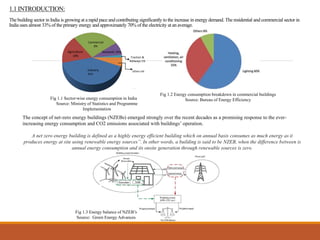
The building sector in India is growing at a rapid pace and contributing significantly to the increase in energy demand. The residential and commercial sector in
India uses almost 33% of the primary energy and approximately 70% of the electricity at an average.
Fig 1.2 Energy consumption breakdown in commercial buildings
Source: Bureau of Energy Efficiency
The concept of net-zero energy buildings (NZEBs) emerged strongly over the recent decades as a promising response to the ever-
increasing energy consumption and CO2 emissions associated with buildings’ operation.
A net zero energy building is defined as a highly energy efficient building which on annual basis consumes as much energy as it
produces energy at site using renewable energy sources”. In other words, a building is said to be NZEB, when the difference between is
annual energy consumption and its onsite generation through renewable sources is zero.
Fig 1.3 Energy balance of NZEB’s
Source: Green Energy Advances
Agriculture
18%
Domestic 26%
Industry
41%
Commercial
8%
Traction &
Railways 1%
Others 6%
Fig 1.1 Sector-wise energy consumption in India
Source: Ministry of Statistics and Programme
Implementation
Net zero energy configuration is an architecture that rediscovers the inactive methodologies of our architectural history and afterward incorporates them
into current thoughts regarding contemporary design. It likewise embraces the best of state-of-the-art technology and renewable energy systems to give
solutions that set new norms for building and inhabitant execution.
1.1 NEED OF THE STUDY
The requirement for alternative energy sources is getting critical, subsequently the improvement of sustainable power is moving quick. Nationally and
internationally various individuals and research companies are creating new and exciting energy systems.
The main issue is that the non-renewable energy sources are exhausting in a quick rate and are more diligently to recover. The outcome is that we can be
confronting an energy emergency later the off chance that we are not cautious today.
The energy costs will soar and not be accessible for some people or nations. To keep away from this destruction situation, we want to track down other
options and utilize them to their maximum capacity.
1.2 PROBLEM STATEMENT
The current energy consumption patterns in urban areas are unsustainable and contribute significantly to greenhouse gas emissions. To address this
pressing issue, there is a need to develop and implement strategies for the widespread adoption of net zero energy buildings, which produce as much
energy as they consume. This problem statement outlines the challenge of reducing energy consumption and emissions in the built environment while
ensuring economic feasibility and practicality.
1.3 AIM & OBJECTIVE
To evaluate the impact of building designs, components, and operational parameters on fulfilling net zero energy requirements.
Conducting a comprehensive literature review of current and past studies on the building sustainability and net zero energy fields.
Examine real-world case studies of NZEBs to identify best practices, challenges, and lessons learned from their design, construction, and operation.
RESEACRH QUESTIONS
What is the need of Net Zero Energy Buildings?
What are the different terms associated with Net Zero Energy Buildings?
How can Net Zero Energy Buildings help in optimizing resources in the modern world?
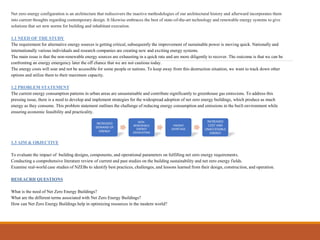
INCREASED
DEMAND OF
ENERGY
NON-
RENEWABLE
ENERGY
EXHAUSTING
ENERGY
SHORTAGE
INCREASED
COST AND
UNACCESSIBLE
ENERGY
SCOPE & LIMITATIONS
The research emphasizes upon the ideology of designing a net zero-energy building or inculcating the practice of net zero-energy architecture as a solution to
increasing urban concerns with clearly indicating various definitions, techniques and examples. This is a necessary endeavour in today's world because of the
excessive consumption of non-renewable resources.
This report is mainly focused on the study of Net Zero Energy Buildings, but Green buildings and Sustainable buildings are not given suffice regard.
METHODOLOGY
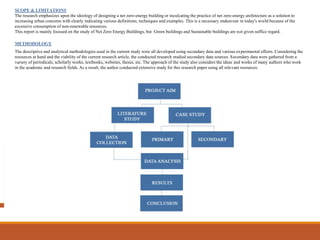
The descriptive and analytical methodologies used in the current study were all developed using secondary data and various experimental efforts. Considering the
resources at hand and the viability of the current research article, the conducted research studied secondary data sources. Secondary data were gathered from a
variety of periodicals, scholarly works, textbooks, websites, theses, etc. The approach of the study also considers the ideas and works of many authors who work
in the academic and research fields. As a result, the author conducted extensive study for this research paper using all relevant resources.
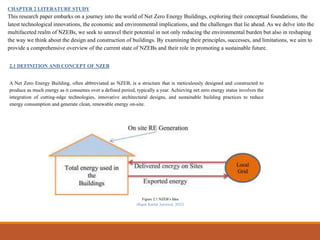
2.1 DEFINITION AND CONCEPT OF NZEB
A Net Zero Energy Building, often abbreviated as NZEB, is a structure that is meticulously designed and constructed to
produce as much energy as it consumes over a defined period, typically a year. Achieving net zero energy status involves the
integration of cutting-edge technologies, innovative architectural designs, and sustainable building practices to reduce
energy consumption and generate clean, renewable energy on-site.
Figure 2.1 NZEB’s Idea
(Rajan Kumar Jaysawal, 2022)
CHAPTER 2 LITERATURE STUDY
This research paper embarks on a journey into the world of Net Zero Energy Buildings, exploring their conceptual foundations, the
latest technological innovations, the economic and environmental implications, and the challenges that lie ahead. As we delve into the
multifaceted realm of NZEBs, we seek to unravel their potential in not only reducing the environmental burden but also in reshaping
the way we think about the design and construction of buildings. By examining their principles, successes, and limitations, we aim to
provide a comprehensive overview of the current state of NZEBs and their role in promoting a sustainable future.
6
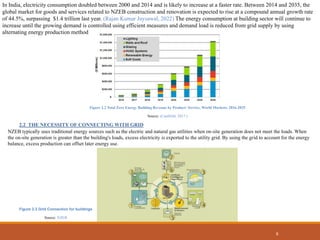
Figure 2.2 Total Zero Energy Building Revenue by Product/ Service, World Markets: 2016-2025
Source: (Caulfield, 2017 )
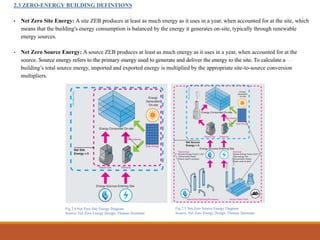
2.2 THE NECESSITY OF CONNECTING WITH GRID
NZEB typically uses traditional energy sources such as the electric and natural gas utilities when on-site generation does not meet the loads. When
the on-site generation is greater than the building's loads, excess electricity is exported to the utility grid. By using the grid to account for the energy
balance, excess production can offset later energy use.
In India, electricity consumption doubled between 2000 and 2014 and is likely to increase at a faster rate. Between 2014 and 2035, the
global market for goods and services related to NZEB construction and renovation is expected to rise at a compound annual growth rate
of 44.5%, surpassing $1.4 trillion last year. (Rajan Kumar Jaysawal, 2022) The energy consumption at building sector will continue to
increase until the growing demand is controlled using efficient measures and demand load is reduced from grid supply by using
alternating energy production method
Figure 2.3 Grid Connection for buildings
Source: NZEB
2.3 ZERO-ENERGY BUILDING DEFINTIONS
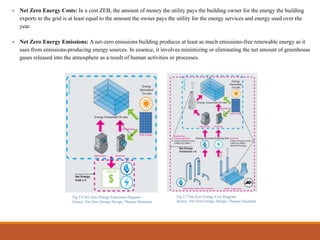
• Net Zero Site Energy: A site ZEB produces at least as much energy as it uses in a year, when accounted for at the site, which
means that the building's energy consumption is balanced by the energy it generates on-site, typically through renewable
energy sources.
• Net Zero Source Energy: A source ZEB produces at least as much energy as it uses in a year, when accounted for at the
source. Source energy refers to the primary energy used to generate and deliver the energy to the site. To calculate a
building’s total source energy, imported and exported energy is multiplied by the appropriate site-to-source conversion
multipliers.
Fig 2.4 Net Zero Site Energy Diagram
Source: Net Zero Energy Design, Thomas Hootman
Fig 2.5 Net Zero Source Energy Diagram
Source: Net Zero Energy Design, Thomas Hootman
• Net Zero Energy Costs: In a cost ZEB, the amount of money the utility pays the building owner for the energy the building
exports to the grid is at least equal to the amount the owner pays the utility for the energy services and energy used over the
year.
• Net Zero Energy Emissions: A net-zero emissions building produces at least as much emissions-free renewable energy as it
uses from emissions-producing energy sources. In essence, it involves minimizing or eliminating the net amount of greenhouse
gases released into the atmosphere as a result of human activities or processes.
Fig 2.6 Net Zero Energy Emissions Diagram
Source: Net Zero Energy Design, Thomas Hootman
Fig 2.7 Net Zero Energy Cost Diagram
Source: Net Zero Energy Design, Thomas Hootman
2.4 NZEB NEED IN INDIA
Energy Demand in building sector:
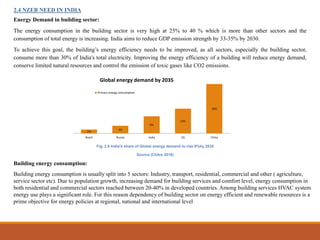
The energy consumption in the building sector is very high at 25% to 40 % which is more than other sectors and the
consumption of total energy is increasing. India aims to reduce GDP emission strength by 33-35% by 2030.
To achieve this goal, the building’s energy efficiency needs to be improved, as all sectors, especially the building sector,
consume more than 30% of India's total electricity. Improving the energy efficiency of a building will reduce energy demand,
conserve limited natural resources and control the emission of toxic gases like CO2 emissions.
2%
4%
9%
13%
26%
Brazil Russia India US China
Global energy demand by 2035
Primary energy consumption
Fig. 2.8 India's share of Global energy demand to rise 9%by 2035
Source (Chitre 2016)
Building energy consumption:
Building energy consumption is usually split into 5 sectors: Industry, transport, residential, commercial and other ( agriculture,
service sector etc). Due to population growth, increasing demand for building services and comfort level, energy consumption in
both residential and commercial sectors reached between 20-40% in developed countries. Among building services HVAC system
energy use plays a significant role. For this reason dependency of building sector on energy efficient and renewable resources is a
prime objective for energy policies at regional, national and international level
293
667 701
2281
3014
414
682
1603
2312
4425
Brazil Russia India US China
Total primary energy consumption (Mtoe)
2015 2035
41
2
129
1
47
0
20
40
60
80
100
120
140
Brazil Russia India US China
% change
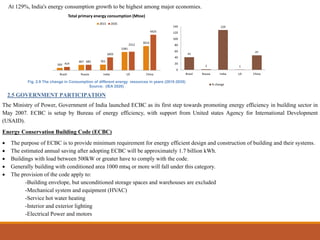
At 129%, India's energy consumption growth to be highest among major economies.
Fig. 2.9 The change in Consumption of different energy resources in years (2015-2035)
Source: (IEA 2020)
2.5 GOVERNMENT PARTICIPATION
The Ministry of Power, Government of India launched ECBC as its first step towards promoting energy efficiency in building sector in
May 2007. ECBC is setup by Bureau of energy efficiency, with support from United states Agency for International Development
(USAID).
Energy Conservation Building Code (ECBC)
 The purpose of ECBC is to provide minimum requirement for energy efficient design and construction of building and their systems.
 The estimated annual saving after adopting ECBC will be approximately 1.7 billion kWh.
 Buildings with load between 500kW or greater have to comply with the code.
 Generally building with conditioned area 1000 mtsq or more will fall under this category.
 The provision of the code apply to:
-Building envelope, but unconditioned storage spaces and warehouses are excluded
-Mechanical system and equipment (HVAC)
-Service hot water heating
-Interior and exterior lighting
-Electrical Power and motors
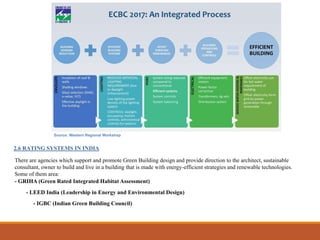
Source: Western Regional Workshop
2.6 RATING SYSTEMS IN INDIA
There are agencies which support and promote Green Building design and provide direction to the architect, sustainable
consultant, owner to build and live in a building that is made with energy-efficient strategies and renewable technologies.
Some of them area:
- GRIHA (Green Rated Integrated Habitat Assessment)
- LEED India (Leadership in Energy and Environmental Design)
- IGBC (Indian Green Building Council)
2.7 TOOLS & RESOURCES REQUIRED TO ACHIEVE NZEB
Design Builder : used for 3D modelling, shading analysis, daylighting, HVAC, renewable, cost
analysis and model optimisation.
Shading II: Sketch up plug-in used for sun path analysis and shading design.
The software used for energy simulation are:
Energy plus: used for whole building simulation
EQuest: used for building energy performance analysis, comfort system design, detail simulation
results.
2.8 STRATEGIES IN ACHIEVING A NZEB
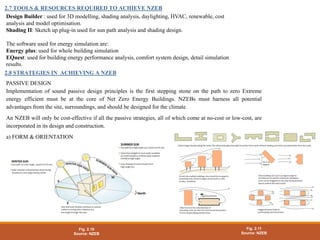
PASSIVE DESIGN
Implementation of sound passive design principles is the first stepping stone on the path to zero Extreme
energy efficient must be at the core of Net Zero Energy Buildings. NZEBs must harness all potential
advantages from the site, surroundings, and should be designed for the climate.
An NZEB will only be cost-effective if all the passive strategies, all of which come at no-cost or low-cost, are
incorporated in its design and construction.
a) FORM & ORIENTATION
Fig. 2.10
Source: NZEB
Fig. 2.11
Source: NZEB
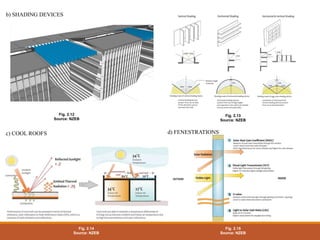
b) SHADING DEVICES
c) COOL ROOFS d) FENESTRATIONS
Fig. 2.12
Source: NZEB
Fig. 2.13
Source: NZEB
Fig. 2.14
Source: NZEB
Fig. 2.15
Source: NZEB
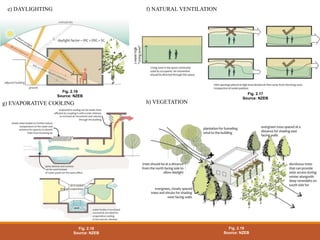
e) DAYLIGHTING f) NATURAL VENTILATION
g) EVAPORATIVE COOLING h) VEGETATION
Fig. 2.18
Source: NZEB
Fig. 2.19
Source: NZEB
Fig. 2.16
Source: NZEB
Fig. 2.17
Source: NZEB
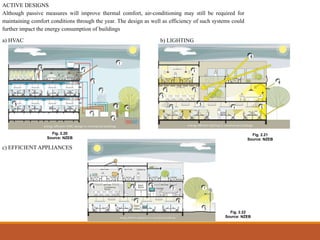
ACTIVE DESIGNS
Although passive measures will improve thermal comfort, air-conditioning may still be required for
maintaining comfort conditions through the year. The design as well as efficiency of such systems could
further impact the energy consumption of buildings
a) HVAC b) LIGHTING
c) EFFICIENT APPLIANCES
Fig. 2.21
Source: NZEB
Fig. 2.22
Source: NZEB
Fig. 2.20
Source: NZEB
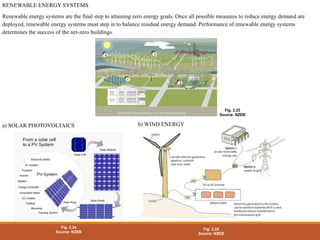
RENEWABLE ENERGY SYSTEMS
Renewable energy systems are the final step to attaining zero energy goals. Once all possible measures to reduce energy demand are
deployed, renewable energy systems must step in to balance residual energy demand. Performance of renewable energy systems
determines the success of the net-zero buildings.
a) SOLAR PHOTOVOLTAICS b) WIND ENERGY
Fig. 2.23
Source: NZEB
Fig. 2.24
Source: NZEB
Fig. 2.25
Source: NZEB
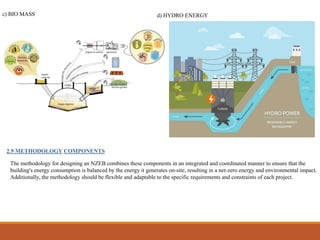
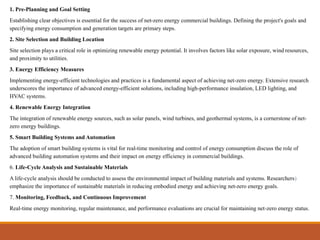
c) BIO MASS d) HYDRO ENERGY
2.9 METHODOLOGY COMPONENTS
The methodology for designing an NZEB combines these components in an integrated and coordinated manner to ensure that the
building's energy consumption is balanced by the energy it generates on-site, resulting in a net-zero energy and environmental impact.
Additionally, the methodology should be flexible and adaptable to the specific requirements and constraints of each project.
1. Pre-Planning and Goal Setting
Establishing clear objectives is essential for the success of net-zero energy commercial buildings. Defining the project's goals and
specifying energy consumption and generation targets are primary steps.
2. Site Selection and Building Location
Site selection plays a critical role in optimizing renewable energy potential. It involves factors like solar exposure, wind resources,
and proximity to utilities.
3. Energy Efficiency Measures
Implementing energy-efficient technologies and practices is a fundamental aspect of achieving net-zero energy. Extensive research
underscores the importance of advanced energy-efficient solutions, including high-performance insulation, LED lighting, and
HVAC systems.
4. Renewable Energy Integration
The integration of renewable energy sources, such as solar panels, wind turbines, and geothermal systems, is a cornerstone of net-
zero energy buildings.
5. Smart Building Systems and Automation
The adoption of smart building systems is vital for real-time monitoring and control of energy consumption discuss the role of
advanced building automation systems and their impact on energy efficiency in commercial buildings.
6. Life-Cycle Analysis and Sustainable Materials
A life-cycle analysis should be conducted to assess the environmental impact of building materials and systems. Researchers)
emphasize the importance of sustainable materials in reducing embodied energy and achieving net-zero energy goals.
7. Monitoring, Feedback, and Continuous Improvement
Real-time energy monitoring, regular maintenance, and performance evaluations are crucial for maintaining net-zero energy status.
CHAPTER 3 CASE STUDIES
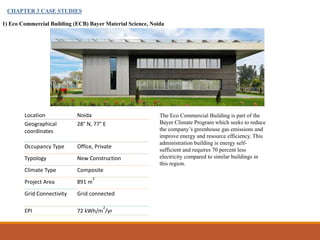
1) Eco Commercial Building (ECB) Bayer Material Science, Noida
Location Noida
Geographical
coordinates
28° N, 77° E
Occupancy Type Office, Private
Typology New Construction
Climate Type Composite
Project Area 891 m
2
Grid Connectivity Grid connected
EPI 72 kWh/m
2
/yr
The Eco Commercial Building is part of the
Bayer Climate Program which seeks to reduce
the company’s greenhouse gas emissions and
improve energy and resource efficiency. This
administration building is energy self-
sufficient and requires 70 percent less
electricity compared to similar buildings in
this region.
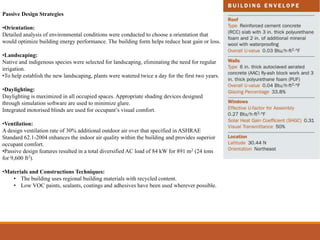
Passive Design Strategies
•Orientation:
Detailed analysis of environmental conditions were conducted to choose a orientation that
would optimize building energy performance. The building form helps reduce heat gain or loss.
•Landscaping:
Native and indigenous species were selected for landscaping, eliminating the need for regular
irrigation.
•To help establish the new landscaping, plants were watered twice a day for the first two years.
•Daylighting:
Daylighting is maximized in all occupied spaces. Appropriate shading devices designed
through simulation software are used to minimize glare.
Integrated motorised blinds are used for occupant’s visual comfort.
•Ventilation:
A design ventilation rate of 30% additional outdoor air over that specified in ASHRAE
Standard 62.1-2004 enhances the indoor air quality within the building and provides superior
occupant comfort.
•Passive design features resulted in a total diversified AC load of 84 kW for 891 m2 (24 tons
for 9,600 ft2).
•Materials and Constructions Techniques:
• The building uses regional building materials with recycled content.
• Low VOC paints, sealants, coatings and adhesives have been used wherever possible.
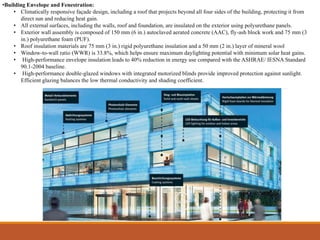
•Building Envelope and Fenestration:
• Climatically responsive façade design, including a roof that projects beyond all four sides of the building, protecting it from
direct sun and reducing heat gain.
• All external surfaces, including the walls, roof and foundation, are insulated on the exterior using polyurethane panels.
• Exterior wall assembly is composed of 150 mm (6 in.) autoclaved aerated concrete (AAC), fly-ash block work and 75 mm (3
in.) polyurethane foam (PUF).
• Roof insulation materials are 75 mm (3 in.) rigid polyurethane insulation and a 50 mm (2 in.) layer of mineral wool
• Window-to-wall ratio (WWR) is 33.8%, which helps ensure maximum daylighting potential with minimum solar heat gains.
• High-performance envelope insulation leads to 40% reduction in energy use compared with the ASHRAE/ IESNA Standard
90.1-2004 baseline.
• High-performance double-glazed windows with integrated motorized blinds provide improved protection against sunlight.
Efficient glazing balances the low thermal conductivity and shading coefficient.
Active Strategies
• Lighting Design
1.An energy-efficient lighting system with daylighting controls is used.
2.Energy-efficient fixtures and ballasts contribute to a 37% reduction in lighting energy compared to ASHRAE Standard 90.1-2004.
3.The building uses a combination of energy-efficient T5 linear fluorescent lamps and compact fluorescent lamps.
4.Occupancy sensors in normally unoccupied areas like storage areas, toilets and mechanical rooms minimize lighting use.
5.Lighting controls ensure minimum internal heat gain and reduced air-conditioning load in those spaces.
6.Approximately 87% of regularly occupied spaces in the building have a minimum daylight factor of 2%. A lighting power density
(LPD) of 7.2 W/m2 (0.67 W/ft2) in all occupied spaces is significantly lower than the ASHRAE Standard 1-2004 baseline of 11.8
W/m2 (1.1 W/ft2).
7.The building uses energy-saving technologies associated with the electrical power supply system/building management system.
Optimized Energy Systems / HVAC system
1.Chilled beams for radiant cooling eliminates energy that would be used for supply fans.
2.Based on indoor design conditions of 24°C (75°F) and 55% relative humidity, the room dew-point temperature is 14°C (57°F) and
chilled water is supplied at a temperature 1°C (0.6°F) higher (at 15°C [59°F]) to avoid any condensation on surfaces.
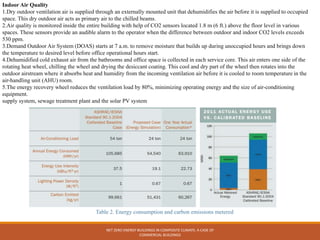
Table 1. Energy production use (kWh)
NET ZERO ENERGY BUILDINGS IN COMPOSITE CLIMATE: A CASE OF
COMMERCIAL BUILDINGS
Indoor Air Quality
1.Dry outdoor ventilation air is supplied through an externally mounted unit that dehumidifies the air before it is supplied to occupied
space. This dry outdoor air acts as primary air to the chilled beams.
2.Air quality is monitored inside the entire building with help of CO2 sensors located 1.8 m (6 ft.) above the floor level in various
spaces. These sensors provide an audible alarm to the operator when the difference between outdoor and indoor CO2 levels exceeds
530 ppm.
3.Demand Outdoor Air System (DOAS) starts at 7 a.m. to remove moisture that builds up during unoccupied hours and brings down
the temperature to desired level before office operational hours start.
4.Dehumidified cold exhaust air from the bathrooms and office space is collected in each service core. This air enters one side of the
rotating heat wheel, chilling the wheel and drying the desiccant coating. This cool and dry part of the wheel then rotates into the
outdoor airstream where it absorbs heat and humidity from the incoming ventilation air before it is cooled to room temperature in the
air-handling unit (AHU) room.
5.The energy recovery wheel reduces the ventilation load by 80%, minimizing operating energy and the size of air-conditioning
equipment.
supply system, sewage treatment plant and the solar PV system
Table 2. Energy consumption and carbon emissions metered
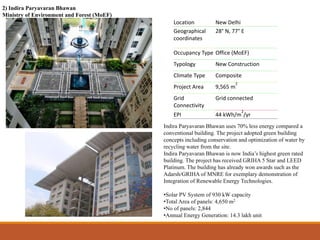
2) Indira Paryavaran Bhawan
Ministry of Environment and Forest (MoEF)
Location New Delhi
Geographical
coordinates
28° N, 77° E
Occupancy Type Office (MoEF)
Typology New Construction
Climate Type Composite
Project Area 9,565 m
2
Grid
Connectivity
Grid connected
EPI 44 kWh/m
2
/yr
Indira Paryavaran Bhawan uses 70% less energy compared a
conventional building. The project adopted green building
concepts including conservation and optimization of water by
recycling water from the site.
Indira Paryavaran Bhawan is now India’s highest green rated
building. The project has received GRIHA 5 Star and LEED
Platinum. The building has already won awards such as the
Adarsh/GRIHA of MNRE for exemplary demonstration of
Integration of Renewable Energy Technologies.
•Solar PV System of 930 kW capacity
•Total Area of panels: 4,650 m2
•No of panels: 2,844
•Annual Energy Generation: 14.3 lakh unit
NET ZERO ENERGY BUILDINGS IN COMPOSITE CLIMATE: A CASE OF
COMMERCIAL BUILDINGS
25
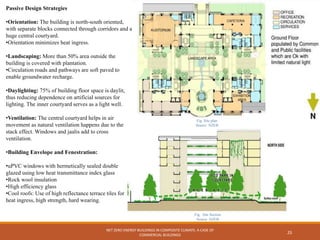
Passive Design Strategies
•Orientation: The building is north-south oriented,
with separate blocks connected through corridors and a
huge central courtyard.
•Orientation minimizes heat ingress.
•Landscaping: More than 50% area outside the
building is covered with plantation.
•Circulation roads and pathways are soft paved to
enable groundwater recharge.
•Daylighting: 75% of building floor space is daylit,
thus reducing dependence on artificial sources for
lighting. The inner courtyard serves as a light well.
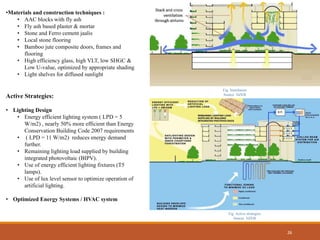
•Ventilation: The central courtyard helps in air
movement as natural ventilation happens due to the
stack effect. Windows and jaalis add to cross
ventilation.
•Building Envelope and Fenestration:
•uPVC windows with hermetically sealed double
glazed using low heat transmittance index glass
•Rock wool insulation
•High efficiency glass
•Cool roofs: Use of high reflectance terrace tiles for
heat ingress, high strength, hard wearing.
Fig. Site plan
Source NZEB
Fig. Site Section
Source NZEB
26
•Materials and construction techniques :
• AAC blocks with fly ash
• Fly ash based plaster & mortar
• Stone and Ferro cement jaalis
• Local stone flooring
• Bamboo jute composite doors, frames and
flooring
• High efficiency glass, high VLT, low SHGC &
Low U-value, optimized by appropriate shading
• Light shelves for diffused sunlight
Active Strategies:
• Lighting Design
• Energy efficient lighting system ( LPD = 5
W/m2) , nearly 50% more efficient than Energy
Conservation Building Code 2007 requirements
• ( LPD = 11 W/m2) reduces energy demand
further.
• Remaining lighting load supplied by building
integrated photovoltaic (BIPV).
• Use of energy efficient lighting fixtures (T5
lamps).
• Use of lux level sensor to optimize operation of
artificial lighting.
• Optimized Energy Systems / HVAC system
Fig. Ventilation
Source NZEB
Fig. Active strategies
Source NZEB
27
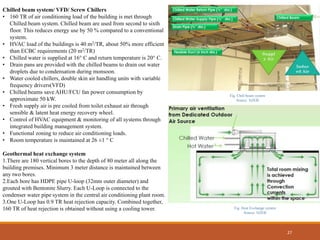
Chilled beam system/ VFD/ Screw Chillers
• 160 TR of air conditioning load of the building is met through
Chilled beam system. Chilled beam are used from second to sixth
floor. This reduces energy use by 50 % compared to a conventional
system.
• HVAC load of the buildings is 40 m2/TR, about 50% more efficient
than ECBC requirements (20 m2/TR)
• Chilled water is supplied at 16° C and return temperature is 20° C.
• Drain pans are provided with the chilled beams to drain out water
droplets due to condensation during monsoon.
• Water cooled chillers, double skin air handling units with variable
frequency drivers(VFD)
• Chilled beams save AHU/FCU fan power consumption by
approximate 50 kW.
• Fresh supply air is pre cooled from toilet exhaust air through
sensible & latent heat energy recovery wheel.
• Control of HVAC equipment & monitoring of all systems through
integrated building management system.
• Functional zoning to reduce air conditioning loads.
• Room temperature is maintained at 26 ±1 ° C
Geothermal heat exchange system
1.There are 180 vertical bores to the depth of 80 meter all along the
building premises. Minimum 3 meter distance is maintained between
any two bores.
2.Each bore has HDPE pipe U-loop (32mm outer diameter) and
grouted with Bentonite Slurry. Each U-Loop is connected to the
condenser water pipe system in the central air conditioning plant room.
3.One U-Loop has 0.9 TR heat rejection capacity. Combined together,
160 TR of heat rejection is obtained without using a cooling tower.
Fig. Chill beam system
Source NZEB
Fig. Heat Exchange system
Source NZEB
3) Unnati Office
Greater NOIDA, Uttar Pradesh
The Unnati Office Building is the
regional headquarter (North) for
Gainwell Commosales Pvt. Ltd., part
of a larger 5 acre campus. It is
certified Platinum under LEED ,
performs 59% better than a
conventional office building in the
region, and 40% of the building
energy consumption is met through
on site renewable energy generation
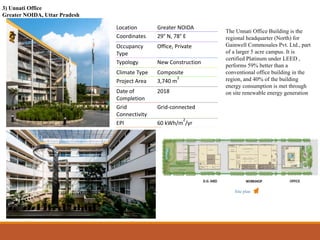
Location Greater NOIDA
Coordinates 29° N, 78° E
Occupancy
Type
Office, Private
Typology New Construction
Climate Type Composite
Project Area 3,740 m
2
Date of
Completion
2018
Grid
Connectivity
Grid-connected
EPI 60 kWh/m
2
/yr
Site plan
NET ZERO ENERGY BUILDINGS IN COMPOSITE CLIMATE: A CASE OF
COMMERCIAL BUILDINGS
29
Orientation
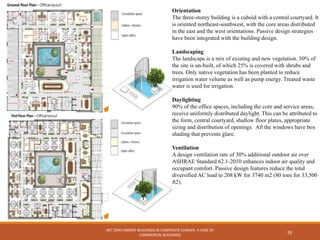
The three-storey building is a cuboid with a central courtyard. It
is oriented northeast-southwest, with the core areas distributed
in the east and the west orientations. Passive design strategies
have been integrated with the building design.
Landscaping
The landscape is a mix of existing and new vegetation. 30% of
the site is un-built, of which 25% is covered with shrubs and
trees. Only native vegetation has been planted to reduce
irrigation water volume as well as pump energy. Treated waste
water is used for irrigation.
Daylighting
90% of the office spaces, including the core and service areas,
receive uniformly distributed daylight. This can be attributed to
the form, central courtyard, shallow floor plates, appropriate
sizing and distribution of openings. All the windows have box
shading that prevents glare.
Ventilation
A design ventilation rate of 30% additional outdoor air over
ASHRAE Standard 62.1-2010 enhances indoor air quality and
occupant comfort. Passive design features reduce the total
diversified AC load to 208 kW for 3740 m2 (80 tons for 33,500
ft2).
NET ZERO ENERGY BUILDINGS IN COMPOSITE CLIMATE: A CASE OF
COMMERCIAL BUILDINGS
30
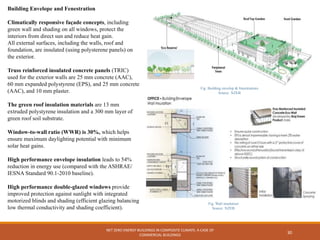
Building Envelope and Fenestration
Climatically responsive façade concepts, including
green wall and shading on all windows, protect the
interiors from direct sun and reduce heat gain.
All external surfaces, including the walls, roof and
foundation, are insulated (using polysterene panels) on
the exterior.
Truss reinforced insulated concrete panels (TRIC)
used for the exterior walls are 25 mm concrete (AAC),
60 mm expanded polystyrene (EPS), and 25 mm concrete
(AAC), and 10 mm plaster.
The green roof insulation materials are 13 mm
extruded polystyrene insulation and a 300 mm layer of
green roof soil substrate.
Window-to-wall ratio (WWR) is 30%, which helps
ensure maximum daylighting potential with minimum
solar heat gains.
High performance envelope insulation leads to 54%
reduction in energy use (compared with the ASHRAE/
IESNA Standard 90.1-2010 baseline).
High performance double-glazed windows provide
improved protection against sunlight with integrated
motorized blinds and shading (efficient glazing balancing
low thermal conductivity and shading coefficient).
Fig. Building envelop & fenestrations
Source NZEB
Fig. Wall insulation
Source NZEB
NET ZERO ENERGY BUILDINGS IN COMPOSITE CLIMATE: A CASE OF
COMMERCIAL BUILDINGS
31
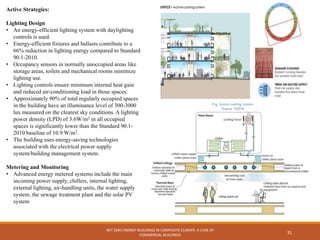
Active Strategies:
Lighting Design
• An energy-efficient lighting system with daylighting
controls is used.
• Energy-efficient fixtures and ballasts contribute to a
66% reduction in lighting energy compared to Standard
90.1-2010.
• Occupancy sensors in normally unoccupied areas like
storage areas, toilets and mechanical rooms minimize
lighting use.
• Lighting controls ensure minimum internal heat gain
and reduced air-conditioning load in those spaces.
• Approximately 90% of total regularly occupied spaces
in the building have an illuminance level of 300-3000
lux measured on the clearest sky conditions. A lighting
power density (LPD) of 3.6W/m2 in all occupied
spaces is significantly lower than the Standard 90.1-
2010 baseline of 10.9 W/m2.
• The building uses energy-saving technologies
associated with the electrical power supply
system/building management system.
Metering and Monitoring
• Advanced energy metered systems include the main
incoming power supply, chillers, internal lighting,
external lighting, air-handling units, the water supply
system, the sewage treatment plant and the solar PV
system
Fig. Active cooling system
Source NZEB
NET ZERO ENERGY BUILDINGS IN COMPOSITE CLIMATE: A CASE OF
COMMERCIAL BUILDINGS
32
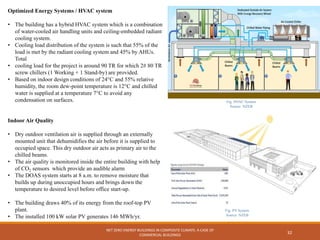
Optimized Energy Systems / HVAC system
• The building has a hybrid HVAC system which is a combination
of water-cooled air handling units and ceiling-embedded radiant
cooling system.
• Cooling load distribution of the system is such that 55% of the
load is met by the radiant cooling system and 45% by AHUs.
Total
• cooling load for the project is around 90 TR for which 2# 80 TR
screw chillers (1 Working + 1 Stand-by) are provided.
• Based on indoor design conditions of 24°C and 55% relative
humidity, the room dew-point temperature is 12°C and chilled
water is supplied at a temperature 7°C to avoid any
condensation on surfaces.
Indoor Air Quality
• Dry outdoor ventilation air is supplied through an externally
mounted unit that dehumidifies the air before it is supplied to
occupied space. This dry outdoor air acts as primary air to the
chilled beams.
• The air quality is monitored inside the entire building with help
of CO2 sensors which provide an audible alarm
• The DOAS system starts at 8 a.m. to remove moisture that
builds up during unoccupied hours and brings down the
temperature to desired level before office start-up.
• The building draws 40% of its energy from the roof-top PV
plant.
• The installed 100 kW solar PV generates 146 MWh/yr.
Fig. HVAC System
Source NZEB
Fig. PV System
Source NZEB
NET ZERO ENERGY BUILDINGS IN COMPOSITE CLIMATE: A CASE OF
COMMERCIAL BUILDINGS
33
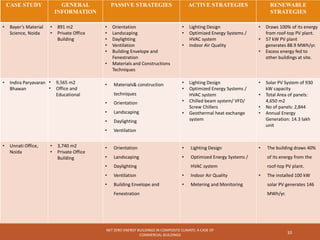
CASE STUDY GENERAL
INFORMATION
PASSIVE STRATEGIES ACTIVE STRATEGIES RENEWABLE
STRATEGIES
• Bayer’s Material
Science, Noida
• 891 m2
• Private Office
Building
• Orientation
• Landscaping
• Daylighting
• Ventilation
• Building Envelope and
Fenestration
• Materials and Constructions
Techniques
• Lighting Design
• Optimized Energy Systems /
HVAC system
• Indoor Air Quality
• Draws 100% of its energy
from roof-top PV plant.
• 57 kW PV plant
generates 88.9 MWh/yr.
• Excess energy fed to
other buildings at site.
• Indira Paryavaran
Bhawan
• 9,565 m2
• Office and
Educational
• Materials& construction
techniques
• Orientation
• Landscaping
• Daylighting
• Ventilation
• Lighting Design
• Optimized Energy Systems /
HVAC system
• Chilled beam system/ VFD/
Screw Chillers
• Geothermal heat exchange
system
• Solar PV System of 930
kW capacity
• Total Area of panels:
4,650 m2
• No of panels: 2,844
• Annual Energy
Generation: 14.3 lakh
unit
• Unnati Office,
Noida
• 3,740 m2
• Private Office
Building
• Orientation
• Landscaping
• Daylighting
• Ventilation
• Building Envelope and
Fenestration
• Lighting Design
• Optimized Energy Systems /
HVAC system
• Indoor Air Quality
• Metering and Monitoring
• The building draws 40%
of its energy from the
roof-top PV plant.
• The installed 100 kW
solar PV generates 146
MWh/yr.
NET ZERO ENERGY BUILDINGS IN COMPOSITE CLIMATE: A CASE OF
COMMERCIAL BUILDINGS
34
FLOOR PLANS
CHAPTER 4 ANALYSIS
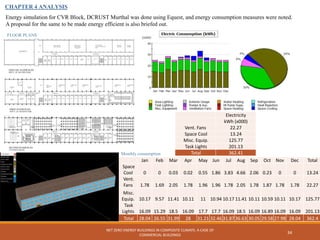
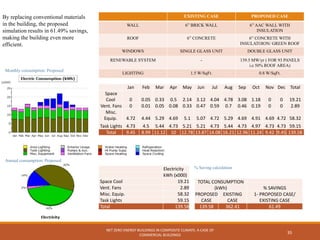
Energy simulation for CVR Block, DCRUST Murthal was done using Equest, and energy consumption measures were noted.
A proposal for the same to be made energy efficient is also briefed out.
Jan Feb Mar Apr May Jun Jul Aug Sep Oct Nov Dec Total
Space
Cool 0 0 0.03 0.02 0.55 1.86 3.83 4.66 2.06 0.23 0 0 13.24
Vent.
Fans 1.78 1.69 2.05 1.78 1.96 1.96 1.78 2.05 1.78 1.87 1.78 1.78 22.27
Misc.
Equip. 10.17 9.57 11.41 10.11 11 10.94 10.17 11.41 10.11 10.59 10.11 10.17 125.77
Task
Lights 16.09 15.29 18.5 16.09 17.7 17.7 16.09 18.5 16.09 16.89 16.09 16.09 201.13
Total 28.04 26.55 31.99 28 31.21 32.46 31.87 36.63 30.05 29.58 27.98 28.04 362.4
Electricity
kWh (x000)
Vent. Fans 22.27
Space Cool 13.24
Misc. Equip. 125.77
Task Lights 201.13
Total 362.41
Monthly consumption
NET ZERO ENERGY BUILDINGS IN COMPOSITE CLIMATE: A CASE OF
COMMERCIAL BUILDINGS
35
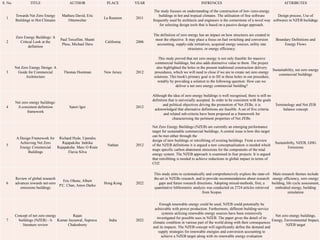
By replacing conventional materials
in the building, the proposed
simulation results in 61.49% savings,
making the building even more
efficient.
EXISTING CASE PROPOSED CASE
WALL 6” BRICK WALL 6” AAC WALL WITH
INSULATION
ROOF 6” CONCRETE 6” CONCRETE WITH
INSULATOION/ GREEN ROOF
WINDOWS SINGLE GLASS UNIT DOUBLE GLASS UNIT
RENEWABLE SYSTEM - 139.5 MW/yr ( FOR 93 PANELS
i.e 50% ROOF AREA)
LIGHTING 1.5 W/SqFt. 0.8 W/SqFt.
Annual consumption: Proposed
Monthly consumption: Proposed
Jan Feb Mar Apr May Jun Jul Aug Sep Oct Nov Dec Total
Space
Cool 0 0.05 0.33 0.5 2.14 3.12 4.04 4.78 3.08 1.18 0 0 19.21
Vent. Fans 0 0.01 0.05 0.08 0.33 0.47 0.59 0.7 0.46 0.19 0 0 2.89
Misc.
Equip. 4.72 4.44 5.29 4.69 5.1 5.07 4.72 5.29 4.69 4.91 4.69 4.72 58.32
Task Lights 4.73 4.5 5.44 4.73 5.21 5.21 4.73 5.44 4.73 4.97 4.73 4.73 59.15
Total 9.45 8.99 11.12 10 12.78 13.87 14.08 16.21 12.96 11.24 9.42 9.45 139.58
Electricity
kWh (x000)
Space Cool 19.21
Vent. Fans 2.89
Misc. Equip. 58.32
Task Lights 59.15
Total 139.58
TOTAL CONSUMPTION
(kWh) % SAVINGS
PROPOSED
CASE
EXISTING
CASE
1- PROPOSED CASE/
EXISTING CASE
139.58 362.41 61.49
% Saving calculation
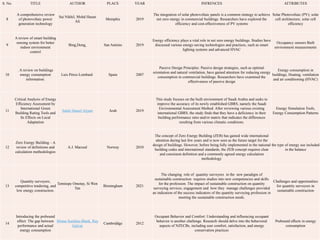
S. No. TITLE AUTHOR PLACE YEAR INFRENCES ATTRIBUTES
1
Towards Net Zero Energy
Buildings in Hot Climates
Mathieu David, Eric
Ottenwelter
La Reunion 2011
The study focuses on understanding of the construction of low-/zero-energy
buildings in hot and tropical climates. The utilisation of free software
frequently used by architects and engineers is the cornerstone of a novel way
for selecting design tools that is based on a passive design approach.
Design process, Use of
softwares in NZEB builidngs
2
Zero Energy Buildings: A
Critical Look at the
definition
Paul Torcellini, Shanti
Pless, Michael Deru
California 2006
The definition of zero energy has an impact on how structures are created to
meet the objective. It may place a focus on fuel switching and conversion
accounting, supply-side initiatives, acquired energy sources, utility rate
structures, or energy efficiency.
Boundary Definitions and
Energy Flows
3
Net Zero Energy Design: A
Guide for Commercial
Architecture
Thomas Hootman New Jersey 2012
This study proved that net zero energy is not only feasible for massive
commercial buildings, but also adds distinctive value to them. The project
also highlighted the holes in the present traditional construction delivery
procedures, which we will need to close if we are to create net zero energy
solutions. This book's primary goal is to fill in these holes in our procedure,
notably by providing a solution to the following question: How can we
deliver a net zero energy commercial building?
Sustainability, net zero energy
commercial buildings
4
Net zero energy buildings:
A consistent definition
framework
Satori Igor 2012
Although the idea of zero energy buildings is well recognised, there is still no
definition that is universally accepted. In order to be consistent with the goals
and political objectives driving the promotion of Net ZEBs, it is
acknowledged that alternative definitions are feasible. A set of five criteria
and related sub-criteria have been proposed as a framework for
characterising the pertinent properties of Net ZEBs.
Terminology and Net ZEB
balance concept
5
A Design Framework for
Achieving Net Zero
Energy Commercial
Buildings
Richard Hyde, Upendra
Rajapaksha Indrika
Rajapaksha Marc O Riain
Flavia Silva
Nathan 2012
Net Zero Energy Buildings (NZEB) are currently an emerging performance
target for sustainable commercial buildings. A central issue is how this target
can be met either through the
design of new buildings or retrofitting of existing buildings. From a review
of the NZEB definitions it is argued a new conceptualisation is needed which
maps specific carbon abatement emissions for the components of the total
energy system. The NZEB approach is examined in four projects. It is argued
that retrofitting is needed to achieve reductions in global impact in terms of
CO2
Sustainibilty, NZEB, GHG
Emissions
6
Review of global research
advances towards net-zero
emissions buildings
Eric Ohene, Albert
P.C. Chan, Amos Darko
Hong Kong 2022
This study aims to systematically and comprehensively explore the state-of-
the-art in NZEBs research, and to provide recommendations about research
gaps and future research directions. Adopting mixed-methods, first, a
quantitative bibliometric analysis was conducted on 2724 articles retrieved
from Scopus
Main research themes include
energy efficiency, zero energy
building, life cycle assessment,
embodied energy, building
simulation
7
Concept of net zero energy
buildings (NZEB) - A
literature review
Rajan
Kumar Jaysawal, Suprava
Chakraborty
India 2022
Enough renewable energy could be used, NZEB could potentially be
achievable with power production. Furthermore, different building-service
systems utilizing renewable energy sources have been extensively
investigated for possible uses in NZEB. The paper gives the detail of its
climatic condition in various part of the world along with their consequences
and its impacts. The NZEB concept will significantly define the demand and
supply strategies for renewable energies and conversion accounting to
achieve a NZEB target along with its renewable energy evaluation
Net zero energy buildings,
Energy, Environmental Impact,
NZEB target
S. No. TITLE AUTHOR PLACE YEAR INFRENCES ATTRIBUTES
8
A comprehensive review
of photovoltaic power
generation technology
Sai Nikhil, Mohd Hasan
Ali
Memphis 2019
The integration of solar photovoltaic panels is a common strategy to achieve
net zero energy in commercial buildings. Researchers have explored the
efficiency and cost-effectiveness of PV systems
Solar Photovoltaic (PV); solar
cell architecture; solar cell
efficiency
9
A review of smart building
sensing system for better
indoor environment
control
Bing Dong San Antinio 2019
Energy efficiency plays a vital role in net zero energy buildings. Studies have
discussed various energy-saving technologies and practices, such as smart
lighting systems and advanced HVAC
Occupancy sensors Built
environment measurements
10
. A review on buildings
energy consumption
information.
Luis Pérez-Lombard Spain 2007
Passive Design Principles: Passive design strategies, such as optimal
orientation and natural ventilation, have gained attention for reducing energy
consumption in commercial buildings. Researchers have examined the
effectiveness of passive design
Energy consumption in
buildings, Heating, ventilation
and air conditioning (HVAC)
11
Critical Analysis of Energy
Efficiency Assessment by
International Green
Building Rating Tools and
Its Effects on Local
Adaptation
Saleh Hamel Alyam Arab 2019
This study focuses on the built environment of Saudi Arabia and seeks to
improve the accuracy of its newly established GBRS, namely the Saudi
Environmental Assessment Method. After reviewing various existing
international GBRS, the study finds that they have a deficiency in their
building performance ratio and/or matrix that indicates the differences
resulting from various climatic conditions.
Energy Simulation Tools,
Energy Consumption Patterns
12
Zero Energy Building – A
review of definitions and
calculation methodologies
A.J. Marszal Norway 2010
The concept of Zero Energy Building (ZEB) has gained wide international
attention during last few years and is now seen as the future target for the
design of buildings. However, before being fully implemented in the national
building codes and international standards, the ZEB concept requires clear
and consistent definition and a commonly agreed energy calculation
methodology.
the type of energy use included
in the balance
13
Quantity surveyors,
competitive tendering, and
low energy construction.
Temitope Omotay, Si Wen
Tan
Birmingham 2021
The changing role of quantity surveyors in the new paradigm of
sustainable construction requires studies into new competencies and skills
for the profession. The impact of sustainable construction on quantity
surveying services, engagement and how they manage challenges provided
an indication of the success indicators of the quantity surveying profession in
meeting the sustainable construction needs.
Challenges and opportunities
for quantity surveyors in
sustainable construction
14
Introducing the prebound
effect: The gap between
performance and actual
energy consumption
Minna Sunikka-Blank, Ray
Galvin
Cambriddge 2012
Occupant Behavior and Comfort: Understanding and influencing occupant
behavior is another challenge. Research should delve into the behavioral
aspects of NZECBs, including user comfort, satisfaction, and energy
conservation practices
Prebound effects in energy
consumption
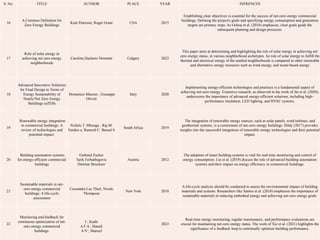
S. No. TITLE AUTHOR PLACE YEAR INFRENCES
16
A Common Definition for
Zero Energy Buildings
Kent Peterson, Roger Grant USA 2015
Establishing clear objectives is essential for the success of net-zero energy commercial
buildings. Defining the project's goals and specifying energy consumption and generation
targets are primary steps. As Ochoa et al. (2018) emphasize, clear goals guide the
subsequent planning and design processes.
17
Role of solar energy in
achieving net zero energy
neighborhoods
Caroline Hachem-Vermette Calgary 2022
This paper aims at determining and highlighting the role of solar energy in achieving net
zero energy status, in various neighborhood archetypes. he role of solar energy to fulfill the
thermal and electrical energy of the studied neighborhoods is compared to other renewable
and alternative energy resources such as wind energy, and waste-based energy
18
Advanced Innovative Solutions
for Final Design in Terms of
Energy Sustainability of
Nearly/Net Zero Energy
Buildings (nZEB)
Domenico Mazzeo , Giuseppe
Oliveti
Italy 2020
Implementing energy-efficient technologies and practices is a fundamental aspect of
achieving net-zero energy. Extensive research, as observed in the work of Jin et al. (2020),
underscores the importance of advanced energy-efficient solutions, including high-
performance insulation, LED lighting, and HVAC systems.
19
Renewable energy integration
in commercial buildings: A
review of technologies and
potential impact.
Nsilulu T. Mbungu , Raj M.
Naidoo a, Ramesh C. Bansal b
South Africa 2019
The integration of renewable energy sources, such as solar panels, wind turbines, and
geothermal systems, is a cornerstone of net-zero energy buildings. Hildy (2017) provides
insights into the successful integration of renewable energy technologies and their potential
impact.
20
Building automation systems
for energy-efficient commercial
buildings
Gerhard Zucker
Tarik Ferhatbegovic
Dietmar Bruckner
Austria 2012
The adoption of smart building systems is vital for real-time monitoring and control of
energy consumption. Liu et al. (2019) discuss the role of advanced building automation
systems and their impact on energy efficiency in commercial buildings.
21
Sustainable materials in net-
zero energy commercial
buildings: A life-cycle
assessment
Cassandra Lee Thiel, Nicole
Thompson
New York 2018
A life-cycle analysis should be conducted to assess the environmental impact of building
materials and systems. Researchers like Santos et al. (2018) emphasize the importance of
sustainable materials in reducing embodied energy and achieving net-zero energy goals.
22
Monitoring and feedback for
continuous optimization of net-
zero energy commercial
buildings.
J ; Kadir
A F A ; Hanafi
A N ; Shareef
2023
Real-time energy monitoring, regular maintenance, and performance evaluations are
crucial for maintaining net-zero energy status. The work of Xie et al. (2021) highlights the
significance of a feedback loop to continually optimize building performance.

dissertation on Net Zero Energy Buildings.pptx

  • 1.
    DEENBANDHU CHHOTU RAMUNIVERSITY OF SCIENCE & TECHNOLOGY MURTHAL (SONEPAT) Department of Architecture Faculty of Architecture, Urban & Town Planning NET ZERO ENERGY BUILDINGS IN COMPOSITE CLIMATE: A CASE OF COMMERCIAL BUILDINGS Dissertation Report submitted in partial fulfilment of the requirement as a subject of Bachelor of Architecture (B. ARCH.) 9th Semester RIDHI JAIN - 19001006047 July-Dec 2023 1
  • 2.
    1.1 INTRODUCTION: The buildingsector in India is growing at a rapid pace and contributing significantly to the increase in energy demand. The residential and commercial sector in India uses almost 33% of the primary energy and approximately 70% of the electricity at an average. Fig 1.2 Energy consumption breakdown in commercial buildings Source: Bureau of Energy Efficiency The concept of net-zero energy buildings (NZEBs) emerged strongly over the recent decades as a promising response to the ever- increasing energy consumption and CO2 emissions associated with buildings’ operation. A net zero energy building is defined as a highly energy efficient building which on annual basis consumes as much energy as it produces energy at site using renewable energy sources”. In other words, a building is said to be NZEB, when the difference between is annual energy consumption and its onsite generation through renewable sources is zero. Fig 1.3 Energy balance of NZEB’s Source: Green Energy Advances Agriculture 18% Domestic 26% Industry 41% Commercial 8% Traction & Railways 1% Others 6% Fig 1.1 Sector-wise energy consumption in India Source: Ministry of Statistics and Programme Implementation
  • 3.
    Net zero energyconfiguration is an architecture that rediscovers the inactive methodologies of our architectural history and afterward incorporates them into current thoughts regarding contemporary design. It likewise embraces the best of state-of-the-art technology and renewable energy systems to give solutions that set new norms for building and inhabitant execution. 1.1 NEED OF THE STUDY The requirement for alternative energy sources is getting critical, subsequently the improvement of sustainable power is moving quick. Nationally and internationally various individuals and research companies are creating new and exciting energy systems. The main issue is that the non-renewable energy sources are exhausting in a quick rate and are more diligently to recover. The outcome is that we can be confronting an energy emergency later the off chance that we are not cautious today. The energy costs will soar and not be accessible for some people or nations. To keep away from this destruction situation, we want to track down other options and utilize them to their maximum capacity. 1.2 PROBLEM STATEMENT The current energy consumption patterns in urban areas are unsustainable and contribute significantly to greenhouse gas emissions. To address this pressing issue, there is a need to develop and implement strategies for the widespread adoption of net zero energy buildings, which produce as much energy as they consume. This problem statement outlines the challenge of reducing energy consumption and emissions in the built environment while ensuring economic feasibility and practicality. 1.3 AIM & OBJECTIVE To evaluate the impact of building designs, components, and operational parameters on fulfilling net zero energy requirements. Conducting a comprehensive literature review of current and past studies on the building sustainability and net zero energy fields. Examine real-world case studies of NZEBs to identify best practices, challenges, and lessons learned from their design, construction, and operation. RESEACRH QUESTIONS What is the need of Net Zero Energy Buildings? What are the different terms associated with Net Zero Energy Buildings? How can Net Zero Energy Buildings help in optimizing resources in the modern world? INCREASED DEMAND OF ENERGY NON- RENEWABLE ENERGY EXHAUSTING ENERGY SHORTAGE INCREASED COST AND UNACCESSIBLE ENERGY
  • 4.
    SCOPE & LIMITATIONS Theresearch emphasizes upon the ideology of designing a net zero-energy building or inculcating the practice of net zero-energy architecture as a solution to increasing urban concerns with clearly indicating various definitions, techniques and examples. This is a necessary endeavour in today's world because of the excessive consumption of non-renewable resources. This report is mainly focused on the study of Net Zero Energy Buildings, but Green buildings and Sustainable buildings are not given suffice regard. METHODOLOGY The descriptive and analytical methodologies used in the current study were all developed using secondary data and various experimental efforts. Considering the resources at hand and the viability of the current research article, the conducted research studied secondary data sources. Secondary data were gathered from a variety of periodicals, scholarly works, textbooks, websites, theses, etc. The approach of the study also considers the ideas and works of many authors who work in the academic and research fields. As a result, the author conducted extensive study for this research paper using all relevant resources.
  • 5.
    2.1 DEFINITION ANDCONCEPT OF NZEB A Net Zero Energy Building, often abbreviated as NZEB, is a structure that is meticulously designed and constructed to produce as much energy as it consumes over a defined period, typically a year. Achieving net zero energy status involves the integration of cutting-edge technologies, innovative architectural designs, and sustainable building practices to reduce energy consumption and generate clean, renewable energy on-site. Figure 2.1 NZEB’s Idea (Rajan Kumar Jaysawal, 2022) CHAPTER 2 LITERATURE STUDY This research paper embarks on a journey into the world of Net Zero Energy Buildings, exploring their conceptual foundations, the latest technological innovations, the economic and environmental implications, and the challenges that lie ahead. As we delve into the multifaceted realm of NZEBs, we seek to unravel their potential in not only reducing the environmental burden but also in reshaping the way we think about the design and construction of buildings. By examining their principles, successes, and limitations, we aim to provide a comprehensive overview of the current state of NZEBs and their role in promoting a sustainable future.
  • 6.
    6 Figure 2.2 TotalZero Energy Building Revenue by Product/ Service, World Markets: 2016-2025 Source: (Caulfield, 2017 ) 2.2 THE NECESSITY OF CONNECTING WITH GRID NZEB typically uses traditional energy sources such as the electric and natural gas utilities when on-site generation does not meet the loads. When the on-site generation is greater than the building's loads, excess electricity is exported to the utility grid. By using the grid to account for the energy balance, excess production can offset later energy use. In India, electricity consumption doubled between 2000 and 2014 and is likely to increase at a faster rate. Between 2014 and 2035, the global market for goods and services related to NZEB construction and renovation is expected to rise at a compound annual growth rate of 44.5%, surpassing $1.4 trillion last year. (Rajan Kumar Jaysawal, 2022) The energy consumption at building sector will continue to increase until the growing demand is controlled using efficient measures and demand load is reduced from grid supply by using alternating energy production method Figure 2.3 Grid Connection for buildings Source: NZEB
  • 7.
    2.3 ZERO-ENERGY BUILDINGDEFINTIONS • Net Zero Site Energy: A site ZEB produces at least as much energy as it uses in a year, when accounted for at the site, which means that the building's energy consumption is balanced by the energy it generates on-site, typically through renewable energy sources. • Net Zero Source Energy: A source ZEB produces at least as much energy as it uses in a year, when accounted for at the source. Source energy refers to the primary energy used to generate and deliver the energy to the site. To calculate a building’s total source energy, imported and exported energy is multiplied by the appropriate site-to-source conversion multipliers. Fig 2.4 Net Zero Site Energy Diagram Source: Net Zero Energy Design, Thomas Hootman Fig 2.5 Net Zero Source Energy Diagram Source: Net Zero Energy Design, Thomas Hootman
  • 8.
    • Net ZeroEnergy Costs: In a cost ZEB, the amount of money the utility pays the building owner for the energy the building exports to the grid is at least equal to the amount the owner pays the utility for the energy services and energy used over the year. • Net Zero Energy Emissions: A net-zero emissions building produces at least as much emissions-free renewable energy as it uses from emissions-producing energy sources. In essence, it involves minimizing or eliminating the net amount of greenhouse gases released into the atmosphere as a result of human activities or processes. Fig 2.6 Net Zero Energy Emissions Diagram Source: Net Zero Energy Design, Thomas Hootman Fig 2.7 Net Zero Energy Cost Diagram Source: Net Zero Energy Design, Thomas Hootman
  • 9.
    2.4 NZEB NEEDIN INDIA Energy Demand in building sector: The energy consumption in the building sector is very high at 25% to 40 % which is more than other sectors and the consumption of total energy is increasing. India aims to reduce GDP emission strength by 33-35% by 2030. To achieve this goal, the building’s energy efficiency needs to be improved, as all sectors, especially the building sector, consume more than 30% of India's total electricity. Improving the energy efficiency of a building will reduce energy demand, conserve limited natural resources and control the emission of toxic gases like CO2 emissions. 2% 4% 9% 13% 26% Brazil Russia India US China Global energy demand by 2035 Primary energy consumption Fig. 2.8 India's share of Global energy demand to rise 9%by 2035 Source (Chitre 2016) Building energy consumption: Building energy consumption is usually split into 5 sectors: Industry, transport, residential, commercial and other ( agriculture, service sector etc). Due to population growth, increasing demand for building services and comfort level, energy consumption in both residential and commercial sectors reached between 20-40% in developed countries. Among building services HVAC system energy use plays a significant role. For this reason dependency of building sector on energy efficient and renewable resources is a prime objective for energy policies at regional, national and international level
  • 10.
    293 667 701 2281 3014 414 682 1603 2312 4425 Brazil RussiaIndia US China Total primary energy consumption (Mtoe) 2015 2035 41 2 129 1 47 0 20 40 60 80 100 120 140 Brazil Russia India US China % change At 129%, India's energy consumption growth to be highest among major economies. Fig. 2.9 The change in Consumption of different energy resources in years (2015-2035) Source: (IEA 2020) 2.5 GOVERNMENT PARTICIPATION The Ministry of Power, Government of India launched ECBC as its first step towards promoting energy efficiency in building sector in May 2007. ECBC is setup by Bureau of energy efficiency, with support from United states Agency for International Development (USAID). Energy Conservation Building Code (ECBC)  The purpose of ECBC is to provide minimum requirement for energy efficient design and construction of building and their systems.  The estimated annual saving after adopting ECBC will be approximately 1.7 billion kWh.  Buildings with load between 500kW or greater have to comply with the code.  Generally building with conditioned area 1000 mtsq or more will fall under this category.  The provision of the code apply to: -Building envelope, but unconditioned storage spaces and warehouses are excluded -Mechanical system and equipment (HVAC) -Service hot water heating -Interior and exterior lighting -Electrical Power and motors
  • 11.
    Source: Western RegionalWorkshop 2.6 RATING SYSTEMS IN INDIA There are agencies which support and promote Green Building design and provide direction to the architect, sustainable consultant, owner to build and live in a building that is made with energy-efficient strategies and renewable technologies. Some of them area: - GRIHA (Green Rated Integrated Habitat Assessment) - LEED India (Leadership in Energy and Environmental Design) - IGBC (Indian Green Building Council)
  • 12.
    2.7 TOOLS &RESOURCES REQUIRED TO ACHIEVE NZEB Design Builder : used for 3D modelling, shading analysis, daylighting, HVAC, renewable, cost analysis and model optimisation. Shading II: Sketch up plug-in used for sun path analysis and shading design. The software used for energy simulation are: Energy plus: used for whole building simulation EQuest: used for building energy performance analysis, comfort system design, detail simulation results. 2.8 STRATEGIES IN ACHIEVING A NZEB PASSIVE DESIGN Implementation of sound passive design principles is the first stepping stone on the path to zero Extreme energy efficient must be at the core of Net Zero Energy Buildings. NZEBs must harness all potential advantages from the site, surroundings, and should be designed for the climate. An NZEB will only be cost-effective if all the passive strategies, all of which come at no-cost or low-cost, are incorporated in its design and construction. a) FORM & ORIENTATION Fig. 2.10 Source: NZEB Fig. 2.11 Source: NZEB
  • 13.
    b) SHADING DEVICES c)COOL ROOFS d) FENESTRATIONS Fig. 2.12 Source: NZEB Fig. 2.13 Source: NZEB Fig. 2.14 Source: NZEB Fig. 2.15 Source: NZEB
  • 14.
    e) DAYLIGHTING f)NATURAL VENTILATION g) EVAPORATIVE COOLING h) VEGETATION Fig. 2.18 Source: NZEB Fig. 2.19 Source: NZEB Fig. 2.16 Source: NZEB Fig. 2.17 Source: NZEB
  • 15.
    ACTIVE DESIGNS Although passivemeasures will improve thermal comfort, air-conditioning may still be required for maintaining comfort conditions through the year. The design as well as efficiency of such systems could further impact the energy consumption of buildings a) HVAC b) LIGHTING c) EFFICIENT APPLIANCES Fig. 2.21 Source: NZEB Fig. 2.22 Source: NZEB Fig. 2.20 Source: NZEB
  • 16.
    RENEWABLE ENERGY SYSTEMS Renewableenergy systems are the final step to attaining zero energy goals. Once all possible measures to reduce energy demand are deployed, renewable energy systems must step in to balance residual energy demand. Performance of renewable energy systems determines the success of the net-zero buildings. a) SOLAR PHOTOVOLTAICS b) WIND ENERGY Fig. 2.23 Source: NZEB Fig. 2.24 Source: NZEB Fig. 2.25 Source: NZEB
  • 17.
    c) BIO MASSd) HYDRO ENERGY 2.9 METHODOLOGY COMPONENTS The methodology for designing an NZEB combines these components in an integrated and coordinated manner to ensure that the building's energy consumption is balanced by the energy it generates on-site, resulting in a net-zero energy and environmental impact. Additionally, the methodology should be flexible and adaptable to the specific requirements and constraints of each project.
  • 18.
    1. Pre-Planning andGoal Setting Establishing clear objectives is essential for the success of net-zero energy commercial buildings. Defining the project's goals and specifying energy consumption and generation targets are primary steps. 2. Site Selection and Building Location Site selection plays a critical role in optimizing renewable energy potential. It involves factors like solar exposure, wind resources, and proximity to utilities. 3. Energy Efficiency Measures Implementing energy-efficient technologies and practices is a fundamental aspect of achieving net-zero energy. Extensive research underscores the importance of advanced energy-efficient solutions, including high-performance insulation, LED lighting, and HVAC systems. 4. Renewable Energy Integration The integration of renewable energy sources, such as solar panels, wind turbines, and geothermal systems, is a cornerstone of net- zero energy buildings. 5. Smart Building Systems and Automation The adoption of smart building systems is vital for real-time monitoring and control of energy consumption discuss the role of advanced building automation systems and their impact on energy efficiency in commercial buildings. 6. Life-Cycle Analysis and Sustainable Materials A life-cycle analysis should be conducted to assess the environmental impact of building materials and systems. Researchers) emphasize the importance of sustainable materials in reducing embodied energy and achieving net-zero energy goals. 7. Monitoring, Feedback, and Continuous Improvement Real-time energy monitoring, regular maintenance, and performance evaluations are crucial for maintaining net-zero energy status.
  • 19.
    CHAPTER 3 CASESTUDIES 1) Eco Commercial Building (ECB) Bayer Material Science, Noida Location Noida Geographical coordinates 28° N, 77° E Occupancy Type Office, Private Typology New Construction Climate Type Composite Project Area 891 m 2 Grid Connectivity Grid connected EPI 72 kWh/m 2 /yr The Eco Commercial Building is part of the Bayer Climate Program which seeks to reduce the company’s greenhouse gas emissions and improve energy and resource efficiency. This administration building is energy self- sufficient and requires 70 percent less electricity compared to similar buildings in this region.
  • 20.
    Passive Design Strategies •Orientation: Detailedanalysis of environmental conditions were conducted to choose a orientation that would optimize building energy performance. The building form helps reduce heat gain or loss. •Landscaping: Native and indigenous species were selected for landscaping, eliminating the need for regular irrigation. •To help establish the new landscaping, plants were watered twice a day for the first two years. •Daylighting: Daylighting is maximized in all occupied spaces. Appropriate shading devices designed through simulation software are used to minimize glare. Integrated motorised blinds are used for occupant’s visual comfort. •Ventilation: A design ventilation rate of 30% additional outdoor air over that specified in ASHRAE Standard 62.1-2004 enhances the indoor air quality within the building and provides superior occupant comfort. •Passive design features resulted in a total diversified AC load of 84 kW for 891 m2 (24 tons for 9,600 ft2). •Materials and Constructions Techniques: • The building uses regional building materials with recycled content. • Low VOC paints, sealants, coatings and adhesives have been used wherever possible.
  • 21.
    •Building Envelope andFenestration: • Climatically responsive façade design, including a roof that projects beyond all four sides of the building, protecting it from direct sun and reducing heat gain. • All external surfaces, including the walls, roof and foundation, are insulated on the exterior using polyurethane panels. • Exterior wall assembly is composed of 150 mm (6 in.) autoclaved aerated concrete (AAC), fly-ash block work and 75 mm (3 in.) polyurethane foam (PUF). • Roof insulation materials are 75 mm (3 in.) rigid polyurethane insulation and a 50 mm (2 in.) layer of mineral wool • Window-to-wall ratio (WWR) is 33.8%, which helps ensure maximum daylighting potential with minimum solar heat gains. • High-performance envelope insulation leads to 40% reduction in energy use compared with the ASHRAE/ IESNA Standard 90.1-2004 baseline. • High-performance double-glazed windows with integrated motorized blinds provide improved protection against sunlight. Efficient glazing balances the low thermal conductivity and shading coefficient.
  • 22.
    Active Strategies • LightingDesign 1.An energy-efficient lighting system with daylighting controls is used. 2.Energy-efficient fixtures and ballasts contribute to a 37% reduction in lighting energy compared to ASHRAE Standard 90.1-2004. 3.The building uses a combination of energy-efficient T5 linear fluorescent lamps and compact fluorescent lamps. 4.Occupancy sensors in normally unoccupied areas like storage areas, toilets and mechanical rooms minimize lighting use. 5.Lighting controls ensure minimum internal heat gain and reduced air-conditioning load in those spaces. 6.Approximately 87% of regularly occupied spaces in the building have a minimum daylight factor of 2%. A lighting power density (LPD) of 7.2 W/m2 (0.67 W/ft2) in all occupied spaces is significantly lower than the ASHRAE Standard 1-2004 baseline of 11.8 W/m2 (1.1 W/ft2). 7.The building uses energy-saving technologies associated with the electrical power supply system/building management system. Optimized Energy Systems / HVAC system 1.Chilled beams for radiant cooling eliminates energy that would be used for supply fans. 2.Based on indoor design conditions of 24°C (75°F) and 55% relative humidity, the room dew-point temperature is 14°C (57°F) and chilled water is supplied at a temperature 1°C (0.6°F) higher (at 15°C [59°F]) to avoid any condensation on surfaces. Table 1. Energy production use (kWh)
  • 23.
    NET ZERO ENERGYBUILDINGS IN COMPOSITE CLIMATE: A CASE OF COMMERCIAL BUILDINGS Indoor Air Quality 1.Dry outdoor ventilation air is supplied through an externally mounted unit that dehumidifies the air before it is supplied to occupied space. This dry outdoor air acts as primary air to the chilled beams. 2.Air quality is monitored inside the entire building with help of CO2 sensors located 1.8 m (6 ft.) above the floor level in various spaces. These sensors provide an audible alarm to the operator when the difference between outdoor and indoor CO2 levels exceeds 530 ppm. 3.Demand Outdoor Air System (DOAS) starts at 7 a.m. to remove moisture that builds up during unoccupied hours and brings down the temperature to desired level before office operational hours start. 4.Dehumidified cold exhaust air from the bathrooms and office space is collected in each service core. This air enters one side of the rotating heat wheel, chilling the wheel and drying the desiccant coating. This cool and dry part of the wheel then rotates into the outdoor airstream where it absorbs heat and humidity from the incoming ventilation air before it is cooled to room temperature in the air-handling unit (AHU) room. 5.The energy recovery wheel reduces the ventilation load by 80%, minimizing operating energy and the size of air-conditioning equipment. supply system, sewage treatment plant and the solar PV system Table 2. Energy consumption and carbon emissions metered
  • 24.
    2) Indira ParyavaranBhawan Ministry of Environment and Forest (MoEF) Location New Delhi Geographical coordinates 28° N, 77° E Occupancy Type Office (MoEF) Typology New Construction Climate Type Composite Project Area 9,565 m 2 Grid Connectivity Grid connected EPI 44 kWh/m 2 /yr Indira Paryavaran Bhawan uses 70% less energy compared a conventional building. The project adopted green building concepts including conservation and optimization of water by recycling water from the site. Indira Paryavaran Bhawan is now India’s highest green rated building. The project has received GRIHA 5 Star and LEED Platinum. The building has already won awards such as the Adarsh/GRIHA of MNRE for exemplary demonstration of Integration of Renewable Energy Technologies. •Solar PV System of 930 kW capacity •Total Area of panels: 4,650 m2 •No of panels: 2,844 •Annual Energy Generation: 14.3 lakh unit
  • 25.
    NET ZERO ENERGYBUILDINGS IN COMPOSITE CLIMATE: A CASE OF COMMERCIAL BUILDINGS 25 Passive Design Strategies •Orientation: The building is north-south oriented, with separate blocks connected through corridors and a huge central courtyard. •Orientation minimizes heat ingress. •Landscaping: More than 50% area outside the building is covered with plantation. •Circulation roads and pathways are soft paved to enable groundwater recharge. •Daylighting: 75% of building floor space is daylit, thus reducing dependence on artificial sources for lighting. The inner courtyard serves as a light well. •Ventilation: The central courtyard helps in air movement as natural ventilation happens due to the stack effect. Windows and jaalis add to cross ventilation. •Building Envelope and Fenestration: •uPVC windows with hermetically sealed double glazed using low heat transmittance index glass •Rock wool insulation •High efficiency glass •Cool roofs: Use of high reflectance terrace tiles for heat ingress, high strength, hard wearing. Fig. Site plan Source NZEB Fig. Site Section Source NZEB
  • 26.
    26 •Materials and constructiontechniques : • AAC blocks with fly ash • Fly ash based plaster & mortar • Stone and Ferro cement jaalis • Local stone flooring • Bamboo jute composite doors, frames and flooring • High efficiency glass, high VLT, low SHGC & Low U-value, optimized by appropriate shading • Light shelves for diffused sunlight Active Strategies: • Lighting Design • Energy efficient lighting system ( LPD = 5 W/m2) , nearly 50% more efficient than Energy Conservation Building Code 2007 requirements • ( LPD = 11 W/m2) reduces energy demand further. • Remaining lighting load supplied by building integrated photovoltaic (BIPV). • Use of energy efficient lighting fixtures (T5 lamps). • Use of lux level sensor to optimize operation of artificial lighting. • Optimized Energy Systems / HVAC system Fig. Ventilation Source NZEB Fig. Active strategies Source NZEB
  • 27.
    27 Chilled beam system/VFD/ Screw Chillers • 160 TR of air conditioning load of the building is met through Chilled beam system. Chilled beam are used from second to sixth floor. This reduces energy use by 50 % compared to a conventional system. • HVAC load of the buildings is 40 m2/TR, about 50% more efficient than ECBC requirements (20 m2/TR) • Chilled water is supplied at 16° C and return temperature is 20° C. • Drain pans are provided with the chilled beams to drain out water droplets due to condensation during monsoon. • Water cooled chillers, double skin air handling units with variable frequency drivers(VFD) • Chilled beams save AHU/FCU fan power consumption by approximate 50 kW. • Fresh supply air is pre cooled from toilet exhaust air through sensible & latent heat energy recovery wheel. • Control of HVAC equipment & monitoring of all systems through integrated building management system. • Functional zoning to reduce air conditioning loads. • Room temperature is maintained at 26 ±1 ° C Geothermal heat exchange system 1.There are 180 vertical bores to the depth of 80 meter all along the building premises. Minimum 3 meter distance is maintained between any two bores. 2.Each bore has HDPE pipe U-loop (32mm outer diameter) and grouted with Bentonite Slurry. Each U-Loop is connected to the condenser water pipe system in the central air conditioning plant room. 3.One U-Loop has 0.9 TR heat rejection capacity. Combined together, 160 TR of heat rejection is obtained without using a cooling tower. Fig. Chill beam system Source NZEB Fig. Heat Exchange system Source NZEB
  • 28.
    3) Unnati Office GreaterNOIDA, Uttar Pradesh The Unnati Office Building is the regional headquarter (North) for Gainwell Commosales Pvt. Ltd., part of a larger 5 acre campus. It is certified Platinum under LEED , performs 59% better than a conventional office building in the region, and 40% of the building energy consumption is met through on site renewable energy generation Location Greater NOIDA Coordinates 29° N, 78° E Occupancy Type Office, Private Typology New Construction Climate Type Composite Project Area 3,740 m 2 Date of Completion 2018 Grid Connectivity Grid-connected EPI 60 kWh/m 2 /yr Site plan
  • 29.
    NET ZERO ENERGYBUILDINGS IN COMPOSITE CLIMATE: A CASE OF COMMERCIAL BUILDINGS 29 Orientation The three-storey building is a cuboid with a central courtyard. It is oriented northeast-southwest, with the core areas distributed in the east and the west orientations. Passive design strategies have been integrated with the building design. Landscaping The landscape is a mix of existing and new vegetation. 30% of the site is un-built, of which 25% is covered with shrubs and trees. Only native vegetation has been planted to reduce irrigation water volume as well as pump energy. Treated waste water is used for irrigation. Daylighting 90% of the office spaces, including the core and service areas, receive uniformly distributed daylight. This can be attributed to the form, central courtyard, shallow floor plates, appropriate sizing and distribution of openings. All the windows have box shading that prevents glare. Ventilation A design ventilation rate of 30% additional outdoor air over ASHRAE Standard 62.1-2010 enhances indoor air quality and occupant comfort. Passive design features reduce the total diversified AC load to 208 kW for 3740 m2 (80 tons for 33,500 ft2).
  • 30.
    NET ZERO ENERGYBUILDINGS IN COMPOSITE CLIMATE: A CASE OF COMMERCIAL BUILDINGS 30 Building Envelope and Fenestration Climatically responsive façade concepts, including green wall and shading on all windows, protect the interiors from direct sun and reduce heat gain. All external surfaces, including the walls, roof and foundation, are insulated (using polysterene panels) on the exterior. Truss reinforced insulated concrete panels (TRIC) used for the exterior walls are 25 mm concrete (AAC), 60 mm expanded polystyrene (EPS), and 25 mm concrete (AAC), and 10 mm plaster. The green roof insulation materials are 13 mm extruded polystyrene insulation and a 300 mm layer of green roof soil substrate. Window-to-wall ratio (WWR) is 30%, which helps ensure maximum daylighting potential with minimum solar heat gains. High performance envelope insulation leads to 54% reduction in energy use (compared with the ASHRAE/ IESNA Standard 90.1-2010 baseline). High performance double-glazed windows provide improved protection against sunlight with integrated motorized blinds and shading (efficient glazing balancing low thermal conductivity and shading coefficient). Fig. Building envelop & fenestrations Source NZEB Fig. Wall insulation Source NZEB
  • 31.
    NET ZERO ENERGYBUILDINGS IN COMPOSITE CLIMATE: A CASE OF COMMERCIAL BUILDINGS 31 Active Strategies: Lighting Design • An energy-efficient lighting system with daylighting controls is used. • Energy-efficient fixtures and ballasts contribute to a 66% reduction in lighting energy compared to Standard 90.1-2010. • Occupancy sensors in normally unoccupied areas like storage areas, toilets and mechanical rooms minimize lighting use. • Lighting controls ensure minimum internal heat gain and reduced air-conditioning load in those spaces. • Approximately 90% of total regularly occupied spaces in the building have an illuminance level of 300-3000 lux measured on the clearest sky conditions. A lighting power density (LPD) of 3.6W/m2 in all occupied spaces is significantly lower than the Standard 90.1- 2010 baseline of 10.9 W/m2. • The building uses energy-saving technologies associated with the electrical power supply system/building management system. Metering and Monitoring • Advanced energy metered systems include the main incoming power supply, chillers, internal lighting, external lighting, air-handling units, the water supply system, the sewage treatment plant and the solar PV system Fig. Active cooling system Source NZEB
  • 32.
    NET ZERO ENERGYBUILDINGS IN COMPOSITE CLIMATE: A CASE OF COMMERCIAL BUILDINGS 32 Optimized Energy Systems / HVAC system • The building has a hybrid HVAC system which is a combination of water-cooled air handling units and ceiling-embedded radiant cooling system. • Cooling load distribution of the system is such that 55% of the load is met by the radiant cooling system and 45% by AHUs. Total • cooling load for the project is around 90 TR for which 2# 80 TR screw chillers (1 Working + 1 Stand-by) are provided. • Based on indoor design conditions of 24°C and 55% relative humidity, the room dew-point temperature is 12°C and chilled water is supplied at a temperature 7°C to avoid any condensation on surfaces. Indoor Air Quality • Dry outdoor ventilation air is supplied through an externally mounted unit that dehumidifies the air before it is supplied to occupied space. This dry outdoor air acts as primary air to the chilled beams. • The air quality is monitored inside the entire building with help of CO2 sensors which provide an audible alarm • The DOAS system starts at 8 a.m. to remove moisture that builds up during unoccupied hours and brings down the temperature to desired level before office start-up. • The building draws 40% of its energy from the roof-top PV plant. • The installed 100 kW solar PV generates 146 MWh/yr. Fig. HVAC System Source NZEB Fig. PV System Source NZEB
  • 33.
    NET ZERO ENERGYBUILDINGS IN COMPOSITE CLIMATE: A CASE OF COMMERCIAL BUILDINGS 33 CASE STUDY GENERAL INFORMATION PASSIVE STRATEGIES ACTIVE STRATEGIES RENEWABLE STRATEGIES • Bayer’s Material Science, Noida • 891 m2 • Private Office Building • Orientation • Landscaping • Daylighting • Ventilation • Building Envelope and Fenestration • Materials and Constructions Techniques • Lighting Design • Optimized Energy Systems / HVAC system • Indoor Air Quality • Draws 100% of its energy from roof-top PV plant. • 57 kW PV plant generates 88.9 MWh/yr. • Excess energy fed to other buildings at site. • Indira Paryavaran Bhawan • 9,565 m2 • Office and Educational • Materials& construction techniques • Orientation • Landscaping • Daylighting • Ventilation • Lighting Design • Optimized Energy Systems / HVAC system • Chilled beam system/ VFD/ Screw Chillers • Geothermal heat exchange system • Solar PV System of 930 kW capacity • Total Area of panels: 4,650 m2 • No of panels: 2,844 • Annual Energy Generation: 14.3 lakh unit • Unnati Office, Noida • 3,740 m2 • Private Office Building • Orientation • Landscaping • Daylighting • Ventilation • Building Envelope and Fenestration • Lighting Design • Optimized Energy Systems / HVAC system • Indoor Air Quality • Metering and Monitoring • The building draws 40% of its energy from the roof-top PV plant. • The installed 100 kW solar PV generates 146 MWh/yr.
  • 34.
    NET ZERO ENERGYBUILDINGS IN COMPOSITE CLIMATE: A CASE OF COMMERCIAL BUILDINGS 34 FLOOR PLANS CHAPTER 4 ANALYSIS Energy simulation for CVR Block, DCRUST Murthal was done using Equest, and energy consumption measures were noted. A proposal for the same to be made energy efficient is also briefed out. Jan Feb Mar Apr May Jun Jul Aug Sep Oct Nov Dec Total Space Cool 0 0 0.03 0.02 0.55 1.86 3.83 4.66 2.06 0.23 0 0 13.24 Vent. Fans 1.78 1.69 2.05 1.78 1.96 1.96 1.78 2.05 1.78 1.87 1.78 1.78 22.27 Misc. Equip. 10.17 9.57 11.41 10.11 11 10.94 10.17 11.41 10.11 10.59 10.11 10.17 125.77 Task Lights 16.09 15.29 18.5 16.09 17.7 17.7 16.09 18.5 16.09 16.89 16.09 16.09 201.13 Total 28.04 26.55 31.99 28 31.21 32.46 31.87 36.63 30.05 29.58 27.98 28.04 362.4 Electricity kWh (x000) Vent. Fans 22.27 Space Cool 13.24 Misc. Equip. 125.77 Task Lights 201.13 Total 362.41 Monthly consumption
  • 35.
    NET ZERO ENERGYBUILDINGS IN COMPOSITE CLIMATE: A CASE OF COMMERCIAL BUILDINGS 35 By replacing conventional materials in the building, the proposed simulation results in 61.49% savings, making the building even more efficient. EXISTING CASE PROPOSED CASE WALL 6” BRICK WALL 6” AAC WALL WITH INSULATION ROOF 6” CONCRETE 6” CONCRETE WITH INSULATOION/ GREEN ROOF WINDOWS SINGLE GLASS UNIT DOUBLE GLASS UNIT RENEWABLE SYSTEM - 139.5 MW/yr ( FOR 93 PANELS i.e 50% ROOF AREA) LIGHTING 1.5 W/SqFt. 0.8 W/SqFt. Annual consumption: Proposed Monthly consumption: Proposed Jan Feb Mar Apr May Jun Jul Aug Sep Oct Nov Dec Total Space Cool 0 0.05 0.33 0.5 2.14 3.12 4.04 4.78 3.08 1.18 0 0 19.21 Vent. Fans 0 0.01 0.05 0.08 0.33 0.47 0.59 0.7 0.46 0.19 0 0 2.89 Misc. Equip. 4.72 4.44 5.29 4.69 5.1 5.07 4.72 5.29 4.69 4.91 4.69 4.72 58.32 Task Lights 4.73 4.5 5.44 4.73 5.21 5.21 4.73 5.44 4.73 4.97 4.73 4.73 59.15 Total 9.45 8.99 11.12 10 12.78 13.87 14.08 16.21 12.96 11.24 9.42 9.45 139.58 Electricity kWh (x000) Space Cool 19.21 Vent. Fans 2.89 Misc. Equip. 58.32 Task Lights 59.15 Total 139.58 TOTAL CONSUMPTION (kWh) % SAVINGS PROPOSED CASE EXISTING CASE 1- PROPOSED CASE/ EXISTING CASE 139.58 362.41 61.49 % Saving calculation
  • 36.
    S. No. TITLEAUTHOR PLACE YEAR INFRENCES ATTRIBUTES 1 Towards Net Zero Energy Buildings in Hot Climates Mathieu David, Eric Ottenwelter La Reunion 2011 The study focuses on understanding of the construction of low-/zero-energy buildings in hot and tropical climates. The utilisation of free software frequently used by architects and engineers is the cornerstone of a novel way for selecting design tools that is based on a passive design approach. Design process, Use of softwares in NZEB builidngs 2 Zero Energy Buildings: A Critical Look at the definition Paul Torcellini, Shanti Pless, Michael Deru California 2006 The definition of zero energy has an impact on how structures are created to meet the objective. It may place a focus on fuel switching and conversion accounting, supply-side initiatives, acquired energy sources, utility rate structures, or energy efficiency. Boundary Definitions and Energy Flows 3 Net Zero Energy Design: A Guide for Commercial Architecture Thomas Hootman New Jersey 2012 This study proved that net zero energy is not only feasible for massive commercial buildings, but also adds distinctive value to them. The project also highlighted the holes in the present traditional construction delivery procedures, which we will need to close if we are to create net zero energy solutions. This book's primary goal is to fill in these holes in our procedure, notably by providing a solution to the following question: How can we deliver a net zero energy commercial building? Sustainability, net zero energy commercial buildings 4 Net zero energy buildings: A consistent definition framework Satori Igor 2012 Although the idea of zero energy buildings is well recognised, there is still no definition that is universally accepted. In order to be consistent with the goals and political objectives driving the promotion of Net ZEBs, it is acknowledged that alternative definitions are feasible. A set of five criteria and related sub-criteria have been proposed as a framework for characterising the pertinent properties of Net ZEBs. Terminology and Net ZEB balance concept 5 A Design Framework for Achieving Net Zero Energy Commercial Buildings Richard Hyde, Upendra Rajapaksha Indrika Rajapaksha Marc O Riain Flavia Silva Nathan 2012 Net Zero Energy Buildings (NZEB) are currently an emerging performance target for sustainable commercial buildings. A central issue is how this target can be met either through the design of new buildings or retrofitting of existing buildings. From a review of the NZEB definitions it is argued a new conceptualisation is needed which maps specific carbon abatement emissions for the components of the total energy system. The NZEB approach is examined in four projects. It is argued that retrofitting is needed to achieve reductions in global impact in terms of CO2 Sustainibilty, NZEB, GHG Emissions 6 Review of global research advances towards net-zero emissions buildings Eric Ohene, Albert P.C. Chan, Amos Darko Hong Kong 2022 This study aims to systematically and comprehensively explore the state-of- the-art in NZEBs research, and to provide recommendations about research gaps and future research directions. Adopting mixed-methods, first, a quantitative bibliometric analysis was conducted on 2724 articles retrieved from Scopus Main research themes include energy efficiency, zero energy building, life cycle assessment, embodied energy, building simulation 7 Concept of net zero energy buildings (NZEB) - A literature review Rajan Kumar Jaysawal, Suprava Chakraborty India 2022 Enough renewable energy could be used, NZEB could potentially be achievable with power production. Furthermore, different building-service systems utilizing renewable energy sources have been extensively investigated for possible uses in NZEB. The paper gives the detail of its climatic condition in various part of the world along with their consequences and its impacts. The NZEB concept will significantly define the demand and supply strategies for renewable energies and conversion accounting to achieve a NZEB target along with its renewable energy evaluation Net zero energy buildings, Energy, Environmental Impact, NZEB target
  • 37.
    S. No. TITLEAUTHOR PLACE YEAR INFRENCES ATTRIBUTES 8 A comprehensive review of photovoltaic power generation technology Sai Nikhil, Mohd Hasan Ali Memphis 2019 The integration of solar photovoltaic panels is a common strategy to achieve net zero energy in commercial buildings. Researchers have explored the efficiency and cost-effectiveness of PV systems Solar Photovoltaic (PV); solar cell architecture; solar cell efficiency 9 A review of smart building sensing system for better indoor environment control Bing Dong San Antinio 2019 Energy efficiency plays a vital role in net zero energy buildings. Studies have discussed various energy-saving technologies and practices, such as smart lighting systems and advanced HVAC Occupancy sensors Built environment measurements 10 . A review on buildings energy consumption information. Luis Pérez-Lombard Spain 2007 Passive Design Principles: Passive design strategies, such as optimal orientation and natural ventilation, have gained attention for reducing energy consumption in commercial buildings. Researchers have examined the effectiveness of passive design Energy consumption in buildings, Heating, ventilation and air conditioning (HVAC) 11 Critical Analysis of Energy Efficiency Assessment by International Green Building Rating Tools and Its Effects on Local Adaptation Saleh Hamel Alyam Arab 2019 This study focuses on the built environment of Saudi Arabia and seeks to improve the accuracy of its newly established GBRS, namely the Saudi Environmental Assessment Method. After reviewing various existing international GBRS, the study finds that they have a deficiency in their building performance ratio and/or matrix that indicates the differences resulting from various climatic conditions. Energy Simulation Tools, Energy Consumption Patterns 12 Zero Energy Building – A review of definitions and calculation methodologies A.J. Marszal Norway 2010 The concept of Zero Energy Building (ZEB) has gained wide international attention during last few years and is now seen as the future target for the design of buildings. However, before being fully implemented in the national building codes and international standards, the ZEB concept requires clear and consistent definition and a commonly agreed energy calculation methodology. the type of energy use included in the balance 13 Quantity surveyors, competitive tendering, and low energy construction. Temitope Omotay, Si Wen Tan Birmingham 2021 The changing role of quantity surveyors in the new paradigm of sustainable construction requires studies into new competencies and skills for the profession. The impact of sustainable construction on quantity surveying services, engagement and how they manage challenges provided an indication of the success indicators of the quantity surveying profession in meeting the sustainable construction needs. Challenges and opportunities for quantity surveyors in sustainable construction 14 Introducing the prebound effect: The gap between performance and actual energy consumption Minna Sunikka-Blank, Ray Galvin Cambriddge 2012 Occupant Behavior and Comfort: Understanding and influencing occupant behavior is another challenge. Research should delve into the behavioral aspects of NZECBs, including user comfort, satisfaction, and energy conservation practices Prebound effects in energy consumption
  • 38.
    S. No. TITLEAUTHOR PLACE YEAR INFRENCES 16 A Common Definition for Zero Energy Buildings Kent Peterson, Roger Grant USA 2015 Establishing clear objectives is essential for the success of net-zero energy commercial buildings. Defining the project's goals and specifying energy consumption and generation targets are primary steps. As Ochoa et al. (2018) emphasize, clear goals guide the subsequent planning and design processes. 17 Role of solar energy in achieving net zero energy neighborhoods Caroline Hachem-Vermette Calgary 2022 This paper aims at determining and highlighting the role of solar energy in achieving net zero energy status, in various neighborhood archetypes. he role of solar energy to fulfill the thermal and electrical energy of the studied neighborhoods is compared to other renewable and alternative energy resources such as wind energy, and waste-based energy 18 Advanced Innovative Solutions for Final Design in Terms of Energy Sustainability of Nearly/Net Zero Energy Buildings (nZEB) Domenico Mazzeo , Giuseppe Oliveti Italy 2020 Implementing energy-efficient technologies and practices is a fundamental aspect of achieving net-zero energy. Extensive research, as observed in the work of Jin et al. (2020), underscores the importance of advanced energy-efficient solutions, including high- performance insulation, LED lighting, and HVAC systems. 19 Renewable energy integration in commercial buildings: A review of technologies and potential impact. Nsilulu T. Mbungu , Raj M. Naidoo a, Ramesh C. Bansal b South Africa 2019 The integration of renewable energy sources, such as solar panels, wind turbines, and geothermal systems, is a cornerstone of net-zero energy buildings. Hildy (2017) provides insights into the successful integration of renewable energy technologies and their potential impact. 20 Building automation systems for energy-efficient commercial buildings Gerhard Zucker Tarik Ferhatbegovic Dietmar Bruckner Austria 2012 The adoption of smart building systems is vital for real-time monitoring and control of energy consumption. Liu et al. (2019) discuss the role of advanced building automation systems and their impact on energy efficiency in commercial buildings. 21 Sustainable materials in net- zero energy commercial buildings: A life-cycle assessment Cassandra Lee Thiel, Nicole Thompson New York 2018 A life-cycle analysis should be conducted to assess the environmental impact of building materials and systems. Researchers like Santos et al. (2018) emphasize the importance of sustainable materials in reducing embodied energy and achieving net-zero energy goals. 22 Monitoring and feedback for continuous optimization of net- zero energy commercial buildings. J ; Kadir A F A ; Hanafi A N ; Shareef 2023 Real-time energy monitoring, regular maintenance, and performance evaluations are crucial for maintaining net-zero energy status. The work of Xie et al. (2021) highlights the significance of a feedback loop to continually optimize building performance.