Net zero or nearly zero energy buildings (NZEB) are highly efficient buildings with extremely
low energy demand, which is met by renewable energy sources.
Such buildings produce as much as energy as they consume accounted for annually.
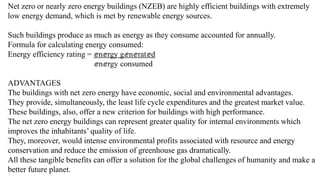
Formula for calculating energy consumed:
Energy efficiency rating = ⅇnⅇrgy gⅇnⅇratⅇd
ⅇnⅇrgy consumed
ADVANTAGES
The buildings with net zero energy have economic, social and environmental advantages.
They provide, simultaneously, the least life cycle expenditures and the greatest market value.
These buildings, also, offer a new criterion for buildings with high performance.
The net zero energy buildings can represent greater quality for internal environments which
improves the inhabitants’ quality of life.
They, moreover, would intense environmental profits associated with resource and energy
conservation and reduce the emission of greenhouse gas dramatically.
All these tangible benefits can offer a solution for the global challenges of humanity and make a
better future planet.
APPROACH
Buildings that through renewable means produce as much energy as they consume
when accounted for annually. There are 3 different approaches used for net zero
buildings .
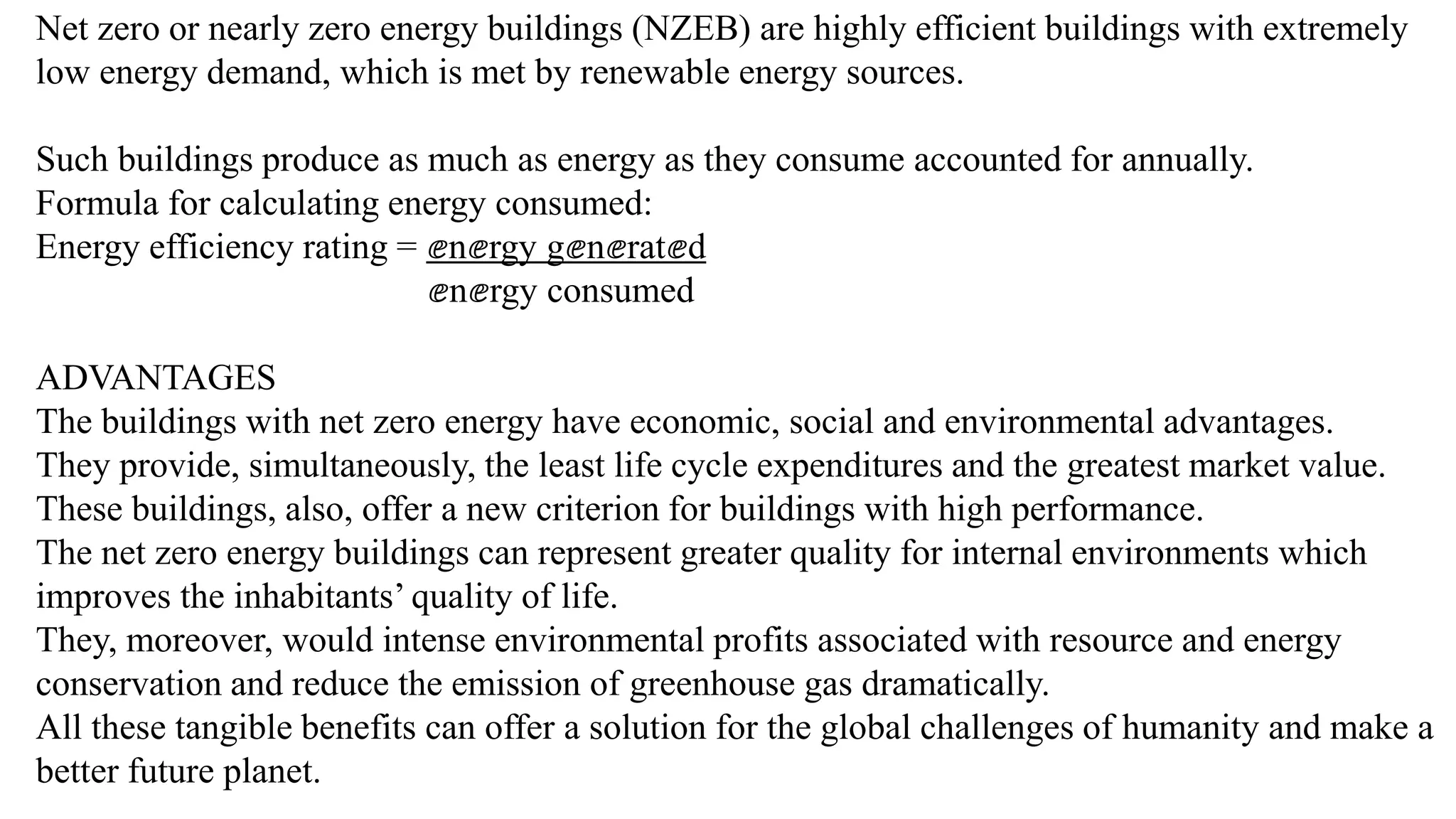
• Zero Energy ≈ 100% Energy efficient If the energy required is obtained
by energy generated, it is called as Zero Energy.
• Nearly Zero Energy ≈ 90% or higher If the energy required is obtained
by energy generated at least 90%, it is called as Nearly Zero Energy
• Plus Energy ≈ over 100% If the energy required is obtained by energy
generated and is more than required, it is called as Plus Zero Energy.
Requirements for achieving Net Zero Energy building
• Passive thermal design: The first step towards NZEB is a Passive Design. There is no use of
installing renewable energy if the design is not efficient enough to reduce energy usage
manually. Building shape, orientation and composition plays an important role in saving
energy. If all these factors are considered, there can be easy reduction in installing mechanical
systems.
• Some of the techniques are:
Natural ventilation:
Nature ventilation is totally based on climatic zones and orientation of the building. Position of
openings also play in important role. Basically, natural ventilation is to keep the indoor climate
pleasant and healthy for occupants and to reduce the usage of mechanical systems.
single- sided ventilation Cross ventilation Stack Ventilation Courtyard effects
Active Thermal Cooling
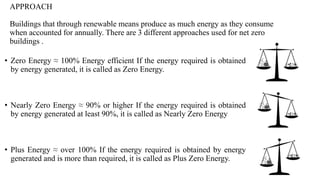
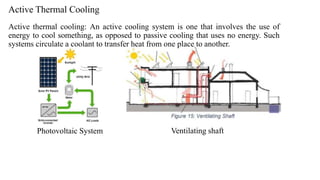
Active thermal cooling: An active cooling system is one that involves the use of
energy to cool something, as opposed to passive cooling that uses no energy. Such
systems circulate a coolant to transfer heat from one place to another.
Photovoltaic System Ventilating shaft
Materials
Selecting materials is also an important factor in constructing NZEB.
One must also see to it that the materials selected are locally available so that transportation
cost is lesser, and materials are available in abundance.
Materials mentioned below are locally available in the proposed site of the project.
• Iron ore and steel: Iron ore – the basic raw material for the iron and steel industry that is also
used in ferromanganese industries, paints, pigments and other allied industries
• Steel as sustainable material: As steel remains steel forever once made, it is a sustainable
material. Steel is infinitely recycled, so the investment in making steel is never wasted and
can be capitalized on by future generations.
• Fly-ash: . Fly ash is a recycled product that can be used as a substitute for some of the
cement in concrete. Fly ash is a waste product of the combustion of coal. It is produced at
coal-fired power plants and blast furnaces. It may be substituted for as much as 35% of the
cement in some concrete mixes.
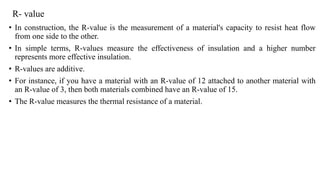
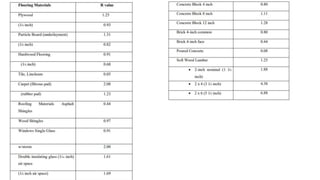
R- value
• In construction, the R-value is the measurement of a material's capacity to resist heat flow
from one side to the other.
• In simple terms, R-values measure the effectiveness of insulation and a higher number
represents more effective insulation.
• R-values are additive.
• For instance, if you have a material with an R-value of 12 attached to another material with
an R-value of 3, then both materials combined have an R-value of 15.
• The R-value measures the thermal resistance of a material.
Requirements
Some basic important requirement which are necessary for net zero energy building, such as
building massing components, building envelope, passive solar heat gain, heat recovery
ventilation, building airtightness and use of renewable energy.
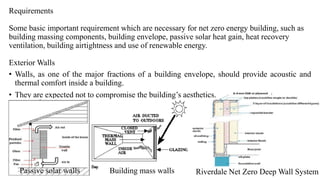
Exterior Walls
• Walls, as one of the major fractions of a building envelope, should provide acoustic and
thermal comfort inside a building.
• They are expected not to compromise the building’s aesthetics.
Passive solar walls Building mass walls Riverdale Net Zero Deep Wall System
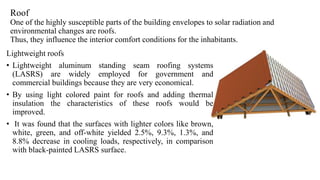
Roof
One of the highly susceptible parts of the building envelopes to solar radiation and
environmental changes are roofs.
Thus, they influence the interior comfort conditions for the inhabitants.
Lightweight roofs
• Lightweight aluminum standing seam roofing systems
(LASRS) are widely employed for government and
commercial buildings because they are very economical.
• By using light colored paint for roofs and adding thermal
insulation the characteristics of these roofs would be
improved.
• It was found that the surfaces with lighter colors like brown,
white, green, and off-white yielded 2.5%, 9.3%, 1.3%, and
8.8% decrease in cooling loads, respectively, in comparison
with black-painted LASRS surface.
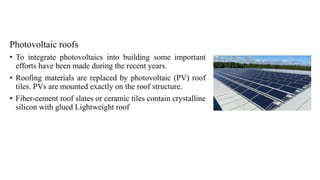
Photovoltaic roofs
• To integrate photovoltaics into building some important
efforts have been made during the recent years.
• Roofing materials are replaced by photovoltaic (PV) roof
tiles. PVs are mounted exactly on the roof structure.
• Fiber-cement roof slates or ceramic tiles contain crystalline
silicon with glued Lightweight roof
Other factors to consider while designing
• Door
• Window
• Renewable Energy
• Solar Energy
• Design as per climatic conditions
• ventilation
Case Studies
• Suzlon One Earth, Pune, Maharashtra- Ar. Christopher Benninger
• CARBSE, Cept University, Ahmedabad – Ar. B. V Doshi
• Avasara Residential School, Pune, Lavale- Ar. Anne Geenen

Net zero or nearly zero energy buildings

  • 1.
    Net zero ornearly zero energy buildings (NZEB) are highly efficient buildings with extremely low energy demand, which is met by renewable energy sources. Such buildings produce as much as energy as they consume accounted for annually. Formula for calculating energy consumed: Energy efficiency rating = ⅇnⅇrgy gⅇnⅇratⅇd ⅇnⅇrgy consumed ADVANTAGES The buildings with net zero energy have economic, social and environmental advantages. They provide, simultaneously, the least life cycle expenditures and the greatest market value. These buildings, also, offer a new criterion for buildings with high performance. The net zero energy buildings can represent greater quality for internal environments which improves the inhabitants’ quality of life. They, moreover, would intense environmental profits associated with resource and energy conservation and reduce the emission of greenhouse gas dramatically. All these tangible benefits can offer a solution for the global challenges of humanity and make a better future planet.
  • 2.
    APPROACH Buildings that throughrenewable means produce as much energy as they consume when accounted for annually. There are 3 different approaches used for net zero buildings . • Zero Energy ≈ 100% Energy efficient If the energy required is obtained by energy generated, it is called as Zero Energy. • Nearly Zero Energy ≈ 90% or higher If the energy required is obtained by energy generated at least 90%, it is called as Nearly Zero Energy • Plus Energy ≈ over 100% If the energy required is obtained by energy generated and is more than required, it is called as Plus Zero Energy.
  • 3.
    Requirements for achievingNet Zero Energy building • Passive thermal design: The first step towards NZEB is a Passive Design. There is no use of installing renewable energy if the design is not efficient enough to reduce energy usage manually. Building shape, orientation and composition plays an important role in saving energy. If all these factors are considered, there can be easy reduction in installing mechanical systems. • Some of the techniques are: Natural ventilation: Nature ventilation is totally based on climatic zones and orientation of the building. Position of openings also play in important role. Basically, natural ventilation is to keep the indoor climate pleasant and healthy for occupants and to reduce the usage of mechanical systems. single- sided ventilation Cross ventilation Stack Ventilation Courtyard effects
  • 4.
    Active Thermal Cooling Activethermal cooling: An active cooling system is one that involves the use of energy to cool something, as opposed to passive cooling that uses no energy. Such systems circulate a coolant to transfer heat from one place to another. Photovoltaic System Ventilating shaft
  • 5.
    Materials Selecting materials isalso an important factor in constructing NZEB. One must also see to it that the materials selected are locally available so that transportation cost is lesser, and materials are available in abundance. Materials mentioned below are locally available in the proposed site of the project. • Iron ore and steel: Iron ore – the basic raw material for the iron and steel industry that is also used in ferromanganese industries, paints, pigments and other allied industries • Steel as sustainable material: As steel remains steel forever once made, it is a sustainable material. Steel is infinitely recycled, so the investment in making steel is never wasted and can be capitalized on by future generations. • Fly-ash: . Fly ash is a recycled product that can be used as a substitute for some of the cement in concrete. Fly ash is a waste product of the combustion of coal. It is produced at coal-fired power plants and blast furnaces. It may be substituted for as much as 35% of the cement in some concrete mixes.
  • 6.
    R- value • Inconstruction, the R-value is the measurement of a material's capacity to resist heat flow from one side to the other. • In simple terms, R-values measure the effectiveness of insulation and a higher number represents more effective insulation. • R-values are additive. • For instance, if you have a material with an R-value of 12 attached to another material with an R-value of 3, then both materials combined have an R-value of 15. • The R-value measures the thermal resistance of a material.
  • 8.
    Requirements Some basic importantrequirement which are necessary for net zero energy building, such as building massing components, building envelope, passive solar heat gain, heat recovery ventilation, building airtightness and use of renewable energy. Exterior Walls • Walls, as one of the major fractions of a building envelope, should provide acoustic and thermal comfort inside a building. • They are expected not to compromise the building’s aesthetics. Passive solar walls Building mass walls Riverdale Net Zero Deep Wall System
  • 9.
    Roof One of thehighly susceptible parts of the building envelopes to solar radiation and environmental changes are roofs. Thus, they influence the interior comfort conditions for the inhabitants. Lightweight roofs • Lightweight aluminum standing seam roofing systems (LASRS) are widely employed for government and commercial buildings because they are very economical. • By using light colored paint for roofs and adding thermal insulation the characteristics of these roofs would be improved. • It was found that the surfaces with lighter colors like brown, white, green, and off-white yielded 2.5%, 9.3%, 1.3%, and 8.8% decrease in cooling loads, respectively, in comparison with black-painted LASRS surface.
  • 10.
    Photovoltaic roofs • Tointegrate photovoltaics into building some important efforts have been made during the recent years. • Roofing materials are replaced by photovoltaic (PV) roof tiles. PVs are mounted exactly on the roof structure. • Fiber-cement roof slates or ceramic tiles contain crystalline silicon with glued Lightweight roof
  • 11.
    Other factors toconsider while designing • Door • Window • Renewable Energy • Solar Energy • Design as per climatic conditions • ventilation
  • 12.
    Case Studies • SuzlonOne Earth, Pune, Maharashtra- Ar. Christopher Benninger • CARBSE, Cept University, Ahmedabad – Ar. B. V Doshi • Avasara Residential School, Pune, Lavale- Ar. Anne Geenen