Net Zero
Emissions
AATIQ SERAJ, 11A
What is Net Zero Emissions and why
does it matter ?
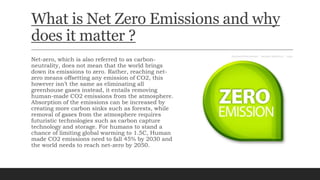
Net-zero, which is also referred to as carbon-
neutrality, does not mean that the world brings
down its emissions to zero. Rather, reaching net-
zero means offsetting any emission of CO2, this
however isn’t the same as eliminating all
greenhouse gases instead, it entails removing
human-made CO2 emissions from the atmosphere.
Absorption of the emissions can be increased by
creating more carbon sinks such as forests, while
removal of gases from the atmosphere requires
futuristic technologies such as carbon capture
technology and storage. For humans to stand a
chance of limiting global warming to 1.5C, Human
made CO2 emissions need to fall 45% by 2030 and
the world needs to reach net-zero by 2050.
Climate Change and Global
Warming
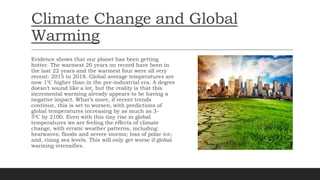
Evidence shows that our planet has been getting
hotter. The warmest 20 years on record have been in
the last 22 years and the warmest four were all very
recent: 2015 to 2018. Global average temperatures are
now 1℃ higher than in the pre-industrial era. A degree
doesn’t sound like a lot, but the reality is that this
incremental warming already appears to be having a
negative impact. What’s more, if recent trends
continue, this is set to worsen, with predictions of
global temperatures increasing by as much as 3-
5℃ by 2100. Even with this tiny rise in global
temperatures we are feeling the effects of climate
change, with erratic weather patterns, including:
heatwaves; floods and severe storms; loss of polar ice;
and, rising sea levels. This will only get worse if global
warming intensifies.
What is causing this Climate
Change
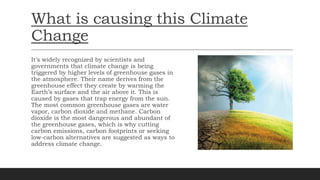
It’s widely recognized by scientists and
governments that climate change is being
triggered by higher levels of greenhouse gases in
the atmosphere. Their name derives from the
greenhouse effect they create by warming the
Earth’s surface and the air above it. This is
caused by gases that trap energy from the sun.
The most common greenhouse gases are water
vapor, carbon dioxide and methane. Carbon
dioxide is the most dangerous and abundant of
the greenhouse gases, which is why cutting
carbon emissions, carbon footprints or seeking
low-carbon alternatives are suggested as ways to
address climate change.
Can we get to Net Zero emissions ?
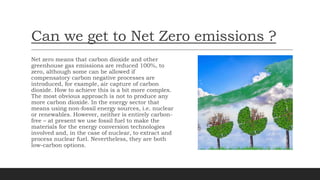
Net zero means that carbon dioxide and other
greenhouse gas emissions are reduced 100%, to
zero, although some can be allowed if
compensatory carbon negative processes are
introduced, for example, air capture of carbon
dioxide. How to achieve this is a bit more complex.
The most obvious approach is not to produce any
more carbon dioxide. In the energy sector that
means using non-fossil energy sources, i.e. nuclear
or renewables. However, neither is entirely carbon-
free – at present we use fossil fuel to make the
materials for the energy conversion technologies
involved and, in the case of nuclear, to extract and
process nuclear fuel. Nevertheless, they are both
low-carbon options.
What does it mean to be Net Zero ?
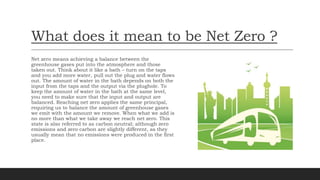
Net zero means achieving a balance between the
greenhouse gases put into the atmosphere and those
taken out. Think about it like a bath – turn on the taps
and you add more water, pull out the plug and water flows
out. The amount of water in the bath depends on both the
input from the taps and the output via the plughole. To
keep the amount of water in the bath at the same level,
you need to make sure that the input and output are
balanced. Reaching net zero applies the same principal,
requiring us to balance the amount of greenhouse gases
we emit with the amount we remove. When what we add is
no more than what we take away we reach net zero. This
state is also referred to as carbon neutral; although zero
emissions and zero carbon are slightly different, as they
usually mean that no emissions were produced in the first
place.
What is a Zero Carbon building ?
With increasing numbers of countries, states, cities and
organizations committing to carbon neutrality by mid-
century, zero carbon buildings are finally getting the
attention they deserve as a critical climate
solution. Buildings are responsible for nearly 40% of
global greenhouse gas emissions. The good news is that
both interest and investment in zero carbon buildings are
growing along with the launch of public commitments
and global initiatives. In the 2018 Johnson Controls
Energy Efficiency Indicator Study, 50% of 1,900 global
organizations in 20 countries plan to have at least one
zero carbon (or net zero energy) building over the next 10
years. Additionally, 59% of organizations plan to increase
investment in energy efficiency, renewable energy and
smart building technology next year. These investments
are key to decarbonizing both new and existing buildings.
How do we build a Zero Carbon
building ?
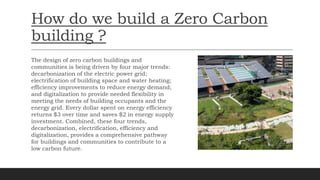
The design of zero carbon buildings and
communities is being driven by four major trends:
decarbonization of the electric power grid;
electrification of building space and water heating;
efficiency improvements to reduce energy demand;
and digitalization to provide needed flexibility in
meeting the needs of building occupants and the
energy grid. Every dollar spent on energy efficiency
returns $3 over time and saves $2 in energy supply
investment. Combined, these four trends,
decarbonization, electrification, efficiency and
digitalization, provides a comprehensive pathway
for buildings and communities to contribute to a
low carbon future.
Why does the world depend on
Net Zero ?
A host of countries have recently announced major commitments to
significantly cut their carbon emissions, promising to reach "net
zero" in the coming years. The term is becoming a global rallying
cry, frequently cited as a necessary step to successfully beat back
climate change, and the devastation it is causing. Put simply, net
zero means we are not adding new emissions to the atmosphere.
Emissions will continue, but will be balanced by absorbing an
equivalent amount from the atmosphere. Practically every country
has joined the Paris Agreement on climate change, which calls for
keeping the global temperature to 1.5°C above pre-industrial era
levels. If we continue to pump out the emissions that cause climate
change, however, temperatures will continue to rise well beyond
1.5, to levels that threaten the lives and livelihoods of people
everywhere. This is why a growing number of countries are making
commitments to achieve carbon neutrality, or "net zero" emissions
within the next few decades. It’s a big task, requiring ambitious
actions starting right now.
Net Zero.pptx

Net Zero.pptx

  • 1.
  • 2.
    What is NetZero Emissions and why does it matter ? Net-zero, which is also referred to as carbon- neutrality, does not mean that the world brings down its emissions to zero. Rather, reaching net- zero means offsetting any emission of CO2, this however isn’t the same as eliminating all greenhouse gases instead, it entails removing human-made CO2 emissions from the atmosphere. Absorption of the emissions can be increased by creating more carbon sinks such as forests, while removal of gases from the atmosphere requires futuristic technologies such as carbon capture technology and storage. For humans to stand a chance of limiting global warming to 1.5C, Human made CO2 emissions need to fall 45% by 2030 and the world needs to reach net-zero by 2050.
  • 3.
    Climate Change andGlobal Warming Evidence shows that our planet has been getting hotter. The warmest 20 years on record have been in the last 22 years and the warmest four were all very recent: 2015 to 2018. Global average temperatures are now 1℃ higher than in the pre-industrial era. A degree doesn’t sound like a lot, but the reality is that this incremental warming already appears to be having a negative impact. What’s more, if recent trends continue, this is set to worsen, with predictions of global temperatures increasing by as much as 3- 5℃ by 2100. Even with this tiny rise in global temperatures we are feeling the effects of climate change, with erratic weather patterns, including: heatwaves; floods and severe storms; loss of polar ice; and, rising sea levels. This will only get worse if global warming intensifies.
  • 4.
    What is causingthis Climate Change It’s widely recognized by scientists and governments that climate change is being triggered by higher levels of greenhouse gases in the atmosphere. Their name derives from the greenhouse effect they create by warming the Earth’s surface and the air above it. This is caused by gases that trap energy from the sun. The most common greenhouse gases are water vapor, carbon dioxide and methane. Carbon dioxide is the most dangerous and abundant of the greenhouse gases, which is why cutting carbon emissions, carbon footprints or seeking low-carbon alternatives are suggested as ways to address climate change.
  • 5.
    Can we getto Net Zero emissions ? Net zero means that carbon dioxide and other greenhouse gas emissions are reduced 100%, to zero, although some can be allowed if compensatory carbon negative processes are introduced, for example, air capture of carbon dioxide. How to achieve this is a bit more complex. The most obvious approach is not to produce any more carbon dioxide. In the energy sector that means using non-fossil energy sources, i.e. nuclear or renewables. However, neither is entirely carbon- free – at present we use fossil fuel to make the materials for the energy conversion technologies involved and, in the case of nuclear, to extract and process nuclear fuel. Nevertheless, they are both low-carbon options.
  • 6.
    What does itmean to be Net Zero ? Net zero means achieving a balance between the greenhouse gases put into the atmosphere and those taken out. Think about it like a bath – turn on the taps and you add more water, pull out the plug and water flows out. The amount of water in the bath depends on both the input from the taps and the output via the plughole. To keep the amount of water in the bath at the same level, you need to make sure that the input and output are balanced. Reaching net zero applies the same principal, requiring us to balance the amount of greenhouse gases we emit with the amount we remove. When what we add is no more than what we take away we reach net zero. This state is also referred to as carbon neutral; although zero emissions and zero carbon are slightly different, as they usually mean that no emissions were produced in the first place.
  • 7.
    What is aZero Carbon building ? With increasing numbers of countries, states, cities and organizations committing to carbon neutrality by mid- century, zero carbon buildings are finally getting the attention they deserve as a critical climate solution. Buildings are responsible for nearly 40% of global greenhouse gas emissions. The good news is that both interest and investment in zero carbon buildings are growing along with the launch of public commitments and global initiatives. In the 2018 Johnson Controls Energy Efficiency Indicator Study, 50% of 1,900 global organizations in 20 countries plan to have at least one zero carbon (or net zero energy) building over the next 10 years. Additionally, 59% of organizations plan to increase investment in energy efficiency, renewable energy and smart building technology next year. These investments are key to decarbonizing both new and existing buildings.
  • 8.
    How do webuild a Zero Carbon building ? The design of zero carbon buildings and communities is being driven by four major trends: decarbonization of the electric power grid; electrification of building space and water heating; efficiency improvements to reduce energy demand; and digitalization to provide needed flexibility in meeting the needs of building occupants and the energy grid. Every dollar spent on energy efficiency returns $3 over time and saves $2 in energy supply investment. Combined, these four trends, decarbonization, electrification, efficiency and digitalization, provides a comprehensive pathway for buildings and communities to contribute to a low carbon future.
  • 9.
    Why does theworld depend on Net Zero ? A host of countries have recently announced major commitments to significantly cut their carbon emissions, promising to reach "net zero" in the coming years. The term is becoming a global rallying cry, frequently cited as a necessary step to successfully beat back climate change, and the devastation it is causing. Put simply, net zero means we are not adding new emissions to the atmosphere. Emissions will continue, but will be balanced by absorbing an equivalent amount from the atmosphere. Practically every country has joined the Paris Agreement on climate change, which calls for keeping the global temperature to 1.5°C above pre-industrial era levels. If we continue to pump out the emissions that cause climate change, however, temperatures will continue to rise well beyond 1.5, to levels that threaten the lives and livelihoods of people everywhere. This is why a growing number of countries are making commitments to achieve carbon neutrality, or "net zero" emissions within the next few decades. It’s a big task, requiring ambitious actions starting right now.