Building Resilience
     for Adaptation to CC
         in Agriculture

Suzan Braatz | Cassandra de Young | Alexandre Meybeck
                         FAO

                    FAO Knowledge Day
                  Doha 1st December 2012
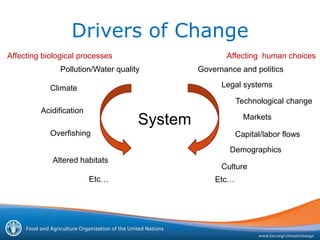
Drivers of Change
Affecting biological processes                       Affecting human choices
               Pollution/Water quality        Governance and politics

            Climate                                 Legal systems

                                                         Technological change
         Acidification
                                     System                Markets

            Overfishing                                  Capital/labor flows
                                                      Demographics
            Altered habitats
                                                    Culture
                         Etc…                     Etc…
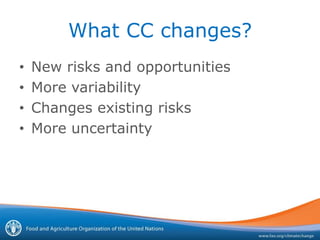
What CC changes?
•   New risks and opportunities
•   More variability
•   Changes existing risks
•   More uncertainty
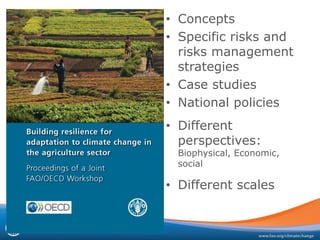
• Concepts
• Specific risks and
  risks management
  strategies
• Case studies
• National policies
• Different
  perspectives:
 Biophysical, Economic,
 social

• Different scales
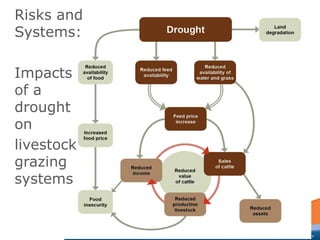
Risks and
Systems:

Impacts
of a
drought
on
livestock
grazing
systems
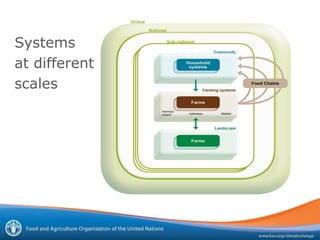
Systems
at different
scales
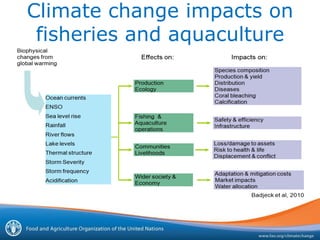
Climate change impacts on
 fisheries and aquaculture
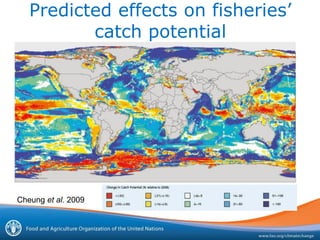
Predicted effects on fisheries’
          catch potential


Cheung et al. 2009
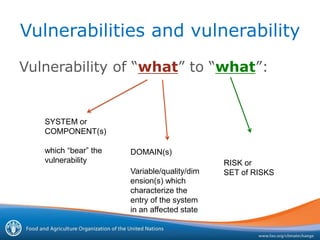
Vulnerabilities and vulnerability
Vulnerability of “what” to “what”:


   SYSTEM or
   COMPONENT(s)

   which “bear” the   DOMAIN(s)
   vulnerability                             RISK or
                      Variable/quality/dim   SET of RISKS
                      ension(s) which
                      characterize the
                      entry of the system
                      in an affected state
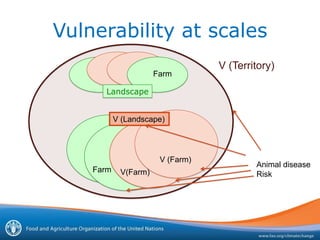
Vulnerability at scales
                                  V (Territory)
                      Farm

      Landscape


           V (Landscape)


                       V (Farm)
                                          Animal disease
    Farm    V(Farm)                       Risk
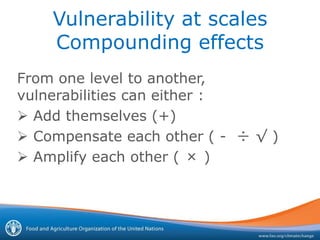
Vulnerability at scales
    Compounding effects
From one level to another,
vulnerabilities can either :
 Add themselves (+)
 Compensate each other ( - ÷ √ )
 Amplify each other ( × )
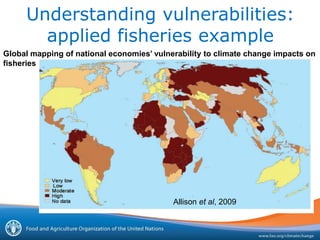
Understanding vulnerabilities:
       applied fisheries example
Global mapping of national economies’ vulnerability to climate change impacts on
fisheries


                                           Allison et al, 2009
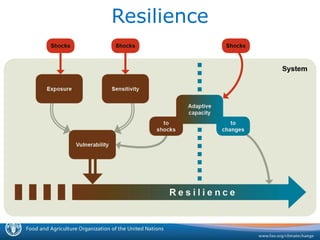
Resilience
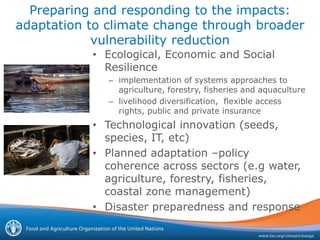
Preparing and responding to the impacts:
adaptation to climate change through broader
            vulnerability reduction
           • Ecological, Economic and Social
             Resilience
              – implementation of systems approaches to
                agriculture, forestry, fisheries and aquaculture
              – livelihood diversification, flexible access
                rights, public and private insurance
           • Technological innovation (seeds,
             species, IT, etc)
           • Planned adaptation –policy
             coherence across sectors (e.g water,
             agriculture, forestry, fisheries,
             coastal zone management)
           • Disaster preparedness and response
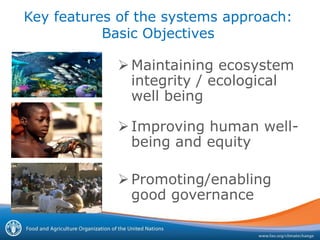
Key features of the systems approach:
           Basic Objectives

             Maintaining ecosystem
              integrity / ecological
              well being

             Improving human well-
              being and equity

             Promoting/enabling
              good governance
Comprehensive strategies
            to build resilience
     in a context of climate change
• Identify/understand all the risks,
  vulnerabilities, systems, dimensions, tools
  and their targets, and how CC act on
  them, is necessary prior to integration in a
  comprehensive approach towards
  resilience
• Reduce, or take account of amplification
  effects between risks
• Organize compensation
Content
Building resilience in/through forestry


    • Maximize resilience of forest ecosystems


    • Use forests and trees to increase human resilience


    • Build resilient landscapes

    • Adopt forest policies and build institutions
    conducive to resilience


     FAO Forestry
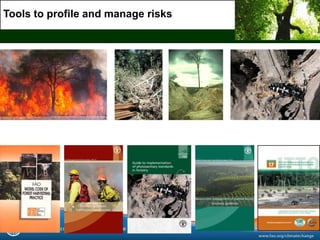
Tools to profile and manage risks
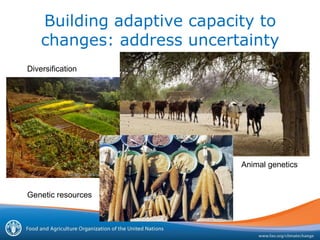
Building adaptive capacity to
    changes: address uncertainty
Diversification


                            Animal genetics


Genetic resources
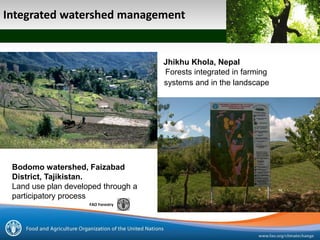
Integrated watershed management
                           z


                                    Policy Framework for
                                               Jhikhu Khola, Nepal
  •   Ds                                       Forests integrated in farming
                                            •  systems and in the landscape


 Bodomo watershed, Faizabad
 District, Tajikistan.
 Land use plan developed through a
 participatory process
                     FAO Forestry
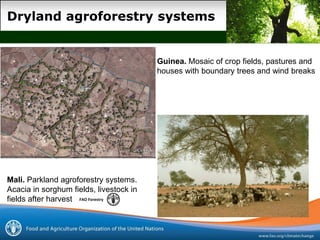
Dryland agroforestry systems
Content              z


                                         Guinea. Mosaic of crop fields, pastures and
                                         houses with boundary trees and wind breaks


Mali. Parkland agroforestry systems.
Acacia in sorghum fields, livestock in
fields after harvest FAO Forestry
Content
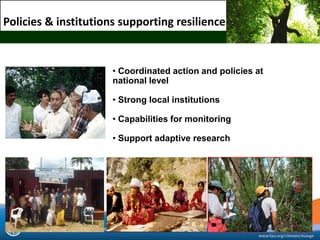
Policies & institutions supporting resilience


                      • Coordinated action and policies at
                      national level

                      • Strong local institutions

                      • Capabilities for monitoring

                      • Support adaptive research


     FAO Forestry