Chapter 4: Threads
4.2 Silberschatz, Galvin and Gagne ©2005
Operating System Concepts
Introduction
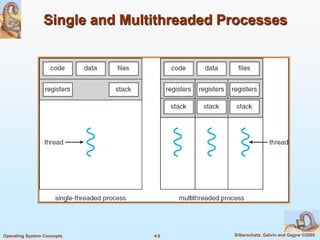
• A thread is a basic unit of CPU utilization; it
comprises a thread ID, a program counter, a
register set, and a stack.
• It shares with other threads belonging to the same
process its code section, data section, and other
operating-system resources, such as open files and
signals.
4.3 Silberschatz, Galvin and Gagne ©2005
Operating System Concepts
Introduction
• Let's say, for example, a program is not capable of
drawing pictures while reading keystrokes. The
program must give its full attention to the keyboard
input lacking the ability to handle more than one event
at a time.
• The ideal solution to this problem is the seamless
execution of two or more sections of a program at the
same time. Threads allows us to do this.
4.4 Silberschatz, Galvin and Gagne ©2005
Operating System Concepts
User Threads
 Mostsoftware applications that run on modern computers are
Multithreaded.
 An application typically is implemented as a separate process with
several threads of control.
 A web browser might have one thread display images or text while another
thread retrieves data from the network, for example.
 A word processor may have a thread for displaying graphics, another
thread for responding to keystrokes from the user, and a third thread for
performing spelling and grammar checking in the background.
4.5 Silberschatz, Galvin and Gagne ©2005
Operating System Concepts
Kernel Threads
 Finally, most operating-system kernels are now
multithreaded. Several threads operate in the
kernel, and each thread performs a specific
task, such as managing devices, managing
memory, or interrupt handling.
4.6 Silberschatz, Galvin and Gagne ©2005
Operating System Concepts
Single and Multithreaded Processes
4.7 Silberschatz, Galvin and Gagne ©2005
Operating System Concepts
Benefits
• Responsiveness– may allow continued execution if part
of process is blocked, especially important for user
interfaces.
• Resource Sharing– threads share resources of process,
easier than shared memory or message passing.
• Economy– cheaper than process creation, thread
switching lower overhead than context switching.
• Scalability– process can take advantage of multiprocessor
architectures.
4.8 Silberschatz, Galvin and Gagne ©2005
Operating System Concepts
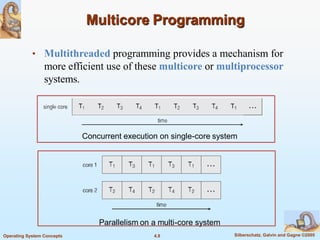
Multicore Programming
• Multithreaded programming provides a mechanism for
more efficient use of these multicore or multiprocessor
systems.
Concurrent execution on single-core system
Parallelism on a multi-core system
4.9 Silberschatz, Galvin and Gagne ©2005
Operating System Concepts
Multithreading Models
• Support for threads may be provided either at the user
level, for user threads, or by the kernel, for kernel
threads.
• User threads are supported above the kernel and are
managed without kernel support, whereas kernel
threads are supported and managed directly by the
operating system.
4.10 Silberschatz, Galvin and Gagne ©2005
Operating System Concepts
Multithreading Models
• Ultimately, a relationship must exist between user threads
and kernel threads.
• We look at three common models:
 the one-to-one model,
 the many-to-one model, and
 the many-to-many model.
4.11 Silberschatz, Galvin and Gagne ©2005
Operating System Concepts
Many-to-One
• Many user-level threads mapped to single kernel thread
• The Drawback is that the entire system will block if a
third makes blocking system call.
• Examples:
• Solaris Green Threads
• GNU Portable Threads
4.12 Silberschatz, Galvin and Gagne ©2005
Operating System Concepts
Many-to-One Model
4.13 Silberschatz, Galvin and Gagne ©2005
Operating System Concepts
One-to-One
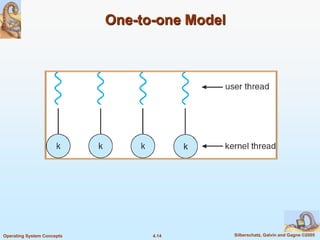
• Each user-level thread maps to kernel thread
• The one-to-one model maps each user thread to a
kernel thread. It also allows multiple threads to run in
parallel on multiprocessors.
• Examples
• Windows NT/XP/2000
• Linux
• Solaris 9 and later
4.14 Silberschatz, Galvin and Gagne ©2005
Operating System Concepts
One-to-one Model
4.15 Silberschatz, Galvin and Gagne ©2005
Operating System Concepts
One-to-One drawback
• The only drawback to this model is that creating a
user thread requires creating the corresponding
kernel thread.
• Because the overhead of creating kernel threads can
burden the performance of an application, most
implementations of this model restrict the number
of threads supported by the system.
• Linux, along with the family of Windows
operating systems, implement the one-to-one
model.
4.16 Silberschatz, Galvin and Gagne ©2005
Operating System Concepts
Many-to-Many Model
• Allows many user level threads to be mapped to many
kernel threads
• Allows the operating system to create a sufficient
number of kernel threads
• Allows the developer to create as many user threads as
she wishes, it does not result in true concurrency,
because the kernel can schedule only one thread at a
time.
• Examples
• Solaris prior to version 9
• Windows NT/2000 with the ThreadFiber package
4.17 Silberschatz, Galvin and Gagne ©2005
Operating System Concepts
Many-to-Many Model
4.18 Silberschatz, Galvin and Gagne ©2005
Operating System Concepts
Two-level Model
 Similar to M:M, except that it allows a user thread to be
bound to kernel thread
 Examples
 IRIX
 HP-UX
 Tru64 UNIX
 Solaris 8 and earlier
4.19 Silberschatz, Galvin and Gagne ©2005
Operating System Concepts
Two-level Model

OS-operating systems- ch04 (Threads) ...

  • 1.
  • 2.
    4.2 Silberschatz, Galvinand Gagne ©2005 Operating System Concepts Introduction • A thread is a basic unit of CPU utilization; it comprises a thread ID, a program counter, a register set, and a stack. • It shares with other threads belonging to the same process its code section, data section, and other operating-system resources, such as open files and signals.
  • 3.
    4.3 Silberschatz, Galvinand Gagne ©2005 Operating System Concepts Introduction • Let's say, for example, a program is not capable of drawing pictures while reading keystrokes. The program must give its full attention to the keyboard input lacking the ability to handle more than one event at a time. • The ideal solution to this problem is the seamless execution of two or more sections of a program at the same time. Threads allows us to do this.
  • 4.
    4.4 Silberschatz, Galvinand Gagne ©2005 Operating System Concepts User Threads  Mostsoftware applications that run on modern computers are Multithreaded.  An application typically is implemented as a separate process with several threads of control.  A web browser might have one thread display images or text while another thread retrieves data from the network, for example.  A word processor may have a thread for displaying graphics, another thread for responding to keystrokes from the user, and a third thread for performing spelling and grammar checking in the background.
  • 5.
    4.5 Silberschatz, Galvinand Gagne ©2005 Operating System Concepts Kernel Threads  Finally, most operating-system kernels are now multithreaded. Several threads operate in the kernel, and each thread performs a specific task, such as managing devices, managing memory, or interrupt handling.
  • 6.
    4.6 Silberschatz, Galvinand Gagne ©2005 Operating System Concepts Single and Multithreaded Processes
  • 7.
    4.7 Silberschatz, Galvinand Gagne ©2005 Operating System Concepts Benefits • Responsiveness– may allow continued execution if part of process is blocked, especially important for user interfaces. • Resource Sharing– threads share resources of process, easier than shared memory or message passing. • Economy– cheaper than process creation, thread switching lower overhead than context switching. • Scalability– process can take advantage of multiprocessor architectures.
  • 8.
    4.8 Silberschatz, Galvinand Gagne ©2005 Operating System Concepts Multicore Programming • Multithreaded programming provides a mechanism for more efficient use of these multicore or multiprocessor systems. Concurrent execution on single-core system Parallelism on a multi-core system
  • 9.
    4.9 Silberschatz, Galvinand Gagne ©2005 Operating System Concepts Multithreading Models • Support for threads may be provided either at the user level, for user threads, or by the kernel, for kernel threads. • User threads are supported above the kernel and are managed without kernel support, whereas kernel threads are supported and managed directly by the operating system.
  • 10.
    4.10 Silberschatz, Galvinand Gagne ©2005 Operating System Concepts Multithreading Models • Ultimately, a relationship must exist between user threads and kernel threads. • We look at three common models:  the one-to-one model,  the many-to-one model, and  the many-to-many model.
  • 11.
    4.11 Silberschatz, Galvinand Gagne ©2005 Operating System Concepts Many-to-One • Many user-level threads mapped to single kernel thread • The Drawback is that the entire system will block if a third makes blocking system call. • Examples: • Solaris Green Threads • GNU Portable Threads
  • 12.
    4.12 Silberschatz, Galvinand Gagne ©2005 Operating System Concepts Many-to-One Model
  • 13.
    4.13 Silberschatz, Galvinand Gagne ©2005 Operating System Concepts One-to-One • Each user-level thread maps to kernel thread • The one-to-one model maps each user thread to a kernel thread. It also allows multiple threads to run in parallel on multiprocessors. • Examples • Windows NT/XP/2000 • Linux • Solaris 9 and later
  • 14.
    4.14 Silberschatz, Galvinand Gagne ©2005 Operating System Concepts One-to-one Model
  • 15.
    4.15 Silberschatz, Galvinand Gagne ©2005 Operating System Concepts One-to-One drawback • The only drawback to this model is that creating a user thread requires creating the corresponding kernel thread. • Because the overhead of creating kernel threads can burden the performance of an application, most implementations of this model restrict the number of threads supported by the system. • Linux, along with the family of Windows operating systems, implement the one-to-one model.
  • 16.
    4.16 Silberschatz, Galvinand Gagne ©2005 Operating System Concepts Many-to-Many Model • Allows many user level threads to be mapped to many kernel threads • Allows the operating system to create a sufficient number of kernel threads • Allows the developer to create as many user threads as she wishes, it does not result in true concurrency, because the kernel can schedule only one thread at a time. • Examples • Solaris prior to version 9 • Windows NT/2000 with the ThreadFiber package
  • 17.
    4.17 Silberschatz, Galvinand Gagne ©2005 Operating System Concepts Many-to-Many Model
  • 18.
    4.18 Silberschatz, Galvinand Gagne ©2005 Operating System Concepts Two-level Model  Similar to M:M, except that it allows a user thread to be bound to kernel thread  Examples  IRIX  HP-UX  Tru64 UNIX  Solaris 8 and earlier
  • 19.
    4.19 Silberschatz, Galvinand Gagne ©2005 Operating System Concepts Two-level Model