Presented By – Ajay Gautam
 Amines are derivatives of ammonia in which one or more
hydrogen atoms have been replaced by alkyl group.
CLASSIFICATION
 Primary (1⁰) amine: one alkyl or aryl (C6H5NH2) group attached to the nitrogen atom.
 Secondary (2⁰) amine: two alkyl or aryl group attached to the nitrogen atom.
 Tertiary (3⁰) amine: three alkyl or aryl group attached to the nitrogen atom.
 Quaternary (4⁰) amine:an ion in which nitrogen is bonded to four alkyl or aryl groups and bears
a positive charge.
COMMON AMINES WE MAY HAVE HEARD OF
:
AROMATIC AMINES
• These are the derivatives of aromatic hydrocarbon in which a hydrogen of benzene ring has
been replaced by amino group.
• All such compound in which an amino or substituted amino group is bonded directly to an
aromatic ring are termed as aromatic amines.
p - toluidine
Click to edit Master title style
6
• Common Names :
Formed from the names of the alkyl groups bonded to nitrogen, followed by
the suffix –amine. - the prefixes di-, tri-, and tetra- are used to decribe two,
three or four identical substituents.
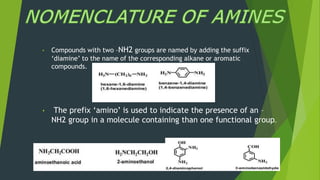
• Compounds with two –NH2 groups are named by adding the suffix
‘diamine’ to the name of the corresponding alkane or aromatic
compounds.
• The prefix ‘amino’ is used to indicate the presence of an –
NH2 group in a molecule containing than one functional group.
KEY WORDS
• BASICITY
• LEWIS BASE
• ELECTRON DENSITY
• INDUCTIVE EFFECT
• STERIC HINDERANCE
 Amines are basic because they possess a pair of unshared
electrons, which they can share with other atoms. These
unshared electrons create an electron density around the
nitrogen atom. The greater the electron density, the more
basic the molecule.
 Aryl amines are basic compounds due to pressence of lone of electron present on
nitrogen.
 Incase of ethyl amine, the lone pair of electron localized on the nitrogen atom.
 Incase of aromatic amines, lone pair of electron deloaclized on the benzene ring.
 As the electron density decreases and basicity also decreases. Hence ethyl amine is
more basic than aromatic amines.
 Aromatic amines react with HCl or acid to form salt.
 Aromatic amines are lewis base because they donate electron pair to form bond.
 Aromatic amines are also bronsted-Lowry base because they accept hydrogen to form
salt.
• For alkyl halides in the gas phase, the order of base strength is given below:
(CH 3) 3 N > (CH 3) 2NH > CH 3NH 2 > NH 3
3⁰ > 2 ⁰ > 1 ⁰
• In aqueous solutions, the order of basicity changes.
(CH 3) 2 NH > CH 3NH 2 > (CH 3) 3N > NH 3
2 ⁰> 3⁰ >1
The differences in the basicity order in the gas phase and aqueous solutions are the result
of solvation effects

Aromatic amines

  • 1.
    Presented By –Ajay Gautam
  • 2.
     Amines arederivatives of ammonia in which one or more hydrogen atoms have been replaced by alkyl group.
  • 3.
    CLASSIFICATION  Primary (1⁰)amine: one alkyl or aryl (C6H5NH2) group attached to the nitrogen atom.  Secondary (2⁰) amine: two alkyl or aryl group attached to the nitrogen atom.  Tertiary (3⁰) amine: three alkyl or aryl group attached to the nitrogen atom.  Quaternary (4⁰) amine:an ion in which nitrogen is bonded to four alkyl or aryl groups and bears a positive charge.
  • 4.
    COMMON AMINES WEMAY HAVE HEARD OF :
  • 5.
    AROMATIC AMINES • Theseare the derivatives of aromatic hydrocarbon in which a hydrogen of benzene ring has been replaced by amino group. • All such compound in which an amino or substituted amino group is bonded directly to an aromatic ring are termed as aromatic amines. p - toluidine
  • 6.
    Click to editMaster title style 6 • Common Names : Formed from the names of the alkyl groups bonded to nitrogen, followed by the suffix –amine. - the prefixes di-, tri-, and tetra- are used to decribe two, three or four identical substituents.
  • 7.
    • Compounds withtwo –NH2 groups are named by adding the suffix ‘diamine’ to the name of the corresponding alkane or aromatic compounds. • The prefix ‘amino’ is used to indicate the presence of an – NH2 group in a molecule containing than one functional group.
  • 9.
    KEY WORDS • BASICITY •LEWIS BASE • ELECTRON DENSITY • INDUCTIVE EFFECT • STERIC HINDERANCE
  • 10.
     Amines arebasic because they possess a pair of unshared electrons, which they can share with other atoms. These unshared electrons create an electron density around the nitrogen atom. The greater the electron density, the more basic the molecule.
  • 11.
     Aryl aminesare basic compounds due to pressence of lone of electron present on nitrogen.  Incase of ethyl amine, the lone pair of electron localized on the nitrogen atom.  Incase of aromatic amines, lone pair of electron deloaclized on the benzene ring.  As the electron density decreases and basicity also decreases. Hence ethyl amine is more basic than aromatic amines.  Aromatic amines react with HCl or acid to form salt.  Aromatic amines are lewis base because they donate electron pair to form bond.  Aromatic amines are also bronsted-Lowry base because they accept hydrogen to form salt.
  • 12.
    • For alkylhalides in the gas phase, the order of base strength is given below: (CH 3) 3 N > (CH 3) 2NH > CH 3NH 2 > NH 3 3⁰ > 2 ⁰ > 1 ⁰ • In aqueous solutions, the order of basicity changes. (CH 3) 2 NH > CH 3NH 2 > (CH 3) 3N > NH 3 2 ⁰> 3⁰ >1 The differences in the basicity order in the gas phase and aqueous solutions are the result of solvation effects