Isotonicity
PHT 434
osmosis
• Osmosis is the diffusion of solvent through a semi-
permeable membrane.
▫ Water always flows from lower solute concentration
[dilute solution] to higher solute concentration until a
balance is produced
• Osmotic pressure is the force that cause this
diffusion .
• Tonicity is a measure of the
osmotic pressure of two solutions
separated by a semi-permeable
membrane.
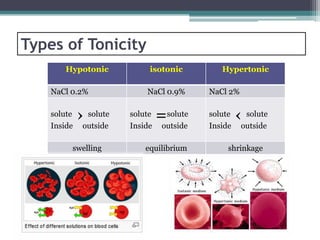
Types of Tonicity
Hypertonic
isotonic
Hypotonic
NaCl 2%
NaCl 0.9%
NaCl 0.2%
solute ‹ solute
Inside outside
solute =solute
Inside outside
solute › solute
Inside outside
shrinkage
equilibrium
swelling
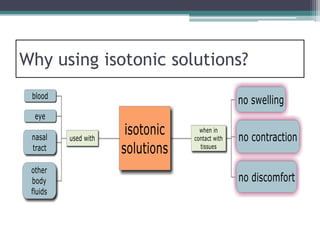
Why using isotonic solutions?
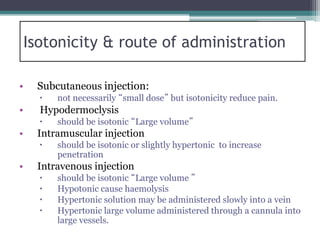
Isotonicity & route of administration
• Subcutaneous injection:
 not necessarily “small dose” but isotonicity reduce pain.
• Hypodermoclysis
 should be isotonic “Large volume”
• Intramuscular injection
 should be isotonic or slightly hypertonic to increase
penetration
• Intravenous injection
 should be isotonic “Large volume ”
 Hypotonic cause haemolysis
 Hypertonic solution may be administered slowly into a vein
 Hypertonic large volume administered through a cannula into
large vessels.
Isotonicity & route of administration
cont.
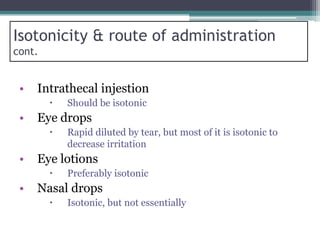
• Intrathecal injestion
 Should be isotonic
• Eye drops
 Rapid diluted by tear, but most of it is isotonic to
decrease irritation
• Eye lotions
 Preferably isotonic
• Nasal drops
 Isotonic, but not essentially
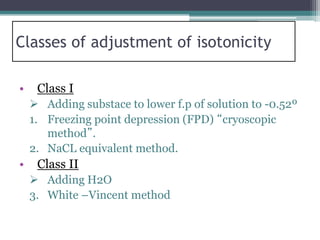
Classes of adjustment of isotonicity
• Class I
 Adding substace to lower f.p of solution to -0.52º
1. Freezing point depression (FPD) “cryoscopic
method”.
2. NaCL equivalent method.
• Class II
 Adding H2O
3. White –Vincent method
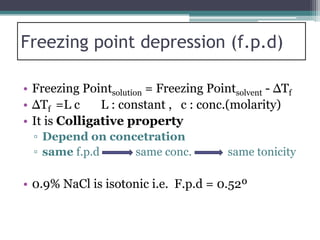
Freezing point depression (f.p.d)
• Freezing Pointsolution = Freezing Pointsolvent - ΔTf
• ΔTf =L c L : constant , c : conc.(molarity)
• It is Colligative property
▫ Depend on concetration
▫ same f.p.d same conc. same tonicity
• 0.9% NaCl is isotonic i.e. F.p.d = 0.52º
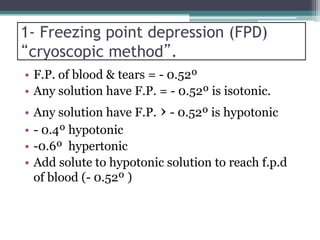
1- Freezing point depression (FPD)
“cryoscopic method”.
• F.P. of blood & tears = - 0.52º
• Any solution have F.P. = - 0.52º is isotonic.
• Any solution have F.P. › - 0.52º is hypotonic
• - 0.4º hypotonic
• -0.6º hypertonic
• Add solute to hypotonic solution to reach f.p.d
of blood (- 0.52º )
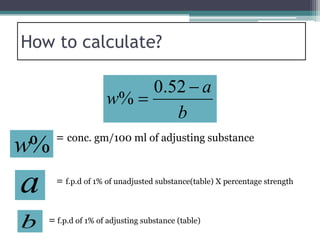
How to calculate?
= conc. gm/100 ml of adjusting substance
= f.p.d of 1% of unadjusted substance(table) X percentage strength
= f.p.d of 1% of adjusting substance (table)
b
a
w


52
.
0
%
%
w
a
b
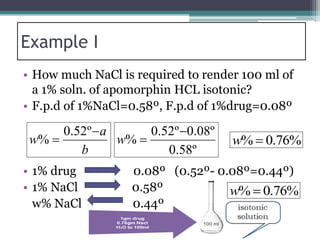
Example I
• How much NaCl is required to render 100 ml of
a 1% soln. of apomorphin HCL isotonic?
• F.p.d of 1%NaCl=0.58º, F.p.d of 1%drug=0.08º
• 1% drug 0.08º (0.52º- 0.08º=0.44º)
• 1% NaCl 0.58º
w% NaCl 0.44º
b
a
w


º
52
.
0
% %
76
.
0
% 
w
º
58
.
0
º
08
.
0
º
52
.
0
%


w
%
76
.
0
% 
w
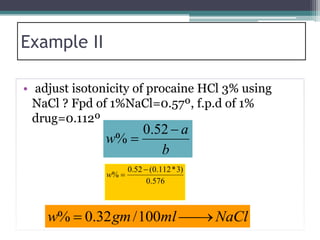
Example II
• adjust isotonicity of procaine HCl 3% using
NaCl ? Fpd of 1%NaCl=0.57º, f.p.d of 1%
drug=0.112º
b
a
w


52
.
0
%
576
.
0
)
3
*
112
.
0
(
52
.
0
%


w
NaCl
ml
gm
w 

 100
/
32
.
0
%
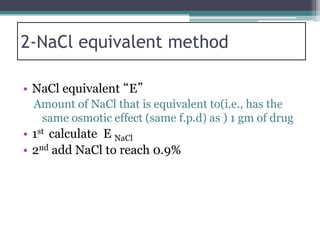
2-NaCl equivalent method
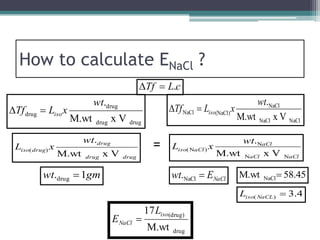
• NaCl equivalent “E”
Amount of NaCl that is equivalent to(i.e., has the
same osmotic effect (same f.p.d) as ) 1 gm of drug
• 1st calculate E NaCl
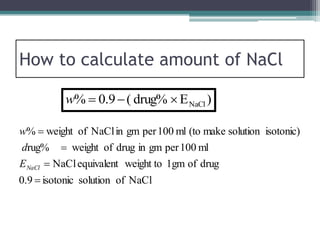
• 2nd add NaCl to reach 0.9%
How to calculate ENaCl ?
drug
drug
drug
drug
V
x
M.wt
.
wt
x
L
Tf iso


NaCl
NaCl
NaCl
(NaCl)
NaCl
V
x
M.wt
.
wt
x
L
Tf iso


aCl
aCl
aCl
aCl
iso
wt
x
L
N
N
N
)
N
(
V
x
M.wt
.
45
.
58
M.wt NaCl
=
drug
(drug)
M.wt
17 iso
NaCl
L
E 
c
L
Tf .


gm
wt 1
.drug  NaCl
E
wt 
NaCl
.
4
.
3
)
( 
NaCL
iso
L
drug
drug
drug
drug
iso
wt
x
L
V
x
M.wt
.
)
(
How to calculate amount of NaCl
NaCl
of
solution
isotonic
9
.
0
drug
of
1gm
weight to
equivalent
NaCl
ml
100
per
gm
in
drug
of
weight
rug%
isotonic)
solution
make
(to
ml
100
per
gm
in
NaCl
of
weight
%




NaCl
E
d
w
)
E
drug%
(
9
.
0
% NaCl



w
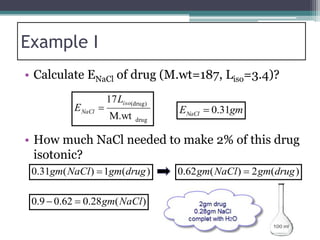
Example I
• Calculate ENaCl of drug (M.wt=187, Liso=3.4)?
• How much NaCl needed to make 2% of this drug
isotonic?
gm
ENaCl 31
.
0

drug
(drug)
M.wt
17 iso
NaCl
L
E 
)
(
1
)
(
31
.
0 drug
gm
NaCl
gm 
)
(
28
.
0
62
.
0
9
.
0 NaCl
gm


)
(
2
)
(
62
.
0 drug
gm
NaCl
gm 
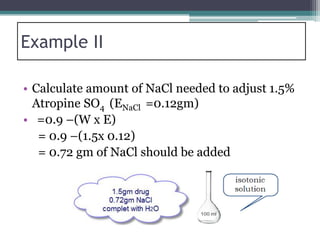
Example II
• Calculate amount of NaCl needed to adjust 1.5%
Atropine SO4 (ENaCl =0.12gm)
• =0.9 –(W x E)
= 0.9 –(1.5x 0.12)
= 0.72 gm of NaCl should be added
3-White – Vincent method
• Principle:
▫ 1st Addition of H2O to drug to make it isotonic
▫ 2nd addition of isotonic vehicle to bring solution to
final volume
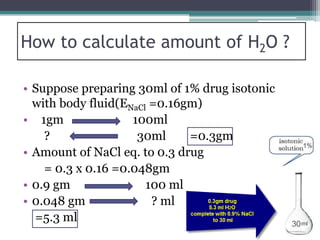
How to calculate amount of H2O ?
• Suppose preparing 30ml of 1% drug isotonic
with body fluid(ENaCl =0.16gm)
• 1gm 100ml
? 30ml =0.3gm
• Amount of NaCl eq. to 0.3 drug
= 0.3 x 0.16 =0.048gm
• 0.9 gm 100 ml
• 0.048 gm ? ml
=5.3 ml
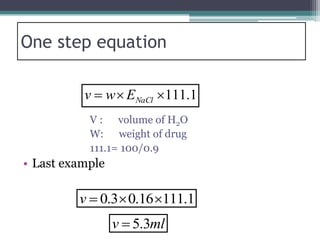
One step equation
V : volume of H2O
W: weight of drug
111.1= 100/0.9
• Last example
1
.
111


 NaCl
E
w
v
1
.
111
16
.
0
3
.
0 


v
ml
v 3
.
5

II
example
Add volume of H2O and then complete with
isotonic solution
Phenacaine HCl 0.06 gm (ENaCl=0.16)
Boric acid 0.3 gm (ENaCl=0.5)
sterile distilled H2O up to 100 ml
V = 111.1 x(weight x ENaCl)
V =111.1 x [(0.06x0.16)+(0.3x0.5)] = 17.7 ml H2O

Isotonicity.ppt

  • 1.
  • 2.
    osmosis • Osmosis isthe diffusion of solvent through a semi- permeable membrane. ▫ Water always flows from lower solute concentration [dilute solution] to higher solute concentration until a balance is produced • Osmotic pressure is the force that cause this diffusion . • Tonicity is a measure of the osmotic pressure of two solutions separated by a semi-permeable membrane.
  • 3.
    Types of Tonicity Hypertonic isotonic Hypotonic NaCl2% NaCl 0.9% NaCl 0.2% solute ‹ solute Inside outside solute =solute Inside outside solute › solute Inside outside shrinkage equilibrium swelling
  • 4.
  • 5.
    Isotonicity & routeof administration • Subcutaneous injection:  not necessarily “small dose” but isotonicity reduce pain. • Hypodermoclysis  should be isotonic “Large volume” • Intramuscular injection  should be isotonic or slightly hypertonic to increase penetration • Intravenous injection  should be isotonic “Large volume ”  Hypotonic cause haemolysis  Hypertonic solution may be administered slowly into a vein  Hypertonic large volume administered through a cannula into large vessels.
  • 6.
    Isotonicity & routeof administration cont. • Intrathecal injestion  Should be isotonic • Eye drops  Rapid diluted by tear, but most of it is isotonic to decrease irritation • Eye lotions  Preferably isotonic • Nasal drops  Isotonic, but not essentially
  • 7.
    Classes of adjustmentof isotonicity • Class I  Adding substace to lower f.p of solution to -0.52º 1. Freezing point depression (FPD) “cryoscopic method”. 2. NaCL equivalent method. • Class II  Adding H2O 3. White –Vincent method
  • 8.
    Freezing point depression(f.p.d) • Freezing Pointsolution = Freezing Pointsolvent - ΔTf • ΔTf =L c L : constant , c : conc.(molarity) • It is Colligative property ▫ Depend on concetration ▫ same f.p.d same conc. same tonicity • 0.9% NaCl is isotonic i.e. F.p.d = 0.52º
  • 9.
    1- Freezing pointdepression (FPD) “cryoscopic method”. • F.P. of blood & tears = - 0.52º • Any solution have F.P. = - 0.52º is isotonic. • Any solution have F.P. › - 0.52º is hypotonic • - 0.4º hypotonic • -0.6º hypertonic • Add solute to hypotonic solution to reach f.p.d of blood (- 0.52º )
  • 10.
    How to calculate? =conc. gm/100 ml of adjusting substance = f.p.d of 1% of unadjusted substance(table) X percentage strength = f.p.d of 1% of adjusting substance (table) b a w   52 . 0 % % w a b
  • 11.
    Example I • Howmuch NaCl is required to render 100 ml of a 1% soln. of apomorphin HCL isotonic? • F.p.d of 1%NaCl=0.58º, F.p.d of 1%drug=0.08º • 1% drug 0.08º (0.52º- 0.08º=0.44º) • 1% NaCl 0.58º w% NaCl 0.44º b a w   º 52 . 0 % % 76 . 0 %  w º 58 . 0 º 08 . 0 º 52 . 0 %   w % 76 . 0 %  w
  • 12.
    Example II • adjustisotonicity of procaine HCl 3% using NaCl ? Fpd of 1%NaCl=0.57º, f.p.d of 1% drug=0.112º b a w   52 . 0 % 576 . 0 ) 3 * 112 . 0 ( 52 . 0 %   w NaCl ml gm w    100 / 32 . 0 %
  • 13.
    2-NaCl equivalent method •NaCl equivalent “E” Amount of NaCl that is equivalent to(i.e., has the same osmotic effect (same f.p.d) as ) 1 gm of drug • 1st calculate E NaCl • 2nd add NaCl to reach 0.9%
  • 14.
    How to calculateENaCl ? drug drug drug drug V x M.wt . wt x L Tf iso   NaCl NaCl NaCl (NaCl) NaCl V x M.wt . wt x L Tf iso   aCl aCl aCl aCl iso wt x L N N N ) N ( V x M.wt . 45 . 58 M.wt NaCl = drug (drug) M.wt 17 iso NaCl L E  c L Tf .   gm wt 1 .drug  NaCl E wt  NaCl . 4 . 3 ) (  NaCL iso L drug drug drug drug iso wt x L V x M.wt . ) (
  • 15.
    How to calculateamount of NaCl NaCl of solution isotonic 9 . 0 drug of 1gm weight to equivalent NaCl ml 100 per gm in drug of weight rug% isotonic) solution make (to ml 100 per gm in NaCl of weight %     NaCl E d w ) E drug% ( 9 . 0 % NaCl    w
  • 16.
    Example I • CalculateENaCl of drug (M.wt=187, Liso=3.4)? • How much NaCl needed to make 2% of this drug isotonic? gm ENaCl 31 . 0  drug (drug) M.wt 17 iso NaCl L E  ) ( 1 ) ( 31 . 0 drug gm NaCl gm  ) ( 28 . 0 62 . 0 9 . 0 NaCl gm   ) ( 2 ) ( 62 . 0 drug gm NaCl gm 
  • 17.
    Example II • Calculateamount of NaCl needed to adjust 1.5% Atropine SO4 (ENaCl =0.12gm) • =0.9 –(W x E) = 0.9 –(1.5x 0.12) = 0.72 gm of NaCl should be added
  • 18.
    3-White – Vincentmethod • Principle: ▫ 1st Addition of H2O to drug to make it isotonic ▫ 2nd addition of isotonic vehicle to bring solution to final volume
  • 19.
    How to calculateamount of H2O ? • Suppose preparing 30ml of 1% drug isotonic with body fluid(ENaCl =0.16gm) • 1gm 100ml ? 30ml =0.3gm • Amount of NaCl eq. to 0.3 drug = 0.3 x 0.16 =0.048gm • 0.9 gm 100 ml • 0.048 gm ? ml =5.3 ml
  • 20.
    One step equation V: volume of H2O W: weight of drug 111.1= 100/0.9 • Last example 1 . 111    NaCl E w v 1 . 111 16 . 0 3 . 0    v ml v 3 . 5 
  • 21.
    II example Add volume ofH2O and then complete with isotonic solution Phenacaine HCl 0.06 gm (ENaCl=0.16) Boric acid 0.3 gm (ENaCl=0.5) sterile distilled H2O up to 100 ml V = 111.1 x(weight x ENaCl) V =111.1 x [(0.06x0.16)+(0.3x0.5)] = 17.7 ml H2O

Editor's Notes

  • #6 subcutaneous infusion, is the subcutaneous administration of fluids to the body. This would often be in the form of a saline or glucose solution
  • #9 Colligative properties are properties of solutions that depend on the number of molecules in a given volume of solvent and not on the properties (e.g. size or mass) of the molecules.