Dr. Ahmed M. Moutlk
College of pharmacy/ Al-Safwa University
Introduction
 When two solutions (one is diluted and the other
is concentrated) are separated by a semipermeable
membrane, water will move from the diluted to the
concentrated solution and finally the concentrations of
them become equalized. This phenomenon is known as
osmosis and the pressure responsible for this
phenomenon is termed osmotic pressure.
 A solution having the same osmotic pressure as a specific body fluid
is termed isotonic (meaning of equal tone) with that specific body
fluid. Solutions of lower osmotic pressure than that of a body fluid
are termed hypotonic, whereas those having a higher osmotic
pressure are termed hypertonic.
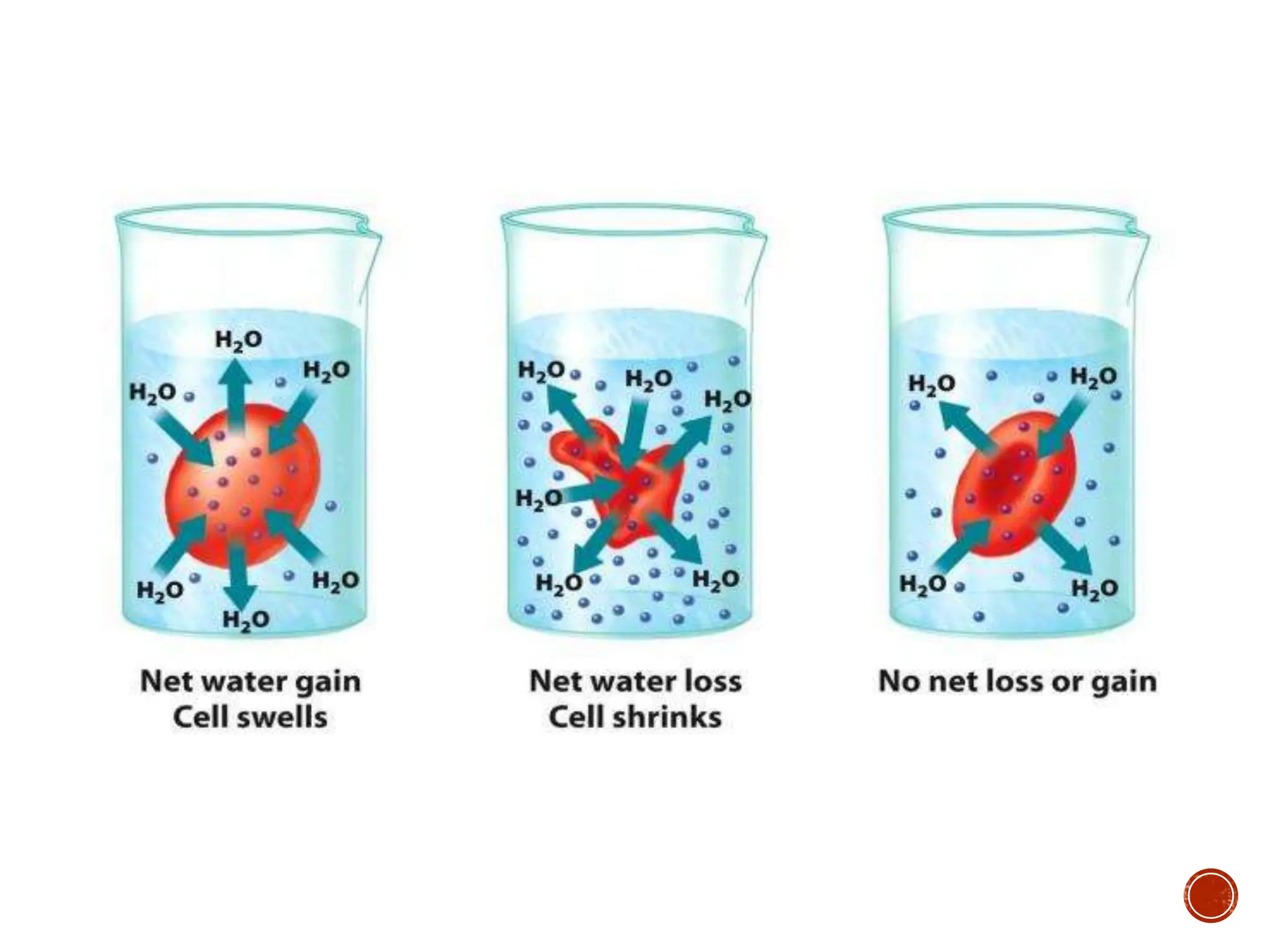
 If a blood sample is placed in hypotonic solution, water will move
inside the red blood cells and this cause swelling of them. On the
other hand, if it is placed in hypertonic solution, water will move out
of blood cells causing their shrinkage. If the blood is placed in
isotonic solution, water will move in and out of cells in the same
amount thus, they remain normal.
 Dosage forms intended to be administered to the blood, eye, nose,
and bowel should be isotonic due to the following reasons:
 They should be isotonic to reduce the likelihood of irritation to the
tissues and to ensure comfort of the patient.
 Intravenous infusions which are hypotonic or hypertonic can have
adverse effects (either swelling or shrinkage of red blood cells)
because they generally are administered in large volumes.
CALCULATION OF ISOTONICITY
 The calculation of isotonicity is important to see if a certain drug
solution is isotonic with the body or not. We can calculate the
isotonicity depending on a physical property called freezing point
depression.
 The freezing point of pure water is zero 0C. If any material (such as
sodium chloride) is added to pure water, the freezing point decreases
below zero 0C. This phenomenon is called freezing point depression
and it depends on the amount of the material added.
 They found that all body fluid such as blood, plasma, serum and
tears have freezing point equal to (- 0.52 0C). They found also that
any solution having the same freezing point as that of body fluid (-
0.52 0C) will be isotonic. In addition, it is found that 0.9% sodium
chloride solution has a freezing point equal to (- 0.52 0C) and
therefore, it is isotonic. The 0.9% sodium chloride solution is made
reference to calculate the isotonicity of any other solution.
Example 1: How much additional sodium chloride should be added
to 0.5% w/v sodium chloride solution to make it isotonic?
Answer: the concentration of isotonic sodium chloride solution is
0.9%, this means that 0.9 gm/100 ml water.
0.5% means that 0.5 gm /100 ml water.
Then 0.9 – 0.5 = 0.4 gm of NaCl should be added to 100 ml 0.5%
solution to be made isotonic with body fluid.
The relative quantity of sodium chloride that has an isotonic effect
equivalent to a certain quantity of other material is called sodium
chloride equivalents or E values.
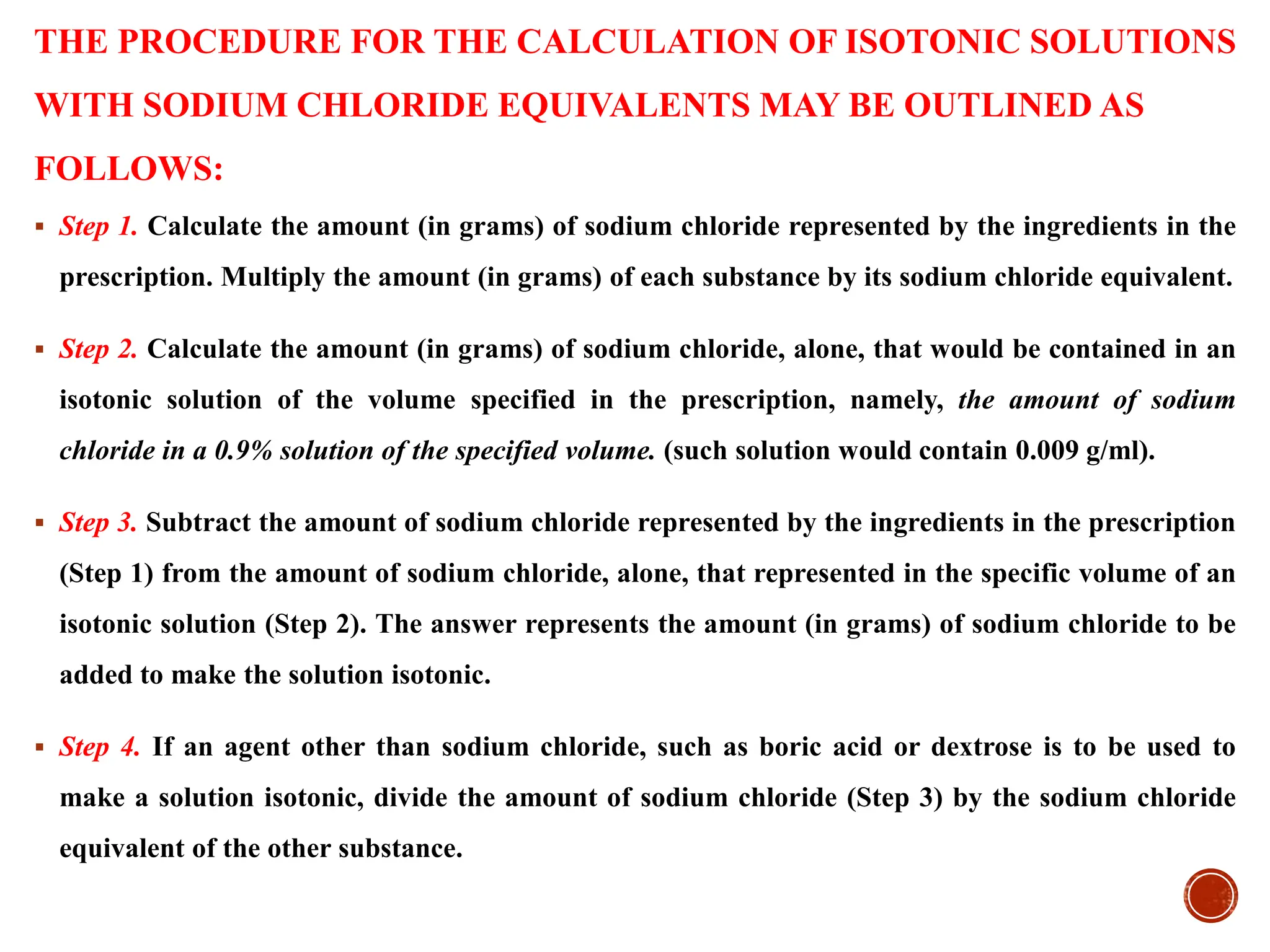
THE PROCEDURE FOR THE CALCULATION OF ISOTONIC SOLUTIONS
WITH SODIUM CHLORIDE EQUIVALENTS MAY BE OUTLINED AS
FOLLOWS:
 Step 1. Calculate the amount (in grams) of sodium chloride represented by the ingredients in the
prescription. Multiply the amount (in grams) of each substance by its sodium chloride equivalent.
 Step 2. Calculate the amount (in grams) of sodium chloride, alone, that would be contained in an
isotonic solution of the volume specified in the prescription, namely, the amount of sodium
chloride in a 0.9% solution of the specified volume. (such solution would contain 0.009 g/ml).
 Step 3. Subtract the amount of sodium chloride represented by the ingredients in the prescription
(Step 1) from the amount of sodium chloride, alone, that represented in the specific volume of an
isotonic solution (Step 2). The answer represents the amount (in grams) of sodium chloride to be
added to make the solution isotonic.
 Step 4. If an agent other than sodium chloride, such as boric acid or dextrose is to be used to
make a solution isotonic, divide the amount of sodium chloride (Step 3) by the sodium chloride
equivalent of the other substance.
Example 2: How many grams of sodium chloride should be used in
compounding the following prescription? If you know that the E
value of Pilocarpine nitrate is 0.23
Rx
Pilocarpine nitrate 0.3
Sodium chloride q.s.
Purified water ad 30 ml
Make isoton. Sol.
Sig. for the eye
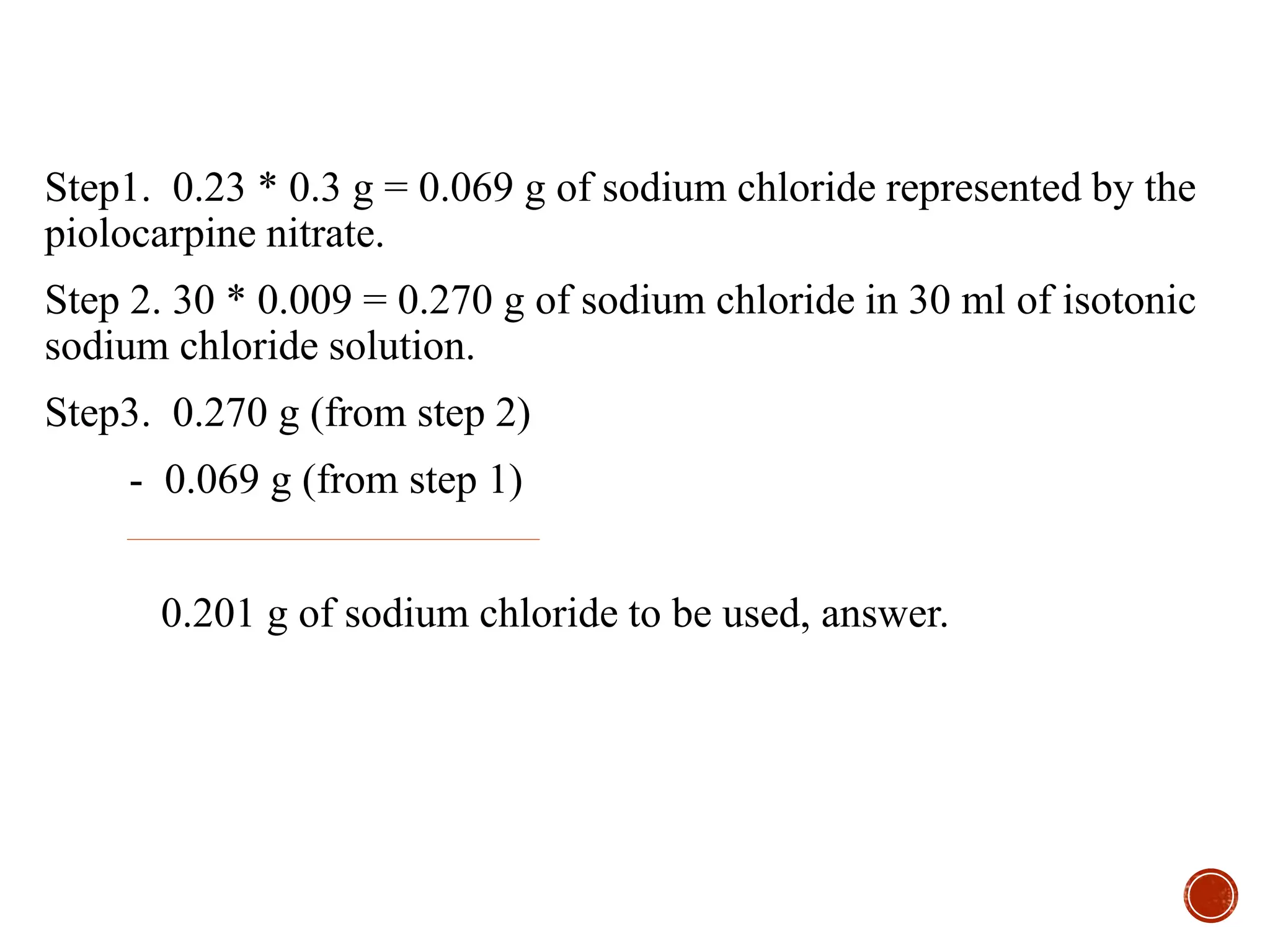
Step1. 0.23 * 0.3 g = 0.069 g of sodium chloride represented by the
piolocarpine nitrate.
Step 2. 30 * 0.009 = 0.270 g of sodium chloride in 30 ml of isotonic
sodium chloride solution.
Step3. 0.270 g (from step 2)
- 0.069 g (from step 1)
0.201 g of sodium chloride to be used, answer.
Example 3: How many grams of Boric acid should be used in compounding
the following prescreptioin? (E value of Phenacaine Hydrochloride is 0.20, E
value of Chlorobutanol is 0.24, E value of Boric acid is 0.52)
Rx
Phenacaine Hydrochloride 1%
Chlorobutanol 0.5 %
Boric acid q.s.
Purified water ad 60
Make isoton. Sol.
Sig. One drop in each eye.
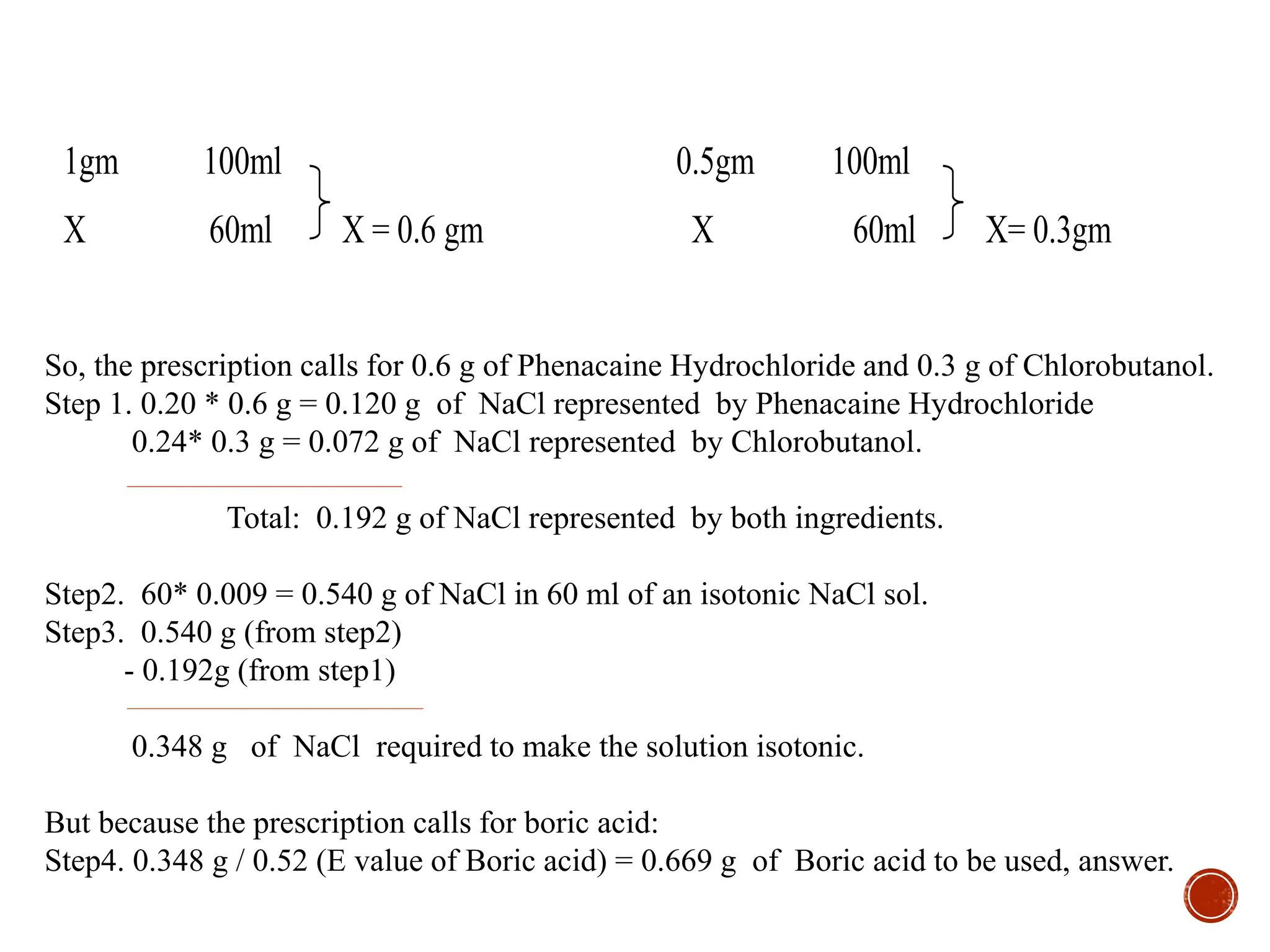
1gm 100ml 0.5gm 100ml
X 60ml X = 0.6 gm X 60ml X= 0.3gm
So, the prescription calls for 0.6 g of Phenacaine Hydrochloride and 0.3 g of Chlorobutanol.
Step 1. 0.20 * 0.6 g = 0.120 g of NaCl represented by Phenacaine Hydrochloride
0.24* 0.3 g = 0.072 g of NaCl represented by Chlorobutanol.
Total: 0.192 g of NaCl represented by both ingredients.
Step2. 60* 0.009 = 0.540 g of NaCl in 60 ml of an isotonic NaCl sol.
Step3. 0.540 g (from step2)
- 0.192g (from step1)
0.348 g of NaCl required to make the solution isotonic.
But because the prescription calls for boric acid:
Step4. 0.348 g / 0.52 (E value of Boric acid) = 0.669 g of Boric acid to be used, answer.
Example 4: How many grams of potassium nitrate should be used to
make the following prescription isotonic? (E values for silver nitrate
and potassium nitrate are 0.33 and 0.58, respectively).
Rx
Sol. Silver Nitrate 60
1:500 w/v
Make isoton. sol.
Sig. For eye use.
The ratio strength 1:500 must be converted to weight in gram, so:
1 g 500 ml
X 60 ml X= 0.12 g of silvernitrate.
Step1. 0.33 X 0.12g = 0.04g ofsodiumchloride representedbysilver nitrate.
Step 2. 60 X 0.009 = 0.54 gof sodiumchloride in 60 ml of the prescription.
Step 3. 0.54g (fromstep 2)
- 0.04 g (fromstep 1)
0.50 gof sodiumchloride required to make solutionisotonic.
Step 4. 0.50g / 0.58 = 0.86 gof potassiumnitrate to be used, answer.
USING OF FREEZING POINT IN ISOTONICITY
CALCULATIONS
Freezing point can be used easily in isotonicity calculations. As
mentioned previously, the freezing point of both blood and lacrimal
fluid is (-0.52) 0C.
Thus, any solution that has a freezing point of (-0.52) 0C is considered
isotonic.
Data of freezing point lowering by medicinal substances are presented
in Table 11.2. These data are calculated for solution strengths of 1%
only.
Example 5: How many milligrams each of NaCl and dibucaine are
required to prepare 30 ml of 1% dibucaine isotonic solution? If you
know that the freezing point lowering of 1% dibucaine solution and
1% NaCl solution are - 0.08 and - 0.58 0C, respectively.
Answer:
The freezing point (0.9% NaCl) = - 0.52 0C [body fluid]
The freezing point (1% dibucaine) = - 0.08 0C
0.52 - 0.08 = 0.44 0C [that mean the amount of NaCl required
should lower the he freezing point additional 0.44 0C]
1% (NaCl) 0.58
X% (NaCl) 0.44 X= 0.76% the concentration of
NaCl needed to make isotonic solution.
Thus to make 30 ml of the prescription isotonic:
1 g 100 ml
X 30 ml X= 0.3gm= 300 mg of dibucaine
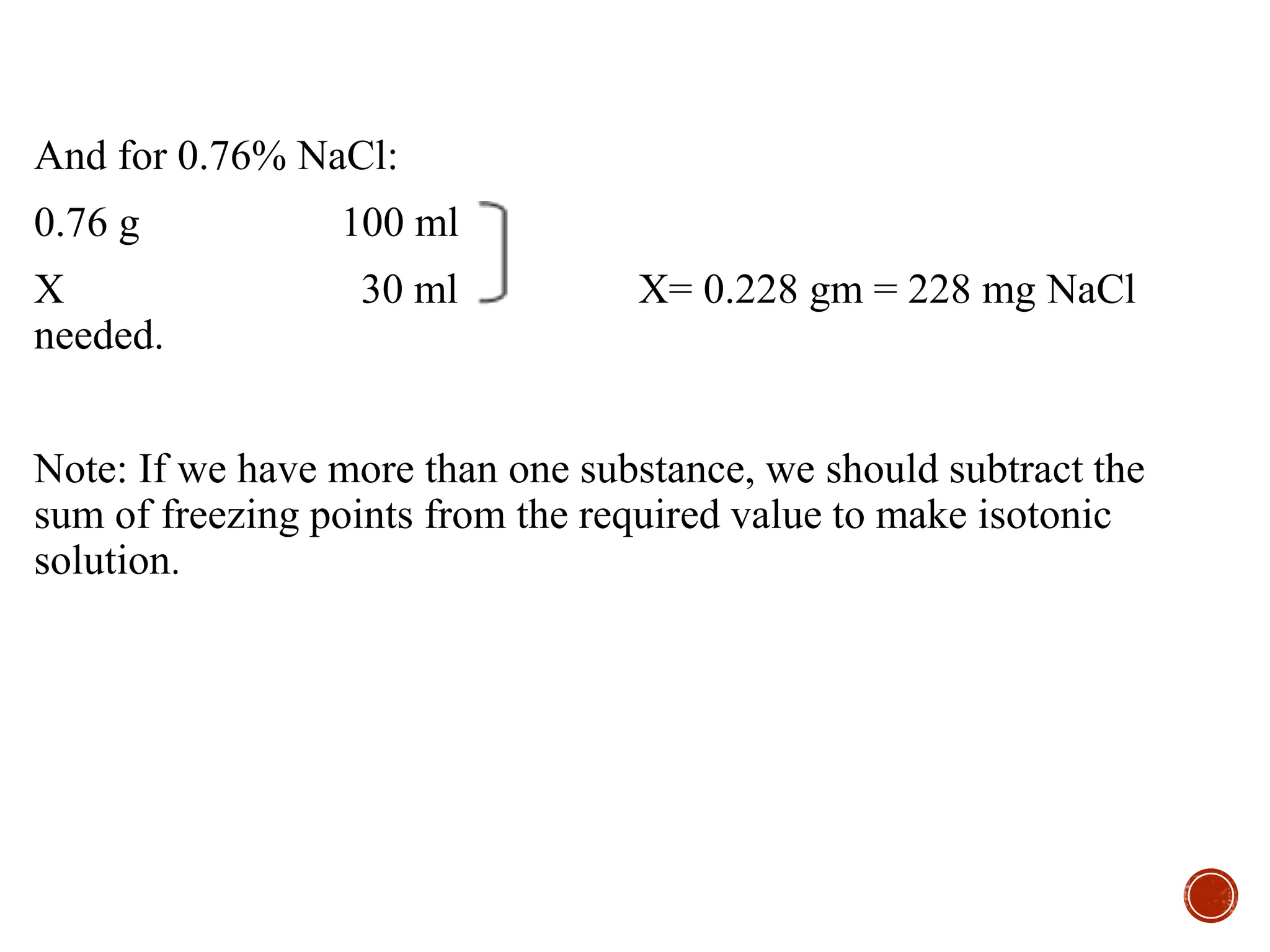
And for 0.76% NaCl:
0.76 g 100 ml
X 30 ml X= 0.228 gm = 228 mg NaCl
needed.
Note: If we have more than one substance, we should subtract the
sum of freezing points from the required value to make isotonic
solution.
Lecture . One  (isotonic solution ).pptx

Lecture . One (isotonic solution ).pptx

  • 1.
    Dr. Ahmed M.Moutlk College of pharmacy/ Al-Safwa University
  • 2.
    Introduction  When twosolutions (one is diluted and the other is concentrated) are separated by a semipermeable membrane, water will move from the diluted to the concentrated solution and finally the concentrations of them become equalized. This phenomenon is known as osmosis and the pressure responsible for this phenomenon is termed osmotic pressure.
  • 4.
     A solutionhaving the same osmotic pressure as a specific body fluid is termed isotonic (meaning of equal tone) with that specific body fluid. Solutions of lower osmotic pressure than that of a body fluid are termed hypotonic, whereas those having a higher osmotic pressure are termed hypertonic.  If a blood sample is placed in hypotonic solution, water will move inside the red blood cells and this cause swelling of them. On the other hand, if it is placed in hypertonic solution, water will move out of blood cells causing their shrinkage. If the blood is placed in isotonic solution, water will move in and out of cells in the same amount thus, they remain normal.
  • 6.
     Dosage formsintended to be administered to the blood, eye, nose, and bowel should be isotonic due to the following reasons:  They should be isotonic to reduce the likelihood of irritation to the tissues and to ensure comfort of the patient.  Intravenous infusions which are hypotonic or hypertonic can have adverse effects (either swelling or shrinkage of red blood cells) because they generally are administered in large volumes.
  • 7.
    CALCULATION OF ISOTONICITY The calculation of isotonicity is important to see if a certain drug solution is isotonic with the body or not. We can calculate the isotonicity depending on a physical property called freezing point depression.  The freezing point of pure water is zero 0C. If any material (such as sodium chloride) is added to pure water, the freezing point decreases below zero 0C. This phenomenon is called freezing point depression and it depends on the amount of the material added.
  • 8.
     They foundthat all body fluid such as blood, plasma, serum and tears have freezing point equal to (- 0.52 0C). They found also that any solution having the same freezing point as that of body fluid (- 0.52 0C) will be isotonic. In addition, it is found that 0.9% sodium chloride solution has a freezing point equal to (- 0.52 0C) and therefore, it is isotonic. The 0.9% sodium chloride solution is made reference to calculate the isotonicity of any other solution.
  • 9.
    Example 1: Howmuch additional sodium chloride should be added to 0.5% w/v sodium chloride solution to make it isotonic? Answer: the concentration of isotonic sodium chloride solution is 0.9%, this means that 0.9 gm/100 ml water. 0.5% means that 0.5 gm /100 ml water. Then 0.9 – 0.5 = 0.4 gm of NaCl should be added to 100 ml 0.5% solution to be made isotonic with body fluid. The relative quantity of sodium chloride that has an isotonic effect equivalent to a certain quantity of other material is called sodium chloride equivalents or E values.
  • 10.
    THE PROCEDURE FORTHE CALCULATION OF ISOTONIC SOLUTIONS WITH SODIUM CHLORIDE EQUIVALENTS MAY BE OUTLINED AS FOLLOWS:  Step 1. Calculate the amount (in grams) of sodium chloride represented by the ingredients in the prescription. Multiply the amount (in grams) of each substance by its sodium chloride equivalent.  Step 2. Calculate the amount (in grams) of sodium chloride, alone, that would be contained in an isotonic solution of the volume specified in the prescription, namely, the amount of sodium chloride in a 0.9% solution of the specified volume. (such solution would contain 0.009 g/ml).  Step 3. Subtract the amount of sodium chloride represented by the ingredients in the prescription (Step 1) from the amount of sodium chloride, alone, that represented in the specific volume of an isotonic solution (Step 2). The answer represents the amount (in grams) of sodium chloride to be added to make the solution isotonic.  Step 4. If an agent other than sodium chloride, such as boric acid or dextrose is to be used to make a solution isotonic, divide the amount of sodium chloride (Step 3) by the sodium chloride equivalent of the other substance.
  • 11.
    Example 2: Howmany grams of sodium chloride should be used in compounding the following prescription? If you know that the E value of Pilocarpine nitrate is 0.23 Rx Pilocarpine nitrate 0.3 Sodium chloride q.s. Purified water ad 30 ml Make isoton. Sol. Sig. for the eye
  • 12.
    Step1. 0.23 *0.3 g = 0.069 g of sodium chloride represented by the piolocarpine nitrate. Step 2. 30 * 0.009 = 0.270 g of sodium chloride in 30 ml of isotonic sodium chloride solution. Step3. 0.270 g (from step 2) - 0.069 g (from step 1) 0.201 g of sodium chloride to be used, answer.
  • 13.
    Example 3: Howmany grams of Boric acid should be used in compounding the following prescreptioin? (E value of Phenacaine Hydrochloride is 0.20, E value of Chlorobutanol is 0.24, E value of Boric acid is 0.52) Rx Phenacaine Hydrochloride 1% Chlorobutanol 0.5 % Boric acid q.s. Purified water ad 60 Make isoton. Sol. Sig. One drop in each eye.
  • 14.
    1gm 100ml 0.5gm100ml X 60ml X = 0.6 gm X 60ml X= 0.3gm So, the prescription calls for 0.6 g of Phenacaine Hydrochloride and 0.3 g of Chlorobutanol. Step 1. 0.20 * 0.6 g = 0.120 g of NaCl represented by Phenacaine Hydrochloride 0.24* 0.3 g = 0.072 g of NaCl represented by Chlorobutanol. Total: 0.192 g of NaCl represented by both ingredients. Step2. 60* 0.009 = 0.540 g of NaCl in 60 ml of an isotonic NaCl sol. Step3. 0.540 g (from step2) - 0.192g (from step1) 0.348 g of NaCl required to make the solution isotonic. But because the prescription calls for boric acid: Step4. 0.348 g / 0.52 (E value of Boric acid) = 0.669 g of Boric acid to be used, answer.
  • 15.
    Example 4: Howmany grams of potassium nitrate should be used to make the following prescription isotonic? (E values for silver nitrate and potassium nitrate are 0.33 and 0.58, respectively). Rx Sol. Silver Nitrate 60 1:500 w/v Make isoton. sol. Sig. For eye use.
  • 16.
    The ratio strength1:500 must be converted to weight in gram, so: 1 g 500 ml X 60 ml X= 0.12 g of silvernitrate. Step1. 0.33 X 0.12g = 0.04g ofsodiumchloride representedbysilver nitrate. Step 2. 60 X 0.009 = 0.54 gof sodiumchloride in 60 ml of the prescription. Step 3. 0.54g (fromstep 2) - 0.04 g (fromstep 1) 0.50 gof sodiumchloride required to make solutionisotonic. Step 4. 0.50g / 0.58 = 0.86 gof potassiumnitrate to be used, answer.
  • 17.
    USING OF FREEZINGPOINT IN ISOTONICITY CALCULATIONS Freezing point can be used easily in isotonicity calculations. As mentioned previously, the freezing point of both blood and lacrimal fluid is (-0.52) 0C. Thus, any solution that has a freezing point of (-0.52) 0C is considered isotonic. Data of freezing point lowering by medicinal substances are presented in Table 11.2. These data are calculated for solution strengths of 1% only.
  • 18.
    Example 5: Howmany milligrams each of NaCl and dibucaine are required to prepare 30 ml of 1% dibucaine isotonic solution? If you know that the freezing point lowering of 1% dibucaine solution and 1% NaCl solution are - 0.08 and - 0.58 0C, respectively. Answer: The freezing point (0.9% NaCl) = - 0.52 0C [body fluid] The freezing point (1% dibucaine) = - 0.08 0C
  • 19.
    0.52 - 0.08= 0.44 0C [that mean the amount of NaCl required should lower the he freezing point additional 0.44 0C] 1% (NaCl) 0.58 X% (NaCl) 0.44 X= 0.76% the concentration of NaCl needed to make isotonic solution. Thus to make 30 ml of the prescription isotonic: 1 g 100 ml X 30 ml X= 0.3gm= 300 mg of dibucaine
  • 20.
    And for 0.76%NaCl: 0.76 g 100 ml X 30 ml X= 0.228 gm = 228 mg NaCl needed. Note: If we have more than one substance, we should subtract the sum of freezing points from the required value to make isotonic solution.