AL-QUDS UNIVERSITY
COLLEGE OF GRADUATE STUDIES
PHARMACEUTICAL TECHNOLOGY (8038675)
OSMOLALITY AND OSMOLARITY
Professor : Dr. Numan Malkieh
Student preparation : Hanibal Mousa Mansour .
1
Jerusalem-Palestine
2020
OUTLINE
2
1. Introduction
2. Classification of drug solution
3. Osmotic of drug solutions
4. Osmotic pressure
5. Clinical relevance of osmotic effects
6. Osmotic properties of Pharmaceutical solution
7. Preparation of isotonic solution
8. Calculation of Osmolarity of Solution
9. References
Introduction
 when two different solutions are separated by a membrane that
is impermeable to the dissolved substances, fluid shifts
through the membrane from the region of low solute
concentration to the region of high solute concentration until
the solution are of equal concentrations.
 This diffusion of water causes by a fluid concentration
gradient is known as osmosis.
Introduction
The Osmolarity and Osmolality of a solution
 Osmolarity and Osmolality are units of Solute concentration that
are often used in reference to biochemistry and body fluids
 The concentration of osmotically active particles in that solution .
The term Osmolarity refers to the number of particles of solute per
liter of solution which is the measure of osmoles of solute per liter
of solution (Osm/L)
Introduction
 Measurements of osmolarity are temperature dependent
because the volume of solvent varies with temperature (i.e.,
the volume is larger at higher temperatures) .
 The term osmolality refers to the number of particles of
solute per kilogram of solvent. Which is the measure of
osmoles of solute per kilogram of solvent (Osm/kg).
 osmolality, which is based on the mass of the solvent, is
temperature independent
Classification of Solutions
Solutions Classified by Route of Administration :
 Oral solutions
 Topical solutions
 Rectal solutions
 Vaginal solution
 Otic solutions
 Nasal solutions
 Ocular solution
 Parenteral solutions
 Inhalations
Osmotic of drug solutions
 Properties that are dependent on the number of molecules in
solution in this way are referred to as colligative properties,
and the most important of such properties from a
pharmaceutical viewpoint is the osmotic pressure .
Colligative properties :
vapor pressure
osmotic pressure
boiling point
freezing point
Osmotic pressure
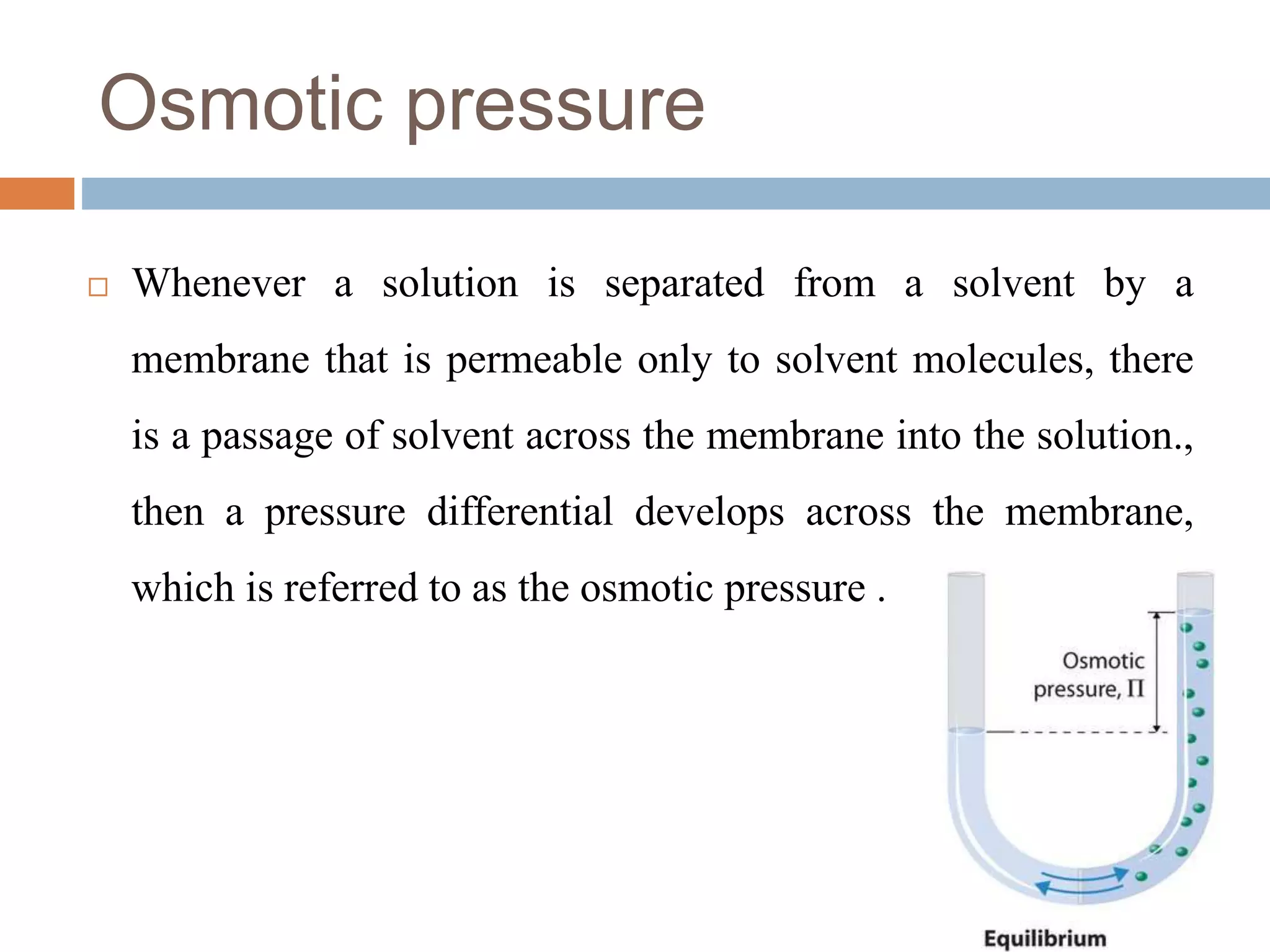
 Whenever a solution is separated from a solvent by a
membrane that is permeable only to solvent molecules, there
is a passage of solvent across the membrane into the solution.,
then a pressure differential develops across the membrane,
which is referred to as the osmotic pressure .
Osmotic pressure
 Solvent passes through the membrane because of the
inequality of the chemical potentials on either side of the
membrane. Since the chemical potential of a solvent molecule
in solution is less than that in pure solvent, solvent will
spontaneously enter the solution until this inequality is
removed .
Clinical relevance of osmotic
effects
 Osmotic effects are particularly important, the red blood cell membrane,
behave in a manner similar to that of semipermeable membranes.
 Solutions that have the same tonicity as blood serum are said to be isotonic
with blood. Solutions with a higher tonicity are hypertonic and those with
a lower tonicity are termed hypotonic solutions.
Clinical relevance of osmotic
effects
• Similarly, in order to avoid discomfort on administration of solutions to the
delicate membranes of the body, such as the eyes, these solutions are made
isotonic with the relevant tissues.
It is important for a solution to be isotonic with a bodily fluid to prevent
irritation and cell damage, and to maximize drug efficacy.
Osmotic properties of Pharmaceutical
solution
 Osmotic properties, plays an important role in formulation and preparation
of parenteral solutions, especially those prepared for ophthalmic, nasal,
rectal administration.
 Administration of solution (i.e. injection) to delicate membranes of body (i.e.
eyes): isotonic solution avoid discomfort feeling
 For preparing of isotonic solution, osmotic pressure is usual to use the freezing
– point depression
Preparation of isotonic solution
 Body fluids such as blood plasma and lachrymal secretions
have a freezing point of 0.52 C° due to different solutes
present in them. 0.9% solution of NaCI (isotonic solution)
also has freezing point of - 0.52 C . Hence, all solutions which
freeze at 0.52 C° will be isotonic with these fluids.
:
Based on freezing point
Preparation of isotonic solution
 With a solution of a drug, it is not of course possible to alter the
drug concentration in this manner, and an adjusting substance must
be added to achieve isotonicity.
 The quantity of the adjusting substance needed for making the
solution isotonic with blood may be calculated below :
 Amount of adjusting substance required = 0.52 - a /b
 Where, a = freezing point of 1% solution of un-adjusted solution
b = freezing point of 1% solution of adjusting substance
Preparation of isotonic solution
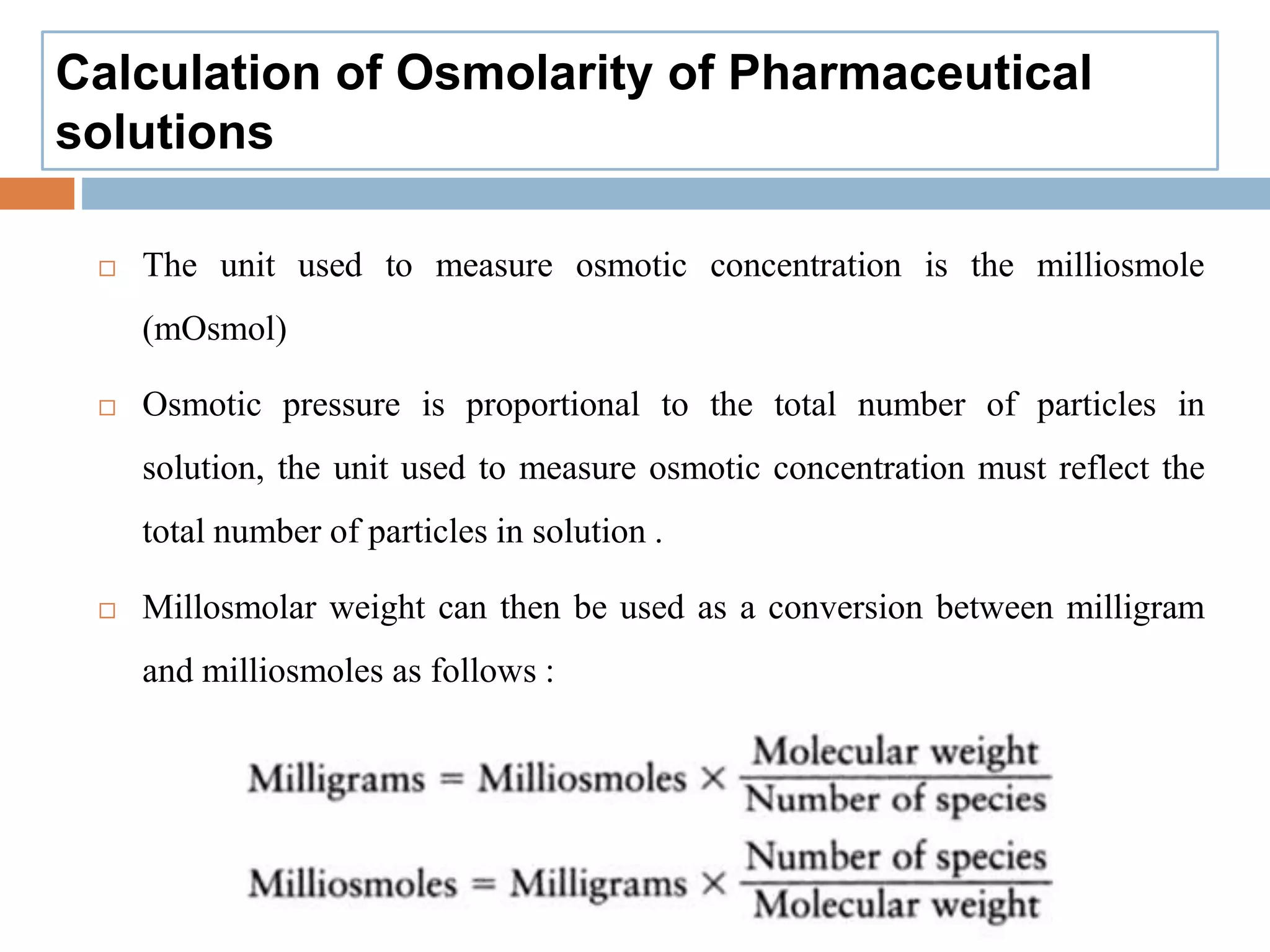
 The unit used to measure osmotic concentration is the milliosmole
(mOsmol)
 Osmotic pressure is proportional to the total number of particles in
solution, the unit used to measure osmotic concentration must reflect the
total number of particles in solution .
 Millosmolar weight can then be used as a conversion between milligram
and milliosmoles as follows :
Calculation of Osmolarity of Pharmaceutical
solutions
Calculation of Osmolarity of Pharmaceutical
solutions
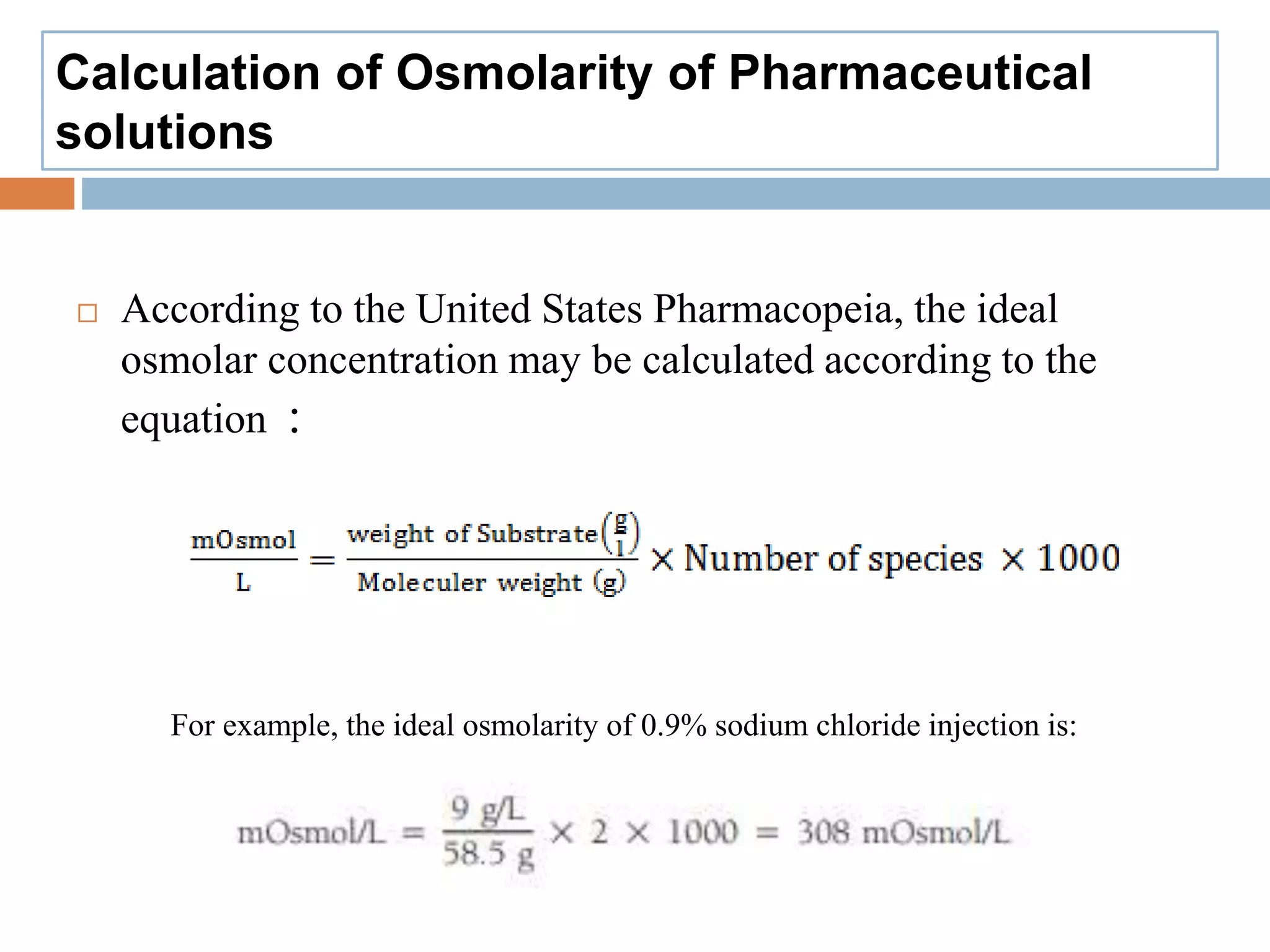
 According to the United States Pharmacopeia, the ideal
osmolar concentration may be calculated according to the
equation :
For example, the ideal osmolarity of 0.9% sodium chloride injection is:
Calculation of Osmolarity of Pharmaceutical
solutions
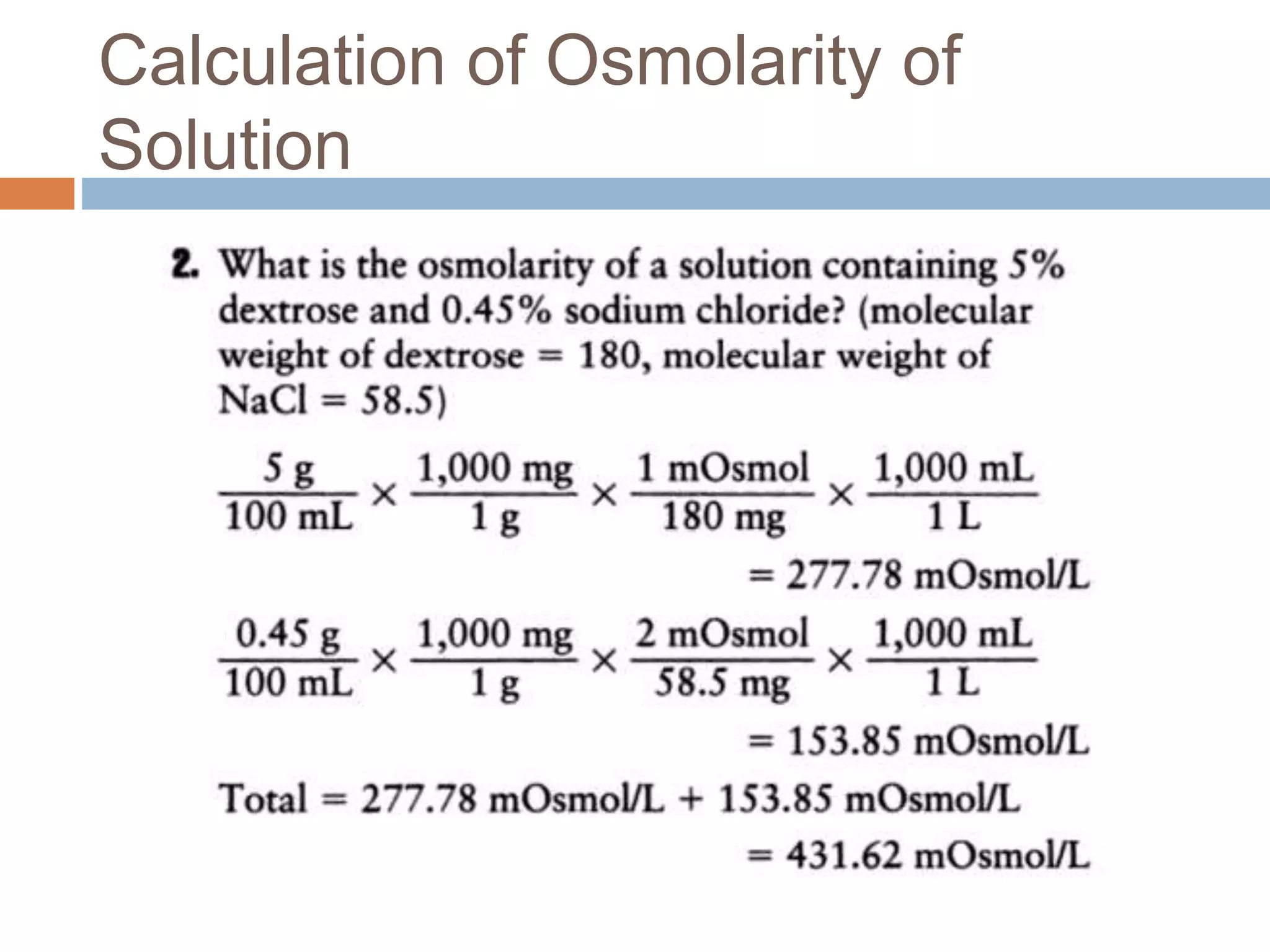
 The total number of particles in solution depends on the degree of dissociation of
the substance in question. Assuming complete dissociation :
 1 mmol of NaCl represents 2 mOsmol (Na+ + Cl-) of total particles .
 1 mmol of CaCl2 represents 3 mOsmol (Ca+ + 2Cl- ) of total particles,
 1 mmol of sodium citrate (Na3C6H5O7) represents 4 mOsmol (3Na+ +
C6H5O7-) of total particles
Calculation of Osmolarity of
Solution
Calculation of Osmolarity of
Solution
References
 Ingham, A., & Poon, C. Y. (2013). Tonicity, Osmoticity, Osmolality,
Osmolarity. Remington, 277
 Helle, K. B., Reed, R. K., Pihl, K. E., & Serck‐Hanssen, G. (1985). Osmotic
Properties Of The Chromogranins And Relation To Osmotic Pressure In
Catecholamine Storage Granules. Acta Physiologica Scandinavica .
 ZATLOUKAL, Z. (2009). Conversion Between Osmolality And Osmolarity Of
Infusion Solutions. Scientia Pharmaceutica, 77(4), 817-826 .
 Zhang, Z., Kleinstreuer, C., & Kim, C. S. (2006). Isotonic And Hypertonic Saline
Droplet Deposition In A Human Upper Airway Model. Journal Of Aerosol
Medicine, 19(2), 184-198.
 Florence, A. T., & Attwood, D. (1988). Physicochemical Properties Of Drugs In
Solution. In Physicochemical Principles Of Pharmacy (Pp. 47-80). Palgrave,
London

Osmolarity

  • 1.
    AL-QUDS UNIVERSITY COLLEGE OFGRADUATE STUDIES PHARMACEUTICAL TECHNOLOGY (8038675) OSMOLALITY AND OSMOLARITY Professor : Dr. Numan Malkieh Student preparation : Hanibal Mousa Mansour . 1 Jerusalem-Palestine 2020
  • 2.
    OUTLINE 2 1. Introduction 2. Classificationof drug solution 3. Osmotic of drug solutions 4. Osmotic pressure 5. Clinical relevance of osmotic effects 6. Osmotic properties of Pharmaceutical solution 7. Preparation of isotonic solution 8. Calculation of Osmolarity of Solution 9. References
  • 3.
    Introduction  when twodifferent solutions are separated by a membrane that is impermeable to the dissolved substances, fluid shifts through the membrane from the region of low solute concentration to the region of high solute concentration until the solution are of equal concentrations.  This diffusion of water causes by a fluid concentration gradient is known as osmosis.
  • 4.
    Introduction The Osmolarity andOsmolality of a solution  Osmolarity and Osmolality are units of Solute concentration that are often used in reference to biochemistry and body fluids  The concentration of osmotically active particles in that solution . The term Osmolarity refers to the number of particles of solute per liter of solution which is the measure of osmoles of solute per liter of solution (Osm/L)
  • 5.
    Introduction  Measurements ofosmolarity are temperature dependent because the volume of solvent varies with temperature (i.e., the volume is larger at higher temperatures) .  The term osmolality refers to the number of particles of solute per kilogram of solvent. Which is the measure of osmoles of solute per kilogram of solvent (Osm/kg).  osmolality, which is based on the mass of the solvent, is temperature independent
  • 6.
    Classification of Solutions SolutionsClassified by Route of Administration :  Oral solutions  Topical solutions  Rectal solutions  Vaginal solution  Otic solutions  Nasal solutions  Ocular solution  Parenteral solutions  Inhalations
  • 7.
    Osmotic of drugsolutions  Properties that are dependent on the number of molecules in solution in this way are referred to as colligative properties, and the most important of such properties from a pharmaceutical viewpoint is the osmotic pressure . Colligative properties : vapor pressure osmotic pressure boiling point freezing point
  • 8.
    Osmotic pressure  Whenevera solution is separated from a solvent by a membrane that is permeable only to solvent molecules, there is a passage of solvent across the membrane into the solution., then a pressure differential develops across the membrane, which is referred to as the osmotic pressure .
  • 9.
    Osmotic pressure  Solventpasses through the membrane because of the inequality of the chemical potentials on either side of the membrane. Since the chemical potential of a solvent molecule in solution is less than that in pure solvent, solvent will spontaneously enter the solution until this inequality is removed .
  • 10.
    Clinical relevance ofosmotic effects  Osmotic effects are particularly important, the red blood cell membrane, behave in a manner similar to that of semipermeable membranes.  Solutions that have the same tonicity as blood serum are said to be isotonic with blood. Solutions with a higher tonicity are hypertonic and those with a lower tonicity are termed hypotonic solutions.
  • 11.
    Clinical relevance ofosmotic effects • Similarly, in order to avoid discomfort on administration of solutions to the delicate membranes of the body, such as the eyes, these solutions are made isotonic with the relevant tissues. It is important for a solution to be isotonic with a bodily fluid to prevent irritation and cell damage, and to maximize drug efficacy.
  • 12.
    Osmotic properties ofPharmaceutical solution  Osmotic properties, plays an important role in formulation and preparation of parenteral solutions, especially those prepared for ophthalmic, nasal, rectal administration.  Administration of solution (i.e. injection) to delicate membranes of body (i.e. eyes): isotonic solution avoid discomfort feeling  For preparing of isotonic solution, osmotic pressure is usual to use the freezing – point depression
  • 13.
    Preparation of isotonicsolution  Body fluids such as blood plasma and lachrymal secretions have a freezing point of 0.52 C° due to different solutes present in them. 0.9% solution of NaCI (isotonic solution) also has freezing point of - 0.52 C . Hence, all solutions which freeze at 0.52 C° will be isotonic with these fluids. : Based on freezing point
  • 14.
    Preparation of isotonicsolution  With a solution of a drug, it is not of course possible to alter the drug concentration in this manner, and an adjusting substance must be added to achieve isotonicity.  The quantity of the adjusting substance needed for making the solution isotonic with blood may be calculated below :  Amount of adjusting substance required = 0.52 - a /b  Where, a = freezing point of 1% solution of un-adjusted solution b = freezing point of 1% solution of adjusting substance
  • 15.
  • 16.
     The unitused to measure osmotic concentration is the milliosmole (mOsmol)  Osmotic pressure is proportional to the total number of particles in solution, the unit used to measure osmotic concentration must reflect the total number of particles in solution .  Millosmolar weight can then be used as a conversion between milligram and milliosmoles as follows : Calculation of Osmolarity of Pharmaceutical solutions
  • 17.
    Calculation of Osmolarityof Pharmaceutical solutions  According to the United States Pharmacopeia, the ideal osmolar concentration may be calculated according to the equation : For example, the ideal osmolarity of 0.9% sodium chloride injection is:
  • 18.
    Calculation of Osmolarityof Pharmaceutical solutions  The total number of particles in solution depends on the degree of dissociation of the substance in question. Assuming complete dissociation :  1 mmol of NaCl represents 2 mOsmol (Na+ + Cl-) of total particles .  1 mmol of CaCl2 represents 3 mOsmol (Ca+ + 2Cl- ) of total particles,  1 mmol of sodium citrate (Na3C6H5O7) represents 4 mOsmol (3Na+ + C6H5O7-) of total particles
  • 19.
  • 20.
  • 21.
    References  Ingham, A.,& Poon, C. Y. (2013). Tonicity, Osmoticity, Osmolality, Osmolarity. Remington, 277  Helle, K. B., Reed, R. K., Pihl, K. E., & Serck‐Hanssen, G. (1985). Osmotic Properties Of The Chromogranins And Relation To Osmotic Pressure In Catecholamine Storage Granules. Acta Physiologica Scandinavica .  ZATLOUKAL, Z. (2009). Conversion Between Osmolality And Osmolarity Of Infusion Solutions. Scientia Pharmaceutica, 77(4), 817-826 .  Zhang, Z., Kleinstreuer, C., & Kim, C. S. (2006). Isotonic And Hypertonic Saline Droplet Deposition In A Human Upper Airway Model. Journal Of Aerosol Medicine, 19(2), 184-198.  Florence, A. T., & Attwood, D. (1988). Physicochemical Properties Of Drugs In Solution. In Physicochemical Principles Of Pharmacy (Pp. 47-80). Palgrave, London