The evolutionary view of origin of plants! For more than the first 3 billion years of Earth’s history The terrestrial surface was lifeless Since colonizing land Plants have diversified into roughly 290,000 living species Researchers have identified green algae called  charophyceans  as the closest relatives of land plants
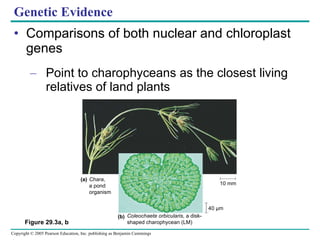
Genetic Evidence Comparisons of both nuclear and chloroplast genes Point to charophyceans as the closest living relatives of land plants Chara ,  a pond  organism (a) 10 mm Coleochaete orbicularis , a disk- shaped charophycean (LM) (b) 40 µm Figure 29.3a, b
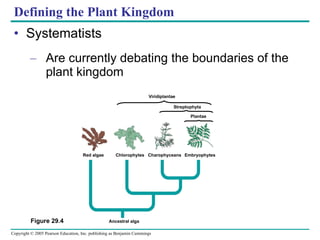
Defining the Plant Kingdom Systematists Are currently debating the boundaries of the plant kingdom Plantae Streptophyta Viridiplantae Red algae Chlorophytes Charophyceans Embryophytes Ancestral alga Figure 29.4
Derived Traits of Plants Five key traits appear in nearly all land plants but are  absent  in the charophyceans Apical meristems Alternation of generations Walled spores produced in sporangia Multicellular gametangia Multicellular dependent embryos
Apical meristems and alternation of generations APICAL MERISTEMS Apical meristem of shoot Developing leaves 100 µm Apical meristems of plant shoots  and roots . The light micrographs  are longitudinal sections at the tips  of a shoot and root. Apical meristem of root Root 100 µm Shoot Figure 29.5 Haploid multicellular organism (gametophyte) Mitosis Mitosis Gametes Zygote Diploid multicellular organism (sporophyte) Alternation of generations: a generalized scheme MEIOSIS FERTILIZATION 2 n 2 n n n n n n Spores Mitosis ALTERNATION OF GENERATIONS
Walled spores; multicellular gametangia; and multicellular, dependent embryos WALLED SPORES PRODUCED IN SPORANGIA MULTICELLULAR GAMETANGIA MULTICELLULAR, DEPENDENT EMBRYOS Spores Sporangium Longitudinal section of Sphagnum  sporangium (LM) Sporophyte Gametophyte Sporophyte and sporangium of  Sphagnum  (a moss) Female gametophyte Archegonium with egg Antheridium with sperm Male gametophyte Archegonia and antheridia of  Marchantia  (a liverwort) Embryo Maternal tissue 2 µm Wall ingrowths Placental transfer cell 10 µm Embryo and placental transfer cell of  Marchantia Figure 29.5
Fossilized spores and tissues Have been extracted from 475-million-year-old rocks Fossilized spores.   Unlike the spores of  most living plants, which are single  grains, these spores  found in Oman are  in groups of four  (left; one hidden)  and two (right). (a) Fossilized sporophyte tissue.   The spores were  embedded in tissue  that appears to be  from plants. (b) Figure 29.6 a, b
Whatever  the age of the first land plants Those ancestral species gave rise to a vast diversity of modern plants An overview of land plant evolution Land plants can be informally grouped based on the presence or absence of vascular  Table 29.1
Bryophytes (nonvascular plants) Seedless vascular plants Seed plants Vascular plants Land plants Origin of seed plants (about 360 mya) Origin of vascular  plants (about 420 mya) Origin of land plants (about 475 mya) Ancestral green alga Charophyceans Liverworts Hornworts Mosses Lycophytes (club mosses, spike mosses, quillworts) Pterophyte  (ferns, horsetails, whisk fern) Gymnosperms Angiosperms
The life cycles of mosses and other bryophytes are  dominated by the gametophyte stage Bryophytes are represented today by three phyla of small herbaceous (nonwoody) plants Liverworts, phylum Hepatophyta Hornworts, phylum Anthocerophyta Mosses, phylum Bryophyta
The life cycle of a moss Mature sporophytes Young sporophyte Male gametophyte Raindrop Sperm Key Haploid ( n ) Diploid (2 n ) Antheridia Female gametophyte Egg Archegonia FERTILIZATION (within archegonium) Zygote Archegonium Embryo Female gametophytes Gametophore Foot Capsule (sporangium) Seta Peristome Spores Protonemata “ Bud” “ Bud” MEIOSIS Sporangium Calyptra Capsule with  peristome (LM) Rhizoid Mature sporophytes Spores develop into threadlike protonemata. 1 The haploid protonemata produce “buds” that grow into gametophytes. 2 Most mosses have separate male and female gametophytes, with antheridia and archegonia, respectively. 3 A sperm swims through a film of moisture to an archegonium and fertilizes the egg. 4 Meiosis occurs and haploid spores develop in the sporangium of the sporophyte. When the sporangium lid pops off, the peristome “teeth” regulate gradual release of the spores. 8 The sporophyte grows a long stalk, or seta, that emerges from the archegonium. 6 The diploid zygote develops into a  sporophyte embryo within the archegonium. 5 Attached by its foot, the sporophyte remains nutritionally dependent on the gametophyte. 7 Figure 29.8
Bryophyte gametophytes Produce flagellated sperm in antheridia Produce ova in archegonia Generally form ground-hugging carpets and are at most only a few cells thick Some mosses Have conducting tissues in the center of their “stems” and may grow vertically
Bryophyte Sporophytes Bryophyte sporophytes Grow out of archegonia Are the smallest and simplest of all extant plant groups Consist of a foot, a seta, and a sporangium Hornwort and moss sporophytes Have stomata
Bryophyte diversity LIVERWORTS (PHYLUM HEPATOPHYTA) HORNWORTS (PHYLUM ANTHOCEROPHYTA) MOSSES (PHYLUM BRYOPHYTA) Gametophore of female gametophyte Marchantia polymorpha , a “thalloid” liverwort Foot Sporangium Seta 500 µm Marchantia  sporophyte (LM) Plagiochila deltoidea , a “leafy” liverwort An  Anthoceros hornwort species Sporophyte Gametophyte Polytrichum commune , hairy-cap moss Sporophyte Gametophyte Figure 29.9
Ecological and Economic Importance of Mosses Sphagnum, or “peat moss” Forms extensive deposits of partially decayed organic material known as peat Plays an important role in the Earth’s carbon cycle “ Tolland Man,” a bog mummy dating from 405–100 B.C.  The acidic, oxygen-poor conditions produced by Sphagnum canpreserve human or other animal bodies for thousands of years. Gametophyte Sporangium at tip of sporophyte Living photo- synthetic cells Dead water- storing cells 100 µm Closeup of  Sphagnum .  Note the “leafy” gametophytes  and their offspring, the sporophytes. (b) Sphagnum  “leaf” (LM).  The combination of living photosynthetic  cells and dead water-storing cells gives the moss its spongy quality. (c) Peat being harvested from a peat bog (a) Figure 29.10 a–d (d)
Ferns and other seedless vascular plants formed the first forests Bryophytes and bryophyte-like plants Were the prevalent vegetation during the first 100 million years of plant evolution Vascular plants Began to evolve during the Carboniferous period
Life Cycles with Dominant Sporophytes In contrast with bryophytes Sporophytes of seedless vascular plants are the larger generation, as in the familiar leafy fern The gametophytes are tiny plants that grow on or below the soil surface
Sporophyte dominance  The life cycle of a fern Fern sperm use flagella to swim from the antheridia  to eggs in the archegonia. 4 Sporangia release spores. Most fern species produce a single type of spore that gives rise to a bisexual gametophyte. The fern spore develops into a small, photosynthetic gametophyte. 2 Although this illustration  shows an egg and sperm  from the same gametophyte,  a variety of mechanisms promote cross-fertilization between gametophytes. 3 On the underside of the sporophyte‘s reproductive leaves are spots called sori. Each sorus is a cluster of sporangia. 6 A zygote develops into a new sporophyte, and the young plant grows out from an archegonium of its parent, the gametophyte. 5 MEIOSIS Sporangium Sporangium Mature sporophyte New sporophyte Zygote FERTILIZATION Archegonium Egg Haploid ( n ) Diploid (2 n ) Spore Young gametophyte Fiddlehead Antheridium Sperm Gametophyte Key Sorus Figure 29.12 1
Vascular plants have two types of vascular tissue (Xylem and phloem) Xylem Conducts most of the water and minerals Includes dead cells called tracheids Phloem Distributes sugars, amino acids, and other organic products Consists of living cells
Evolution of Roots Roots Are organs that anchor vascular plants Enable vascular plants to absorb water and nutrients from the soil May have evolved from subterranean stems
Evolution of Leaves Leaves Are organs that increase the surface area of vascular plants, thereby capturing more solar energy for photosynthesis Leaves are categorized by two types Microphylls, leaves with a single vein Megaphylls, leaves with a highly branched vascular system
According to one model of evolution Microphylls evolved first, as outgrowths of stems Vascular tissue Microphylls,  such as those of lycophytes, may have  originated as small stem outgrowths supported by  single, unbranched strands of vascular tissue.  (a) Megaphylls,  which have branched vascular  systems, may have evolved by the fusion of  branched stems. (b) Figure 29.13a, b
Sporophylls and Spore Variations Sporophylls Are modified leaves with sporangia Most seedless vascular plants Are homosporous, producing one type of spore that develops into a bisexual gametophyte
All seed plants and some seedless vascular plants Are heterosporous, having two types of spores that give rise to male and female gametophytes
Classification of Seedless Vascular Plants Seedless vascular plants form two phyla Lycophyta, including club mosses, spike mosses, and quillworts Pterophyta, including ferns, horsetails, and whisk ferns and their relatives Ferns Are the most diverse seedless vascular plants
The general groups of seedless vascular plants LYCOPHYTES (PHYLUM LYCOPHYTA) PTEROPHYTES (PHYLUM PTEROPHYTA) WHISK FERNS AND RELATIVES HORSETAILS FERNS Isoetes gunnii , a quillwort Selaginella apoda , a spike moss Diphasiastrum tristachyum , a club moss Strobili (clusters of sporophylls) Psilotum nudum, a whisk fern Equisetum arvense, field horsetail Vegetative stem Strobilus on fertile stem Athyrium  filix-femina ,  lady fern Figure 29.14
The Significance of Seedless Vascular Plants The ancestors of modern lycophytes, horsetails, and ferns Grew to great heights during the Carboniferous, forming the first forests The growth of these early forests May have helped produce the major global cooling that characterized the end of the Carboniferous period Decayed and eventually became coal
Seeds changed the course of plant evolution Enabling their bearers to become the dominant producers in most terrestrial ecosystems Figure 30.1
The reduced gametophytes of seed plants are protected in ovules and pollen grains In addition to seeds, the following are common to all seed plants Reduced gametophytes Heterospory Ovules Pollen
Advantages of Reduced Gametophytes The gametophytes of seed plants Develop within the walls of spores retained within tissues of the parent sporophyte
Gametophyte/sporophyte relationships Figure 30.2a–c Microscopic female gametophytes ( n ) in ovulate cones (dependent)  Sporophyte (2 n ), the flowering plant (independent) Microscopic male gametophytes ( n ) inside these parts of flowers (dependent) Microscopic male gametophytes ( n ) in pollen cones (dependent)  Sporophyte (2 n ) (independent) Microscopic female gametophytes ( n ) inside these parts of flowers (dependent) Gametophyte ( n ) Gametophyte ( n ) Sporophyte (2 n ) Sporophyte (2 n ) Sporophyte dependent  on gametophyte  (mosses and other  bryophytes). (a) Large sporophyte and  small, independent  gametophyte (ferns  and other seedless  vascular plants). (b) Reduced gametophyte dependent on sporophyte  (seed plants: gymnosperms and angiosperms). (c)
Heterospory: The Rule Among Seed Plants Seed plants evolved from plants that had megasporangia Which produce megaspores that give rise to female gametophytes Seed plants evolved from plants that had microsporangia Which produce microspores that give rise to male gametophytes
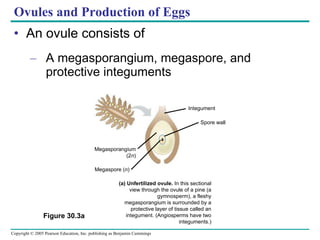
Ovules and Production of Eggs An ovule consists of A megasporangium, megaspore, and protective integuments Figure 30.3a (a) Unfertilized ovule.  In this sectional view through the ovule of a pine (a gymnosperm), a fleshy megasporangium is surrounded by a protective layer of tissue called an integument. (Angiosperms have two integuments.) Integument Spore wall Megasporangium (2 n ) Megaspore ( n )
Pollen and Production of Sperm Microspores develop into pollen grains Which contain the male gametophytes of plants Pollination Is the transfer of pollen to the part of a seed plant containing the ovules
If a pollen grain germinates It gives rise to a pollen tube that discharges two sperm into the female gametophyte within the ovule Figure 30.3b (b) Fertilized ovule.  A megaspore develops into a multicellular female gametophyte. The micropyle, the only opening through the integument, allows entry of a pollen grain. The pollen grain contains a male gametophyte, which develops a pollen tube that discharges sperm. Spore wall Male gametophyte (within germinating pollen grain) ( n ) Female gametophyte ( n ) Egg nucleus ( n ) Discharged sperm nucleus ( n ) Pollen grain ( n ) Micropyle
Pollen, which can be dispersed by air or animals  Eliminated the water requirement for fertilization
The Evolutionary Advantage of Seeds A seed  Develops from the whole ovule Is a sporophyte embryo, along with its food supply, packaged in a protective coat Figure 30.3c Gymnosperm seed.  Fertilization initiates the transformation of the ovule into a seed, which consists of a sporophyte embryo, a  food supply, and a protective seed coat  derived from the integument. (c) Seed coat (derived from Integument) Food supply (female gametophyte tissue) ( n ) Embryo (2 n ) (new sporophyte)
Gymnosperms bear “naked” seeds, typically on cones Among the gymnosperms are many well-known conifers Or cone-bearing trees, including pine, fir, and redwood
The gymnosperms include four plant phyla Cycadophyta Gingkophyta Gnetophyta Coniferophyta
Exploring Gymnosperm Diversity Figure 30.4 Gnetum   Ephedra   Ovulate cones Welwitschia  PHYLUM GNETOPHYTA PHYLUM CYCADOPHYTA PHYLUM GINKGOPHYTA Cycas revoluta
Exploring Gymnosperm Diversity Figure 30.4 PHYLUM CYCADOPHYTA Douglas fir   Pacific yew Common juniper Wollemia pine Bristlecone pine Sequoia
Gymnosperm Evolution Fossil evidence reveals that by the late Devonian Some plants, called progymnosperms, had begun to acquire some adaptations that characterize seed plants Figure 30.5
Gymnosperms appear early in the fossil record  And dominated the Mesozoic terrestrial ecosystems Living seed plants Can be divided into two groups: gymnosperms and angiosperms
A Closer Look at the Life Cycle of a Pine Key features of the gymnosperm life cycle include Dominance of the  sporophyte generation , the pine tree The development of seeds from fertilized ovules The role of pollen in transferring sperm to ovules
The life cycle of a pine Figure 30.6 Ovule Megasporocyte (2 n ) Integument Longitudinal section of ovulate cone Ovulate cone Pollen cone Mature sporophyte (2 n ) Longitudinal section of pollen cone Microsporocytes (2 n ) Pollen grains ( n ) (containing male gametophytes) MEIOSIS Micropyle Germinating pollen grain Megasporangium MEIOSIS Sporophyll Microsporangium Surviving megaspore ( n ) Germinating pollen grain Archegonium Integument Egg ( n ) Female gametophyte Germinating pollen grain ( n ) Discharged sperm nucleus ( n ) Pollen tube Egg nucleus ( n ) FERTILIZATION Seed coat (derived from parent sporophyte) (2 n ) Food reserves (gametophyte tissue) ( n ) Embryo (new sporophyte) (2 n ) Seeds on surface of ovulate scale Seedling Key Diploid (2 n ) Haploid ( n ) A pollen cone contains many microsporangia  held in sporophylls. Each microsporangium  contains microsporocytes (microspore mother cells). These undergo meiosis, giving rise to haploid microspores that develop into  pollen grains. 3 In most conifer species, each tree has both ovulate and pollen cones. 1 A pollen grain enters through the micropyle and germinates, forming a pollen tube that slowly digests through the megasporangium. 4 While the pollen tube develops, the megasporocyte (megaspore mother cell) undergoes meiosis, producing four haploid cells. One survives as a megaspore.  5 The female gametophyte develops within the megaspore and contains two or three archegonia, each with an egg. 6 By the time the eggs are mature, two sperm cells have developed in the pollen tube, which extends to the female gametophyte. Fertilization occurs when sperm and egg nuclei unite. 7 Fertilization usually occurs more   than a year after pollination. All eggs   may be fertilized, but usually only one   zygote develops into an embryo. The   ovule becomes a seed, consisting of an  embryo, food supply, and seed coat. 8 An ovulate cone scale has two ovules, each containing a mega- sporangium. Only one ovule is shown. 2
The reproductive adaptations of angiosperms include flowers and fruits Angiosperms Are commonly known as flowering plants Are seed plants that produce the reproductive structures called flowers and fruits Are the most widespread and diverse of all plants
Characteristics of Angiosperms The key adaptations in the evolution of angiosperms Are flowers and fruits
Flowers The flower Is an angiosperm structure specialized for sexual reproduction
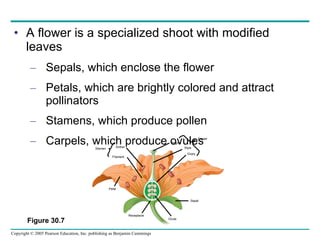
A flower is a specialized shoot with modified leaves Sepals, which enclose the flower  Petals, which are brightly colored and attract pollinators Stamens, which produce pollen Carpels, which produce ovules Figure 30.7 Anther Filament Stigma Style Ovary Carpel Petal Receptacle Ovule Sepal Stamen
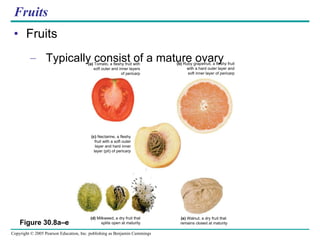
Fruits Fruits Typically consist of a mature ovary   Figure 30.8a–e (b)  Ruby grapefruit, a fleshy fruit with a hard outer layer and soft inner layer of pericarp (a)  Tomato, a fleshy fruit with soft outer and inner layers of pericarp (c)  Nectarine, a fleshy fruit with a soft outer layer and hard inner layer (pit) of pericarp (e)  Walnut, a dry fruit that  remains closed at maturity (d)  Milkweed, a dry fruit that splits open at maturity
Can be carried by wind, water, or animals to new locations, enhancing seed dispersal Figure 30.9a–c Wings enable maple fruits  to be easily carried by the wind. (a) Seeds within berries and other  edible fruits are often dispersed  in animal feces. (b) The barbs of cockleburs  facilitate seed dispersal by  allowing the fruits to  “ hitchhike” on animals. (c)
The Angiosperm Life Cycle In the angiosperm life cycle Double fertilization occurs when a pollen tube discharges two sperm into the female gametophyte within an ovule One sperm fertilizes the egg, while the other combines with two nuclei in the center cell of the female gametophyte and initiates development of food-storing endosperm The endosperm Nourishes the developing embryo
The life cycle of an angiosperm Figure 30.10 Key Mature flower on sporophyte plant (2 n ) Ovule with megasporangium (2 n ) Female gametophyte (embryo sac) Nucleus of developing endosperm (3 n ) Discharged sperm nuclei ( n ) Pollen tube Male gametophyte (in pollen grain) Pollen tube Sperm Surviving megaspore ( n ) Microspore ( n ) Generative cell Tube cell Stigma Ovary MEIOSIS MEIOSIS Megasporangium ( n ) Pollen grains Egg Nucleus ( n ) Zygote (2 n ) Antipodal cells Polar nuclei Synergids Egg ( n ) Embryo (2 n ) Endosperm (food Supply) (3 n ) Seed coat (2 n ) Seed FERTILIZATION Haploid ( n ) Diploid (2 n ) Anther Sperm ( n ) Pollen tube Style Microsporangium Microsporocytes (2 n ) Germinating Seed Anthers contain microsporangia. Each microsporangium contains micro- sporocytes (microspore mother cells) that divide by meiosis, producing microspores. 1 Microspores form pollen grains (containing male gametophytes). The generative cell will divide to form two sperm. The tube cell will produce the pollen tube. 2 In the megasporangium of each ovule, the megasporocyte divides by meiosis and produces four megaspores. The surviving megaspore in each ovule forms a female gametophyte (embryo sac). 3 After pollina- tion, eventually two sperm nuclei are discharged in each ovule. 4 Double fertilization occurs. One sperm fertilizes the egg, forming a zygote. The other sperm combines with the two polar nuclei to form the nucleus of the endosperm, which is triploid in this example. 5 The zygote develops into an embryo that is packaged along with food into a seed. (The fruit tissues surround- ing the seed are not shown). 6 When a seed germinates, the embryo develops into a mature sporophyte. 7
Angiosperm Evolution Clarifying the origin and diversification of angiosperms Poses fascinating challenges  to evolutionary biologists Angiosperms originated at least 140 million years ago And during the late Mesozoic, the major branches of the clade diverged from their common ancestor
Fossil Angiosperms Primitive fossils of 125-million-year-old angiosperms Display both derived and primitive traits Figure 30.11a, b Carpel Stamen Archaefructus sinensis,  a 125-million-year- old fossil. (a) Artist’s reconstruction of  Archaefructus sinensis (b) 5 cm
An “Evo-Devo” Hypothesis of Flower Origins In hypothesizing how pollen-producing and ovule-producing structures were combined into a single flower Scientist Michael Frohlich proposed that the ancestor of angiosperms had separate pollen-producing and ovule-producing structures
Angiosperm Diversity The two main groups of angiosperms Are monocots and eudicots Basal angiosperms Are less derived and include the flowering plants belonging to the oldest lineages Magnoliids Share some traits with basal angiosperms but are more closely related to monocots and eudicots
Exploring Angiosperm Diversity Figure 30.12 Amborella trichopoda Water lily  (Nymphaea  “ Rene Gerard”) Star anise  (Illicium  floridanum) BASAL ANGIOSPERMS HYPOTHETICAL TREE OF FLOWERING PLANTS MAGNOLIIDS Amborella Water lilies Star anise and relatives Magnoliids Monocots Eudicots Southern magnolia ( Magnolia grandiflora )
Exploring Angiosperm Diversity Figure 30.12 Orchid ( Lemboglossum fossii ) Monocot Characteristics Embryos Leaf venation Stems Roots Pollen Flowers Pollen grain with one opening Root system Usually fibrous (no main root) Vascular tissue scattered Veins usually parallel One cotyledon Two cotyledons Veins usually netlike Vascular tissue usually arranged in ring Taproot (main root) usually present Pollen grain with three openings Zucchini ( Cucurbita Pepo ) ,  female (left) and male flowers Pea ( Lathyrus nervosus, Lord Anson’s blue pea), a legume Dog rose ( Rosa canina ), a wild rose Pygmy date palm  ( Phoenix roebelenii ) Lily ( Lilium “ Enchant- ment” ) Barley ( Hordeum vulgare ), a grass Anther Stigma California poppy ( Eschscholzia californica ) Pyrenean oak ( Quercus pyrenaica ) Floral organs usually in multiples of three Floral organs usually in multiples of four or five Filament Ovary Eudicot Characteristics MONOCOTS EUDICOTS
Evolutionary Links Between Angiosperms and Animals Pollination of flowers by animals and transport of seeds by animals Are two important relationships in terrestrial ecosystems Figure 30.13a–c (a) A flower pollinated by honeybees.  This honeybee is harvesting pollen and nectar (a sugary solution secreted by flower glands) from a Scottish broom flower. The flower has a tripping mechanism that arches the stamens over the bee and dusts it with pollen, some of which will rub off onto the stigma of the next flower the bee visits. (c) A flower pollinated by nocturnal animals.  Some angiosperms, such as this cactus, depend mainly on nocturnal pollinators, including bats. Common adaptations of such plants include large, light-colored, highly fragrant flowers that nighttime pollinators can locate. (b) A flower pollinated by hummingbirds. The long, thin beak and tongue of this rufous hummingbird enable the animal to probe flowers that secrete nectar deep within floral tubes. Before the hummer leaves, anthers will dust its beak and head feathers with pollen. Many flowers that are pollinated by birds are red or pink, colors to which bird eyes are especially sensitive.
Products from Seed Plants Humans depend on seed plants for Food Wood Many medicines Table 30.1
Threats to Plant Diversity Destruction of habitat Is causing extinction of many plant species and the animal species they support

29 plants ii text

  • 1.
    The evolutionary viewof origin of plants! For more than the first 3 billion years of Earth’s history The terrestrial surface was lifeless Since colonizing land Plants have diversified into roughly 290,000 living species Researchers have identified green algae called charophyceans as the closest relatives of land plants
  • 2.
    Genetic Evidence Comparisonsof both nuclear and chloroplast genes Point to charophyceans as the closest living relatives of land plants Chara , a pond organism (a) 10 mm Coleochaete orbicularis , a disk- shaped charophycean (LM) (b) 40 µm Figure 29.3a, b
  • 3.
    Defining the PlantKingdom Systematists Are currently debating the boundaries of the plant kingdom Plantae Streptophyta Viridiplantae Red algae Chlorophytes Charophyceans Embryophytes Ancestral alga Figure 29.4
  • 4.
    Derived Traits ofPlants Five key traits appear in nearly all land plants but are absent in the charophyceans Apical meristems Alternation of generations Walled spores produced in sporangia Multicellular gametangia Multicellular dependent embryos
  • 5.
    Apical meristems andalternation of generations APICAL MERISTEMS Apical meristem of shoot Developing leaves 100 µm Apical meristems of plant shoots and roots . The light micrographs are longitudinal sections at the tips of a shoot and root. Apical meristem of root Root 100 µm Shoot Figure 29.5 Haploid multicellular organism (gametophyte) Mitosis Mitosis Gametes Zygote Diploid multicellular organism (sporophyte) Alternation of generations: a generalized scheme MEIOSIS FERTILIZATION 2 n 2 n n n n n n Spores Mitosis ALTERNATION OF GENERATIONS
  • 6.
    Walled spores; multicellulargametangia; and multicellular, dependent embryos WALLED SPORES PRODUCED IN SPORANGIA MULTICELLULAR GAMETANGIA MULTICELLULAR, DEPENDENT EMBRYOS Spores Sporangium Longitudinal section of Sphagnum sporangium (LM) Sporophyte Gametophyte Sporophyte and sporangium of Sphagnum (a moss) Female gametophyte Archegonium with egg Antheridium with sperm Male gametophyte Archegonia and antheridia of Marchantia (a liverwort) Embryo Maternal tissue 2 µm Wall ingrowths Placental transfer cell 10 µm Embryo and placental transfer cell of Marchantia Figure 29.5
  • 7.
    Fossilized spores andtissues Have been extracted from 475-million-year-old rocks Fossilized spores. Unlike the spores of most living plants, which are single grains, these spores found in Oman are in groups of four (left; one hidden) and two (right). (a) Fossilized sporophyte tissue. The spores were embedded in tissue that appears to be from plants. (b) Figure 29.6 a, b
  • 8.
    Whatever theage of the first land plants Those ancestral species gave rise to a vast diversity of modern plants An overview of land plant evolution Land plants can be informally grouped based on the presence or absence of vascular Table 29.1
  • 9.
    Bryophytes (nonvascular plants)Seedless vascular plants Seed plants Vascular plants Land plants Origin of seed plants (about 360 mya) Origin of vascular plants (about 420 mya) Origin of land plants (about 475 mya) Ancestral green alga Charophyceans Liverworts Hornworts Mosses Lycophytes (club mosses, spike mosses, quillworts) Pterophyte (ferns, horsetails, whisk fern) Gymnosperms Angiosperms
  • 10.
    The life cyclesof mosses and other bryophytes are dominated by the gametophyte stage Bryophytes are represented today by three phyla of small herbaceous (nonwoody) plants Liverworts, phylum Hepatophyta Hornworts, phylum Anthocerophyta Mosses, phylum Bryophyta
  • 11.
    The life cycleof a moss Mature sporophytes Young sporophyte Male gametophyte Raindrop Sperm Key Haploid ( n ) Diploid (2 n ) Antheridia Female gametophyte Egg Archegonia FERTILIZATION (within archegonium) Zygote Archegonium Embryo Female gametophytes Gametophore Foot Capsule (sporangium) Seta Peristome Spores Protonemata “ Bud” “ Bud” MEIOSIS Sporangium Calyptra Capsule with peristome (LM) Rhizoid Mature sporophytes Spores develop into threadlike protonemata. 1 The haploid protonemata produce “buds” that grow into gametophytes. 2 Most mosses have separate male and female gametophytes, with antheridia and archegonia, respectively. 3 A sperm swims through a film of moisture to an archegonium and fertilizes the egg. 4 Meiosis occurs and haploid spores develop in the sporangium of the sporophyte. When the sporangium lid pops off, the peristome “teeth” regulate gradual release of the spores. 8 The sporophyte grows a long stalk, or seta, that emerges from the archegonium. 6 The diploid zygote develops into a sporophyte embryo within the archegonium. 5 Attached by its foot, the sporophyte remains nutritionally dependent on the gametophyte. 7 Figure 29.8
  • 12.
    Bryophyte gametophytes Produceflagellated sperm in antheridia Produce ova in archegonia Generally form ground-hugging carpets and are at most only a few cells thick Some mosses Have conducting tissues in the center of their “stems” and may grow vertically
  • 13.
    Bryophyte Sporophytes Bryophytesporophytes Grow out of archegonia Are the smallest and simplest of all extant plant groups Consist of a foot, a seta, and a sporangium Hornwort and moss sporophytes Have stomata
  • 14.
    Bryophyte diversity LIVERWORTS(PHYLUM HEPATOPHYTA) HORNWORTS (PHYLUM ANTHOCEROPHYTA) MOSSES (PHYLUM BRYOPHYTA) Gametophore of female gametophyte Marchantia polymorpha , a “thalloid” liverwort Foot Sporangium Seta 500 µm Marchantia sporophyte (LM) Plagiochila deltoidea , a “leafy” liverwort An Anthoceros hornwort species Sporophyte Gametophyte Polytrichum commune , hairy-cap moss Sporophyte Gametophyte Figure 29.9
  • 15.
    Ecological and EconomicImportance of Mosses Sphagnum, or “peat moss” Forms extensive deposits of partially decayed organic material known as peat Plays an important role in the Earth’s carbon cycle “ Tolland Man,” a bog mummy dating from 405–100 B.C. The acidic, oxygen-poor conditions produced by Sphagnum canpreserve human or other animal bodies for thousands of years. Gametophyte Sporangium at tip of sporophyte Living photo- synthetic cells Dead water- storing cells 100 µm Closeup of Sphagnum . Note the “leafy” gametophytes and their offspring, the sporophytes. (b) Sphagnum “leaf” (LM). The combination of living photosynthetic cells and dead water-storing cells gives the moss its spongy quality. (c) Peat being harvested from a peat bog (a) Figure 29.10 a–d (d)
  • 16.
    Ferns and otherseedless vascular plants formed the first forests Bryophytes and bryophyte-like plants Were the prevalent vegetation during the first 100 million years of plant evolution Vascular plants Began to evolve during the Carboniferous period
  • 17.
    Life Cycles withDominant Sporophytes In contrast with bryophytes Sporophytes of seedless vascular plants are the larger generation, as in the familiar leafy fern The gametophytes are tiny plants that grow on or below the soil surface
  • 18.
    Sporophyte dominance The life cycle of a fern Fern sperm use flagella to swim from the antheridia to eggs in the archegonia. 4 Sporangia release spores. Most fern species produce a single type of spore that gives rise to a bisexual gametophyte. The fern spore develops into a small, photosynthetic gametophyte. 2 Although this illustration shows an egg and sperm from the same gametophyte, a variety of mechanisms promote cross-fertilization between gametophytes. 3 On the underside of the sporophyte‘s reproductive leaves are spots called sori. Each sorus is a cluster of sporangia. 6 A zygote develops into a new sporophyte, and the young plant grows out from an archegonium of its parent, the gametophyte. 5 MEIOSIS Sporangium Sporangium Mature sporophyte New sporophyte Zygote FERTILIZATION Archegonium Egg Haploid ( n ) Diploid (2 n ) Spore Young gametophyte Fiddlehead Antheridium Sperm Gametophyte Key Sorus Figure 29.12 1
  • 19.
    Vascular plants havetwo types of vascular tissue (Xylem and phloem) Xylem Conducts most of the water and minerals Includes dead cells called tracheids Phloem Distributes sugars, amino acids, and other organic products Consists of living cells
  • 20.
    Evolution of RootsRoots Are organs that anchor vascular plants Enable vascular plants to absorb water and nutrients from the soil May have evolved from subterranean stems
  • 21.
    Evolution of LeavesLeaves Are organs that increase the surface area of vascular plants, thereby capturing more solar energy for photosynthesis Leaves are categorized by two types Microphylls, leaves with a single vein Megaphylls, leaves with a highly branched vascular system
  • 22.
    According to onemodel of evolution Microphylls evolved first, as outgrowths of stems Vascular tissue Microphylls, such as those of lycophytes, may have originated as small stem outgrowths supported by single, unbranched strands of vascular tissue. (a) Megaphylls, which have branched vascular systems, may have evolved by the fusion of branched stems. (b) Figure 29.13a, b
  • 23.
    Sporophylls and SporeVariations Sporophylls Are modified leaves with sporangia Most seedless vascular plants Are homosporous, producing one type of spore that develops into a bisexual gametophyte
  • 24.
    All seed plantsand some seedless vascular plants Are heterosporous, having two types of spores that give rise to male and female gametophytes
  • 25.
    Classification of SeedlessVascular Plants Seedless vascular plants form two phyla Lycophyta, including club mosses, spike mosses, and quillworts Pterophyta, including ferns, horsetails, and whisk ferns and their relatives Ferns Are the most diverse seedless vascular plants
  • 26.
    The general groupsof seedless vascular plants LYCOPHYTES (PHYLUM LYCOPHYTA) PTEROPHYTES (PHYLUM PTEROPHYTA) WHISK FERNS AND RELATIVES HORSETAILS FERNS Isoetes gunnii , a quillwort Selaginella apoda , a spike moss Diphasiastrum tristachyum , a club moss Strobili (clusters of sporophylls) Psilotum nudum, a whisk fern Equisetum arvense, field horsetail Vegetative stem Strobilus on fertile stem Athyrium filix-femina , lady fern Figure 29.14
  • 27.
    The Significance ofSeedless Vascular Plants The ancestors of modern lycophytes, horsetails, and ferns Grew to great heights during the Carboniferous, forming the first forests The growth of these early forests May have helped produce the major global cooling that characterized the end of the Carboniferous period Decayed and eventually became coal
  • 28.
    Seeds changed thecourse of plant evolution Enabling their bearers to become the dominant producers in most terrestrial ecosystems Figure 30.1
  • 29.
    The reduced gametophytesof seed plants are protected in ovules and pollen grains In addition to seeds, the following are common to all seed plants Reduced gametophytes Heterospory Ovules Pollen
  • 30.
    Advantages of ReducedGametophytes The gametophytes of seed plants Develop within the walls of spores retained within tissues of the parent sporophyte
  • 31.
    Gametophyte/sporophyte relationships Figure30.2a–c Microscopic female gametophytes ( n ) in ovulate cones (dependent) Sporophyte (2 n ), the flowering plant (independent) Microscopic male gametophytes ( n ) inside these parts of flowers (dependent) Microscopic male gametophytes ( n ) in pollen cones (dependent) Sporophyte (2 n ) (independent) Microscopic female gametophytes ( n ) inside these parts of flowers (dependent) Gametophyte ( n ) Gametophyte ( n ) Sporophyte (2 n ) Sporophyte (2 n ) Sporophyte dependent on gametophyte (mosses and other bryophytes). (a) Large sporophyte and small, independent gametophyte (ferns and other seedless vascular plants). (b) Reduced gametophyte dependent on sporophyte (seed plants: gymnosperms and angiosperms). (c)
  • 32.
    Heterospory: The RuleAmong Seed Plants Seed plants evolved from plants that had megasporangia Which produce megaspores that give rise to female gametophytes Seed plants evolved from plants that had microsporangia Which produce microspores that give rise to male gametophytes
  • 33.
    Ovules and Productionof Eggs An ovule consists of A megasporangium, megaspore, and protective integuments Figure 30.3a (a) Unfertilized ovule. In this sectional view through the ovule of a pine (a gymnosperm), a fleshy megasporangium is surrounded by a protective layer of tissue called an integument. (Angiosperms have two integuments.) Integument Spore wall Megasporangium (2 n ) Megaspore ( n )
  • 34.
    Pollen and Productionof Sperm Microspores develop into pollen grains Which contain the male gametophytes of plants Pollination Is the transfer of pollen to the part of a seed plant containing the ovules
  • 35.
    If a pollengrain germinates It gives rise to a pollen tube that discharges two sperm into the female gametophyte within the ovule Figure 30.3b (b) Fertilized ovule. A megaspore develops into a multicellular female gametophyte. The micropyle, the only opening through the integument, allows entry of a pollen grain. The pollen grain contains a male gametophyte, which develops a pollen tube that discharges sperm. Spore wall Male gametophyte (within germinating pollen grain) ( n ) Female gametophyte ( n ) Egg nucleus ( n ) Discharged sperm nucleus ( n ) Pollen grain ( n ) Micropyle
  • 36.
    Pollen, which canbe dispersed by air or animals Eliminated the water requirement for fertilization
  • 37.
    The Evolutionary Advantageof Seeds A seed Develops from the whole ovule Is a sporophyte embryo, along with its food supply, packaged in a protective coat Figure 30.3c Gymnosperm seed. Fertilization initiates the transformation of the ovule into a seed, which consists of a sporophyte embryo, a food supply, and a protective seed coat derived from the integument. (c) Seed coat (derived from Integument) Food supply (female gametophyte tissue) ( n ) Embryo (2 n ) (new sporophyte)
  • 38.
    Gymnosperms bear “naked”seeds, typically on cones Among the gymnosperms are many well-known conifers Or cone-bearing trees, including pine, fir, and redwood
  • 39.
    The gymnosperms includefour plant phyla Cycadophyta Gingkophyta Gnetophyta Coniferophyta
  • 40.
    Exploring Gymnosperm DiversityFigure 30.4 Gnetum Ephedra Ovulate cones Welwitschia PHYLUM GNETOPHYTA PHYLUM CYCADOPHYTA PHYLUM GINKGOPHYTA Cycas revoluta
  • 41.
    Exploring Gymnosperm DiversityFigure 30.4 PHYLUM CYCADOPHYTA Douglas fir Pacific yew Common juniper Wollemia pine Bristlecone pine Sequoia
  • 42.
    Gymnosperm Evolution Fossilevidence reveals that by the late Devonian Some plants, called progymnosperms, had begun to acquire some adaptations that characterize seed plants Figure 30.5
  • 43.
    Gymnosperms appear earlyin the fossil record And dominated the Mesozoic terrestrial ecosystems Living seed plants Can be divided into two groups: gymnosperms and angiosperms
  • 44.
    A Closer Lookat the Life Cycle of a Pine Key features of the gymnosperm life cycle include Dominance of the sporophyte generation , the pine tree The development of seeds from fertilized ovules The role of pollen in transferring sperm to ovules
  • 45.
    The life cycleof a pine Figure 30.6 Ovule Megasporocyte (2 n ) Integument Longitudinal section of ovulate cone Ovulate cone Pollen cone Mature sporophyte (2 n ) Longitudinal section of pollen cone Microsporocytes (2 n ) Pollen grains ( n ) (containing male gametophytes) MEIOSIS Micropyle Germinating pollen grain Megasporangium MEIOSIS Sporophyll Microsporangium Surviving megaspore ( n ) Germinating pollen grain Archegonium Integument Egg ( n ) Female gametophyte Germinating pollen grain ( n ) Discharged sperm nucleus ( n ) Pollen tube Egg nucleus ( n ) FERTILIZATION Seed coat (derived from parent sporophyte) (2 n ) Food reserves (gametophyte tissue) ( n ) Embryo (new sporophyte) (2 n ) Seeds on surface of ovulate scale Seedling Key Diploid (2 n ) Haploid ( n ) A pollen cone contains many microsporangia held in sporophylls. Each microsporangium contains microsporocytes (microspore mother cells). These undergo meiosis, giving rise to haploid microspores that develop into pollen grains. 3 In most conifer species, each tree has both ovulate and pollen cones. 1 A pollen grain enters through the micropyle and germinates, forming a pollen tube that slowly digests through the megasporangium. 4 While the pollen tube develops, the megasporocyte (megaspore mother cell) undergoes meiosis, producing four haploid cells. One survives as a megaspore. 5 The female gametophyte develops within the megaspore and contains two or three archegonia, each with an egg. 6 By the time the eggs are mature, two sperm cells have developed in the pollen tube, which extends to the female gametophyte. Fertilization occurs when sperm and egg nuclei unite. 7 Fertilization usually occurs more than a year after pollination. All eggs may be fertilized, but usually only one zygote develops into an embryo. The ovule becomes a seed, consisting of an embryo, food supply, and seed coat. 8 An ovulate cone scale has two ovules, each containing a mega- sporangium. Only one ovule is shown. 2
  • 46.
    The reproductive adaptationsof angiosperms include flowers and fruits Angiosperms Are commonly known as flowering plants Are seed plants that produce the reproductive structures called flowers and fruits Are the most widespread and diverse of all plants
  • 47.
    Characteristics of AngiospermsThe key adaptations in the evolution of angiosperms Are flowers and fruits
  • 48.
    Flowers The flowerIs an angiosperm structure specialized for sexual reproduction
  • 49.
    A flower isa specialized shoot with modified leaves Sepals, which enclose the flower Petals, which are brightly colored and attract pollinators Stamens, which produce pollen Carpels, which produce ovules Figure 30.7 Anther Filament Stigma Style Ovary Carpel Petal Receptacle Ovule Sepal Stamen
  • 50.
    Fruits Fruits Typicallyconsist of a mature ovary Figure 30.8a–e (b) Ruby grapefruit, a fleshy fruit with a hard outer layer and soft inner layer of pericarp (a) Tomato, a fleshy fruit with soft outer and inner layers of pericarp (c) Nectarine, a fleshy fruit with a soft outer layer and hard inner layer (pit) of pericarp (e) Walnut, a dry fruit that remains closed at maturity (d) Milkweed, a dry fruit that splits open at maturity
  • 51.
    Can be carriedby wind, water, or animals to new locations, enhancing seed dispersal Figure 30.9a–c Wings enable maple fruits to be easily carried by the wind. (a) Seeds within berries and other edible fruits are often dispersed in animal feces. (b) The barbs of cockleburs facilitate seed dispersal by allowing the fruits to “ hitchhike” on animals. (c)
  • 52.
    The Angiosperm LifeCycle In the angiosperm life cycle Double fertilization occurs when a pollen tube discharges two sperm into the female gametophyte within an ovule One sperm fertilizes the egg, while the other combines with two nuclei in the center cell of the female gametophyte and initiates development of food-storing endosperm The endosperm Nourishes the developing embryo
  • 53.
    The life cycleof an angiosperm Figure 30.10 Key Mature flower on sporophyte plant (2 n ) Ovule with megasporangium (2 n ) Female gametophyte (embryo sac) Nucleus of developing endosperm (3 n ) Discharged sperm nuclei ( n ) Pollen tube Male gametophyte (in pollen grain) Pollen tube Sperm Surviving megaspore ( n ) Microspore ( n ) Generative cell Tube cell Stigma Ovary MEIOSIS MEIOSIS Megasporangium ( n ) Pollen grains Egg Nucleus ( n ) Zygote (2 n ) Antipodal cells Polar nuclei Synergids Egg ( n ) Embryo (2 n ) Endosperm (food Supply) (3 n ) Seed coat (2 n ) Seed FERTILIZATION Haploid ( n ) Diploid (2 n ) Anther Sperm ( n ) Pollen tube Style Microsporangium Microsporocytes (2 n ) Germinating Seed Anthers contain microsporangia. Each microsporangium contains micro- sporocytes (microspore mother cells) that divide by meiosis, producing microspores. 1 Microspores form pollen grains (containing male gametophytes). The generative cell will divide to form two sperm. The tube cell will produce the pollen tube. 2 In the megasporangium of each ovule, the megasporocyte divides by meiosis and produces four megaspores. The surviving megaspore in each ovule forms a female gametophyte (embryo sac). 3 After pollina- tion, eventually two sperm nuclei are discharged in each ovule. 4 Double fertilization occurs. One sperm fertilizes the egg, forming a zygote. The other sperm combines with the two polar nuclei to form the nucleus of the endosperm, which is triploid in this example. 5 The zygote develops into an embryo that is packaged along with food into a seed. (The fruit tissues surround- ing the seed are not shown). 6 When a seed germinates, the embryo develops into a mature sporophyte. 7
  • 54.
    Angiosperm Evolution Clarifyingthe origin and diversification of angiosperms Poses fascinating challenges to evolutionary biologists Angiosperms originated at least 140 million years ago And during the late Mesozoic, the major branches of the clade diverged from their common ancestor
  • 55.
    Fossil Angiosperms Primitivefossils of 125-million-year-old angiosperms Display both derived and primitive traits Figure 30.11a, b Carpel Stamen Archaefructus sinensis, a 125-million-year- old fossil. (a) Artist’s reconstruction of Archaefructus sinensis (b) 5 cm
  • 56.
    An “Evo-Devo” Hypothesisof Flower Origins In hypothesizing how pollen-producing and ovule-producing structures were combined into a single flower Scientist Michael Frohlich proposed that the ancestor of angiosperms had separate pollen-producing and ovule-producing structures
  • 57.
    Angiosperm Diversity Thetwo main groups of angiosperms Are monocots and eudicots Basal angiosperms Are less derived and include the flowering plants belonging to the oldest lineages Magnoliids Share some traits with basal angiosperms but are more closely related to monocots and eudicots
  • 58.
    Exploring Angiosperm DiversityFigure 30.12 Amborella trichopoda Water lily (Nymphaea “ Rene Gerard”) Star anise (Illicium floridanum) BASAL ANGIOSPERMS HYPOTHETICAL TREE OF FLOWERING PLANTS MAGNOLIIDS Amborella Water lilies Star anise and relatives Magnoliids Monocots Eudicots Southern magnolia ( Magnolia grandiflora )
  • 59.
    Exploring Angiosperm DiversityFigure 30.12 Orchid ( Lemboglossum fossii ) Monocot Characteristics Embryos Leaf venation Stems Roots Pollen Flowers Pollen grain with one opening Root system Usually fibrous (no main root) Vascular tissue scattered Veins usually parallel One cotyledon Two cotyledons Veins usually netlike Vascular tissue usually arranged in ring Taproot (main root) usually present Pollen grain with three openings Zucchini ( Cucurbita Pepo ) , female (left) and male flowers Pea ( Lathyrus nervosus, Lord Anson’s blue pea), a legume Dog rose ( Rosa canina ), a wild rose Pygmy date palm ( Phoenix roebelenii ) Lily ( Lilium “ Enchant- ment” ) Barley ( Hordeum vulgare ), a grass Anther Stigma California poppy ( Eschscholzia californica ) Pyrenean oak ( Quercus pyrenaica ) Floral organs usually in multiples of three Floral organs usually in multiples of four or five Filament Ovary Eudicot Characteristics MONOCOTS EUDICOTS
  • 60.
    Evolutionary Links BetweenAngiosperms and Animals Pollination of flowers by animals and transport of seeds by animals Are two important relationships in terrestrial ecosystems Figure 30.13a–c (a) A flower pollinated by honeybees. This honeybee is harvesting pollen and nectar (a sugary solution secreted by flower glands) from a Scottish broom flower. The flower has a tripping mechanism that arches the stamens over the bee and dusts it with pollen, some of which will rub off onto the stigma of the next flower the bee visits. (c) A flower pollinated by nocturnal animals. Some angiosperms, such as this cactus, depend mainly on nocturnal pollinators, including bats. Common adaptations of such plants include large, light-colored, highly fragrant flowers that nighttime pollinators can locate. (b) A flower pollinated by hummingbirds. The long, thin beak and tongue of this rufous hummingbird enable the animal to probe flowers that secrete nectar deep within floral tubes. Before the hummer leaves, anthers will dust its beak and head feathers with pollen. Many flowers that are pollinated by birds are red or pink, colors to which bird eyes are especially sensitive.
  • 61.
    Products from SeedPlants Humans depend on seed plants for Food Wood Many medicines Table 30.1
  • 62.
    Threats to PlantDiversity Destruction of habitat Is causing extinction of many plant species and the animal species they support