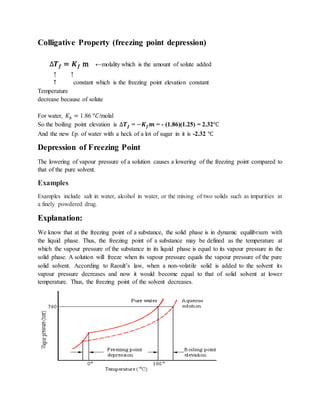
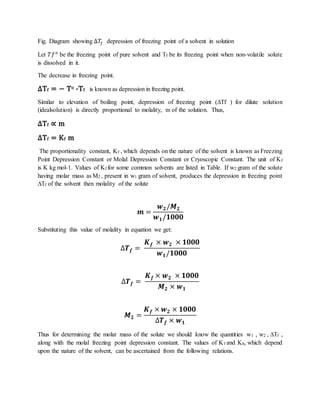
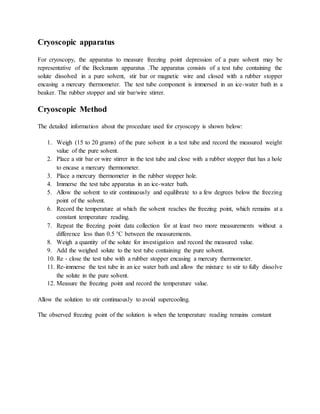
The freezing point of a solvent is lowered when a non-volatile solute is dissolved in it. This phenomenon is known as freezing point depression. The degree of freezing point depression (∆Tf) is directly proportional to the molality of the solution. The proportionality constant (Kf) depends on the identity of the solvent. Common applications of freezing point depression include using salt to de-ice roads and ethylene glycol in automotive antifreeze. The cryoscopic method can be used to determine the molar mass of an unknown solute by measuring the freezing point depression it causes in a solvent.