Ozone layer and its depletion
What is Ozone Layer?
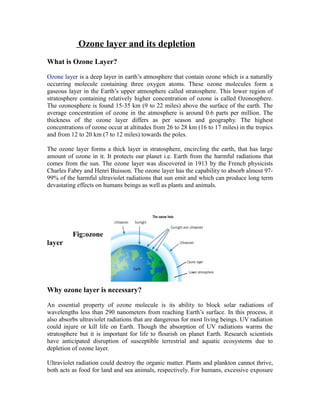
Ozone layer is a deep layer in earth’s atmosphere that contain ozone which is a naturally
occurring molecule containing three oxygen atoms. These ozone molecules form a
gaseous layer in the Earth’s upper atmosphere called stratosphere. This lower region of
stratosphere containing relatively higher concentration of ozone is called Ozonosphere.
The ozonosphere is found 15-35 km (9 to 22 miles) above the surface of the earth. The
average concentration of ozone in the atmosphere is around 0.6 parts per million. The
thickness of the ozone layer differs as per season and geography. The highest
concentrations of ozone occur at altitudes from 26 to 28 km (16 to 17 miles) in the tropics
and from 12 to 20 km (7 to 12 miles) towards the poles.
The ozone layer forms a thick layer in stratosphere, encircling the earth, that has large
amount of ozone in it. It protects our planet i.e. Earth from the harmful radiations that
comes from the sun. The ozone layer was discovered in 1913 by the French physicists
Charles Fabry and Henri Buisson. The ozone layer has the capability to absorb almost 97-
99% of the harmful ultraviolet radiations that sun emit and which can produce long term
devastating effects on humans beings as well as plants and animals.
Fig:ozone
layer
Why ozone layer is necessary?
An essential property of ozone molecule is its ability to block solar radiations of
wavelengths less than 290 nanometers from reaching Earth’s surface. In this process, it
also absorbs ultraviolet radiations that are dangerous for most living beings. UV radiation
could injure or kill life on Earth. Though the absorption of UV radiations warms the
stratosphere but it is important for life to flourish on planet Earth. Research scientists
have anticipated disruption of susceptible terrestrial and aquatic ecosystems due to
depletion of ozone layer.
Ultraviolet radiation could destroy the organic matter. Plants and plankton cannot thrive,
both acts as food for land and sea animals, respectively. For humans, excessive exposure
to ultraviolet radiation leads to higher risks of cancer (especially skin cancer) and
cataracts. It is calculated that every 1 percent decrease in ozone layer results in a 2-5
percent increase in the occurrence of skin cancer. Other ill-effects of the reduction of
protective ozone layer include – increase in the incidence of cataracts, sunburns and
suppression of the immune system.
Depletion of ozone layer:
The depletion of the ozone layer is a phenomena that was observed during the later part
of the 70s and has since then showed a declining rate of 4% per decade and there is a
remarkable decrease over the polar regions of the Earth. The main reason for the
destruction of the ozone is by man-made halocarbon refrigerants such as CFCs, halons
and freons that are released into the atmosphere and are known as ‘ozone depleting
substances’ or ODS. These harmful substances strike the ozone and thin it apart Earth is
letting pass many harmful ultraviolet rays which cause many health hazards like cancer
planktron and cataracts. Therefore many governments have banned products that produce
ODS.
The ozone layer is our warrior against the might Sun that is bombarding earth with
harmful UV radiation and we are trying our best to protect it. Ozone is basically a gas
also referred to as O3 which is formed and reformed constantly in our Earth’s
atmosphere. If it were not for the ozone layer, our Earth would be barren with slight
traces of life. It is also being said that the southern hemisphere of the Earth could have an
additional 20% depletion of the ozone that could result in natural calamities like
tornadoes, avalanches, fires, tsunamis etc.
Causes of Ozone Depletion:
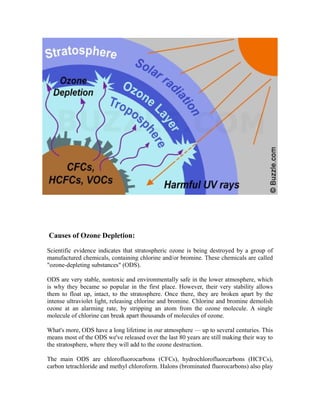
Scientific evidence indicates that stratospheric ozone is being destroyed by a group of
manufactured chemicals, containing chlorine and/or bromine. These chemicals are called
"ozone-depleting substances" (ODS).
ODS are very stable, nontoxic and environmentally safe in the lower atmosphere, which
is why they became so popular in the first place. However, their very stability allows
them to float up, intact, to the stratosphere. Once there, they are broken apart by the
intense ultraviolet light, releasing chlorine and bromine. Chlorine and bromine demolish
ozone at an alarming rate, by stripping an atom from the ozone molecule. A single
molecule of chlorine can break apart thousands of molecules of ozone.
What's more, ODS have a long lifetime in our atmosphere — up to several centuries. This
means most of the ODS we've released over the last 80 years are still making their way to
the stratosphere, where they will add to the ozone destruction.
The main ODS are chlorofluorocarbons (CFCs), hydrochlorofluorcarbons (HCFCs),
carbon tetrachloride and methyl chloroform. Halons (brominated fluorocarbons) also play
a large role. Their application is quite limited: they're used in specialized fire
extinguishers. But the problem with halons is they can destroy up to 10 times as much
ozone as CFCs can. For this reason, halons are the most serious ozone-depleting group of
chemicals emitted in British Columbia.
Hydrofluorocarbons (HFCs) are being developed to replace CFCs and HCFCs, for uses
such as vehicle air conditioning. HFCs do not deplete ozone, but they are strong
greenhouse gases. CFCs are even more powerful contributors to global climate change,
though, so HFCs are still the better option until even safer substitutes are discovered.
The Main Ozone-Depleting Substances (ODS) :
Chlorofluorocarbons (CFCs)
o The most widely used ODS, accounting for over 80% of total stratospheric
ozone depletion.
o Used as coolants in refrigerators, freezers and air conditioners in buildings
and cars manufactured before 1995.
o Found in industrial solvents, dry-cleaning agents and hospital sterilants.
o Also used in foam products — such as soft-foam padding (e.g. cushions
and mattresses) and rigid foam (e.g. home insulation).
Halons
o Used in some fire extinguishers, in cases where materials and equipment
would be destroyed by water or other fire extinguisher chemicals. In B.C.,
halons cause greater damage to the ozone layer than do CFCs from
automobile air conditioners.
Methyl Chloroform
o Used mainly in industry — for vapour degreasing, some aerosols, cold
cleaning, adhesives and chemical processing.
Carbon Tetrachloride
o Used in solvents and some fire extinguishers.
Hydrofluorocarbons (HCFCs)
o HCFCs have become major, “transitional” substitutes for CFCs. They are
much less harmful to stratospheric ozone than CFCs are. But HCFCs they
still cause some ozone destruction and are potent greenhouse gases.
The ways to prevent ozone layer depletion
There are several ways by which depletion of ozone layer can be prevented.
1. Limit private vehicle driving
A very easy way to control ozone depletion would be to limit or reduce the amount of
driving as vehicular emissions eventually result in smog which is a culprit in the
deterioration of the ozone layer. Car pooling, taking public transport, walking, using a
bicycle would limit the usage of individual transportation. It would be a great option to
switch to cars/vehicles that have a hybrid or electric zero-emission engine.
2. Use eco-friendly household cleaning products
Usage of eco-friendly and natural cleaning products for household chores is a great way
to prevent ozone depletion. This is because many of these cleaning agents contain toxic
chemicals that interfere with the ozone layer. A lot of supermarkets and health stores sell
cleaning products that are toxic-free and made out of natural ingredients.
3. Avoid using pesticides
Pesticides may be an easy solution for getting rid of weed, but are harmful for the ozone
layer. The best solution for this would be to try using natural remedies, rather than
heading out for pesticides. You can perhaps try to weed manually or mow your garden
consistently so as to avoid weed-growth.
4. Developing stringent regulations for rocket launches
The world is progressing in scientific discoveries by leaps and bounds. A lot of rocket
launches are happening the world over without consideration of the fact that it can
damage the ozone layer if it is not regulated soon. A study shows that the harm caused by
rocket launches would outpace the harm caused due to CFCs. At present, the global
rocket launches do not contribute hugely to ozone layer depletion, but over the course of
time, due to the advancement of the space industry, it will become a major contributor to
ozone depletion. All types of rocket engines result in combustion by products that are
ozone-destroying compounds that are expelled directly in the middle and upper
stratosphere layer – near the ozone layer.
5. Banning the use of dangerous nitrous oxide
Due to the worldwide alarm caused by a study in the late 70s about the alarming rate at
which the ozone was being depleted, nations around the globe got together and formed
the Montreal Protocol in the year 1989 with a strong aim to stop the usage of CFCs.
However, the protocol did not include nitrous oxide which is the most fatal chemical that
can destroy the ozone layer and is still in use. Governments across the world should take
a strong stand for banning the use of this harmful compound to save the ozone layer.

Ozone layer

  • 1.
    Ozone layer andits depletion What is Ozone Layer? Ozone layer is a deep layer in earth’s atmosphere that contain ozone which is a naturally occurring molecule containing three oxygen atoms. These ozone molecules form a gaseous layer in the Earth’s upper atmosphere called stratosphere. This lower region of stratosphere containing relatively higher concentration of ozone is called Ozonosphere. The ozonosphere is found 15-35 km (9 to 22 miles) above the surface of the earth. The average concentration of ozone in the atmosphere is around 0.6 parts per million. The thickness of the ozone layer differs as per season and geography. The highest concentrations of ozone occur at altitudes from 26 to 28 km (16 to 17 miles) in the tropics and from 12 to 20 km (7 to 12 miles) towards the poles. The ozone layer forms a thick layer in stratosphere, encircling the earth, that has large amount of ozone in it. It protects our planet i.e. Earth from the harmful radiations that comes from the sun. The ozone layer was discovered in 1913 by the French physicists Charles Fabry and Henri Buisson. The ozone layer has the capability to absorb almost 97- 99% of the harmful ultraviolet radiations that sun emit and which can produce long term devastating effects on humans beings as well as plants and animals. Fig:ozone layer Why ozone layer is necessary? An essential property of ozone molecule is its ability to block solar radiations of wavelengths less than 290 nanometers from reaching Earth’s surface. In this process, it also absorbs ultraviolet radiations that are dangerous for most living beings. UV radiation could injure or kill life on Earth. Though the absorption of UV radiations warms the stratosphere but it is important for life to flourish on planet Earth. Research scientists have anticipated disruption of susceptible terrestrial and aquatic ecosystems due to depletion of ozone layer. Ultraviolet radiation could destroy the organic matter. Plants and plankton cannot thrive, both acts as food for land and sea animals, respectively. For humans, excessive exposure
  • 2.
    to ultraviolet radiationleads to higher risks of cancer (especially skin cancer) and cataracts. It is calculated that every 1 percent decrease in ozone layer results in a 2-5 percent increase in the occurrence of skin cancer. Other ill-effects of the reduction of protective ozone layer include – increase in the incidence of cataracts, sunburns and suppression of the immune system.
  • 3.
    Depletion of ozonelayer: The depletion of the ozone layer is a phenomena that was observed during the later part of the 70s and has since then showed a declining rate of 4% per decade and there is a remarkable decrease over the polar regions of the Earth. The main reason for the destruction of the ozone is by man-made halocarbon refrigerants such as CFCs, halons and freons that are released into the atmosphere and are known as ‘ozone depleting substances’ or ODS. These harmful substances strike the ozone and thin it apart Earth is letting pass many harmful ultraviolet rays which cause many health hazards like cancer planktron and cataracts. Therefore many governments have banned products that produce ODS. The ozone layer is our warrior against the might Sun that is bombarding earth with harmful UV radiation and we are trying our best to protect it. Ozone is basically a gas also referred to as O3 which is formed and reformed constantly in our Earth’s atmosphere. If it were not for the ozone layer, our Earth would be barren with slight traces of life. It is also being said that the southern hemisphere of the Earth could have an additional 20% depletion of the ozone that could result in natural calamities like tornadoes, avalanches, fires, tsunamis etc.
  • 4.
    Causes of OzoneDepletion: Scientific evidence indicates that stratospheric ozone is being destroyed by a group of manufactured chemicals, containing chlorine and/or bromine. These chemicals are called "ozone-depleting substances" (ODS). ODS are very stable, nontoxic and environmentally safe in the lower atmosphere, which is why they became so popular in the first place. However, their very stability allows them to float up, intact, to the stratosphere. Once there, they are broken apart by the intense ultraviolet light, releasing chlorine and bromine. Chlorine and bromine demolish ozone at an alarming rate, by stripping an atom from the ozone molecule. A single molecule of chlorine can break apart thousands of molecules of ozone. What's more, ODS have a long lifetime in our atmosphere — up to several centuries. This means most of the ODS we've released over the last 80 years are still making their way to the stratosphere, where they will add to the ozone destruction. The main ODS are chlorofluorocarbons (CFCs), hydrochlorofluorcarbons (HCFCs), carbon tetrachloride and methyl chloroform. Halons (brominated fluorocarbons) also play
  • 5.
    a large role.Their application is quite limited: they're used in specialized fire extinguishers. But the problem with halons is they can destroy up to 10 times as much ozone as CFCs can. For this reason, halons are the most serious ozone-depleting group of chemicals emitted in British Columbia. Hydrofluorocarbons (HFCs) are being developed to replace CFCs and HCFCs, for uses such as vehicle air conditioning. HFCs do not deplete ozone, but they are strong greenhouse gases. CFCs are even more powerful contributors to global climate change, though, so HFCs are still the better option until even safer substitutes are discovered. The Main Ozone-Depleting Substances (ODS) : Chlorofluorocarbons (CFCs) o The most widely used ODS, accounting for over 80% of total stratospheric ozone depletion. o Used as coolants in refrigerators, freezers and air conditioners in buildings and cars manufactured before 1995. o Found in industrial solvents, dry-cleaning agents and hospital sterilants. o Also used in foam products — such as soft-foam padding (e.g. cushions and mattresses) and rigid foam (e.g. home insulation). Halons o Used in some fire extinguishers, in cases where materials and equipment would be destroyed by water or other fire extinguisher chemicals. In B.C., halons cause greater damage to the ozone layer than do CFCs from automobile air conditioners. Methyl Chloroform o Used mainly in industry — for vapour degreasing, some aerosols, cold cleaning, adhesives and chemical processing. Carbon Tetrachloride o Used in solvents and some fire extinguishers. Hydrofluorocarbons (HCFCs) o HCFCs have become major, “transitional” substitutes for CFCs. They are much less harmful to stratospheric ozone than CFCs are. But HCFCs they still cause some ozone destruction and are potent greenhouse gases.
  • 6.
    The ways toprevent ozone layer depletion There are several ways by which depletion of ozone layer can be prevented. 1. Limit private vehicle driving A very easy way to control ozone depletion would be to limit or reduce the amount of driving as vehicular emissions eventually result in smog which is a culprit in the deterioration of the ozone layer. Car pooling, taking public transport, walking, using a bicycle would limit the usage of individual transportation. It would be a great option to switch to cars/vehicles that have a hybrid or electric zero-emission engine. 2. Use eco-friendly household cleaning products Usage of eco-friendly and natural cleaning products for household chores is a great way to prevent ozone depletion. This is because many of these cleaning agents contain toxic chemicals that interfere with the ozone layer. A lot of supermarkets and health stores sell cleaning products that are toxic-free and made out of natural ingredients. 3. Avoid using pesticides Pesticides may be an easy solution for getting rid of weed, but are harmful for the ozone layer. The best solution for this would be to try using natural remedies, rather than heading out for pesticides. You can perhaps try to weed manually or mow your garden consistently so as to avoid weed-growth. 4. Developing stringent regulations for rocket launches The world is progressing in scientific discoveries by leaps and bounds. A lot of rocket launches are happening the world over without consideration of the fact that it can damage the ozone layer if it is not regulated soon. A study shows that the harm caused by rocket launches would outpace the harm caused due to CFCs. At present, the global rocket launches do not contribute hugely to ozone layer depletion, but over the course of time, due to the advancement of the space industry, it will become a major contributor to ozone depletion. All types of rocket engines result in combustion by products that are ozone-destroying compounds that are expelled directly in the middle and upper stratosphere layer – near the ozone layer. 5. Banning the use of dangerous nitrous oxide Due to the worldwide alarm caused by a study in the late 70s about the alarming rate at which the ozone was being depleted, nations around the globe got together and formed
  • 7.
    the Montreal Protocolin the year 1989 with a strong aim to stop the usage of CFCs. However, the protocol did not include nitrous oxide which is the most fatal chemical that can destroy the ozone layer and is still in use. Governments across the world should take a strong stand for banning the use of this harmful compound to save the ozone layer.