Bryophytes
 Liverworts, hornworts, and mosses
 Lack vascular tissues
 No lignified tissues
 Have rhizoids
 Gametophyte generation is dominant
 Phylum

: Bryophyta

: Hepatophyta
: Anthocerophyta
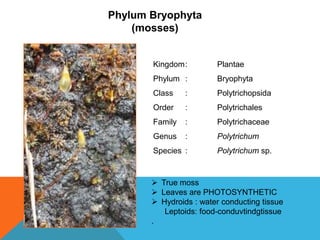
Phylum Bryophyta
(mosses)

Kingdom:

Plantae

Phylum :

Bryophyta

Class

:

Polytrichopsida

Order

:

Polytrichales

Family

:

Polytrichaceae

Genus

:

Polytrichum

Species :

Polytrichum sp.

 True moss
 Leaves are PHOTOSYNTHETIC
 Hydroids : water conducting tissue
Leptoids: food-conduvtindgtissue
.
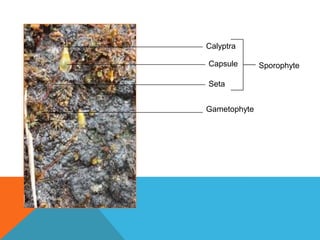
Calyptra
Capsule
Seta
Gametophyte

Sporophyte
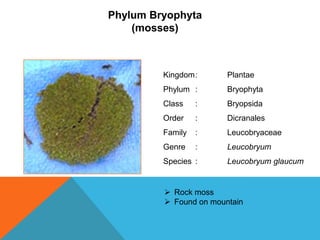
Phylum Bryophyta
(mosses)

Kingdom:

Plantae

Phylum :

Bryophyta

Class

:

Bryopsida

Order

:

Dicranales

Family

:

Leucobryaceae

Genre

:

Leucobryum

Species :

Leucobryum glaucum

 Rock moss
 Found on mountain
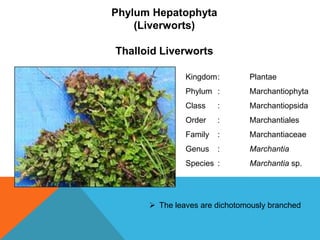
Phylum Hepatophyta
(Liverworts)

Thalloid Liverworts
Kingdom:

Plantae

Phylum :

Marchantiophyta

Class

:

Marchantiopsida

Order

:

Marchantiales

Family

:

Marchantiaceae

Genus

:

Marchantia

Species :

Marchantia sp.

 The leaves are dichotomously branched
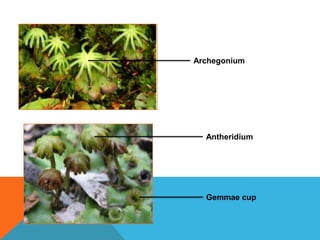
Archegonium

Antheridium

Gemmae cup
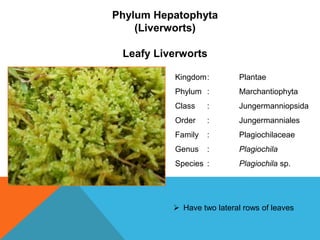
Phylum Hepatophyta
(Liverworts)
Leafy Liverworts
Kingdom:

Plantae

Phylum :

Marchantiophyta

Class

:

Jungermanniopsida

Order

:

Jungermanniales

Family

:

Plagiochilaceae

Genus

:

Plagiochila

Species :

Plagiochila sp.

 Have two lateral rows of leaves
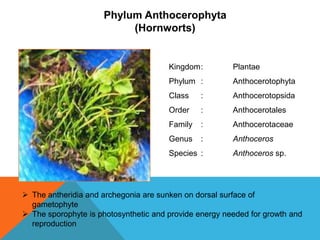
Phylum Anthocerophyta
(Hornworts)

Kingdom:

Plantae

Phylum :

Anthocerotophyta

Class

:

Anthocerotopsida

Order

:

Anthocerotales

Family

:

Anthocerotaceae

Genus

:

Anthoceros

Species :

Anthoceros sp.

 The antheridia and archegonia are sunken on dorsal surface of
gametophyte
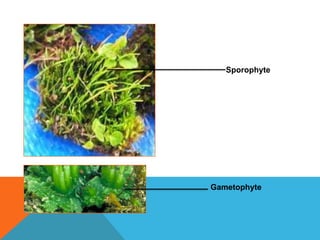
 The sporophyte is photosynthetic and provide energy needed for growth and
reproduction
Sporophyte

Gametophyte

Bryophyte