The Bryophytes
Mosses, Liverworts, & Hornworts
Damnjanović Ivana
Introduction

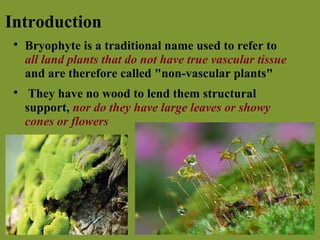
Bryophyte is a traditional name used to refer to
all land plants that do not have true vascular tissue
and are therefore called "non-vascular plants"

They have no wood to lend them structural
support, nor do they have large leaves or showy
cones or flowers

This does not mean that mosses are not
important; in fact, mosses play important
roles in reducing erosion along streams,
water and nutrient cycling in tropical forests,
and insulating.

Bryophytes are gametophyte dominant, meaning
that the more prominent, longer-lived plant is the
haploid gametophyte.

The diploid sporophytes appear only occasionally
and remain attached to and nutritionally
dependent on the gametophyte.
Sporangium and Spores

Absence of specialized tissues for transporting water and
dissolved food throughout the organism limits terrestrial
forms to being very short plants, since the only way to
move substances through the plant body is by osmosis
and diffusion from surface moisture.

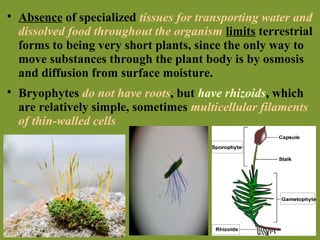
Bryophytes do not have roots, but have rhizoids, which
are relatively simple, sometimes multicellular filaments
of thin-walled cells
Reproduction and Life cycle
Vegetative reproduction

A piece that breaks off a gametophyte and then
lands in a suitable habitat will grow into a new
gametophyte .

The breakage may be accidental, such as animal
trampling or erosion leading to fragmentation of
an existing bryophyte colony.
Sexual Reproduction

This cycle of fertilization and meiosis involves an
alternation of generations between the haploid gamete
-producing stage (gametophyte) and the diploid
organism (sporophyte).

In the bryophytes, it is the haploid gametophyte that
produces the leaves and thali and therefore
predominates.

The process requires the production of male
gametes (sperm), female gametes (eggs) and some
means of getting the sperm to the eggs.

The gametes are produced on the gametophytes.

The sperm are produced within tiny, typically
stalked, club-shaped structures called antheridia.

Each antheridium produces numerous sperm.

The eggs are produced in tiny, typically somewhat
flask-like structures called archegonia.

Each archegonium holds one egg (in a swollen section
called the venter).

The sperm enter through the channel in the narrower,
tubular section (or neck).

A fertilized egg in an archegonium develops into the
sporophyte.

The sporophyte consists of a spore-containing capsule
which, depending on the species, may be stalked or
stalkless. Each spore contains a mix of genes from the
two parents and on successful germination will give
rise to a new gametophyte.
Bryphytes
• 3 types of Bryophytes
Mosses
Liverworts
Hornworts
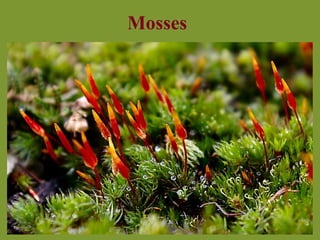
Mosses
Mosses
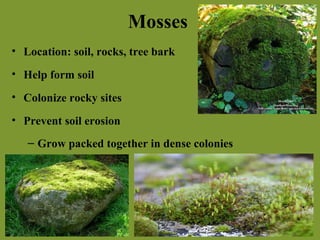
• Location: soil, rocks, tree bark
• Help form soil
• Colonize rocky sites
• Prevent soil erosion
– Grow packed together in dense colonies

The Moss Body
− Thallus – Body structure
− Rhizoids – hair-like absorptive structures
− Do not have TRUE roots, stems, or leaves
-Many mosses have separate sexes: male plants and
female plants
-The gametophyte generation is dominant
Sphagnum sp.
Polytrichum commune
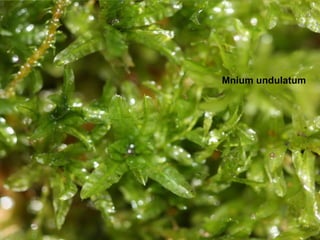
Mnium undulatum
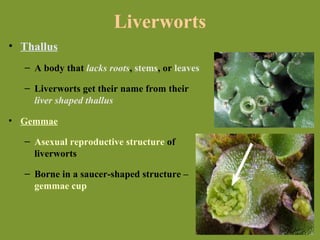
Liverworts
• Thallus
– A body that lacks roots, stems, or leaves
– Liverworts get their name from their
liver shaped thallus
• Gemmae
– Asexual reproductive structure of
liverworts
– Borne in a saucer-shaped structure –
gemmae cup
Marchantia polymorpha
-Location: fields &
roadsides
-Thalloids - 1-2 cm
-Sporophyte
generations form
hornlike
projections out of
the gametophyte
thallus
Hornworts
Uses of Bryophytes

Medicine

Cosmetics

Food for animals

Home insulating
The Bryophytes

The Bryophytes

  • 1.
    The Bryophytes Mosses, Liverworts,& Hornworts Damnjanović Ivana
  • 2.
    Introduction  Bryophyte is atraditional name used to refer to all land plants that do not have true vascular tissue and are therefore called "non-vascular plants"  They have no wood to lend them structural support, nor do they have large leaves or showy cones or flowers
  • 3.
     This does notmean that mosses are not important; in fact, mosses play important roles in reducing erosion along streams, water and nutrient cycling in tropical forests, and insulating.
  • 4.
     Bryophytes are gametophytedominant, meaning that the more prominent, longer-lived plant is the haploid gametophyte.  The diploid sporophytes appear only occasionally and remain attached to and nutritionally dependent on the gametophyte.
  • 5.
  • 6.
     Absence of specializedtissues for transporting water and dissolved food throughout the organism limits terrestrial forms to being very short plants, since the only way to move substances through the plant body is by osmosis and diffusion from surface moisture.  Bryophytes do not have roots, but have rhizoids, which are relatively simple, sometimes multicellular filaments of thin-walled cells
  • 8.
    Reproduction and Lifecycle Vegetative reproduction  A piece that breaks off a gametophyte and then lands in a suitable habitat will grow into a new gametophyte .  The breakage may be accidental, such as animal trampling or erosion leading to fragmentation of an existing bryophyte colony.
  • 9.
    Sexual Reproduction  This cycleof fertilization and meiosis involves an alternation of generations between the haploid gamete -producing stage (gametophyte) and the diploid organism (sporophyte).  In the bryophytes, it is the haploid gametophyte that produces the leaves and thali and therefore predominates.
  • 11.
     The process requiresthe production of male gametes (sperm), female gametes (eggs) and some means of getting the sperm to the eggs.  The gametes are produced on the gametophytes.  The sperm are produced within tiny, typically stalked, club-shaped structures called antheridia.  Each antheridium produces numerous sperm.
  • 12.
     The eggs areproduced in tiny, typically somewhat flask-like structures called archegonia.  Each archegonium holds one egg (in a swollen section called the venter).  The sperm enter through the channel in the narrower, tubular section (or neck).
  • 13.
     A fertilized eggin an archegonium develops into the sporophyte.  The sporophyte consists of a spore-containing capsule which, depending on the species, may be stalked or stalkless. Each spore contains a mix of genes from the two parents and on successful germination will give rise to a new gametophyte.
  • 15.
    Bryphytes • 3 typesof Bryophytes Mosses Liverworts Hornworts
  • 16.
  • 17.
    Mosses • Location: soil,rocks, tree bark • Help form soil • Colonize rocky sites • Prevent soil erosion – Grow packed together in dense colonies
  • 18.
     The Moss Body −Thallus – Body structure − Rhizoids – hair-like absorptive structures − Do not have TRUE roots, stems, or leaves -Many mosses have separate sexes: male plants and female plants -The gametophyte generation is dominant
  • 19.
  • 21.
  • 22.
  • 23.
    Liverworts • Thallus – Abody that lacks roots, stems, or leaves – Liverworts get their name from their liver shaped thallus • Gemmae – Asexual reproductive structure of liverworts – Borne in a saucer-shaped structure – gemmae cup
  • 25.
  • 27.
    -Location: fields & roadsides -Thalloids- 1-2 cm -Sporophyte generations form hornlike projections out of the gametophyte thallus Hornworts
  • 30.

Editor's Notes

  • #16 6th Hour Left off Here
  • #24 1st Hour Left off Here