Brain wave Technology
UNDER THE SUPERVISION OF:
Ms. K. Neelima, M.Tech.,
Assistant Professor
Department of Electronics and Communication Engineering
SREE VIDYANIKETHAN ENGINEERING COLLEGE
(AUTONOMOUS)
Sri Sainathnagar, A.Rangampet, Tirupathi-517102
Contents:
Introduction
Aim and Principle
Construction and Working
Brain Waves
Characteristics
Overall view
Features
Advantages
Applications
Conclusion
Introduction:
Brainwave technology is a direct technological interface between a
brain & a computer system not requires a motor output from the
user.
It is also known as Direct Neural Interface (DNI) & Brain –
Machine Interface (BMI) & Brain Computer Interface (BCI).
This technology is mainly used for physically and mentally
challenged people.
Principle:
In 1924 German physiologist and psychiatrist Hans Berger (1873–
1941) recorded the first human brain signal by EEG.
Capture the brain signals pass from neurons to neurons while we are
thinking.
Discrimination between left and right hand imagery movements.
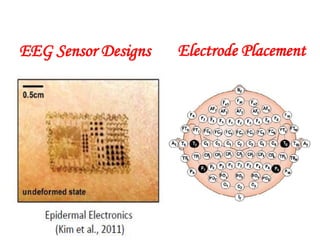
EEG Sensor Designs Electrode Placement
Construction and working:
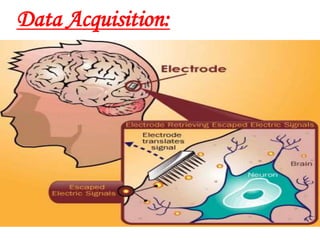
Electro Encephalo Graphy (EEG) is the recording
of electrical activity.
 EEG measures voltage fluctuations resulting from ionic
current flows within the neurons of the brain.
We use ZigBee in this technology which transmits data
through intermediate devices.
ZigBee:
ZigBee specification suites for high level communication protocols.
 ZigBee has a defined rate of 250 kilo bit/s, best suited for periodic or
intermittent data or a single signal transmission from a sensor or input
device.
ZigBee uses the 2.4 GHz radio frequency to deliver a variety of reliable
and easy-to-use standards anywhere in the world.
ZigBee offers a variety of innovative standards smartly designed to
help you be green and save money.
ZigBee is used in applications that require only a low data rate, long
battery life, and secure networking.
Specifications :
• Bluetooth Wireless communication
• Passive Dry Sensor EEG
• Single AAA battery
• 10 Hours Run Time
• Frequency Bands: 0.5 to 50Hz
• Micro Controller : 8051
• ZIGBEE MODULE-Frequency : 2.4 Ghz
• Attention level < 65 ------ STOP
• Attention level > 65 ------ START
• Baud rates available at 1200, 9600 ,57600 or 115200
Data Acquisition:
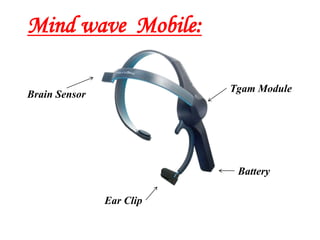
Mind wave Mobile:
Brain Sensor
Ear Clip
Battery
Tgam Module
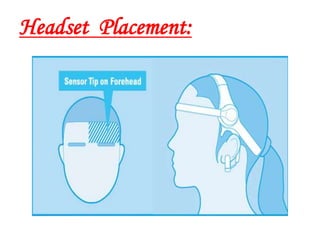
Headset Placement:
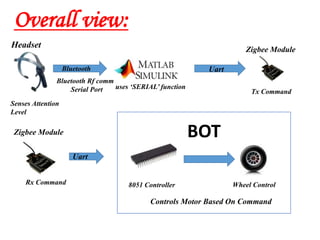
Overall view:
Bluetooth Uart
Uart
Zigbee Module
Senses Attention
Level
Bluetooth Rf comm
Serial Port
Zigbee Module
8051 Controller Wheel Control
BOT
uses ‘SERIAL’ function
Tx Command
Headset
Rx Command
Controls Motor Based On Command
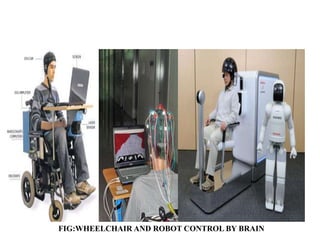
FIG:WHEELCHAIR AND ROBOT CONTROL BY BRAIN
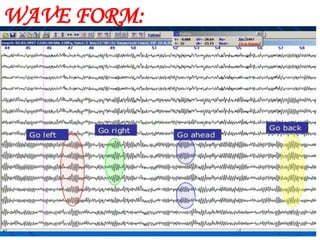
WAVE FORM:
Brain Wave Characteristics :
Main source of the EEG is the synchronous activity of
thousands of cortical neurons.
Everyone's brainwave signal is a bit different even when they
think about the same thing.
In abnormal adults the EEG shows sudden bursts of electrical
activity (spikes). These abnormal discharges may be caused by
a brain tumor, infection, injury, stroke, or epilepsy.
Features :
 Can detect multiple mental states simultaneously
 Reference electrode on Ear clip is to remove ambient noises
 Provides EMG feature for Eye Blink detection
 By changing some connections we can use it as brain figure prints.
Advantages:
It is also used to relax our mind.
Brain finger prints is used in airports or in transport areas to
identify the person is dangerous are not.
BCIs will help creating a Direct communication pathway between
a human or animal brain and any external devices like computers.
BCI has increased the possibility of treatment of disabilities
related to nervous system along with the old technique of
Neuroprosthetics.
Techniques like EEG, MEG and neurochips have come into
discussions since the BCI application have started developing.
Complexity of brain
Information transformation rate is limited to 20 bits/min.
Adaptation and learning is difficult
It is very expensive.
Research is still in beginning state.
Disadvantages:
Applications:
Portable medical applications
Mental typewriter
Light intensity control
Music play based on mind state
Mind gaming
Controlling the electronic devices and a wheel chair
LIVE APPLICATIONS:
Conclusion:
This technology is a sort of making disabled
persons physically courageous and mentally strong
enough to face and make their beautiful life more
beautiful even though they lack physical fitness.
References:
1) Schalk,G. ;Leuthardt, E.C.,"Brain-Computer Interfaces Using
Electrocorticographic Signals," Biomedical Engineering, IEEE Reviews in ,
vol.4,no.,pp.140,154,2011doi: 10.1109/RBME.2011.2172408
2) P. Sajda, K-R. Mueller, and K.V. Shenoy, eds., special issue, “Brain Computer
interfaces,” IEEE Signal Processing Magazine,Jan. 2008
3) www.wikipedia.org
4) www.brain-waves-technology.com
5) www.slideshare.net
6) http://www.ieeexplore.ieee.org
BRAINWAVE TECHNOLOGY

BRAINWAVE TECHNOLOGY

  • 1.
    Brain wave Technology UNDERTHE SUPERVISION OF: Ms. K. Neelima, M.Tech., Assistant Professor Department of Electronics and Communication Engineering SREE VIDYANIKETHAN ENGINEERING COLLEGE (AUTONOMOUS) Sri Sainathnagar, A.Rangampet, Tirupathi-517102
  • 2.
    Contents: Introduction Aim and Principle Constructionand Working Brain Waves Characteristics Overall view Features Advantages Applications Conclusion
  • 3.
    Introduction: Brainwave technology isa direct technological interface between a brain & a computer system not requires a motor output from the user. It is also known as Direct Neural Interface (DNI) & Brain – Machine Interface (BMI) & Brain Computer Interface (BCI). This technology is mainly used for physically and mentally challenged people.
  • 4.
    Principle: In 1924 Germanphysiologist and psychiatrist Hans Berger (1873– 1941) recorded the first human brain signal by EEG. Capture the brain signals pass from neurons to neurons while we are thinking. Discrimination between left and right hand imagery movements.
  • 5.
    EEG Sensor DesignsElectrode Placement
  • 6.
    Construction and working: ElectroEncephalo Graphy (EEG) is the recording of electrical activity.  EEG measures voltage fluctuations resulting from ionic current flows within the neurons of the brain. We use ZigBee in this technology which transmits data through intermediate devices.
  • 7.
    ZigBee: ZigBee specification suitesfor high level communication protocols.  ZigBee has a defined rate of 250 kilo bit/s, best suited for periodic or intermittent data or a single signal transmission from a sensor or input device. ZigBee uses the 2.4 GHz radio frequency to deliver a variety of reliable and easy-to-use standards anywhere in the world. ZigBee offers a variety of innovative standards smartly designed to help you be green and save money. ZigBee is used in applications that require only a low data rate, long battery life, and secure networking.
  • 8.
    Specifications : • BluetoothWireless communication • Passive Dry Sensor EEG • Single AAA battery • 10 Hours Run Time • Frequency Bands: 0.5 to 50Hz • Micro Controller : 8051 • ZIGBEE MODULE-Frequency : 2.4 Ghz • Attention level < 65 ------ STOP • Attention level > 65 ------ START • Baud rates available at 1200, 9600 ,57600 or 115200
  • 9.
  • 10.
    Mind wave Mobile: BrainSensor Ear Clip Battery Tgam Module
  • 11.
  • 12.
    Overall view: Bluetooth Uart Uart ZigbeeModule Senses Attention Level Bluetooth Rf comm Serial Port Zigbee Module 8051 Controller Wheel Control BOT uses ‘SERIAL’ function Tx Command Headset Rx Command Controls Motor Based On Command
  • 13.
    FIG:WHEELCHAIR AND ROBOTCONTROL BY BRAIN
  • 14.
  • 15.
    Brain Wave Characteristics: Main source of the EEG is the synchronous activity of thousands of cortical neurons. Everyone's brainwave signal is a bit different even when they think about the same thing. In abnormal adults the EEG shows sudden bursts of electrical activity (spikes). These abnormal discharges may be caused by a brain tumor, infection, injury, stroke, or epilepsy.
  • 16.
    Features :  Candetect multiple mental states simultaneously  Reference electrode on Ear clip is to remove ambient noises  Provides EMG feature for Eye Blink detection  By changing some connections we can use it as brain figure prints.
  • 17.
    Advantages: It is alsoused to relax our mind. Brain finger prints is used in airports or in transport areas to identify the person is dangerous are not. BCIs will help creating a Direct communication pathway between a human or animal brain and any external devices like computers. BCI has increased the possibility of treatment of disabilities related to nervous system along with the old technique of Neuroprosthetics. Techniques like EEG, MEG and neurochips have come into discussions since the BCI application have started developing.
  • 18.
    Complexity of brain Informationtransformation rate is limited to 20 bits/min. Adaptation and learning is difficult It is very expensive. Research is still in beginning state. Disadvantages:
  • 19.
    Applications: Portable medical applications Mentaltypewriter Light intensity control Music play based on mind state Mind gaming Controlling the electronic devices and a wheel chair
  • 20.
  • 21.
    Conclusion: This technology isa sort of making disabled persons physically courageous and mentally strong enough to face and make their beautiful life more beautiful even though they lack physical fitness.
  • 22.
    References: 1) Schalk,G. ;Leuthardt,E.C.,"Brain-Computer Interfaces Using Electrocorticographic Signals," Biomedical Engineering, IEEE Reviews in , vol.4,no.,pp.140,154,2011doi: 10.1109/RBME.2011.2172408 2) P. Sajda, K-R. Mueller, and K.V. Shenoy, eds., special issue, “Brain Computer interfaces,” IEEE Signal Processing Magazine,Jan. 2008 3) www.wikipedia.org 4) www.brain-waves-technology.com 5) www.slideshare.net 6) http://www.ieeexplore.ieee.org