Theory,
Standards, &
SCT
Symbolic
Interactionism,
EVT, &
Constructivism
SPT,
URT, & SIP
Relational
Dialectics,
CPM, &
Systems
Theory
FPG, Orgs as
Cultures, &
Cultivation
Theory
Cultural
Studies, CAT,
& FNT
10
20
30
40
50
10
20
30
40
50
10
20
30
40
50
10
20
30
40
50
10
20
30
40
50
10
20
30
40
50
10
20
30
40
50
10
20
30
40
50
CAT, FNT, &
Gendered
Comm.
Gendered
Comm.
Talking about Theory, Weighing the
Words, & Social Convergence Theory
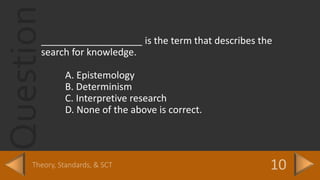
Question___________________ is the term that describes the
search for knowledge.
A. Epistemology
B. Determinism
C. Interpretive research
D. None of the above is correct.
Answer
A. Epistemology
(Griffin, 2012, p. 16).
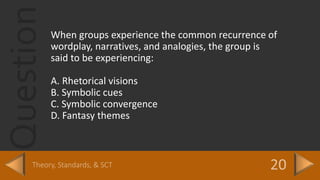
QuestionWhen groups experience the common recurrence of
wordplay, narratives, and analogies, the group is
said to be experiencing:
A. Rhetorical visions
B. Symbolic cues
C. Symbolic convergence
D. Fantasy themes
Answer
D. Symbolic convergence
(Griffin, 2012, pp. 251-252).
Question
You have one minute to answer this question.
List the six standards of evaluating an interpretive
theory.
DAILY DOUBLE!!
Answer Six Interpretive Standards
1. New Understanding of People
2. Clarification of Values
3. Aesthetic Appeal
4. Community of Agreement
5. Reform of Society
6. Qualitative Research
(Griffin, 2012, pp. 30-34).
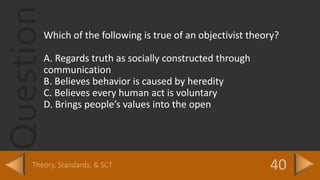
QuestionWhich of the following is true of an objectivist theory?
A. Regards truth as socially constructed through
communication
B. Believes behavior is caused by heredity
C. Believes every human act is voluntary
D. Brings people’s values into the open
Answer
B. Believes behavior is caused by heredity
(Griffin, 2012, pp. 17-18).
QuestionWhich of the following is NOT a criticism of Symbolic
Convergence Theory?
A. It does not explain the benefits of occasionally chaotic
group experiences
B. It does not sufficiently explain why humans are predisposed
to dramatizing reality and sharing fantasy in the first place.
C. The method of fantasy theme analysis is not consistent as
Bormann admits some critics do this better than others
D. The vocabulary shows the theory’s pro-social, bias but it
ignores issues of power.
Answer
A. It does not explain the benefits of occasionally
chaotic group experiences
(Griffin, 2012, pp. 256-257).
Symbolic Interactionism, Expectancy Violations
Theory, & Constructivism
QuestionThe looking-glass self is best defined as:
A. The subjective self
B. The mental image that results from taking the role of
the other
C. The process of mentally imagining you’re someone else
viewing you.
D. The mental image others have of you
Answer
B. The mental image that results from taking the
role of the other
(Griffin, 2012, p. 59).
QuestionDelia's use of the phrase person-centered messages
refers to messages that people who have an ability
to adapt to _____________ aspects of various
communication contexts can craft.
A. Subjective
B. Affective
C. Relational
D. All of the above are correct
Answer
D. All of the above are correct
(Griffin, 2012, p. 101).
QuestionThe human tendency to size up other people in
terms of what they have to offer is called
A. Violation valence
B. Interaction adaptation
C. Communicator reward valance
D. reciprocity
Answer
C. Communicator reward valance
(Griffin, 2012, p. 91).
QuestionPeople who assume that communication is a game
that is played cooperatively in the context of social
rules are using the
A. Rhetorical design logic
B. Conventional design logic
C. Expressive design logic
D. Scientific design logic
Answer
B. Conventional design logic
(Read over lecture notes on Constructivism – Message Design Logics).
QuestionMead believed that the self can be impacted by:
A. The comments others make about us.
B. The things we tell ourselves
C. The thoughts we choose to entertain
D. All of the above are correct
Answer
D. All of the above are correct
(Griffin, 2012, p. 59-61).
Social Penetration Theory, Uncertainty Reduction
Theory, & Social Information Processing Theory
Question According to social exchange theory, if the perceived
rewards minus the perceived costs exceed what is
available in other relationships, a person will:
A. end the relationship
B. have a discussion with his or her partner to
determine if they need to do more.
C. most likely stay in the relationship.
D. withdraw slightly from the relationship.
Answer
C. most likely stay in the relationship.
(Griffin, 2012, p. 119).
QuestionIf Ben wants to get to know Sarah in class who he finds attractive
and talks to a friend who also knows Sarah, he is using:
A. Passive strategy
B. Active strategy
C. Interactive strategy
D. A combination of all three strategies
Answer
B. Active strategy
(Griffin, 2012, p. 131).
QuestionWalther labeled CMC relationships that were more intimate
than the relationships would be if partners were physically
together as:
A. selective self-preservation.
B. overattribution of similarity.
C. hyperpersonal.
D. All of the above are correct.
Answer
C. hyperpersonal
(Griffin, 2012, p. 143).
QuestionThe real connection between uncertainty and
reciprocity is an issue of:
A. Self-esteem
B. Fear
C. Power
D. Expectations
Answer
C. Power
(Griffin, 2012, p. 128).
QuestionWhich of the following is a criticism of Social Information
Processing Theory?
A. It relies too heavily on warranting values
B. The hyperpersonal perspective lacks theoretical basis,
which does not allow for testability.
C. The theory does not offer a solution for handling the
slower exchange of messages with CMC
D. The theory does not follow the rule of parsimony
Answer
B. The hyperpersonal perspective lacks theoretical
basis, which does not allow for testability.
(Griffin, 2012, pp. 147-148).
Relational Dialectics, Communication
Privacy Management, & the Interactional
View
QuestionOn the TV series Friends, Monica and Chandler tried
to hide their relationship from the other members
of their group. This is a demonstration of the
external dialectic tension labeled:
A. conventionality-uniqueness.
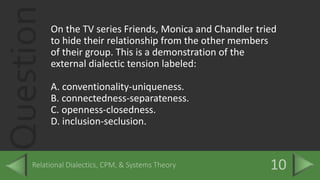
B. connectedness-separateness.

C. openness-closedness.
D. inclusion-seclusion.
Answer
D. inclusion-seclusion.
(Griffin, 2012, pp. 156-157).
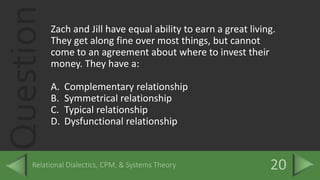
QuestionZach and Jill have equal ability to earn a great living.
They get along fine over most things, but cannot
come to an agreement about where to invest their
money. They have a:
A. Complementary relationship
B. Symmetrical relationship
C. Typical relationship
D. Dysfunctional relationship
Answer
B. Symmetrical relationship
(Griffin, 2012, p. 186).
Question
The relational dimension of communication tends to
be carried through:
A. Nonverbal channels
B. Media channels
C. Verbal channels
D. A combination of channels
Answer
A. Nonverbal channels
(Griffin, 2012, p. 184).
QuestionWhich of the following is NOT one of Petronio’s suggested
negotiations to focus on when coordinating mutual privacy
boundaries?
A. Boundary Linkage
B. Boundary Permeability
C. Boundary Ownership
D. Boundary Turbulence
Answer
D. Boundary Turbulence
(Griffin, 2012, p. 173).
Question _________ is best defined as a system having
multiple causes for one outcome.
A. Requisite Variety
B. Entropy
C. Equifinality
D. Holism
Answer
C. Equifinality
(Read over lecture notes on the Interactional View – Systems Properties).
Functional Perspective on Group Decision
Making, Organizations as Cultures, &
Cultivation Theory
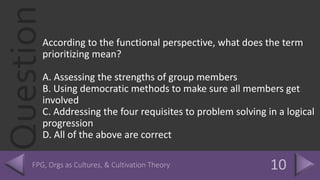
QuestionAccording to the functional perspective, what does the term
prioritizing mean?
A. Assessing the strengths of group members
B. Using democratic methods to make sure all members get
involved
C. Addressing the four requisites to problem solving in a logical
progression
D. All of the above are correct
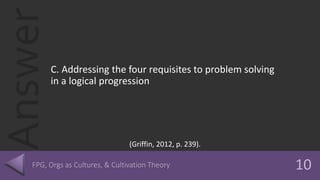
Answer
C. Addressing the four requisites to problem solving
in a logical progression
(Griffin, 2012, p. 239).
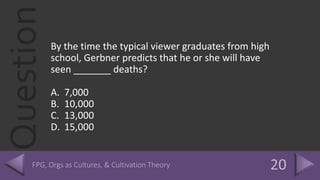
QuestionBy the time the typical viewer graduates from high
school, Gerbner predicts that he or she will have
seen _______ deaths?
A. 7,000
B. 10,000
C. 13,000
D. 15,000
Answer
C. 13,000
(Griffin, 2012, p. 369).
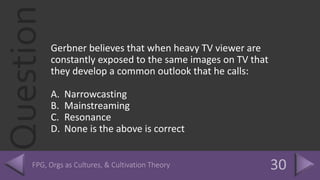
QuestionGerbner believes that when heavy TV viewer are
constantly exposed to the same images on TV that
they develop a common outlook that he calls:
A. Narrowcasting
B. Mainstreaming
C. Resonance
D. None is the above is correct
Answer
B. Mainstreaming
(Griffin, 2012, pp. 371-372).
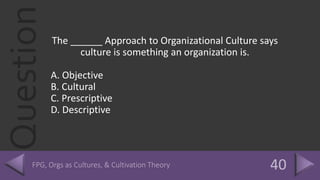
Question The ______ Approach to Organizational Culture says
culture is something an organization is.
A. Objective
B. Cultural
C. Prescriptive
D. Descriptive
Answer
D. Descriptive
(Read over lecture notes on Organizations as Cultures).
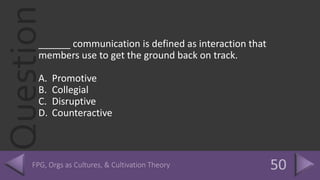
Question______ communication is defined as interaction that
members use to get the ground back on track.
A. Promotive
B. Collegial
C. Disruptive
D. Counteractive
Answer
D. Counteractive
(Griffin, 2012, pp. 240-241).
Cultural Studies, Communication
Accommodation Theory, & Face Negotiation
Theory
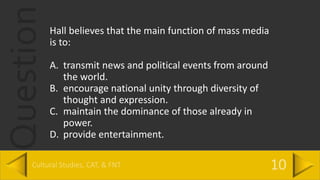
QuestionHall believes that the main function of mass media
is to:
A. transmit news and political events from around
the world.
B. encourage national unity through diversity of
thought and expression.
C. maintain the dominance of those already in
power.
D. provide entertainment.
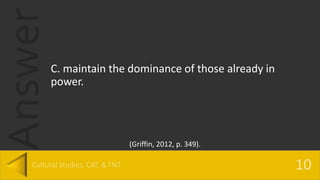
Answer
C. maintain the dominance of those already in
power.
(Griffin, 2012, p. 349).
QuestionHall argues that the primary function of discourse is
to:
A. persuade other people.
B. make meaning.
C. create diverse viewpoints.
D. encourage free thinking.
Answer
B. Make meaning
(Griffin, 2012, p. 346).
QuestionFollowing the incidents of September 11, President
Bush created an unusual equation that stated:
A. buying cars can help fight terrorism.
B. people should be searched before getting on
public transportation.
C. supporting military spending is the way to defeat
terrorism.
D. None of the above is correct.
Answer
A. buying cars can help fight terrorism.
(Griffin, 2012, p. 348-349).
Question
The face-restoration strategy is used:
A. to stake out a unique place in life.
B. to preserve autonomy.
C. to defend against loss of personal freedom.
D. All the above are correct.
Answer
D. All the above are correct.
(Griffin, 2012, p. 412).
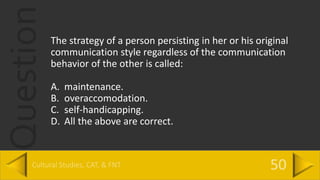
QuestionThe strategy of a person persisting in her or his original
communication style regardless of the communication
behavior of the other is called:
A. maintenance.
B. overaccomodation.
C. self-handicapping.
D. All the above are correct.
Answer
A. maintenance.
(Griffin, 2012, p. 398).
Communication Accommodation Theory, Face
Negotiation Theory, Genderlect Styles, &
Wood chapters
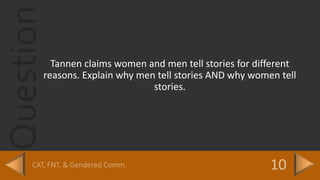
Question
Tannen claims women and men tell stories for different
reasons. Explain why men tell stories AND why women tell
stories.
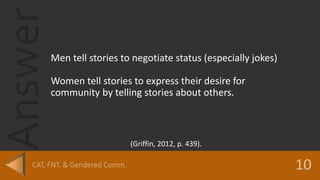
Answer
Men tell stories to negotiate status (especially jokes)
Women tell stories to express their desire for
community by telling stories about others.
(Griffin, 2012, p. 439).
QuestionA person who has had a hostile interaction with a person
from another group in the past, will tend to:
A. over accommodate to make up for the previous
experience.
B. look beyond the experience.
C. ascribe that outcome to the other person's social
identity.
D. All the above are correct.
Answer
C. ascribe that outcome to the other person's social
identity.
Question"I'll give up the first week of my vacation; you give up one
week of yours," is an example of which conflict style?
A. Avoiding
B. Compromising
C. Dominating
D. Obliging
Answer
B. Compromising
(Griffin, 2012, pp. 412-413).
Question
The concept of face is important because it is an extension
of self-concept.
A. True
B. False
Answer
A. True
(Griffin, 2012, p. 411).
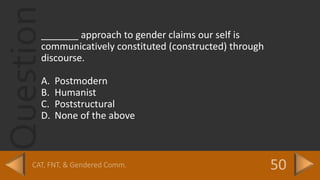
Question_______ approach to gender claims our self is
communicatively constituted (constructed) through
discourse.
A. Postmodern
B. Humanist
C. Poststructural
D. None of the above
Answer
C. Poststructural
Genderlect Styles & Wood chapters
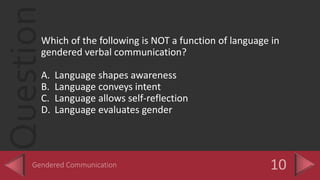
QuestionWhich of the following is NOT a function of language in
gendered verbal communication?
A. Language shapes awareness
B. Language conveys intent
C. Language allows self-reflection
D. Language evaluates gender
Answer
B. Language conveys intent
(Wood chapters).
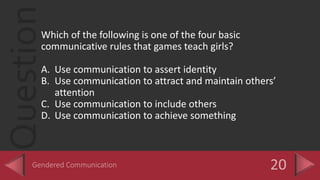
QuestionWhich of the following is one of the four basic
communicative rules that games teach girls?
A. Use communication to assert identity
B. Use communication to attract and maintain others’
attention
C. Use communication to include others
D. Use communication to achieve something
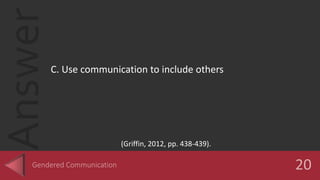
Answer
C. Use communication to include others
(Griffin, 2012, pp. 438-439).
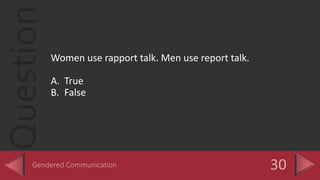
Question
Women use rapport talk. Men use report talk.
A. True
B. False
Answer
A. True
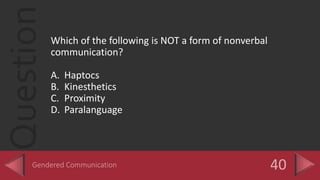
QuestionWhich of the following is NOT a form of nonverbal
communication?
A. Haptocs
B. Kinesthetics
C. Proximity
D. Paralanguage
Answer
A. Haptocs
(Wood chapters).
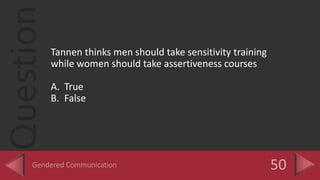
Question
Tannen thinks men should take sensitivity training
while women should take assertiveness courses
A. True
B. False
Answer
A. True

Final exam review game

  • 1.
    Theory, Standards, & SCT Symbolic Interactionism, EVT, & Constructivism SPT, URT,& SIP Relational Dialectics, CPM, & Systems Theory FPG, Orgs as Cultures, & Cultivation Theory Cultural Studies, CAT, & FNT 10 20 30 40 50 10 20 30 40 50 10 20 30 40 50 10 20 30 40 50 10 20 30 40 50 10 20 30 40 50 10 20 30 40 50 10 20 30 40 50 CAT, FNT, & Gendered Comm. Gendered Comm.
  • 2.
    Talking about Theory,Weighing the Words, & Social Convergence Theory
  • 3.
    Question___________________ is theterm that describes the search for knowledge. A. Epistemology B. Determinism C. Interpretive research D. None of the above is correct.
  • 4.
  • 5.
    QuestionWhen groups experiencethe common recurrence of wordplay, narratives, and analogies, the group is said to be experiencing: A. Rhetorical visions B. Symbolic cues C. Symbolic convergence D. Fantasy themes
  • 6.
  • 7.
    Question You have oneminute to answer this question. List the six standards of evaluating an interpretive theory. DAILY DOUBLE!!
  • 8.
    Answer Six InterpretiveStandards 1. New Understanding of People 2. Clarification of Values 3. Aesthetic Appeal 4. Community of Agreement 5. Reform of Society 6. Qualitative Research (Griffin, 2012, pp. 30-34).
  • 9.
    QuestionWhich of thefollowing is true of an objectivist theory? A. Regards truth as socially constructed through communication B. Believes behavior is caused by heredity C. Believes every human act is voluntary D. Brings people’s values into the open
  • 10.
    Answer B. Believes behavioris caused by heredity (Griffin, 2012, pp. 17-18).
  • 11.
    QuestionWhich of thefollowing is NOT a criticism of Symbolic Convergence Theory? A. It does not explain the benefits of occasionally chaotic group experiences B. It does not sufficiently explain why humans are predisposed to dramatizing reality and sharing fantasy in the first place. C. The method of fantasy theme analysis is not consistent as Bormann admits some critics do this better than others D. The vocabulary shows the theory’s pro-social, bias but it ignores issues of power.
  • 12.
    Answer A. It doesnot explain the benefits of occasionally chaotic group experiences (Griffin, 2012, pp. 256-257).
  • 13.
    Symbolic Interactionism, ExpectancyViolations Theory, & Constructivism
  • 14.
    QuestionThe looking-glass selfis best defined as: A. The subjective self B. The mental image that results from taking the role of the other C. The process of mentally imagining you’re someone else viewing you. D. The mental image others have of you
  • 15.
    Answer B. The mentalimage that results from taking the role of the other (Griffin, 2012, p. 59).
  • 16.
    QuestionDelia's use ofthe phrase person-centered messages refers to messages that people who have an ability to adapt to _____________ aspects of various communication contexts can craft. A. Subjective B. Affective C. Relational D. All of the above are correct
  • 17.
    Answer D. All ofthe above are correct (Griffin, 2012, p. 101).
  • 18.
    QuestionThe human tendencyto size up other people in terms of what they have to offer is called A. Violation valence B. Interaction adaptation C. Communicator reward valance D. reciprocity
  • 19.
    Answer C. Communicator rewardvalance (Griffin, 2012, p. 91).
  • 20.
    QuestionPeople who assumethat communication is a game that is played cooperatively in the context of social rules are using the A. Rhetorical design logic B. Conventional design logic C. Expressive design logic D. Scientific design logic
  • 21.
    Answer B. Conventional designlogic (Read over lecture notes on Constructivism – Message Design Logics).
  • 22.
    QuestionMead believed thatthe self can be impacted by: A. The comments others make about us. B. The things we tell ourselves C. The thoughts we choose to entertain D. All of the above are correct
  • 23.
    Answer D. All ofthe above are correct (Griffin, 2012, p. 59-61).
  • 24.
    Social Penetration Theory,Uncertainty Reduction Theory, & Social Information Processing Theory
  • 25.
    Question According tosocial exchange theory, if the perceived rewards minus the perceived costs exceed what is available in other relationships, a person will: A. end the relationship B. have a discussion with his or her partner to determine if they need to do more. C. most likely stay in the relationship. D. withdraw slightly from the relationship.
  • 26.
    Answer C. most likelystay in the relationship. (Griffin, 2012, p. 119).
  • 27.
    QuestionIf Ben wantsto get to know Sarah in class who he finds attractive and talks to a friend who also knows Sarah, he is using: A. Passive strategy B. Active strategy C. Interactive strategy D. A combination of all three strategies
  • 28.
  • 29.
    QuestionWalther labeled CMCrelationships that were more intimate than the relationships would be if partners were physically together as: A. selective self-preservation. B. overattribution of similarity. C. hyperpersonal. D. All of the above are correct.
  • 30.
  • 31.
    QuestionThe real connectionbetween uncertainty and reciprocity is an issue of: A. Self-esteem B. Fear C. Power D. Expectations
  • 32.
  • 33.
    QuestionWhich of thefollowing is a criticism of Social Information Processing Theory? A. It relies too heavily on warranting values B. The hyperpersonal perspective lacks theoretical basis, which does not allow for testability. C. The theory does not offer a solution for handling the slower exchange of messages with CMC D. The theory does not follow the rule of parsimony
  • 34.
    Answer B. The hyperpersonalperspective lacks theoretical basis, which does not allow for testability. (Griffin, 2012, pp. 147-148).
  • 35.
    Relational Dialectics, Communication PrivacyManagement, & the Interactional View
  • 36.
    QuestionOn the TVseries Friends, Monica and Chandler tried to hide their relationship from the other members of their group. This is a demonstration of the external dialectic tension labeled: A. conventionality-uniqueness. B. connectedness-separateness. C. openness-closedness. D. inclusion-seclusion.
  • 37.
  • 38.
    QuestionZach and Jillhave equal ability to earn a great living. They get along fine over most things, but cannot come to an agreement about where to invest their money. They have a: A. Complementary relationship B. Symmetrical relationship C. Typical relationship D. Dysfunctional relationship
  • 39.
  • 40.
    Question The relational dimensionof communication tends to be carried through: A. Nonverbal channels B. Media channels C. Verbal channels D. A combination of channels
  • 41.
  • 42.
    QuestionWhich of thefollowing is NOT one of Petronio’s suggested negotiations to focus on when coordinating mutual privacy boundaries? A. Boundary Linkage B. Boundary Permeability C. Boundary Ownership D. Boundary Turbulence
  • 43.
  • 44.
    Question _________ isbest defined as a system having multiple causes for one outcome. A. Requisite Variety B. Entropy C. Equifinality D. Holism
  • 45.
    Answer C. Equifinality (Read overlecture notes on the Interactional View – Systems Properties).
  • 46.
    Functional Perspective onGroup Decision Making, Organizations as Cultures, & Cultivation Theory
  • 47.
    QuestionAccording to thefunctional perspective, what does the term prioritizing mean? A. Assessing the strengths of group members B. Using democratic methods to make sure all members get involved C. Addressing the four requisites to problem solving in a logical progression D. All of the above are correct
  • 48.
    Answer C. Addressing thefour requisites to problem solving in a logical progression (Griffin, 2012, p. 239).
  • 49.
    QuestionBy the timethe typical viewer graduates from high school, Gerbner predicts that he or she will have seen _______ deaths? A. 7,000 B. 10,000 C. 13,000 D. 15,000
  • 50.
  • 51.
    QuestionGerbner believes thatwhen heavy TV viewer are constantly exposed to the same images on TV that they develop a common outlook that he calls: A. Narrowcasting B. Mainstreaming C. Resonance D. None is the above is correct
  • 52.
  • 53.
    Question The ______Approach to Organizational Culture says culture is something an organization is. A. Objective B. Cultural C. Prescriptive D. Descriptive
  • 54.
    Answer D. Descriptive (Read overlecture notes on Organizations as Cultures).
  • 55.
    Question______ communication isdefined as interaction that members use to get the ground back on track. A. Promotive B. Collegial C. Disruptive D. Counteractive
  • 56.
  • 57.
    Cultural Studies, Communication AccommodationTheory, & Face Negotiation Theory
  • 58.
    QuestionHall believes thatthe main function of mass media is to: A. transmit news and political events from around the world. B. encourage national unity through diversity of thought and expression. C. maintain the dominance of those already in power. D. provide entertainment.
  • 59.
    Answer C. maintain thedominance of those already in power. (Griffin, 2012, p. 349).
  • 60.
    QuestionHall argues thatthe primary function of discourse is to: A. persuade other people. B. make meaning. C. create diverse viewpoints. D. encourage free thinking.
  • 61.
  • 62.
    QuestionFollowing the incidentsof September 11, President Bush created an unusual equation that stated: A. buying cars can help fight terrorism. B. people should be searched before getting on public transportation. C. supporting military spending is the way to defeat terrorism. D. None of the above is correct.
  • 63.
    Answer A. buying carscan help fight terrorism. (Griffin, 2012, p. 348-349).
  • 64.
    Question The face-restoration strategyis used: A. to stake out a unique place in life. B. to preserve autonomy. C. to defend against loss of personal freedom. D. All the above are correct.
  • 65.
    Answer D. All theabove are correct. (Griffin, 2012, p. 412).
  • 66.
    QuestionThe strategy ofa person persisting in her or his original communication style regardless of the communication behavior of the other is called: A. maintenance. B. overaccomodation. C. self-handicapping. D. All the above are correct.
  • 67.
  • 68.
    Communication Accommodation Theory,Face Negotiation Theory, Genderlect Styles, & Wood chapters
  • 69.
    Question Tannen claims womenand men tell stories for different reasons. Explain why men tell stories AND why women tell stories.
  • 70.
    Answer Men tell storiesto negotiate status (especially jokes) Women tell stories to express their desire for community by telling stories about others. (Griffin, 2012, p. 439).
  • 71.
    QuestionA person whohas had a hostile interaction with a person from another group in the past, will tend to: A. over accommodate to make up for the previous experience. B. look beyond the experience. C. ascribe that outcome to the other person's social identity. D. All the above are correct.
  • 72.
    Answer C. ascribe thatoutcome to the other person's social identity.
  • 73.
    Question"I'll give upthe first week of my vacation; you give up one week of yours," is an example of which conflict style? A. Avoiding B. Compromising C. Dominating D. Obliging
  • 74.
  • 75.
    Question The concept offace is important because it is an extension of self-concept. A. True B. False
  • 76.
  • 77.
    Question_______ approach togender claims our self is communicatively constituted (constructed) through discourse. A. Postmodern B. Humanist C. Poststructural D. None of the above
  • 78.
  • 79.
    Genderlect Styles &Wood chapters
  • 80.
    QuestionWhich of thefollowing is NOT a function of language in gendered verbal communication? A. Language shapes awareness B. Language conveys intent C. Language allows self-reflection D. Language evaluates gender
  • 81.
    Answer B. Language conveysintent (Wood chapters).
  • 82.
    QuestionWhich of thefollowing is one of the four basic communicative rules that games teach girls? A. Use communication to assert identity B. Use communication to attract and maintain others’ attention C. Use communication to include others D. Use communication to achieve something
  • 83.
    Answer C. Use communicationto include others (Griffin, 2012, pp. 438-439).
  • 84.
    Question Women use rapporttalk. Men use report talk. A. True B. False
  • 85.
  • 86.
    QuestionWhich of thefollowing is NOT a form of nonverbal communication? A. Haptocs B. Kinesthetics C. Proximity D. Paralanguage
  • 87.
  • 88.
    Question Tannen thinks menshould take sensitivity training while women should take assertiveness courses A. True B. False
  • 89.