CONTENT :
INTRODUCTION
MODE OF LIFE
MORPHOLOGY 1
MORPHOLOGY 2
MORPHOLOGY 3
MORPHOLOGY 4
MORPHOLOGY 5
INTERNAL FEATURES
INTERNAL MORPHOLOGY 2
INTERNAL MORPHOLOGY 3
INTERNAL MORPHOLOGY 4
GEOLOGICAL HISTORY
CONCLUSION
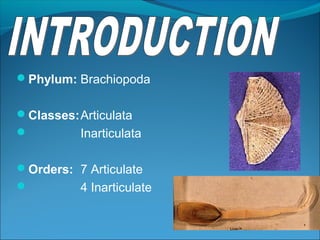
Phylum: Brachiopoda
Classes:Articulata
 Inarticulata
 
Orders: 7 Articulate 
 4 Inarticulate
Brachiopod
Brachiopods
(brachio=arm; pod
= foot)
valves are opened
and closed by
contracting muscles
called adductor and
diductor muscles.
Mode of Life
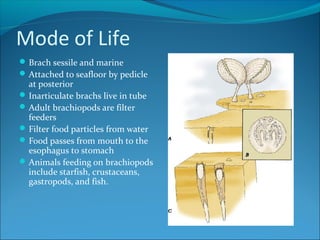
Brach sessile and marine
Attached to seafloor by pedicle
at posterior
Inarticulate brachs live in tube
Adult brachiopods are filter
feeders
Filter food particles from water
Food passes from mouth to the
esophagus to stomach
Animals feeding on brachiopods
include starfish, crustaceans,
gastropods, and fish.
They have 2 VALVES
(shells) that totally enclose
the soft parts.
The average size is 20 - 70
mm but can range up to 370
mm.
The valves can open and are
hinged at one end; muscles
open and close the shell.
 Modified from Clarkson (1986)
clam
Morphology 2
They usually allow water into
the shell, as they are filter
feeders extracting food from
seawater.
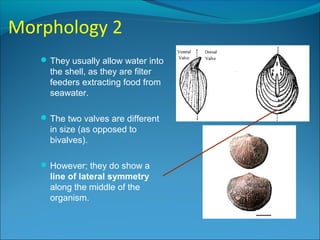
The two valves are different
in size (as opposed to
bivalves).
However; they do show a
line of lateral symmetry
along the middle of the
organism.
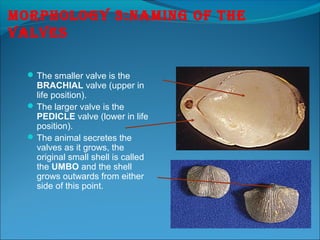
Morphology 3:NaMiNg of the
valves
The smaller valve is the
BRACHIAL valve (upper in
life position).
The larger valve is the
PEDICLE valve (lower in life
position).
The animal secretes the
valves as it grows, the
original small shell is called
the UMBO and the shell
grows outwards from either
side of this point.
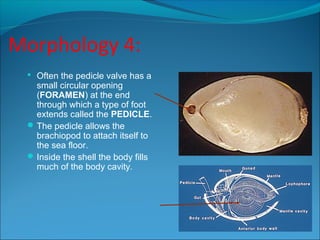
Morphology 4:
 Often the pedicle valve has a
small circular opening
(FORAMEN) at the end
through which a type of foot
extends called the PEDICLE.
The pedicle allows the
brachiopod to attach itself to
the sea floor.
Inside the shell the body fills
much of the body cavity.
Morphology 5:
 Some shells like rhynchonellids
have a wrinkly COMMISURE
with FOLDS (one on either side
of the sulcus) and a SULCUS
(in the middle).
 Draw a rhynchonellid showing
the fold and sulcus and the
inhalent and exhalent currents.
 Folds have inhalent and sulcus
has the exhalent.
 The currents are therefore
separated.
 The crenulated commissure also
provides a greater surface area.
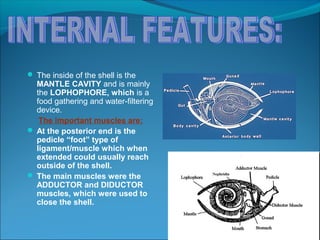
 The inside of the shell is the
MANTLE CAVITY and is mainly
the LOPHOPHORE, which is a
food gathering and water-filtering
device.
The important muscles are:
 At the posterior end is the
pedicle “foot” type of
ligament/muscle which when
extended could usually reach
outside of the shell.
 The main muscles were the
ADDUCTOR and DIDUCTOR
muscles, which were used to
close the shell.
Internal morphology 2:
Both sets of muscles
were attached to the
shell and although not
preserved in the fossils
there are scars left from
where the muscles were
attached to the shell.
The CARDINAL
PROCESS and HINGE
acts as a fulcrum on
which the muscles can
pull.
The diductor muscles
contract and pull down
the cardinal process and
open the shell.
Internal Morphology 3:
As the diductor muscles relax
the adductor muscles
contract and close the shell.
Role of the lophophore is to
act as a feeding device,
which collects suspended
particles.
Some brachiopods like
spiriferids have a spiral
calcite support called a
lophophore support or
spiralia.
Internal morphology 4:
On the diagram you can see
that the brachiopod has
TEETH (pedicle valve) and
SOCKETS (brachial valve).
Brachiopods are a long-lived
Phylum ranging from the
Cambrian to Present.
They were very common in
the Palaeozoic and slightly
less so in the Mesozoic but
still remain important.
In the Present not many
forms are left with
approximately 70 Genera.
Over 2500 fossil Genera are
known.
The largest were found in the
Cambrian (370 mm).
CONCLUSION
 Brachiopods are exclusively marine
Live in environments ranging from subtidal to the
abyss
Brachiopods swim only during larval stage
Widespread distribution reflects free-swimming
larval stage
Brachiopods occur throughout the world in both
cool and temperate waters (Japan, S. Australia, and
New Zealand).
Most brachiopods found in the neritic zone (waters
over the continental shelf), a few are found depths
of 5000 m
Most brachiopods range between 20 and 70 mm, some
are up to 370 mm.

Brachiopoda

  • 2.
    CONTENT : INTRODUCTION MODE OFLIFE MORPHOLOGY 1 MORPHOLOGY 2 MORPHOLOGY 3 MORPHOLOGY 4 MORPHOLOGY 5 INTERNAL FEATURES INTERNAL MORPHOLOGY 2 INTERNAL MORPHOLOGY 3 INTERNAL MORPHOLOGY 4 GEOLOGICAL HISTORY CONCLUSION
  • 3.
  • 4.
    Brachiopod Brachiopods (brachio=arm; pod = foot) valvesare opened and closed by contracting muscles called adductor and diductor muscles.
  • 5.
    Mode of Life Brachsessile and marine Attached to seafloor by pedicle at posterior Inarticulate brachs live in tube Adult brachiopods are filter feeders Filter food particles from water Food passes from mouth to the esophagus to stomach Animals feeding on brachiopods include starfish, crustaceans, gastropods, and fish.
  • 6.
    They have 2VALVES (shells) that totally enclose the soft parts. The average size is 20 - 70 mm but can range up to 370 mm. The valves can open and are hinged at one end; muscles open and close the shell.
  • 7.
     Modified fromClarkson (1986) clam
  • 8.
    Morphology 2 They usuallyallow water into the shell, as they are filter feeders extracting food from seawater. The two valves are different in size (as opposed to bivalves). However; they do show a line of lateral symmetry along the middle of the organism.
  • 9.
    Morphology 3:NaMiNg ofthe valves The smaller valve is the BRACHIAL valve (upper in life position). The larger valve is the PEDICLE valve (lower in life position). The animal secretes the valves as it grows, the original small shell is called the UMBO and the shell grows outwards from either side of this point.
  • 10.
    Morphology 4:  Oftenthe pedicle valve has a small circular opening (FORAMEN) at the end through which a type of foot extends called the PEDICLE. The pedicle allows the brachiopod to attach itself to the sea floor. Inside the shell the body fills much of the body cavity.
  • 11.
    Morphology 5:  Someshells like rhynchonellids have a wrinkly COMMISURE with FOLDS (one on either side of the sulcus) and a SULCUS (in the middle).  Draw a rhynchonellid showing the fold and sulcus and the inhalent and exhalent currents.  Folds have inhalent and sulcus has the exhalent.  The currents are therefore separated.  The crenulated commissure also provides a greater surface area.
  • 12.
     The insideof the shell is the MANTLE CAVITY and is mainly the LOPHOPHORE, which is a food gathering and water-filtering device. The important muscles are:  At the posterior end is the pedicle “foot” type of ligament/muscle which when extended could usually reach outside of the shell.  The main muscles were the ADDUCTOR and DIDUCTOR muscles, which were used to close the shell.
  • 13.
    Internal morphology 2: Bothsets of muscles were attached to the shell and although not preserved in the fossils there are scars left from where the muscles were attached to the shell. The CARDINAL PROCESS and HINGE acts as a fulcrum on which the muscles can pull. The diductor muscles contract and pull down the cardinal process and open the shell.
  • 14.
    Internal Morphology 3: Asthe diductor muscles relax the adductor muscles contract and close the shell. Role of the lophophore is to act as a feeding device, which collects suspended particles. Some brachiopods like spiriferids have a spiral calcite support called a lophophore support or spiralia.
  • 15.
    Internal morphology 4: Onthe diagram you can see that the brachiopod has TEETH (pedicle valve) and SOCKETS (brachial valve).
  • 16.
    Brachiopods are along-lived Phylum ranging from the Cambrian to Present. They were very common in the Palaeozoic and slightly less so in the Mesozoic but still remain important. In the Present not many forms are left with approximately 70 Genera. Over 2500 fossil Genera are known. The largest were found in the Cambrian (370 mm).
  • 18.
    CONCLUSION  Brachiopods areexclusively marine Live in environments ranging from subtidal to the abyss Brachiopods swim only during larval stage Widespread distribution reflects free-swimming larval stage Brachiopods occur throughout the world in both cool and temperate waters (Japan, S. Australia, and New Zealand). Most brachiopods found in the neritic zone (waters over the continental shelf), a few are found depths of 5000 m Most brachiopods range between 20 and 70 mm, some are up to 370 mm.