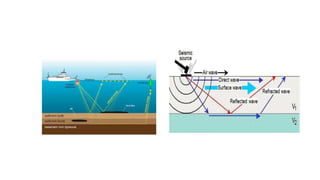
GROUP MEMBERS
 FARHAD JAFFAR CHISHTI
 MUHAMMAD AZHAR MUSHTAQ
 USMAN ALI
 SHUJAH NASIR
 WAJID MANZOOR
 NASEER AHMAD
 Muhammad HUSSAIN
Types of STRATIGRAPHY
 Lithostratigraphy
 Biostratigraphy
 Seismic stratigraphy
 chronostratigraphy
 Sequence stratigraphy
 Magnetostratigraphy
Seismic stratigraphy
1. Introduction
2. Seismology
3. Seismic methods
4. Parameters used
5. Depositional environment
 Introduction
 An English seismologist, Robert Mallet. Was
the first scientist to measure the velocity
of seismic waves. He initiated experimental
seismology in 1848.
 Seismic stratigraphy is a new science born
in early 1960’s.
Seismic Stratigraphy
 It is the combination of 2 words
1. seismic
2.stratigraphy
1.Seismic
 Seismology:
Study of earthquakes and the structure of
earth on the basis of characteristics of seismic waves.
Seismic waves:
These are waves of energy caused by sudden breaking of
rocks with in the earth.
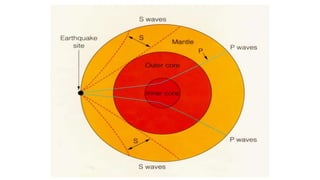
 Seismic waves have two main types:
1. body waves
2. surface waves
BODY WAVES
1. p-waves
2. S-waves
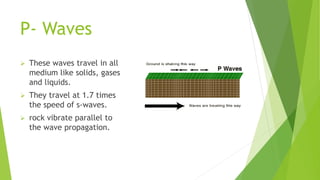
P- Waves
 These waves travel in all
medium like solids, gases
and liquids.
 They travel at 1.7 times
the speed of s-waves.
 rock vibrate parallel to
the wave propagation.
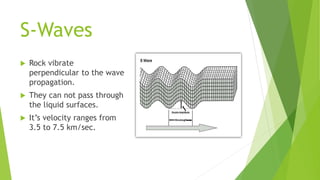
S-Waves
 Rock vibrate
perpendicular to the wave
propagation.
 They can not pass through
the liquid surfaces.
 It’s velocity ranges from
3.5 to 7.5 km/sec.
Surface waves
It has two types
1. Love waves
2. Rayleigh waves
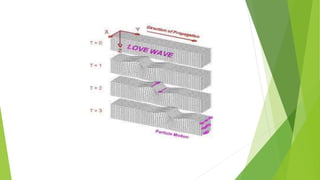
Love waves
 The first kind of surface waves in love waves.
 Which is named after A.E.H Love a British
mathematician.
 It is the fastest surface wave and moves the
ground from side to side.
 It moves the surface forward and backward,left
and right at the same time.
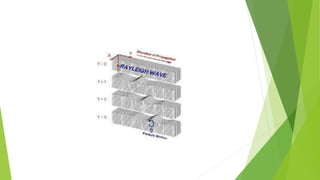
Rayleigh waves
 The second type of surface waves is Rayleigh
wave.
 Which is Named after J.W.S.Lord Rayleigh, in
1885.
 These waves are combination of P , S-waves.
 It moves the ground up and down,side to side at
the same time in the direction that the wave is
moving.
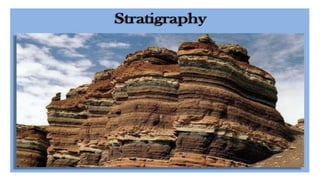
Stratigraphy
Stratigraphy is a branch of geology
which studies rock layers (strata) and
layering (stratification).
Seismic Stratigraphy
The study of seismic data for the
purpose of extracting stratigraphic
information is called seismic
stratigraphy.
It is widely used on land and at sea
because of it’s applicability to
subsurface.
Seismic Methods
 There are two methods:
1.refraction seismic method
2.reflection seismic method
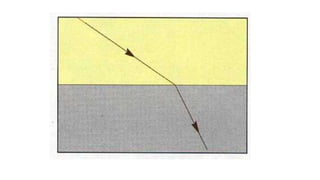
Refraction :
when a wave enters from rare medium (air) to
denser medium (glass) then it bends towards normal. This
phenomenon is called refraction.
Refraction Seismic Method
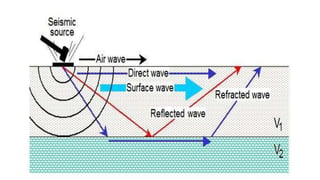
 Refraction seismic method for determine the
structure of sub-surface formations.
Principle:
Artificially generated seismic
waves are refracted or bent at discontinuity
surfaces as they travel downward below the
surface.
Process
 When waves meet a discontinuity at critical angle( angle of
Incidence for which angle of reflection is 90*), some of the waves are
refracted or bent.
 The refracted waves will travel along the top of the layer
underlying the discontinuity surface with greater velocity
then that at which they passed downward through the
overlying layer because velocity of seismic waves
increases with depth.
Reflection
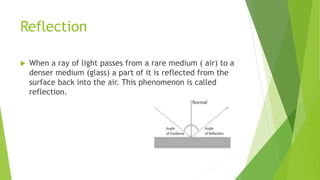
 When a ray of light passes from a rare medium ( air) to a
denser medium (glass) a part of it is reflected from the
surface back into the air. This phenomenon is called
reflection.
Reflection Seismic Method
 Refraction method did not work well for deeper structures because of the
excessive distances required between short points (source of seismic waves)
and detectors (geo phones)
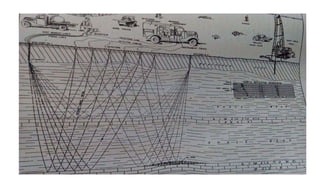
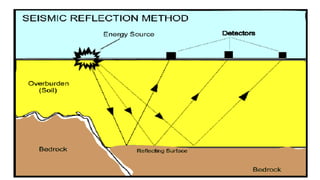
 In reflection method, waves created by an explusion or reflected back to the
surface directly from sub-surface rock without being refracted and travelling
along discontinuity surfaces.
 Reflection method are relatively more used than refractive techniques
because detectors can be located at relatively short distances from short
points.
 Refracted waves are also generated but due to closer location of detectors,
are not picked up.
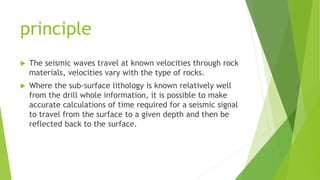
principle
 The seismic waves travel at known velocities through rock
materials, velocities vary with the type of rocks.
 Where the sub-surface lithology is known relatively well
from the drill whole information, it is possible to make
accurate calculations of time required for a seismic signal
to travel from the surface to a given depth and then be
reflected back to the surface.
Application of reflection seismic
method
 The science of seismic stratigraphy was developed largely
by petroleum companies out of pragmatic (practicable)
necessity to locate petroleum deposit in deep.
 It is also used to study deep structures and features like
folds, faults etc…
 Seismic reflection are used to identify and map the
structural attitudes sub-surface sedimentary layers.
 This method is also used to find the depth of ocean.
Parameters used in seismic stratigraphic
interpretation
 Seismic reflections are critical to entire concept of seismic stratigraphy because
seismic reflections occur in response to the presence of density-velocity changes at
discontinuities.
 The important parameters of Seismic interpretation are:
a) Reflection configuration
b) Reflection continuity
c) Reflection amplitude
d) Reflection frequency
e) Interval velocity
Parameters used in seismic stratigraphic
interpretation
a) Reflection configuration
 It refers to the large no. of stratification patterns identified on seismic
records.
Types of Reflection configuration are:
1. Parallel patterns
2. Divergent configuration
3. Prograding reflection configuration
4. Chaotic reflection configuration
Parameters used in seismic stratigraphic
interpretation
1. Parallel patterns
 Parallel patterns, including sub-parallel and wavy
patterns are generated by strata that were
deposited at uniform rates.
Parameters used in seismic stratigraphic
interpretation
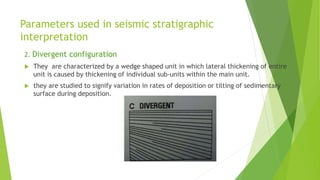
2. Divergent configuration
 They are characterized by a wedge shaped unit in which lateral thickening of entire
unit is caused by thickening of individual sub-units within the main unit.
 they are studied to signify variation in rates of deposition or tilting of sedimentary
surface during deposition.
Parameters used in seismic stratigraphic
interpretation
3. Prograding reflection patterns
 They are reflection patterns generated by strata that were deposited by
lateral outbuildings.
e.g clinoform, sigmoid(super-posed S-shaped reflectors),
oblique or hummocky patterns etc.
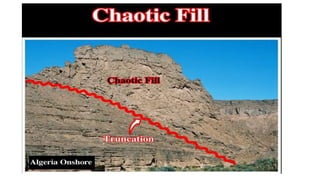
4. Chaotic reflection pattern
 They are the disordered arrangements of reflection surfaces, showing soft-
sediments deformation.
Depositional environments
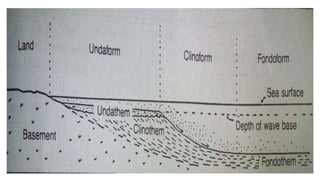
 There are three Depositional environments in relation to wave base:
1. Undaform
 Flat surface above the wave base where sediments are moved by waves.
2. Clinoform
 The sloping surface extending from wave base down to the flat floor.
3. Fondoform
 The flat surface In the depth of wave base.
 The rock units which are formed in each of these environments are called
UNDATHEM, CLINOTHEM and FONDOTHEM.
Parameters used in seismic stratigraphic
interpretation
b) Reflection continuity
 It depends upon the continuity of the density-velocity
contrast along bedding surfaces or unconformities.
 It is closely associated with continuity of strata.
 It provides information about depositional process and
environment.
Parameters used in seismic stratigraphic
interpretation
c) Reflection amplitude
it is measured as the distance from the mid-position of a wave to the
extreme position.
d) Reflection frequency
No of vibrations of seismic wave per second.
e) Interval velocity
it is the average velocity of seismic waves between reflectors.
Seismic stratigraphy

Seismic stratigraphy

  • 2.
    GROUP MEMBERS  FARHADJAFFAR CHISHTI  MUHAMMAD AZHAR MUSHTAQ  USMAN ALI  SHUJAH NASIR  WAJID MANZOOR  NASEER AHMAD  Muhammad HUSSAIN
  • 3.
    Types of STRATIGRAPHY Lithostratigraphy  Biostratigraphy  Seismic stratigraphy  chronostratigraphy  Sequence stratigraphy  Magnetostratigraphy
  • 4.
    Seismic stratigraphy 1. Introduction 2.Seismology 3. Seismic methods 4. Parameters used 5. Depositional environment
  • 5.
     Introduction  AnEnglish seismologist, Robert Mallet. Was the first scientist to measure the velocity of seismic waves. He initiated experimental seismology in 1848.  Seismic stratigraphy is a new science born in early 1960’s.
  • 6.
    Seismic Stratigraphy  Itis the combination of 2 words 1. seismic 2.stratigraphy
  • 7.
    1.Seismic  Seismology: Study ofearthquakes and the structure of earth on the basis of characteristics of seismic waves. Seismic waves: These are waves of energy caused by sudden breaking of rocks with in the earth.  Seismic waves have two main types: 1. body waves 2. surface waves
  • 8.
  • 9.
    P- Waves  Thesewaves travel in all medium like solids, gases and liquids.  They travel at 1.7 times the speed of s-waves.  rock vibrate parallel to the wave propagation.
  • 10.
    S-Waves  Rock vibrate perpendicularto the wave propagation.  They can not pass through the liquid surfaces.  It’s velocity ranges from 3.5 to 7.5 km/sec.
  • 12.
    Surface waves It hastwo types 1. Love waves 2. Rayleigh waves
  • 13.
    Love waves  Thefirst kind of surface waves in love waves.  Which is named after A.E.H Love a British mathematician.  It is the fastest surface wave and moves the ground from side to side.  It moves the surface forward and backward,left and right at the same time.
  • 15.
    Rayleigh waves  Thesecond type of surface waves is Rayleigh wave.  Which is Named after J.W.S.Lord Rayleigh, in 1885.  These waves are combination of P , S-waves.  It moves the ground up and down,side to side at the same time in the direction that the wave is moving.
  • 17.
    Stratigraphy Stratigraphy is abranch of geology which studies rock layers (strata) and layering (stratification).
  • 19.
    Seismic Stratigraphy The studyof seismic data for the purpose of extracting stratigraphic information is called seismic stratigraphy. It is widely used on land and at sea because of it’s applicability to subsurface.
  • 20.
    Seismic Methods  Thereare two methods: 1.refraction seismic method 2.reflection seismic method Refraction : when a wave enters from rare medium (air) to denser medium (glass) then it bends towards normal. This phenomenon is called refraction.
  • 22.
    Refraction Seismic Method Refraction seismic method for determine the structure of sub-surface formations. Principle: Artificially generated seismic waves are refracted or bent at discontinuity surfaces as they travel downward below the surface.
  • 23.
    Process  When wavesmeet a discontinuity at critical angle( angle of Incidence for which angle of reflection is 90*), some of the waves are refracted or bent.  The refracted waves will travel along the top of the layer underlying the discontinuity surface with greater velocity then that at which they passed downward through the overlying layer because velocity of seismic waves increases with depth.
  • 25.
    Reflection  When aray of light passes from a rare medium ( air) to a denser medium (glass) a part of it is reflected from the surface back into the air. This phenomenon is called reflection.
  • 26.
    Reflection Seismic Method Refraction method did not work well for deeper structures because of the excessive distances required between short points (source of seismic waves) and detectors (geo phones)  In reflection method, waves created by an explusion or reflected back to the surface directly from sub-surface rock without being refracted and travelling along discontinuity surfaces.  Reflection method are relatively more used than refractive techniques because detectors can be located at relatively short distances from short points.  Refracted waves are also generated but due to closer location of detectors, are not picked up.
  • 28.
    principle  The seismicwaves travel at known velocities through rock materials, velocities vary with the type of rocks.  Where the sub-surface lithology is known relatively well from the drill whole information, it is possible to make accurate calculations of time required for a seismic signal to travel from the surface to a given depth and then be reflected back to the surface.
  • 31.
    Application of reflectionseismic method  The science of seismic stratigraphy was developed largely by petroleum companies out of pragmatic (practicable) necessity to locate petroleum deposit in deep.  It is also used to study deep structures and features like folds, faults etc…  Seismic reflection are used to identify and map the structural attitudes sub-surface sedimentary layers.  This method is also used to find the depth of ocean.
  • 32.
    Parameters used inseismic stratigraphic interpretation  Seismic reflections are critical to entire concept of seismic stratigraphy because seismic reflections occur in response to the presence of density-velocity changes at discontinuities.  The important parameters of Seismic interpretation are: a) Reflection configuration b) Reflection continuity c) Reflection amplitude d) Reflection frequency e) Interval velocity
  • 33.
    Parameters used inseismic stratigraphic interpretation a) Reflection configuration  It refers to the large no. of stratification patterns identified on seismic records. Types of Reflection configuration are: 1. Parallel patterns 2. Divergent configuration 3. Prograding reflection configuration 4. Chaotic reflection configuration
  • 34.
    Parameters used inseismic stratigraphic interpretation 1. Parallel patterns  Parallel patterns, including sub-parallel and wavy patterns are generated by strata that were deposited at uniform rates.
  • 36.
    Parameters used inseismic stratigraphic interpretation 2. Divergent configuration  They are characterized by a wedge shaped unit in which lateral thickening of entire unit is caused by thickening of individual sub-units within the main unit.  they are studied to signify variation in rates of deposition or tilting of sedimentary surface during deposition.
  • 37.
    Parameters used inseismic stratigraphic interpretation 3. Prograding reflection patterns  They are reflection patterns generated by strata that were deposited by lateral outbuildings. e.g clinoform, sigmoid(super-posed S-shaped reflectors), oblique or hummocky patterns etc. 4. Chaotic reflection pattern  They are the disordered arrangements of reflection surfaces, showing soft- sediments deformation.
  • 40.
    Depositional environments  Thereare three Depositional environments in relation to wave base: 1. Undaform  Flat surface above the wave base where sediments are moved by waves. 2. Clinoform  The sloping surface extending from wave base down to the flat floor. 3. Fondoform  The flat surface In the depth of wave base.  The rock units which are formed in each of these environments are called UNDATHEM, CLINOTHEM and FONDOTHEM.
  • 42.
    Parameters used inseismic stratigraphic interpretation b) Reflection continuity  It depends upon the continuity of the density-velocity contrast along bedding surfaces or unconformities.  It is closely associated with continuity of strata.  It provides information about depositional process and environment.
  • 43.
    Parameters used inseismic stratigraphic interpretation c) Reflection amplitude it is measured as the distance from the mid-position of a wave to the extreme position. d) Reflection frequency No of vibrations of seismic wave per second. e) Interval velocity it is the average velocity of seismic waves between reflectors.