How to describe a Brachiopod
Shell, Shape of Shell,
Symmetry etc.
Sumaiya Amin Titun
Brachiopoda
Brachiopods are marine invertebrates,
meaning they have no backbone, and are
one of the few animal groups that live only
in the ocean. The name 'Brachiopoda' comes
from the Greek words 'brachion" (=arm)
and "podos" (=foot). They are sometimes
referred to as 'lamp shells' since certain
groups.
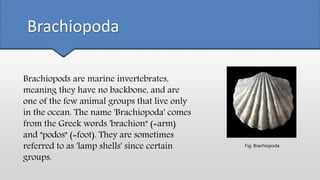
Fig: Brachiopoda
Brachiopod Shell
 Living brachiopods are normally
attached to rocks, shells, or other
objects with the help of pedicle.
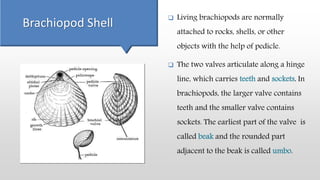
 The two valves articulate along a hinge
line, which carries teeth and sockets. In
brachiopods, the larger valve contains
teeth and the smaller valve contains
sockets. The earliest part of the valve is
called beak and the rounded part
adjacent to the beak is called umbo.
Description of Shell
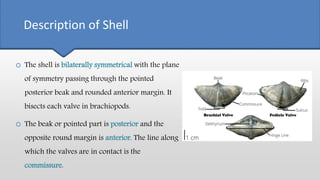
 The shell is bilaterally symmetrical with the plane
of symmetry passing through the pointed
posterior beak and rounded anterior margin. It
bisects each valve in brachiopods.
 The beak or pointed part is posterior and the
opposite round margin is anterior. The line along
which the valves are in contact is the
commissure.
The Shell
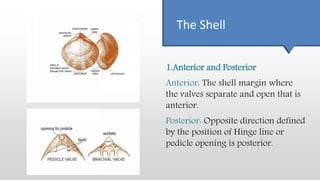
1.Anterior and Posterior
Anterior: The shell margin where
the valves separate and open that is
anterior.
Posterior: Opposite direction defined
by the position of Hinge line or
pedicle opening is posterior.
The Shell
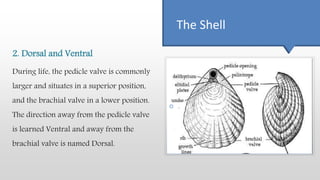
2. Dorsal and Ventral
During life, the pedicle valve is commonly
larger and situates in a superior position,
and the brachial valve in a lower position.
The direction away from the pedicle valve
is learned Ventral and away from the
brachial valve is named Dorsal.
 .
Shell Shape
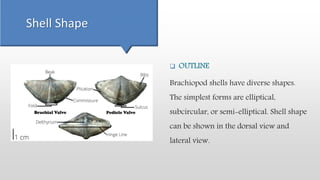
 OUTLINE
Brachiopod shells have diverse shapes.
The simplest forms are elliptical,
subcircular, or semi-elliptical. Shell shape
can be shown in the dorsal view and
lateral view.
Shell Shape
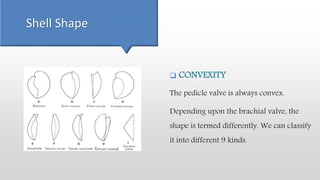
 CONVEXITY
The pedicle valve is always convex.
Depending upon the brachial valve, the
shape is termed differently. We can classify
it into different 9 kinds.
Symmetry
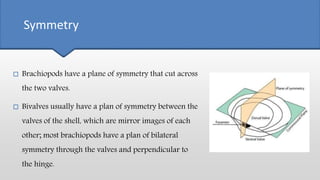
 Brachiopods have a plane of symmetry that cut across
the two valves.
 Bivalves usually have a plan of symmetry between the
valves of the shell, which are mirror images of each
other; most brachiopods have a plan of bilateral
symmetry through the valves and perpendicular to
the hinge.
Bilateral Symmetry
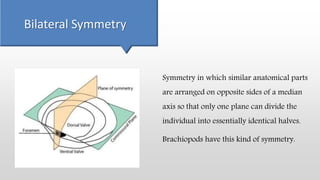
Symmetry in which similar anatomical parts
are arranged on opposite sides of a median
axis so that only one plane can divide the
individual into essentially identical halves.
Brachiopods have this kind of symmetry.
References :
1. https://static.hwpi.harvard.edu/files/styles/os_files_xxlarge/public/trenton/files/brachconvexity.jpg?
m=1525446811&itok=ro1zJeHyhttps://images.app.goo.gl/mcyFL2sTE4ksTqfQ7
2. https://trenton.mcz.harvard.edu/phylum-
brachipopodahttps://www.slideshare.net/LeeannaCota/mollusks-bivalvesgastrocepha-marine
3. https://www.bgs.ac.uk/discovering-geology/fossils-and-geological-time/brachiopods/
4. https://www.digitalatlasofancientlife.org/learn/brachiopoda/
5. https://fossiilid.info/64?mode=in_baltoscandia&lang=en
Thank You for
your Patience

Brachiopod Shell, Symmetry and Shell Shape

  • 1.
    How to describea Brachiopod Shell, Shape of Shell, Symmetry etc. Sumaiya Amin Titun
  • 2.
    Brachiopoda Brachiopods are marineinvertebrates, meaning they have no backbone, and are one of the few animal groups that live only in the ocean. The name 'Brachiopoda' comes from the Greek words 'brachion" (=arm) and "podos" (=foot). They are sometimes referred to as 'lamp shells' since certain groups. Fig: Brachiopoda
  • 3.
    Brachiopod Shell  Livingbrachiopods are normally attached to rocks, shells, or other objects with the help of pedicle.  The two valves articulate along a hinge line, which carries teeth and sockets. In brachiopods, the larger valve contains teeth and the smaller valve contains sockets. The earliest part of the valve is called beak and the rounded part adjacent to the beak is called umbo.
  • 4.
    Description of Shell The shell is bilaterally symmetrical with the plane of symmetry passing through the pointed posterior beak and rounded anterior margin. It bisects each valve in brachiopods.  The beak or pointed part is posterior and the opposite round margin is anterior. The line along which the valves are in contact is the commissure.
  • 5.
    The Shell 1.Anterior andPosterior Anterior: The shell margin where the valves separate and open that is anterior. Posterior: Opposite direction defined by the position of Hinge line or pedicle opening is posterior.
  • 6.
    The Shell 2. Dorsaland Ventral During life, the pedicle valve is commonly larger and situates in a superior position, and the brachial valve in a lower position. The direction away from the pedicle valve is learned Ventral and away from the brachial valve is named Dorsal.  .
  • 7.
    Shell Shape  OUTLINE Brachiopodshells have diverse shapes. The simplest forms are elliptical, subcircular, or semi-elliptical. Shell shape can be shown in the dorsal view and lateral view.
  • 8.
    Shell Shape  CONVEXITY Thepedicle valve is always convex. Depending upon the brachial valve, the shape is termed differently. We can classify it into different 9 kinds.
  • 9.
    Symmetry  Brachiopods havea plane of symmetry that cut across the two valves.  Bivalves usually have a plan of symmetry between the valves of the shell, which are mirror images of each other; most brachiopods have a plan of bilateral symmetry through the valves and perpendicular to the hinge.
  • 10.
    Bilateral Symmetry Symmetry inwhich similar anatomical parts are arranged on opposite sides of a median axis so that only one plane can divide the individual into essentially identical halves. Brachiopods have this kind of symmetry.
  • 11.
    References : 1. https://static.hwpi.harvard.edu/files/styles/os_files_xxlarge/public/trenton/files/brachconvexity.jpg? m=1525446811&itok=ro1zJeHyhttps://images.app.goo.gl/mcyFL2sTE4ksTqfQ7 2.https://trenton.mcz.harvard.edu/phylum- brachipopodahttps://www.slideshare.net/LeeannaCota/mollusks-bivalvesgastrocepha-marine 3. https://www.bgs.ac.uk/discovering-geology/fossils-and-geological-time/brachiopods/ 4. https://www.digitalatlasofancientlife.org/learn/brachiopoda/ 5. https://fossiilid.info/64?mode=in_baltoscandia&lang=en
  • 12.

Editor's Notes

  • #3 Emu Bay Shale: The Emu Bay Shale is a geological formation in Emu Bay, South Australia, containing a major Konservat-Lagerstätte (fossil beds with soft tissue preservation). Maotianshan Shales: The Maotianshan Shales are a series of Early Cambrian deposits in the Chiungchussu Formation,[2] famous for their Konservat Lagerstätten, deposits known for the exceptional preservation of fossilized organisms or traces.
  • #4 Holochroal Eyes: Consisted of typically small but numerous lenses. Lenses are all in direct contact with each other and there is no sclera (thick cuticular material between lenses) between them. Corneal membrane covers surface only.
  • #8 Holochroal Eyes: Consisted of typically small but numerous lenses. Lenses are all in direct contact with each other and there is no sclera (thick cuticular material between lenses) between them. Corneal membrane covers surface only.
  • #9 Holochroal Eyes: Consisted of typically small but numerous lenses. Lenses are all in direct contact with each other and there is no sclera (thick cuticular material between lenses) between them. Corneal membrane covers surface only.
  • #11 Holochroal Eyes: Consisted of typically small but numerous lenses. Lenses are all in direct contact with each other and there is no sclera (thick cuticular material between lenses) between them. Corneal membrane covers surface only.