BrachiopodsBrachiopods
lampshellslampshells
Brachiopods belong to the large category ofBrachiopods belong to the large category of
animals without backbones, theanimals without backbones, the
invertebrates.invertebrates.
They have two shells or valves that areThey have two shells or valves that are
often composed of the mineral calciteoften composed of the mineral calcite
((calcium carbonate).calcium carbonate).
Brachiopods have a coiled feeding organBrachiopods have a coiled feeding organ
called acalled a lophophorelophophore that is protected by itsthat is protected by its
valves.valves.
There are two major divisions (Classes) ofThere are two major divisions (Classes) of
brachiopods:brachiopods: thethe inarticulate brachiopodsinarticulate brachiopods
and the articulate brachiopodsand the articulate brachiopods..
. They have a fossil record stretching back. They have a fossil record stretching back
to the start of the Cambrian Period, someto the start of the Cambrian Period, some
570 million years ago.570 million years ago.
Brachiopods are still living in the world’sBrachiopods are still living in the world’s
oceans. It is the brachiopod valves thatoceans. It is the brachiopod valves that
are often found fossilized.are often found fossilized.
Brachiopods live on the ocean floor. TheyBrachiopods live on the ocean floor. They
have been found living in a wide range ofhave been found living in a wide range of
water depths fromwater depths from very shallow waters ofvery shallow waters of
rocky shorelines to ocean floor three androcky shorelines to ocean floor three and
a half miles beneath the ocean surface.a half miles beneath the ocean surface.
They are known from many places, rangingThey are known from many places, ranging
from the warm tropical waters of thefrom the warm tropical waters of the
Caribbean to cold Antarctic seas. FossilCaribbean to cold Antarctic seas. Fossil
brachiopods in sedimentary rocks indicatebrachiopods in sedimentary rocks indicate
ancient marine environments.ancient marine environments.
There are lots of DifferentThere are lots of Different
shaped brachiopods.shaped brachiopods.
When you look at themWhen you look at them
side-on some are biconvexside-on some are biconvex
and some are concavoand some are concavo
convex .convex .
The valves are joinedThe valves are joined
along the hinge line whichalong the hinge line which
can be straight or curved.can be straight or curved.
Some have smooth valves,Some have smooth valves,
others have ridges .others have ridges .
A biconvex
brachiopod
A concavo-
convex
brachiopod
A
convexi-
concave
brachiop
od
Articulate brachiopods are often the mostArticulate brachiopods are often the most
common fossil brachiopods. They havecommon fossil brachiopods. They have
two valves, the larger is the pedicle valve.two valves, the larger is the pedicle valve.
The pedicle foramen is a hole towards theThe pedicle foramen is a hole towards the
end of the pedicle valve.end of the pedicle valve.
The valves articulate by teeth on theThe valves articulate by teeth on the
pedicle valve that fit into sockets on thepedicle valve that fit into sockets on the
brachial valve, giving them thebrachial valve, giving them the namename
‘Articulate brachiopods’‘Articulate brachiopods’.. There are aThere are a
number of distinct types, or Orders,number of distinct types, or Orders,
mentioned below:mentioned below:
Brachiopods often have one valve largerBrachiopods often have one valve larger
than the other.than the other.
The larger valve often has a hole called aThe larger valve often has a hole called a
pedicle foramen towards its posterior end.pedicle foramen towards its posterior end.
In life, the pedicle, a fleshy stalk mayIn life, the pedicle, a fleshy stalk may
emerge through this hole.emerge through this hole.
This gives its name to the larger valve,This gives its name to the larger valve,
the pedicle valve.the pedicle valve.
The pedicle can be used for attachmentThe pedicle can be used for attachment
and rotation of the brachiopod.and rotation of the brachiopod.
Sometimes brachiopods are anchored inSometimes brachiopods are anchored in
seafloor sediment by spines.seafloor sediment by spines.
The smaller valve of a brachiopodThe smaller valve of a brachiopod
contains a coiled feeding organ called acontains a coiled feeding organ called a
lophophore.lophophore.
This may be sup-ported by a smallThis may be sup-ported by a small
calcareous skeleton or loop called acalcareous skeleton or loop called a
brachidium.brachidium.
This structure gives its name to theThis structure gives its name to the
smaller valve, the brachial valve.smaller valve, the brachial valve.
Articulate brachiopodsArticulate brachiopods
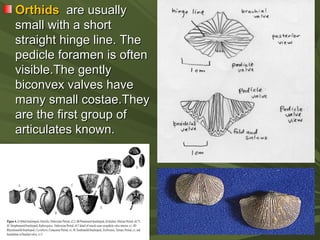
OrthidsOrthids are usuallyare usually
small with a shortsmall with a short
straight hinge line. Thestraight hinge line. The
pedicle foramen is oftenpedicle foramen is often
visible.The gentlyvisible.The gently
biconvex valves havebiconvex valves have
many small costae.Theymany small costae.They
are the first group ofare the first group of
articulates known.articulates known.
RhynchonellidsRhynchonellids areare
biconvex, often withbiconvex, often with
costae and a pediclecostae and a pedicle
foramen in the pedicleforamen in the pedicle
valve.valve.
TerebratulidsTerebratulids oftenoften
have smooth valveshave smooth valves
with growth lines andwith growth lines and
a pedicle foramen.a pedicle foramen.
They are biconvexThey are biconvex
and have a roundedand have a rounded
hinge line.hinge line.
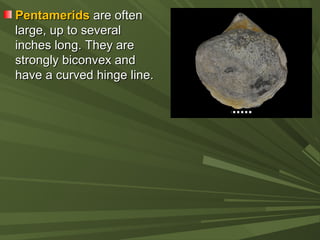
PentameridsPentamerids are oftenare often
large, up to severallarge, up to several
inches long. They areinches long. They are
strongly biconvex andstrongly biconvex and
have a curved hinge line.have a curved hinge line.
StrophomenidsStrophomenids
have a straight hingehave a straight hinge
line and the valvesline and the valves
are concavo-convex.are concavo-convex.
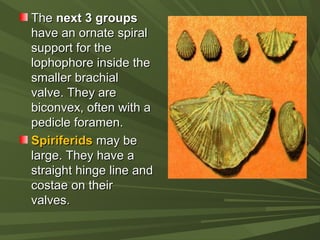
TheThe next 3 groupsnext 3 groups
have an ornate spiralhave an ornate spiral
support for thesupport for the
lophophore inside thelophophore inside the
smaller brachialsmaller brachial
valve. They arevalve. They are
biconvex, often with abiconvex, often with a
pedicle foramen.pedicle foramen.
SpiriferidsSpiriferids may bemay be
large. They have alarge. They have a
straight hinge line andstraight hinge line and
costae on theircostae on their
valves.valves.
AtrypidsAtrypids have ahave a
rounded hinge linerounded hinge line
and often haveand often have
costae on theircostae on their
valves.valves.
AthyridsAthyrids have ahave a
rounded hinge linerounded hinge line
and the valves areand the valves are
often smooth.often smooth.
InarticulateInarticulate
BrachiopodsBrachiopods have twohave two
valves, but do not havevalves, but do not have
teeth and sockets,teeth and sockets,
relying on muscles torelying on muscles to
hold and move them.hold and move them.
LingulaLingula is an unusualis an unusual
brachiopod, not onlybrachiopod, not only
because it has twobecause it has two
similar sized valves, butsimilar sized valves, but
also because it lives inalso because it lives in
a burrow, attached by aa burrow, attached by a
long pedicle.long pedicle.
Difference between brachiopods andDifference between brachiopods and
bivalvesbivalves
Brachiopods (or Brachiopoda) are oftenBrachiopods (or Brachiopoda) are often
confused with bivalved mollusks (clams orconfused with bivalved mollusks (clams or
Bivalvia). However, there are major biologicalBivalvia). However, there are major biological
differences between brachiopods anddifferences between brachiopods and
bivalves.bivalves.
A mirror image or plane of symmetry of aA mirror image or plane of symmetry of a
brachiopodbrachiopod cuts the valve in half along itscuts the valve in half along its
length .length .
InIn bivalvesbivalves the mirror image runs along thethe mirror image runs along the
edge of the valves where they close together.edge of the valves where they close together.
Brachiopods often have one valve largerBrachiopods often have one valve larger
than the other.than the other.
Brachiopods are very common as fossilsBrachiopods are very common as fossils
in rocks from certain parts of Northin rocks from certain parts of North
America and other continents around theAmerica and other continents around the
world.world.
The evolution of different brachiopodsThe evolution of different brachiopods
through time can be useful in identifyingthrough time can be useful in identifying
the time at which a sedimentary rockthe time at which a sedimentary rock
containing these fossils formed.containing these fossils formed.
It has long been assumed thatIt has long been assumed that
brachiopods are now a minor group ofbrachiopods are now a minor group of
animals on their way to extinction.animals on their way to extinction.
Certainly they were more abundant in theCertainly they were more abundant in the
shallow seas of the Paleozoic Era thanshallow seas of the Paleozoic Era than
they are today.they are today.
However, as more is discovered of theirHowever, as more is discovered of their
present-day distribution, they appear to bepresent-day distribution, they appear to be
more widespread and successful in todaysmore widespread and successful in todays
oceans than previously realized.oceans than previously realized.
Only marineOnly marine
2 groups…articulated and non articulated2 groups…articulated and non articulated
Suspension feedersSuspension feeders
Live about 3 yearsLive about 3 years
Great fossil record and oldest living hardGreat fossil record and oldest living hard
shell organismsshell organisms
Brachiopods are marine animals that,Brachiopods are marine animals that,
upon first glance, look like clams.upon first glance, look like clams.
They are actually quite different fromThey are actually quite different from
clams in their anatomy, and they areclams in their anatomy, and they are
not closely related to the molluscs.not closely related to the molluscs.
Brachiopods Click here for
brachiopod
species
Main Menu Trilobites
Brachiopods Cephalopod
s
Tentaculitoids
Bryozoans
Gastropods
PelecypodsCrinoidsCorals
Kingdom Animalia
Phylum Brachiopoda
Exit
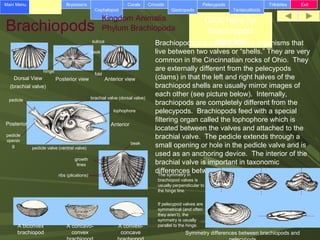
Brachiopods are solitary marine organisms that
live between two valves or “shells.” They are very
common in the Cincinnatian rocks of Ohio. They
are externally different from the pelecypods
(clams) in that the left and right halves of the
brachiopod shells are usually mirror images of
each other (see picture below). Internally,
brachiopods are completely different from the
pelecypods. Brachiopods feed with a special
filtering organ called the lophophore which is
located between the valves and attached to the
brachial valve. The pedicle extends through a
small opening or hole in the pedicle valve and is
used as an anchoring device. The interior of the
brachial valve is important in taxonomic
differences between various species.
Dorsal View
(brachial valve)
Posterior view Anterior view
sulcus
fold
beak
hinge
AnteriorPosterior
brachial valve (dorsal valve)
pedicle valve (ventral valve)
pedicle
openin
g
lophophore
beak
growth
lines
ribs (plications)
A biconvex
brachiopod
A concavo-
convex
A convexi-
concave Symmetry differences between brachiopods and
The symmetry in
brachiopod valves is
usually perpendicular to
the hinge line.
If pelecypod valves are
symmetrical (and often
they aren’t), the
symmetry is usually
parallel to the hinge.
pedicle
They are lophophorates, and so areThey are lophophorates, and so are
related to the Bryozoa and Phoronida.related to the Bryozoa and Phoronida.
Although they seem rare in today's seas,Although they seem rare in today's seas,
they are actually fairly common.they are actually fairly common.
There are about 300 living species ofThere are about 300 living species of
brachiopodsbrachiopods
They like cold deep water which is whyThey like cold deep water which is why
they are not seen much.they are not seen much.
It has been suggested that the slowIt has been suggested that the slow
decline of the brachiopods over the lastdecline of the brachiopods over the last
100 million years or so is a direct result of100 million years or so is a direct result of
the following:the following:
(1) the rise in diversity of filter feeding(1) the rise in diversity of filter feeding
bivalves, which have ousted thebivalves, which have ousted the
brachiopods from their former habitats;brachiopods from their former habitats;
] (2) the increasing disturbance of] (2) the increasing disturbance of
sediments by roving deposit feederssediments by roving deposit feeders
(including many burrowing bivalves);(including many burrowing bivalves);
and/orand/or
(3) the increased intensity and variety of(3) the increased intensity and variety of
shell-crushing predation.shell-crushing predation.
Brachiopods

Brachiopods

  • 1.
  • 2.
    Brachiopods belong tothe large category ofBrachiopods belong to the large category of animals without backbones, theanimals without backbones, the invertebrates.invertebrates. They have two shells or valves that areThey have two shells or valves that are often composed of the mineral calciteoften composed of the mineral calcite ((calcium carbonate).calcium carbonate). Brachiopods have a coiled feeding organBrachiopods have a coiled feeding organ called acalled a lophophorelophophore that is protected by itsthat is protected by its valves.valves. There are two major divisions (Classes) ofThere are two major divisions (Classes) of brachiopods:brachiopods: thethe inarticulate brachiopodsinarticulate brachiopods and the articulate brachiopodsand the articulate brachiopods..
  • 3.
    . They havea fossil record stretching back. They have a fossil record stretching back to the start of the Cambrian Period, someto the start of the Cambrian Period, some 570 million years ago.570 million years ago. Brachiopods are still living in the world’sBrachiopods are still living in the world’s oceans. It is the brachiopod valves thatoceans. It is the brachiopod valves that are often found fossilized.are often found fossilized. Brachiopods live on the ocean floor. TheyBrachiopods live on the ocean floor. They have been found living in a wide range ofhave been found living in a wide range of water depths fromwater depths from very shallow waters ofvery shallow waters of rocky shorelines to ocean floor three androcky shorelines to ocean floor three and a half miles beneath the ocean surface.a half miles beneath the ocean surface.
  • 4.
    They are knownfrom many places, rangingThey are known from many places, ranging from the warm tropical waters of thefrom the warm tropical waters of the Caribbean to cold Antarctic seas. FossilCaribbean to cold Antarctic seas. Fossil brachiopods in sedimentary rocks indicatebrachiopods in sedimentary rocks indicate ancient marine environments.ancient marine environments.
  • 5.
    There are lotsof DifferentThere are lots of Different shaped brachiopods.shaped brachiopods. When you look at themWhen you look at them side-on some are biconvexside-on some are biconvex and some are concavoand some are concavo convex .convex . The valves are joinedThe valves are joined along the hinge line whichalong the hinge line which can be straight or curved.can be straight or curved. Some have smooth valves,Some have smooth valves, others have ridges .others have ridges . A biconvex brachiopod A concavo- convex brachiopod A convexi- concave brachiop od
  • 6.
    Articulate brachiopods areoften the mostArticulate brachiopods are often the most common fossil brachiopods. They havecommon fossil brachiopods. They have two valves, the larger is the pedicle valve.two valves, the larger is the pedicle valve. The pedicle foramen is a hole towards theThe pedicle foramen is a hole towards the end of the pedicle valve.end of the pedicle valve. The valves articulate by teeth on theThe valves articulate by teeth on the pedicle valve that fit into sockets on thepedicle valve that fit into sockets on the brachial valve, giving them thebrachial valve, giving them the namename ‘Articulate brachiopods’‘Articulate brachiopods’.. There are aThere are a number of distinct types, or Orders,number of distinct types, or Orders, mentioned below:mentioned below:
  • 7.
    Brachiopods often haveone valve largerBrachiopods often have one valve larger than the other.than the other. The larger valve often has a hole called aThe larger valve often has a hole called a pedicle foramen towards its posterior end.pedicle foramen towards its posterior end. In life, the pedicle, a fleshy stalk mayIn life, the pedicle, a fleshy stalk may emerge through this hole.emerge through this hole. This gives its name to the larger valve,This gives its name to the larger valve, the pedicle valve.the pedicle valve. The pedicle can be used for attachmentThe pedicle can be used for attachment and rotation of the brachiopod.and rotation of the brachiopod.
  • 8.
    Sometimes brachiopods areanchored inSometimes brachiopods are anchored in seafloor sediment by spines.seafloor sediment by spines. The smaller valve of a brachiopodThe smaller valve of a brachiopod contains a coiled feeding organ called acontains a coiled feeding organ called a lophophore.lophophore. This may be sup-ported by a smallThis may be sup-ported by a small calcareous skeleton or loop called acalcareous skeleton or loop called a brachidium.brachidium. This structure gives its name to theThis structure gives its name to the smaller valve, the brachial valve.smaller valve, the brachial valve.
  • 10.
  • 11.
    OrthidsOrthids are usuallyareusually small with a shortsmall with a short straight hinge line. Thestraight hinge line. The pedicle foramen is oftenpedicle foramen is often visible.The gentlyvisible.The gently biconvex valves havebiconvex valves have many small costae.Theymany small costae.They are the first group ofare the first group of articulates known.articulates known.
  • 12.
    RhynchonellidsRhynchonellids areare biconvex, oftenwithbiconvex, often with costae and a pediclecostae and a pedicle foramen in the pedicleforamen in the pedicle valve.valve.
  • 13.
    TerebratulidsTerebratulids oftenoften have smoothvalveshave smooth valves with growth lines andwith growth lines and a pedicle foramen.a pedicle foramen. They are biconvexThey are biconvex and have a roundedand have a rounded hinge line.hinge line.
  • 14.
    PentameridsPentamerids are oftenareoften large, up to severallarge, up to several inches long. They areinches long. They are strongly biconvex andstrongly biconvex and have a curved hinge line.have a curved hinge line.
  • 15.
    StrophomenidsStrophomenids have a straighthingehave a straight hinge line and the valvesline and the valves are concavo-convex.are concavo-convex.
  • 16.
    TheThe next 3groupsnext 3 groups have an ornate spiralhave an ornate spiral support for thesupport for the lophophore inside thelophophore inside the smaller brachialsmaller brachial valve. They arevalve. They are biconvex, often with abiconvex, often with a pedicle foramen.pedicle foramen. SpiriferidsSpiriferids may bemay be large. They have alarge. They have a straight hinge line andstraight hinge line and costae on theircostae on their valves.valves.
  • 17.
    AtrypidsAtrypids have ahavea rounded hinge linerounded hinge line and often haveand often have costae on theircostae on their valves.valves.
  • 18.
    AthyridsAthyrids have ahavea rounded hinge linerounded hinge line and the valves areand the valves are often smooth.often smooth.
  • 19.
    InarticulateInarticulate BrachiopodsBrachiopods have twohavetwo valves, but do not havevalves, but do not have teeth and sockets,teeth and sockets, relying on muscles torelying on muscles to hold and move them.hold and move them. LingulaLingula is an unusualis an unusual brachiopod, not onlybrachiopod, not only because it has twobecause it has two similar sized valves, butsimilar sized valves, but also because it lives inalso because it lives in a burrow, attached by aa burrow, attached by a long pedicle.long pedicle.
  • 20.
    Difference between brachiopodsandDifference between brachiopods and bivalvesbivalves Brachiopods (or Brachiopoda) are oftenBrachiopods (or Brachiopoda) are often confused with bivalved mollusks (clams orconfused with bivalved mollusks (clams or Bivalvia). However, there are major biologicalBivalvia). However, there are major biological differences between brachiopods anddifferences between brachiopods and bivalves.bivalves. A mirror image or plane of symmetry of aA mirror image or plane of symmetry of a brachiopodbrachiopod cuts the valve in half along itscuts the valve in half along its length .length . InIn bivalvesbivalves the mirror image runs along thethe mirror image runs along the edge of the valves where they close together.edge of the valves where they close together.
  • 21.
    Brachiopods often haveone valve largerBrachiopods often have one valve larger than the other.than the other.
  • 22.
    Brachiopods are verycommon as fossilsBrachiopods are very common as fossils in rocks from certain parts of Northin rocks from certain parts of North America and other continents around theAmerica and other continents around the world.world. The evolution of different brachiopodsThe evolution of different brachiopods through time can be useful in identifyingthrough time can be useful in identifying the time at which a sedimentary rockthe time at which a sedimentary rock containing these fossils formed.containing these fossils formed. It has long been assumed thatIt has long been assumed that brachiopods are now a minor group ofbrachiopods are now a minor group of animals on their way to extinction.animals on their way to extinction.
  • 23.
    Certainly they weremore abundant in theCertainly they were more abundant in the shallow seas of the Paleozoic Era thanshallow seas of the Paleozoic Era than they are today.they are today. However, as more is discovered of theirHowever, as more is discovered of their present-day distribution, they appear to bepresent-day distribution, they appear to be more widespread and successful in todaysmore widespread and successful in todays oceans than previously realized.oceans than previously realized.
  • 25.
    Only marineOnly marine 2groups…articulated and non articulated2 groups…articulated and non articulated Suspension feedersSuspension feeders Live about 3 yearsLive about 3 years Great fossil record and oldest living hardGreat fossil record and oldest living hard shell organismsshell organisms
  • 27.
    Brachiopods are marineanimals that,Brachiopods are marine animals that, upon first glance, look like clams.upon first glance, look like clams. They are actually quite different fromThey are actually quite different from clams in their anatomy, and they areclams in their anatomy, and they are not closely related to the molluscs.not closely related to the molluscs.
  • 29.
    Brachiopods Click herefor brachiopod species Main Menu Trilobites Brachiopods Cephalopod s Tentaculitoids Bryozoans Gastropods PelecypodsCrinoidsCorals Kingdom Animalia Phylum Brachiopoda Exit Brachiopods are solitary marine organisms that live between two valves or “shells.” They are very common in the Cincinnatian rocks of Ohio. They are externally different from the pelecypods (clams) in that the left and right halves of the brachiopod shells are usually mirror images of each other (see picture below). Internally, brachiopods are completely different from the pelecypods. Brachiopods feed with a special filtering organ called the lophophore which is located between the valves and attached to the brachial valve. The pedicle extends through a small opening or hole in the pedicle valve and is used as an anchoring device. The interior of the brachial valve is important in taxonomic differences between various species. Dorsal View (brachial valve) Posterior view Anterior view sulcus fold beak hinge AnteriorPosterior brachial valve (dorsal valve) pedicle valve (ventral valve) pedicle openin g lophophore beak growth lines ribs (plications) A biconvex brachiopod A concavo- convex A convexi- concave Symmetry differences between brachiopods and The symmetry in brachiopod valves is usually perpendicular to the hinge line. If pelecypod valves are symmetrical (and often they aren’t), the symmetry is usually parallel to the hinge. pedicle
  • 30.
    They are lophophorates,and so areThey are lophophorates, and so are related to the Bryozoa and Phoronida.related to the Bryozoa and Phoronida. Although they seem rare in today's seas,Although they seem rare in today's seas, they are actually fairly common.they are actually fairly common. There are about 300 living species ofThere are about 300 living species of brachiopodsbrachiopods
  • 32.
    They like colddeep water which is whyThey like cold deep water which is why they are not seen much.they are not seen much. It has been suggested that the slowIt has been suggested that the slow decline of the brachiopods over the lastdecline of the brachiopods over the last 100 million years or so is a direct result of100 million years or so is a direct result of the following:the following:
  • 34.
    (1) the risein diversity of filter feeding(1) the rise in diversity of filter feeding bivalves, which have ousted thebivalves, which have ousted the brachiopods from their former habitats;brachiopods from their former habitats; ] (2) the increasing disturbance of] (2) the increasing disturbance of sediments by roving deposit feederssediments by roving deposit feeders (including many burrowing bivalves);(including many burrowing bivalves); and/orand/or (3) the increased intensity and variety of(3) the increased intensity and variety of shell-crushing predation.shell-crushing predation.