Department of Applied Geology
Dr. Harisingh Gour Vishwavidyalaya, Sagar (M.P.)
Presentation
On
Igneous Structures and Genesis
Presented
by
Wahid Baig
Y18251035
(M.Tech. 1st Sem.)
Under the Guidance
Of
Prof. A.K. Shandilya Sir
CONTENTS
• Introductions
• Intrusive igneous rock structures
• (Secondary Structures)
• Laccoliths Intrusion
• Lopoliths Intrusion
• Phacoliths
• Batholith
• Stocks
• Extrusive Igneous rock
(Primary Structures)
• Pillow Structure
• lava Flow Structure
• Spherulitic Structures
• Vesicular Structures
• Columnar Structures
• Miarolitic Structures
• References
• Amygdaloidal
• colour banding
• Ropy lava
• Comb structure
• Orbicular structures
• Corona structures
• Sill
• Dykes/Dikes
• Volcanic Neck
• Salt domes
INRODUCTION:-
• Those features of igneous rock that developed on a large scale in
the body of an extrusive or intrusive- give rise to conspicuous shape
or forms are included under the term “structures”.
• Igneous rocks have primary structures but in hypabyssal case they shows
secondary structure because magma intruded in country rocks
• Primary Structures developed in the igneous rock during the time of
cooling, crystallization and solidification of magma or lava.
• There are two main classifications of igneous rocks :
1. Extrusive igneous rock structures
[Primary structures]
2. Intrusive igneous rock structures
[Secondary structures]
1. Intrusive igneous rock structures
• Intrusive igneous rock structures formed below the Earth’s surface
where magma is subjected to cooling and solidification.
• They are of two types
A. Plutonic Igneous rock: The rocks which form by the crystallization of
magma at very great depth to the earth surface
B. Hypabyssal Igneous rocks: The rocks form by the crystallization of
magma at intermediate depth or near to the earth surface
Intrusive igneous rock structures are classified in two ways, based on the
relationship of intrusive igneous structures to country rock
• Some intrusion flow parallel to the bedding plane, i.e. they don’t disturb the
individual layers of country and deposited with the bed or layer.
• Some intrusion move perpendicular to the bedding plane and they disturb
the individual layers of country.
Concordant Intrusion:
Concordant Intrusion are those which are parallel to the bedding plane,
i.e. they don’t disturb, the individual layers of country rocks but however
they deposited with the bed or layer. Examples are..
I. Laccoliths
II. Lopoliths
III. Sills
IV. Phacoliths
V. Salt domes
Discordant Intrusion:
Discordant Intrusion are those which are perpendicular to the bedding
plane, i.e. they cuts across the bedding layers of country rocks.
The thickness vary widely from an inch up to hundred of feet.
The magma injected through fractures, joints and week planes. Exmples are
I. Dykes/Dikes
II. Stocks
III. Batholiths[Both]
IV. Volcanic Necks
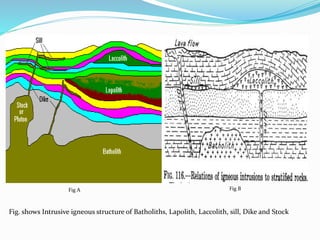
Fig A Fig B
Fig. shows Intrusive igneous structure of Batholiths, Lapolith, Laccolith, sill, Dike and Stock
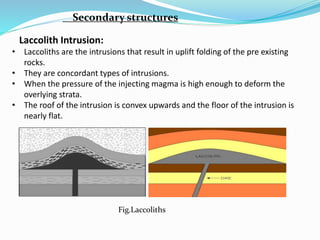
Laccolith Intrusion:
• Laccoliths are the intrusions that result in uplift folding of the pre existing
rocks.
• They are concordant types of intrusions.
• When the pressure of the injecting magma is high enough to deform the
overlying strata.
• The roof of the intrusion is convex upwards and the floor of the intrusion is
nearly flat.
Fig.Laccoliths
Secondary structures
Lopoliths Intrusion:-
• Lopoliths are the intrusions that result in down lift folding of the pre existing
rocks.
• They are concordant types of intrusions, occur between parallel layers of rock at
relatively deeper depths.
• When the pressure of the injecting magma is very low and pressure of overlying
strata is high.
Fig. Lopoliths
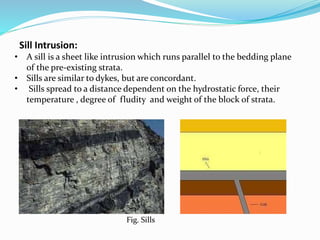
Sill Intrusion:
• A sill is a sheet like intrusion which runs parallel to the bedding plane
of the pre-existing strata.
• Sills are similar to dykes, but are concordant.
• Sills spread to a distance dependent on the hydrostatic force, their
temperature , degree of fludity and weight of the block of strata.
Fig. Sills
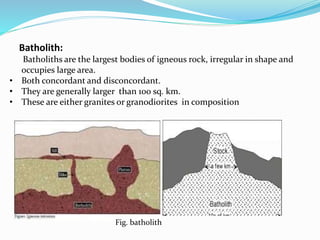
Batholith:
Batholiths are the largest bodies of igneous rock, irregular in shape and
occupies large area.
• Both concordant and disconcordant.
• They are generally larger than 100 sq. km.
• These are either granites or granodiorites in composition
Fig. batholith
Stocks:-
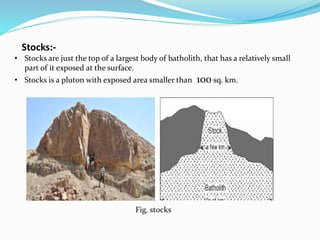
• Stocks are just the top of a largest body of batholith, that has a relatively small
part of it exposed at the surface.
• Stocks is a pluton with exposed area smaller than 100 sq. km.
Fig. stocks
Dike:-
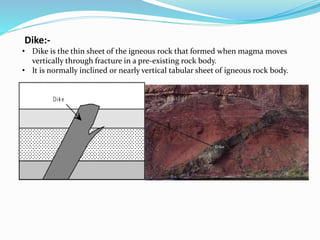
• Dike is the thin sheet of the igneous rock that formed when magma moves
vertically through fracture in a pre-existing rock body.
• It is normally inclined or nearly vertical tabular sheet of igneous rock body.
Volcanic neck:-
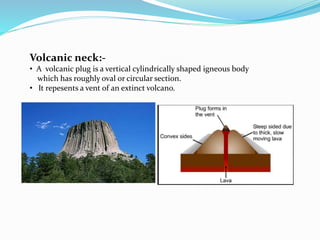
• A volcanic plug is a vertical cylindrically shaped igneous body
which has roughly oval or circular section.
• It repesents a vent of an extinct volcano.
Salt domes:-
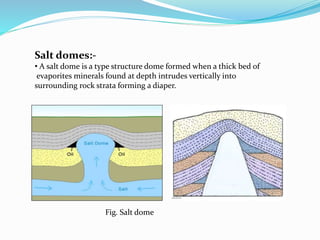
• A salt dome is a type structure dome formed when a thick bed of
evaporites minerals found at depth intrudes vertically into
surrounding rock strata forming a diaper.
Fig. Salt dome
Plutonic igneous structures
[Primary structures]
• A ring like structures
•Formed during the crystallisation of magma
• Zone of reaction products which occurs near the boundary of
the mineral grains
Corona :-
• The reaction rims formed by the primary magmatic reaction.
kelyphitic border:-
• Develop during secondary processes such as metamorphism.
REACTION RIM:-
Fig. Reaction rim,corona and kelyphitic border.
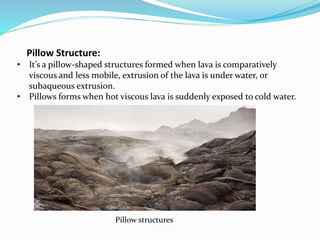
Pillow Structure:
• It’s a pillow-shaped structures formed when lava is comparatively
viscous and less mobile, extrusion of the lava is under water, or
subaqueous extrusion.
• Pillows forms when hot viscous lava is suddenly exposed to cold water.
Pillow structures
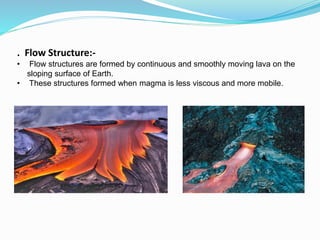
. Flow Structure:-
• Flow structures are formed by continuous and smoothly moving lava on the
sloping surface of Earth.
• These structures formed when magma is less viscous and more mobile.
. Spherulitic Structures:-
• Spherulitic Structures are Identified by the presence of the Needle like
Mineral Grains in igneous rock masses.
Fig. columnar structures Fig Spherulitic Structures
Columnar Structures:
• This structure consists of columns (mostly commonly hexagonal in
shape) that are separated by joints or fractures in the rock, formed
when the rock contracted, most often during
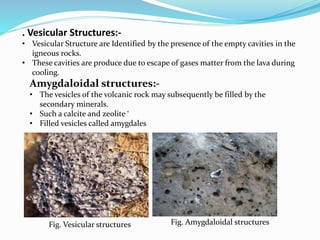
. Vesicular Structures:-
• Vesicular Structure are Identified by the presence of the empty cavities in the
igneous rocks.
• These cavities are produce due to escape of gases matter from the lava during
cooling.
Fig. Vesicular structures Fig. Amygdaloidal structures
Amygdaloidal structures:-
• The vesicles of the volcanic rock may subsequently be filled by the
secondary minerals.
• Such a calcite and zeolite ‘
• Filled vesicles called amygdales
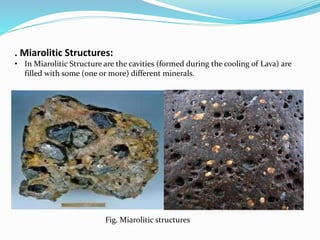
. Miarolitic Structures:
• In Miarolitic Structure are the cavities (formed during the cooling of Lava) are
filled with some (one or more) different minerals.
Fig. Miarolitic structures
References
• Principles of igneous and metamorphic petrology By J.D Winter
• Igneous petrology By Bose M.K
• Topics in igneous petrology By Bose M.K
• Engineering and general Geology, Katson educational series, By
Parbin Singh
Thank you

Igneous structure and genesis (structural geology)

  • 1.
    Department of AppliedGeology Dr. Harisingh Gour Vishwavidyalaya, Sagar (M.P.) Presentation On Igneous Structures and Genesis Presented by Wahid Baig Y18251035 (M.Tech. 1st Sem.) Under the Guidance Of Prof. A.K. Shandilya Sir
  • 2.
    CONTENTS • Introductions • Intrusiveigneous rock structures • (Secondary Structures) • Laccoliths Intrusion • Lopoliths Intrusion • Phacoliths • Batholith • Stocks • Extrusive Igneous rock (Primary Structures) • Pillow Structure • lava Flow Structure • Spherulitic Structures • Vesicular Structures • Columnar Structures • Miarolitic Structures • References • Amygdaloidal • colour banding • Ropy lava • Comb structure • Orbicular structures • Corona structures • Sill • Dykes/Dikes • Volcanic Neck • Salt domes
  • 3.
    INRODUCTION:- • Those featuresof igneous rock that developed on a large scale in the body of an extrusive or intrusive- give rise to conspicuous shape or forms are included under the term “structures”. • Igneous rocks have primary structures but in hypabyssal case they shows secondary structure because magma intruded in country rocks • Primary Structures developed in the igneous rock during the time of cooling, crystallization and solidification of magma or lava. • There are two main classifications of igneous rocks : 1. Extrusive igneous rock structures [Primary structures] 2. Intrusive igneous rock structures [Secondary structures]
  • 4.
    1. Intrusive igneousrock structures • Intrusive igneous rock structures formed below the Earth’s surface where magma is subjected to cooling and solidification. • They are of two types A. Plutonic Igneous rock: The rocks which form by the crystallization of magma at very great depth to the earth surface B. Hypabyssal Igneous rocks: The rocks form by the crystallization of magma at intermediate depth or near to the earth surface Intrusive igneous rock structures are classified in two ways, based on the relationship of intrusive igneous structures to country rock • Some intrusion flow parallel to the bedding plane, i.e. they don’t disturb the individual layers of country and deposited with the bed or layer. • Some intrusion move perpendicular to the bedding plane and they disturb the individual layers of country.
  • 5.
    Concordant Intrusion: Concordant Intrusionare those which are parallel to the bedding plane, i.e. they don’t disturb, the individual layers of country rocks but however they deposited with the bed or layer. Examples are.. I. Laccoliths II. Lopoliths III. Sills IV. Phacoliths V. Salt domes Discordant Intrusion: Discordant Intrusion are those which are perpendicular to the bedding plane, i.e. they cuts across the bedding layers of country rocks. The thickness vary widely from an inch up to hundred of feet. The magma injected through fractures, joints and week planes. Exmples are I. Dykes/Dikes II. Stocks III. Batholiths[Both] IV. Volcanic Necks
  • 6.
    Fig A FigB Fig. shows Intrusive igneous structure of Batholiths, Lapolith, Laccolith, sill, Dike and Stock
  • 7.
    Laccolith Intrusion: • Laccolithsare the intrusions that result in uplift folding of the pre existing rocks. • They are concordant types of intrusions. • When the pressure of the injecting magma is high enough to deform the overlying strata. • The roof of the intrusion is convex upwards and the floor of the intrusion is nearly flat. Fig.Laccoliths Secondary structures
  • 8.
    Lopoliths Intrusion:- • Lopolithsare the intrusions that result in down lift folding of the pre existing rocks. • They are concordant types of intrusions, occur between parallel layers of rock at relatively deeper depths. • When the pressure of the injecting magma is very low and pressure of overlying strata is high. Fig. Lopoliths
  • 9.
    Sill Intrusion: • Asill is a sheet like intrusion which runs parallel to the bedding plane of the pre-existing strata. • Sills are similar to dykes, but are concordant. • Sills spread to a distance dependent on the hydrostatic force, their temperature , degree of fludity and weight of the block of strata. Fig. Sills
  • 10.
    Batholith: Batholiths are thelargest bodies of igneous rock, irregular in shape and occupies large area. • Both concordant and disconcordant. • They are generally larger than 100 sq. km. • These are either granites or granodiorites in composition Fig. batholith
  • 11.
    Stocks:- • Stocks arejust the top of a largest body of batholith, that has a relatively small part of it exposed at the surface. • Stocks is a pluton with exposed area smaller than 100 sq. km. Fig. stocks
  • 12.
    Dike:- • Dike isthe thin sheet of the igneous rock that formed when magma moves vertically through fracture in a pre-existing rock body. • It is normally inclined or nearly vertical tabular sheet of igneous rock body.
  • 13.
    Volcanic neck:- • Avolcanic plug is a vertical cylindrically shaped igneous body which has roughly oval or circular section. • It repesents a vent of an extinct volcano.
  • 14.
    Salt domes:- • Asalt dome is a type structure dome formed when a thick bed of evaporites minerals found at depth intrudes vertically into surrounding rock strata forming a diaper. Fig. Salt dome
  • 15.
    Plutonic igneous structures [Primarystructures] • A ring like structures •Formed during the crystallisation of magma • Zone of reaction products which occurs near the boundary of the mineral grains Corona :- • The reaction rims formed by the primary magmatic reaction. kelyphitic border:- • Develop during secondary processes such as metamorphism. REACTION RIM:- Fig. Reaction rim,corona and kelyphitic border.
  • 16.
    Pillow Structure: • It’sa pillow-shaped structures formed when lava is comparatively viscous and less mobile, extrusion of the lava is under water, or subaqueous extrusion. • Pillows forms when hot viscous lava is suddenly exposed to cold water. Pillow structures
  • 17.
    . Flow Structure:- •Flow structures are formed by continuous and smoothly moving lava on the sloping surface of Earth. • These structures formed when magma is less viscous and more mobile.
  • 18.
    . Spherulitic Structures:- •Spherulitic Structures are Identified by the presence of the Needle like Mineral Grains in igneous rock masses. Fig. columnar structures Fig Spherulitic Structures Columnar Structures: • This structure consists of columns (mostly commonly hexagonal in shape) that are separated by joints or fractures in the rock, formed when the rock contracted, most often during
  • 19.
    . Vesicular Structures:- •Vesicular Structure are Identified by the presence of the empty cavities in the igneous rocks. • These cavities are produce due to escape of gases matter from the lava during cooling. Fig. Vesicular structures Fig. Amygdaloidal structures Amygdaloidal structures:- • The vesicles of the volcanic rock may subsequently be filled by the secondary minerals. • Such a calcite and zeolite ‘ • Filled vesicles called amygdales
  • 20.
    . Miarolitic Structures: •In Miarolitic Structure are the cavities (formed during the cooling of Lava) are filled with some (one or more) different minerals. Fig. Miarolitic structures
  • 21.
    References • Principles ofigneous and metamorphic petrology By J.D Winter • Igneous petrology By Bose M.K • Topics in igneous petrology By Bose M.K • Engineering and general Geology, Katson educational series, By Parbin Singh
  • 22.