FORAMINIFERA
&
IT’S APPLICATIONS
ADITYA BHATTACHARYA
16MC000265
V th Semester
M.Sc Tech(AGL)
INTRODUCTION
• Microfossils are very small remains of organisms 0.001mm(1
micron) to 1mm, that require magnification for study.
• They are abundant , can be recovered from small samples.
• It provides the main evidence for organic evolution through
time.
• They are classified into two groups:
• Organic walled: Acritarchs, Dinoflagellates, Spores ,Pollen
etc.
• Inorganic walled: Diatoms, Silicoflagellates, Ostracods,
Conodonts and Foraminifera
Kingdom: PROTOZOA
Phylum : SARCODINA
Class : RHIZOPODA
Order : FORAMINIFERA
• Most abundant can be studied with simple techniques and
low power microscopes.
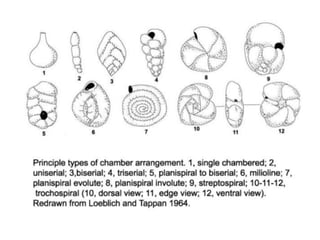
• Their shells are called tests which consist of single or
multiple chamber(s).
•Each chamber is interconnected by an opening (foramen) or
several openings (foramina)
•Known from Early Cambrian to Recent times and has reached
its acme during Cenezoic
MORPHOLOGY
•Shell morphology and mineralogy form the prime basis for
identification of species and higher categories of Foraminifera.
•Most have a shell or test comprising chambers, interconnected
through holes or foramina.
•The test may be composed of a number of materials but three
main categories have been documented:
•Organic
Consist of tectin, which is protinaceous
•Agglutinated
Fragments of extraneous material bounded by variety of cements
•Calcareous
Subdivided into three sub-groups:
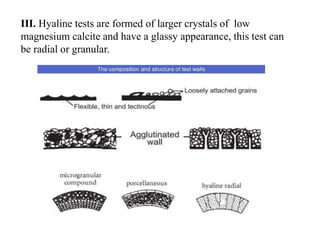
I. Microgranular consists of tight packed, similar size grains of
crystalline calcite
II. Porcellaneous tests are formed of small, randomly oriented
crystals of high Mg calcite
III. Hyaline tests are formed of larger crystals of low
magnesium calcite and have a glassy appearance, this test can
be radial or granular.
ECOLOGY
•Foraminifera have a wide environmental range, from terrestrial
to deep sea and from polar to tropical.
•Species of foraminifera live in particular environments which
help in studies of recent and ancient environmental conditions.
•Changes in the composition of foraminiferal assemblages used
to track changes in the circulation of water and depth.
•Most are marine they can tolerate only in very small variations
in salinity of the water.
•Certain groups having a porcelaneous test can live equally in
hyperhaline environments lagoons with a salinity > 35 ppm
•Some groups such as the agglutinates and hyalines prefer water
with a low salinity e.g. brackish lagoons and estuaries.
•Food: They feed on small bacteria, algae, protests and
invertebrates.
•Light: Primary production of nutrients by planktonic and
benthonic algae render this zone attractive to foraminifera.
•Salinity: The majority of foraminifera are adapted to normal
marine salinities about 35 ppm.
•Temperature: Each species is adapted to a certain range of
temperature conditions.
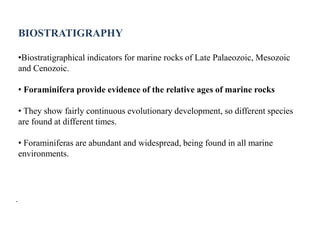
Two Groups of Foraminifera
Benthic foraminifera is the bottom
dwellers. They live all along and
beneath the ocean floor in the
sediments.
Planktonic foraminifera live in the
upper zone of the ocean. They are
found only in the open ocean. When
they die, they settle to the bottom of
the ocean.
BIOSTRATIGRAPHY
•Biostratigraphical indicators for marine rocks of Late Palaeozoic, Mesozoic
and Cenozoic.
• Foraminifera provide evidence of the relative ages of marine rocks
• They show fairly continuous evolutionary development, so different species
are found at different times.
• Foraminiferas are abundant and widespread, being found in all marine
environments.
.
PALEOECOLOGY
• Foraminifera provide evidence about past environments.
• Foraminifera have been used to locate ancient shorelines, and track global
ocean temperature changes during the ice ages.
• If a sample of fossil foraminifera contains many extant species, the
present-day distribution of those species can be used to infer the
environment at that site when the fossils were alive.
• If samples contain all or mostly extinct species, there are still numerous
clues that can be used to infer past environments.
• These include species diversity, the relative numbers of planktonic and
benthic species, the ratios of different shell types, and shell chemistry.
PALAEOBIOGEOGRAPHY
• The chemistry of the shell is useful because it reflects the chemistry of
the water in which it grew.
• For example, the ratio of stable oxygen isotopes depends on the water
temperature, because warmer water tends to evaporate off more of the
lighter isotopes.
• Measurement of stable oxygen isotopes in planktonic and benthic
foram shells from hundreds of deep-sea cores worldwide have been used
to map past surface and bottom water temperatures.
• This data helps us understand how climate and ocean currents have
changed in the past and may change in the future.
OIL EXPLORATION
Foraminifera are used to find petroleum
• Some species are geologically short-lived and some forms are only
found in specific environments.
• Therefore, a paleontologist can examine the specimens in a small rock
sample like those recovered during the drilling of oil wells and
determine the geologic age and environment when the rock formed.
• Stratigraphic control using foraminifera is so precise that these fossils
are even used to direct sideways drilling within an oil-bearing horizon to
increase well productivity.
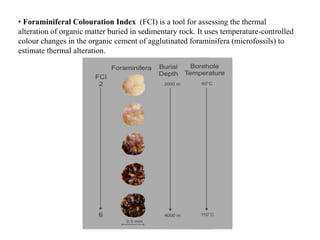
• Foraminiferal Colouration Index (FCI) is a tool for assessing the thermal
alteration of organic matter buried in sedimentary rock. It uses temperature-controlled
colour changes in the organic cement of agglutinated foraminifera (microfossils) to
estimate thermal alteration.
• Foraminifera are abundant in most marine environment so only
small sediment samples are needed to obtain statistically significant
numbers of microfossils to perform environmental analysis.
• They are sensitive to environmental change and their mineralized
shell normally get preserved in the sediment after the death of the
organism
• Foraminifera extremely useful in determining palaeoclimate,
stratigraphy and oil prospecting.
• Foraminiferal analysis of dated sediment cores represent a quick and
cost efficient way to evaluate possible differences between present
and reference conditions without previous knowledge of the area
being examined.
REFERENCES:
•Howard A., Armstrong and Martin D. Brasier (2005), Microfossils,
Blackwell Publishing, 2nd Edition, 296 p.
•Michael J. Benton and David A.T. Harper (2009), Introduction to
Palaeobiology and the Fossil Record, A John Wiley & Sons, Ltd, 592 p.
• Jones, R.W (1996): Micropaleontology in Petroleum
Exploration. Oxford University Press, Oxford.
• http://www.ucmp.berkeley.edu/fosrec/Wetmore.html
Foraminifera and its Applications

Foraminifera and its Applications

  • 1.
  • 2.
    INTRODUCTION • Microfossils arevery small remains of organisms 0.001mm(1 micron) to 1mm, that require magnification for study. • They are abundant , can be recovered from small samples. • It provides the main evidence for organic evolution through time. • They are classified into two groups: • Organic walled: Acritarchs, Dinoflagellates, Spores ,Pollen etc. • Inorganic walled: Diatoms, Silicoflagellates, Ostracods, Conodonts and Foraminifera
  • 3.
    Kingdom: PROTOZOA Phylum :SARCODINA Class : RHIZOPODA Order : FORAMINIFERA • Most abundant can be studied with simple techniques and low power microscopes. • Their shells are called tests which consist of single or multiple chamber(s). •Each chamber is interconnected by an opening (foramen) or several openings (foramina) •Known from Early Cambrian to Recent times and has reached its acme during Cenezoic
  • 4.
  • 5.
    •Shell morphology andmineralogy form the prime basis for identification of species and higher categories of Foraminifera. •Most have a shell or test comprising chambers, interconnected through holes or foramina. •The test may be composed of a number of materials but three main categories have been documented: •Organic Consist of tectin, which is protinaceous •Agglutinated Fragments of extraneous material bounded by variety of cements •Calcareous Subdivided into three sub-groups: I. Microgranular consists of tight packed, similar size grains of crystalline calcite II. Porcellaneous tests are formed of small, randomly oriented crystals of high Mg calcite
  • 6.
    III. Hyaline testsare formed of larger crystals of low magnesium calcite and have a glassy appearance, this test can be radial or granular.
  • 8.
  • 9.
    •Foraminifera have awide environmental range, from terrestrial to deep sea and from polar to tropical. •Species of foraminifera live in particular environments which help in studies of recent and ancient environmental conditions. •Changes in the composition of foraminiferal assemblages used to track changes in the circulation of water and depth. •Most are marine they can tolerate only in very small variations in salinity of the water. •Certain groups having a porcelaneous test can live equally in hyperhaline environments lagoons with a salinity > 35 ppm
  • 10.
    •Some groups suchas the agglutinates and hyalines prefer water with a low salinity e.g. brackish lagoons and estuaries.
  • 11.
    •Food: They feedon small bacteria, algae, protests and invertebrates. •Light: Primary production of nutrients by planktonic and benthonic algae render this zone attractive to foraminifera. •Salinity: The majority of foraminifera are adapted to normal marine salinities about 35 ppm. •Temperature: Each species is adapted to a certain range of temperature conditions.
  • 13.
    Two Groups ofForaminifera Benthic foraminifera is the bottom dwellers. They live all along and beneath the ocean floor in the sediments. Planktonic foraminifera live in the upper zone of the ocean. They are found only in the open ocean. When they die, they settle to the bottom of the ocean.
  • 14.
    BIOSTRATIGRAPHY •Biostratigraphical indicators formarine rocks of Late Palaeozoic, Mesozoic and Cenozoic. • Foraminifera provide evidence of the relative ages of marine rocks • They show fairly continuous evolutionary development, so different species are found at different times. • Foraminiferas are abundant and widespread, being found in all marine environments. .
  • 15.
    PALEOECOLOGY • Foraminifera provideevidence about past environments. • Foraminifera have been used to locate ancient shorelines, and track global ocean temperature changes during the ice ages. • If a sample of fossil foraminifera contains many extant species, the present-day distribution of those species can be used to infer the environment at that site when the fossils were alive. • If samples contain all or mostly extinct species, there are still numerous clues that can be used to infer past environments. • These include species diversity, the relative numbers of planktonic and benthic species, the ratios of different shell types, and shell chemistry.
  • 16.
    PALAEOBIOGEOGRAPHY • The chemistryof the shell is useful because it reflects the chemistry of the water in which it grew. • For example, the ratio of stable oxygen isotopes depends on the water temperature, because warmer water tends to evaporate off more of the lighter isotopes. • Measurement of stable oxygen isotopes in planktonic and benthic foram shells from hundreds of deep-sea cores worldwide have been used to map past surface and bottom water temperatures. • This data helps us understand how climate and ocean currents have changed in the past and may change in the future.
  • 17.
    OIL EXPLORATION Foraminifera areused to find petroleum • Some species are geologically short-lived and some forms are only found in specific environments. • Therefore, a paleontologist can examine the specimens in a small rock sample like those recovered during the drilling of oil wells and determine the geologic age and environment when the rock formed. • Stratigraphic control using foraminifera is so precise that these fossils are even used to direct sideways drilling within an oil-bearing horizon to increase well productivity.
  • 18.
    • Foraminiferal ColourationIndex (FCI) is a tool for assessing the thermal alteration of organic matter buried in sedimentary rock. It uses temperature-controlled colour changes in the organic cement of agglutinated foraminifera (microfossils) to estimate thermal alteration.
  • 19.
    • Foraminifera areabundant in most marine environment so only small sediment samples are needed to obtain statistically significant numbers of microfossils to perform environmental analysis. • They are sensitive to environmental change and their mineralized shell normally get preserved in the sediment after the death of the organism • Foraminifera extremely useful in determining palaeoclimate, stratigraphy and oil prospecting. • Foraminiferal analysis of dated sediment cores represent a quick and cost efficient way to evaluate possible differences between present and reference conditions without previous knowledge of the area being examined.
  • 20.
    REFERENCES: •Howard A., Armstrongand Martin D. Brasier (2005), Microfossils, Blackwell Publishing, 2nd Edition, 296 p. •Michael J. Benton and David A.T. Harper (2009), Introduction to Palaeobiology and the Fossil Record, A John Wiley & Sons, Ltd, 592 p. • Jones, R.W (1996): Micropaleontology in Petroleum Exploration. Oxford University Press, Oxford. • http://www.ucmp.berkeley.edu/fosrec/Wetmore.html