08 Sept. 2014 1Arthropoda.ppt
Arthropoda.ppt 08 Sept. 2014
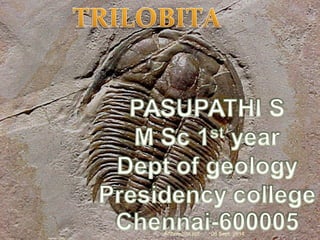
PHYLUM : ARTHROPODA
SUBPHYLUM : TRILOBITOMORPHA
CLASS : TRILOBITA
Arthropoda.ppt 08 Sept. 2014
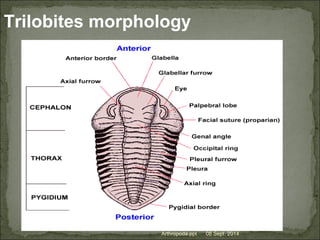
The body of the animal is divided into three parts from anterior to posterior
diraction (tri=three+lob=lobs+bit=pieces) and hence the name trilobita
The transverse division of the body divided animal into three
regions, vis. Cephalon(head), thorax(body), and pygidium(tail).
The dorsal surface of the body is protected by a strong,
calcareous exoskeleton known as carapace which covers part.
The segments of cophalon and pygidium are fused together but
are free and movable in thorax
Arthropoda.ppt 08 Sept. 2014
Trilobites morphology
Arthropoda.ppt 08 Sept. 2014
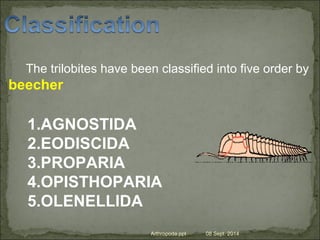
The trilobites have been classified into five order by
beecher
1.AGNOSTIDA
2.EODISCIDA
3.PROPARIA
4.OPISTHOPARIA
5.OLENELLIDA
Arthropoda.ppt 08 Sept. 2014
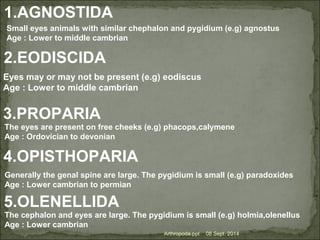
1.AGNOSTIDA
Small eyes animals with similar chephalon and pygidium (e.g) agnostus
Age : Lower to middle cambrian
3.PROPARIA
The eyes are present on free cheeks (e.g) phacops,calymene
Age : Ordovician to devonian
4.OPISTHOPARIA
Generally the genal spine are large. The pygidium is small (e.g) paradoxides
Age : Lower cambrian to permian
5.OLENELLIDA
The cephalon and eyes are large. The pygidium is small (e.g) holmia,olenellus
Age : Lower cambrian
2.EODISCIDA
Eyes may or may not be present (e.g) eodiscus
Age : Lower to middle cambrian
Arthropoda.ppt 08 Sept. 2014
Changes in glabella
In primitive lower cambrian forms the glabellar furrows are distinct and extended from
One site to other (e.g) homalonotus
Changes in eyes
Low light intensity in deep water conditions, burrowing mode of life and intense light in
Shallow water conditions. The two conditions lead to the loss of eyes by disintegration
(e.g) aeglina
Changes in thorax
The primitive trilobites have large number of thoracic sements, forty five are more,
(e.g) olenellus
The advance of palaeozoic era, the segments two or three.(e.g) agnostusc
Changes in pygidium
In primitive condition, the pygidium was absent, (e.g) nevadia,
Later on rise to pygidium. (e.g) micropygousArthropoda.ppt 08 Sept. 2014
Geological range
Trilobites occur as fossils only within the rock
of palaeozoic ages.
They suddenly appeared in the lower cambrian
and ordovician period.
In silurian, they were still abudant but became
less important in devonian.
With end of palaeozoic era, they became extinct.
Arthropoda.ppt 08 Sept. 2014
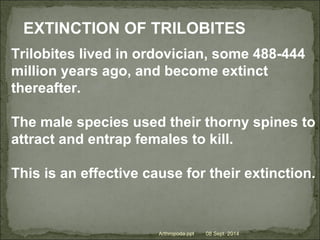
EXTINCTION OF TRILOBITES
Trilobites lived in ordovician, some 488-444
million years ago, and become extinct
thereafter.
The male species used their thorny spines to
attract and entrap females to kill.
This is an effective cause for their extinction.
Arthropoda.ppt 08 Sept. 2014
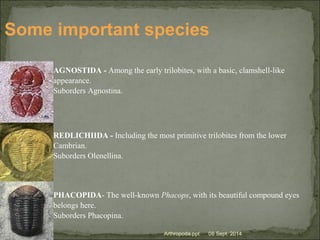
AGNOSTIDA - Among the early trilobites, with a basic, clamshell-like
appearance.
Suborders Agnostina.
REDLICHIIDA - Including the most primitive trilobites from the lower
Cambrian.
Suborders Olenellina.
PHACOPIDA- The well-known Phacops, with its beautiful compound eyes
belongs here.
Suborders Phacopina.
Some important species
Arthropoda.ppt 08 Sept. 2014
08 Sept. 2014Arthropoda.ppt 11
Arthropoda.ppt 08 Sept. 2014
08 Sept. 2014Arthropoda.ppt
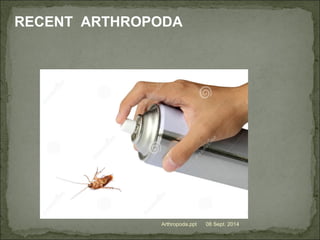
RECENT ARTHROPODA
Arthropoda.ppt 08 Sept. 2014

trilobites

  • 1.
    08 Sept. 20141Arthropoda.ppt Arthropoda.ppt 08 Sept. 2014
  • 2.
    PHYLUM : ARTHROPODA SUBPHYLUM: TRILOBITOMORPHA CLASS : TRILOBITA Arthropoda.ppt 08 Sept. 2014
  • 3.
    The body ofthe animal is divided into three parts from anterior to posterior diraction (tri=three+lob=lobs+bit=pieces) and hence the name trilobita The transverse division of the body divided animal into three regions, vis. Cephalon(head), thorax(body), and pygidium(tail). The dorsal surface of the body is protected by a strong, calcareous exoskeleton known as carapace which covers part. The segments of cophalon and pygidium are fused together but are free and movable in thorax Arthropoda.ppt 08 Sept. 2014
  • 4.
  • 5.
    The trilobites havebeen classified into five order by beecher 1.AGNOSTIDA 2.EODISCIDA 3.PROPARIA 4.OPISTHOPARIA 5.OLENELLIDA Arthropoda.ppt 08 Sept. 2014
  • 6.
    1.AGNOSTIDA Small eyes animalswith similar chephalon and pygidium (e.g) agnostus Age : Lower to middle cambrian 3.PROPARIA The eyes are present on free cheeks (e.g) phacops,calymene Age : Ordovician to devonian 4.OPISTHOPARIA Generally the genal spine are large. The pygidium is small (e.g) paradoxides Age : Lower cambrian to permian 5.OLENELLIDA The cephalon and eyes are large. The pygidium is small (e.g) holmia,olenellus Age : Lower cambrian 2.EODISCIDA Eyes may or may not be present (e.g) eodiscus Age : Lower to middle cambrian Arthropoda.ppt 08 Sept. 2014
  • 7.
    Changes in glabella Inprimitive lower cambrian forms the glabellar furrows are distinct and extended from One site to other (e.g) homalonotus Changes in eyes Low light intensity in deep water conditions, burrowing mode of life and intense light in Shallow water conditions. The two conditions lead to the loss of eyes by disintegration (e.g) aeglina Changes in thorax The primitive trilobites have large number of thoracic sements, forty five are more, (e.g) olenellus The advance of palaeozoic era, the segments two or three.(e.g) agnostusc Changes in pygidium In primitive condition, the pygidium was absent, (e.g) nevadia, Later on rise to pygidium. (e.g) micropygousArthropoda.ppt 08 Sept. 2014
  • 8.
    Geological range Trilobites occuras fossils only within the rock of palaeozoic ages. They suddenly appeared in the lower cambrian and ordovician period. In silurian, they were still abudant but became less important in devonian. With end of palaeozoic era, they became extinct. Arthropoda.ppt 08 Sept. 2014
  • 9.
    EXTINCTION OF TRILOBITES Trilobiteslived in ordovician, some 488-444 million years ago, and become extinct thereafter. The male species used their thorny spines to attract and entrap females to kill. This is an effective cause for their extinction. Arthropoda.ppt 08 Sept. 2014
  • 10.
    AGNOSTIDA - Amongthe early trilobites, with a basic, clamshell-like appearance. Suborders Agnostina. REDLICHIIDA - Including the most primitive trilobites from the lower Cambrian. Suborders Olenellina. PHACOPIDA- The well-known Phacops, with its beautiful compound eyes belongs here. Suborders Phacopina. Some important species Arthropoda.ppt 08 Sept. 2014
  • 11.
    08 Sept. 2014Arthropoda.ppt11 Arthropoda.ppt 08 Sept. 2014
  • 12.
  • 13.