Chemostratigraphy
Mohd Farhan
5531
BSc(H) Geology 2nd
Year
Chemostratigraphy
 Chemostratigraphy, or chemical stratigraphy, is the study of the
chemical variations(correlation on the basis of oxygen and
carbon isotope) within sedimentary sequences to determine
stratigraphic relationships.
 Chemostratigraphy may be defined as a correlation technique
involving the application of inorganic geochemical data.
 sedimentary geochemistry has been in use to understand the
conditions of deposition, climatic variations, tectonic setting,
provenance, reservoir characteristics, etc.
However,characterization of depositional units for distinction
and correlation based on stratigraphic variation of geochemical
traits and usage of the term “chemostratigraphy.
 the basic idea of chemostratigraphy is nearly as old
as stratigraphy itself, distinct chemical signatures can be as
useful as distinct fossil assemblages or distinct lithographies in
establishing stratigraphic relationships between different rock
layers.
 Chemostratigraphy found its utility for comparing and
contrasting geochemical compositions of strata across major
geochronological boundaries, such as Precambrian–Cambrian,
Permian–Triassic, Triassic–Jurassic, Jurassic–Cretaceous,
Cretaceous–Tertiary, Palaeocene–Eocene, etc
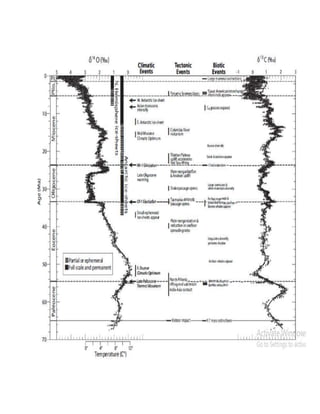
Oxygen isotopes
 The two oxygen isotopes used in chemostratigraphy are
16
O and
18
O. 99.8% of all the oxygen is in the form of
16
O,
18
O makes up most of the remaining 0.2%.
 these two isotopes are present in the oceanin this ratio.
these two isotopes fractionated with changes in
temperature
Oxygen isotopes are measured with respect to an
arbitrary laboratory standard calledPDB(Pee Dee
Belemnite)
Oxygen isotopes are measured in the shells of marine
organisms, because the isotope record occurs primarily
in ocean water.
 The records of oxygen isotopes from deep-marine
carbonate sediments have become powerful tools for
Paleoclimaticanalyses
Carbon isotopes
 Like oxygen, carbon has more than one
stable isotope in the Earth's oceans and
atmosphere
 two stable carbon isotopes, the
abundance of 12C in nature is given as
98.89%, while 13C forms the
remaining 1.11%.
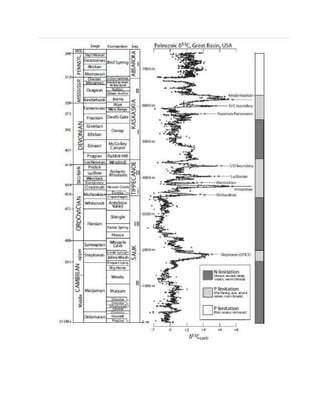
 The knowledge of the C isotope record is
very important not only in stratigraphic
correlation but also because of its potential
to help understand the development of
Earth’s climate, evolution of its biota, and
CO2 levels in the atmosphere.
APPLICATION OFCHEMOSTRATIGRAPHY
The obvious advantages of elemental
chemostratigraphy are that it can be utilized
in sediments of any lithology, any age, found
in any location and deposited in any
environment
A further advantage of the technique is that
it can be applied to field outcrop, core,
sidewall core and ditch cuttings samples.
Chemostratigraphy is also applicable in
Clastic, Carbonate and Unconventional
Reservoirs
Chemostartigraphy of Ordovician- Silurian Boundary
 During the past two decades, a very large amount of
chemostratigraphic research has been carried out in
lower Paleozoicsedimentary successions around the
world that has led to very significant improvements in
our understanding of stratigraphic relations at both
localand regional scales.
 Most of the investigations in the Ordovician‐Silurian
boundary interval have been based on ¹³C but recent
pioneer studies using ³⁴S and ⁸⁶Sr/⁸⁷Sr suggest that
also these isotopes have great potential as tools for both
correlationand understanding of paleoenvironmental
changes. Because very little has been published on the
use of the two latter isotopes in the Ordovician‐Silurian
boundary successions, the present review is focused on
¹³C chemostratigraphy.
Thank you
Reference:
Sedimentary Geology(D.R. Prothero)
Principle of Elemental Chemostratigraphy(Neil Craigie)

Chemostratigraphy

  • 1.
  • 2.
    Chemostratigraphy  Chemostratigraphy, orchemical stratigraphy, is the study of the chemical variations(correlation on the basis of oxygen and carbon isotope) within sedimentary sequences to determine stratigraphic relationships.  Chemostratigraphy may be defined as a correlation technique involving the application of inorganic geochemical data.  sedimentary geochemistry has been in use to understand the conditions of deposition, climatic variations, tectonic setting, provenance, reservoir characteristics, etc. However,characterization of depositional units for distinction and correlation based on stratigraphic variation of geochemical traits and usage of the term “chemostratigraphy.  the basic idea of chemostratigraphy is nearly as old as stratigraphy itself, distinct chemical signatures can be as useful as distinct fossil assemblages or distinct lithographies in establishing stratigraphic relationships between different rock layers.  Chemostratigraphy found its utility for comparing and contrasting geochemical compositions of strata across major geochronological boundaries, such as Precambrian–Cambrian, Permian–Triassic, Triassic–Jurassic, Jurassic–Cretaceous, Cretaceous–Tertiary, Palaeocene–Eocene, etc
  • 3.
    Oxygen isotopes  Thetwo oxygen isotopes used in chemostratigraphy are 16 O and 18 O. 99.8% of all the oxygen is in the form of 16 O, 18 O makes up most of the remaining 0.2%.  these two isotopes are present in the oceanin this ratio. these two isotopes fractionated with changes in temperature Oxygen isotopes are measured with respect to an arbitrary laboratory standard calledPDB(Pee Dee Belemnite) Oxygen isotopes are measured in the shells of marine organisms, because the isotope record occurs primarily in ocean water.  The records of oxygen isotopes from deep-marine carbonate sediments have become powerful tools for Paleoclimaticanalyses
  • 5.
    Carbon isotopes  Likeoxygen, carbon has more than one stable isotope in the Earth's oceans and atmosphere  two stable carbon isotopes, the abundance of 12C in nature is given as 98.89%, while 13C forms the remaining 1.11%.  The knowledge of the C isotope record is very important not only in stratigraphic correlation but also because of its potential to help understand the development of Earth’s climate, evolution of its biota, and CO2 levels in the atmosphere.
  • 7.
    APPLICATION OFCHEMOSTRATIGRAPHY The obviousadvantages of elemental chemostratigraphy are that it can be utilized in sediments of any lithology, any age, found in any location and deposited in any environment A further advantage of the technique is that it can be applied to field outcrop, core, sidewall core and ditch cuttings samples. Chemostratigraphy is also applicable in Clastic, Carbonate and Unconventional Reservoirs
  • 8.
    Chemostartigraphy of Ordovician-Silurian Boundary  During the past two decades, a very large amount of chemostratigraphic research has been carried out in lower Paleozoicsedimentary successions around the world that has led to very significant improvements in our understanding of stratigraphic relations at both localand regional scales.  Most of the investigations in the Ordovician‐Silurian boundary interval have been based on ¹³C but recent pioneer studies using ³⁴S and ⁸⁶Sr/⁸⁷Sr suggest that also these isotopes have great potential as tools for both correlationand understanding of paleoenvironmental changes. Because very little has been published on the use of the two latter isotopes in the Ordovician‐Silurian boundary successions, the present review is focused on ¹³C chemostratigraphy.
  • 9.
    Thank you Reference: Sedimentary Geology(D.R.Prothero) Principle of Elemental Chemostratigraphy(Neil Craigie)