Dimensional Stone
Technology
Dimensional stone refers to natural rock materials quarried for use in construction
and decorative applications. This industry encompasses the extraction, processing,
and utilization of stones like granite, marble, limestone, and sandstone. From
ancient monuments to modern architecture, dimensional stones have played a
crucial role in human civilization, prized for their durability, beauty, and versatility.
The dimensional stone industry involves complex processes of quarrying, cutting,
shaping, and finishing to transform raw stone into valuable building materials and
decorative elements. As technology advances, new methods emerge to improve
efficiency and sustainability in stone extraction and processing.
BY
Dr. Pramoda G
Faculty In Geology
Department of Geology
Yuvaraja’s College Mysuru
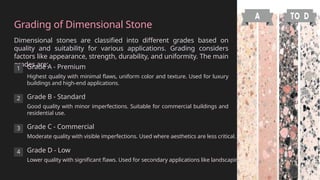
Grading of Dimensional Stone
Dimensional stones are classified into different grades based on
quality and suitability for various applications. Grading considers
factors like appearance, strength, durability, and uniformity. The main
grades are:
1 Grade A - Premium
Highest quality with minimal flaws, uniform color and texture. Used for luxury
buildings and high-end applications.
2 Grade B - Standard
Good quality with minor imperfections. Suitable for commercial buildings and
residential use.
3 Grade C - Commercial
Moderate quality with visible imperfections. Used where aesthetics are less critical.
4 Grade D - Low
Lower quality with significant flaws. Used for secondary applications like landscaping.
Exploration of Dimensional Stone Resources
Exploring dimensional stone deposits involves several key steps:
1 Preliminary Geological Survey
Review existing geological data and conduct field
reconnaissance to assess surface exposures and identify
potential deposits.
2 Sampling and Testing
Collect surface samples and conduct core drilling to analyze
stone properties and quality at depth.
3 Geophysical Surveys
Use methods like electrical resistivity tomography and
ground-penetrating radar to detect subsurface features.
4 Environmental Assessment
Evaluate potential impacts on ecosystems, water resources,
and local communities.
Estimation of Dimensional Stone Reserves
Estimating dimensional stone reserves involves classifying
deposits and calculating volumes:
Reserve Classification
Reserves are categorized as proved, probable, or possible based on the
level of geological confidence and economic viability.
Volume Calculation
Methods include geometric calculation, block modeling, and the bench
method for hillside formations.
Recovery Factor
Estimates the amount of usable stone, typically ranging from 15-50%
depending on geological factors.
Economic Analysis
Considers market demand, transportation costs, and processing
expenses to assess project viability.
Quarrying Techniques for Dimensional Stone
Various techniques are used to extract dimensional stone,
depending on the stone type and deposit characteristics:
Drilling and Blasting
Used for hard stones like granite, involving controlled explosions to fracture the rock.
Diamond Wire Sawing
Precise cutting method using diamond-coated wires, ideal for marble and limestone.
Channeling
Cutting narrow slots along the quarry face to separate blocks, common for softer stones.
Splitting
Using wedges or hydraulic pressure to split stone along natural fractures or drilled lines.
Conventional Mining Methods for Limestone
Conventional mining of limestone, including Kotah stone, involves traditional extraction techniques:
1
Overburden Removal
Manual or minimal machinery use to
remove topsoil and expose limestone
beds.
2
Manual Cutting
Use of chisels and hammers to create
small cuts and openings in the stone.
3
Wedge and Feather Method
Drilling holes along desired split lines and
inserting wedges to apply pressure and
split the stone.
4
Transport and Dressing
Manual lifting and loading of blocks,
followed by cutting and finishing at the
dressing site.
Conventional Mining Methods for Sandston
Sandstone is typically extracted using traditional methods in regions
like Rajasthan, India:
Surface Quarrying
Manual removal of overburden to expose sandstone deposits
near the surface.
Manual Extraction
Use of chisels, crowbars, and pickaxes to create openings
and split sandstone slabs along natural bedding planes.
Wedge and Feather Splitting
Controlled splitting using wedges inserted into drilled holes
along predetermined lines.
On-site Finishing
Shaping and sizing of slabs using handheld tools, often
followed by hand polishing if required.
Conventional Mining Methods for Granite
Granite, being harder, requires more forceful extraction methods:
1 Overburden Removal
Use of small excavators or manual labor to clear the quarry site
2 Drilling and Blasting
Controlled blasting to loosen large blocks from the
quarry face, carefully done to minimize fracturing.
3 Wedge and Feather Splitting
Further splitting of large blocks using wedges and feathers
inserted into drilled holes.
4 Manual Dressing
Refining granite blocks using hammers and chisels to
remove imperfections before transport.
Conventional Mining Methods for Marble
Marble extraction employs techniques that preserve its beauty and integrity:
Overburden Removal
Manual or limited machinery use to expose marble deposits.
Line Drilling
Creating a series of closely spaced holes along the intended split line using handheld drills.
Block Extraction
Using wedges and hammers to split marble blocks from the quarry face,
controlling the break for larger, intact slabs.
Manual Finishing
Hand-finishing blocks at the quarry site using chisels, mallets, and
polishing tools to enhance surface quality.
Specifications and Tests for Dimensional Stone
Dimensional stones must meet specific quality standards set by organizations like the Bureau of Indian Standards (BIS) and American
Society for Testing and Materials (ASTM). Key specifications include:
Property Granite Marble Sandstone
Water Absorption ≤0.4% ≤0.4% ≤1.5%
Compressive Strength ≥145 MPa ≥52 MPa ≥35 MPa
Density High Medium Medium
Key Tests for Dimensional Stone
Several tests are crucial for assessing the quality and suitability of dimensional stones:
1 Water Absorption Test
Measures porosity and the stone's ability to resist weathering,
crucial for outdoor applications.
2 Compressive Strength Test
Indicates the stone's load-bearing capacity, essential for structural uses.
3 Flexural Strength Test
Assesses resistance to bending forces, important for applications
like flooring and cladding.
4 Abrasion Resistance Test
Determines wear resistance, critical for flooring and high-traffic areas.
Processing of Dimensional Stone: Overview
The processing of dimensional stone involves several stages to transform raw blocks into finished products:
1
Dressing
Initial shaping and cleaning of stone blocks to
remove irregularities and prepare for cutting.
2 Cutting/Sawing
Slicing blocks into slabs or specific shapes
using various sawing techniques.
3
Surface Grinding
Smoothing the stone surface to remove
roughness and prepare for polishing.
4 Polishing
Achieving a smooth, shiny finish through
progressive stages of finer abrasives.
5
Edging/Trimming
Finishing edges and achieving precise
dimensions for the final product.
Cutting and Sawing Techniques
Various cutting and sawing techniques are employed in dimensional stone processing:
Gang Saw
Multiple blades cut large blocks into thin slabs simultaneously,
ideal for efficient processing of large volumes.
Circular Saw
Used for precise, straight cuts on smaller and medium-sized stones,
equipped with diamond-edged blades.
Wire Saw
Diamond-embedded wire creates intricate cuts and shapes,
especially useful for thick stones.
Water Jet
High-pressure water cutting for precision shaping and
minimal heat-induced stress on the stone.
Surface Grinding and Polishing
Surface grinding and polishing are crucial steps in achieving the desired finish
on dimensional stones:
Initial Grinding
Coarse abrasives remove saw marks and major imperfections from
the stone surface.
Progressive Smoothing
Increasingly finer abrasives are used to smooth the surface gradually.
Fine Polishing
Very fine abrasives create a smooth, reflective surface on the stone.
Final Buffing
Buffing compounds are used to achieve a high gloss finish if desired.
Edging, Trimming, and Grooving
The final stages of dimensional stone processing involve refining
the edges and creating specific features:
Edging
Smoothing and shaping the edges of stone slabs to create straight
or beveled profiles.
Trimming
Cutting stone to precise dimensions and removing excess material
around the edges.
Grooving
Creating grooves or patterns on the stone surface for aesthetic
or functional purposes, such as non-slip textures.
Finishing
Final touches to ensure the stone meets quality standards and
customer specifications.
Types of Cutting and Polishing Machines
Various specialized machines are used in dimensional stone processing:
Gang Saw
Large-scale sawing
machine with multiple
blades for efficient slab
production.
Rotary Polisher
Machine with rotating
heads and abrasive pads
for surface polishing.
Edge Polisher
Specialized machine for
finishing and polishing
stone edges.
CNC Machine
Computer-controlled
cutting and shaping for
complex designs and
patterns.
Abrasives in Dimensional Stone Processing
Abrasives play a crucial role in cutting, grinding, and polishing dimensional stones. They are classified based on
hardness, grain size, and material composition:
Natural Abrasives
Include emery, garnet, and
natural diamond. Emery is used
for polishing softer stones, while
diamond abrasives are excellent
for hard stones like granite.
Synthetic Abrasives
Silicon carbide, aluminum oxide,
and synthetic diamond dust are
widely used. Silicon carbide is
preferred for harder stones, while
aluminum oxide is used for finer
finishing applications.
Abrasive Forms
Available as wheels, discs, pads,
saw blades, and sandpaper. The
choice depends on the specific
processing stage and desired
finish.
Uses of Abrasives in Stone Processin
Abrasives serve various purposes in dimensional stone processing:
1 Cutting and Shaping
Diamond-tipped blades and wire saws cut stones into
desired dimensions and forms.
2 Grinding
Abrasive wheels smooth and refine stone surfaces,
preparing them for polishing.
3 Polishing
Progressively finer abrasives achieve a glossy finish on stone surfaces
4 Texturing
Specific abrasives create textured finishes like honed,
flamed, or sandblasted surfaces.
Selection of Abrasives
Choosing the right abrasive depends on several factors:
Stone Hardness
Harder stones like granite require diamond or silicon carbide
abrasives, while softer stones can use aluminum oxide or
emery.
Processing Stage
Coarse abrasives for initial cutting, medium grit for grinding, and fine grit for polishin
Desired Finish
Different abrasives achieve various finishes from honed to high-gloss polished
Environmental Factors
Consider dust generation and waste management when selecting abrasives.
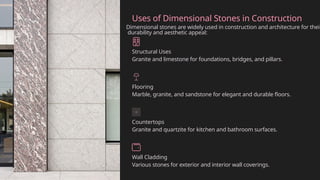
Uses of Dimensional Stones in Construction
Dimensional stones are widely used in construction and architecture for their
durability and aesthetic appeal:
Structural Uses
Granite and limestone for foundations, bridges, and pillars.
Flooring
Marble, granite, and sandstone for elegant and durable floors.
Countertops
Granite and quartzite for kitchen and bathroom surfaces.
Wall Cladding
Various stones for exterior and interior wall coverings.
Decorative Applications of Dimensional Stones
Dimensional stones are prized for their beauty in various decorative applications:
Sculptures and Monuments
Marble and granite are
traditionally used for statues and
memorials due to their durability
and carving qualities.
Mosaics and Tiles
Stone tiles and mosaics create
artistic and functional designs in
various spaces.
Landscaping Elements
Stones like sandstone and
limestone are used for outdoor
features such as fountains,
benches, and decorative walls.
Industrial Applications of Dimensional Stones
Beyond construction and decoration, dimensional stones find use in various
industrial applications:
Precision Equipment
Granite is used for precision surface plates and measuring
equipment due to its stability and low thermal expansion.
Abrasive Materials
Crushed and powdered stone is used in the production of abrasives
and polishing compounds.
Filler Materials
Stone powders are used as fillers in various industries, including
plastics, paints, and rubber.
Refractory Materials
Certain stones are used in the production of heat-resistant materials
for industrial furnaces.
Marketing of Dimensional Stones
The marketing of dimensional stones is influenced by various factors:
Global Demand
Strong markets exist both
domestically and internationally,
with countries like India, Brazil, and
China being major exporters. High
demand in construction-heavy
regions like the USA, Europe, and
the Middle East drives international
sales.
Branding and Value Addition
Value-added products like
customized slabs and pre-cut
stones enhance marketability.
Branding based on stone origin,
such as "Italian Marble" or "Indian
Granite," adds premium appeal.
Sustainability Focus
Growing demand for eco-friendly
products, especially in
environmentally conscious
markets, emphasizes sustainable
quarrying and processing practices.
Digital Marketing and Trade Shows
Modern marketing strategies for dimensional stones include:
1 Online Platforms
Digital catalogs and virtual showcases allow
buyers to view stone options remotely.
2 Social Media Presence
Platforms showcase products, share industry
news, and engage with customers.
3 International Expos
Trade shows like Marmomac in Italy and Stone
Expo in the USA provide networking
opportunities.
4 Virtual Reality Tours
VR technology offers immersive experiences of
quarries and showrooms.
Environmental Impacts of Stone Industry
The dimensional stone industry faces several environmental challenges:
Land Degradation
Quarrying can lead to deforestation and habitat destruction.
Water Pollution
Wastewater from processing contains suspended particles and chemicals.
Dust Emissions
Quarrying operations generate dust, affecting air quality.
Energy Consumption
Stone extraction and processing require substantial energy, often from
non-renewable sources.
Waste Generation in Stone Industry
The stone industry produces significant waste, presenting environmental challenges:
Stone Fragments
Cutting and shaping processes generate large amounts
of stone waste.
Overburden
Removal of topsoil and unwanted rock during quarrying
creates substantial waste.
Slurry
Wet cutting and polishing processes produce slurry
containing stone particles and chemicals.
Land Use
Accumulated waste often occupies large areas of land
near quarrying sites.
Health Hazards in Stone Industry
Workers in the stone industry face several health risks:
1 Silica Dust Exposure
Inhalation of silica dust can lead to silicosis, a
chronic respiratory condition.
2 Noise Pollution
Prolonged exposure to loud machinery can cause hearing loss.
3 Physical Strain
Heavy lifting and repetitive motions can lead to
musculoskeletal disorders.
4 Chemical Exposure
Contact with cutting fluids and polishing
compounds may cause skin irritation or
respiratory issues.
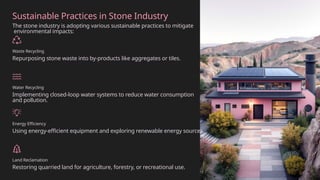
Sustainable Practices in Stone Industry
The stone industry is adopting various sustainable practices to mitigate
environmental impacts:
Waste Recycling
Repurposing stone waste into by-products like aggregates or tiles.
Water Recycling
Implementing closed-loop water systems to reduce water consumption
and pollution.
Energy Efficiency
Using energy-efficient equipment and exploring renewable energy sources.
Land Reclamation
Restoring quarried land for agriculture, forestry, or recreational use.

Dimensional - Stone - Technology .pptx

  • 1.
    Dimensional Stone Technology Dimensional stonerefers to natural rock materials quarried for use in construction and decorative applications. This industry encompasses the extraction, processing, and utilization of stones like granite, marble, limestone, and sandstone. From ancient monuments to modern architecture, dimensional stones have played a crucial role in human civilization, prized for their durability, beauty, and versatility. The dimensional stone industry involves complex processes of quarrying, cutting, shaping, and finishing to transform raw stone into valuable building materials and decorative elements. As technology advances, new methods emerge to improve efficiency and sustainability in stone extraction and processing. BY Dr. Pramoda G Faculty In Geology Department of Geology Yuvaraja’s College Mysuru
  • 2.
    Grading of DimensionalStone Dimensional stones are classified into different grades based on quality and suitability for various applications. Grading considers factors like appearance, strength, durability, and uniformity. The main grades are: 1 Grade A - Premium Highest quality with minimal flaws, uniform color and texture. Used for luxury buildings and high-end applications. 2 Grade B - Standard Good quality with minor imperfections. Suitable for commercial buildings and residential use. 3 Grade C - Commercial Moderate quality with visible imperfections. Used where aesthetics are less critical. 4 Grade D - Low Lower quality with significant flaws. Used for secondary applications like landscaping.
  • 3.
    Exploration of DimensionalStone Resources Exploring dimensional stone deposits involves several key steps: 1 Preliminary Geological Survey Review existing geological data and conduct field reconnaissance to assess surface exposures and identify potential deposits. 2 Sampling and Testing Collect surface samples and conduct core drilling to analyze stone properties and quality at depth. 3 Geophysical Surveys Use methods like electrical resistivity tomography and ground-penetrating radar to detect subsurface features. 4 Environmental Assessment Evaluate potential impacts on ecosystems, water resources, and local communities.
  • 4.
    Estimation of DimensionalStone Reserves Estimating dimensional stone reserves involves classifying deposits and calculating volumes: Reserve Classification Reserves are categorized as proved, probable, or possible based on the level of geological confidence and economic viability. Volume Calculation Methods include geometric calculation, block modeling, and the bench method for hillside formations. Recovery Factor Estimates the amount of usable stone, typically ranging from 15-50% depending on geological factors. Economic Analysis Considers market demand, transportation costs, and processing expenses to assess project viability.
  • 5.
    Quarrying Techniques forDimensional Stone Various techniques are used to extract dimensional stone, depending on the stone type and deposit characteristics: Drilling and Blasting Used for hard stones like granite, involving controlled explosions to fracture the rock. Diamond Wire Sawing Precise cutting method using diamond-coated wires, ideal for marble and limestone. Channeling Cutting narrow slots along the quarry face to separate blocks, common for softer stones. Splitting Using wedges or hydraulic pressure to split stone along natural fractures or drilled lines.
  • 6.
    Conventional Mining Methodsfor Limestone Conventional mining of limestone, including Kotah stone, involves traditional extraction techniques: 1 Overburden Removal Manual or minimal machinery use to remove topsoil and expose limestone beds. 2 Manual Cutting Use of chisels and hammers to create small cuts and openings in the stone. 3 Wedge and Feather Method Drilling holes along desired split lines and inserting wedges to apply pressure and split the stone. 4 Transport and Dressing Manual lifting and loading of blocks, followed by cutting and finishing at the dressing site.
  • 7.
    Conventional Mining Methodsfor Sandston Sandstone is typically extracted using traditional methods in regions like Rajasthan, India: Surface Quarrying Manual removal of overburden to expose sandstone deposits near the surface. Manual Extraction Use of chisels, crowbars, and pickaxes to create openings and split sandstone slabs along natural bedding planes. Wedge and Feather Splitting Controlled splitting using wedges inserted into drilled holes along predetermined lines. On-site Finishing Shaping and sizing of slabs using handheld tools, often followed by hand polishing if required.
  • 8.
    Conventional Mining Methodsfor Granite Granite, being harder, requires more forceful extraction methods: 1 Overburden Removal Use of small excavators or manual labor to clear the quarry site 2 Drilling and Blasting Controlled blasting to loosen large blocks from the quarry face, carefully done to minimize fracturing. 3 Wedge and Feather Splitting Further splitting of large blocks using wedges and feathers inserted into drilled holes. 4 Manual Dressing Refining granite blocks using hammers and chisels to remove imperfections before transport.
  • 9.
    Conventional Mining Methodsfor Marble Marble extraction employs techniques that preserve its beauty and integrity: Overburden Removal Manual or limited machinery use to expose marble deposits. Line Drilling Creating a series of closely spaced holes along the intended split line using handheld drills. Block Extraction Using wedges and hammers to split marble blocks from the quarry face, controlling the break for larger, intact slabs. Manual Finishing Hand-finishing blocks at the quarry site using chisels, mallets, and polishing tools to enhance surface quality.
  • 10.
    Specifications and Testsfor Dimensional Stone Dimensional stones must meet specific quality standards set by organizations like the Bureau of Indian Standards (BIS) and American Society for Testing and Materials (ASTM). Key specifications include: Property Granite Marble Sandstone Water Absorption ≤0.4% ≤0.4% ≤1.5% Compressive Strength ≥145 MPa ≥52 MPa ≥35 MPa Density High Medium Medium
  • 11.
    Key Tests forDimensional Stone Several tests are crucial for assessing the quality and suitability of dimensional stones: 1 Water Absorption Test Measures porosity and the stone's ability to resist weathering, crucial for outdoor applications. 2 Compressive Strength Test Indicates the stone's load-bearing capacity, essential for structural uses. 3 Flexural Strength Test Assesses resistance to bending forces, important for applications like flooring and cladding. 4 Abrasion Resistance Test Determines wear resistance, critical for flooring and high-traffic areas.
  • 12.
    Processing of DimensionalStone: Overview The processing of dimensional stone involves several stages to transform raw blocks into finished products: 1 Dressing Initial shaping and cleaning of stone blocks to remove irregularities and prepare for cutting. 2 Cutting/Sawing Slicing blocks into slabs or specific shapes using various sawing techniques. 3 Surface Grinding Smoothing the stone surface to remove roughness and prepare for polishing. 4 Polishing Achieving a smooth, shiny finish through progressive stages of finer abrasives. 5 Edging/Trimming Finishing edges and achieving precise dimensions for the final product.
  • 13.
    Cutting and SawingTechniques Various cutting and sawing techniques are employed in dimensional stone processing: Gang Saw Multiple blades cut large blocks into thin slabs simultaneously, ideal for efficient processing of large volumes. Circular Saw Used for precise, straight cuts on smaller and medium-sized stones, equipped with diamond-edged blades. Wire Saw Diamond-embedded wire creates intricate cuts and shapes, especially useful for thick stones. Water Jet High-pressure water cutting for precision shaping and minimal heat-induced stress on the stone.
  • 14.
    Surface Grinding andPolishing Surface grinding and polishing are crucial steps in achieving the desired finish on dimensional stones: Initial Grinding Coarse abrasives remove saw marks and major imperfections from the stone surface. Progressive Smoothing Increasingly finer abrasives are used to smooth the surface gradually. Fine Polishing Very fine abrasives create a smooth, reflective surface on the stone. Final Buffing Buffing compounds are used to achieve a high gloss finish if desired.
  • 15.
    Edging, Trimming, andGrooving The final stages of dimensional stone processing involve refining the edges and creating specific features: Edging Smoothing and shaping the edges of stone slabs to create straight or beveled profiles. Trimming Cutting stone to precise dimensions and removing excess material around the edges. Grooving Creating grooves or patterns on the stone surface for aesthetic or functional purposes, such as non-slip textures. Finishing Final touches to ensure the stone meets quality standards and customer specifications.
  • 16.
    Types of Cuttingand Polishing Machines Various specialized machines are used in dimensional stone processing: Gang Saw Large-scale sawing machine with multiple blades for efficient slab production. Rotary Polisher Machine with rotating heads and abrasive pads for surface polishing. Edge Polisher Specialized machine for finishing and polishing stone edges. CNC Machine Computer-controlled cutting and shaping for complex designs and patterns.
  • 17.
    Abrasives in DimensionalStone Processing Abrasives play a crucial role in cutting, grinding, and polishing dimensional stones. They are classified based on hardness, grain size, and material composition: Natural Abrasives Include emery, garnet, and natural diamond. Emery is used for polishing softer stones, while diamond abrasives are excellent for hard stones like granite. Synthetic Abrasives Silicon carbide, aluminum oxide, and synthetic diamond dust are widely used. Silicon carbide is preferred for harder stones, while aluminum oxide is used for finer finishing applications. Abrasive Forms Available as wheels, discs, pads, saw blades, and sandpaper. The choice depends on the specific processing stage and desired finish.
  • 18.
    Uses of Abrasivesin Stone Processin Abrasives serve various purposes in dimensional stone processing: 1 Cutting and Shaping Diamond-tipped blades and wire saws cut stones into desired dimensions and forms. 2 Grinding Abrasive wheels smooth and refine stone surfaces, preparing them for polishing. 3 Polishing Progressively finer abrasives achieve a glossy finish on stone surfaces 4 Texturing Specific abrasives create textured finishes like honed, flamed, or sandblasted surfaces.
  • 19.
    Selection of Abrasives Choosingthe right abrasive depends on several factors: Stone Hardness Harder stones like granite require diamond or silicon carbide abrasives, while softer stones can use aluminum oxide or emery. Processing Stage Coarse abrasives for initial cutting, medium grit for grinding, and fine grit for polishin Desired Finish Different abrasives achieve various finishes from honed to high-gloss polished Environmental Factors Consider dust generation and waste management when selecting abrasives.
  • 20.
    Uses of DimensionalStones in Construction Dimensional stones are widely used in construction and architecture for their durability and aesthetic appeal: Structural Uses Granite and limestone for foundations, bridges, and pillars. Flooring Marble, granite, and sandstone for elegant and durable floors. Countertops Granite and quartzite for kitchen and bathroom surfaces. Wall Cladding Various stones for exterior and interior wall coverings.
  • 21.
    Decorative Applications ofDimensional Stones Dimensional stones are prized for their beauty in various decorative applications: Sculptures and Monuments Marble and granite are traditionally used for statues and memorials due to their durability and carving qualities. Mosaics and Tiles Stone tiles and mosaics create artistic and functional designs in various spaces. Landscaping Elements Stones like sandstone and limestone are used for outdoor features such as fountains, benches, and decorative walls.
  • 22.
    Industrial Applications ofDimensional Stones Beyond construction and decoration, dimensional stones find use in various industrial applications: Precision Equipment Granite is used for precision surface plates and measuring equipment due to its stability and low thermal expansion. Abrasive Materials Crushed and powdered stone is used in the production of abrasives and polishing compounds. Filler Materials Stone powders are used as fillers in various industries, including plastics, paints, and rubber. Refractory Materials Certain stones are used in the production of heat-resistant materials for industrial furnaces.
  • 23.
    Marketing of DimensionalStones The marketing of dimensional stones is influenced by various factors: Global Demand Strong markets exist both domestically and internationally, with countries like India, Brazil, and China being major exporters. High demand in construction-heavy regions like the USA, Europe, and the Middle East drives international sales. Branding and Value Addition Value-added products like customized slabs and pre-cut stones enhance marketability. Branding based on stone origin, such as "Italian Marble" or "Indian Granite," adds premium appeal. Sustainability Focus Growing demand for eco-friendly products, especially in environmentally conscious markets, emphasizes sustainable quarrying and processing practices.
  • 24.
    Digital Marketing andTrade Shows Modern marketing strategies for dimensional stones include: 1 Online Platforms Digital catalogs and virtual showcases allow buyers to view stone options remotely. 2 Social Media Presence Platforms showcase products, share industry news, and engage with customers. 3 International Expos Trade shows like Marmomac in Italy and Stone Expo in the USA provide networking opportunities. 4 Virtual Reality Tours VR technology offers immersive experiences of quarries and showrooms.
  • 25.
    Environmental Impacts ofStone Industry The dimensional stone industry faces several environmental challenges: Land Degradation Quarrying can lead to deforestation and habitat destruction. Water Pollution Wastewater from processing contains suspended particles and chemicals. Dust Emissions Quarrying operations generate dust, affecting air quality. Energy Consumption Stone extraction and processing require substantial energy, often from non-renewable sources.
  • 26.
    Waste Generation inStone Industry The stone industry produces significant waste, presenting environmental challenges: Stone Fragments Cutting and shaping processes generate large amounts of stone waste. Overburden Removal of topsoil and unwanted rock during quarrying creates substantial waste. Slurry Wet cutting and polishing processes produce slurry containing stone particles and chemicals. Land Use Accumulated waste often occupies large areas of land near quarrying sites.
  • 27.
    Health Hazards inStone Industry Workers in the stone industry face several health risks: 1 Silica Dust Exposure Inhalation of silica dust can lead to silicosis, a chronic respiratory condition. 2 Noise Pollution Prolonged exposure to loud machinery can cause hearing loss. 3 Physical Strain Heavy lifting and repetitive motions can lead to musculoskeletal disorders. 4 Chemical Exposure Contact with cutting fluids and polishing compounds may cause skin irritation or respiratory issues.
  • 28.
    Sustainable Practices inStone Industry The stone industry is adopting various sustainable practices to mitigate environmental impacts: Waste Recycling Repurposing stone waste into by-products like aggregates or tiles. Water Recycling Implementing closed-loop water systems to reduce water consumption and pollution. Energy Efficiency Using energy-efficient equipment and exploring renewable energy sources. Land Reclamation Restoring quarried land for agriculture, forestry, or recreational use.