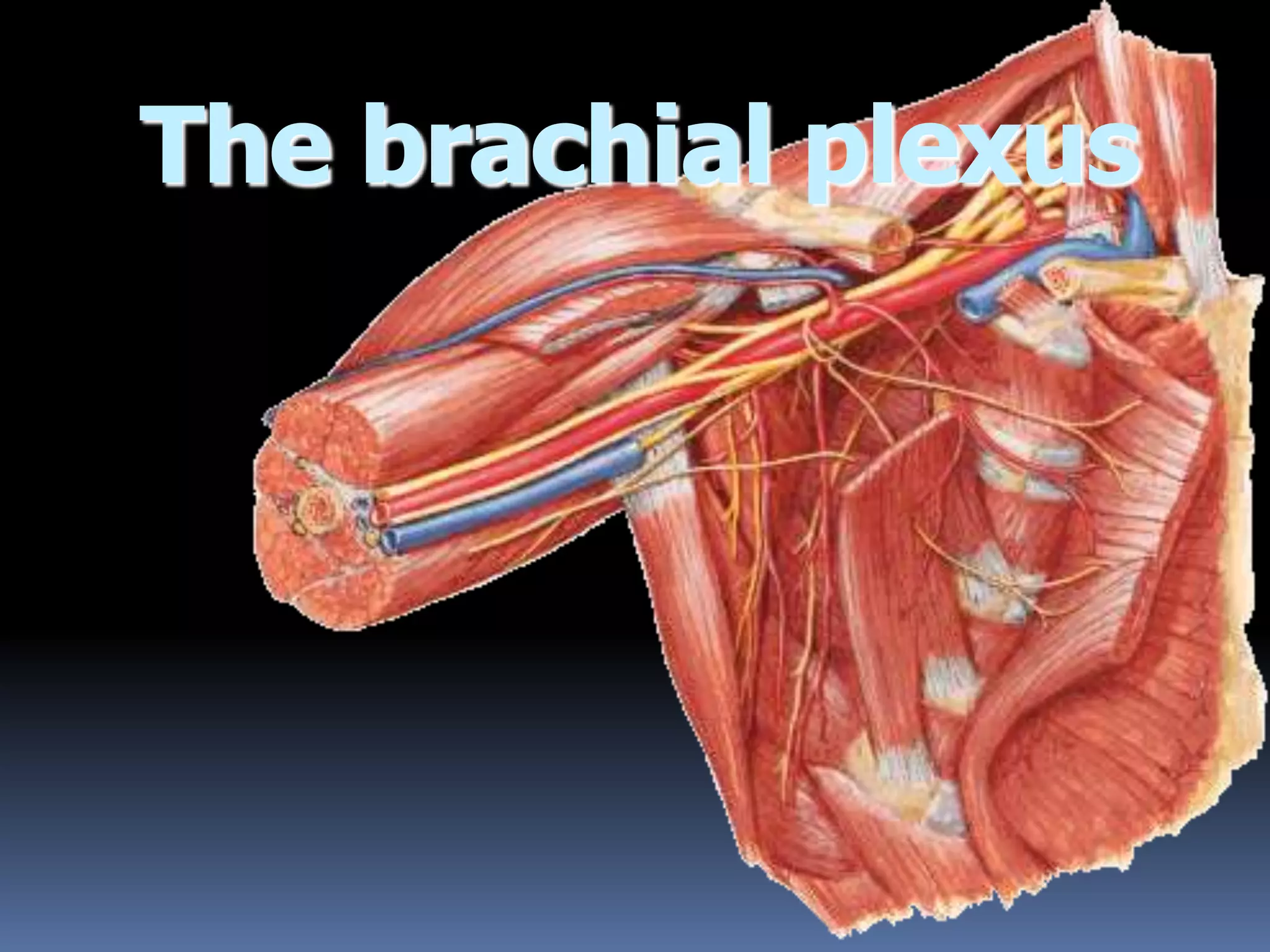
The brachial plexus
The brachial plexus
 Formation
 Supraclavicular portion
 Trunks
 Divisions
 Infraclavicular portion
 Cords
 Branches
The brachial plexus
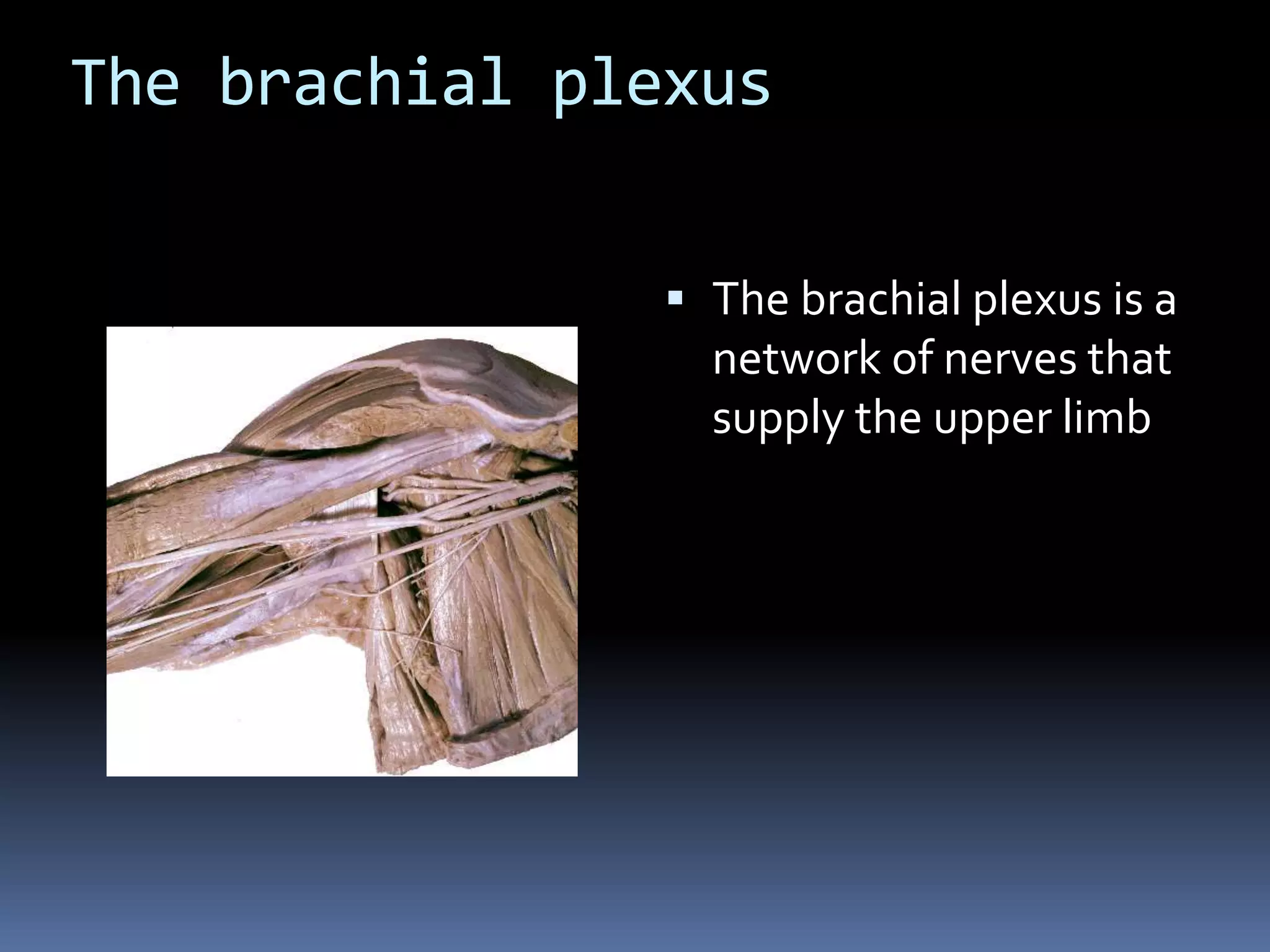
 The brachial plexus is a
network of nerves that
supply the upper limb
The brachial plexus
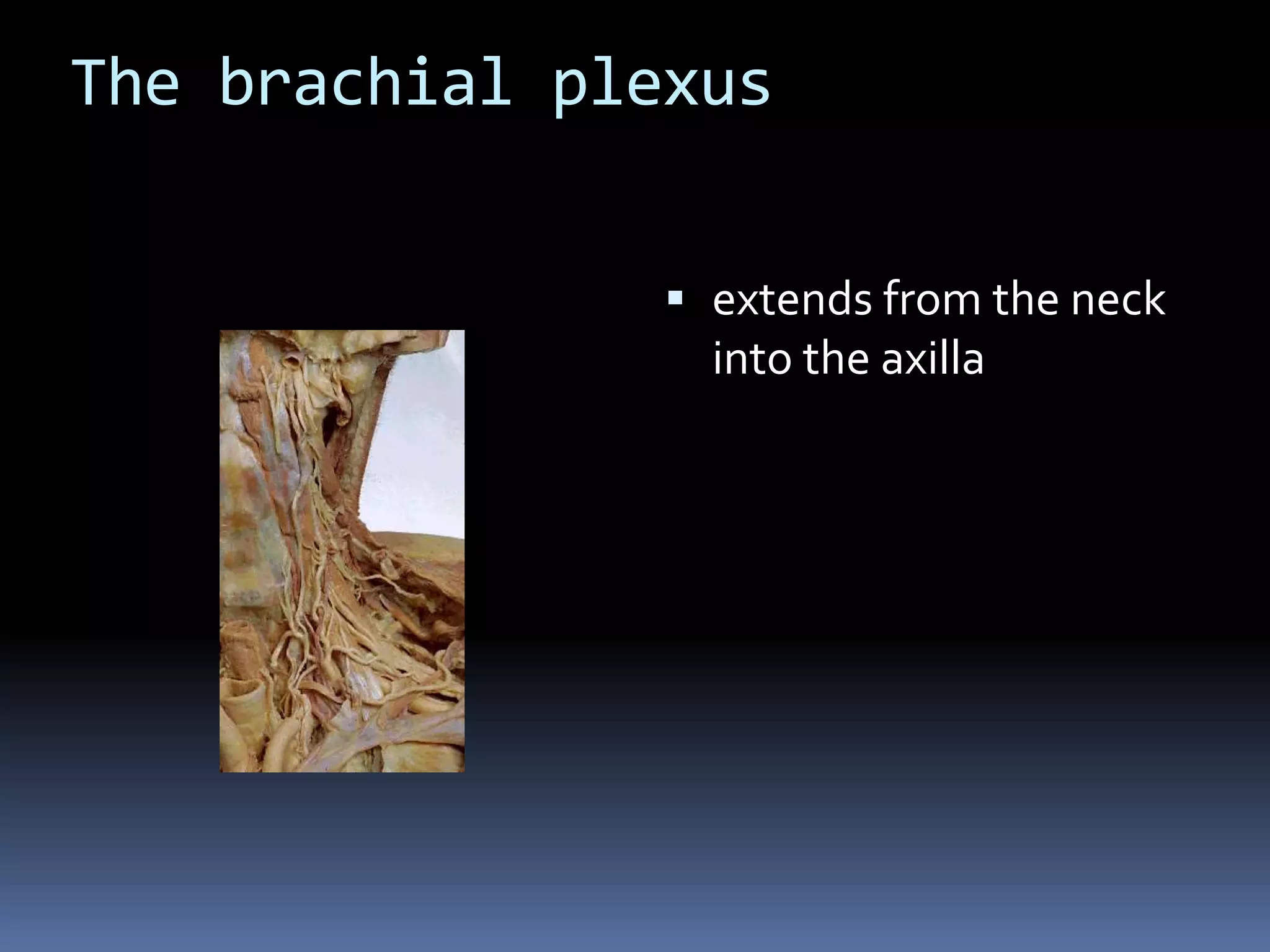
 extends from the neck
into the axilla
Formation
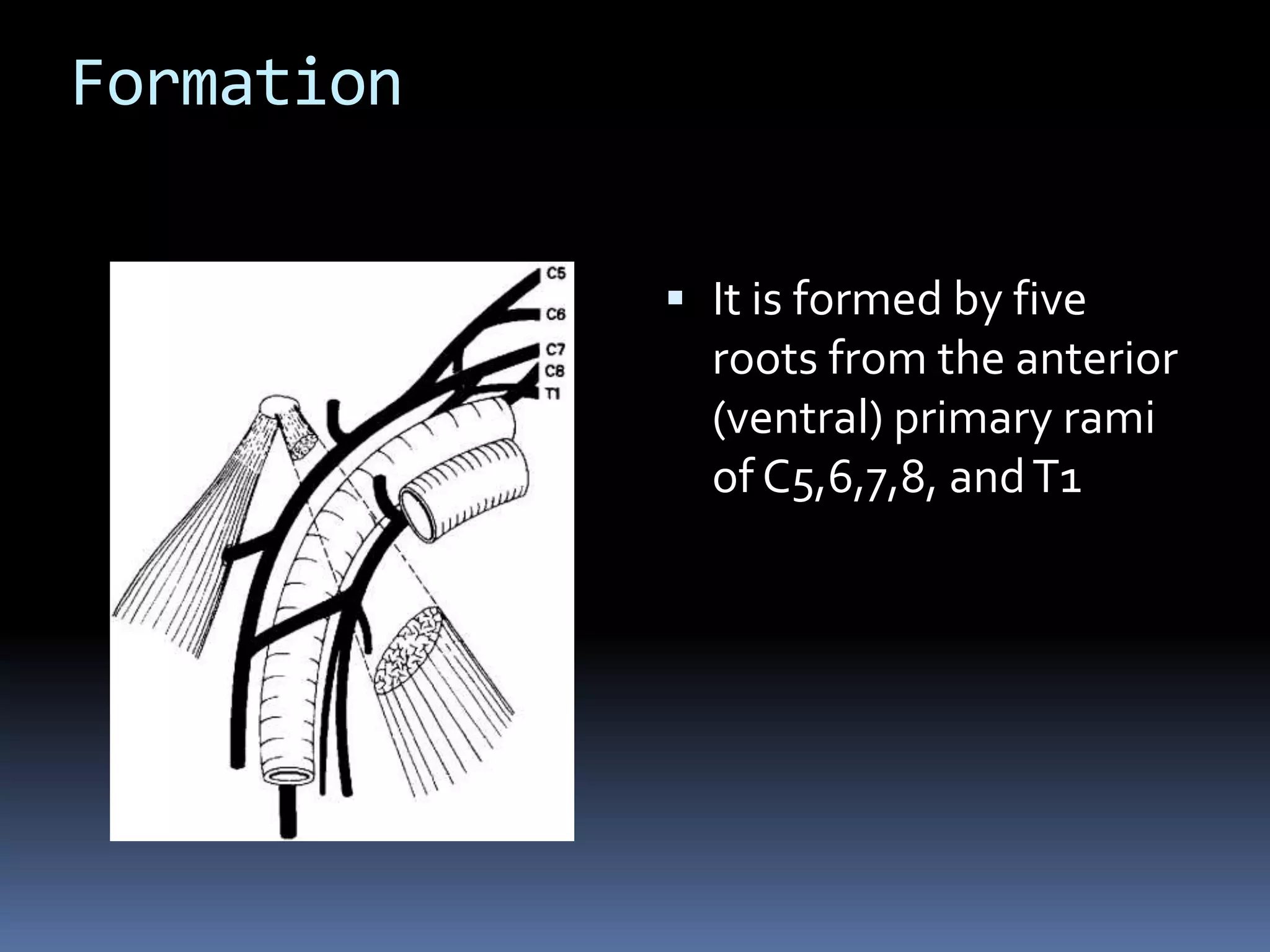
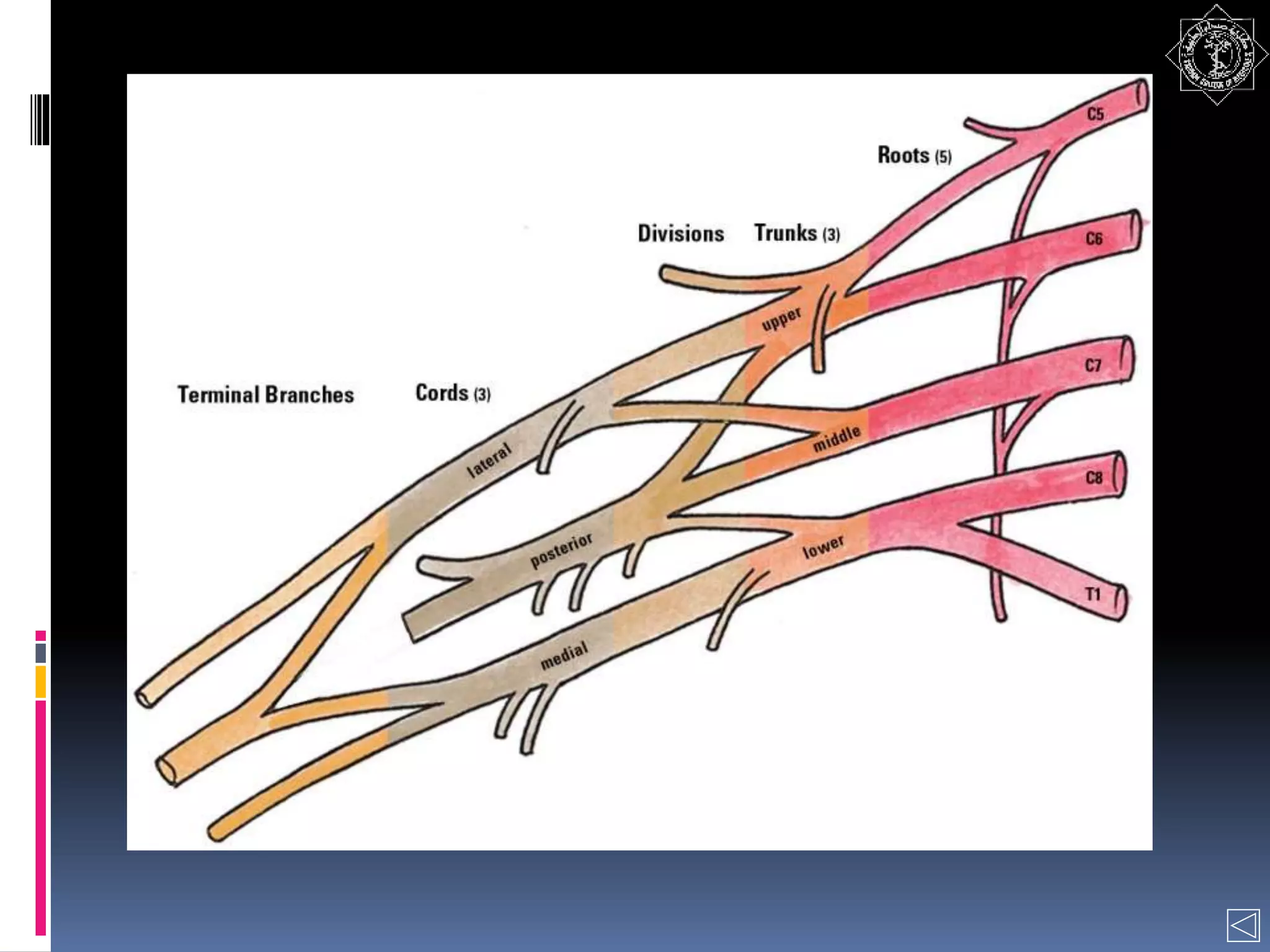
 It is formed by five
roots from the anterior
(ventral) primary rami
of C5,6,7,8, andT1
Formation
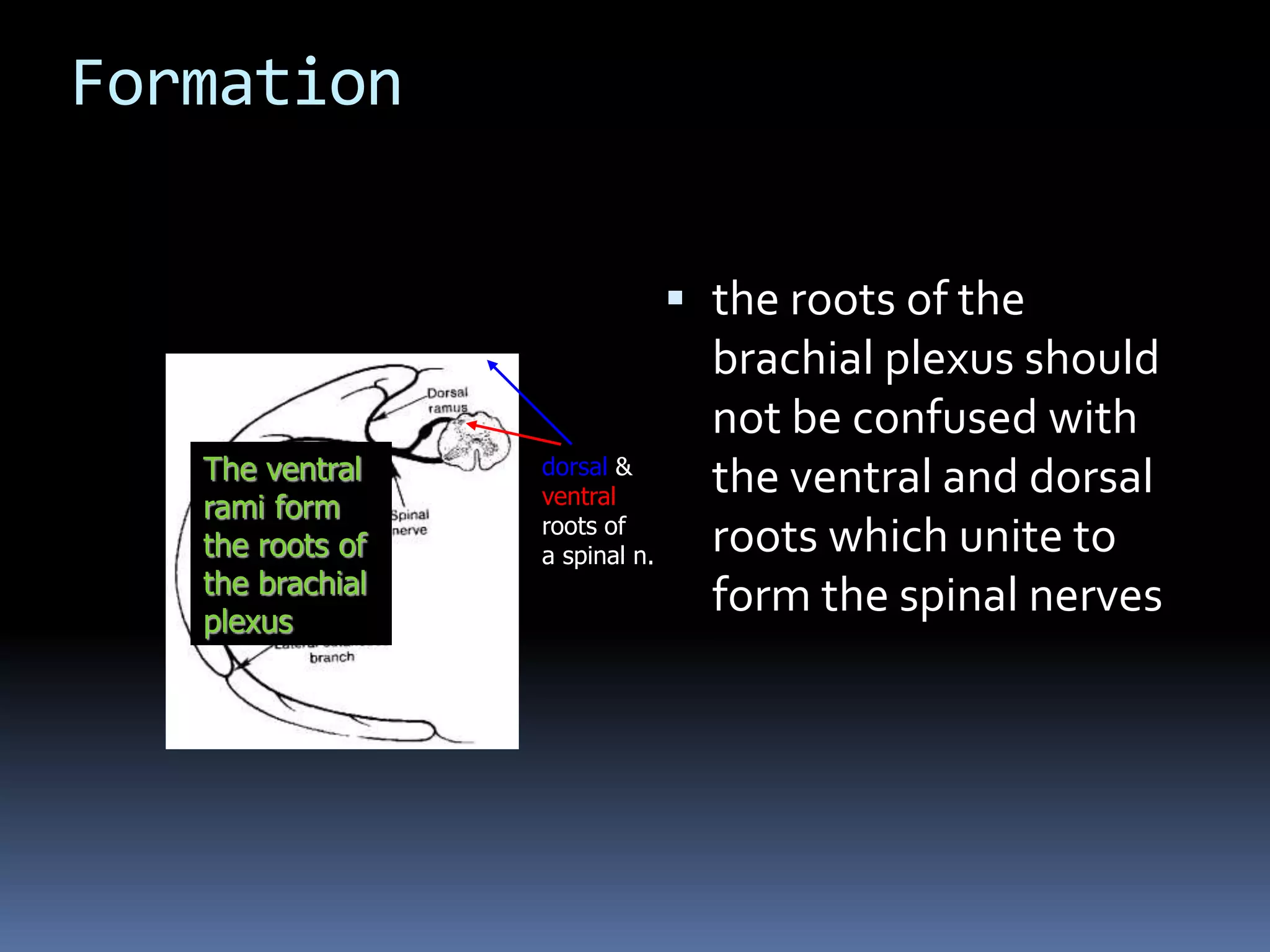
 the roots of the
brachial plexus should
not be confused with
the ventral and dorsal
roots which unite to
form the spinal nerves
dorsal &
ventral
roots of
a spinal n.
The ventral
rami form
the roots of
the brachial
plexus
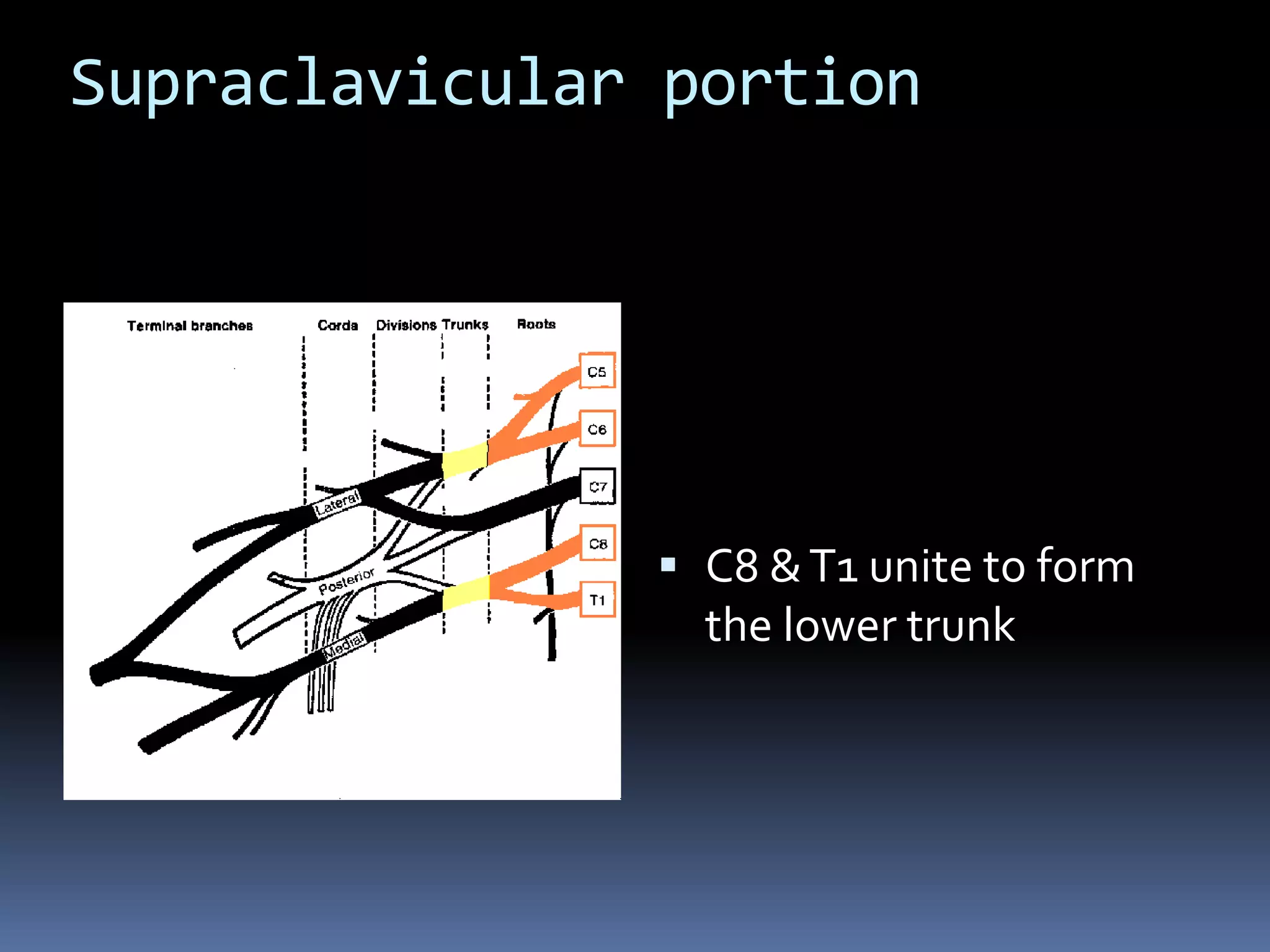
Supraclavicular portion
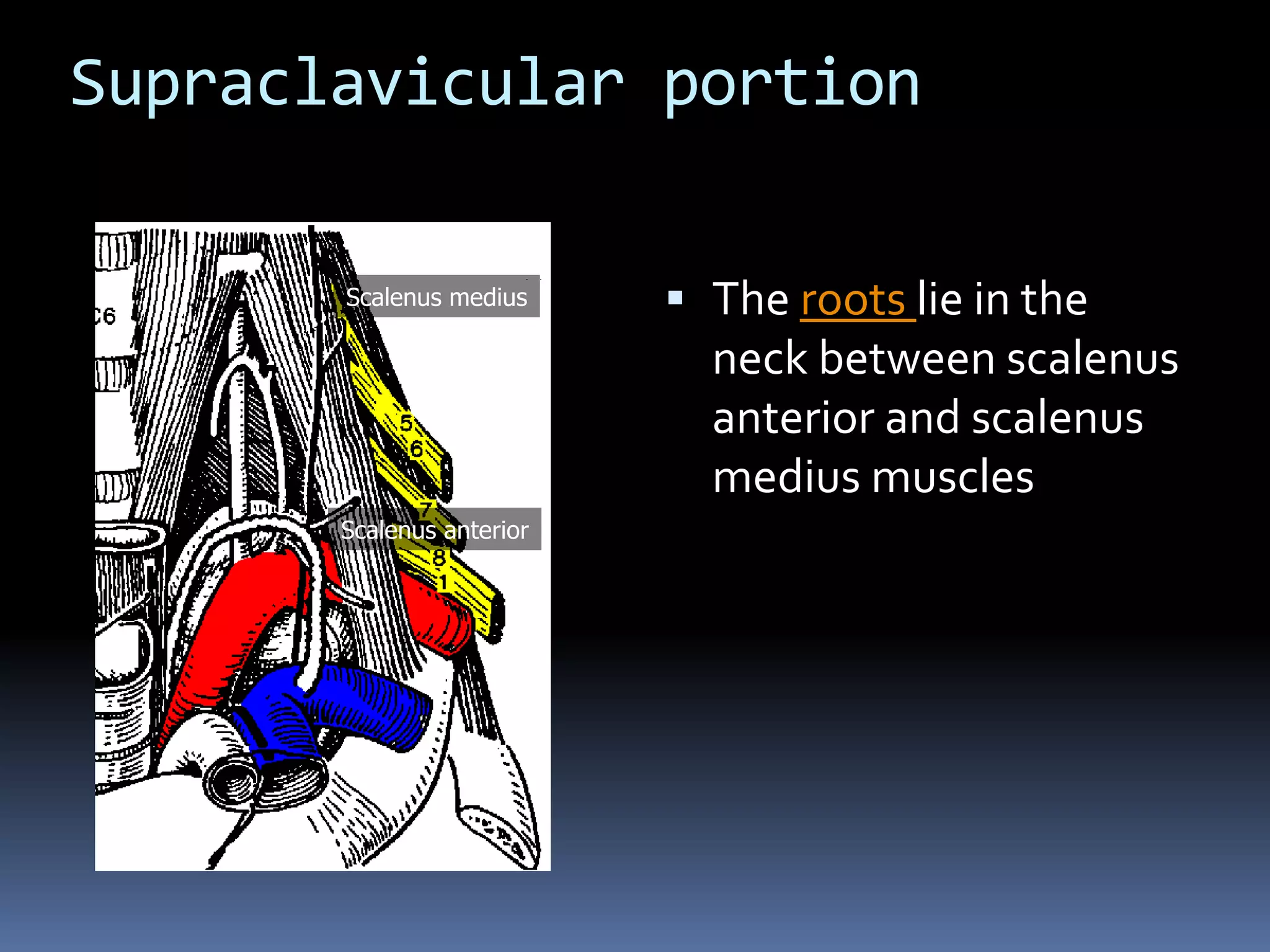
 The roots lie in the
neck between scalenus
anterior and scalenus
medius muscles
Scalenus anterior
Scalenus medius
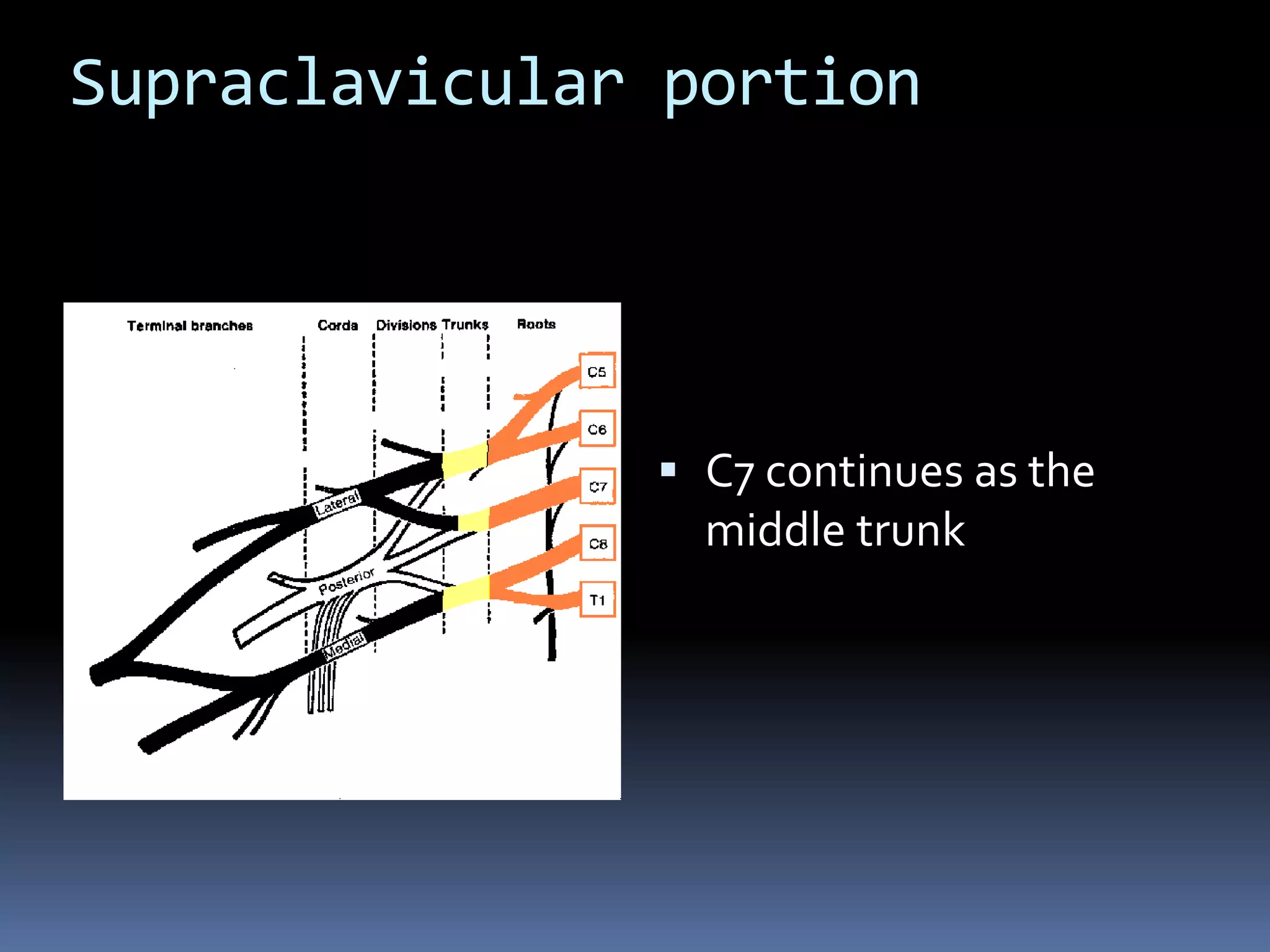
Supraclavicular portion
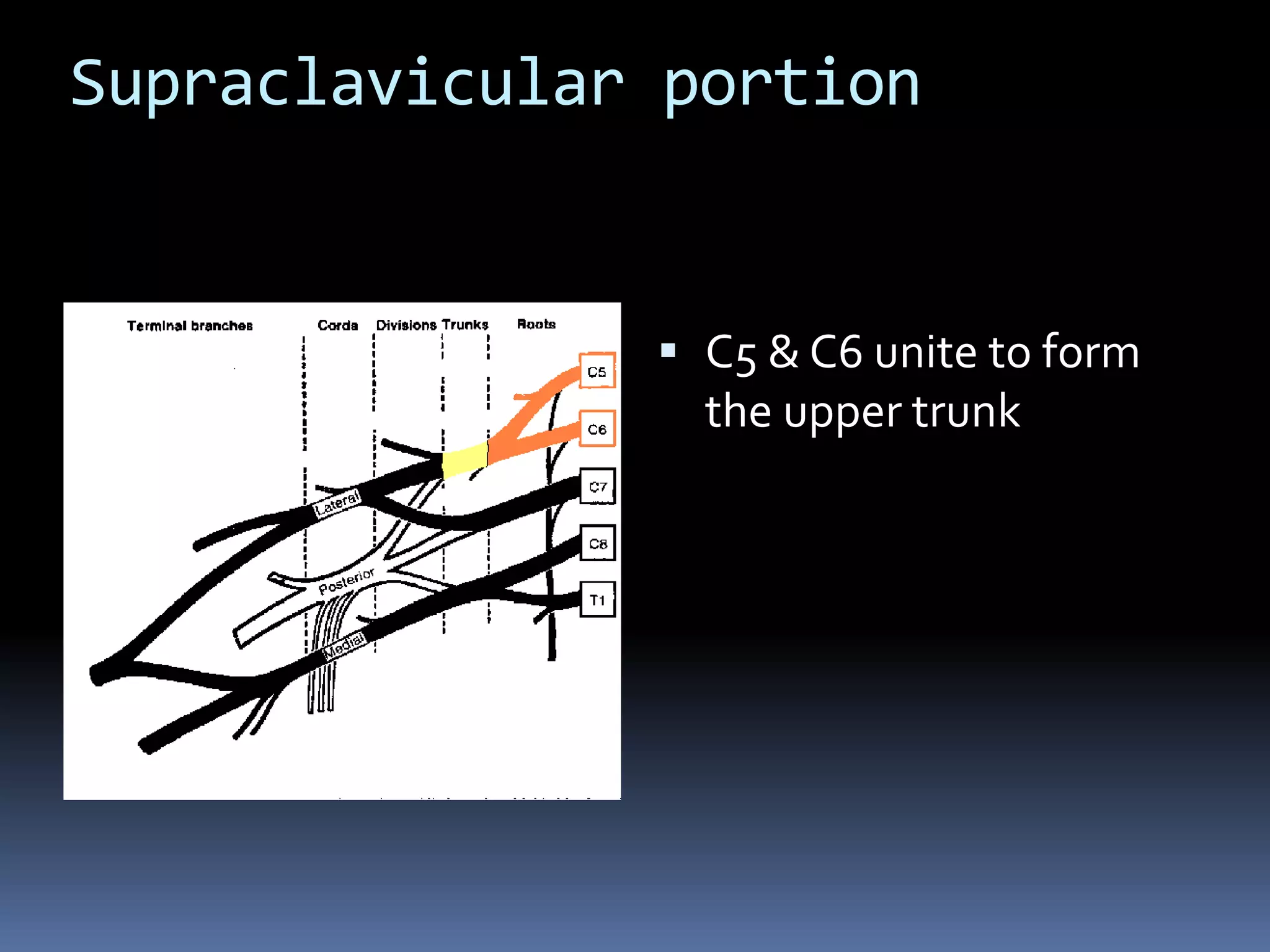
 C5 & C6 unite to form
the upper trunk
Supraclavicular portion
 C8 &T1 unite to form
the lower trunk
Supraclavicular portion
 C7 continues as the
middle trunk
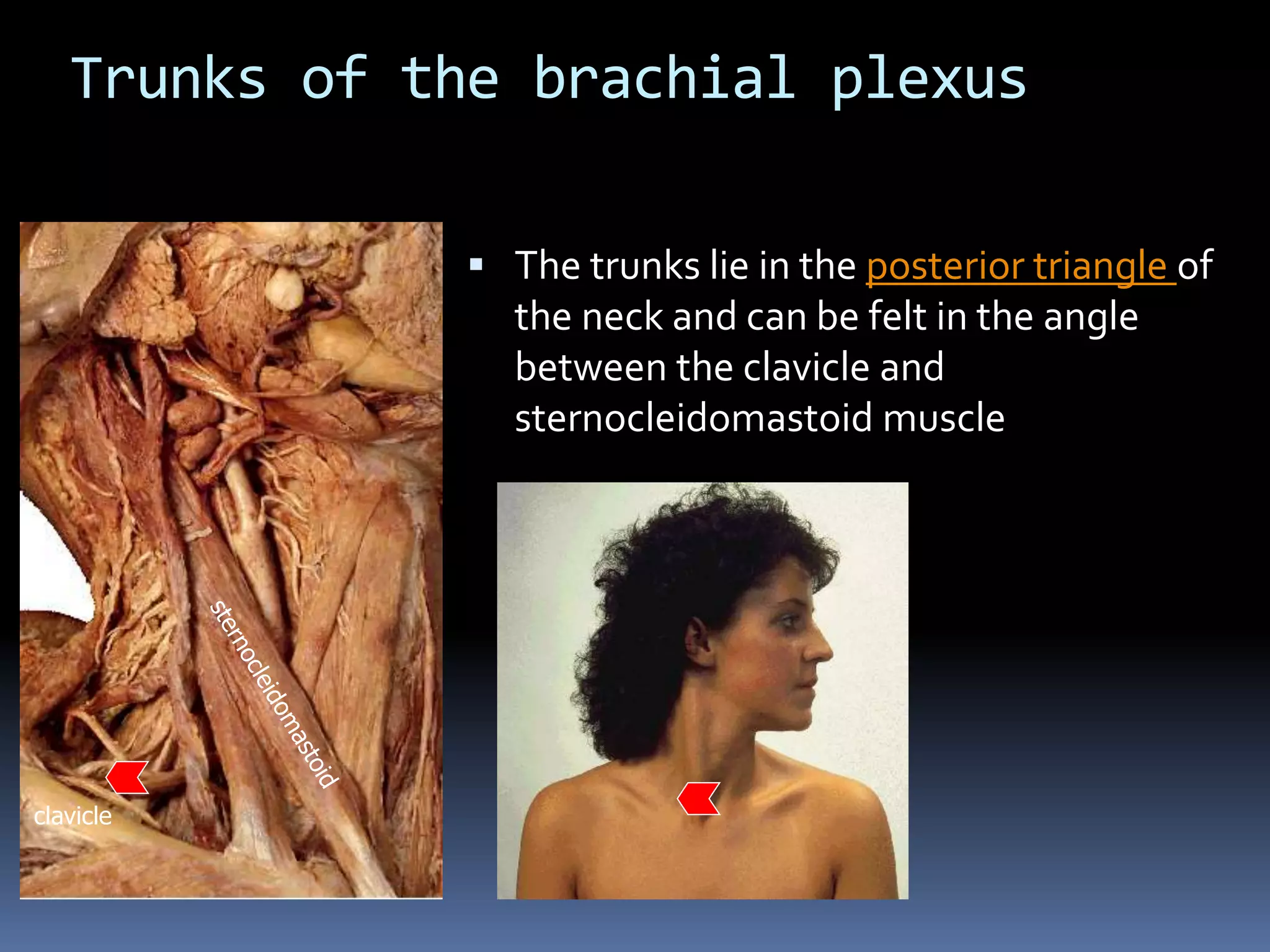
Trunks of the brachial plexus
 The trunks lie in the posterior triangle of
the neck and can be felt in the angle
between the clavicle and
sternocleidomastoid muscle
clavicle
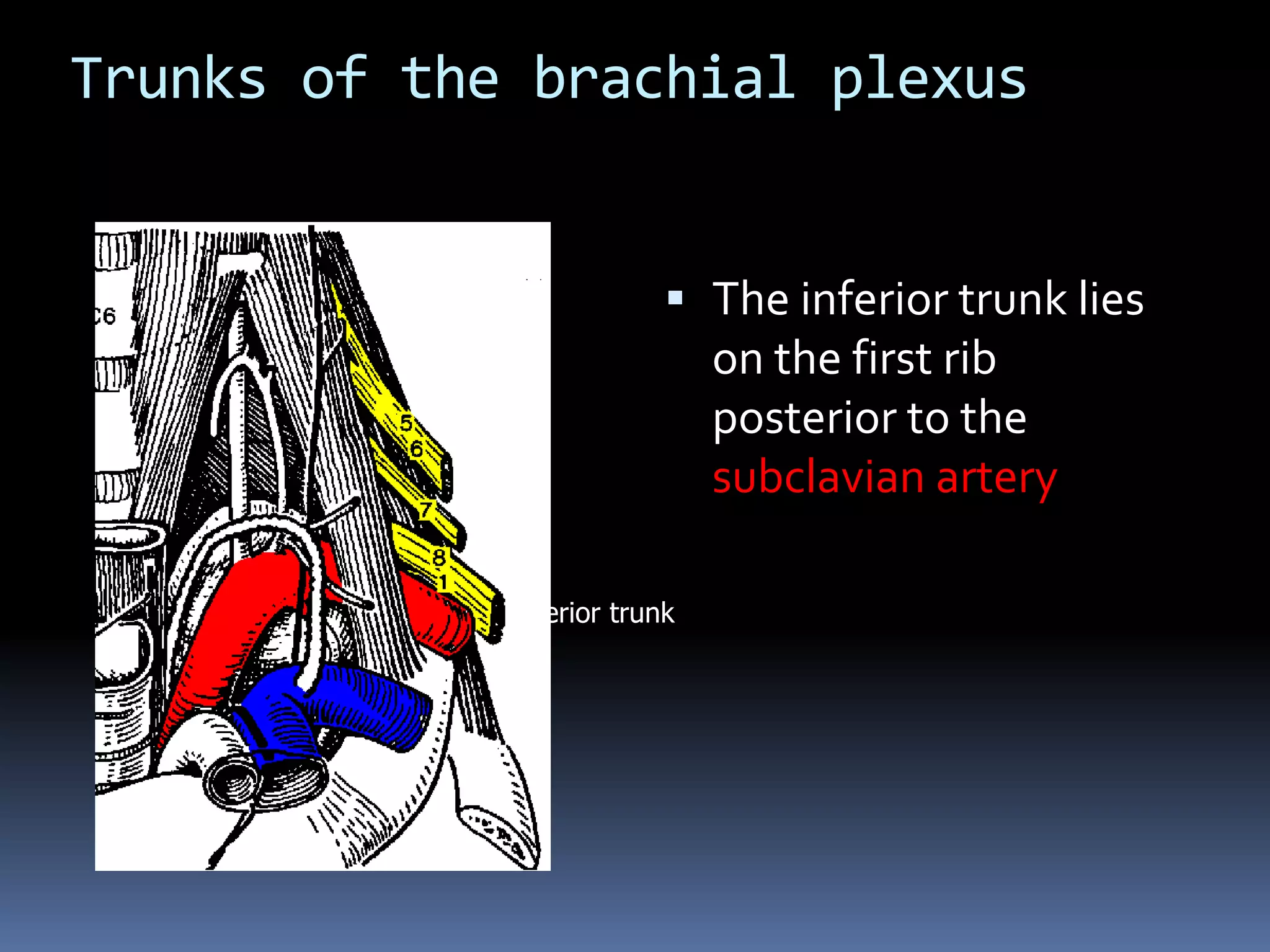
Trunks of the brachial plexus
 The inferior trunk lies
on the first rib
posterior to the
subclavian artery
Inferior trunk
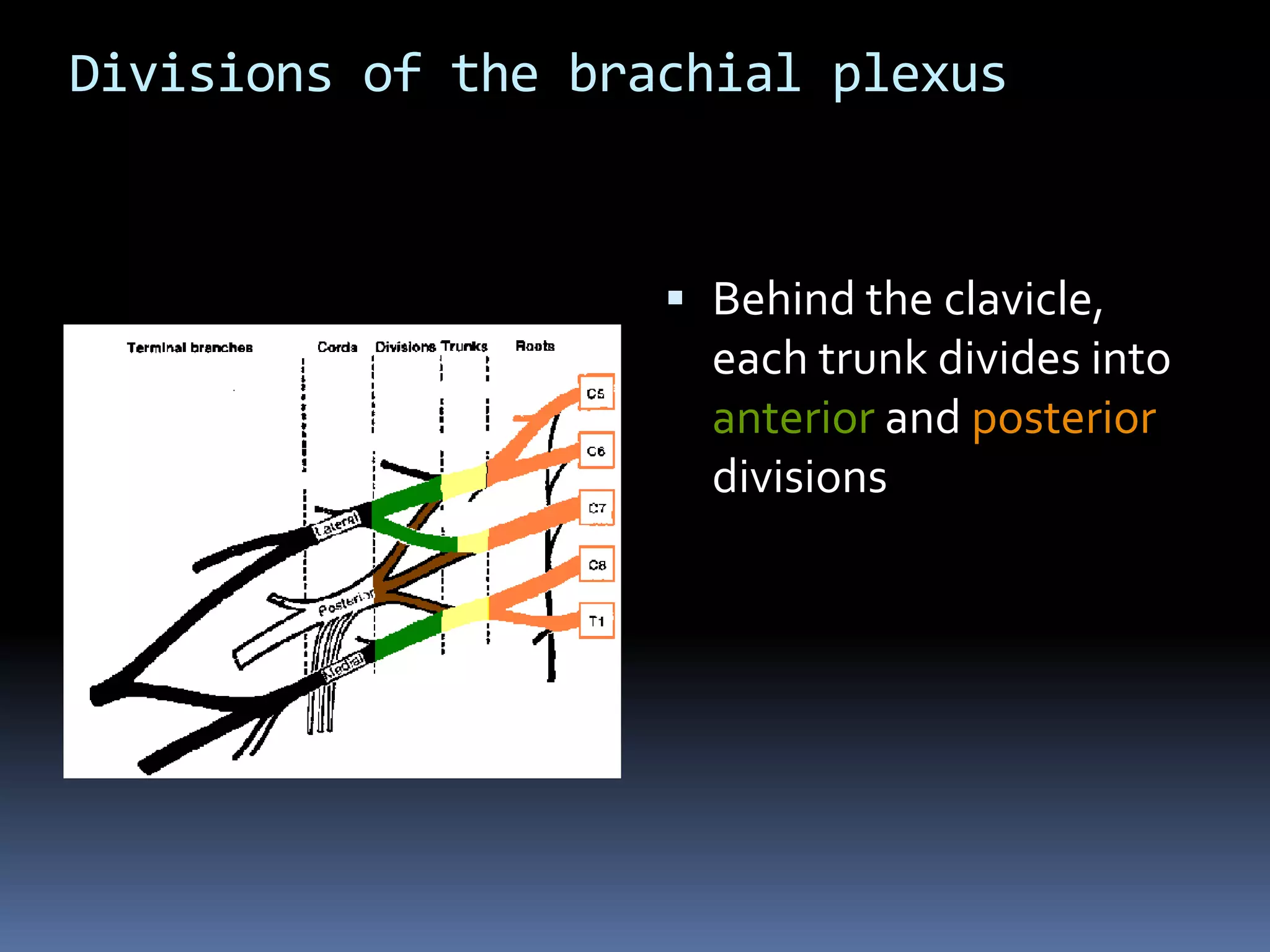
Divisions of the brachial plexus
 Behind the clavicle,
each trunk divides into
anterior and posterior
divisions
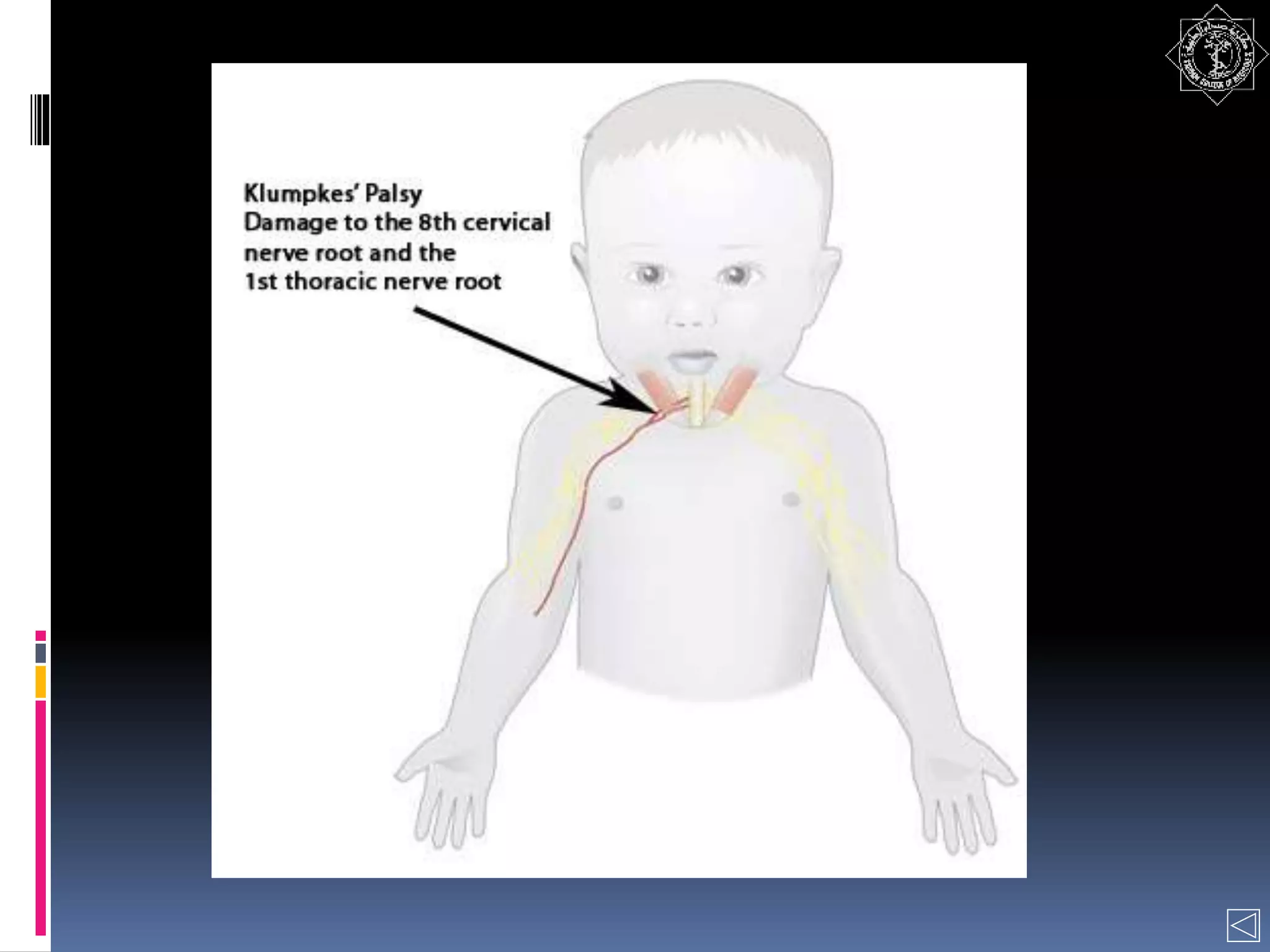
Trunks of the brachial plexus
 the anterior divisions
supply anterior (flexor)
parts while the
posterior divisions
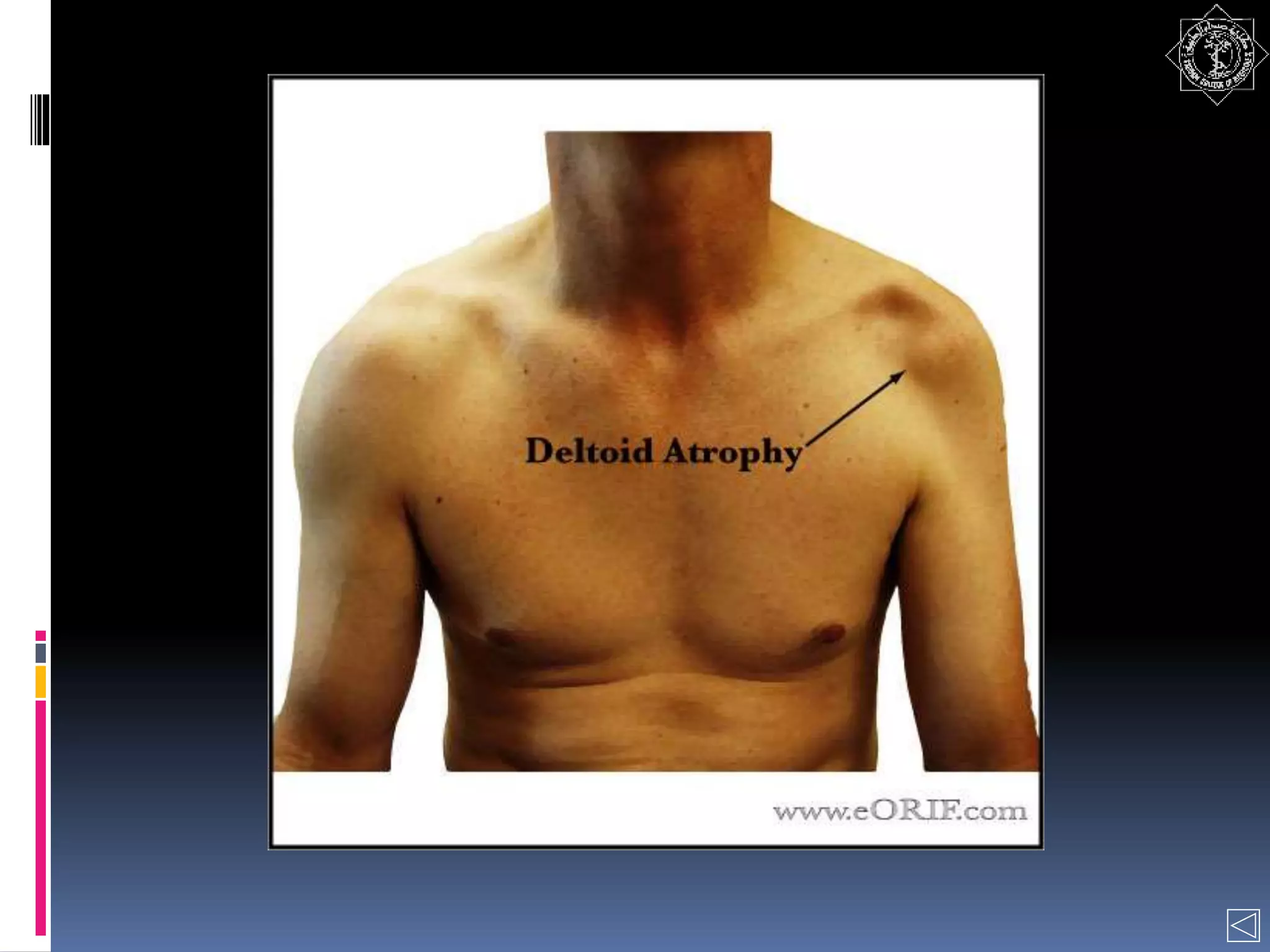
supply posterior
(extensor) parts of the
upper limb
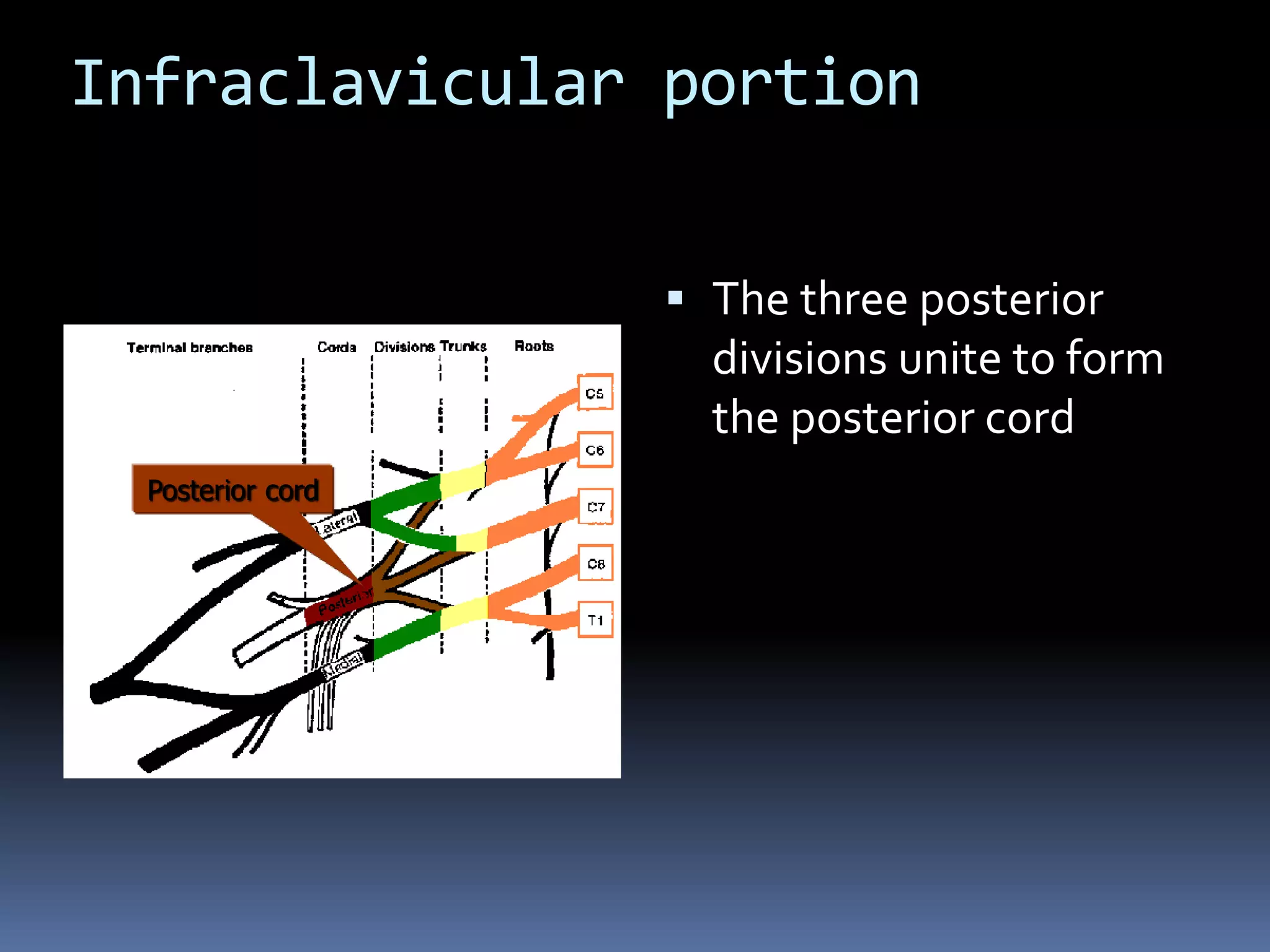
Infraclavicular portion
 The three posterior
divisions unite to form
the posterior cord
Posterior cord
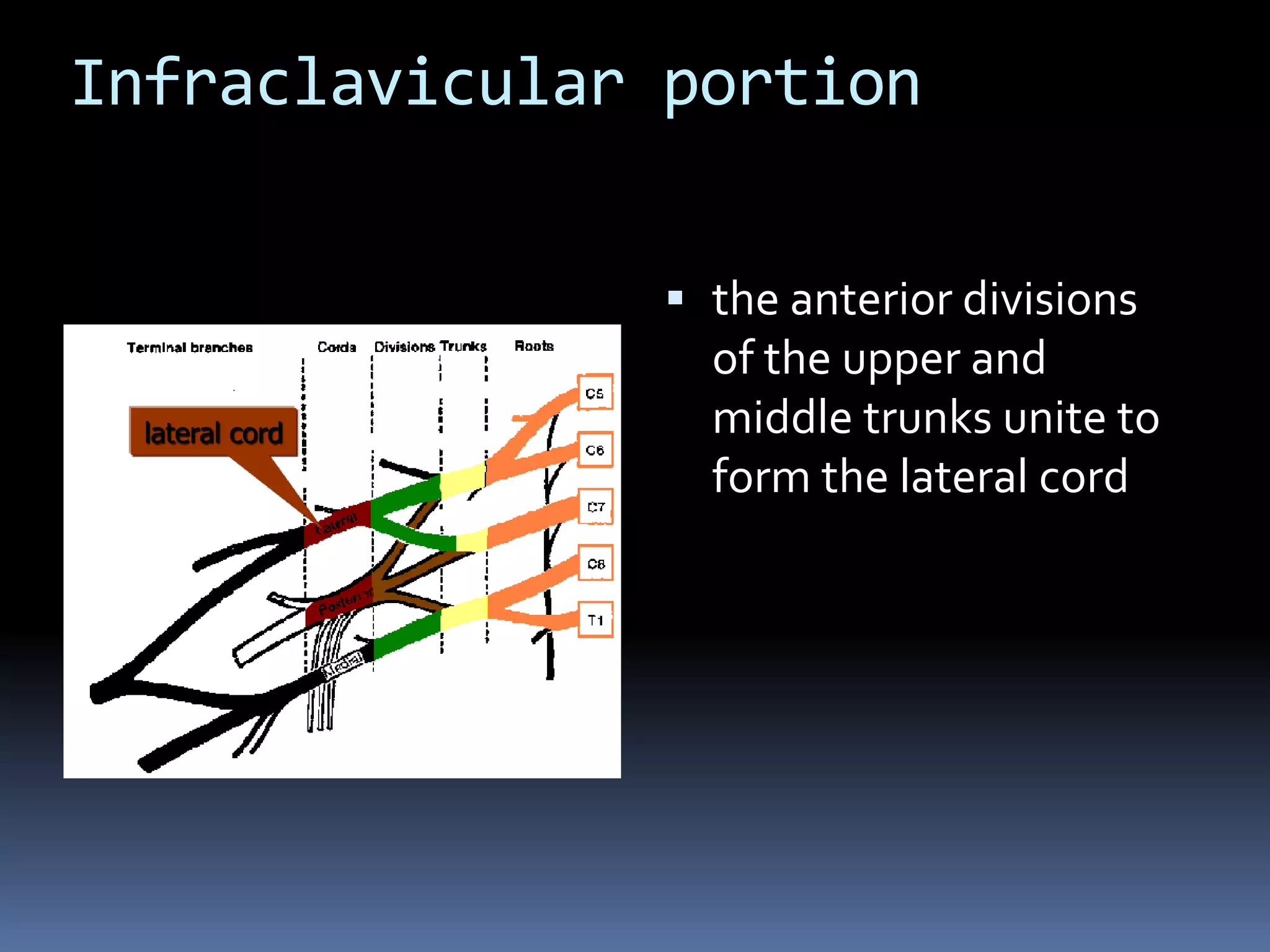
Infraclavicular portion
 the anterior divisions
of the upper and
middle trunks unite to
form the lateral cord
lateral cord
Infraclavicular portion
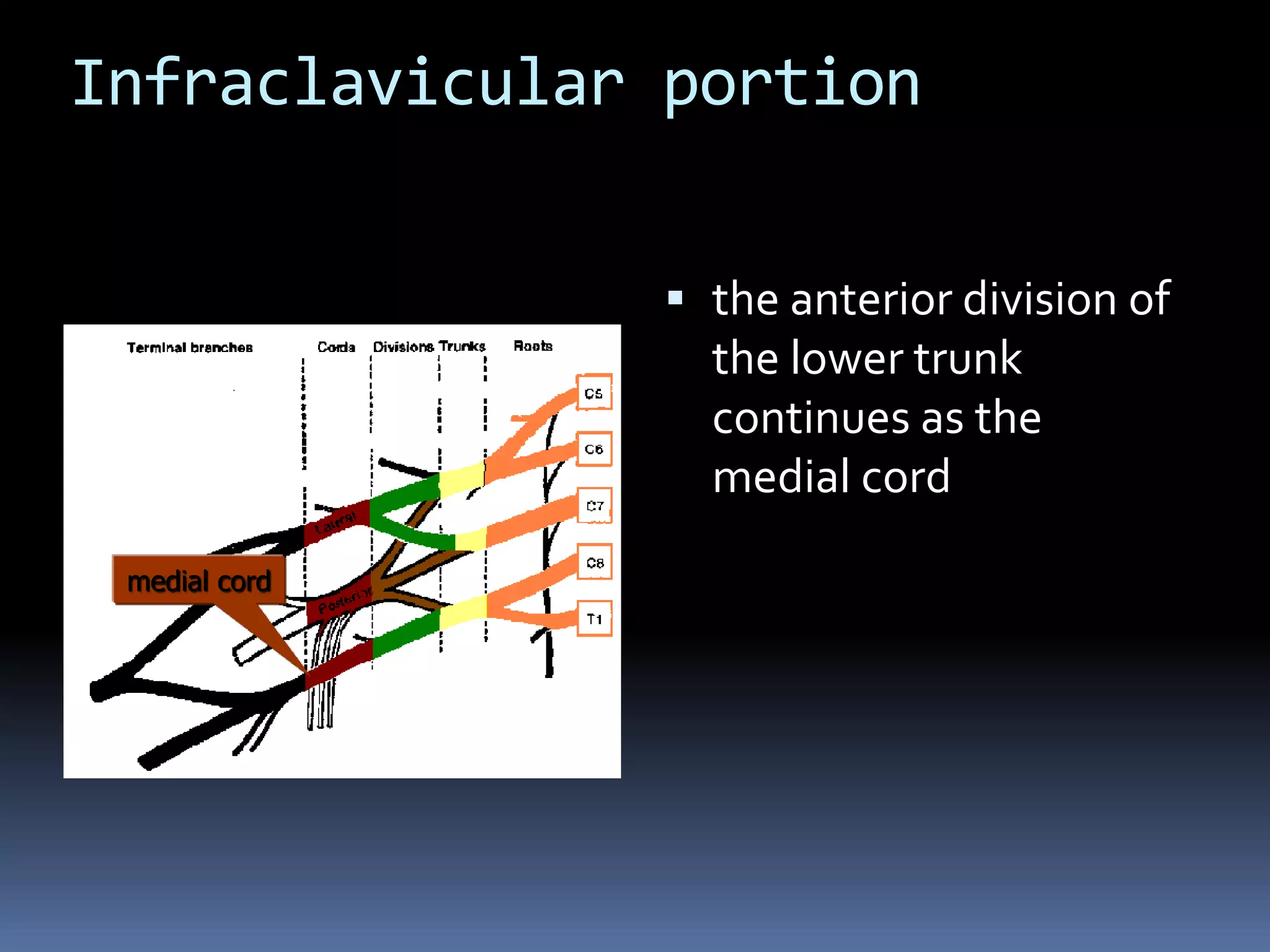
 the anterior division of
the lower trunk
continues as the
medial cord
medial cord
Cords of the brachial plexus
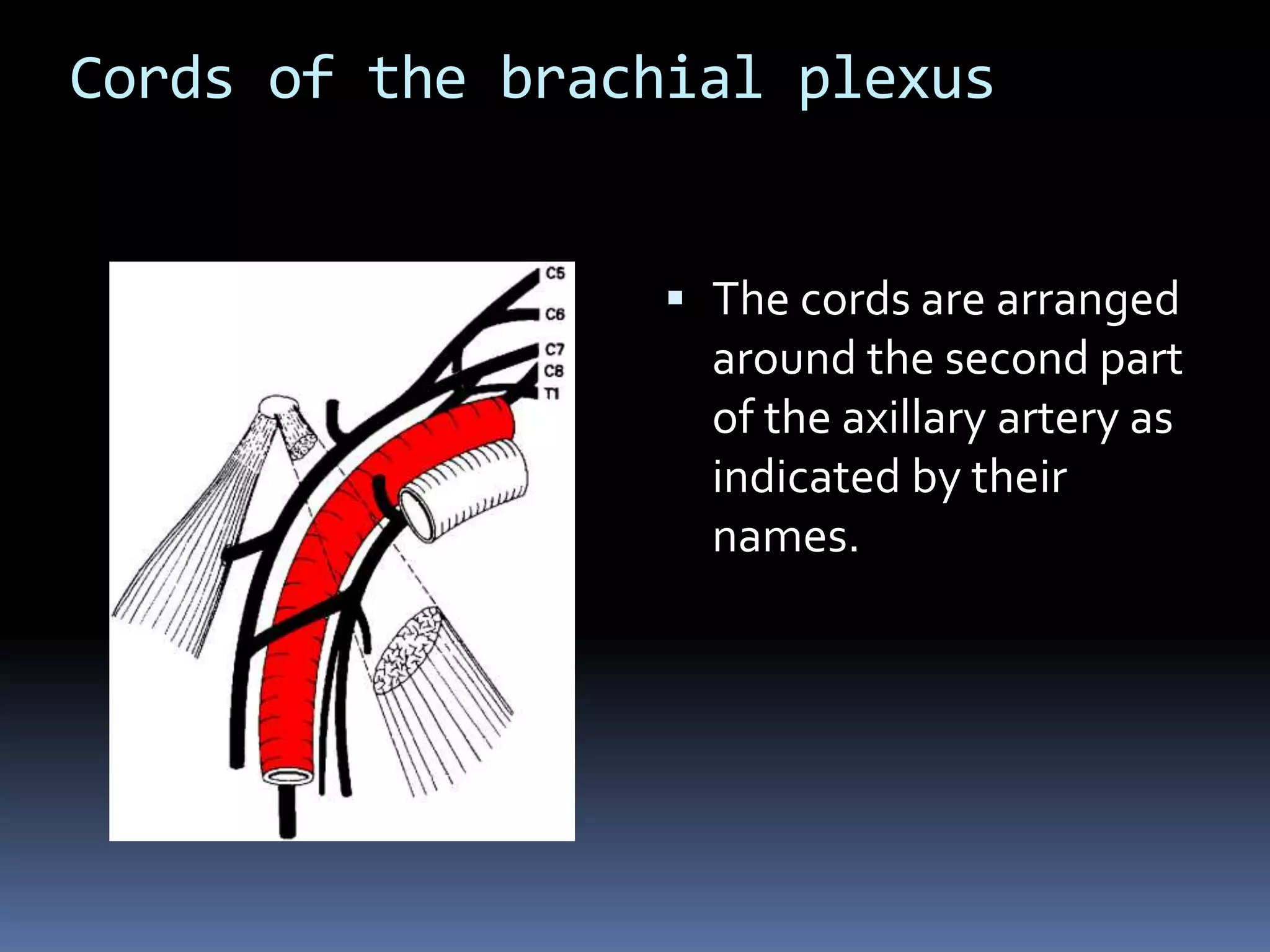
 The cords are arranged
around the second part
of the axillary artery as
indicated by their
names.
Branches of the brachial plexus
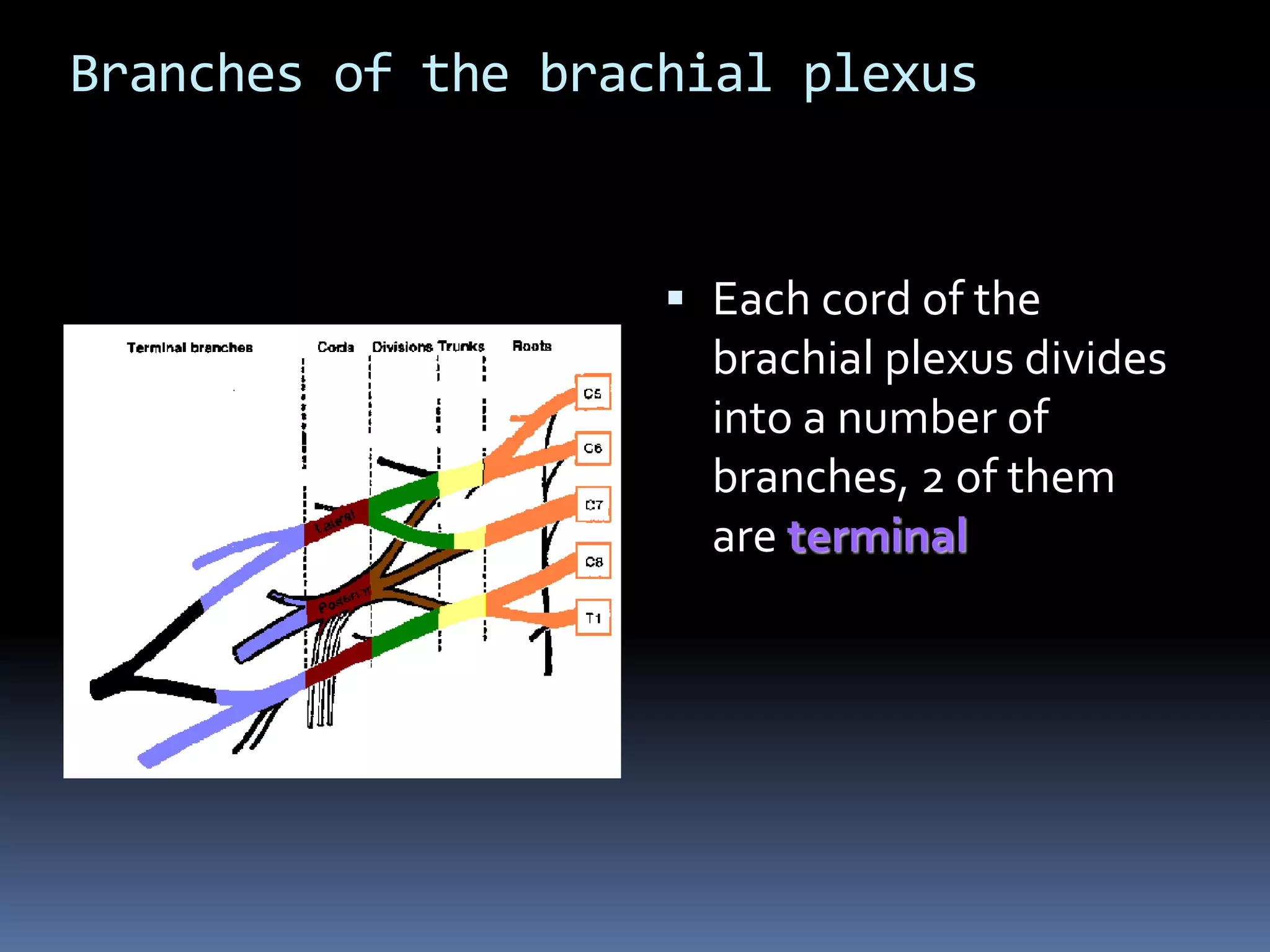
 Each cord of the
brachial plexus divides
into a number of
branches, 2 of them
are terminal
Branches of the brachial plexus
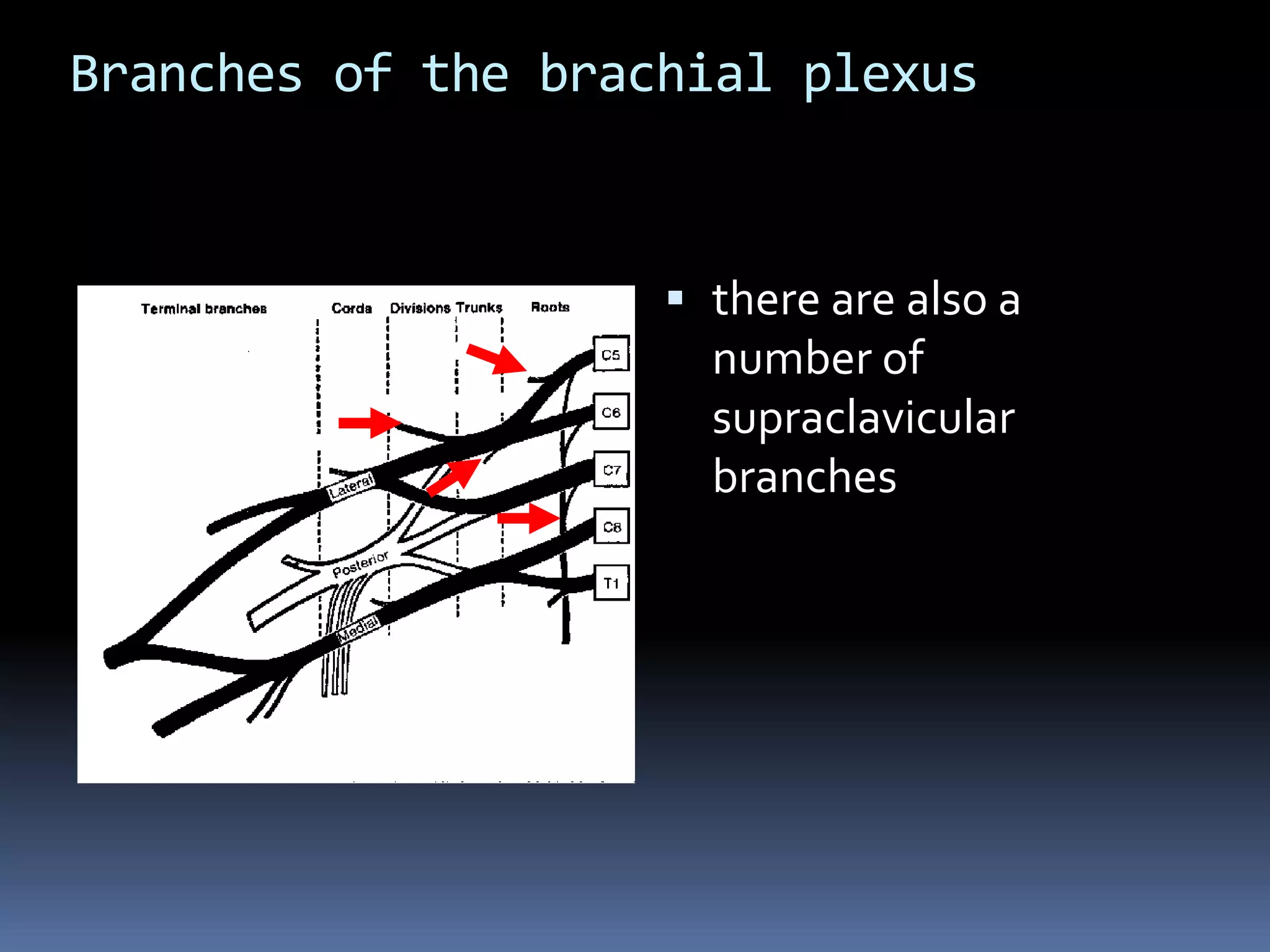
 there are also a
number of
supraclavicular
branches
Branches of the roots
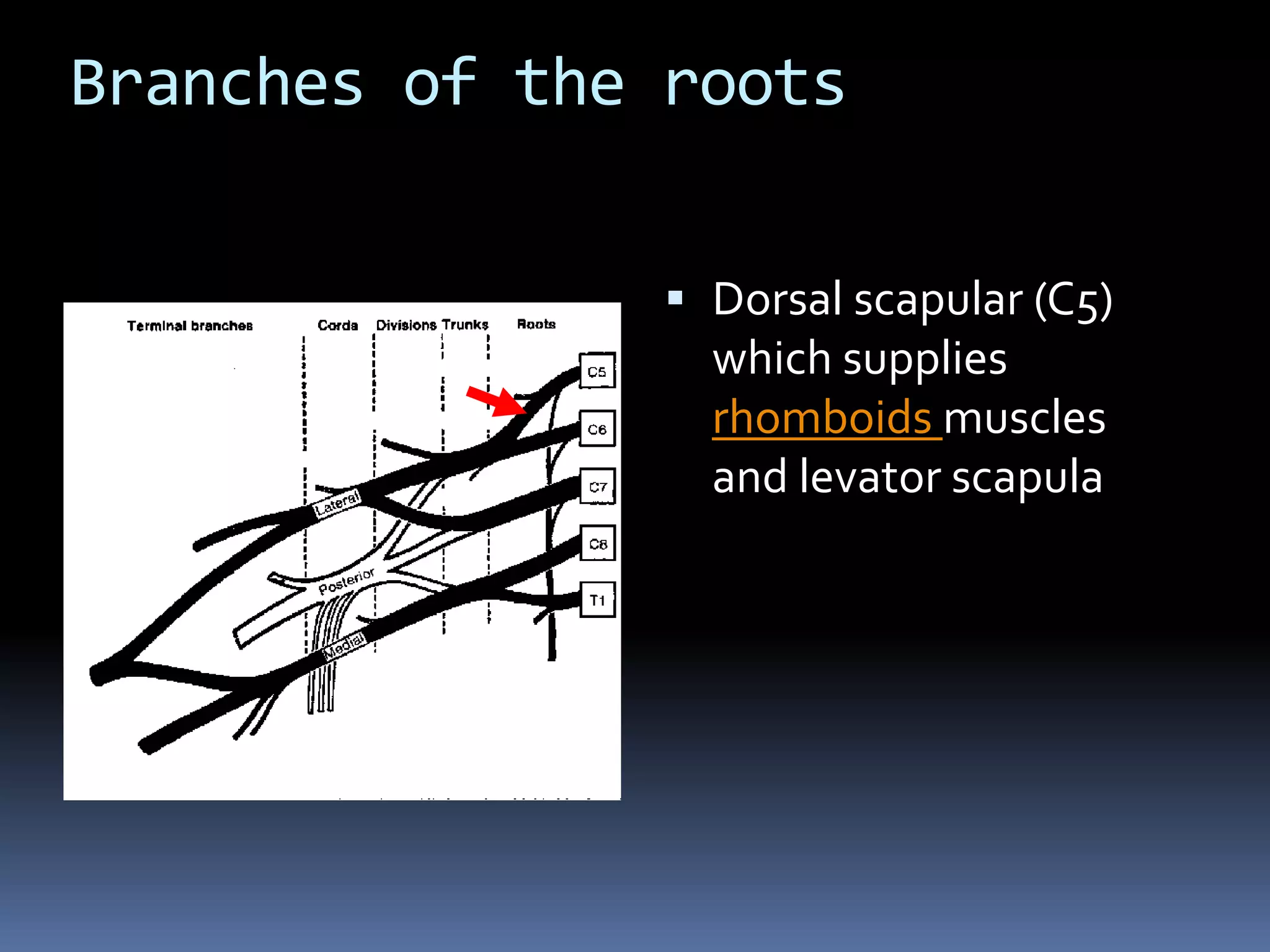
 Dorsal scapular (C5)
which supplies
rhomboids muscles
and levator scapula
Branches of the roots
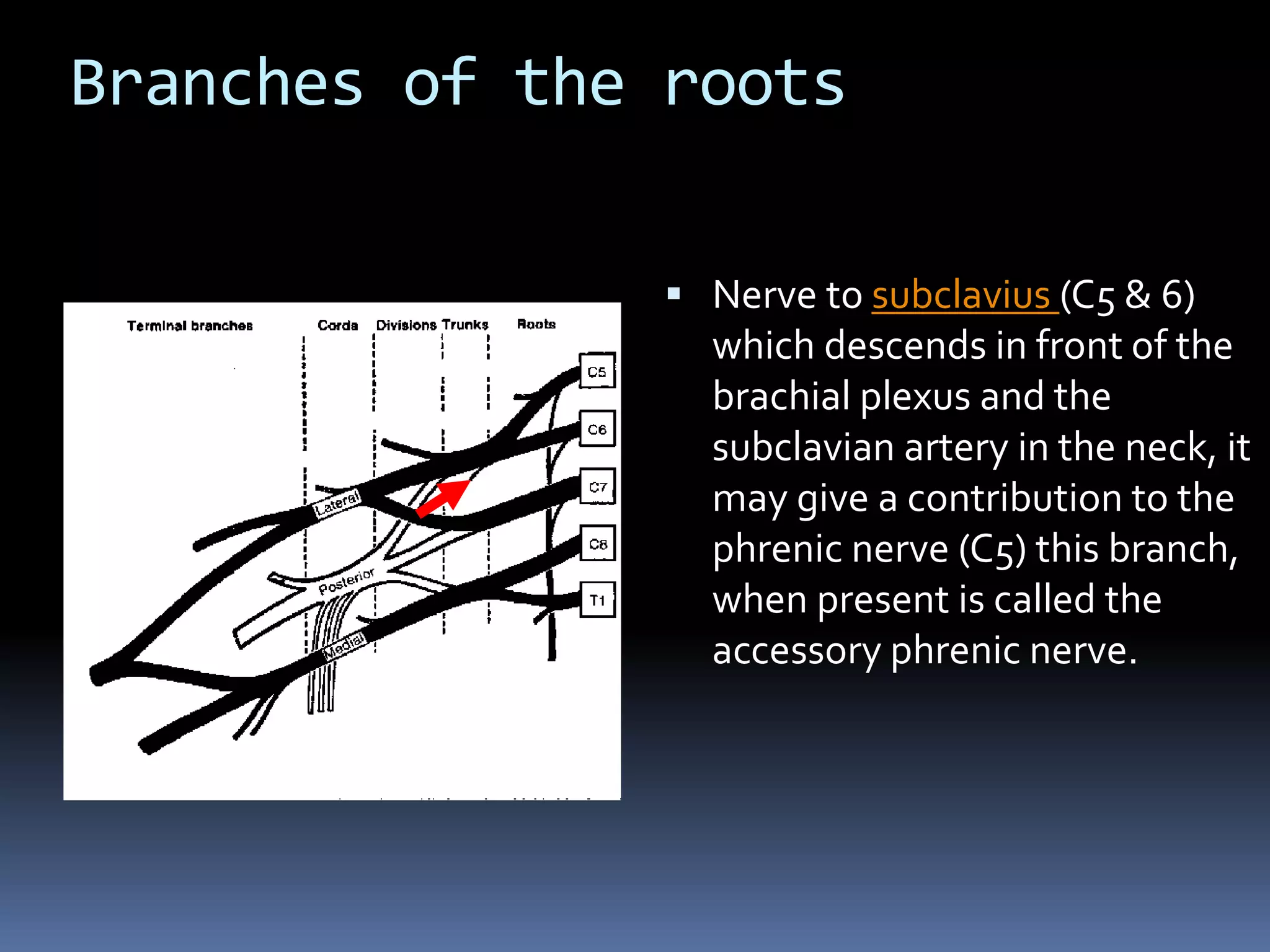
 Nerve to subclavius (C5 & 6)
which descends in front of the
brachial plexus and the
subclavian artery in the neck, it
may give a contribution to the
phrenic nerve (C5) this branch,
when present is called the
accessory phrenic nerve.
Branches of the roots
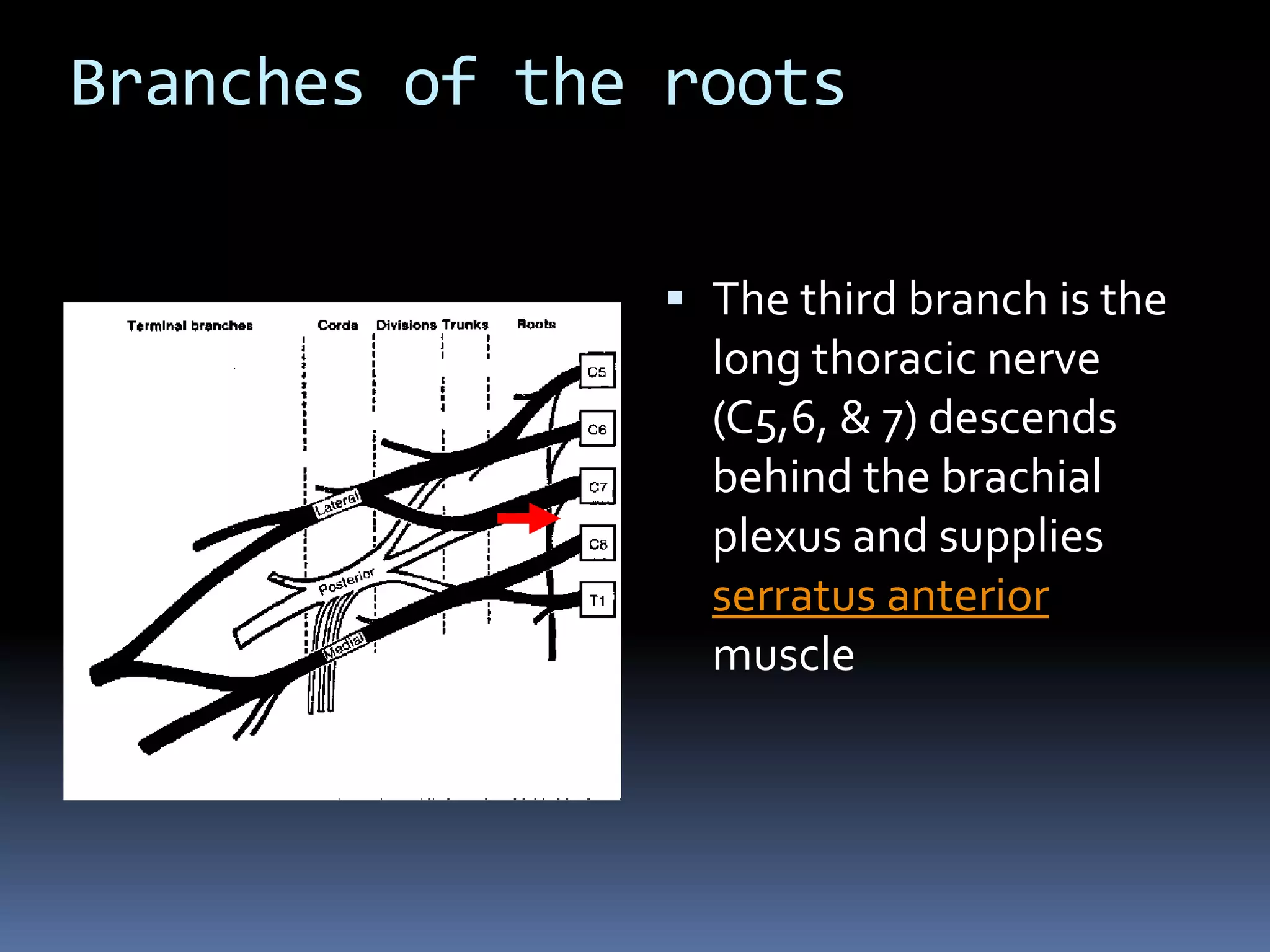
 The third branch is the
long thoracic nerve
(C5,6, & 7) descends
behind the brachial
plexus and supplies
serratus anterior
muscle
Suprascapular nerve
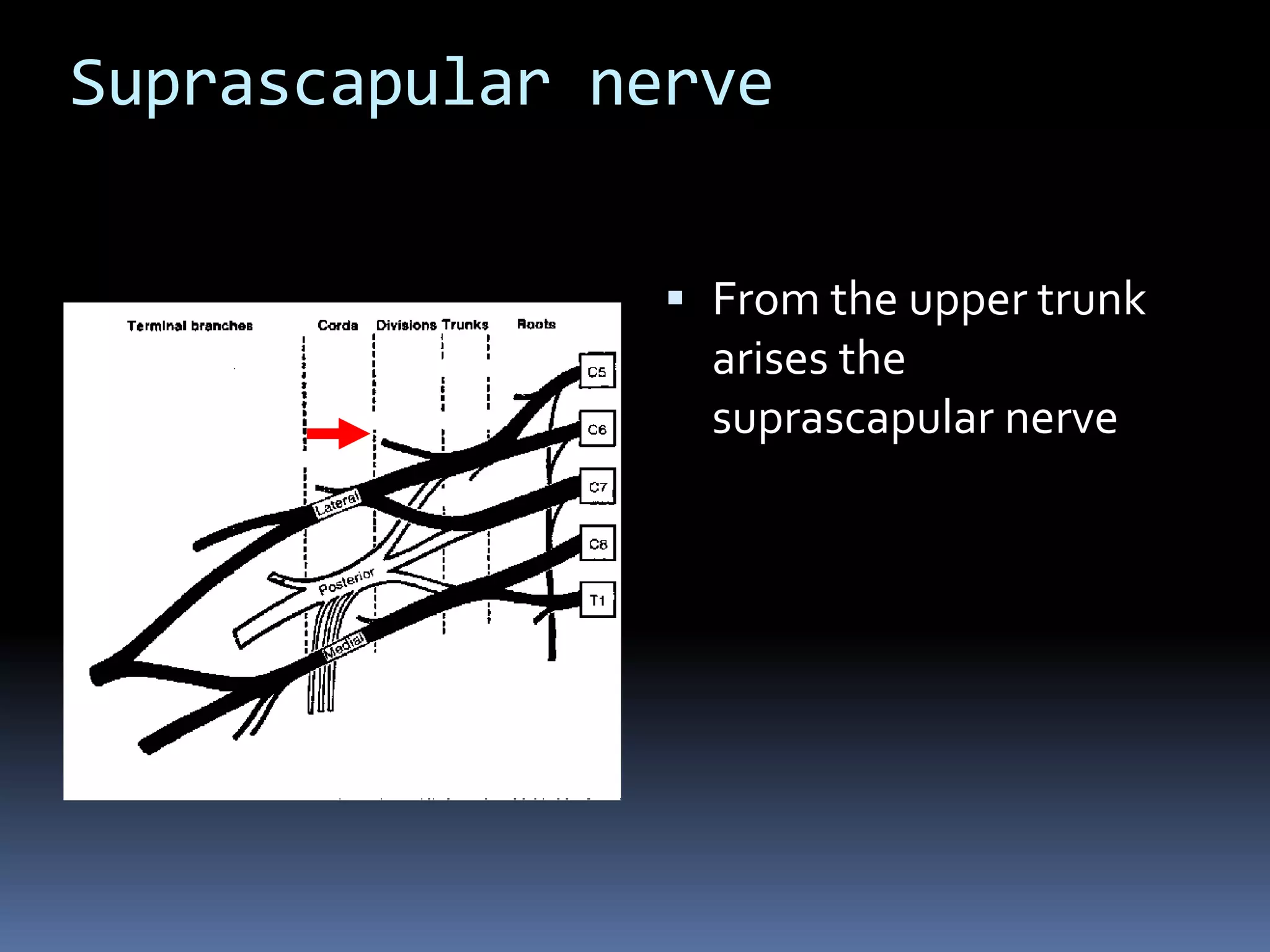
 From the upper trunk
arises the
suprascapular nerve
Suprascapular nerve
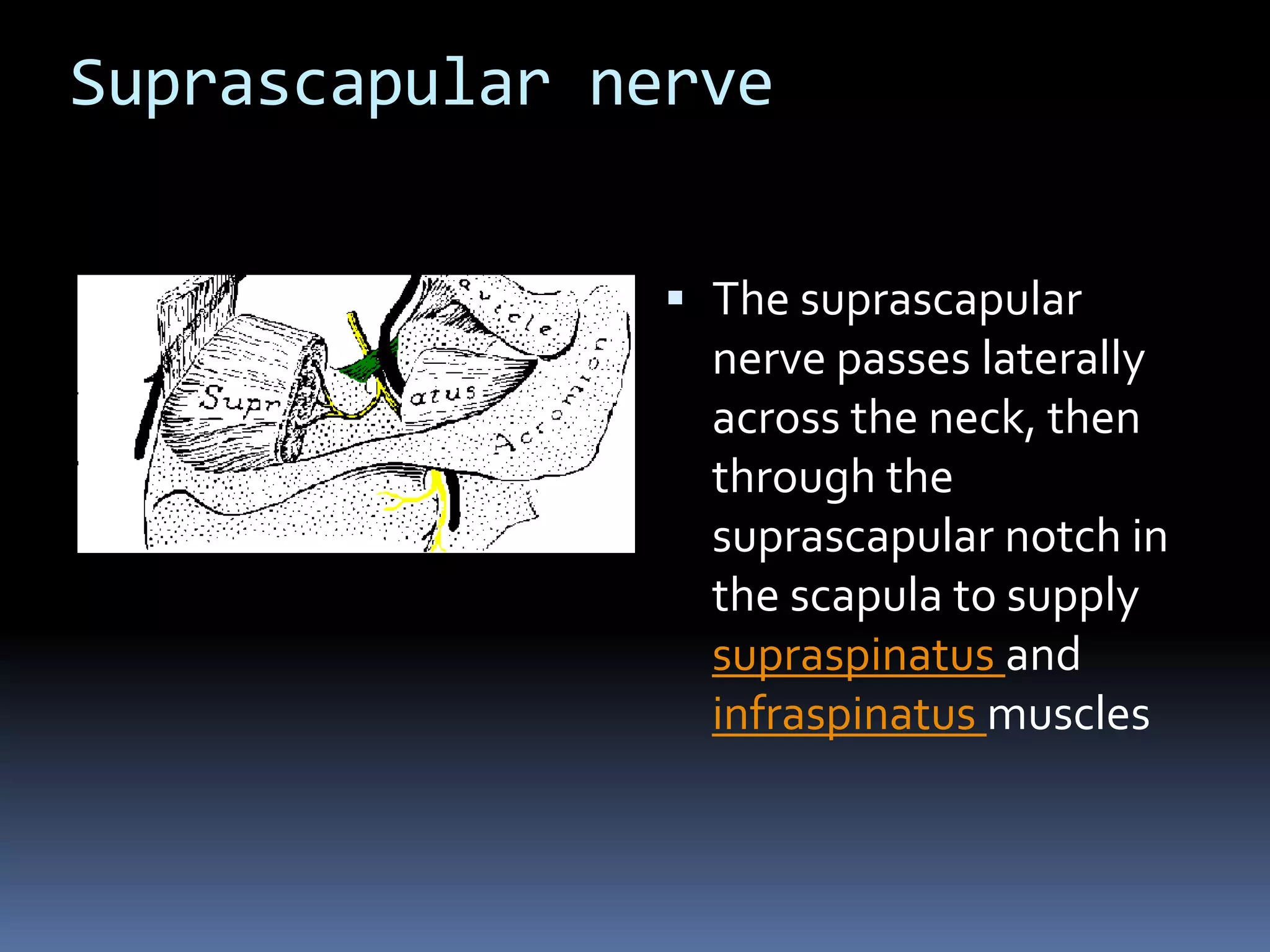
 The suprascapular
nerve passes laterally
across the neck, then
through the
suprascapular notch in
the scapula to supply
supraspinatus and
infraspinatus muscles
Infraclavicular branches
 The infraclavicular
branches are derived
from the cords
 Each cord divides into
2 terminal branches.
Branches of the lateral cord
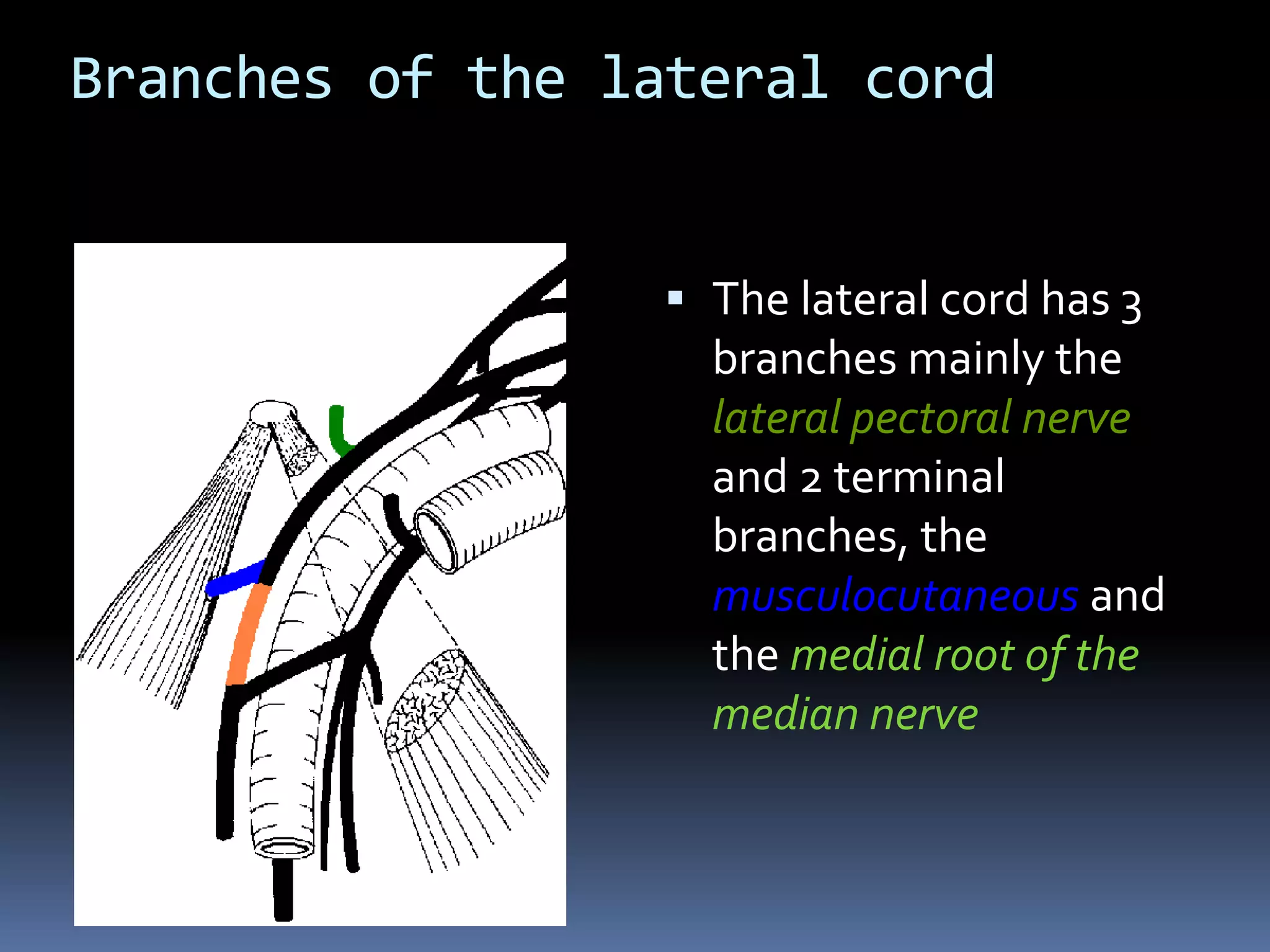
 The lateral cord has 3
branches mainly the
lateral pectoral nerve
and 2 terminal
branches, the
musculocutaneous and
the medial root of the
median nerve
Lateral pectoral nerve
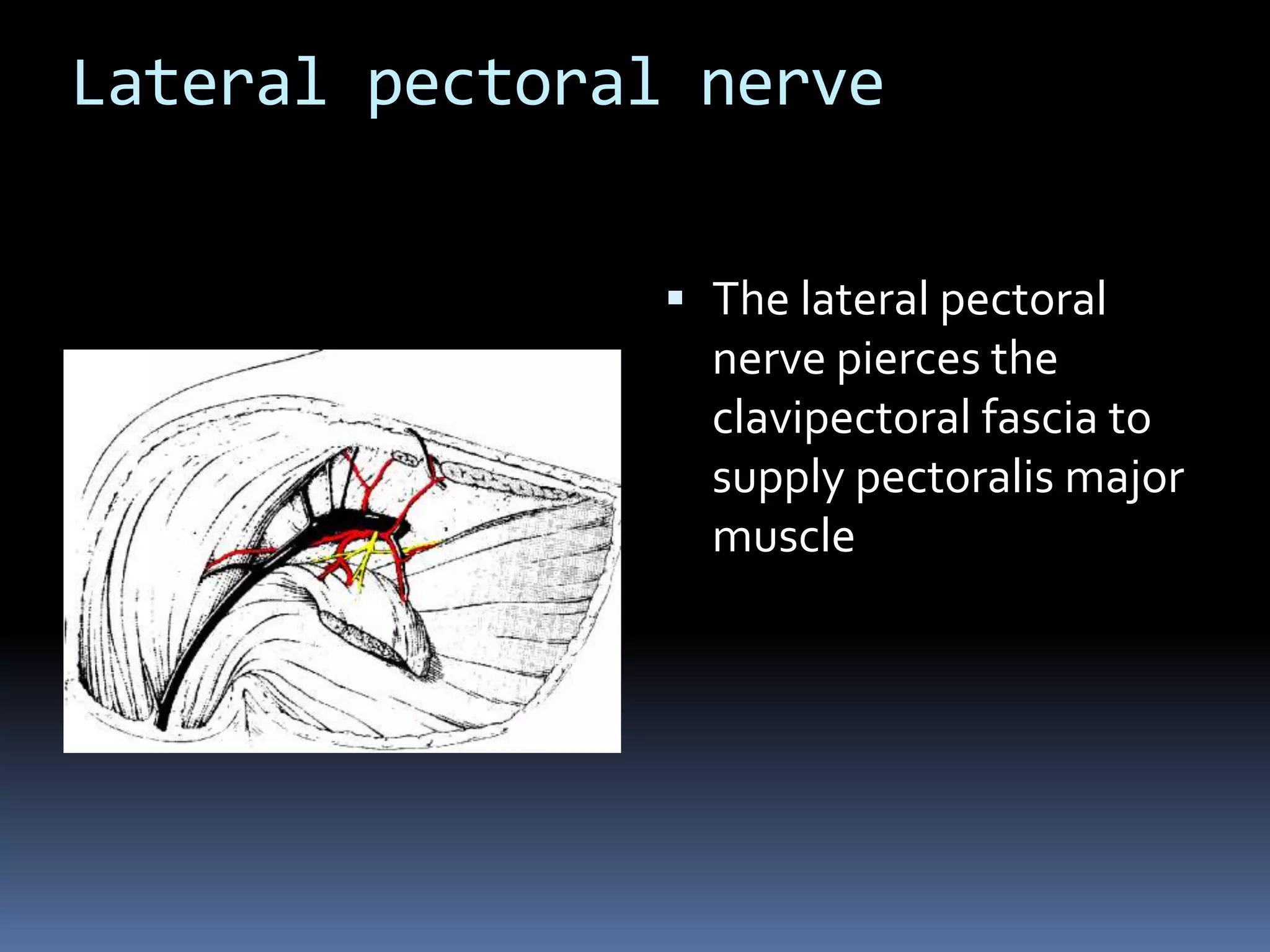
 The lateral pectoral
nerve pierces the
clavipectoral fascia to
supply pectoralis major
muscle
Lateral pectoral nerve
 sends a communicating
loop to the medial
pectoral nerve, through
which it supplies
pectoralis minor muscle
Axillary a.
Pectoralis minor
medial
pectoral n.
laterall
pectoral n.
Medial
cord
lateral
cord
posterior
cord
Axillary v.
communicating loop
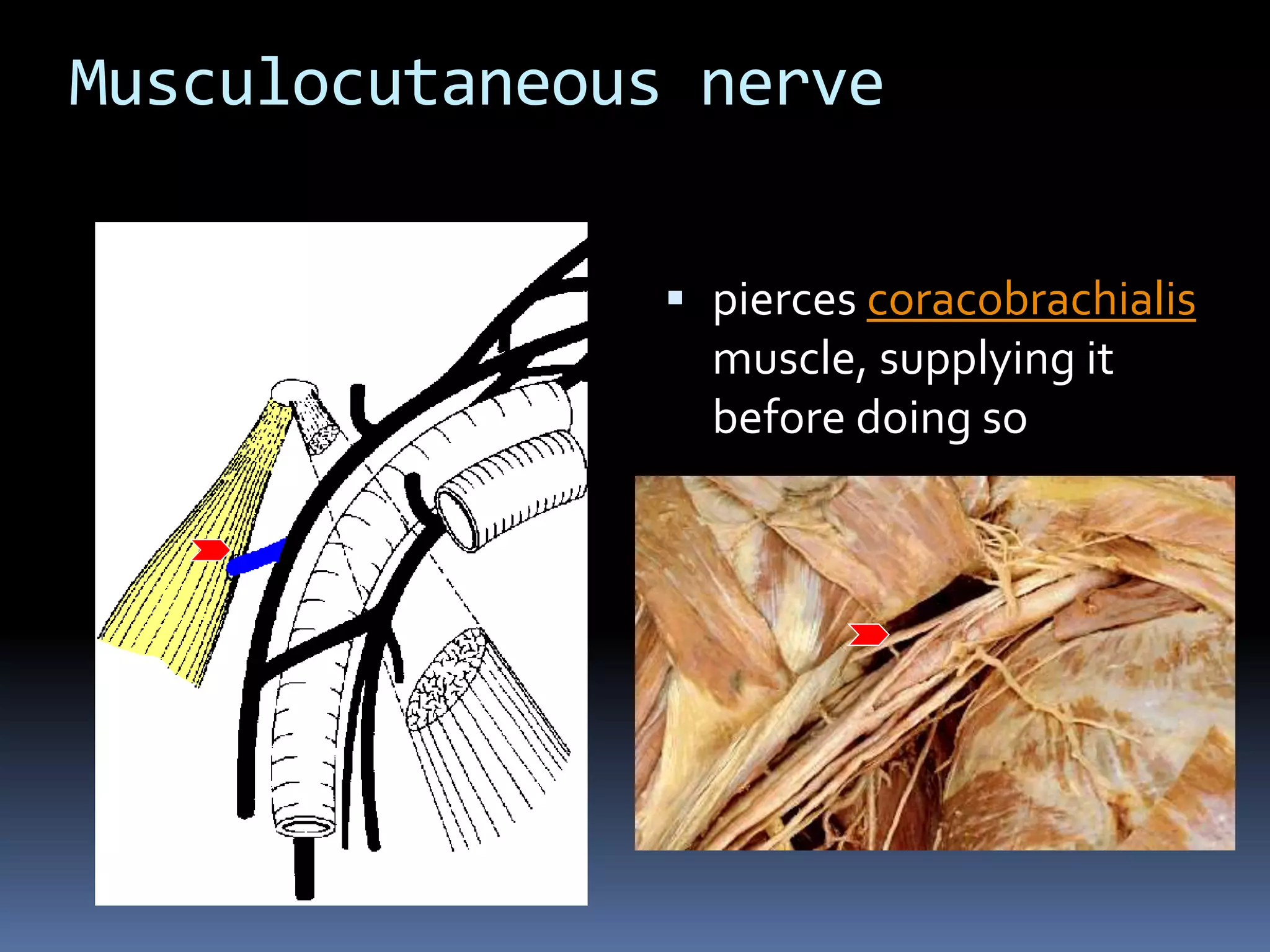
Musculocutaneous nerve
 pierces coracobrachialis
muscle, supplying it
before doing so
Musculocutaneous nerve
 it then supplies the
muscles of the flexor
(anterior)
compartment of the
arm mainly biceps
and brachialis
 therefore it is known
as the BBC nerve
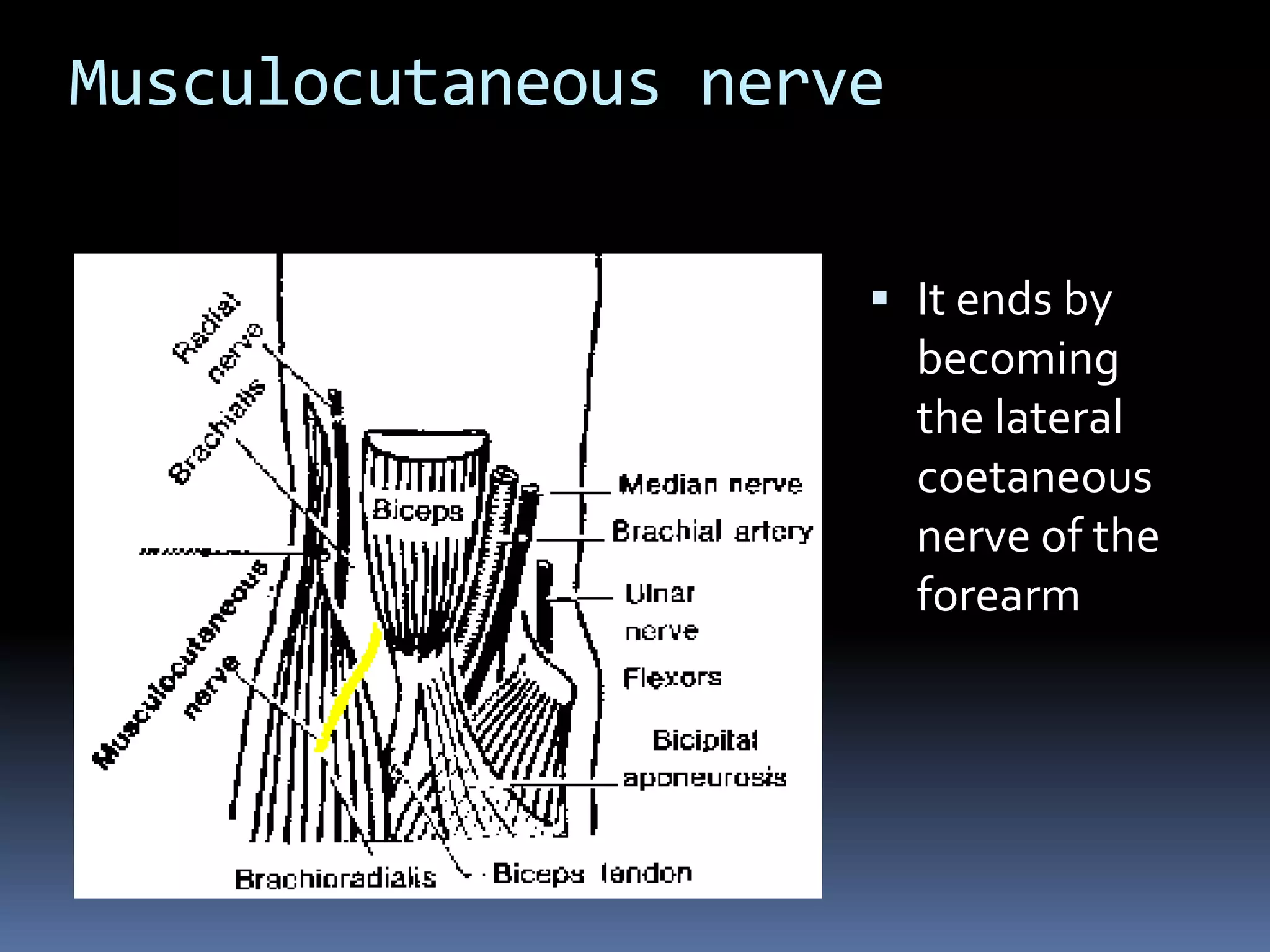
Musculocutaneous nerve
 It ends by
becoming
the lateral
coetaneous
nerve of the
forearm
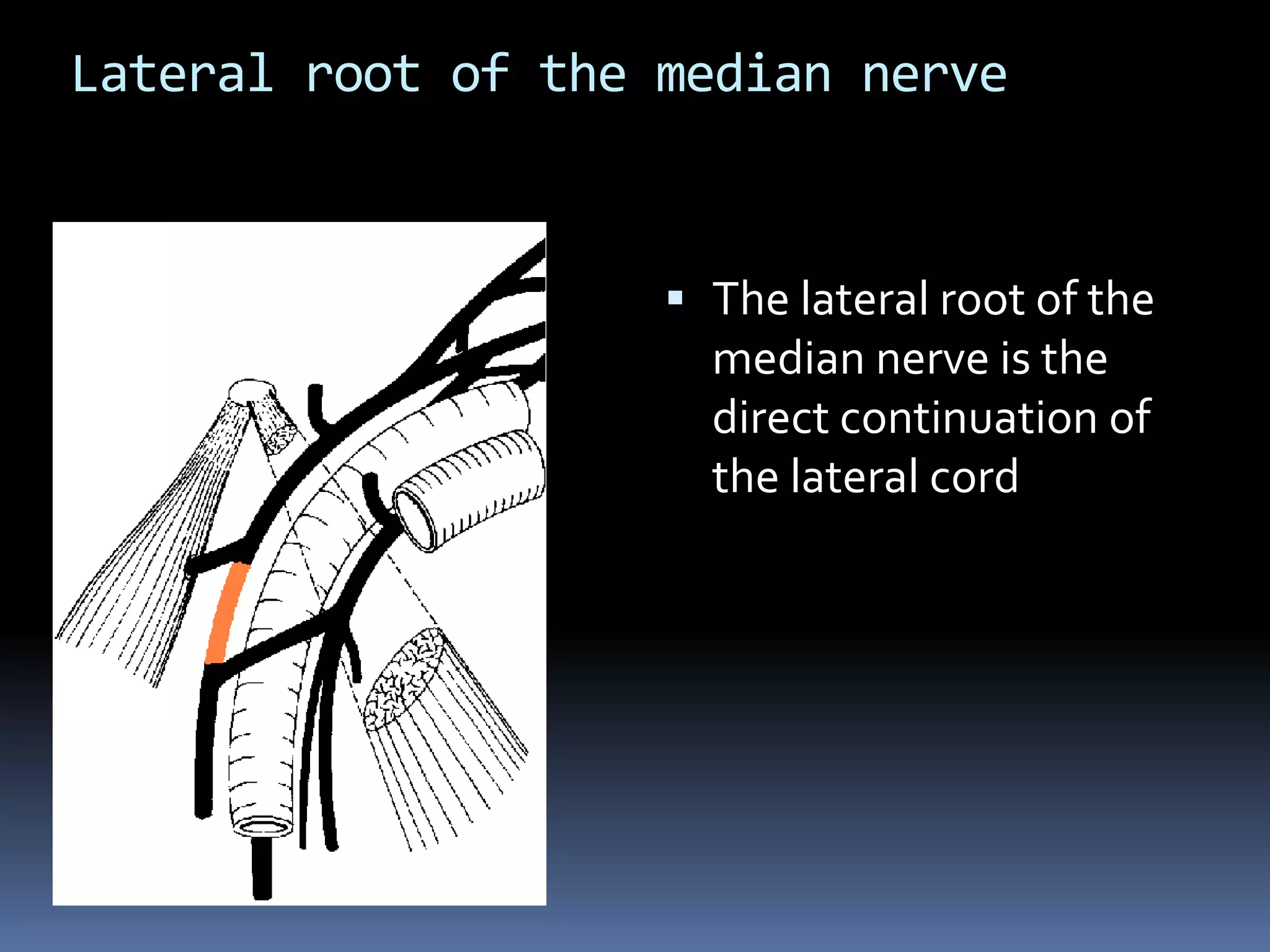
Lateral root of the median nerve
 The lateral root of the
median nerve is the
direct continuation of
the lateral cord
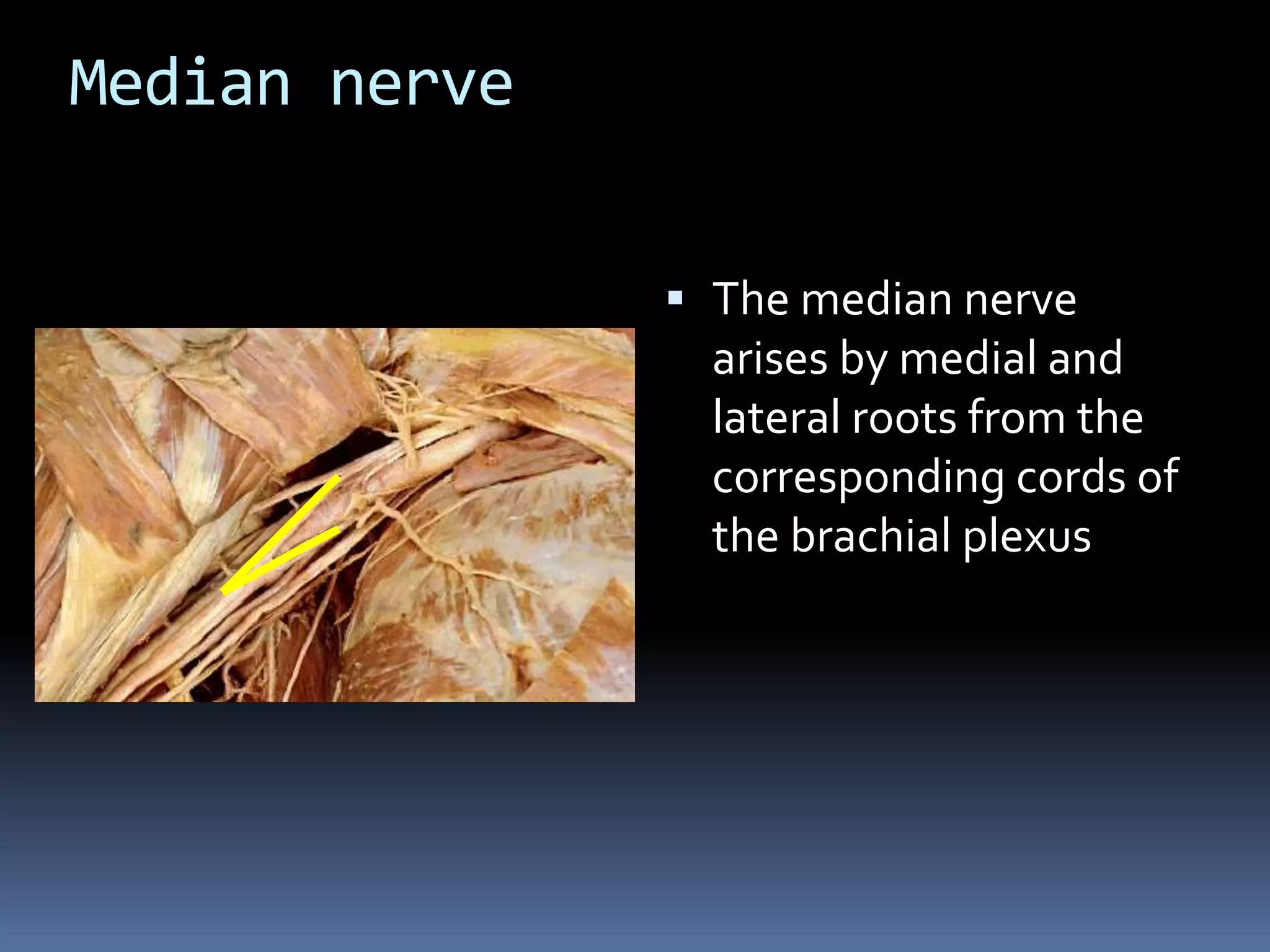
Median nerve
 The median nerve
arises by medial and
lateral roots from the
corresponding cords of
the brachial plexus
Median nerve
 the medial root crosses
the axillary artery to
join the lateral root so
the median nerve is
formed at first lateral
to the axillary artery.
Median nerve
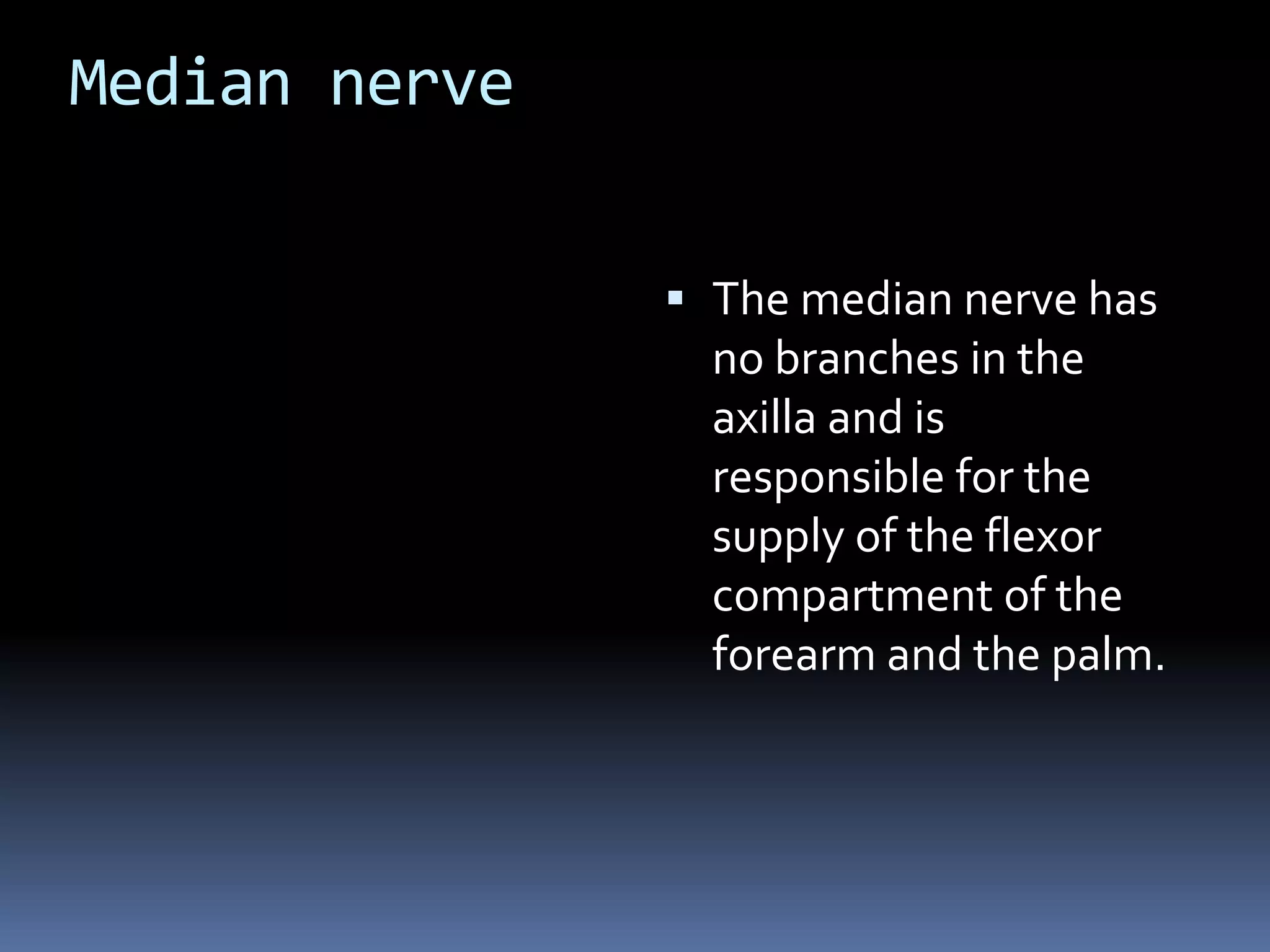
 The median nerve has
no branches in the
axilla and is
responsible for the
supply of the flexor
compartment of the
forearm and the palm.
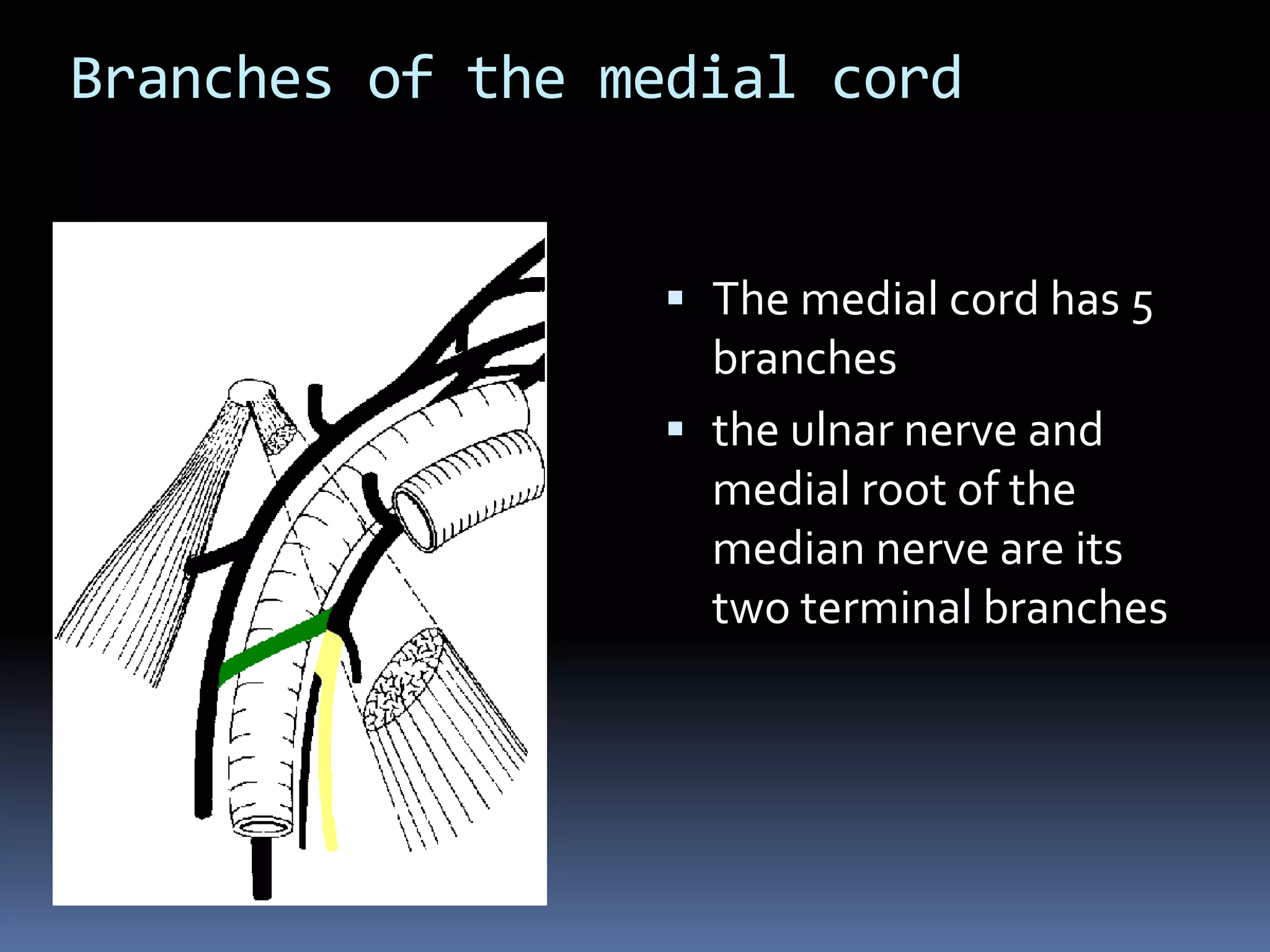
Branches of the medial cord
 The medial cord has 5
branches
 the ulnar nerve and
medial root of the
median nerve are its
two terminal branches
Ulnar n.
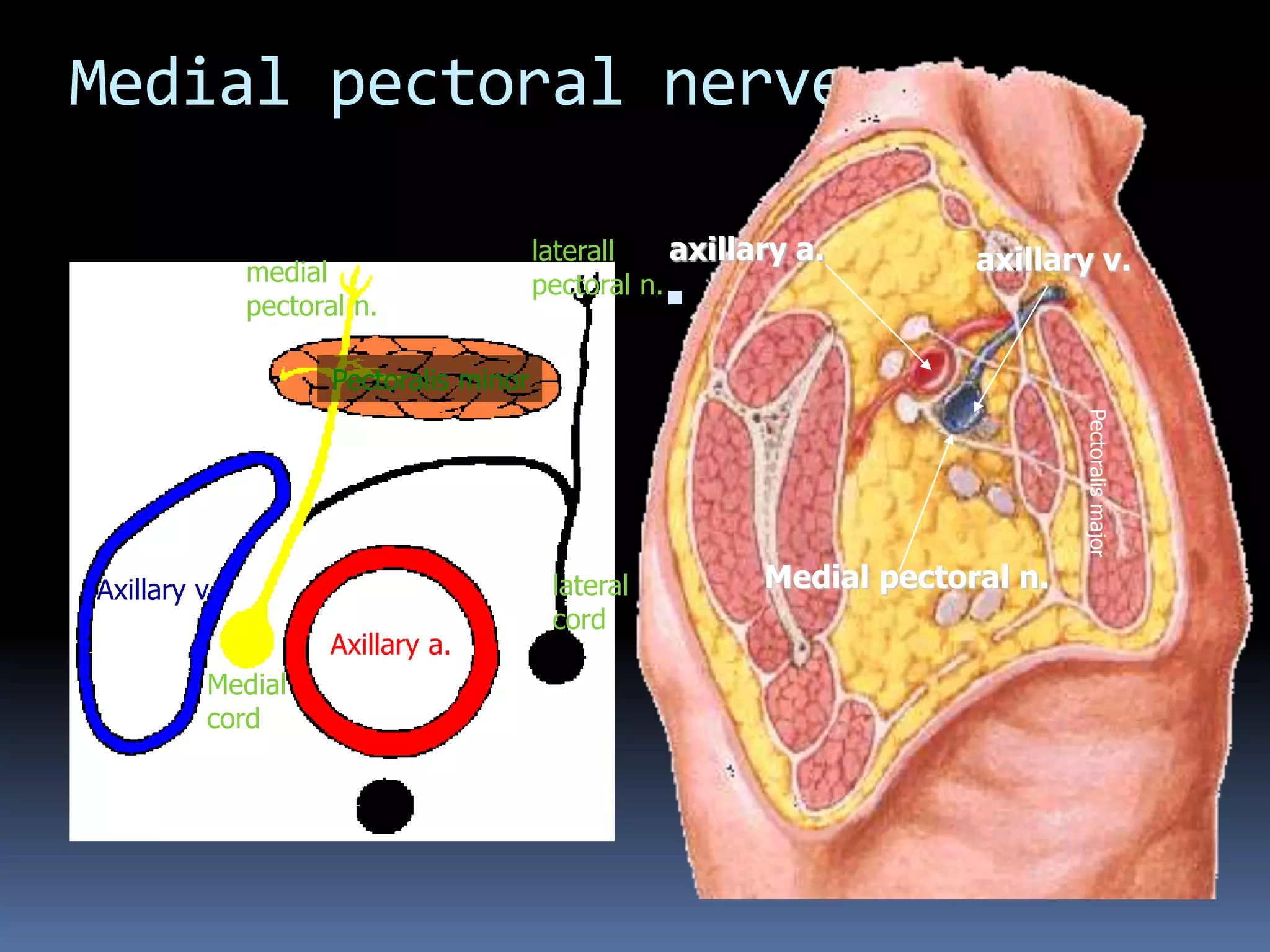
Medial pectoral nerve
 The medial pectoral
nerve passes through
pectoralis minor
supplying it then it
supplies pectoralis
major
Axillary a.
Pectoralis minor
medial
pectoral n.
laterall
pectoral n.
Medial
cord
lateral
cord
Axillary v.
axillary a. axillary v.
Medial pectoral n.
Pectoralismajor
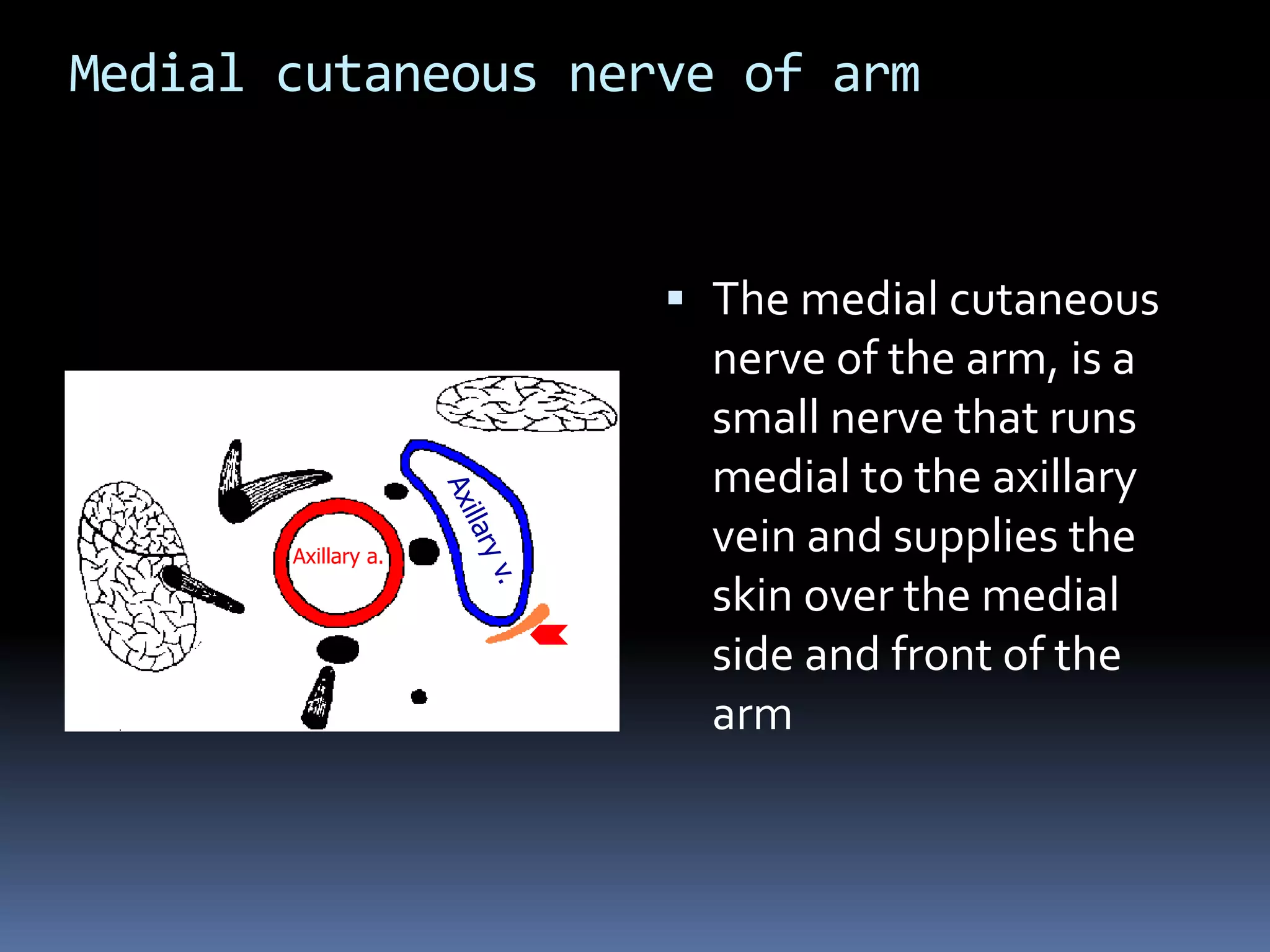
Medial cutaneous nerve of arm
 The medial cutaneous
nerve of the arm, is a
small nerve that runs
medial to the axillary
vein and supplies the
skin over the medial
side and front of the
arm
Axillary a.
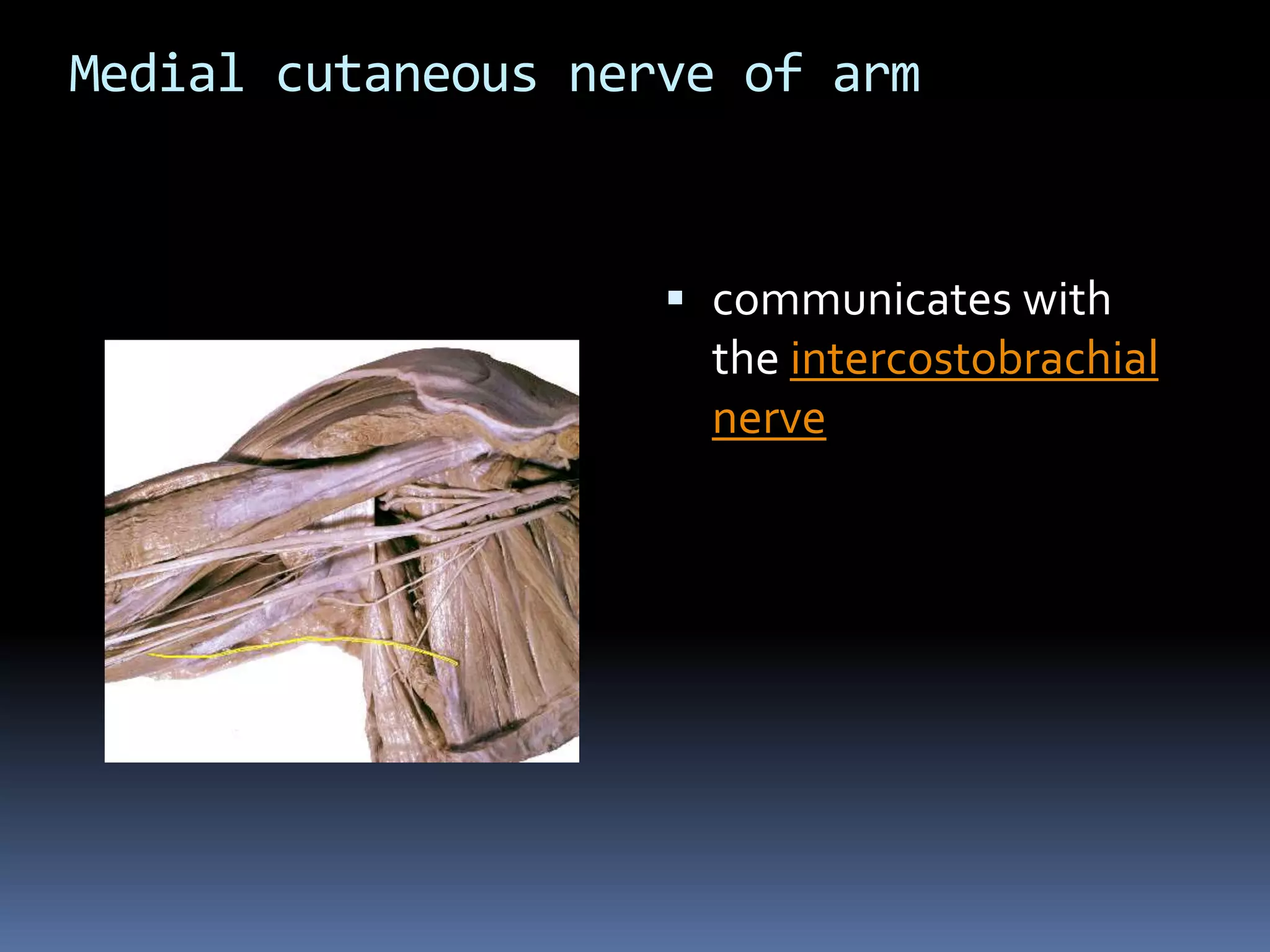
Medial cutaneous nerve of arm
 communicates with
the intercostobrachial
nerve
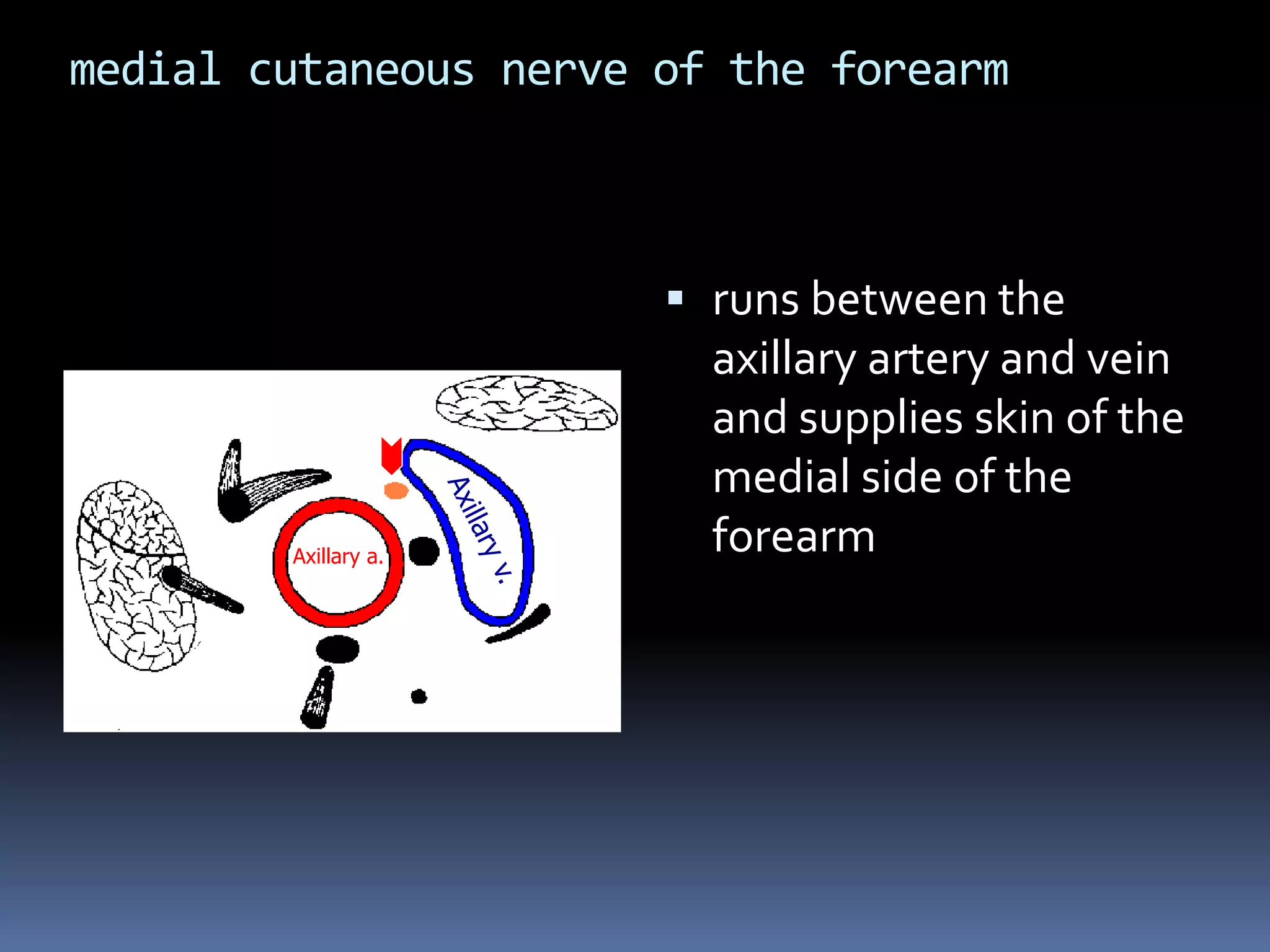
medial cutaneous nerve of the forearm
 runs between the
axillary artery and vein
and supplies skin of the
medial side of the
forearmAxillary a.
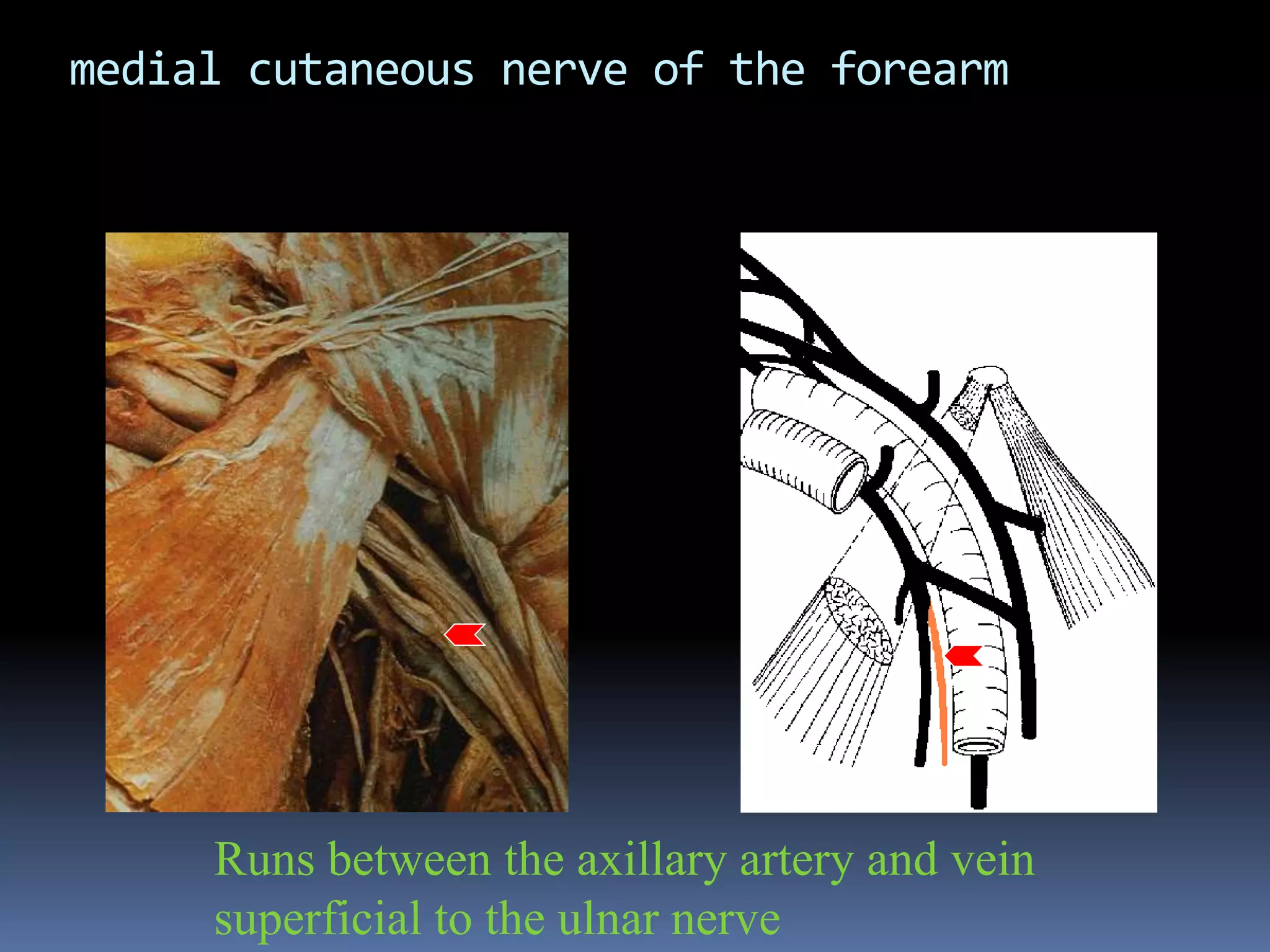
medial cutaneous nerve of the forearm
Runs between the axillary artery and vein
superficial to the ulnar nerve
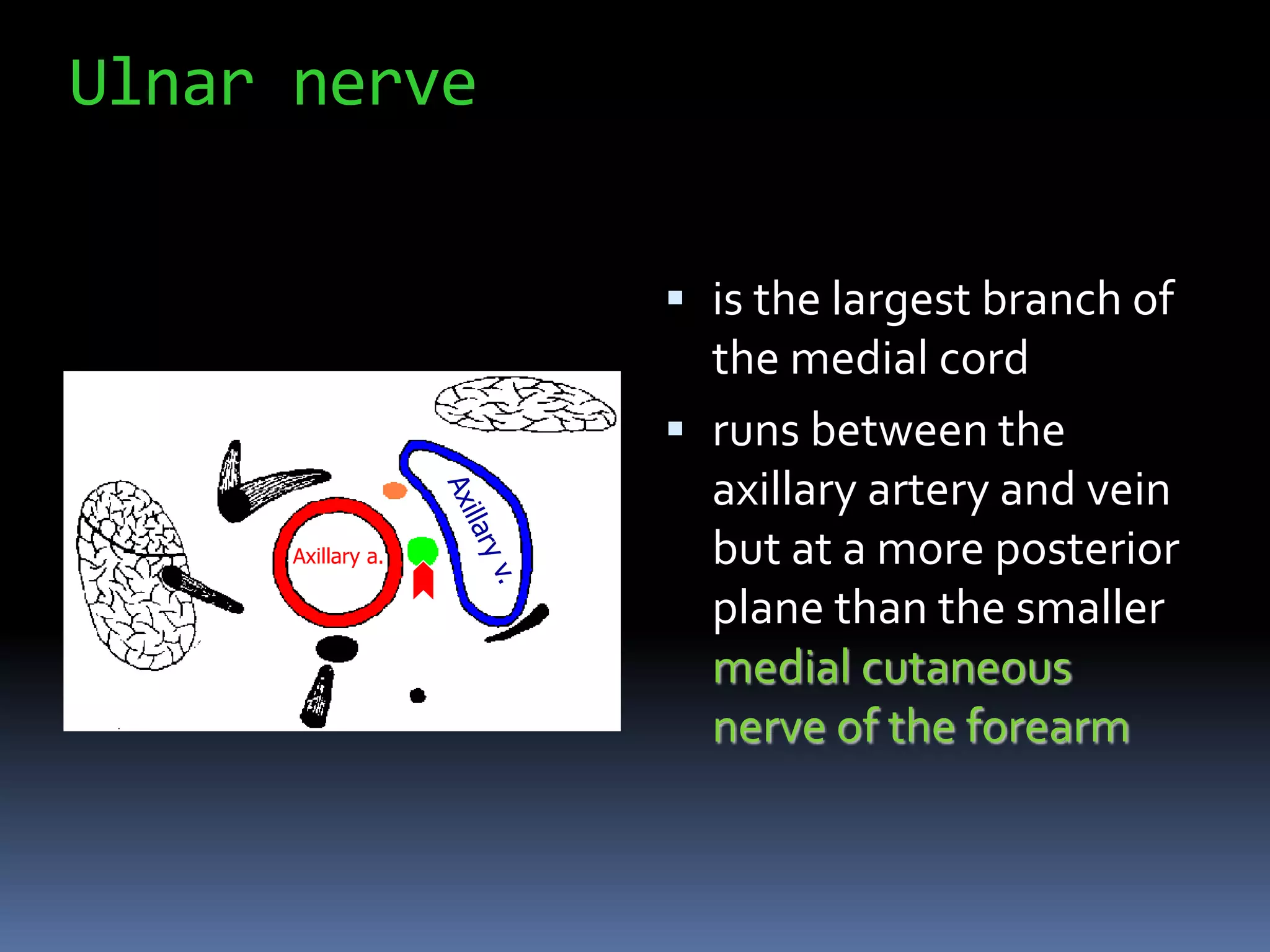
Ulnar nerve
 is the largest branch of
the medial cord
 runs between the
axillary artery and vein
but at a more posterior
plane than the smaller
medial cutaneous
nerve of the forearm
Axillary a.
Ulnar nerve
 receives a branch from
the lateral cord in more
than 90% of cases
 has no branches in the
axilla
 is mainly concerned
with the innervation of
the palm.
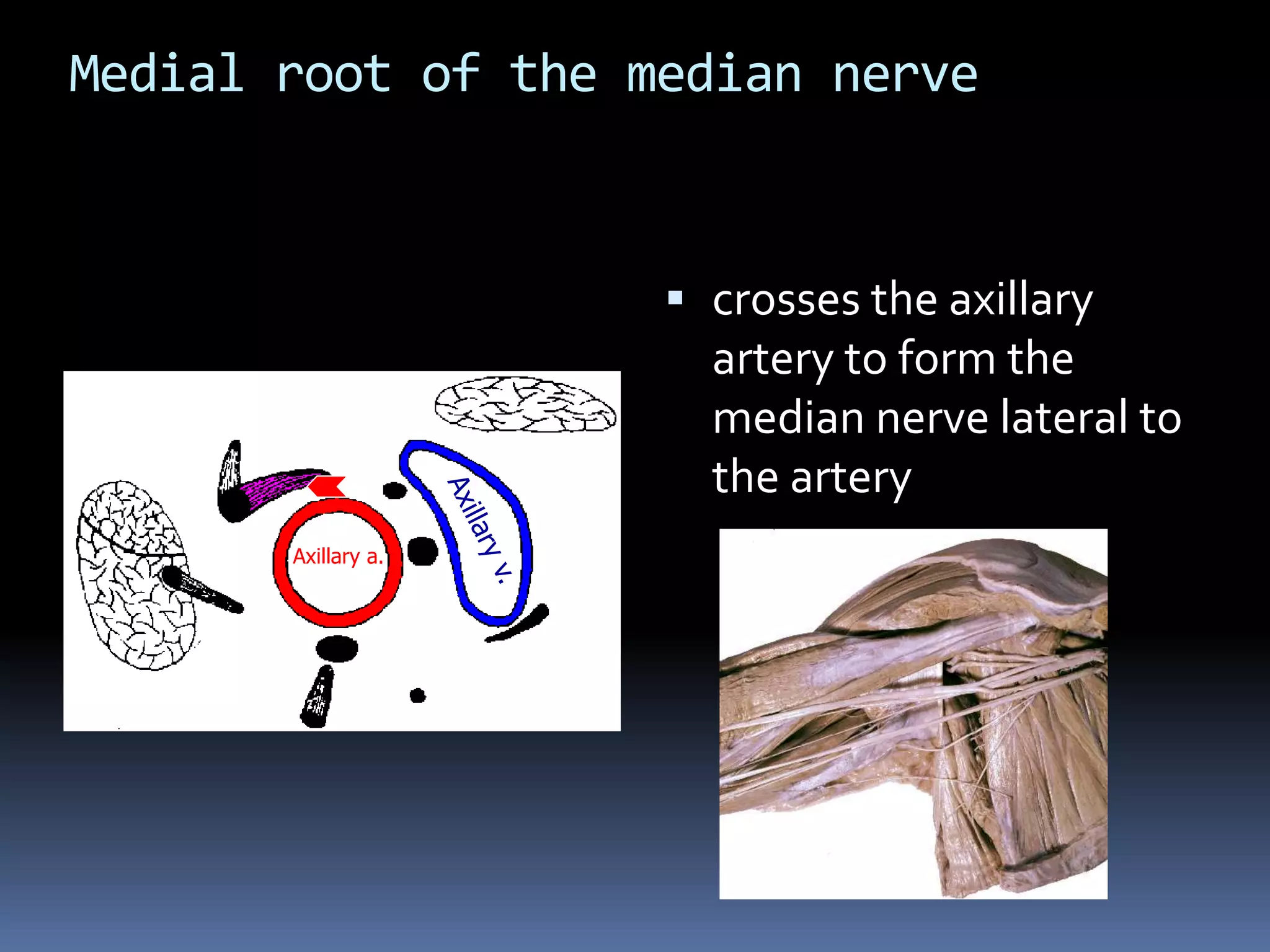
Medial root of the median nerve
 crosses the axillary
artery to form the
median nerve lateral to
the artery
Axillary a.
Branches of the brachial plexus
 Note that the
musculocutaneous,
median, and ulnar
nerve form the letter
M, which serves as the
key to the brachial
plexus
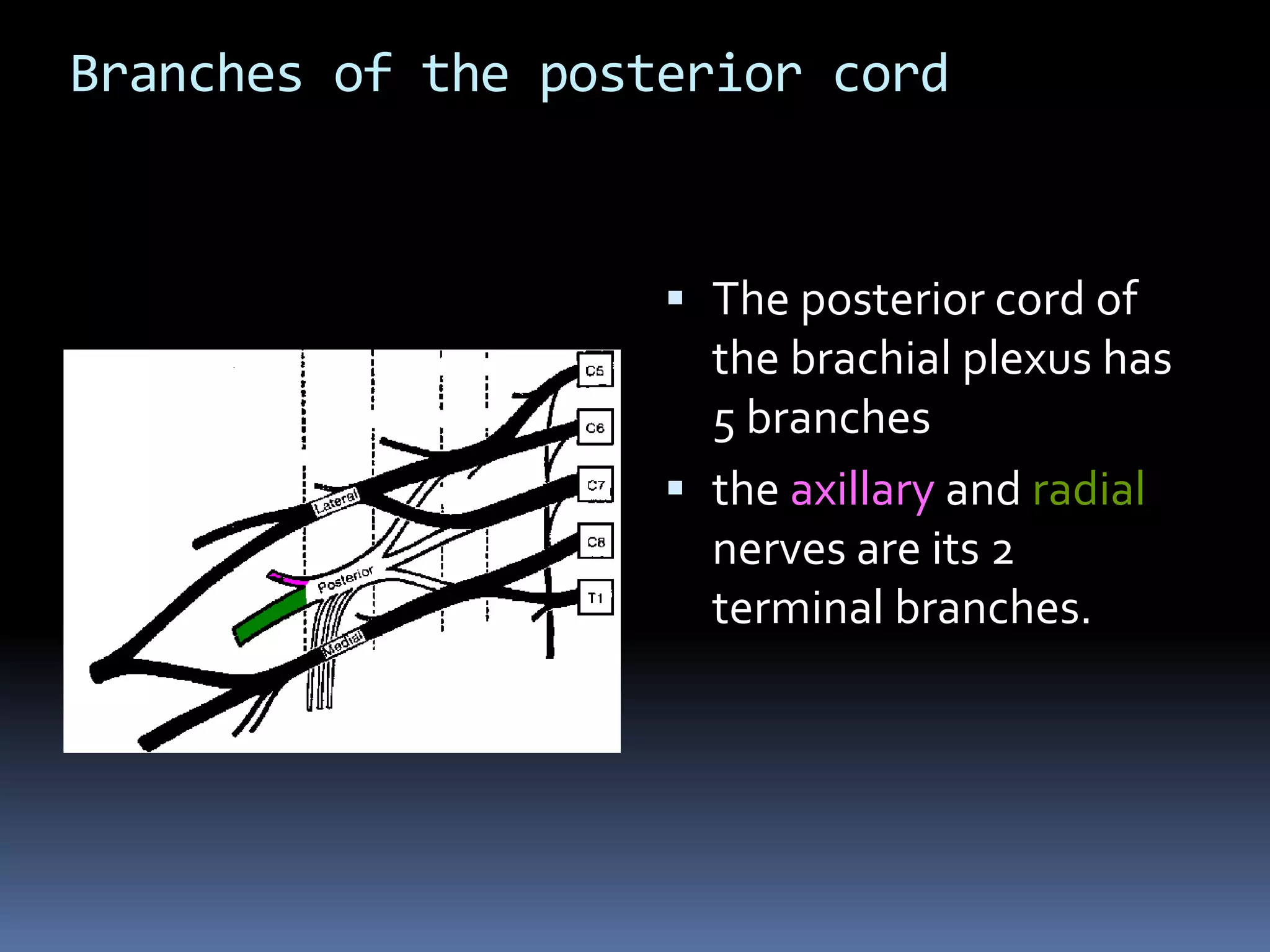
Branches of the posterior cord
 The posterior cord of
the brachial plexus has
5 branches
 the axillary and radial
nerves are its 2
terminal branches.
Upper and lower subscapular nerves
 The upper and lower
subscapular nerves
supply the upper and
lower parts of
subscapularis
muscle
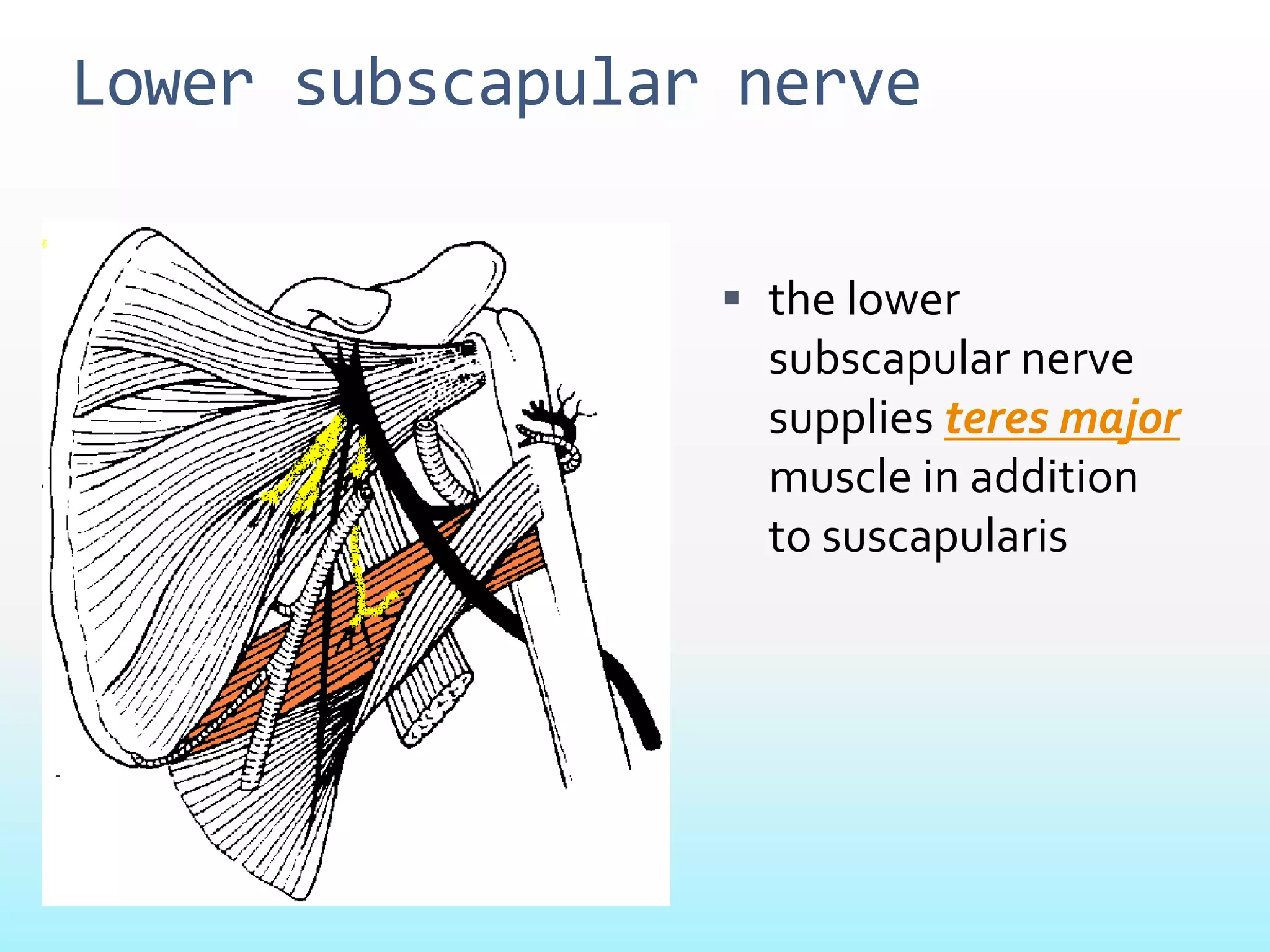
Lower subscapular nerve
 the lower
subscapular nerve
supplies teres major
muscle in addition
to suscapularis
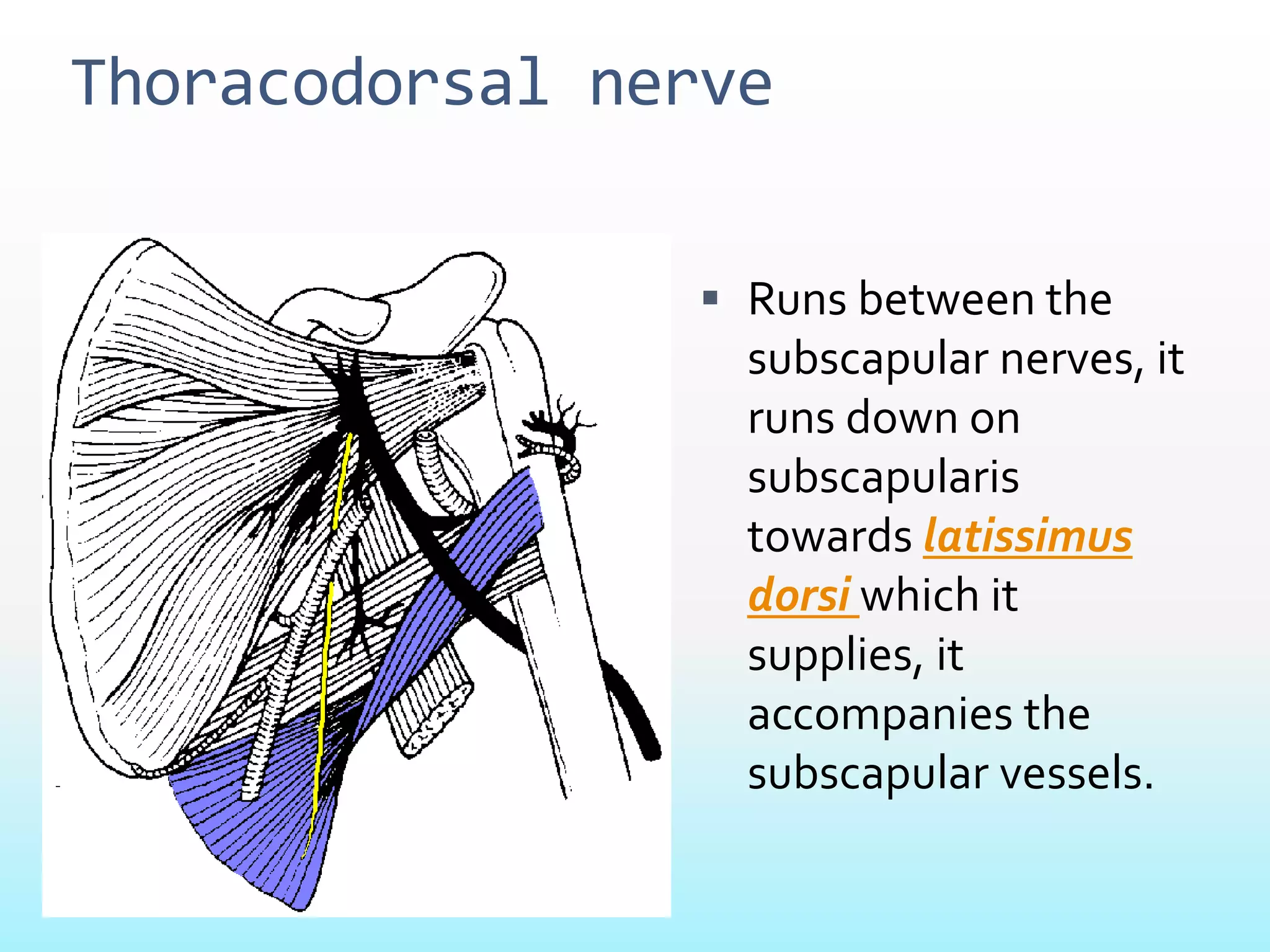
Thoracodorsal nerve
 Runs between the
subscapular nerves, it
runs down on
subscapularis
towards latissimus
dorsi which it
supplies, it
accompanies the
subscapular vessels.
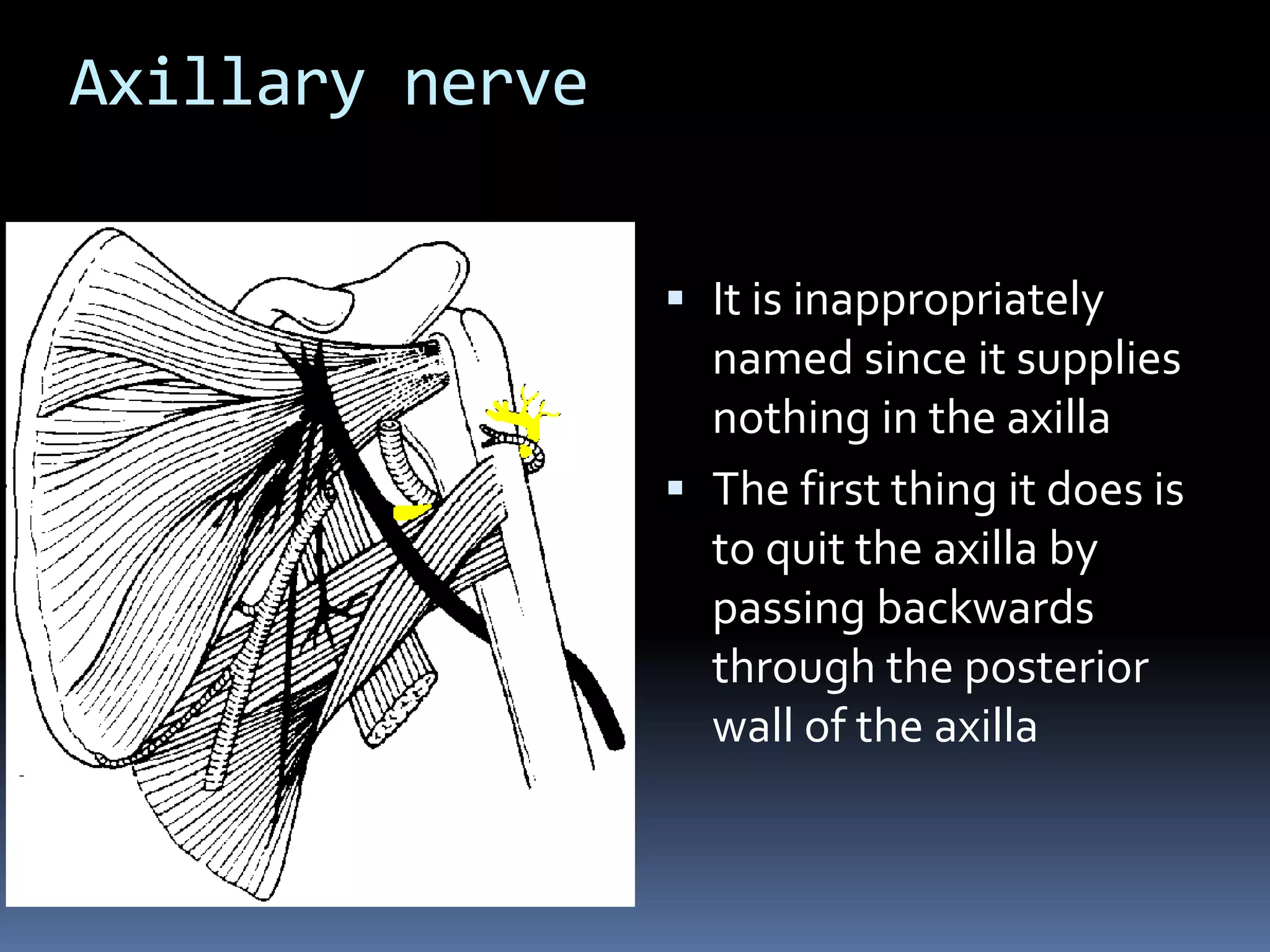
Axillary nerve
 It is inappropriately
named since it supplies
nothing in the axilla
 The first thing it does is
to quit the axilla by
passing backwards
through the posterior
wall of the axilla
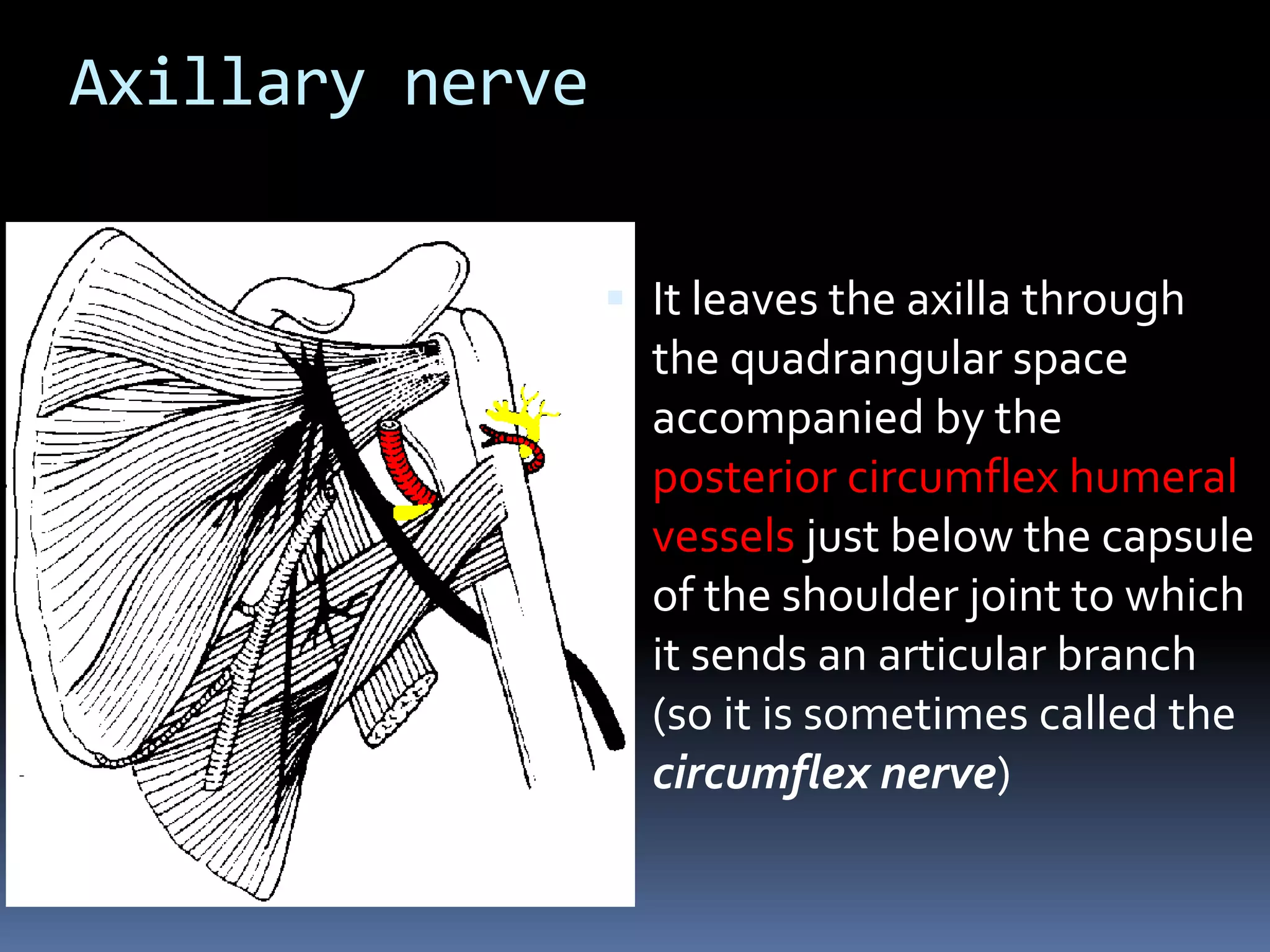
Axillary nerve
 It leaves the axilla through
the quadrangular space
accompanied by the
posterior circumflex humeral
vessels just below the capsule
of the shoulder joint to which
it sends an articular branch
(so it is sometimes called the
circumflex nerve)
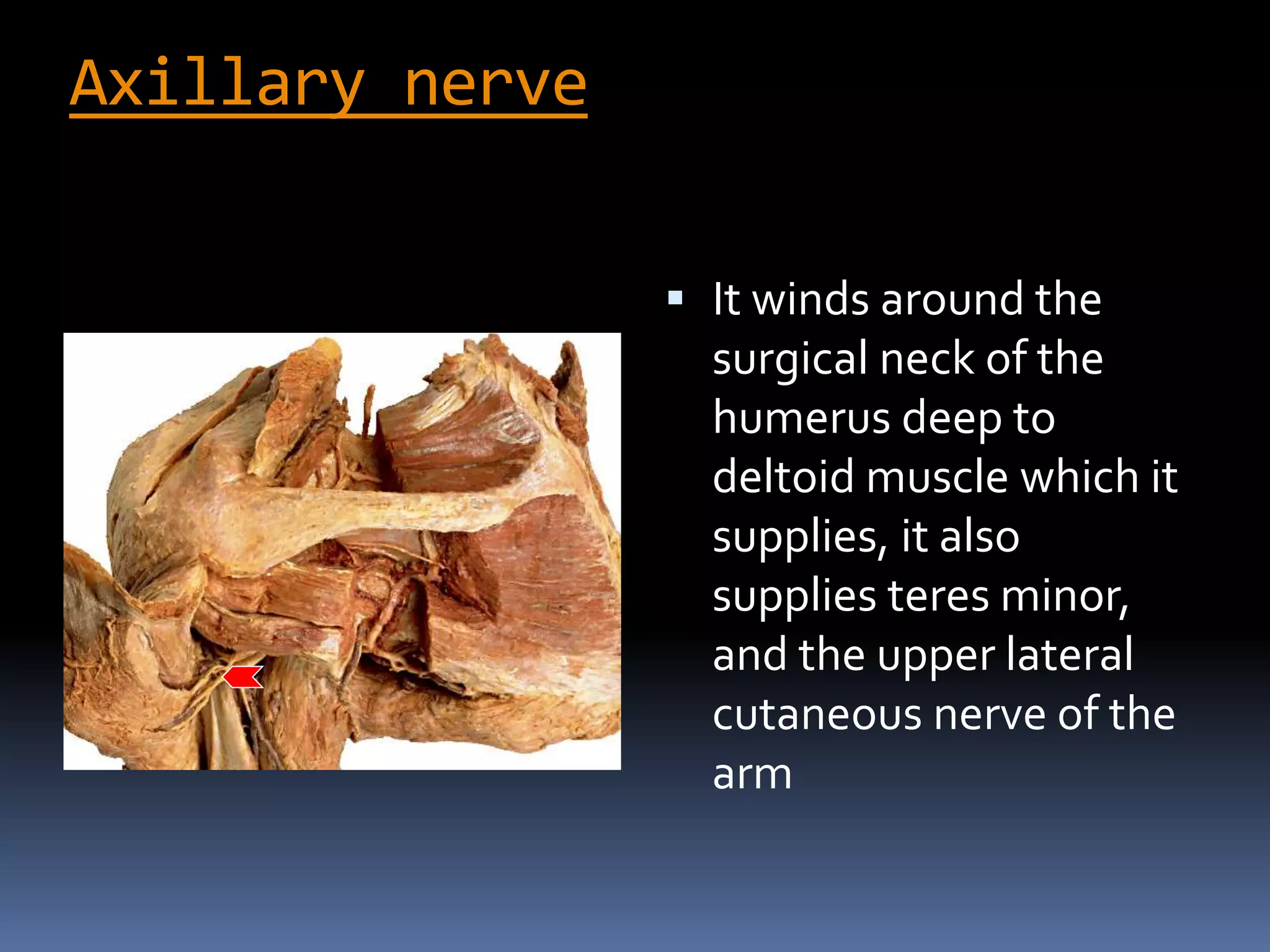
Axillary nerve
 It winds around the
surgical neck of the
humerus deep to
deltoid muscle which it
supplies, it also
supplies teres minor,
and the upper lateral
cutaneous nerve of the
arm
Radial nerve
 The radial nerve
provides the major
nerve supply of the
extensor muscles of
the upper limb (arm
and forearm)
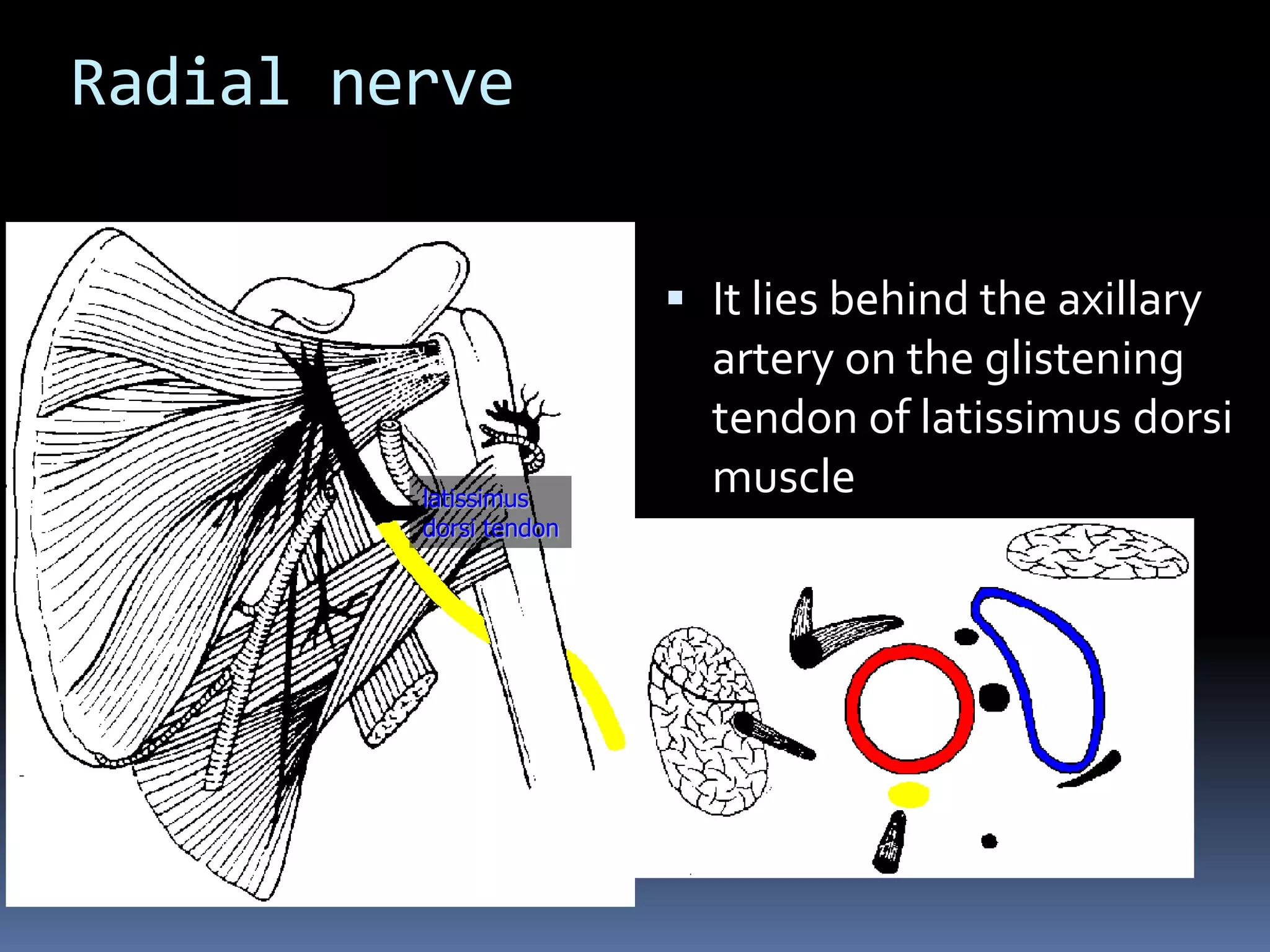
Radial nerve
 It lies behind the axillary
artery on the glistening
tendon of latissimus dorsi
musclelatissimus
dorsi tendon
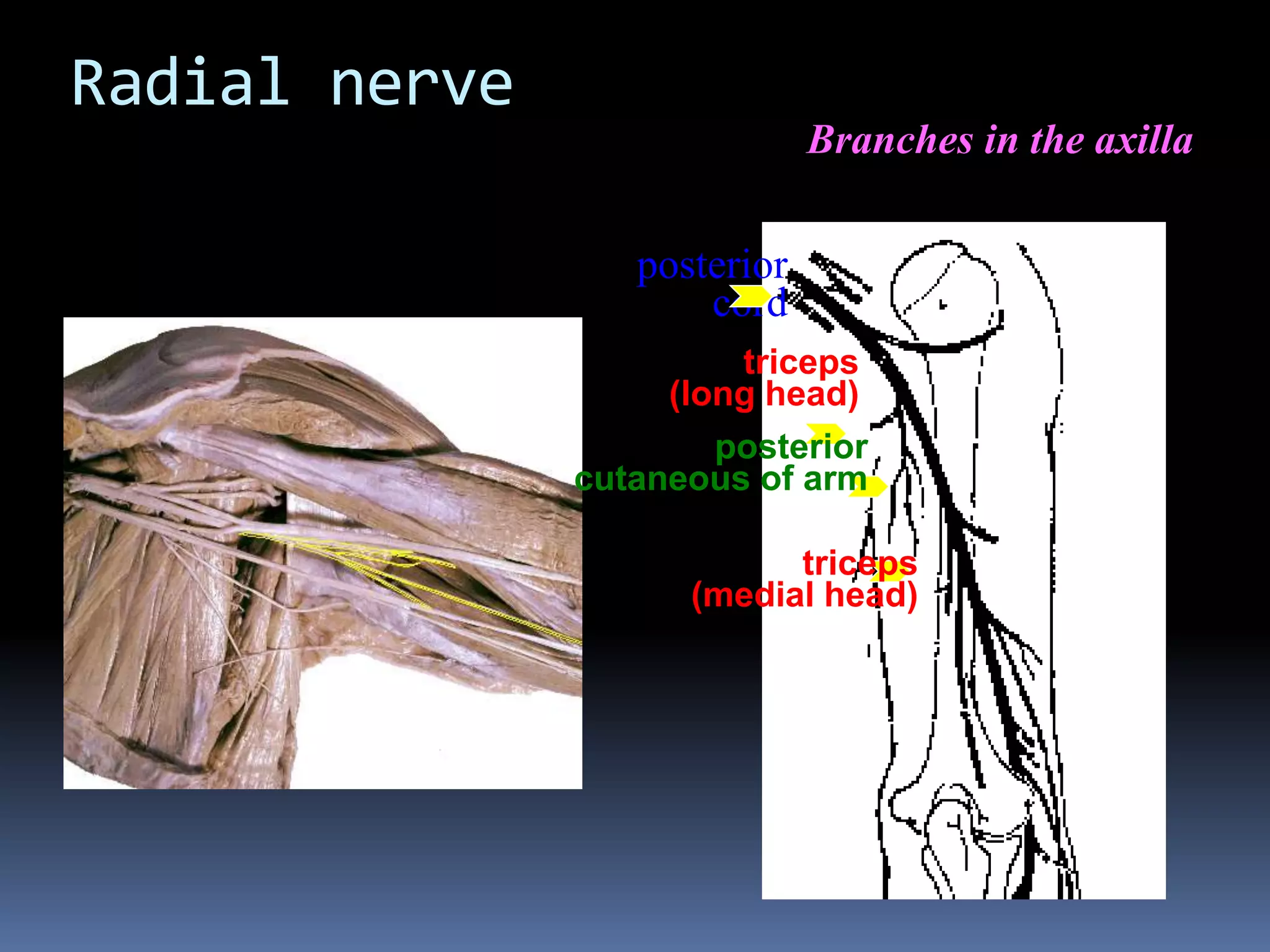
Radial nerve
posterior
cord
triceps
(long head)
posterior
cutaneous of arm
triceps
(medial head)
Branches in the axilla
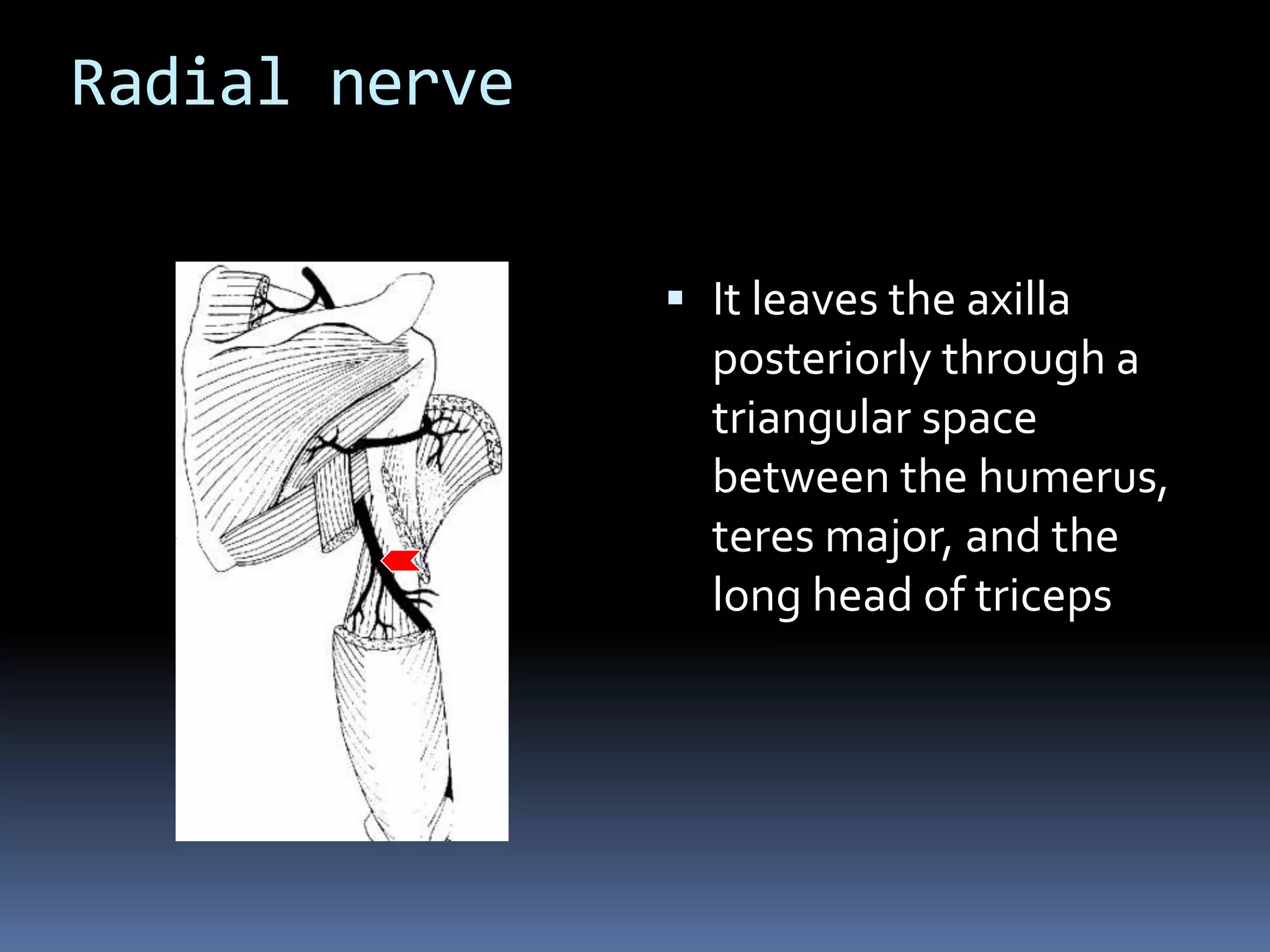
Radial nerve
 It leaves the axilla
posteriorly through a
triangular space
between the humerus,
teres major, and the
long head of triceps
Variants of normal anatomy –
Expanded plexus
 Prefixed plexus – substantial contribution from
C4 with smallT1 contribution.
 Postfixed plexus – MajorT2 contribution with
small C5 contribution.
Brachial plexus
injuries
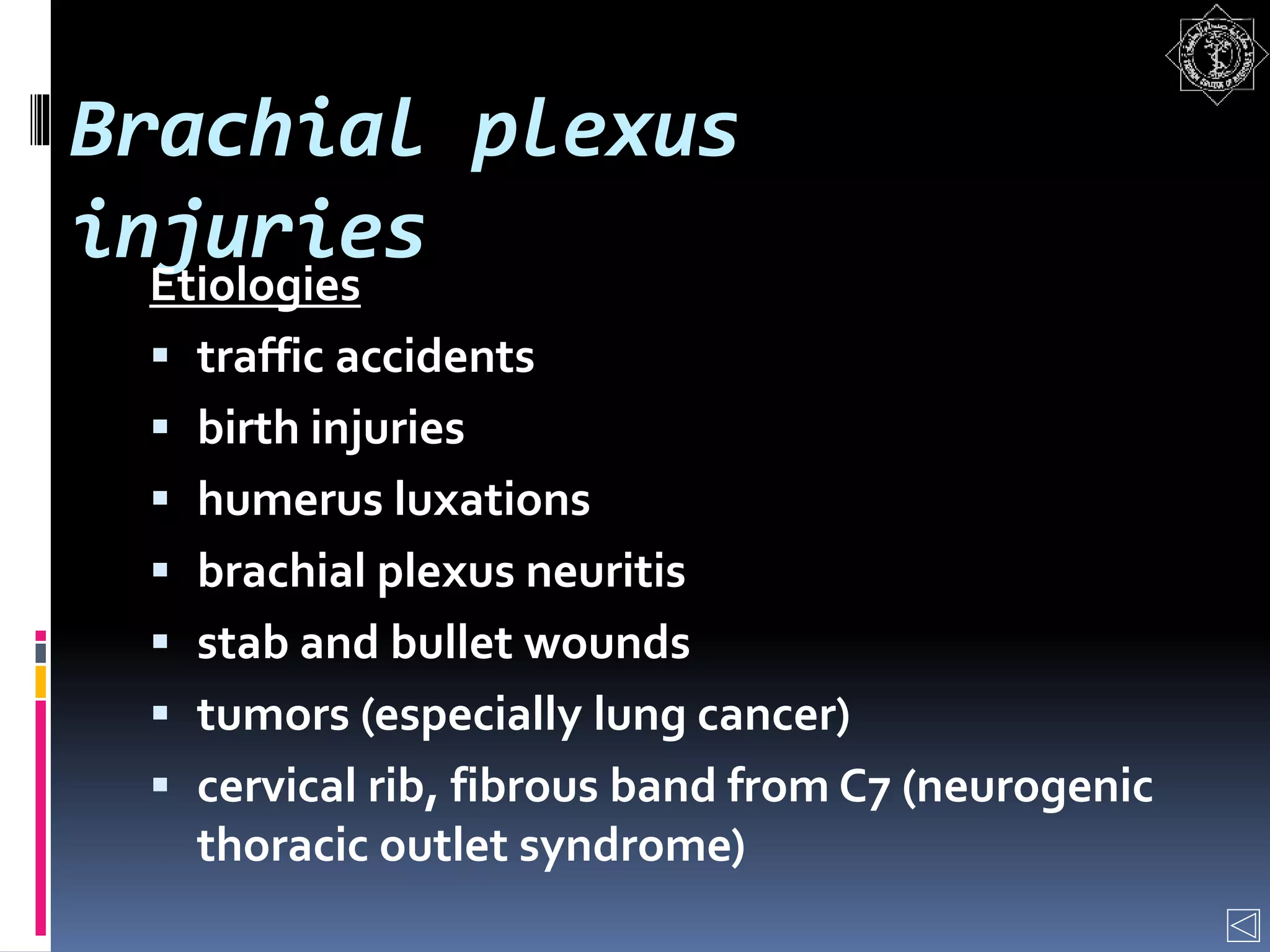
Etiologies
 traffic accidents
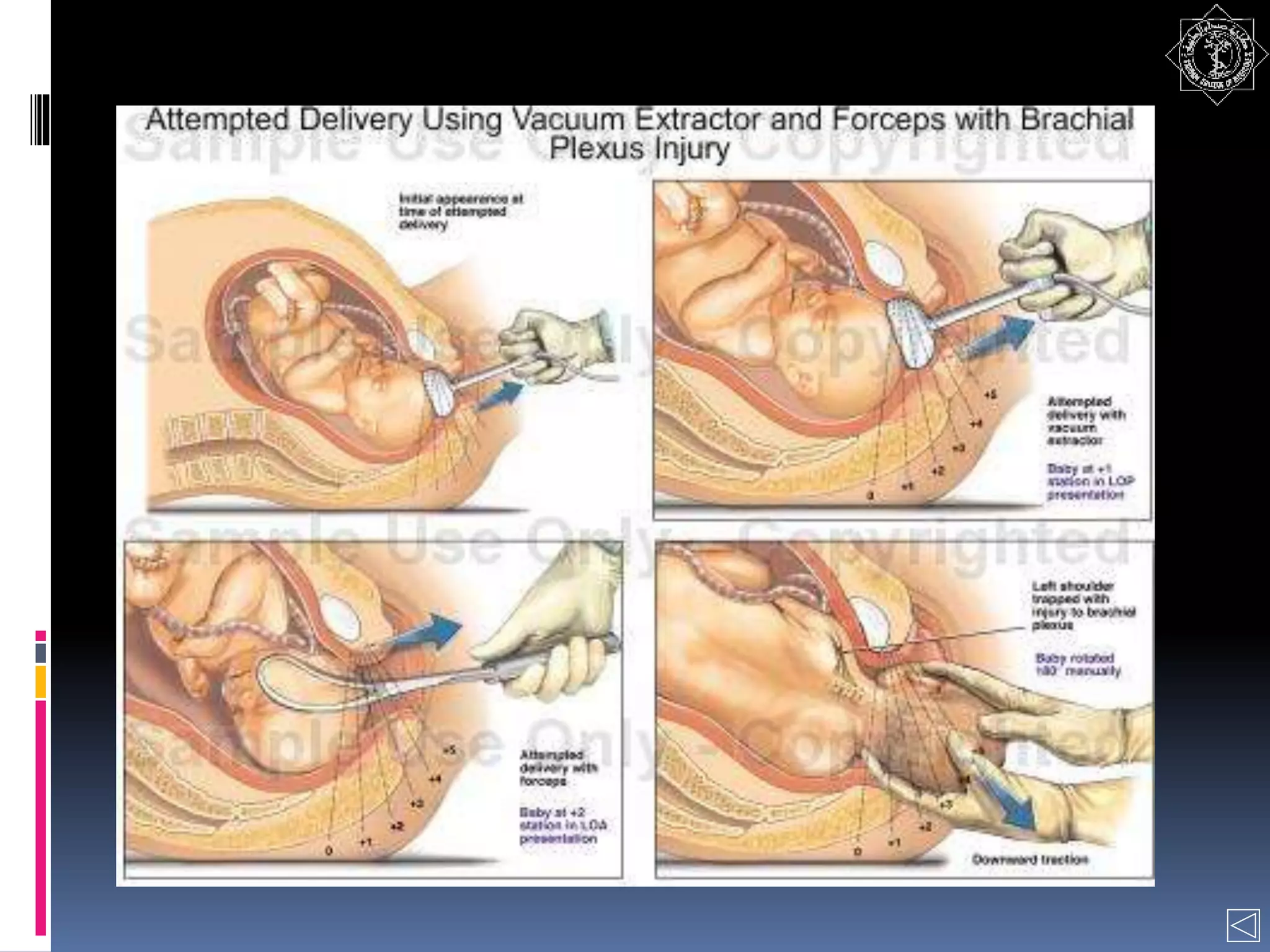
 birth injuries
 humerus luxations
 brachial plexus neuritis
 stab and bullet wounds
 tumors (especially lung cancer)
 cervical rib, fibrous band from C7 (neurogenic
thoracic outlet syndrome)
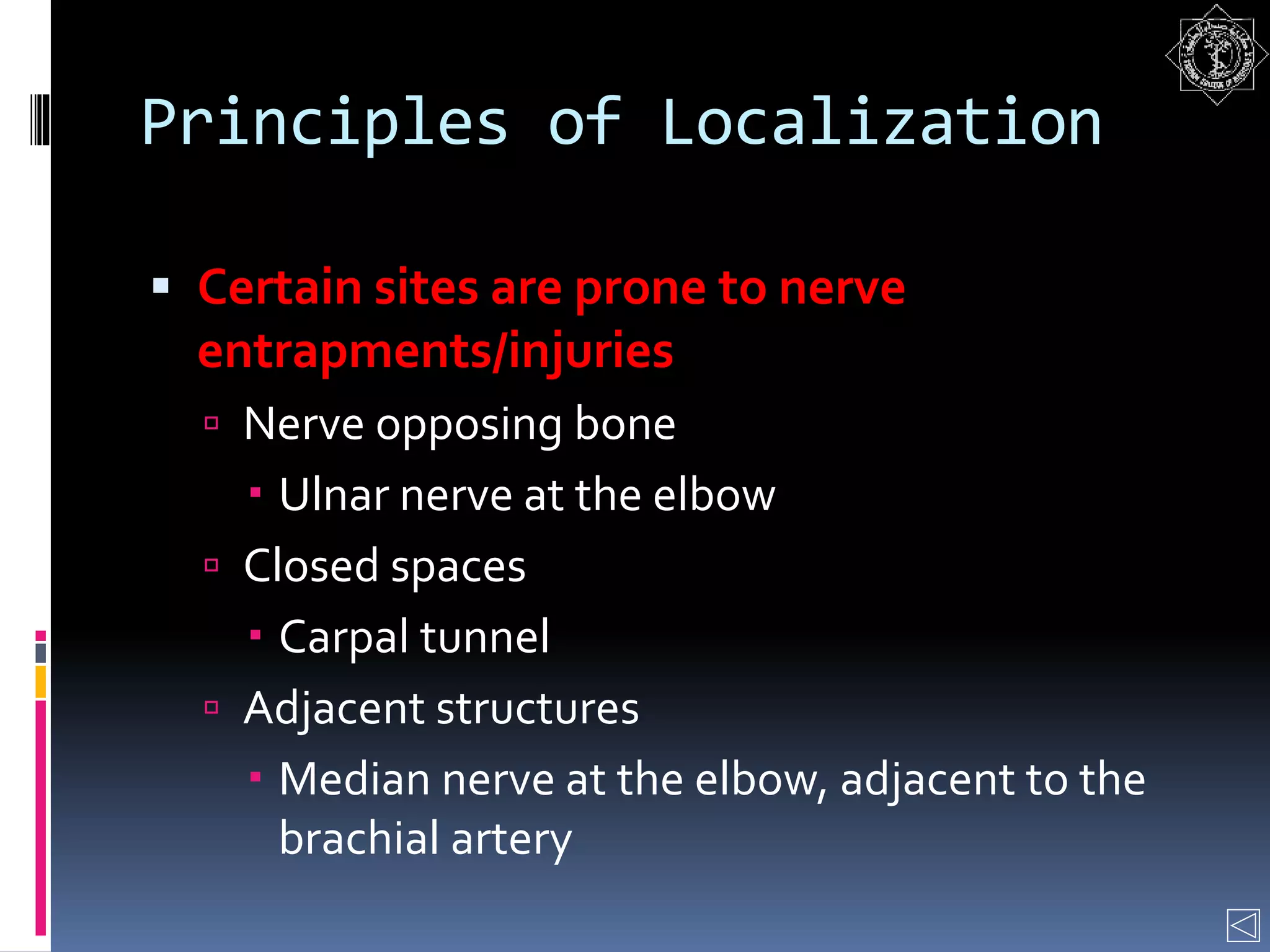
Principles of Localization
 Certain sites are prone to nerve
entrapments/injuries
 Nerve opposing bone
 Ulnar nerve at the elbow
 Closed spaces
 Carpal tunnel
 Adjacent structures
 Median nerve at the elbow, adjacent to the
brachial artery
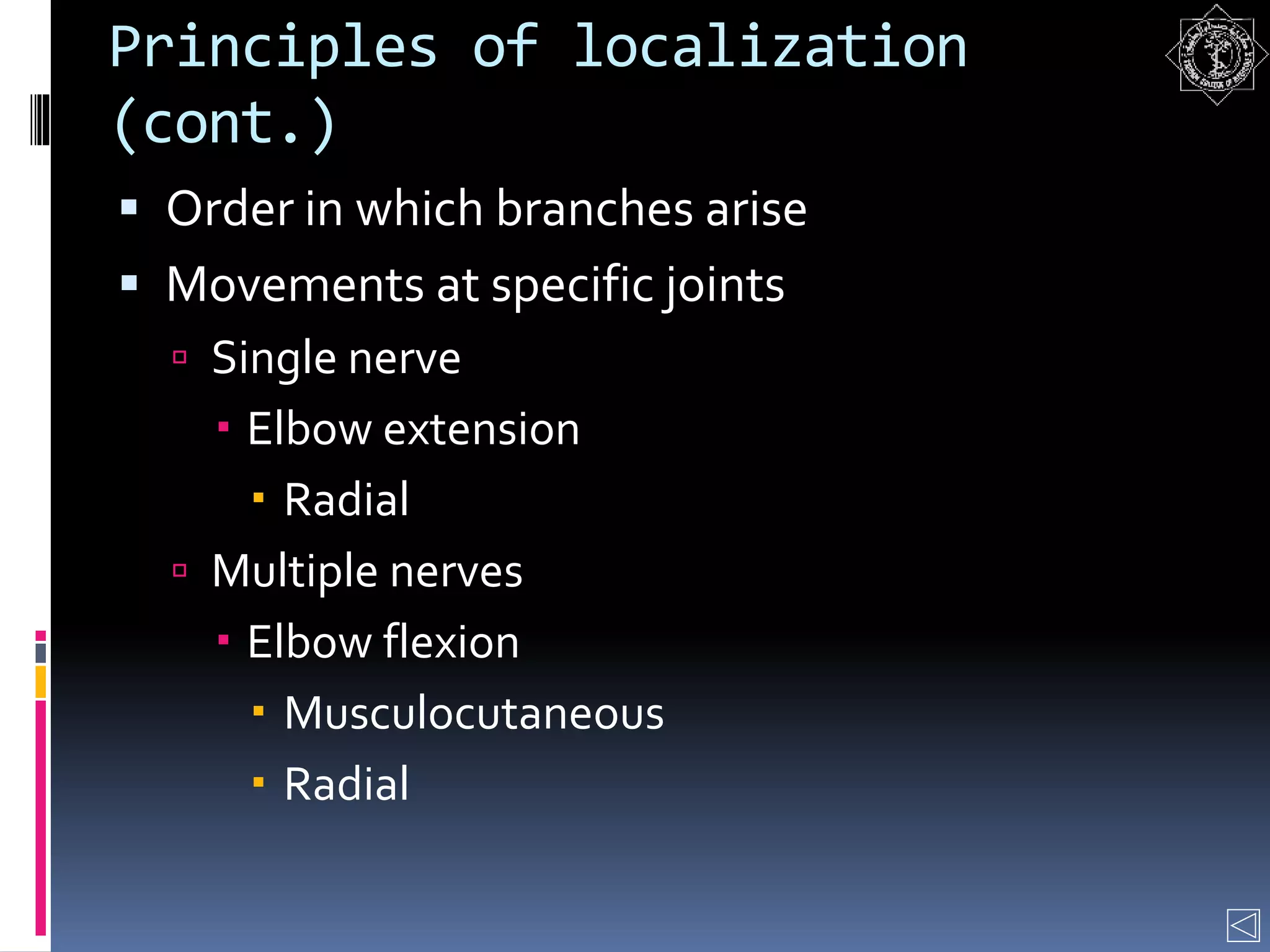
Principles of localization
(cont.)
 Order in which branches arise
 Movements at specific joints
 Single nerve
 Elbow extension
 Radial
 Multiple nerves
 Elbow flexion
 Musculocutaneous
 Radial
Brachial Plexus
Injuries
 Upper Lesions of the Brachial Plexus
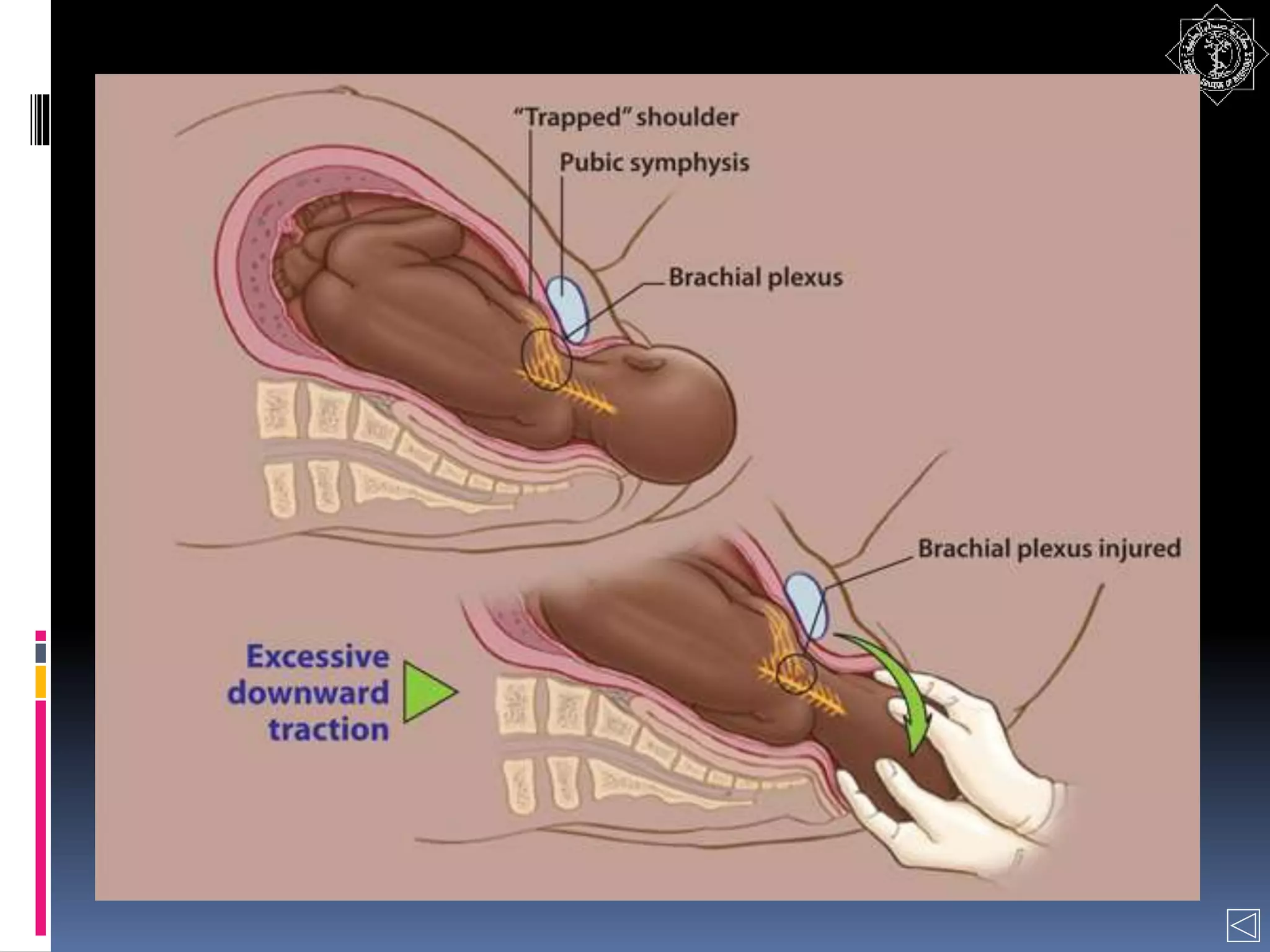
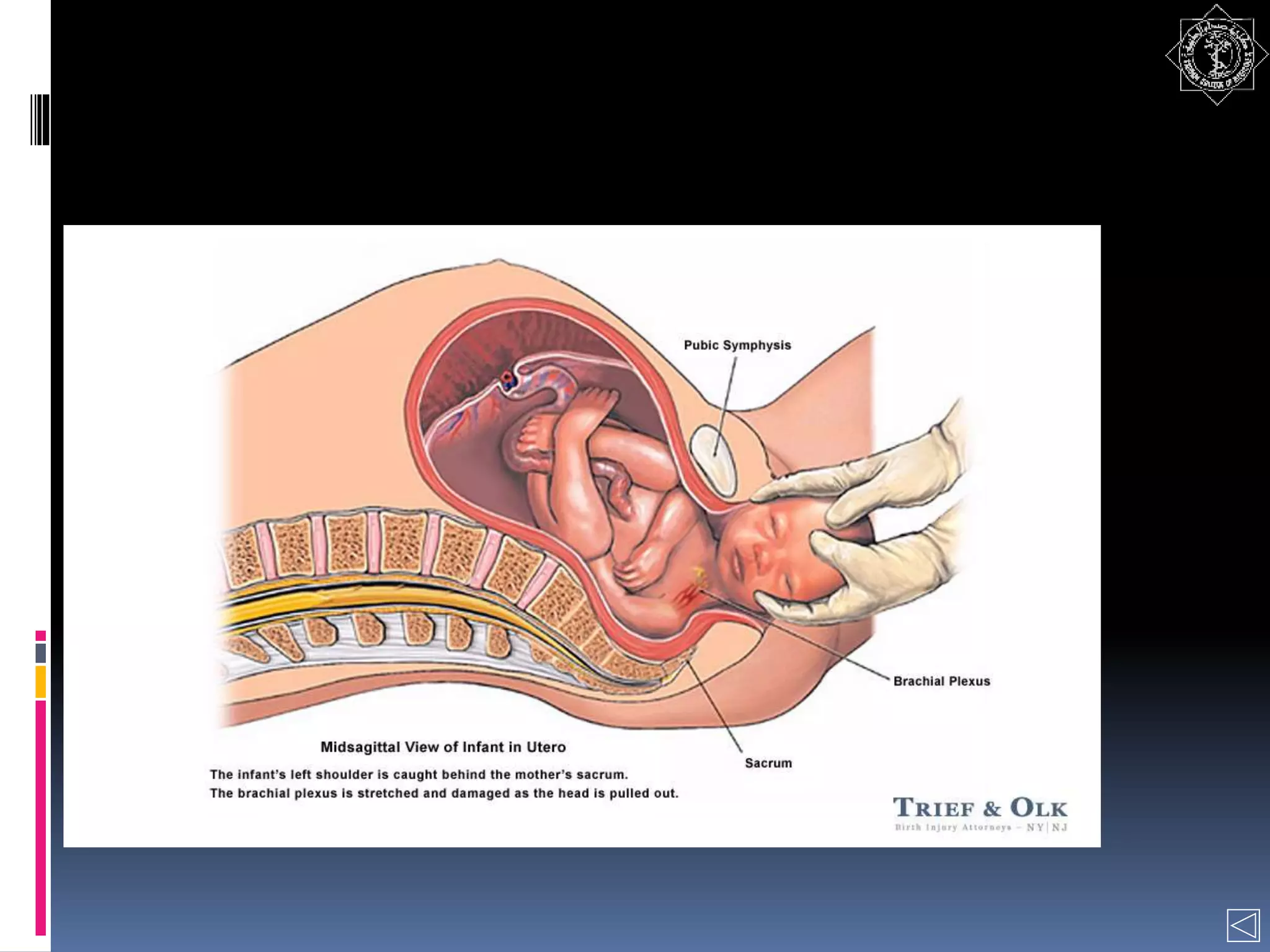
(Erb’s Palsy): resulting from excessive
displacement of the head to opposite side
and depression of shoulder on the same side.
This causes excessive traction or even
tearing of C5 and 6 roots of the
plexus. It occurs in infants during a
difficult delivery or in adults after a
blow to or fall on shoulder.
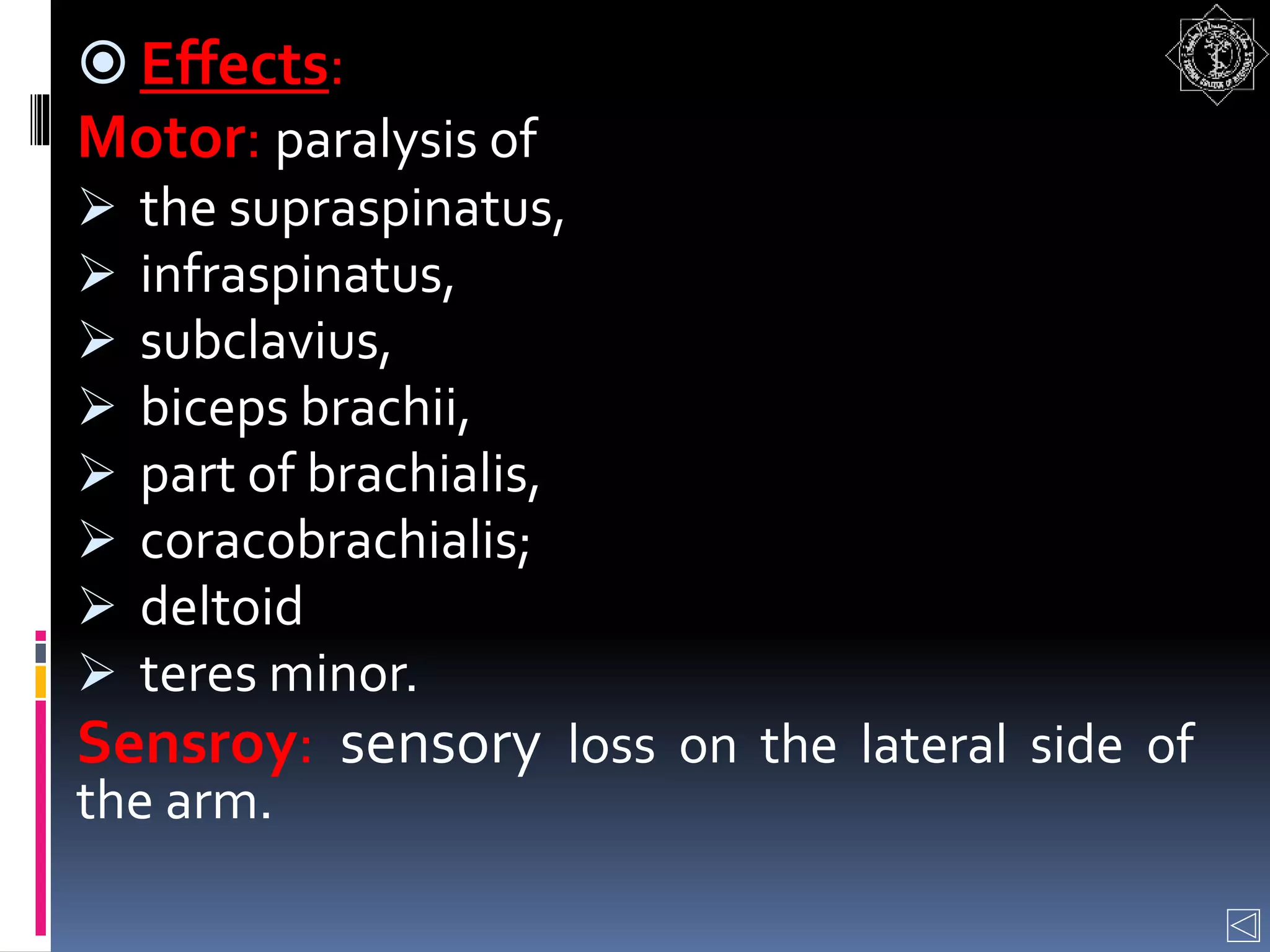
 Effects:
Motor: paralysis of
 the supraspinatus,
 infraspinatus,
 subclavius,
 biceps brachii,
 part of brachialis,
 coracobrachialis;
 deltoid
 teres minor.
Sensroy: sensory loss on the lateral side of
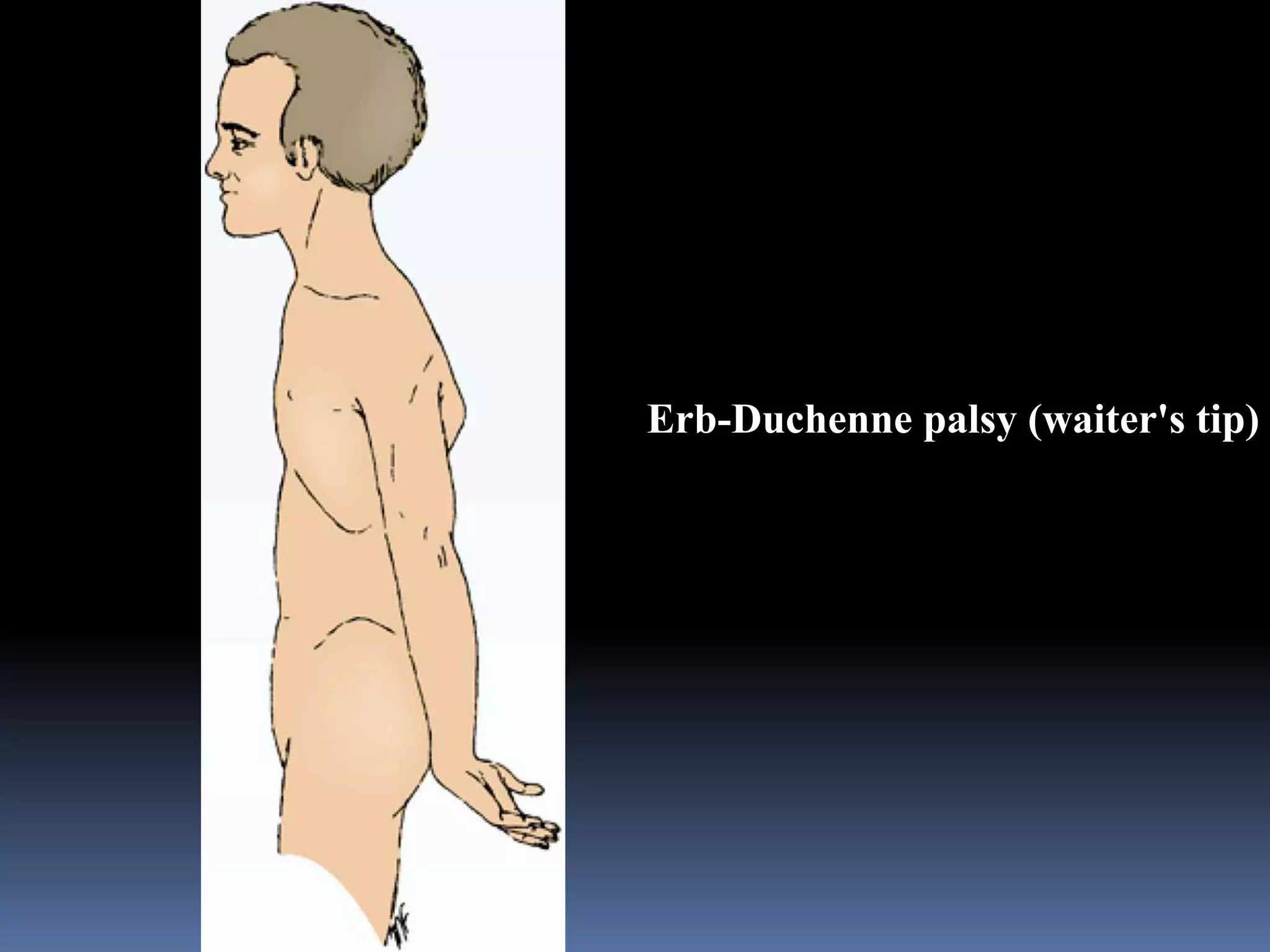
the arm.
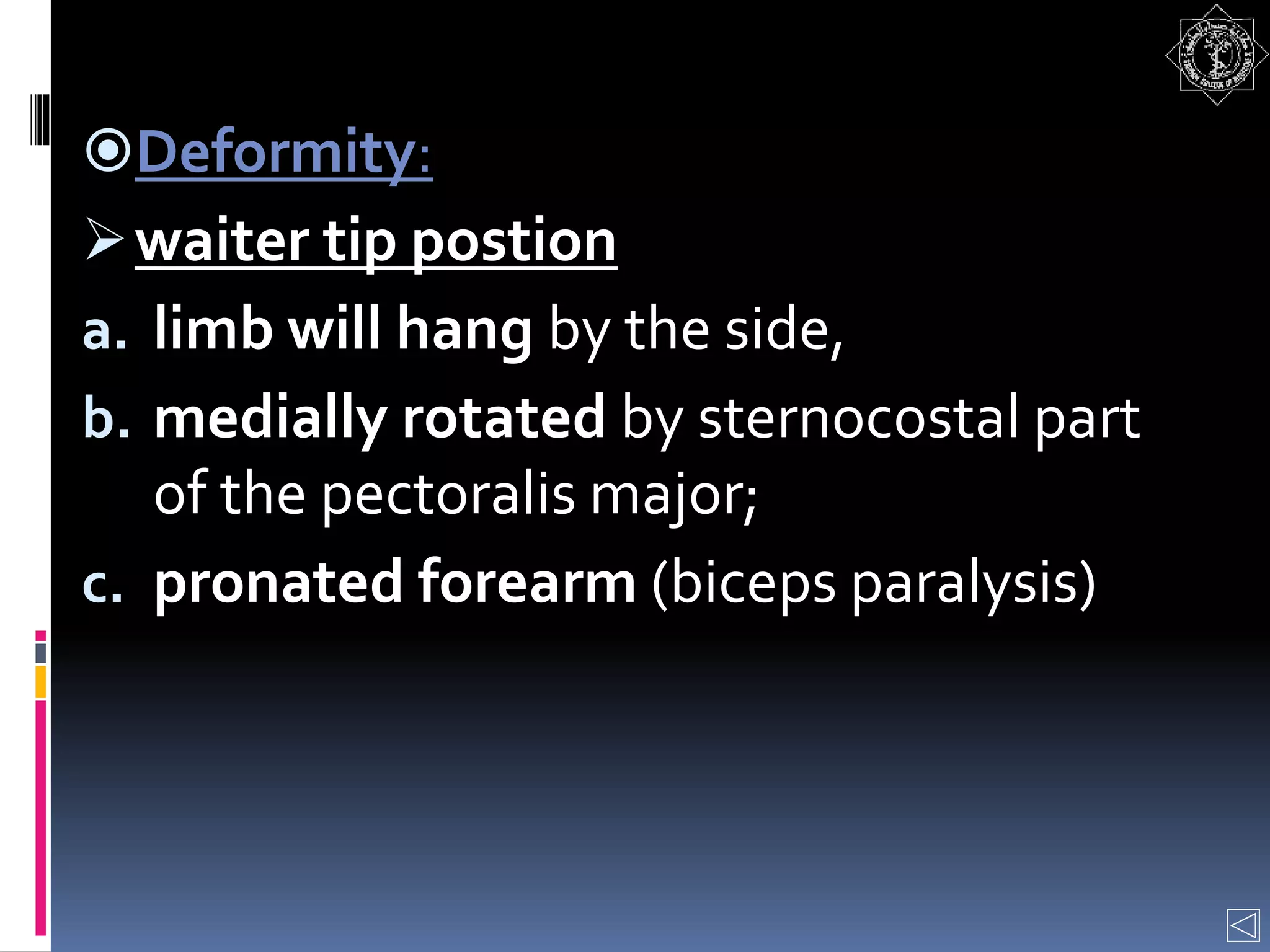
Deformity:
waiter tip postion
a. limb will hang by the side,
b. medially rotated by sternocostal part
of the pectoralis major;
c. pronated forearm (biceps paralysis)
Erb-Duchenne palsy (waiter's tip)
Lower Lesions of the Brachial Plexus
(Klumpke Palsy)
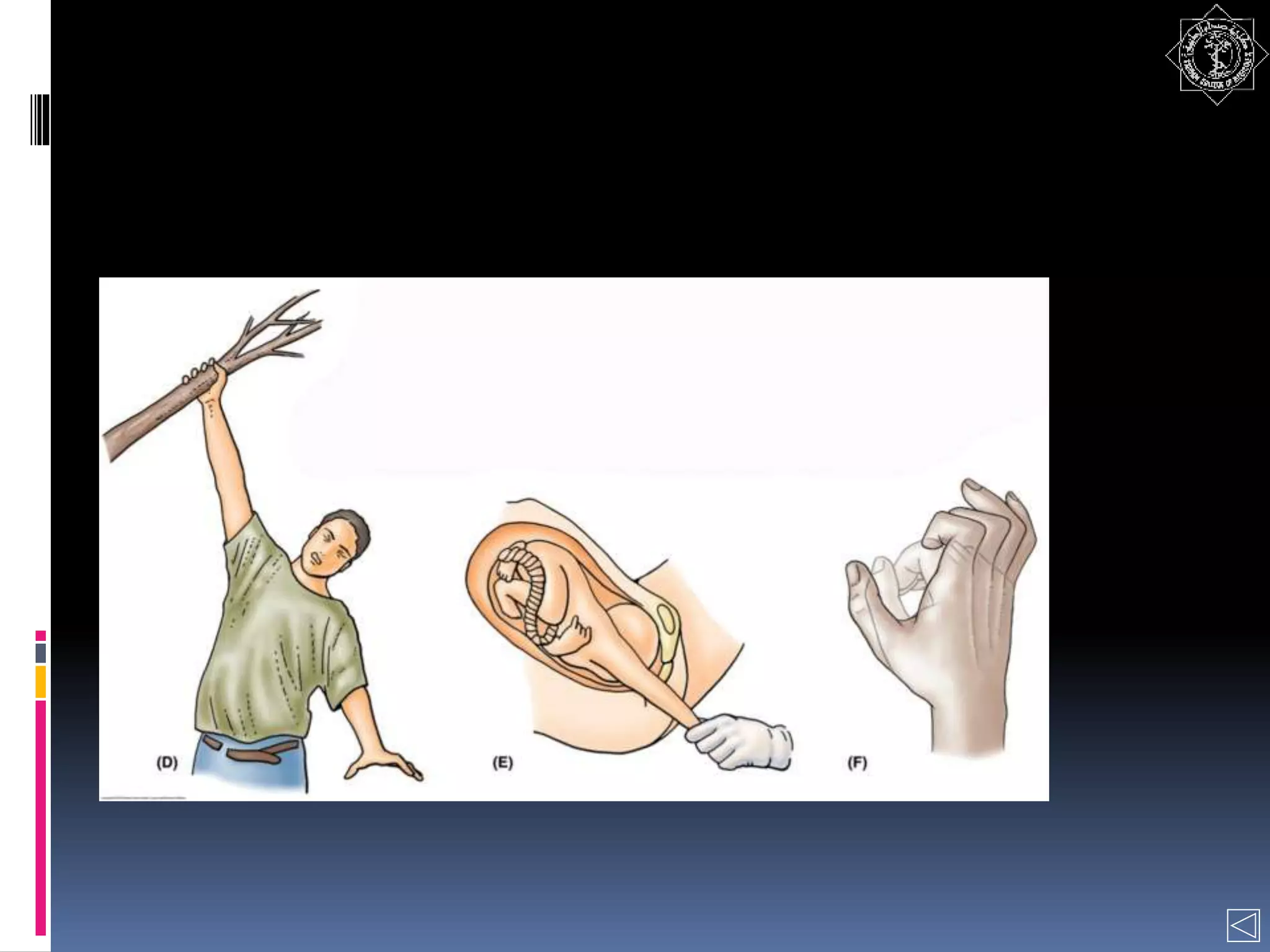
 traction injuries by excessive abduction of the
arm
 i.e. occurs if person falling from a height
clutching at an object to save himself or
herself.
 Can be caused by cervical rib.
 T1 is usually torn (ulnar and median nerves)
Motor Effects: paralysis of all the
small muscles of the hand.
Sensory effects: loss of sensation
along the medial side of the arm.
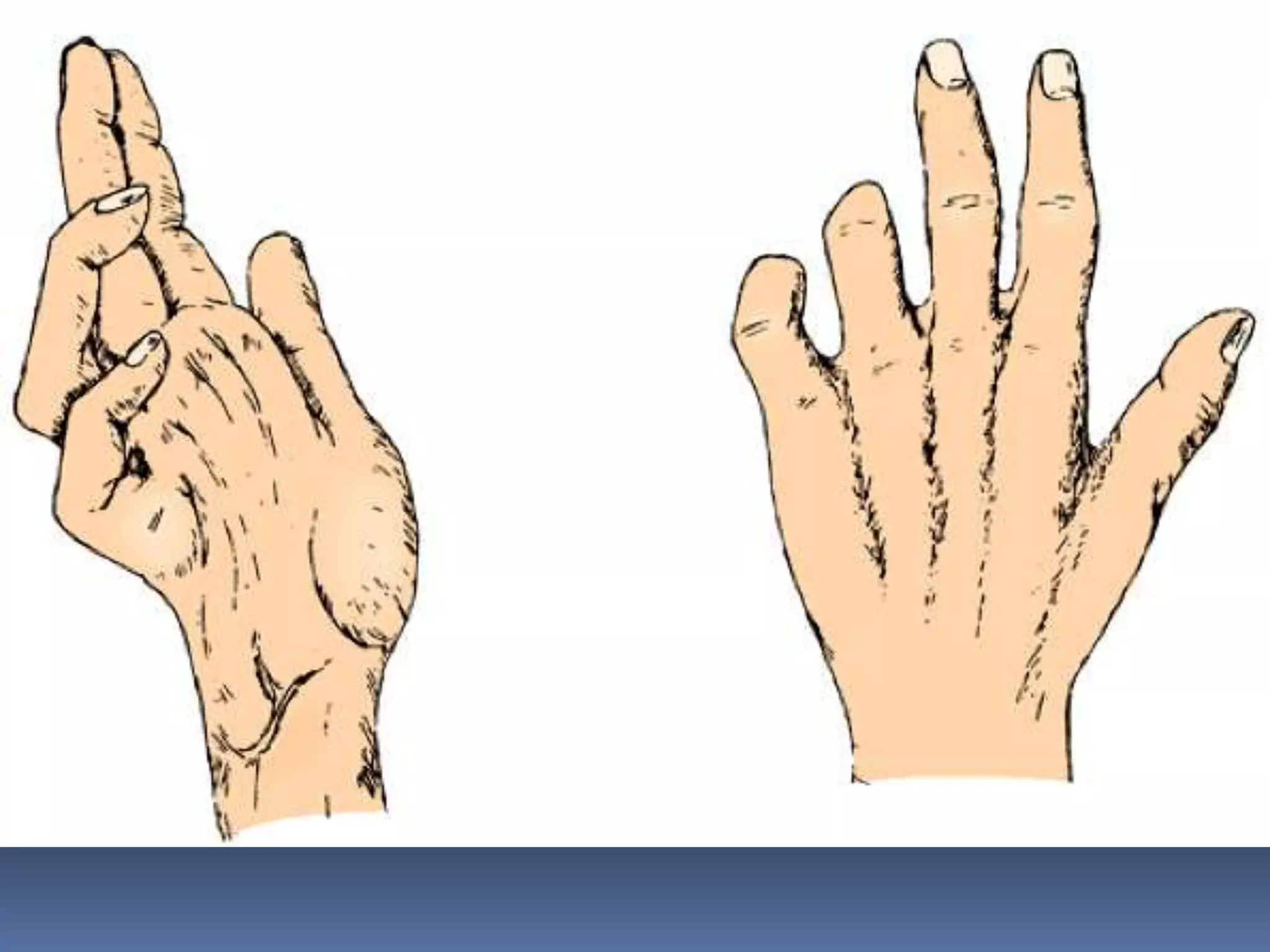
deformity: claw hand caused by
hyperextension of the
metacarpophalangeal joints and
flexion of the interphalangeal
joints.
Axillary Nerve
injury
Causes:
crutch pressing upward into the
armpit,
Downward shoulder dislocations
fractures of the surgical neck of the
humerus.
Motor effects:
Deltoid paralysis
teres minor paralysis.
Sensory effects:
loss of sensation at lower ½ of
deltoid
Deformity:
Wasting of deltoid
Radial Nerve injury
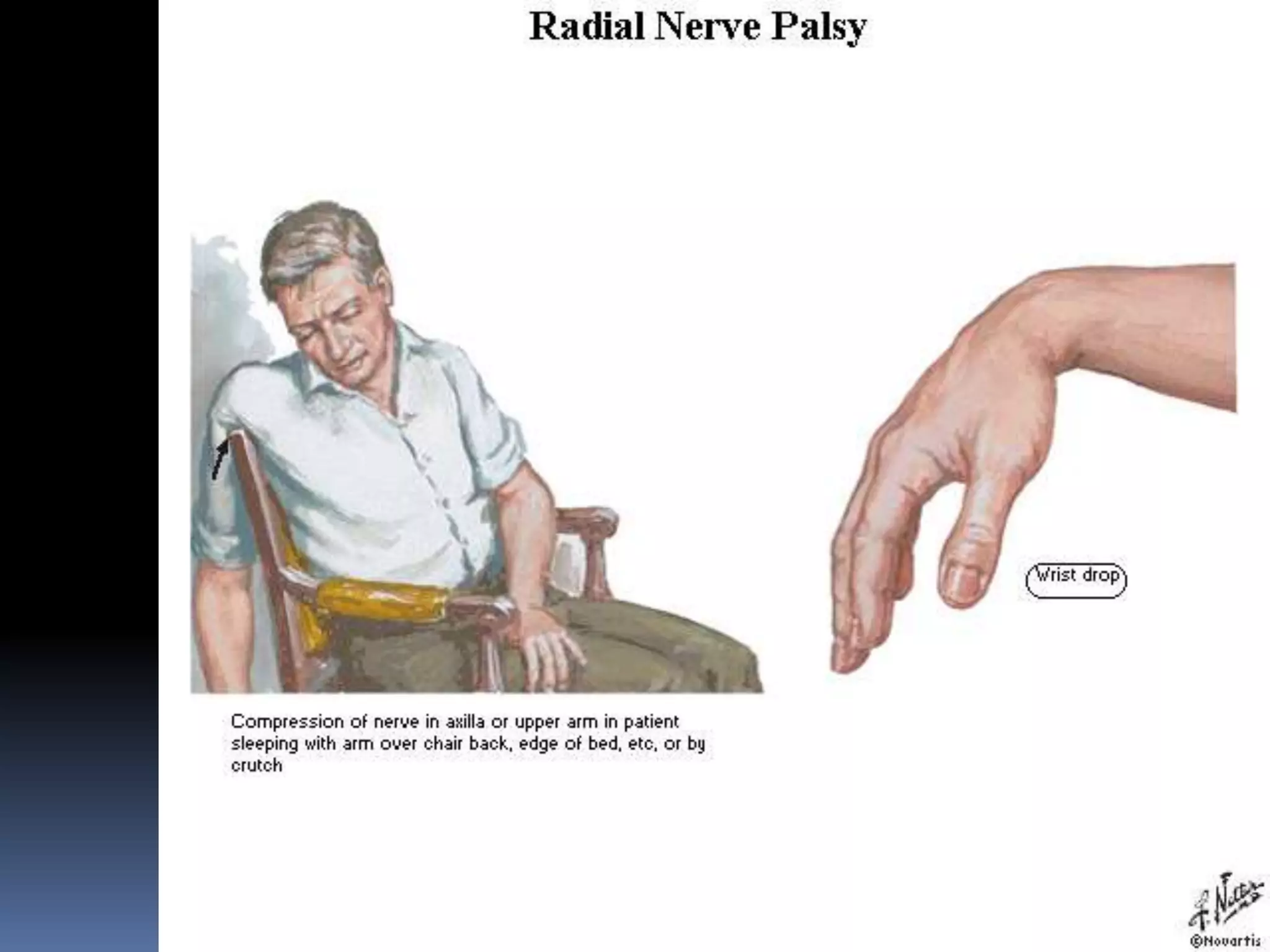
Injury in axilla :
 crutch pressing up into armpit
 drunkard falling asleep with one
arm over the back of a chair.
 fractures of proximal humerus.
 Motor effects:paralysis of
 triceps
 Anconeus
 extensors of the wrist
 Extensors of fingers.
 Brachioradialis
 supinator muscle
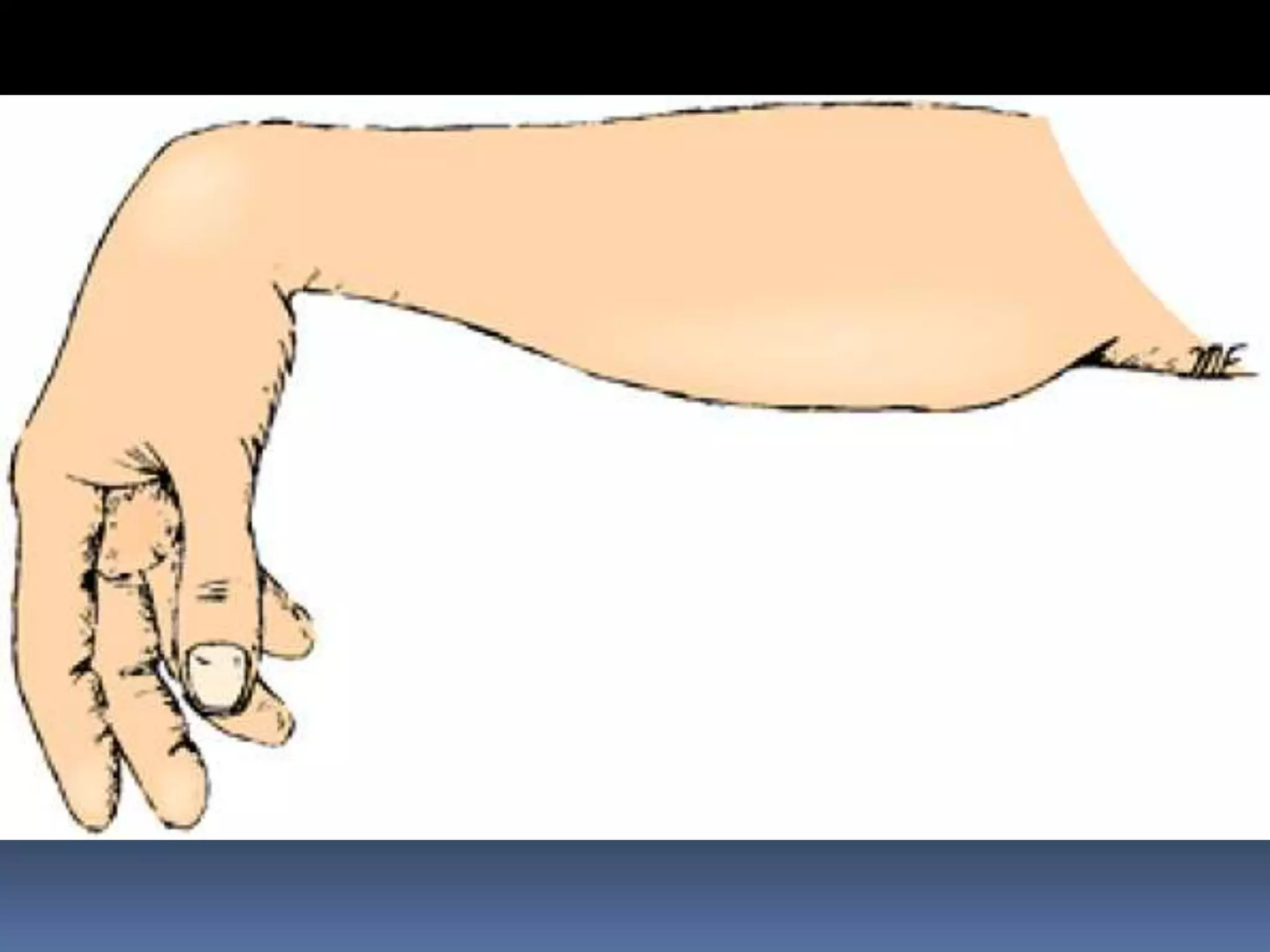
 Deformity: Wrist and finger
drop
Sensory effects :
small area of sansation loss
at arm and forearm
sensory loss over lateral part
of the dorsum of the hand
(lat. 3.5 fingers without distal
phalynges)
Injuries at Spiral Groove
Caused by fracture shaft of humerus.
 Motor effects: paralysis of
extensors of the wrist
Extensors of fingers
 Deformity:
Wrist and finger drop
 Sensory effects:
anesthesia is present over the dorsal
surface of the hand (lat. 3.5 fingers)
Median Nerve injury
Motor effects: paralysis of
pronator muscles
long flexor muscles of the wrist and
fingers,
Exception:
a. flexor carpi ulnaris
b. medial half flexor digitorum profundus.
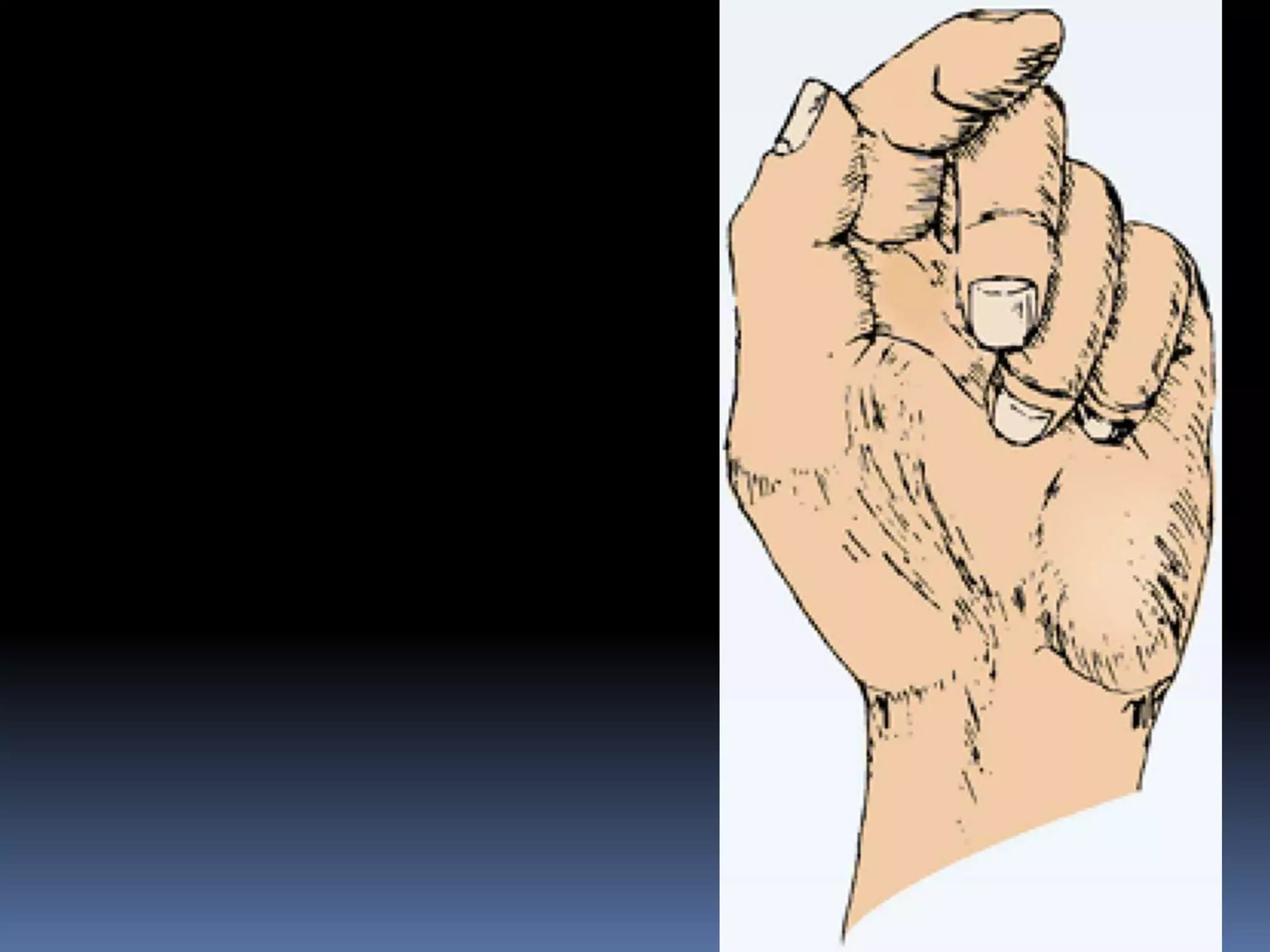
Deformity:
apelike hand
1. thenar muscles wasted
2. thumb is laterally rotated and
adducted.
3. index and to a lesser extent the
middle fingers tend to remain
straight on making
4. Weakening of lat. 2 fingers
Sensory:
Sensory loss on the lat. 3.5
fingers on palmar side
Sensory loss over distal
phalynges of lat. 4 fingers on
dorsal surface
Ulnar nerve injury
 Motor effects: paralysis of
 flexor carpi ulnaris
medial half of the flexor digitorum profundus
All interossei
3-4 lumbricals
 loss of abduction and adduction of fingers
 Wasting of hypothenar
 Deformity:
partial claw hand
 Sensory effects :
Sensory loss over 1.5 fingers on both
surfaces
CARPAL TUNNEL
 TUNNEL FORMED BETWEENTHE CONCAVITY OFTHE CARPAL BONES
AND A LIGAMENTTHAT COVERSTHIS( FLEXOR RETINACULAM)
 TENDONS OFTHE FLEXORS PASSTHROUGH
 MEDIAN NERVEALSO PASSESTHROUGH
 CROWDEDTUNNEL
CARPALTUNNEL SYNDROME
- CAUSED DUETO COMPRESSIONOFTHE NERVE INTHETUNNEL
- CAUSES-
- 1. SWELLING OFTHETEDONS( OVERUSE)
- 2. PREGNANCY( EDEMA)
- 3. ARTHRITIS
SYMPTOMS-TINGLING OR NUMBNESS-LATERAL PART OF HAND,
WEAKNESS INTHUMB MOVEMENT
TREATMENT- REST, SPLINTING,ANTI-INFLAMMATORY DRUGS, SURGERY
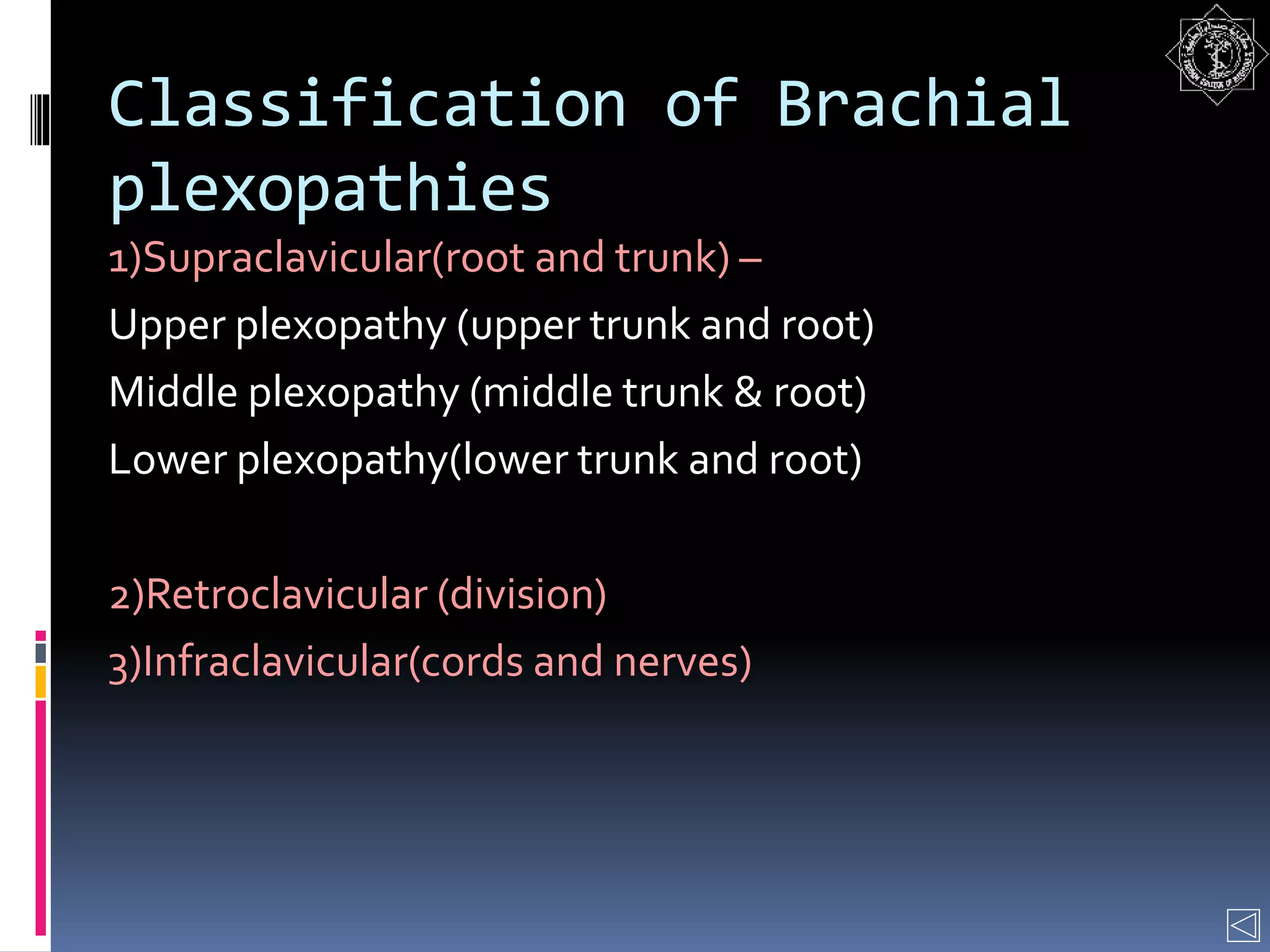
Classification of Brachial
plexopathies
1)Supraclavicular(root and trunk) –
Upper plexopathy (upper trunk and root)
Middle plexopathy (middle trunk & root)
Lower plexopathy(lower trunk and root)
2)Retroclavicular (division)
3)Infraclavicular(cords and nerves)
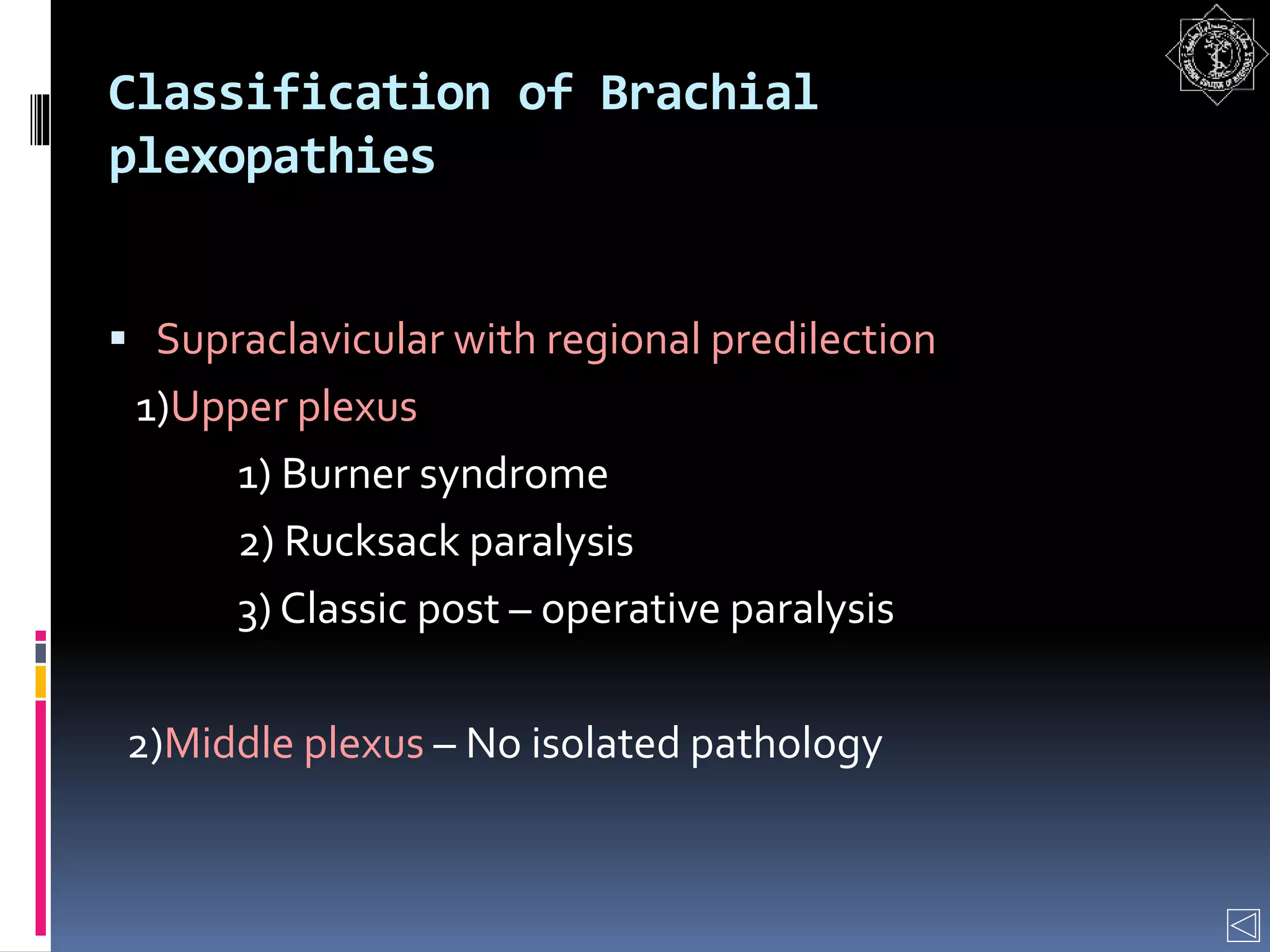
Classification of Brachial
plexopathies
 Supraclavicular with regional predilection
1)Upper plexus
1) Burner syndrome
2) Rucksack paralysis
3) Classic post – operative paralysis
2)Middle plexus – No isolated pathology
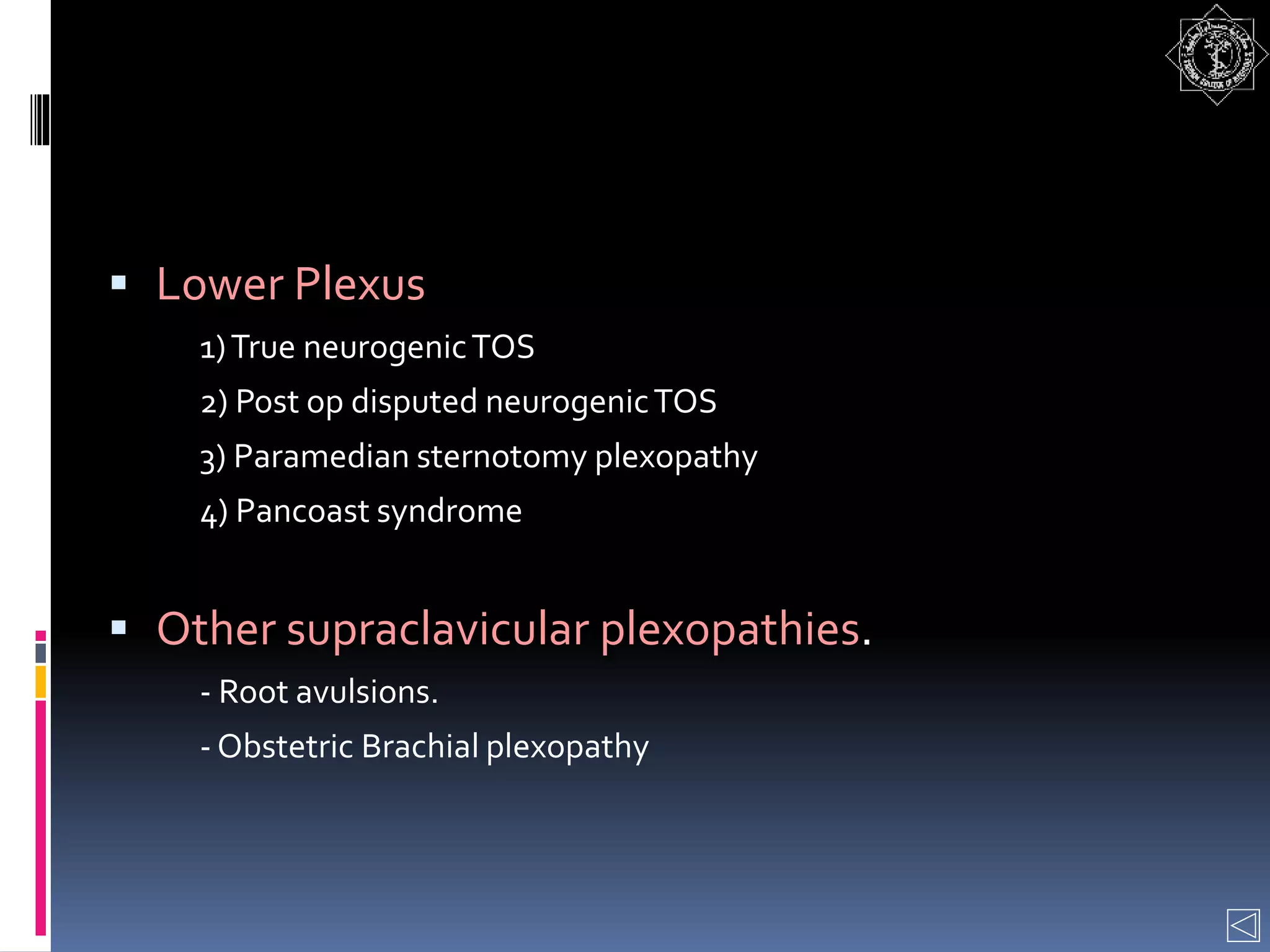
 Lower Plexus
1)True neurogenicTOS
2) Post op disputed neurogenicTOS
3) Paramedian sternotomy plexopathy
4) Pancoast syndrome
 Other supraclavicular plexopathies.
- Root avulsions.
- Obstetric Brachial plexopathy
Site nonspecific brachial plexopathies
 1) Neuralgic amyotrophy
 2) Neoplastic brachial plexopathies
 3) Radiation induced.
 4)Traumatic
 5) Iatrogenic
Supraclavicular vs infra
Supraclavicular
 More common
 More often caused by closed traction injuries
– more lengthy lesions
 More severe
 Worse outcome
Upper plexopathy vs lower
Upper plexopathy
 More commonly due to demyelinating
conduction block
 Recovery better
Less axonopathy
Located closer to the muscles
Lesion mostly extraforaminal (amenable to
surgical repair)
Evaluation of Brachial
plexus
 History and Clinical examination
 Electrophysiological tests.
 Imaging and other ancillary tests –
angiogram, myelogram etc
Clinical evaluation
History
 Initial and subsequent symptoms – esp pain
 Circumstances
Trauma – sports, injections, accident
obstetrical
Rucksack, Post – operative
H/o malignancy or radiation
Clinical evaluation
 If trauma - what was the arm position on
impact?
Arm by side of body – C5, C6
Arm parallel to ground – C7
Arm above shoulder – C8T1
 Past medical history
 Family history
Examination
 Look for wasting with weakness – axonopathy vs
demyelinating.
 Pattern of deficits
Supraclavicular – segmental
Infraclavicular – more in territory of multiple
peripheral nerves of diff segments.
 Vascular assessment – carotid and radial pulse.
Any expanding mass, bruit or thrill near injury
site
 Concomitant injuries – fractures of bones
 Examine breast, lungs and for lymphnodes
Electrodiagnostic assessment
Advantages over clinical
1) Better localisation and characterisation
2) Subtle involvment in clincally normal muscle
3)To prove continuity when visible muscle movement is
lacking.
4) Clinically inaccessible muscles
5) Estimate lesion severity for current and future
comparisons.
 Being a complicated structure, no single study
can localize or characterize the lesion.
 Requires extensive NCS and NEE
 A regional approach may make it more
simpler.
Electrodiagnostic tests
 Nerve conduction studies
Motor
Sensory
 Needle Electrode Examination
General principles in EP
 Pathophysiologically
1) Axonal –
loss of continuity of axon –Wallerian degeneration-
conduction failure.
More severe lesion
2) Demyelinating - Conduction block or conduction
slowing.
Axon loss lesions
 Most common pathology in BP.
 Mostly in isolation (avulsion, neoplasm)
 Occasionally with demyelination (radiation
plexopathy, traumatic)
Edx features of axon loss
lesions
 Reduced CMAP/SNAP amp with preserved CV
and latencies.
 Absolute decrease in amp – less than normal
for lab
 Relative decrease in amp - < 50 % of amp on
C/L side.
NEE
 Most sensitive indicator of motor axonal loss.
 To know the proximal extend of lesion (where nerves
are difficult to assess)
 To know continuity and identify early reinnervation
when there is no muscle movement clinically.
A regional approach
 What will be the electrodiagnostic features if
each element of the brachial plexus is taken
seperately?
 Muscle domain of element
 CMAP/SNAP domain
 The muscle domain of a brachial plexus
element – muscles innervated by the motor
fibers contained within it.
 CMAP/SNAP domain – motor and sensory
fibers contained within that element and
whether they are assessable by NCS.
 CMAP domains are a subset of muscle
domains.
Treatment Most injuries recover without any Rx
 Rx is done in very highly specialized centers
 Surgical options
a. nerve transfers
b. nerve grafting
c. muscle transfers
d. free muscle transfers
e. neurolysis of scar around the brachial
plexus in incomplete lesions.
Brachial plexus

Brachial plexus

  • 1.
  • 2.
    The brachial plexus Formation  Supraclavicular portion  Trunks  Divisions  Infraclavicular portion  Cords  Branches
  • 3.
    The brachial plexus The brachial plexus is a network of nerves that supply the upper limb
  • 4.
    The brachial plexus extends from the neck into the axilla
  • 5.
    Formation  It isformed by five roots from the anterior (ventral) primary rami of C5,6,7,8, andT1
  • 6.
    Formation  the rootsof the brachial plexus should not be confused with the ventral and dorsal roots which unite to form the spinal nerves dorsal & ventral roots of a spinal n. The ventral rami form the roots of the brachial plexus
  • 7.
    Supraclavicular portion  Theroots lie in the neck between scalenus anterior and scalenus medius muscles Scalenus anterior Scalenus medius
  • 8.
    Supraclavicular portion  C5& C6 unite to form the upper trunk
  • 9.
    Supraclavicular portion  C8&T1 unite to form the lower trunk
  • 10.
    Supraclavicular portion  C7continues as the middle trunk
  • 11.
    Trunks of thebrachial plexus  The trunks lie in the posterior triangle of the neck and can be felt in the angle between the clavicle and sternocleidomastoid muscle clavicle
  • 12.
    Trunks of thebrachial plexus  The inferior trunk lies on the first rib posterior to the subclavian artery Inferior trunk
  • 13.
    Divisions of thebrachial plexus  Behind the clavicle, each trunk divides into anterior and posterior divisions
  • 14.
    Trunks of thebrachial plexus  the anterior divisions supply anterior (flexor) parts while the posterior divisions supply posterior (extensor) parts of the upper limb
  • 15.
    Infraclavicular portion  Thethree posterior divisions unite to form the posterior cord Posterior cord
  • 16.
    Infraclavicular portion  theanterior divisions of the upper and middle trunks unite to form the lateral cord lateral cord
  • 17.
    Infraclavicular portion  theanterior division of the lower trunk continues as the medial cord medial cord
  • 18.
    Cords of thebrachial plexus  The cords are arranged around the second part of the axillary artery as indicated by their names.
  • 19.
    Branches of thebrachial plexus  Each cord of the brachial plexus divides into a number of branches, 2 of them are terminal
  • 20.
    Branches of thebrachial plexus  there are also a number of supraclavicular branches
  • 21.
    Branches of theroots  Dorsal scapular (C5) which supplies rhomboids muscles and levator scapula
  • 22.
    Branches of theroots  Nerve to subclavius (C5 & 6) which descends in front of the brachial plexus and the subclavian artery in the neck, it may give a contribution to the phrenic nerve (C5) this branch, when present is called the accessory phrenic nerve.
  • 23.
    Branches of theroots  The third branch is the long thoracic nerve (C5,6, & 7) descends behind the brachial plexus and supplies serratus anterior muscle
  • 24.
    Suprascapular nerve  Fromthe upper trunk arises the suprascapular nerve
  • 25.
    Suprascapular nerve  Thesuprascapular nerve passes laterally across the neck, then through the suprascapular notch in the scapula to supply supraspinatus and infraspinatus muscles
  • 26.
    Infraclavicular branches  Theinfraclavicular branches are derived from the cords  Each cord divides into 2 terminal branches.
  • 27.
    Branches of thelateral cord  The lateral cord has 3 branches mainly the lateral pectoral nerve and 2 terminal branches, the musculocutaneous and the medial root of the median nerve
  • 28.
    Lateral pectoral nerve The lateral pectoral nerve pierces the clavipectoral fascia to supply pectoralis major muscle
  • 29.
    Lateral pectoral nerve sends a communicating loop to the medial pectoral nerve, through which it supplies pectoralis minor muscle Axillary a. Pectoralis minor medial pectoral n. laterall pectoral n. Medial cord lateral cord posterior cord Axillary v. communicating loop
  • 30.
    Musculocutaneous nerve  piercescoracobrachialis muscle, supplying it before doing so
  • 31.
    Musculocutaneous nerve  itthen supplies the muscles of the flexor (anterior) compartment of the arm mainly biceps and brachialis  therefore it is known as the BBC nerve
  • 32.
    Musculocutaneous nerve  Itends by becoming the lateral coetaneous nerve of the forearm
  • 33.
    Lateral root ofthe median nerve  The lateral root of the median nerve is the direct continuation of the lateral cord
  • 34.
    Median nerve  Themedian nerve arises by medial and lateral roots from the corresponding cords of the brachial plexus
  • 35.
    Median nerve  themedial root crosses the axillary artery to join the lateral root so the median nerve is formed at first lateral to the axillary artery.
  • 36.
    Median nerve  Themedian nerve has no branches in the axilla and is responsible for the supply of the flexor compartment of the forearm and the palm.
  • 37.
    Branches of themedial cord  The medial cord has 5 branches  the ulnar nerve and medial root of the median nerve are its two terminal branches Ulnar n.
  • 38.
    Medial pectoral nerve The medial pectoral nerve passes through pectoralis minor supplying it then it supplies pectoralis major Axillary a. Pectoralis minor medial pectoral n. laterall pectoral n. Medial cord lateral cord Axillary v. axillary a. axillary v. Medial pectoral n. Pectoralismajor
  • 39.
    Medial cutaneous nerveof arm  The medial cutaneous nerve of the arm, is a small nerve that runs medial to the axillary vein and supplies the skin over the medial side and front of the arm Axillary a.
  • 40.
    Medial cutaneous nerveof arm  communicates with the intercostobrachial nerve
  • 41.
    medial cutaneous nerveof the forearm  runs between the axillary artery and vein and supplies skin of the medial side of the forearmAxillary a.
  • 42.
    medial cutaneous nerveof the forearm Runs between the axillary artery and vein superficial to the ulnar nerve
  • 43.
    Ulnar nerve  isthe largest branch of the medial cord  runs between the axillary artery and vein but at a more posterior plane than the smaller medial cutaneous nerve of the forearm Axillary a.
  • 44.
    Ulnar nerve  receivesa branch from the lateral cord in more than 90% of cases  has no branches in the axilla  is mainly concerned with the innervation of the palm.
  • 45.
    Medial root ofthe median nerve  crosses the axillary artery to form the median nerve lateral to the artery Axillary a.
  • 46.
    Branches of thebrachial plexus  Note that the musculocutaneous, median, and ulnar nerve form the letter M, which serves as the key to the brachial plexus
  • 47.
    Branches of theposterior cord  The posterior cord of the brachial plexus has 5 branches  the axillary and radial nerves are its 2 terminal branches.
  • 48.
    Upper and lowersubscapular nerves  The upper and lower subscapular nerves supply the upper and lower parts of subscapularis muscle
  • 49.
    Lower subscapular nerve the lower subscapular nerve supplies teres major muscle in addition to suscapularis
  • 50.
    Thoracodorsal nerve  Runsbetween the subscapular nerves, it runs down on subscapularis towards latissimus dorsi which it supplies, it accompanies the subscapular vessels.
  • 51.
    Axillary nerve  Itis inappropriately named since it supplies nothing in the axilla  The first thing it does is to quit the axilla by passing backwards through the posterior wall of the axilla
  • 52.
    Axillary nerve  Itleaves the axilla through the quadrangular space accompanied by the posterior circumflex humeral vessels just below the capsule of the shoulder joint to which it sends an articular branch (so it is sometimes called the circumflex nerve)
  • 53.
    Axillary nerve  Itwinds around the surgical neck of the humerus deep to deltoid muscle which it supplies, it also supplies teres minor, and the upper lateral cutaneous nerve of the arm
  • 54.
    Radial nerve  Theradial nerve provides the major nerve supply of the extensor muscles of the upper limb (arm and forearm)
  • 55.
    Radial nerve  Itlies behind the axillary artery on the glistening tendon of latissimus dorsi musclelatissimus dorsi tendon
  • 56.
    Radial nerve posterior cord triceps (long head) posterior cutaneousof arm triceps (medial head) Branches in the axilla
  • 57.
    Radial nerve  Itleaves the axilla posteriorly through a triangular space between the humerus, teres major, and the long head of triceps
  • 58.
    Variants of normalanatomy – Expanded plexus  Prefixed plexus – substantial contribution from C4 with smallT1 contribution.  Postfixed plexus – MajorT2 contribution with small C5 contribution.
  • 59.
    Brachial plexus injuries Etiologies  trafficaccidents  birth injuries  humerus luxations  brachial plexus neuritis  stab and bullet wounds  tumors (especially lung cancer)  cervical rib, fibrous band from C7 (neurogenic thoracic outlet syndrome)
  • 60.
    Principles of Localization Certain sites are prone to nerve entrapments/injuries  Nerve opposing bone  Ulnar nerve at the elbow  Closed spaces  Carpal tunnel  Adjacent structures  Median nerve at the elbow, adjacent to the brachial artery
  • 61.
    Principles of localization (cont.) Order in which branches arise  Movements at specific joints  Single nerve  Elbow extension  Radial  Multiple nerves  Elbow flexion  Musculocutaneous  Radial
  • 62.
    Brachial Plexus Injuries  UpperLesions of the Brachial Plexus (Erb’s Palsy): resulting from excessive displacement of the head to opposite side and depression of shoulder on the same side.
  • 63.
    This causes excessivetraction or even tearing of C5 and 6 roots of the plexus. It occurs in infants during a difficult delivery or in adults after a blow to or fall on shoulder.
  • 67.
     Effects: Motor: paralysisof  the supraspinatus,  infraspinatus,  subclavius,  biceps brachii,  part of brachialis,  coracobrachialis;  deltoid  teres minor. Sensroy: sensory loss on the lateral side of the arm.
  • 68.
    Deformity: waiter tip postion a.limb will hang by the side, b. medially rotated by sternocostal part of the pectoralis major; c. pronated forearm (biceps paralysis)
  • 69.
  • 70.
    Lower Lesions ofthe Brachial Plexus (Klumpke Palsy)  traction injuries by excessive abduction of the arm  i.e. occurs if person falling from a height clutching at an object to save himself or herself.  Can be caused by cervical rib.  T1 is usually torn (ulnar and median nerves)
  • 71.
    Motor Effects: paralysisof all the small muscles of the hand. Sensory effects: loss of sensation along the medial side of the arm. deformity: claw hand caused by hyperextension of the metacarpophalangeal joints and flexion of the interphalangeal joints.
  • 74.
    Axillary Nerve injury Causes: crutch pressingupward into the armpit, Downward shoulder dislocations fractures of the surgical neck of the humerus.
  • 75.
    Motor effects: Deltoid paralysis teresminor paralysis. Sensory effects: loss of sensation at lower ½ of deltoid Deformity: Wasting of deltoid
  • 77.
    Radial Nerve injury Injuryin axilla :  crutch pressing up into armpit  drunkard falling asleep with one arm over the back of a chair.  fractures of proximal humerus.
  • 78.
     Motor effects:paralysisof  triceps  Anconeus  extensors of the wrist  Extensors of fingers.  Brachioradialis  supinator muscle  Deformity: Wrist and finger drop
  • 79.
    Sensory effects : smallarea of sansation loss at arm and forearm sensory loss over lateral part of the dorsum of the hand (lat. 3.5 fingers without distal phalynges)
  • 80.
    Injuries at SpiralGroove Caused by fracture shaft of humerus.  Motor effects: paralysis of extensors of the wrist Extensors of fingers
  • 81.
     Deformity: Wrist andfinger drop  Sensory effects: anesthesia is present over the dorsal surface of the hand (lat. 3.5 fingers)
  • 84.
    Median Nerve injury Motoreffects: paralysis of pronator muscles long flexor muscles of the wrist and fingers, Exception: a. flexor carpi ulnaris b. medial half flexor digitorum profundus.
  • 85.
    Deformity: apelike hand 1. thenarmuscles wasted 2. thumb is laterally rotated and adducted. 3. index and to a lesser extent the middle fingers tend to remain straight on making 4. Weakening of lat. 2 fingers
  • 86.
    Sensory: Sensory loss onthe lat. 3.5 fingers on palmar side Sensory loss over distal phalynges of lat. 4 fingers on dorsal surface
  • 90.
    Ulnar nerve injury Motor effects: paralysis of  flexor carpi ulnaris medial half of the flexor digitorum profundus All interossei 3-4 lumbricals  loss of abduction and adduction of fingers  Wasting of hypothenar
  • 91.
     Deformity: partial clawhand  Sensory effects : Sensory loss over 1.5 fingers on both surfaces
  • 93.
    CARPAL TUNNEL  TUNNELFORMED BETWEENTHE CONCAVITY OFTHE CARPAL BONES AND A LIGAMENTTHAT COVERSTHIS( FLEXOR RETINACULAM)  TENDONS OFTHE FLEXORS PASSTHROUGH  MEDIAN NERVEALSO PASSESTHROUGH  CROWDEDTUNNEL CARPALTUNNEL SYNDROME - CAUSED DUETO COMPRESSIONOFTHE NERVE INTHETUNNEL - CAUSES- - 1. SWELLING OFTHETEDONS( OVERUSE) - 2. PREGNANCY( EDEMA) - 3. ARTHRITIS SYMPTOMS-TINGLING OR NUMBNESS-LATERAL PART OF HAND, WEAKNESS INTHUMB MOVEMENT TREATMENT- REST, SPLINTING,ANTI-INFLAMMATORY DRUGS, SURGERY
  • 94.
    Classification of Brachial plexopathies 1)Supraclavicular(rootand trunk) – Upper plexopathy (upper trunk and root) Middle plexopathy (middle trunk & root) Lower plexopathy(lower trunk and root) 2)Retroclavicular (division) 3)Infraclavicular(cords and nerves)
  • 95.
    Classification of Brachial plexopathies Supraclavicular with regional predilection 1)Upper plexus 1) Burner syndrome 2) Rucksack paralysis 3) Classic post – operative paralysis 2)Middle plexus – No isolated pathology
  • 96.
     Lower Plexus 1)TrueneurogenicTOS 2) Post op disputed neurogenicTOS 3) Paramedian sternotomy plexopathy 4) Pancoast syndrome  Other supraclavicular plexopathies. - Root avulsions. - Obstetric Brachial plexopathy
  • 97.
    Site nonspecific brachialplexopathies  1) Neuralgic amyotrophy  2) Neoplastic brachial plexopathies  3) Radiation induced.  4)Traumatic  5) Iatrogenic
  • 98.
    Supraclavicular vs infra Supraclavicular More common  More often caused by closed traction injuries – more lengthy lesions  More severe  Worse outcome
  • 99.
    Upper plexopathy vslower Upper plexopathy  More commonly due to demyelinating conduction block  Recovery better Less axonopathy Located closer to the muscles Lesion mostly extraforaminal (amenable to surgical repair)
  • 100.
    Evaluation of Brachial plexus History and Clinical examination  Electrophysiological tests.  Imaging and other ancillary tests – angiogram, myelogram etc
  • 101.
    Clinical evaluation History  Initialand subsequent symptoms – esp pain  Circumstances Trauma – sports, injections, accident obstetrical Rucksack, Post – operative H/o malignancy or radiation
  • 102.
    Clinical evaluation  Iftrauma - what was the arm position on impact? Arm by side of body – C5, C6 Arm parallel to ground – C7 Arm above shoulder – C8T1  Past medical history  Family history
  • 103.
    Examination  Look forwasting with weakness – axonopathy vs demyelinating.  Pattern of deficits Supraclavicular – segmental Infraclavicular – more in territory of multiple peripheral nerves of diff segments.
  • 104.
     Vascular assessment– carotid and radial pulse. Any expanding mass, bruit or thrill near injury site  Concomitant injuries – fractures of bones  Examine breast, lungs and for lymphnodes
  • 105.
    Electrodiagnostic assessment Advantages overclinical 1) Better localisation and characterisation 2) Subtle involvment in clincally normal muscle 3)To prove continuity when visible muscle movement is lacking. 4) Clinically inaccessible muscles 5) Estimate lesion severity for current and future comparisons.
  • 106.
     Being acomplicated structure, no single study can localize or characterize the lesion.  Requires extensive NCS and NEE  A regional approach may make it more simpler.
  • 107.
    Electrodiagnostic tests  Nerveconduction studies Motor Sensory  Needle Electrode Examination
  • 108.
    General principles inEP  Pathophysiologically 1) Axonal – loss of continuity of axon –Wallerian degeneration- conduction failure. More severe lesion 2) Demyelinating - Conduction block or conduction slowing.
  • 109.
    Axon loss lesions Most common pathology in BP.  Mostly in isolation (avulsion, neoplasm)  Occasionally with demyelination (radiation plexopathy, traumatic)
  • 110.
    Edx features ofaxon loss lesions  Reduced CMAP/SNAP amp with preserved CV and latencies.  Absolute decrease in amp – less than normal for lab  Relative decrease in amp - < 50 % of amp on C/L side.
  • 111.
    NEE  Most sensitiveindicator of motor axonal loss.  To know the proximal extend of lesion (where nerves are difficult to assess)  To know continuity and identify early reinnervation when there is no muscle movement clinically.
  • 112.
    A regional approach What will be the electrodiagnostic features if each element of the brachial plexus is taken seperately?  Muscle domain of element  CMAP/SNAP domain
  • 113.
     The muscledomain of a brachial plexus element – muscles innervated by the motor fibers contained within it.  CMAP/SNAP domain – motor and sensory fibers contained within that element and whether they are assessable by NCS.  CMAP domains are a subset of muscle domains.
  • 114.
    Treatment Most injuriesrecover without any Rx  Rx is done in very highly specialized centers  Surgical options a. nerve transfers b. nerve grafting c. muscle transfers d. free muscle transfers e. neurolysis of scar around the brachial plexus in incomplete lesions.