BRACHIAL PLEXUS INJURIES
MODERATOR :DR. B C PATIL
PROFESSOR
DEPT OF ORTHOPAEDICS
MRMC GULBARGA
PRESENTER :DR.RAMACHANDRA
• The Brachial Plexus is a large & very imp
plexus of nerves.
• Situated partly in neck & partly in axilla.
• Brachial Plexus formed by union of ventral
rami of nerves C5 to C8 & greater part of
T1 ventral ramus.
• Rami that form Brachial Plexus are often
referred to as roots of Brachial Plexus.
• They lie between scalenus anterior &
medius muscle.
ANATOMY OF BRACHIAL PLEXUS
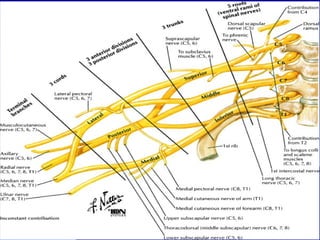
• The ventaral rami from C5 & C6 unite to
form superior trunk.
• C7 continues as inferior trunk.
• C8 & T1 unite to form inferior trunk.
• Each of 3 trunks divides into anterior &
posterior divisions.
• The 3 posterior divisions unite to form
posterior cord.
• Anterior divisions of superior & middle
trunks unite to form lateral cord.
• Anterior division of inferior trunk continues
as medial cord.
• Cords of Brachial Plexus bear their name
in relation to their position to axillary
artery.
• Each cord of Brachial Plexus divides into
two terminal branches.
• Brachial Plexus includes five components
• 5 Roots
• 3 Trunks
• 2 Divisions
• 3 Cords
• Terminal nerves
• Branches of the brachial plexus may be described as
supraclavicular and infraclavicular.
Supraclavicular branches
• Supraclavicular branches arise from roots or from trunks
as follows:
From roots
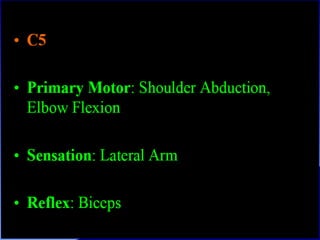
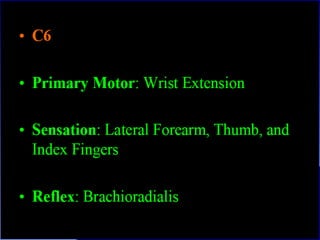
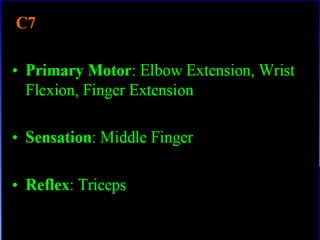
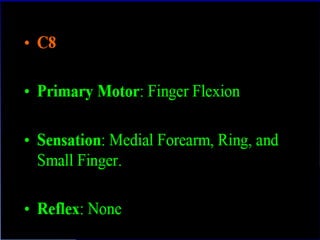
• 1. Nerves to scaleni and longus colli C5, 6, 7, 8
• 2. Branch to phrenic nerve C5
• 3. Dorsal scapular nerve C5
• 4. Long thoracic nerve C5, 6 (7)
From trunks
• 1. Nerve to subclavius C5, 6
• 2. Suprascapular nerve C5, 6
Infraclavicular branches
• Infraclavicular branches come from the
cords, but their axons may be traced back
to the spinal nerves:
Lateral cord
• Lateral pectoral C5, 6, 7
• Musculocutaneous C5, 6 7
• Lateral root of median C(5), 6, 7
Medial cord
• Medial pectoral C8, T1
• Medial cutaneous of forearm C8, T1
• Medial cutaneous of arm C8, T1
• Ulnar C(7), 8, T1
Posterior cord
• Upper subscapular C5, 6
• Thoracodorsal C6, 7,8
• Lower subscapular C5, 6
• Axillary C5, 6
• Radial C5, 6, 7, 8, (T1)
CLOSED
• a) Traction lesions
• b)Radiation induced
• c)Neoplastic
• d)Post operative
Brachial Plexus Lesions:
ETIOLOGY:
OPEN
• Gun shot wounds
Lacerations
• During surgeries
• Orthopaedic related
• Needles & cannulas
• MC cause in large series is motor cycle
accidents of 70%.
• In 20% cases a/w rupture of subclavian or
axillary artery.
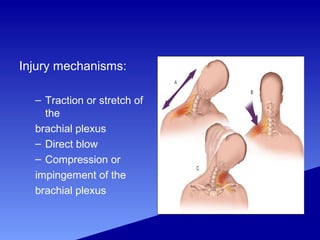
Injury mechanisms:
– Traction or stretch of
the
brachial plexus
– Direct blow
– Compression or
impingement of the
brachial plexus
CLASSIFICATION OF BRACHIAL PLEXUS
INJURIES:
• Upper Plexus Injuries(Erb's Palsy)
• Lower Plexus Injuries(Klumpke)
• Leffert classified injuries acc to mech &
level of injury
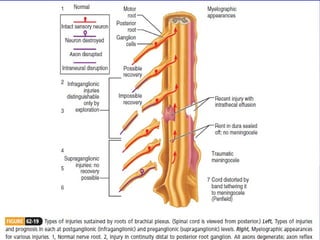
• Preganglionic or supraganglionic injuries
occuring proximal to neural foramen in
which neurons have been seperated from
spinal cord.
• Postganglionic or infraganglionic injuries
occur distal to neural foramen & neurons
remain connected to spinal cord.
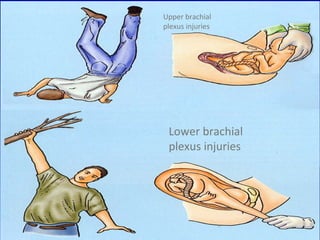
Upper Brachial Plexus Injuries
• Increase in angle between neck & shoulder
• Traction (stretching or avulsion) of upper
rootlets (e.g., C5,C6)
• Produces Erb’s Palsy
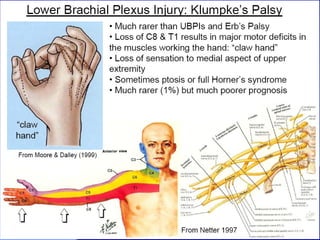
Lower Brachial Plexus Injuries
• Excessive upward pull of limb
• Traction (stretching or avulsion) of lower
rootlets (e.g., C8, T1)
• Produces Klumpke’s Palsy
Lower brachial
plexus injuries
Upper brachial
plexus injuries
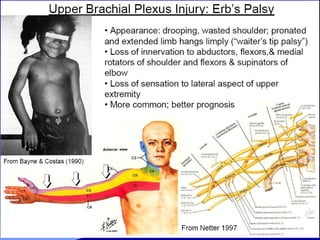
ERB'S PALSY
• Involves C5 & C6 nerve roots.
• Limb is extended at elbow flaccid at side
of trunk & adducted & internally rotated.
• Abduction impossible because of paralysis
of deltoid & supraspinatus m/s.
• ER impossible because of paralysis of
infraspinatus & teres minor m/s.
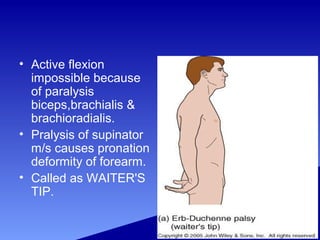
• Active flexion
impossible because
of paralysis
biceps,brachialis &
brachioradialis.
• Pralysis of supinator
m/s causes pronation
deformity of forearm.
• Called as WAITER'S
TIP.
Brachial Plexus Lesions of individual
nerve:
Long Thoracic Nerve(C5,6,7):
• Winging of scapula- Serratus Anterior.
Suprascapular Nerve(C5,6):
• Hard to start shoulder abduction.
Axillary Nerve(C5,6)
Motor Deficits
• Difficult abducting
arm to horizontal
• Loss of shoulder
roundness
Sensory Deficits
• Lateral side of arm
below point of
shoulder.
Musculocutaneous Nerve(C5,6,7)
Motor Deficits
• Very weak flexion of
elbow joint -Biceps &
Brachioradialis.
• Weak supination of
radioulnar joint-
Biceps
Sensory Deficits
• Lateral forearm
Radial Nerve(C5-T1) at elbow
Low lesions:
• BR, ECRL, & ECRB are spared.
• Can't extend MCP joints of hand.
• Thumb weakness of abduction & IP joints
extension.
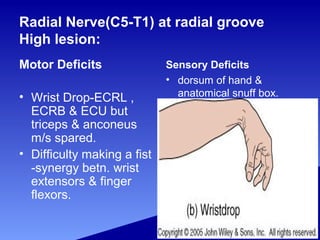
Radial Nerve(C5-T1) at radial groove
High lesion:
Motor Deficits
• Wrist Drop-ECRL ,
ECRB & ECU but
triceps & anconeus
m/s spared.
• Difficulty making a fist
-synergy betn. wrist
extensors & finger
flexors.
Sensory Deficits
• dorsum of hand &
anatomical snuff box.
Radial Nerve(C5-T1)
Very high lesion
Motor Deficits:
• Saturday Night Palsy/
Crutch Palsy
• Along with weakness
of wrist & hand,
triceps also paralyzed
• Triceps reflex absent
• No sensory deficits as
it is Neuropraxia.
• Best prognosis.
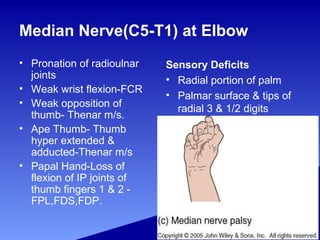
Median Nerve(C5-T1) at Elbow
• Pronation of radioulnar
joints
• Weak wrist flexion-FCR
• Weak opposition of
thumb- Thenar m/s.
• Ape Thumb- Thumb
hyper extended &
adducted-Thenar m/s
• Papal Hand-Loss of
flexion of IP joints of
thumb fingers 1 & 2 -
FPL,FDS,FDP.
Sensory Deficits
• Radial portion of palm
• Palmar surface & tips of
radial 3 & 1/2 digits
Median Nerve(C5-T1) at Wrist
Motor Deficits
• Weak opposition of
thumb- Thenar m/s.
• Ape Thumb- Thumb
hyper extended &
adducted-Thenar m/s
Sensory Deficits
• Palmar surface & tips
of radial 3 & 1/2 digits
Ulnar Nerve(C8,T1)at Elbow
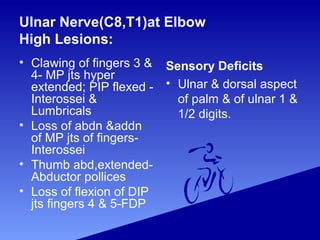
High Lesions:
• Clawing of fingers 3 &
4- MP jts hyper
extended; PIP flexed -
Interossei &
Lumbricals
• Loss of abdn &addn
of MP jts of fingers-
Interossei
• Thumb abd,extended-
Abductor pollices
• Loss of flexion of DIP
jts fingers 4 & 5-FDP
Sensory Deficits
• Ulnar & dorsal aspect
of palm & of ulnar 1 &
1/2 digits.
Ulnar Nerve(C8,T1)at Wrist
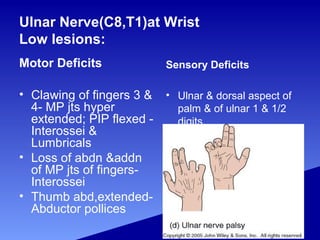
Low lesions:
Motor Deficits
• Clawing of fingers 3 &
4- MP jts hyper
extended; PIP flexed -
Interossei &
Lumbricals
• Loss of abdn &addn
of MP jts of fingers-
Interossei
• Thumb abd,extended-
Abductor pollices
Sensory Deficits
• Ulnar & dorsal aspect of
palm & of ulnar 1 & 1/2
digits.
INVESTIGATIONS
• Imaging Studies
• Electromyogram
• Nerve Conduction Velocity
• Somatosensory Evoked Potentials
• Intraoperative Nerve Action Potential
• Myelography
• CT scan for any tumours
• MRI
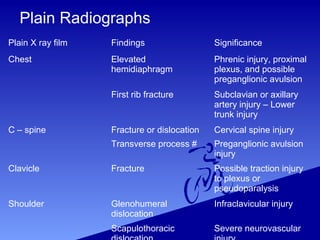
Plain Radiographs
Plain X ray film Findings Significance
Chest Elevated
hemidiaphragm
Phrenic injury, proximal
plexus, and possible
preganglionic avulsion
First rib fracture Subclavian or axillary
artery injury – Lower
trunk injury
C – spine Fracture or dislocation Cervical spine injury
Transverse process # Preganglionic avulsion
injury
Clavicle Fracture Possible traction injury
to plexus or
pseudoparalysis
Shoulder Glenohumeral
dislocation
Infraclavicular injury
Scapulothoracic Severe neurovascular
MANAGEMENT
• Closed Brachial Plexus Injury
• Open Brachial Plexus Injury
Closed Brachial Plexus Injury
• Barnes divided Upper & Lower Plexuses
injuries caused by traction into four groups
• 1)Injuries at C5 & C6
• 2)Injuries at C5,C6 & C7
• 3)Degenerative lesions of entire plexus
• 4)Injuries at C7,C8 & T1 (rare)
• Barnes reported that spontaneous
recovery in group 1 & 2 cases
• But in case of Degenerative plexuses
injuries there is partial recovery.
• EMG should be done at 3 to 4 wks
• At 6 to 8wks additional studies like
myelography & axon reflex evaluaton can
be done if return of functions not seen.
• Exploration is justified at 3 to 6 mths after
injury if function has not returned.
Open Brachial Plexus Injury
• Indications for Surgery:
• Injuries caused by sharp objects or
missiles.
• When pt seen soon after injury & pt's
general condition permits exploration &
primary repair can be done.
• When pt not seen soon after injury but
only after initial management,
• It is best to wait for wound healing &
stabilization of any other injuries.
• During this period locate neurological
deficit for level of injury.
• EMG performed 3 to 4 wks after injury.
• Exploration of plexus & neurorrhaphy,
autogenous interfascicular nerve grafting
or neurolysis is indicated 3 to 6wks after
injury.
• Motor function recovered to a grade of 3
or better in half of pts.
• Best results obtained in upper trunk &
lateral cord & posterior cord injuries.
• Poor prognosis can be expected in lower
trunk injuries.
SURGICAL GOALS
In order of priority as follows:
1)Restoration of elbow flexion
2)Restoration of shoulder abduction
3)Restoration of sensation of medial border
of forearm & hand.
• Depending on extent of injury various
surgical techniques may be required:
• Primary neurorrhaphy
• Neurolysis
• Nerve grafting
• Neurotization
• Direct intraoperative nerve stimulation &
recording used to repair nerve.
• If nerve action potentials are obtained
simple NEUROLYSIS is indicated.
• If neural integrity is completely lost or if no
nerve action potentials recorded across a
damaged element EXCISION & NERVE
GRAFTING is required.
• In ROOT avulsion of upper plexus in
which no proximal neural stump is
available for nerve grafting,
• To restore ELBOW FLEXION
neurotization between intercostal nerves
or FCU motor fascicles of ulnar nerve &
musculocutaneous nerve may be
considered.
• For ELBOW FLEXION latismus dorsi &
triceps muscle transfers to be the most
reliable as reviewed by Marshall et al..
• Amputation considered when dead weight
of a functonless upper extremity is
disabling & prosthetic fitting may be
helpful.
• Amputation should never be performed for
pain relief.
• To restore SHOULDER ABDUCTION &
ER neurotization of suprascapular nerve
using the spinal accessory nerve done.
• Neurotization of axillary nerve with
fascicles of radial nerve innervating lateral,
medial, or long head of triceps can be
used.
After Brachial plexus repair & regeneration
12 to 18 mths required to determine extent
of neural regeneration.
If recovery inadequate
Peripheral reconstruction considered
Can be divided into 3 groups
• 1) Tendon transfer without open reduction
• 2) Open reduction with concomitant
tendon transfer
• 3) Salvage procedures for older pts with
severe glenohumeral deformity
SURGICAL INTERVENTION
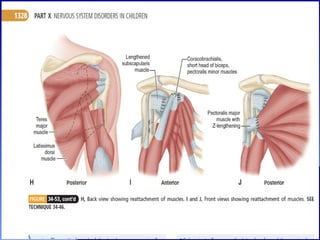
• To improve shoulder ABDUCTION & ER
• Tendon transfer around shoulder
considered include TRAPEZIUS TO
DELTOID transfer as described by Saha
FOR ABDUCTION &
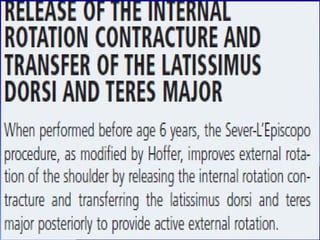
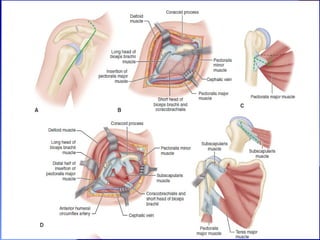
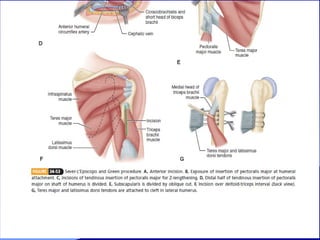
• LATISMUS DORSI & TERES MAJOR
transfer as described by L'Episcopo FOR
ER of shoulder jt.
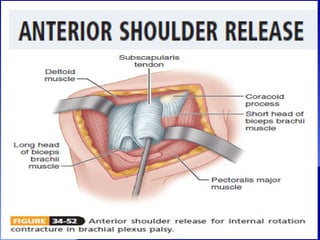
• Anterior shoulder release:
• First described by Fairbanks & modified by
Sever
• Main indication is iatrogenic internal
rotation contracture & imbalance betn
shoulder internal & external rotation.
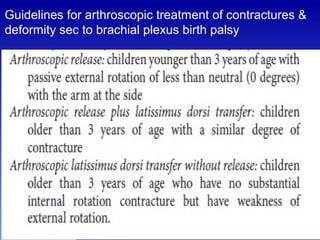
Guidelines for arthroscopic treatment of contractures &
deformity sec to brachial plexus birth palsy
DHANYAVAAD

Brachial plexus injuries by krr

  • 1.
    BRACHIAL PLEXUS INJURIES MODERATOR:DR. B C PATIL PROFESSOR DEPT OF ORTHOPAEDICS MRMC GULBARGA PRESENTER :DR.RAMACHANDRA
  • 2.
    • The BrachialPlexus is a large & very imp plexus of nerves. • Situated partly in neck & partly in axilla. • Brachial Plexus formed by union of ventral rami of nerves C5 to C8 & greater part of T1 ventral ramus. • Rami that form Brachial Plexus are often referred to as roots of Brachial Plexus. • They lie between scalenus anterior & medius muscle. ANATOMY OF BRACHIAL PLEXUS
  • 3.
    • The ventaralrami from C5 & C6 unite to form superior trunk. • C7 continues as inferior trunk. • C8 & T1 unite to form inferior trunk. • Each of 3 trunks divides into anterior & posterior divisions.
  • 4.
    • The 3posterior divisions unite to form posterior cord. • Anterior divisions of superior & middle trunks unite to form lateral cord. • Anterior division of inferior trunk continues as medial cord. • Cords of Brachial Plexus bear their name in relation to their position to axillary artery. • Each cord of Brachial Plexus divides into two terminal branches.
  • 5.
    • Brachial Plexusincludes five components • 5 Roots • 3 Trunks • 2 Divisions • 3 Cords • Terminal nerves
  • 7.
    • Branches ofthe brachial plexus may be described as supraclavicular and infraclavicular. Supraclavicular branches • Supraclavicular branches arise from roots or from trunks as follows: From roots • 1. Nerves to scaleni and longus colli C5, 6, 7, 8 • 2. Branch to phrenic nerve C5 • 3. Dorsal scapular nerve C5 • 4. Long thoracic nerve C5, 6 (7) From trunks • 1. Nerve to subclavius C5, 6 • 2. Suprascapular nerve C5, 6
  • 8.
    Infraclavicular branches • Infraclavicularbranches come from the cords, but their axons may be traced back to the spinal nerves: Lateral cord • Lateral pectoral C5, 6, 7 • Musculocutaneous C5, 6 7 • Lateral root of median C(5), 6, 7
  • 9.
    Medial cord • Medialpectoral C8, T1 • Medial cutaneous of forearm C8, T1 • Medial cutaneous of arm C8, T1 • Ulnar C(7), 8, T1 Posterior cord • Upper subscapular C5, 6 • Thoracodorsal C6, 7,8 • Lower subscapular C5, 6 • Axillary C5, 6 • Radial C5, 6, 7, 8, (T1)
  • 10.
    CLOSED • a) Tractionlesions • b)Radiation induced • c)Neoplastic • d)Post operative Brachial Plexus Lesions: ETIOLOGY: OPEN • Gun shot wounds Lacerations • During surgeries • Orthopaedic related • Needles & cannulas
  • 11.
    • MC causein large series is motor cycle accidents of 70%. • In 20% cases a/w rupture of subclavian or axillary artery.
  • 12.
    Injury mechanisms: – Tractionor stretch of the brachial plexus – Direct blow – Compression or impingement of the brachial plexus
  • 13.
    CLASSIFICATION OF BRACHIALPLEXUS INJURIES: • Upper Plexus Injuries(Erb's Palsy) • Lower Plexus Injuries(Klumpke) • Leffert classified injuries acc to mech & level of injury
  • 14.
    • Preganglionic orsupraganglionic injuries occuring proximal to neural foramen in which neurons have been seperated from spinal cord. • Postganglionic or infraganglionic injuries occur distal to neural foramen & neurons remain connected to spinal cord.
  • 15.
    Upper Brachial PlexusInjuries • Increase in angle between neck & shoulder • Traction (stretching or avulsion) of upper rootlets (e.g., C5,C6) • Produces Erb’s Palsy Lower Brachial Plexus Injuries • Excessive upward pull of limb • Traction (stretching or avulsion) of lower rootlets (e.g., C8, T1) • Produces Klumpke’s Palsy
  • 16.
    Lower brachial plexus injuries Upperbrachial plexus injuries
  • 22.
    ERB'S PALSY • InvolvesC5 & C6 nerve roots. • Limb is extended at elbow flaccid at side of trunk & adducted & internally rotated. • Abduction impossible because of paralysis of deltoid & supraspinatus m/s. • ER impossible because of paralysis of infraspinatus & teres minor m/s.
  • 23.
    • Active flexion impossiblebecause of paralysis biceps,brachialis & brachioradialis. • Pralysis of supinator m/s causes pronation deformity of forearm. • Called as WAITER'S TIP.
  • 25.
    Brachial Plexus Lesionsof individual nerve: Long Thoracic Nerve(C5,6,7): • Winging of scapula- Serratus Anterior. Suprascapular Nerve(C5,6): • Hard to start shoulder abduction.
  • 26.
    Axillary Nerve(C5,6) Motor Deficits •Difficult abducting arm to horizontal • Loss of shoulder roundness Sensory Deficits • Lateral side of arm below point of shoulder.
  • 27.
    Musculocutaneous Nerve(C5,6,7) Motor Deficits •Very weak flexion of elbow joint -Biceps & Brachioradialis. • Weak supination of radioulnar joint- Biceps Sensory Deficits • Lateral forearm
  • 28.
    Radial Nerve(C5-T1) atelbow Low lesions: • BR, ECRL, & ECRB are spared. • Can't extend MCP joints of hand. • Thumb weakness of abduction & IP joints extension.
  • 29.
    Radial Nerve(C5-T1) atradial groove High lesion: Motor Deficits • Wrist Drop-ECRL , ECRB & ECU but triceps & anconeus m/s spared. • Difficulty making a fist -synergy betn. wrist extensors & finger flexors. Sensory Deficits • dorsum of hand & anatomical snuff box.
  • 30.
    Radial Nerve(C5-T1) Very highlesion Motor Deficits: • Saturday Night Palsy/ Crutch Palsy • Along with weakness of wrist & hand, triceps also paralyzed • Triceps reflex absent • No sensory deficits as it is Neuropraxia. • Best prognosis.
  • 31.
    Median Nerve(C5-T1) atElbow • Pronation of radioulnar joints • Weak wrist flexion-FCR • Weak opposition of thumb- Thenar m/s. • Ape Thumb- Thumb hyper extended & adducted-Thenar m/s • Papal Hand-Loss of flexion of IP joints of thumb fingers 1 & 2 - FPL,FDS,FDP. Sensory Deficits • Radial portion of palm • Palmar surface & tips of radial 3 & 1/2 digits
  • 32.
    Median Nerve(C5-T1) atWrist Motor Deficits • Weak opposition of thumb- Thenar m/s. • Ape Thumb- Thumb hyper extended & adducted-Thenar m/s Sensory Deficits • Palmar surface & tips of radial 3 & 1/2 digits
  • 33.
    Ulnar Nerve(C8,T1)at Elbow HighLesions: • Clawing of fingers 3 & 4- MP jts hyper extended; PIP flexed - Interossei & Lumbricals • Loss of abdn &addn of MP jts of fingers- Interossei • Thumb abd,extended- Abductor pollices • Loss of flexion of DIP jts fingers 4 & 5-FDP Sensory Deficits • Ulnar & dorsal aspect of palm & of ulnar 1 & 1/2 digits.
  • 34.
    Ulnar Nerve(C8,T1)at Wrist Lowlesions: Motor Deficits • Clawing of fingers 3 & 4- MP jts hyper extended; PIP flexed - Interossei & Lumbricals • Loss of abdn &addn of MP jts of fingers- Interossei • Thumb abd,extended- Abductor pollices Sensory Deficits • Ulnar & dorsal aspect of palm & of ulnar 1 & 1/2 digits.
  • 36.
    INVESTIGATIONS • Imaging Studies •Electromyogram • Nerve Conduction Velocity • Somatosensory Evoked Potentials • Intraoperative Nerve Action Potential • Myelography • CT scan for any tumours • MRI
  • 37.
    Plain Radiographs Plain Xray film Findings Significance Chest Elevated hemidiaphragm Phrenic injury, proximal plexus, and possible preganglionic avulsion First rib fracture Subclavian or axillary artery injury – Lower trunk injury C – spine Fracture or dislocation Cervical spine injury Transverse process # Preganglionic avulsion injury Clavicle Fracture Possible traction injury to plexus or pseudoparalysis Shoulder Glenohumeral dislocation Infraclavicular injury Scapulothoracic Severe neurovascular
  • 38.
    MANAGEMENT • Closed BrachialPlexus Injury • Open Brachial Plexus Injury
  • 39.
    Closed Brachial PlexusInjury • Barnes divided Upper & Lower Plexuses injuries caused by traction into four groups • 1)Injuries at C5 & C6 • 2)Injuries at C5,C6 & C7 • 3)Degenerative lesions of entire plexus • 4)Injuries at C7,C8 & T1 (rare)
  • 40.
    • Barnes reportedthat spontaneous recovery in group 1 & 2 cases • But in case of Degenerative plexuses injuries there is partial recovery. • EMG should be done at 3 to 4 wks • At 6 to 8wks additional studies like myelography & axon reflex evaluaton can be done if return of functions not seen. • Exploration is justified at 3 to 6 mths after injury if function has not returned.
  • 41.
    Open Brachial PlexusInjury • Indications for Surgery: • Injuries caused by sharp objects or missiles. • When pt seen soon after injury & pt's general condition permits exploration & primary repair can be done.
  • 42.
    • When ptnot seen soon after injury but only after initial management, • It is best to wait for wound healing & stabilization of any other injuries. • During this period locate neurological deficit for level of injury. • EMG performed 3 to 4 wks after injury. • Exploration of plexus & neurorrhaphy, autogenous interfascicular nerve grafting or neurolysis is indicated 3 to 6wks after injury.
  • 43.
    • Motor functionrecovered to a grade of 3 or better in half of pts. • Best results obtained in upper trunk & lateral cord & posterior cord injuries. • Poor prognosis can be expected in lower trunk injuries.
  • 44.
    SURGICAL GOALS In orderof priority as follows: 1)Restoration of elbow flexion 2)Restoration of shoulder abduction 3)Restoration of sensation of medial border of forearm & hand.
  • 45.
    • Depending onextent of injury various surgical techniques may be required: • Primary neurorrhaphy • Neurolysis • Nerve grafting • Neurotization
  • 46.
    • Direct intraoperativenerve stimulation & recording used to repair nerve. • If nerve action potentials are obtained simple NEUROLYSIS is indicated. • If neural integrity is completely lost or if no nerve action potentials recorded across a damaged element EXCISION & NERVE GRAFTING is required.
  • 47.
    • In ROOTavulsion of upper plexus in which no proximal neural stump is available for nerve grafting, • To restore ELBOW FLEXION neurotization between intercostal nerves or FCU motor fascicles of ulnar nerve & musculocutaneous nerve may be considered.
  • 48.
    • For ELBOWFLEXION latismus dorsi & triceps muscle transfers to be the most reliable as reviewed by Marshall et al.. • Amputation considered when dead weight of a functonless upper extremity is disabling & prosthetic fitting may be helpful. • Amputation should never be performed for pain relief.
  • 49.
    • To restoreSHOULDER ABDUCTION & ER neurotization of suprascapular nerve using the spinal accessory nerve done. • Neurotization of axillary nerve with fascicles of radial nerve innervating lateral, medial, or long head of triceps can be used.
  • 51.
    After Brachial plexusrepair & regeneration 12 to 18 mths required to determine extent of neural regeneration. If recovery inadequate Peripheral reconstruction considered
  • 52.
    Can be dividedinto 3 groups • 1) Tendon transfer without open reduction • 2) Open reduction with concomitant tendon transfer • 3) Salvage procedures for older pts with severe glenohumeral deformity SURGICAL INTERVENTION
  • 53.
    • To improveshoulder ABDUCTION & ER • Tendon transfer around shoulder considered include TRAPEZIUS TO DELTOID transfer as described by Saha FOR ABDUCTION & • LATISMUS DORSI & TERES MAJOR transfer as described by L'Episcopo FOR ER of shoulder jt.
  • 54.
    • Anterior shoulderrelease: • First described by Fairbanks & modified by Sever • Main indication is iatrogenic internal rotation contracture & imbalance betn shoulder internal & external rotation.
  • 60.
    Guidelines for arthroscopictreatment of contractures & deformity sec to brachial plexus birth palsy
  • 61.