Ulnar Nerve
Dr Prashant Shringi
Senior Resident
Neurology
ULNAR NERVE C 7, 8 &T1
• Origin:
• From the medial cord of the brachial plexus.
• It runs downward on the medial side of the brachial artery as far
as the middle of the arm.
• At the insertion of the coracobrachialis, it pierces the medial
intermuscular septum and, accompanied by the superior ulnar
collateral artery, to enter the posterior compartment of the arm.
• At the elbow, it passes behind the medial epicondyle.
• It has no branches in the arm.
ULNAR NERVE
in the Forearm
• It continues downward to enter the forearm between the two
heads of the flexor carpi ulnaris.
• It runs down the forearm between FCU and FDP.
• In the lower half of the forearm it lies medial to the ulnar artery.
• Branches:
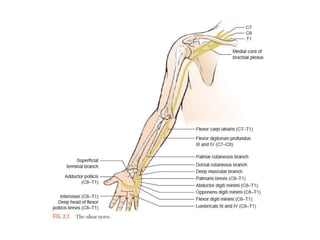
Muscular: Immediately distal to the elbow joint the
nerve gives off its first two muscular branches
Flexor carpi ulnaris- ulnar flexor of the wrist
Medial ½ of FDP- flexor of the terminal phalanges of the fourth
and fifth fingers
• Articular: To elbow joint.
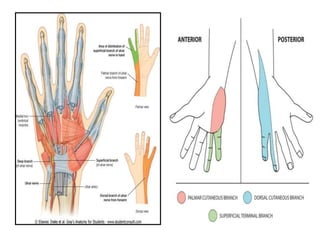
• Dorsal or posterior cutaneous branch:
• To the dorsal surface medial 1/3rd of the hand and 1½ fingers.
• Palmar cutaneous branch : to supply skin of palm of hand.
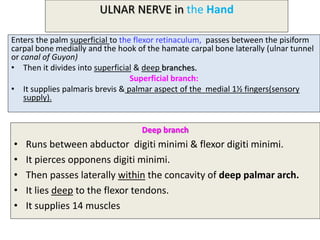
ULNAR NERVE in the Hand
Enters the palm superficial to the flexor retinaculum, passes between the pisiform
carpal bone medially and the hook of the hamate carpal bone laterally (ulnar tunnel
or canal of Guyon)
• Then it divides into superficial & deep branches.
Superficial branch:
• It supplies palmaris brevis & palmar aspect of the medial 1½ fingers(sensory
supply).
Deep branch
• Runs between abductor digiti minimi & flexor digiti minimi.
• It pierces opponens digiti minimi.
• Then passes laterally within the concavity of deep palmar arch.
• It lies deep to the flexor tendons.
• It supplies 14 muscles
Musclar supply on hand
• Palmaris brevis (C8–T1) :A cutaneous muscle
• Abductor digiti minimi (C8–Tl) :An abductor of the fifth finger
• Opponens digiti minimi (C8–T1): An opposer of the fifth finger
• Flexor digiti minimi (C8–T1) :Flexor of the fifth finger
• Lumbricals III and IV (C8–T1): Flexors of the
metacarpophalangeal joints and extensors of the proximal
interphalangeal joints of the fifth and fourth fingers
• Interosseous muscles (C8–Tl) :Flexors of the
metacarpophalangeal joints and extensors of the proximal
interphalangeal joints, four dorsal interossei are finger
abductors, whereas the three palmar interossei are finger
adductors
• Adductor pollicis (C8–T1) : An adductor of the metacarpal of
the thumb.
• Deep head of the flexor pollicis brevis (C8–Tl): Flexor of the
first phalanx of the thumb.
Localisation of nerve leison
• Lesions above the Elbow:
• lesion of the medial cord of the brachial plexus
• Abnormal appearance of the hand –hypothenar eminence
and interossei are atrophied and flattened
• Incomplete claw hand
• Sensory findings: all three sensorybranches of the ulnar nerve
are affected (palmar,dorsal, and superficial terminal
cutaneous branches)
Lesions at the Elbow (Cubital Tunnel Syndrome).
• Ulnar nerve is most commonly compressed at the elbow in
the cubital tunnel
• Ulnar neuropathy at the elbow often spares the flexor carpi
ulnaris muscle
• tardy ulnar nerve palsy
• Lesions in the Forearm:
• Lesions above the Elbow except that the flexor carpi ulnaris
and the flexor digitorum profundus I and II muscles are often
spared
• In a patient with surgical section of the distal ulnar nerve in
the forearm, ulnar sensation in the dorsal hand was spared in
relation to the superficial radial sensory innervation of the
ulnar hand dorsum
• (“paradoxical” preservation of ulnar sensory function)
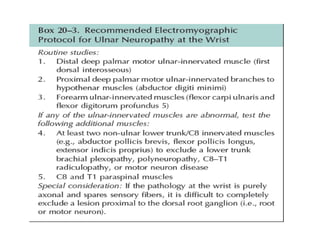
• Lesions at the Wrist and in the Hand-
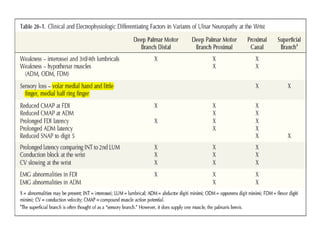
• Distal deep palmar motor lesion:
• Affects all muscles supplied by the deep palmar motor branch
except the hypothenar muscles, superficial branch containing
the sensory fibers and motor innervation to the palmaris
brevis is not affected.
• Proximal deep palmar motor lesion:Affects all ulnar-
innervated hand muscles, including the hypothenar muscles,
with the exception of the palmaris brevis; the superficial
branch containing the sensory fibers and motor innervation to
the palmaris brevis is not affected.
• Proximal canal lesion: Affects all branches of the ulnar nerve,
including the proximal and distal deep palmar motor and the
superficial branches which contain the sensory fibers and
motor innervation to the palmaris brevis
• Superficial branch lesion: Affects only the superficial branch,
which is primarily sensory
• Pseudoulnar Nerve Palsy:Pseudoulnar nerve palsy refers to
isolated hand weakness apparently in an ulnar distribution
that is due to contralateral cerebral infarction in the white
matter of the angular gyrus of the inferior parietal lobe
• Palmaris brevis spasm syndrome:Prolonged use of a
computer mouse and keyboard Electrophysiologic studies
suggest a distal ulnar motor branch
Thank you

Ulnar nerve

  • 1.
    Ulnar Nerve Dr PrashantShringi Senior Resident Neurology
  • 2.
    ULNAR NERVE C7, 8 &T1 • Origin: • From the medial cord of the brachial plexus. • It runs downward on the medial side of the brachial artery as far as the middle of the arm. • At the insertion of the coracobrachialis, it pierces the medial intermuscular septum and, accompanied by the superior ulnar collateral artery, to enter the posterior compartment of the arm. • At the elbow, it passes behind the medial epicondyle. • It has no branches in the arm.
  • 4.
    ULNAR NERVE in theForearm • It continues downward to enter the forearm between the two heads of the flexor carpi ulnaris. • It runs down the forearm between FCU and FDP. • In the lower half of the forearm it lies medial to the ulnar artery.
  • 5.
    • Branches: Muscular: Immediatelydistal to the elbow joint the nerve gives off its first two muscular branches Flexor carpi ulnaris- ulnar flexor of the wrist Medial ½ of FDP- flexor of the terminal phalanges of the fourth and fifth fingers • Articular: To elbow joint. • Dorsal or posterior cutaneous branch: • To the dorsal surface medial 1/3rd of the hand and 1½ fingers. • Palmar cutaneous branch : to supply skin of palm of hand.
  • 7.
    ULNAR NERVE inthe Hand Enters the palm superficial to the flexor retinaculum, passes between the pisiform carpal bone medially and the hook of the hamate carpal bone laterally (ulnar tunnel or canal of Guyon) • Then it divides into superficial & deep branches. Superficial branch: • It supplies palmaris brevis & palmar aspect of the medial 1½ fingers(sensory supply). Deep branch • Runs between abductor digiti minimi & flexor digiti minimi. • It pierces opponens digiti minimi. • Then passes laterally within the concavity of deep palmar arch. • It lies deep to the flexor tendons. • It supplies 14 muscles
  • 8.
    Musclar supply onhand • Palmaris brevis (C8–T1) :A cutaneous muscle • Abductor digiti minimi (C8–Tl) :An abductor of the fifth finger • Opponens digiti minimi (C8–T1): An opposer of the fifth finger • Flexor digiti minimi (C8–T1) :Flexor of the fifth finger • Lumbricals III and IV (C8–T1): Flexors of the metacarpophalangeal joints and extensors of the proximal interphalangeal joints of the fifth and fourth fingers
  • 9.
    • Interosseous muscles(C8–Tl) :Flexors of the metacarpophalangeal joints and extensors of the proximal interphalangeal joints, four dorsal interossei are finger abductors, whereas the three palmar interossei are finger adductors • Adductor pollicis (C8–T1) : An adductor of the metacarpal of the thumb. • Deep head of the flexor pollicis brevis (C8–Tl): Flexor of the first phalanx of the thumb.
  • 12.
    Localisation of nerveleison • Lesions above the Elbow: • lesion of the medial cord of the brachial plexus • Abnormal appearance of the hand –hypothenar eminence and interossei are atrophied and flattened • Incomplete claw hand
  • 14.
    • Sensory findings:all three sensorybranches of the ulnar nerve are affected (palmar,dorsal, and superficial terminal cutaneous branches)
  • 15.
    Lesions at theElbow (Cubital Tunnel Syndrome).
  • 16.
    • Ulnar nerveis most commonly compressed at the elbow in the cubital tunnel • Ulnar neuropathy at the elbow often spares the flexor carpi ulnaris muscle • tardy ulnar nerve palsy
  • 19.
    • Lesions inthe Forearm: • Lesions above the Elbow except that the flexor carpi ulnaris and the flexor digitorum profundus I and II muscles are often spared • In a patient with surgical section of the distal ulnar nerve in the forearm, ulnar sensation in the dorsal hand was spared in relation to the superficial radial sensory innervation of the ulnar hand dorsum • (“paradoxical” preservation of ulnar sensory function)
  • 21.
    • Lesions atthe Wrist and in the Hand- • Distal deep palmar motor lesion: • Affects all muscles supplied by the deep palmar motor branch except the hypothenar muscles, superficial branch containing the sensory fibers and motor innervation to the palmaris brevis is not affected. • Proximal deep palmar motor lesion:Affects all ulnar- innervated hand muscles, including the hypothenar muscles, with the exception of the palmaris brevis; the superficial branch containing the sensory fibers and motor innervation to the palmaris brevis is not affected.
  • 22.
    • Proximal canallesion: Affects all branches of the ulnar nerve, including the proximal and distal deep palmar motor and the superficial branches which contain the sensory fibers and motor innervation to the palmaris brevis • Superficial branch lesion: Affects only the superficial branch, which is primarily sensory
  • 23.
    • Pseudoulnar NervePalsy:Pseudoulnar nerve palsy refers to isolated hand weakness apparently in an ulnar distribution that is due to contralateral cerebral infarction in the white matter of the angular gyrus of the inferior parietal lobe • Palmaris brevis spasm syndrome:Prolonged use of a computer mouse and keyboard Electrophysiologic studies suggest a distal ulnar motor branch
  • 31.