UNIT II
Business Process Reengineering
By Dr. Dhobale J V
Associate Professor
School of Engineering & Technology
RNB Global University, Bikaner
RNB Global University, Bikaner. 1Course Code - 11010700
Objectives
 Business Process Reengineering.
 Business Process Improvement v/s BPR.
 ERP.
 Building Knowledge – Creating Knowledge
management systems
2RNB Global University, Bikaner.Course Code - 11010700
Introduction
 Business Process Reengineering
involves changes in structures and in
processes within the business
environment.
 The entire technological, human, and
organizational dimensions may be
changed in BPR.
RNB Global University, Bikaner. 3Course Code - 11010700
Introduction
 Information Technology plays a major
role in Business Process Reengineering.
 In general it allows an efficient and
effective change in the manner in which
work is performed.
RNB Global University, Bikaner. 4Course Code - 11010700
Business Process Re-engineering
 Competition is continuously increasing
with respect to price, quality and
selection, service and promptness of
delivery.
 Removal of barriers, international
cooperation, technological innovations
cause competition to intensify.
RNB Global University, Bikaner. 5Course Code - 11010700
Business Process Re-engineering
 All these changes impose the need for
organizational transformation, where the
entire processes, organization climate
and organization structure are changed.
RNB Global University, Bikaner. 6Course Code - 11010700
Business Process Re-engineering
 Hammer and Champy provide the
following definitions:
 Reengineering is the fundamental
rethinking and radical redesign of
business processes to achieve dramatic
improvements in critical contemporary
measures of performance such as cost,
quality, service and speed.
RNB Global University, Bikaner. 7Course Code - 11010700
Business Process Re-engineering
 Process is a structured, measured set of
activities designed to produce a specified
output for a particular customer or
market.
 It implies a strong emphasis on how
work is done within an organization
 Ex. 1.Credit Approval Process in a Bank.
2. Admission Process.
RNB Global University, Bikaner. 8Course Code - 11010700
Business Process Re-engineering
 Business processes are characterized by
three elements:
1. The Inputs.
2. The Processing.
3. The Outcome.
 The problematic part of the process is
processing.
RNB Global University, Bikaner. 9Course Code - 11010700
Business Process Re-engineering
RNB Global University, Bikaner. 10Course Code - 11010700
Business Process Re-engineering
RNB Global University, Bikaner. 11Course Code - 11010700
Business Process Re-engineering
 The difference between the vertical
organization and the cross functional
Organization lies in the way businesses
are organized internally.
 The vertical organization is organized
based on functional units.
 In cross-functional organizational units
the main organizational unit is the
process.
RNB Global University, Bikaner. 12Course Code - 11010700
Business Process Re-engineering
 BPR focuses on team building
operations around processes and
building a company mentality to
personnel.
 The objective of the technique is to build
customer-oriented effective
organizations.
RNB Global University, Bikaner. 13Course Code - 11010700
BPR Applications
 British Telecom had decided to transform
all the operations of the organization the
way customers wanted them to operate.
 The most important action in applying
BPR is the company's strategic goal to
provide customer oriented services.
 Another very important factor for
implementing BPR, is the enabling role
of Information Technology.
RNB Global University, Bikaner. 14Course Code - 11010700
BPR Applications
 New development in the area of
telecommunication makes BPR world-
wide applicable as managing technique
for business upgrade, enabled by the
technology.
 Empowering people.
 Providing Information.
 Providing Tools.
 Providing Training.
RNB Global University, Bikaner. 15Course Code - 11010700
BPR Applications
 Eliminating Unproductive Uses of
Time Information.
 Eliminating Unnecessary Paper.
 Eliminating Unnecessary Variations in
the Procedures and Systems.
 Minimizing the Burden of Record
Keeping.
RNB Global University, Bikaner. 16Course Code - 11010700
BPR Applications
 BPR is achieving dramatic performance
improvements through radical change in
organizational processes, rearchitecting
of business and management processes.
 This occurs with the creation and the use
of models.
RNB Global University, Bikaner. 17Course Code - 11010700
BPR Applications
 Whether those be physical models,
mathematical, computer or structural
models, engineers build and analyze
models to predict the performance of
designs or to understand the behaviour
of devices.
RNB Global University, Bikaner. 18Course Code - 11010700
BPR Principles
RNB Global University, Bikaner. 19Course Code - 11010700
BPR Principles
 There is a fundamental transformation
occurring in business - in terms of its
structure, processes, people, and
technology.
RNB Global University, Bikaner. 20Course Code - 11010700
BP Improvement V/s BPR
RNB Global University, Bikaner. 21Course Code - 11010700
Objectives of BPR
RNB Global University, Bikaner. 22
 Customer Focus.
 Speed.
 Compression.
 Flexibility.
 Quality.
 Innovation.
 Productivity.
Course Code - 11010700
BPR implementation Methods
RNB Global University, Bikaner. 23
 The technique implements organizational
change based on the close coordination
of a methodology for rapid change,
employee empowerment and training
and support by information technology.
 To implement BPR followings key
actions required.
Course Code - 11010700
BPR implementation Methods
RNB Global University, Bikaner. 24
1. Selection of the strategic processes for
redesign.
2. Simplify new processes - minimize
steps - optimize efficiency (Modelling).
3. Organize a team of employees for each
process and assign a role for process
coordinator.
4. Organize the workflow - document
transfer and control.
Course Code - 11010700
BPR implementation Methods
RNB Global University, Bikaner. 25
5. Assign responsibilities and roles for
each process.
6. Automate processes using IT.
7. Train the process team to efficiently
manage and operate the new process.
8. Introduce the redesigned process into
the business organizational structure.
Course Code - 11010700
BPR implementation Methods
RNB Global University, Bikaner. 26
 The complete articulation of the future
five state; basic steps are mentioned
below:
1. The right combination of individuals
come together to form an optimistic and
energized team.
2. Clear objectives exist and the scope for
the project is well defined and
understood.
Course Code - 11010700
BPR implementation Methods
RNB Global University, Bikaner. 27
3. The team can stand in the future and
look back, rather than stand in the
present and look forward.
4. The vision is rooted in a set of guiding
principles.
5. All methodologies could be generalized.
Course Code - 11010700
BPR implementation Methods
RNB Global University, Bikaner. 28
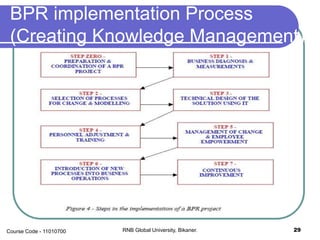
 BPR Implementation stages:
1. The Envision stage
2. The Initiation Stage
3. The Diagnosis Stage
4. The Redesign Stage
5. The Reconstruction stage
6. The Evaluation stage
Course Code - 11010700
BPR implementation Process
(Creating Knowledge Management)
RNB Global University, Bikaner. 29Course Code - 11010700
Review
 Business Process Reengineering.
 Business Process Improvement v/s BPR.
 ERP.
 Building Knowledge – Creating Knowledge
management systems
30RNB Global University, Bikaner.Course Code - 11010700
Thank You!
RNB Global University, Bikaner. 31Course Code - 11010700

Bpr

  • 1.
    UNIT II Business ProcessReengineering By Dr. Dhobale J V Associate Professor School of Engineering & Technology RNB Global University, Bikaner RNB Global University, Bikaner. 1Course Code - 11010700
  • 2.
    Objectives  Business ProcessReengineering.  Business Process Improvement v/s BPR.  ERP.  Building Knowledge – Creating Knowledge management systems 2RNB Global University, Bikaner.Course Code - 11010700
  • 3.
    Introduction  Business ProcessReengineering involves changes in structures and in processes within the business environment.  The entire technological, human, and organizational dimensions may be changed in BPR. RNB Global University, Bikaner. 3Course Code - 11010700
  • 4.
    Introduction  Information Technologyplays a major role in Business Process Reengineering.  In general it allows an efficient and effective change in the manner in which work is performed. RNB Global University, Bikaner. 4Course Code - 11010700
  • 5.
    Business Process Re-engineering Competition is continuously increasing with respect to price, quality and selection, service and promptness of delivery.  Removal of barriers, international cooperation, technological innovations cause competition to intensify. RNB Global University, Bikaner. 5Course Code - 11010700
  • 6.
    Business Process Re-engineering All these changes impose the need for organizational transformation, where the entire processes, organization climate and organization structure are changed. RNB Global University, Bikaner. 6Course Code - 11010700
  • 7.
    Business Process Re-engineering Hammer and Champy provide the following definitions:  Reengineering is the fundamental rethinking and radical redesign of business processes to achieve dramatic improvements in critical contemporary measures of performance such as cost, quality, service and speed. RNB Global University, Bikaner. 7Course Code - 11010700
  • 8.
    Business Process Re-engineering Process is a structured, measured set of activities designed to produce a specified output for a particular customer or market.  It implies a strong emphasis on how work is done within an organization  Ex. 1.Credit Approval Process in a Bank. 2. Admission Process. RNB Global University, Bikaner. 8Course Code - 11010700
  • 9.
    Business Process Re-engineering Business processes are characterized by three elements: 1. The Inputs. 2. The Processing. 3. The Outcome.  The problematic part of the process is processing. RNB Global University, Bikaner. 9Course Code - 11010700
  • 10.
    Business Process Re-engineering RNBGlobal University, Bikaner. 10Course Code - 11010700
  • 11.
    Business Process Re-engineering RNBGlobal University, Bikaner. 11Course Code - 11010700
  • 12.
    Business Process Re-engineering The difference between the vertical organization and the cross functional Organization lies in the way businesses are organized internally.  The vertical organization is organized based on functional units.  In cross-functional organizational units the main organizational unit is the process. RNB Global University, Bikaner. 12Course Code - 11010700
  • 13.
    Business Process Re-engineering BPR focuses on team building operations around processes and building a company mentality to personnel.  The objective of the technique is to build customer-oriented effective organizations. RNB Global University, Bikaner. 13Course Code - 11010700
  • 14.
    BPR Applications  BritishTelecom had decided to transform all the operations of the organization the way customers wanted them to operate.  The most important action in applying BPR is the company's strategic goal to provide customer oriented services.  Another very important factor for implementing BPR, is the enabling role of Information Technology. RNB Global University, Bikaner. 14Course Code - 11010700
  • 15.
    BPR Applications  Newdevelopment in the area of telecommunication makes BPR world- wide applicable as managing technique for business upgrade, enabled by the technology.  Empowering people.  Providing Information.  Providing Tools.  Providing Training. RNB Global University, Bikaner. 15Course Code - 11010700
  • 16.
    BPR Applications  EliminatingUnproductive Uses of Time Information.  Eliminating Unnecessary Paper.  Eliminating Unnecessary Variations in the Procedures and Systems.  Minimizing the Burden of Record Keeping. RNB Global University, Bikaner. 16Course Code - 11010700
  • 17.
    BPR Applications  BPRis achieving dramatic performance improvements through radical change in organizational processes, rearchitecting of business and management processes.  This occurs with the creation and the use of models. RNB Global University, Bikaner. 17Course Code - 11010700
  • 18.
    BPR Applications  Whetherthose be physical models, mathematical, computer or structural models, engineers build and analyze models to predict the performance of designs or to understand the behaviour of devices. RNB Global University, Bikaner. 18Course Code - 11010700
  • 19.
    BPR Principles RNB GlobalUniversity, Bikaner. 19Course Code - 11010700
  • 20.
    BPR Principles  Thereis a fundamental transformation occurring in business - in terms of its structure, processes, people, and technology. RNB Global University, Bikaner. 20Course Code - 11010700
  • 21.
    BP Improvement V/sBPR RNB Global University, Bikaner. 21Course Code - 11010700
  • 22.
    Objectives of BPR RNBGlobal University, Bikaner. 22  Customer Focus.  Speed.  Compression.  Flexibility.  Quality.  Innovation.  Productivity. Course Code - 11010700
  • 23.
    BPR implementation Methods RNBGlobal University, Bikaner. 23  The technique implements organizational change based on the close coordination of a methodology for rapid change, employee empowerment and training and support by information technology.  To implement BPR followings key actions required. Course Code - 11010700
  • 24.
    BPR implementation Methods RNBGlobal University, Bikaner. 24 1. Selection of the strategic processes for redesign. 2. Simplify new processes - minimize steps - optimize efficiency (Modelling). 3. Organize a team of employees for each process and assign a role for process coordinator. 4. Organize the workflow - document transfer and control. Course Code - 11010700
  • 25.
    BPR implementation Methods RNBGlobal University, Bikaner. 25 5. Assign responsibilities and roles for each process. 6. Automate processes using IT. 7. Train the process team to efficiently manage and operate the new process. 8. Introduce the redesigned process into the business organizational structure. Course Code - 11010700
  • 26.
    BPR implementation Methods RNBGlobal University, Bikaner. 26  The complete articulation of the future five state; basic steps are mentioned below: 1. The right combination of individuals come together to form an optimistic and energized team. 2. Clear objectives exist and the scope for the project is well defined and understood. Course Code - 11010700
  • 27.
    BPR implementation Methods RNBGlobal University, Bikaner. 27 3. The team can stand in the future and look back, rather than stand in the present and look forward. 4. The vision is rooted in a set of guiding principles. 5. All methodologies could be generalized. Course Code - 11010700
  • 28.
    BPR implementation Methods RNBGlobal University, Bikaner. 28  BPR Implementation stages: 1. The Envision stage 2. The Initiation Stage 3. The Diagnosis Stage 4. The Redesign Stage 5. The Reconstruction stage 6. The Evaluation stage Course Code - 11010700
  • 29.
    BPR implementation Process (CreatingKnowledge Management) RNB Global University, Bikaner. 29Course Code - 11010700
  • 30.
    Review  Business ProcessReengineering.  Business Process Improvement v/s BPR.  ERP.  Building Knowledge – Creating Knowledge management systems 30RNB Global University, Bikaner.Course Code - 11010700
  • 31.
    Thank You! RNB GlobalUniversity, Bikaner. 31Course Code - 11010700