Business Process
Re-engineering
History
 Introduced in the late Micheal Hammer’s 1990 Harvard
Business Review article.
 Promoted by Hammer and James Champy published book
Reengineering the corporation.
By the mid-1990s, BPR became popular as a justification for
downsizing.
 The next new methodology, after BPR is Enterprise Resource
Planning.
Meaning
Business process reengineering (BPR) is
the analysis and redesign of workflows
within and between enterprises in order to
optimize end-to-end processes and
automate non-value-added tasks.
Business Process Reengineering(BPR)
Process: A process is a cross-functional
interrelated series of activities that convert
business inputs into business outputs
Business Process: “A business process is a
collection of activities which together produces
some value to the customer” (OR)
A group of logically related tasks that use the
firm's resources to provide customer-oriented
results in support of the organization's objectives.
Reengineering: Reengineering is fundamental
rethinking and radical redesign.
Objective/Purpose of BPR
BPR focuses on processes and not on tasks, jobs or
people BPR advocates that enterprises re-examines from
basics aims at total re-invention not small improvements.
Example:
“Hewlett Packard’s assembly time for server computers
reduces to low-4 minutes”
Seven Reengineering Principles
1. Organize around outcomes, not tasks.
2. Identify all the processes in an organization and prioritize them in order of
redesign urgency.
3. Integrate information processing work into the real work that produces the
information.
4. Treat geographically dispersed resources as though they were centralized.
5. Link parallel activities in the workflow instead of just integrating their
results.
6. Put the decision point where the work is performed, and build control into
the process.
7. Capture information once and at the source.
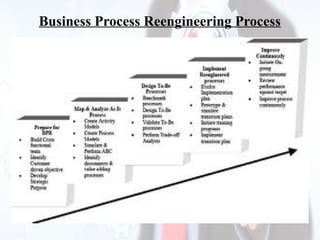
Business Process Reengineering Process
Step 1: Prepare for Reengineering
• There must be significant need for the process to be reengineered.
• Identifying the customer driven objectives, the mission and vision
statement is formulated
Step2: Map & Analyse As-Is process
• Understand the existing process and its shortfalls and improvement
areas of redesign.
• Activity and process models are documented.
• Then, the amount and cost of each activity is calculated.
Step3: Design To-Be process
• The objective of this phase is to produce one or more alternatives to
the current situation that satisfies strategic goals of the enterprise.
Step4: Implement Reengineering Process
• Using prototype and simulation method plans are designed and
demonstrated.
• Training programs for the workers are initiated and the plan is
executed in full scale
Step5: Improving the reengineering process
continuously
• The progress of action is measured on change acceptance in broader
perspective of the organisation, how well the employee are
informed and their commitments
• Monitoring the results measures employee attitude, customer
perception, supplier responsiveness etc.,
Benefits of Reengineering
 Eliminates waste, and obsolete or inefficient process
 Significant reduction in cost and time
 Revolutionary improvements in many business
processes as measured by quality and customer service
 Increasing the competency of both top and low level
companies
BPR Management Technique Focused
• Customer focus-Customer service oriented processes aiming to
eliminate customer complaints.
• Speed-Dramatic compression of the time it takes to complete a
task for key business processes.
• Flexibility- Adaptive processes and structures to changing
conditions and competition.
• Quality-Obsession with the superior service and value to the
customers.
• Innovation-Leadership through imaginative change providing
to organization competitive advantage.
• Productivity-Improve drastically effectiveness and efficiency.
APPLICATION
• Many public and private sector organizations and SMEs Word-wide had
undergone major reengineering efforts.
• The technique was applied first to multinational cooperation's, such as
IBM, SONY, GENERAL ELECTRIC, WALL MART, HEWLLET PACKARD,
KRAFT FOODS having as a result major downsizing in their organizational
structures
• Later, the banking sector began to reengineer with a great degree of success
such as CITIBANK , NORTHWESTERN BANK, BANK OF AMERICA and
others.
• Major utility companies used reengineering as a technique to improve
service like OTE.
• This technique was becoming well known to the business
sector
• Today most SMEs are investigating the re-engineering
technique and a lot of them are applying re-engineering.
• Most of the times re-engineering is applied as a "must" when
innovative IT tools are introduced to SMEs. Tools such as SAP,
and various ERP systems that promote the horizontal
organizational structure.
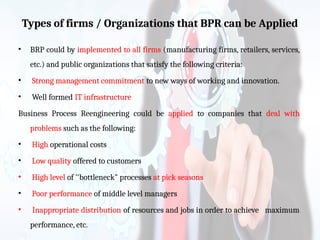
Types of firms / Organizations that BPR can be Applied
• BRP could by implemented to all firms (manufacturing firms, retailers, services,
etc.) and public organizations that satisfy the following criteria:
• Strong management commitment to new ways of working and innovation.
• Well formed IT infrastructure
Business Process Reengineering could be applied to companies that deal with
problems such as the following:
• High operational costs
• Low quality offered to customers
• High level of ''bottleneck" processes at pick seasons
• Poor performance of middle level managers
• Inappropriate distribution of resources and jobs in order to achieve maximum
performance, etc.
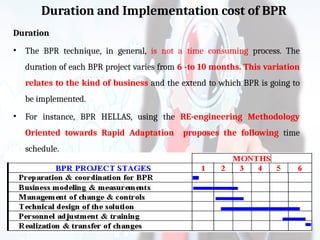
Duration and Implementation cost of BPR
Duration
• The BPR technique, in general, is not a time consuming process. The
duration of each BPR project varies from 6 -to 10 months. This variation
relates to the kind of business and the extend to which BPR is going to
be implemented.
• For instance, BPR HELLAS, using the RE-engineering Methodology
Oriented towards Rapid Adaptation proposes the following time
schedule.
Implementation Cost
• The cost of a BPR for projects applied to SMEs for
selective processes varies depending on the
complexity of the business environment and the
number of processes
Case Study
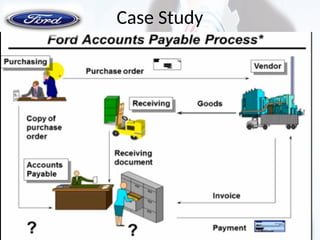
Trigger For Ford’s AP Re-Engineering
• Mazda only uses 1/5 personnel to do the same
Accounts payable .(Ford:500; Mazda:5)
• When goods arrive at the loading dock at Mazda:
-Use bar-code reader is used the loading dock at
Mazda.
- Inventory data are updated.
-Send electronic payment to the supplier.
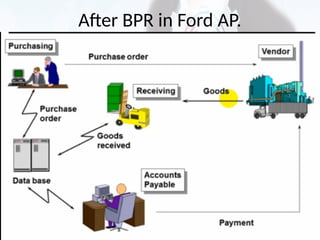
After BPR in Ford AP.
Ford Accounts Payable
Before
• More than 500 accounts payable clerks matched purchase order,
receiving documents and invoices and then issued payment.
• It was slow and burdensome.
• Mismatches were common.
After
• The new process cuts head count in AP by 75%.
• Invoices are eliminated.
• Matching is computerized.
• Accuracy is improved.
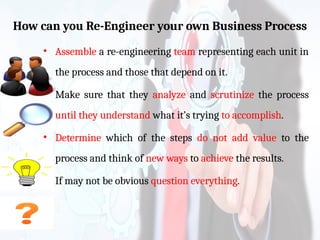
How can you Re-Engineer your own Business Process
• Assemble a re-engineering team representing each unit in
the process and those that depend on it.
• Make sure that they analyze and scrutinize the process
until they understand what it’s trying to accomplish.
• Determine which of the steps do not add value to the
process and think of new ways to achieve the results.
• If may not be obvious question everything.

notes on Business Processing Re-engineering.pptx

  • 1.
  • 2.
    History  Introduced inthe late Micheal Hammer’s 1990 Harvard Business Review article.  Promoted by Hammer and James Champy published book Reengineering the corporation. By the mid-1990s, BPR became popular as a justification for downsizing.  The next new methodology, after BPR is Enterprise Resource Planning.
  • 3.
    Meaning Business process reengineering(BPR) is the analysis and redesign of workflows within and between enterprises in order to optimize end-to-end processes and automate non-value-added tasks.
  • 4.
    Business Process Reengineering(BPR) Process:A process is a cross-functional interrelated series of activities that convert business inputs into business outputs Business Process: “A business process is a collection of activities which together produces some value to the customer” (OR) A group of logically related tasks that use the firm's resources to provide customer-oriented results in support of the organization's objectives. Reengineering: Reengineering is fundamental rethinking and radical redesign.
  • 5.
    Objective/Purpose of BPR BPRfocuses on processes and not on tasks, jobs or people BPR advocates that enterprises re-examines from basics aims at total re-invention not small improvements. Example: “Hewlett Packard’s assembly time for server computers reduces to low-4 minutes”
  • 6.
    Seven Reengineering Principles 1.Organize around outcomes, not tasks. 2. Identify all the processes in an organization and prioritize them in order of redesign urgency. 3. Integrate information processing work into the real work that produces the information. 4. Treat geographically dispersed resources as though they were centralized. 5. Link parallel activities in the workflow instead of just integrating their results. 6. Put the decision point where the work is performed, and build control into the process. 7. Capture information once and at the source.
  • 7.
  • 8.
    Step 1: Preparefor Reengineering • There must be significant need for the process to be reengineered. • Identifying the customer driven objectives, the mission and vision statement is formulated Step2: Map & Analyse As-Is process • Understand the existing process and its shortfalls and improvement areas of redesign. • Activity and process models are documented. • Then, the amount and cost of each activity is calculated. Step3: Design To-Be process • The objective of this phase is to produce one or more alternatives to the current situation that satisfies strategic goals of the enterprise.
  • 9.
    Step4: Implement ReengineeringProcess • Using prototype and simulation method plans are designed and demonstrated. • Training programs for the workers are initiated and the plan is executed in full scale Step5: Improving the reengineering process continuously • The progress of action is measured on change acceptance in broader perspective of the organisation, how well the employee are informed and their commitments • Monitoring the results measures employee attitude, customer perception, supplier responsiveness etc.,
  • 10.
    Benefits of Reengineering Eliminates waste, and obsolete or inefficient process  Significant reduction in cost and time  Revolutionary improvements in many business processes as measured by quality and customer service  Increasing the competency of both top and low level companies
  • 11.
    BPR Management TechniqueFocused • Customer focus-Customer service oriented processes aiming to eliminate customer complaints. • Speed-Dramatic compression of the time it takes to complete a task for key business processes. • Flexibility- Adaptive processes and structures to changing conditions and competition. • Quality-Obsession with the superior service and value to the customers. • Innovation-Leadership through imaginative change providing to organization competitive advantage. • Productivity-Improve drastically effectiveness and efficiency.
  • 12.
    APPLICATION • Many publicand private sector organizations and SMEs Word-wide had undergone major reengineering efforts. • The technique was applied first to multinational cooperation's, such as IBM, SONY, GENERAL ELECTRIC, WALL MART, HEWLLET PACKARD, KRAFT FOODS having as a result major downsizing in their organizational structures • Later, the banking sector began to reengineer with a great degree of success such as CITIBANK , NORTHWESTERN BANK, BANK OF AMERICA and others. • Major utility companies used reengineering as a technique to improve service like OTE.
  • 13.
    • This techniquewas becoming well known to the business sector • Today most SMEs are investigating the re-engineering technique and a lot of them are applying re-engineering. • Most of the times re-engineering is applied as a "must" when innovative IT tools are introduced to SMEs. Tools such as SAP, and various ERP systems that promote the horizontal organizational structure.
  • 14.
    Types of firms/ Organizations that BPR can be Applied • BRP could by implemented to all firms (manufacturing firms, retailers, services, etc.) and public organizations that satisfy the following criteria: • Strong management commitment to new ways of working and innovation. • Well formed IT infrastructure Business Process Reengineering could be applied to companies that deal with problems such as the following: • High operational costs • Low quality offered to customers • High level of ''bottleneck" processes at pick seasons • Poor performance of middle level managers • Inappropriate distribution of resources and jobs in order to achieve maximum performance, etc.
  • 15.
    Duration and Implementationcost of BPR Duration • The BPR technique, in general, is not a time consuming process. The duration of each BPR project varies from 6 -to 10 months. This variation relates to the kind of business and the extend to which BPR is going to be implemented. • For instance, BPR HELLAS, using the RE-engineering Methodology Oriented towards Rapid Adaptation proposes the following time schedule.
  • 16.
    Implementation Cost • Thecost of a BPR for projects applied to SMEs for selective processes varies depending on the complexity of the business environment and the number of processes
  • 17.
  • 18.
    Trigger For Ford’sAP Re-Engineering • Mazda only uses 1/5 personnel to do the same Accounts payable .(Ford:500; Mazda:5) • When goods arrive at the loading dock at Mazda: -Use bar-code reader is used the loading dock at Mazda. - Inventory data are updated. -Send electronic payment to the supplier.
  • 19.
    After BPR inFord AP.
  • 20.
    Ford Accounts Payable Before •More than 500 accounts payable clerks matched purchase order, receiving documents and invoices and then issued payment. • It was slow and burdensome. • Mismatches were common. After • The new process cuts head count in AP by 75%. • Invoices are eliminated. • Matching is computerized. • Accuracy is improved.
  • 21.
    How can youRe-Engineer your own Business Process • Assemble a re-engineering team representing each unit in the process and those that depend on it. • Make sure that they analyze and scrutinize the process until they understand what it’s trying to accomplish. • Determine which of the steps do not add value to the process and think of new ways to achieve the results. • If may not be obvious question everything.