QUALITY MANAGEMENT
A. QUALITY GURUS
B. MAIN CONTRIBUTION.
ELIZABETH RUIZ
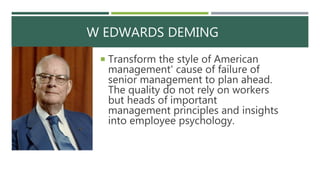
W EDWARDS DEMING
 Transform the style of American
management' cause of failure of
senior management to plan ahead.
The quality do not rely on workers
but heads of important
management principles and insights
into employee psychology.
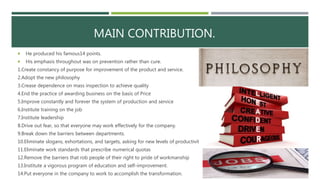
MAIN CONTRIBUTION.
 He produced his famous14 points.
 His emphasis throughout was on prevention rather than cure.
1.Create constancy of purpose for improvement of the product and service.
2.Adopt the new philosophy
3.Crease dependence on mass inspection to achieve quality
4.End the practice of awarding business on the basis of Price
5.Improve constantly and forever the system of production and service
6.Institute training on the job
7.Institute leadership
8.Drive out fear, so that everyone may work effectively for the company.
9.Break down the barriers between departments.
10.Eliminate slogans, exhortations, and targets, asking for new levels of productivity
11.Eliminate work standards that prescribe numerical quotas
12.Remove the barriers that rob people of their right to pride of workmanship
13.Institute a vigorous program of education and self-improvement.
14.Put everyone in the company to work to accomplish the transformation.
SEVEN DEADLY DISEASES (JUST 5 RELATED TO EDUCATION)
 Seven deadly diseases (just 5 related to education)
1. the lack of constancy of purpose.
2. Short-term thinking
3. Evaluation of an individual’s performance through merit ratings or annual review.
4. Job-hopping
5. Management by the use of visible figures.
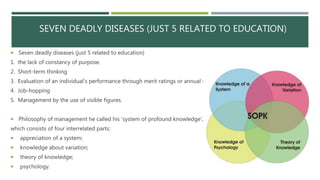
 Philosophy of management he called his ‘system of profound knowledge’,
which consists of four interrelated parts:
 appreciation of a system;
 knowledge about variation;
 theory of knowledge;
 psychology.
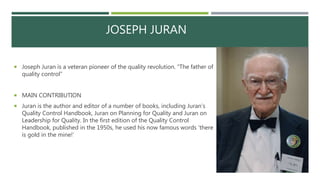
JOSEPH JURAN
 Joseph Juran is a veteran pioneer of the quality revolution. “The father of
quality control”
 MAIN CONTRIBUTION
 Juran is the author and editor of a number of books, including Juran’s
Quality Control Handbook, Juran on Planning for Quality and Juran on
Leadership for Quality. In the first edition of the Quality Control
Handbook, published in the 1950s, he used his now famous words ‘there
is gold in the mine!’
THE 80/20 RULE
 It follows from this that 80 per cent of
problems lie with management, as
they have control of 80 per cent of the
systems in an organization.
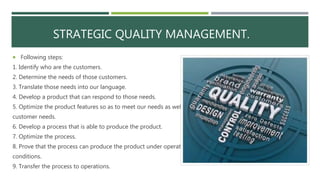
STRATEGIC QUALITY MANAGEMENT.
 Following steps:
1. Identify who are the customers.
2. Determine the needs of those customers.
3. Translate those needs into our language.
4. Develop a product that can respond to those needs.
5. Optimize the product features so as to meet our needs as well as
customer needs.
6. Develop a process that is able to produce the product.
7. Optimize the process.
8. Prove that the process can produce the product under operating
conditions.
9. Transfer the process to operations.
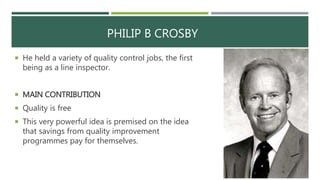
PHILIP B CROSBY
 He held a variety of quality control jobs, the first
being as a line inspector.
 MAIN CONTRIBUTION
 Quality is free
 This very powerful idea is premised on the idea
that savings from quality improvement
programmes pay for themselves.
ZERO DEFECTS AND STEPS IN A QUALITY PROGRAMME
 Zero defects
 It is the commitment to success and the elimination of failure. It
involves putting systems in place that ensure that things are always
done in the right way first time and every time.
 STEPS IN A QUALITY PROGRAMME
 1) Management Commitment.
 2) The Quality Improvement Team
 3)Quality Measurement
 4)quantifying The Cost of Quality.
 5)Quality Awareness.
 6)Corrective Action
 7)Zero Defects Planning.
 8)Supervisor Training
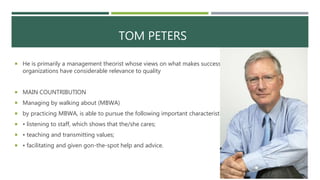
TOM PETERS
 He is primarily a management theorist whose views on what makes successful
organizations have considerable relevance to quality
 MAIN COUNTRIBUTION
 Managing by walking about (MBWA)
 by practicing MBWA, is able to pursue the following important characteristics:
 • listening to staff, which shows that the/she cares;
 • teaching and transmitting values;
 • facilitating and given gon-the-spot help and advice.
ATTRIBUTES OR TRAITS
 These traits are:
1. A management obsession with quality—Peters stresses the importance of practical action to back
up the emotional commitment to quality
2. Passionate systems—for Peters, failure is invariably due to passion without system, or system
without passion.
3. Measurement of quality—Quality is rewarded—Peters believes that financial incentives can boost
quality improvement.
4. Everyone is trained for quality—Peters believes that every person in an organization should be
extensively trained.
5. Multi-function teams
6. Small is beautiful—Peters does not believe that there is any such
7. thing as a small improvement.
8. Create endless ‘Hawthorne effects’—he believes in getting things going with new goals, new
themes and new events.
9. Pharallel organizational structure devoted to quality improvement
10. Everyone is involved
11. When quality goes up, costs go down
12. Quality improvement is a never-ending journey
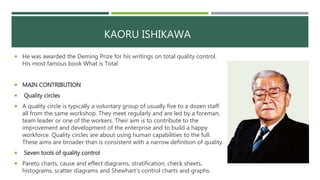
KAORU ISHIKAWA
 He was awarded the Deming Prize for his writings on total quality control.
His most famous book What is Total
 MAIN CONTRIBUTION
 Quality circles
 A quality circle is typically a voluntary group of usually five to a dozen staff
all from the same workshop. They meet regularly and are led by a foreman,
team leader or one of the workers. Their aim is to contribute to the
improvement and development of the enterprise and to build a happy
workforce. Quality circles are about using human capabilities to the full.
These aims are broader than is consistent with a narrow definition of quality.
 Seven tools of quality control
 Pareto charts, cause and effect diagrams, stratification, check sheets,
histograms, scatter diagrams and Shewhart’s control charts and graphs.
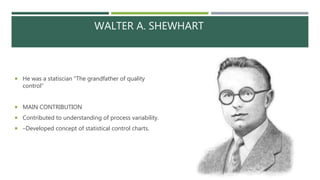
WALTER A. SHEWHART
 He was a statiscian “The grandfather of quality
control”
 MAIN CONTRIBUTION
 Contributed to understanding of process variability.
 –Developed concept of statistical control charts.
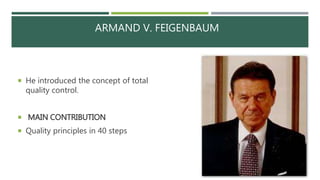
ARMAND V. FEIGENBAUM
 He introduced the concept of total
quality control.
 MAIN CONTRIBUTION
 Quality principles in 40 steps
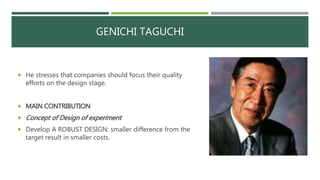
GENICHI TAGUCHI
 He stresses that companies should focus their quality
efforts on the design stage.
 MAIN CONTRIBUTION
 Concept of Design of experiment
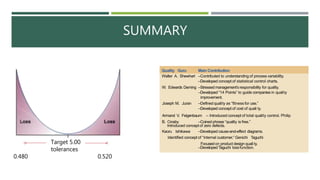
 Develop A ROBUST DESIGN: smaller difference from the
target result in smaller costs.
SUMMARY
Target 5.00
tolerances
0.480 0.520
Quality Guru Main Contribution
Walter A. Shewhart –Contributed to understanding of process variability.
–Developed concept of statistical control charts.
W. Edwards Deming –Stressed management’sresponsibility for quality.
–Developed “14 Points” to guide companies in quality
improvement.
Joseph M. Juran –Defined quality as “fitnessfor use.”
–Developed concept of cost of quali ty.
Armand V. Feigenbaum – Introduced concept of total quality control. Philip
B. Crosby –Coined phrase “quality is free.”
Introduced concept of zero defects.
Kaoru Ishikawa –Developed cause-and-effect diagrams.
Identified concept of “internal customer.” Genichi Taguchi
Focused on product design quali ty.
–Developed Taguchi lossfunction.

Total Quality Management GURUS

  • 1.
    QUALITY MANAGEMENT A. QUALITYGURUS B. MAIN CONTRIBUTION. ELIZABETH RUIZ
  • 2.
    W EDWARDS DEMING Transform the style of American management' cause of failure of senior management to plan ahead. The quality do not rely on workers but heads of important management principles and insights into employee psychology.
  • 3.
    MAIN CONTRIBUTION.  Heproduced his famous14 points.  His emphasis throughout was on prevention rather than cure. 1.Create constancy of purpose for improvement of the product and service. 2.Adopt the new philosophy 3.Crease dependence on mass inspection to achieve quality 4.End the practice of awarding business on the basis of Price 5.Improve constantly and forever the system of production and service 6.Institute training on the job 7.Institute leadership 8.Drive out fear, so that everyone may work effectively for the company. 9.Break down the barriers between departments. 10.Eliminate slogans, exhortations, and targets, asking for new levels of productivity 11.Eliminate work standards that prescribe numerical quotas 12.Remove the barriers that rob people of their right to pride of workmanship 13.Institute a vigorous program of education and self-improvement. 14.Put everyone in the company to work to accomplish the transformation.
  • 4.
    SEVEN DEADLY DISEASES(JUST 5 RELATED TO EDUCATION)  Seven deadly diseases (just 5 related to education) 1. the lack of constancy of purpose. 2. Short-term thinking 3. Evaluation of an individual’s performance through merit ratings or annual review. 4. Job-hopping 5. Management by the use of visible figures.  Philosophy of management he called his ‘system of profound knowledge’, which consists of four interrelated parts:  appreciation of a system;  knowledge about variation;  theory of knowledge;  psychology.
  • 5.
    JOSEPH JURAN  JosephJuran is a veteran pioneer of the quality revolution. “The father of quality control”  MAIN CONTRIBUTION  Juran is the author and editor of a number of books, including Juran’s Quality Control Handbook, Juran on Planning for Quality and Juran on Leadership for Quality. In the first edition of the Quality Control Handbook, published in the 1950s, he used his now famous words ‘there is gold in the mine!’
  • 6.
    THE 80/20 RULE It follows from this that 80 per cent of problems lie with management, as they have control of 80 per cent of the systems in an organization.
  • 7.
    STRATEGIC QUALITY MANAGEMENT. Following steps: 1. Identify who are the customers. 2. Determine the needs of those customers. 3. Translate those needs into our language. 4. Develop a product that can respond to those needs. 5. Optimize the product features so as to meet our needs as well as customer needs. 6. Develop a process that is able to produce the product. 7. Optimize the process. 8. Prove that the process can produce the product under operating conditions. 9. Transfer the process to operations.
  • 8.
    PHILIP B CROSBY He held a variety of quality control jobs, the first being as a line inspector.  MAIN CONTRIBUTION  Quality is free  This very powerful idea is premised on the idea that savings from quality improvement programmes pay for themselves.
  • 9.
    ZERO DEFECTS ANDSTEPS IN A QUALITY PROGRAMME  Zero defects  It is the commitment to success and the elimination of failure. It involves putting systems in place that ensure that things are always done in the right way first time and every time.  STEPS IN A QUALITY PROGRAMME  1) Management Commitment.  2) The Quality Improvement Team  3)Quality Measurement  4)quantifying The Cost of Quality.  5)Quality Awareness.  6)Corrective Action  7)Zero Defects Planning.  8)Supervisor Training
  • 10.
    TOM PETERS  Heis primarily a management theorist whose views on what makes successful organizations have considerable relevance to quality  MAIN COUNTRIBUTION  Managing by walking about (MBWA)  by practicing MBWA, is able to pursue the following important characteristics:  • listening to staff, which shows that the/she cares;  • teaching and transmitting values;  • facilitating and given gon-the-spot help and advice.
  • 11.
    ATTRIBUTES OR TRAITS These traits are: 1. A management obsession with quality—Peters stresses the importance of practical action to back up the emotional commitment to quality 2. Passionate systems—for Peters, failure is invariably due to passion without system, or system without passion. 3. Measurement of quality—Quality is rewarded—Peters believes that financial incentives can boost quality improvement. 4. Everyone is trained for quality—Peters believes that every person in an organization should be extensively trained. 5. Multi-function teams 6. Small is beautiful—Peters does not believe that there is any such 7. thing as a small improvement. 8. Create endless ‘Hawthorne effects’—he believes in getting things going with new goals, new themes and new events. 9. Pharallel organizational structure devoted to quality improvement 10. Everyone is involved 11. When quality goes up, costs go down 12. Quality improvement is a never-ending journey
  • 12.
    KAORU ISHIKAWA  Hewas awarded the Deming Prize for his writings on total quality control. His most famous book What is Total  MAIN CONTRIBUTION  Quality circles  A quality circle is typically a voluntary group of usually five to a dozen staff all from the same workshop. They meet regularly and are led by a foreman, team leader or one of the workers. Their aim is to contribute to the improvement and development of the enterprise and to build a happy workforce. Quality circles are about using human capabilities to the full. These aims are broader than is consistent with a narrow definition of quality.  Seven tools of quality control  Pareto charts, cause and effect diagrams, stratification, check sheets, histograms, scatter diagrams and Shewhart’s control charts and graphs.
  • 13.
    WALTER A. SHEWHART He was a statiscian “The grandfather of quality control”  MAIN CONTRIBUTION  Contributed to understanding of process variability.  –Developed concept of statistical control charts.
  • 14.
    ARMAND V. FEIGENBAUM He introduced the concept of total quality control.  MAIN CONTRIBUTION  Quality principles in 40 steps
  • 15.
    GENICHI TAGUCHI  Hestresses that companies should focus their quality efforts on the design stage.  MAIN CONTRIBUTION  Concept of Design of experiment  Develop A ROBUST DESIGN: smaller difference from the target result in smaller costs.
  • 16.
    SUMMARY Target 5.00 tolerances 0.480 0.520 QualityGuru Main Contribution Walter A. Shewhart –Contributed to understanding of process variability. –Developed concept of statistical control charts. W. Edwards Deming –Stressed management’sresponsibility for quality. –Developed “14 Points” to guide companies in quality improvement. Joseph M. Juran –Defined quality as “fitnessfor use.” –Developed concept of cost of quali ty. Armand V. Feigenbaum – Introduced concept of total quality control. Philip B. Crosby –Coined phrase “quality is free.” Introduced concept of zero defects. Kaoru Ishikawa –Developed cause-and-effect diagrams. Identified concept of “internal customer.” Genichi Taguchi Focused on product design quali ty. –Developed Taguchi lossfunction.