Histology of Bone
What is Bone:
Bone is the basic unit of skeletal system
which provides-
 Framework of the body
 Protection to vital organs
 Mechanical movement
Classification of Bone
Based on location: 2
Types
 Axial skeleton.
* Central axis of skeleton
* 28 skull bone
* 26 vertebrae
* 25 ribs
* 1 hyoid bone
 Appendicular skeleton.
* Non-axial bones of skeleton
* 64 in upper extremities
* 62 in lower extremities
Classification of Bone (cont.)
Based on shape:
 Flat bone: skull, vertebrae, ribs
 Tubular bone: bones in hands and feets
 Irregular bone: face and vertebral column
 Sesamoid bone: patella
 Accessory bone: bones that develop in other
ossification centre
Classification of Bone (cont.)
Based on size:
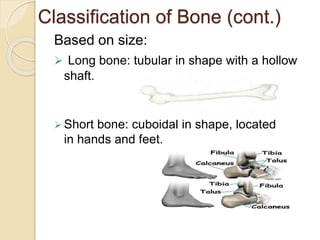
 Long bone: tubular in shape with a hollow
shaft.
Classification of Bone (cont.)
 Short bone: cuboidal in shape, located
in hands and feet.
Gross structure of bone:
 Epiphysis: Ends of a bone
 Diaphysis: Shaft of a bone
 Metaphysis: Joining of Epiphysis and
Diaphysis. This is the most vascular part of a
bone. Because most of the supplying arteries
and veins enters through this area.
 Periosteum: Outer covering of bone. This
area is pain sensitive.
 Endosteum: thin layer lining the medulary
cavity.
Blood and nerve supply of
Bone:
Blood: Bone has a rich vascular supply,
receiving 10-20% of total CO. major
contributing arteries are-
* Diaphyseal Nutrient artery
* Metaphyseal and Epiphysial arteries
* Periosteal arterioles
Nerves: Rich in articular extremities,
vertabrae, and flat bones. Most of the
cases nerves accompany with arteries.
Microscopic structure of bone:
1. Bone cell:
 Osteoprogenitor cell:
◦ Osteo = bone, pro = precursor, gen = to
produce
◦ Unspecialized cells
◦ Undergo mitosis and develop into
osteoblasts
◦ Found in: inner periosteum, endosteum,
and in canals
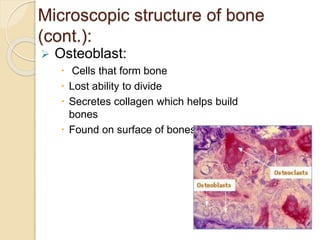
 Osteoblast:
 Cells that form bone
 Lost ability to divide
 Secretes collagen which helps build
bones
 Found on surface of bones
Microscopic structure of bone
(cont.):
 Osteoclast:
◦ Develop from circulating monocytes (WBC)
◦ Settles on surface of bone
◦ Function is bone resorption (destroying
matrix)
Microscopic structure of bone
(cont.):
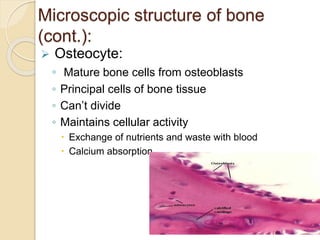
 Osteocyte:
◦ Mature bone cells from osteoblasts
◦ Principal cells of bone tissue
◦ Can’t divide
◦ Maintains cellular activity
 Exchange of nutrients and waste with blood
 Calcium absorption
Microscopic structure of bone
(cont.):
2. Bone matrix: Bone matrix consist of
both organic and inorganic materials.
The major constituent of matrix are-
 Type-1 collagen
 Glycos-aminoglycan
 Bi-carbonate
 Citrate
 Mg, K, P, Na
Microscopic structure of bone
(cont.):
3. Haversian system: primary structural
unit of a compact bone is the
haversian system. This is usually a
few milimiteres long and 0.2mm in
diameter. This system contains-
 Haversian canal
 Volkmans canal
 blood vessel
 Bone cells
Microscopic structure of bone
(cont.):
Microscopic structure of bone
(cont.):
Microscopic structure of bone
(cont.):
Joints:
 Synostosis joint: Nonmovable
 Synchondrosis: joint with limited movement,
ie. Costochondral joints
 Syndesmosis: bones are joint with interrosias
membrane, ie. Tibio-fibular joint.
 Diarthrosis: joint with great mobility, ie. Knee,
shoulder etc.
Connective structure of bone:
Periosteum:
 Outer covering of bone
 Carries a dense network of blood, lymphatic
vessels and sensory nerve.
 Due to presence of sensory nerve
periosteum is pain sensitive.
Connective structure of bone
(cont.):
Endosteum:
 composed of osteoprogenitor cell
 covering of the surface of medullary cavity
and haversian canal.
Connective structure of bone
(cont.):
Synovium:
 Synovial membrane: smooth and
villous connective tissue.
 Consists of phagocytic and fibroblast
like cells, elastic fibers, nerve, adipose
tissue.
Meniscus
Intervertebral disc
Connective structure of bone
(cont.):
Bone ppt

Bone ppt

  • 1.
  • 2.
    What is Bone: Boneis the basic unit of skeletal system which provides-  Framework of the body  Protection to vital organs  Mechanical movement
  • 3.
    Classification of Bone Basedon location: 2 Types  Axial skeleton. * Central axis of skeleton * 28 skull bone * 26 vertebrae * 25 ribs * 1 hyoid bone
  • 4.
     Appendicular skeleton. *Non-axial bones of skeleton * 64 in upper extremities * 62 in lower extremities Classification of Bone (cont.)
  • 5.
    Based on shape: Flat bone: skull, vertebrae, ribs  Tubular bone: bones in hands and feets  Irregular bone: face and vertebral column  Sesamoid bone: patella  Accessory bone: bones that develop in other ossification centre Classification of Bone (cont.)
  • 6.
    Based on size: Long bone: tubular in shape with a hollow shaft. Classification of Bone (cont.)  Short bone: cuboidal in shape, located in hands and feet.
  • 7.
    Gross structure ofbone:  Epiphysis: Ends of a bone  Diaphysis: Shaft of a bone  Metaphysis: Joining of Epiphysis and Diaphysis. This is the most vascular part of a bone. Because most of the supplying arteries and veins enters through this area.  Periosteum: Outer covering of bone. This area is pain sensitive.  Endosteum: thin layer lining the medulary cavity.
  • 9.
    Blood and nervesupply of Bone: Blood: Bone has a rich vascular supply, receiving 10-20% of total CO. major contributing arteries are- * Diaphyseal Nutrient artery * Metaphyseal and Epiphysial arteries * Periosteal arterioles Nerves: Rich in articular extremities, vertabrae, and flat bones. Most of the cases nerves accompany with arteries.
  • 10.
    Microscopic structure ofbone: 1. Bone cell:  Osteoprogenitor cell: ◦ Osteo = bone, pro = precursor, gen = to produce ◦ Unspecialized cells ◦ Undergo mitosis and develop into osteoblasts ◦ Found in: inner periosteum, endosteum, and in canals
  • 11.
     Osteoblast:  Cellsthat form bone  Lost ability to divide  Secretes collagen which helps build bones  Found on surface of bones Microscopic structure of bone (cont.):
  • 12.
     Osteoclast: ◦ Developfrom circulating monocytes (WBC) ◦ Settles on surface of bone ◦ Function is bone resorption (destroying matrix) Microscopic structure of bone (cont.):
  • 13.
     Osteocyte: ◦ Maturebone cells from osteoblasts ◦ Principal cells of bone tissue ◦ Can’t divide ◦ Maintains cellular activity  Exchange of nutrients and waste with blood  Calcium absorption Microscopic structure of bone (cont.):
  • 14.
    2. Bone matrix:Bone matrix consist of both organic and inorganic materials. The major constituent of matrix are-  Type-1 collagen  Glycos-aminoglycan  Bi-carbonate  Citrate  Mg, K, P, Na Microscopic structure of bone (cont.):
  • 15.
    3. Haversian system:primary structural unit of a compact bone is the haversian system. This is usually a few milimiteres long and 0.2mm in diameter. This system contains-  Haversian canal  Volkmans canal  blood vessel  Bone cells Microscopic structure of bone (cont.):
  • 16.
  • 17.
  • 18.
    Joints:  Synostosis joint:Nonmovable  Synchondrosis: joint with limited movement, ie. Costochondral joints  Syndesmosis: bones are joint with interrosias membrane, ie. Tibio-fibular joint.  Diarthrosis: joint with great mobility, ie. Knee, shoulder etc. Connective structure of bone:
  • 19.
    Periosteum:  Outer coveringof bone  Carries a dense network of blood, lymphatic vessels and sensory nerve.  Due to presence of sensory nerve periosteum is pain sensitive. Connective structure of bone (cont.):
  • 20.
    Endosteum:  composed ofosteoprogenitor cell  covering of the surface of medullary cavity and haversian canal. Connective structure of bone (cont.):
  • 21.
    Synovium:  Synovial membrane:smooth and villous connective tissue.  Consists of phagocytic and fibroblast like cells, elastic fibers, nerve, adipose tissue. Meniscus Intervertebral disc Connective structure of bone (cont.):