
Dr. Urfeya Mirza
Department of Veterinary Surgery & Radiology

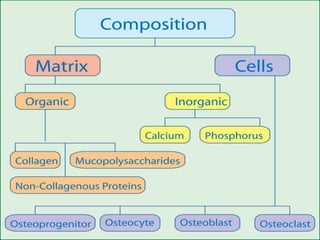
 Bone is a highly vascular, living, constantly changing
mineralized connective tissue
 It is provided with vessels and nerves
 Consists of bone cells (osteocytes), embedded in a matrix
of calcified intercelluar substance
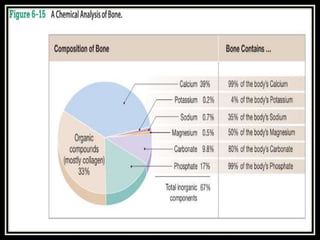
 Bone matrix composed of organic materials,mainly
collagen fibres & inorganic salts rich in calcium &
phosphate
Introduction
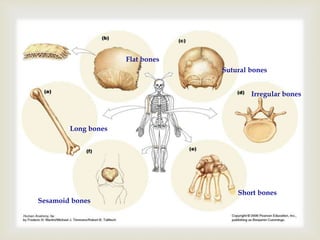
Long bones
Short bones
Flat bones
Irregular bones
Sesamoid bones
Sutural bones



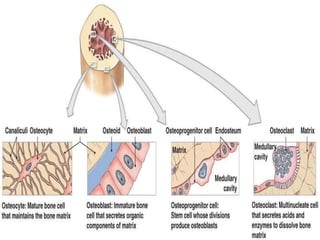
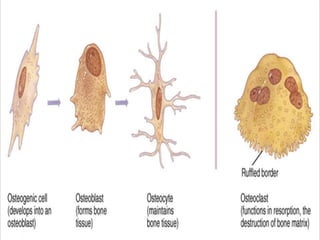
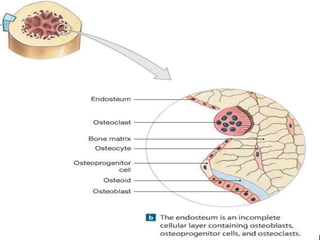
1. Osteocytes ("bone cells") – mature cells separated
by intercellular substance
2. Osteoblasts ("bone makers") – bone producing
cells
3. Osteoclasts (“bone breakers”) – bone removing
cells
4. Osteoproginator cells (Pleuripotent stem cells) –
from which osteoblasts and osteoclasts derived
Bone Cells
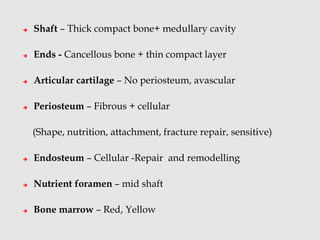
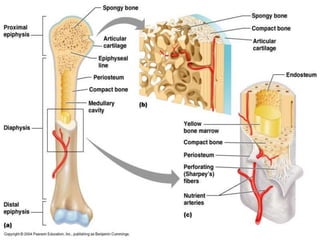
 Shaft – Thick compact bone+ medullary cavity
 Ends - Cancellous bone + thin compact layer
 Articular cartilage – No periosteum, avascular
 Periosteum – Fibrous + cellular
(Shape, nutrition, attachment, fracture repair, sensitive)
 Endosteum – Cellular -Repair and remodelling
 Nutrient foramen – mid shaft
 Bone marrow – Red, Yellow
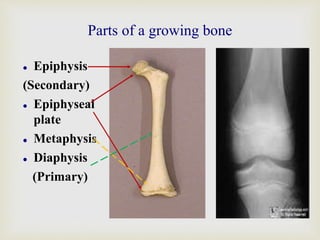
Parts of a growing bone
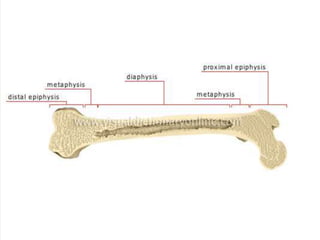
 Epiphysis
(Secondary)
 Epiphyseal
plate
 Metaphysis
 Diaphysis
(Primary)
 Epiphysis
• Are expanded articular ends
• Separated from the shaft by the epiphyseal plate
during bone growth
• Composed of a spongy bone surrounded by a thin
layer of compact bone.
 Proximal epiphysis
 Enlarged terminal part of the bone,
 Nearest the center of the body
 Distal epiphysis
 Enlarged terminal part of the bone,
 Farthest from the center of the body
 Metaphysis
 Part of the bone between the epiphysis and the
diaphysis
 It contains the connecting cartilage enabling the bone
to grow
 Disappears at adulthood
 Diaphysis
 Elongated hollow central portion of the bone located
between the methaphyses
 Made of compact tissue
 Encloses the medullary cavity.

 The outer surface of the bone is covered by a
membrane except at the cartilage known as
Periosteum and a thin membrane invests the
medullary cavity known as Endosteum
 Bones are composed of two types of substances –
compact and spongy
• Compact(Lamellar)bone: Outer cortical part of long
bones, which is hard & homogeneous in appearance.
• Spongy(Cancellous) bone: The inner part of long
bones, less hard & presents a spongy appearance.
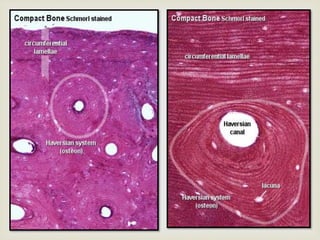
Compact Bone (Lamellar bone):
The basic structural unit of compact Bone is
Haversian system or Osteon, named after Clopton
Havers(1691).
It contains following structures:
• Haversian canal
• Lamellae
• Lacunae
• Canaliculi
• Volkamann's canal
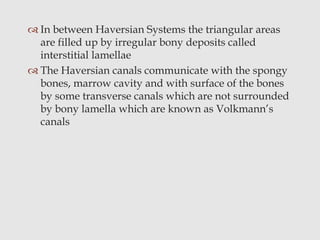
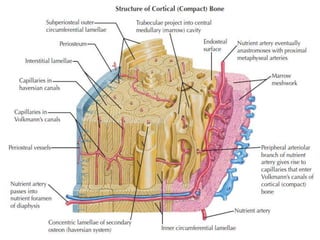
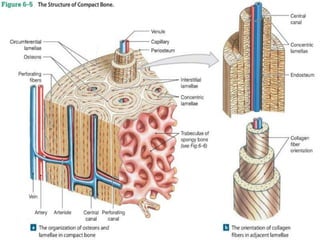
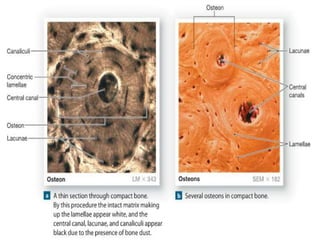
 A bony tissue arranged in a definite pattern is
known as Haversian System or Osteons
 Numerous very narrow canals pass through the
compact substance along the length of the bone are
known as Haversian canals, which carry blood
vessels and nerves
 Around these canals bone matrix is present in the
form of several concentric lamellae
 In between the lamellae there are minute spaces
known as Lacunae which give accommodation to the
bone cells – the osteocytes
 Very minute canals radiate from these lacunae to
accommodate the processes of bone cells. These are
called Canaliculi
 In between Haversian Systems the triangular areas
are filled up by irregular bony deposits called
interstitial lamellae
 The Haversian canals communicate with the spongy
bones, marrow cavity and with surface of the bones
by some transverse canals which are not surrounded
by bony lamella which are known as Volkmann’s
canals
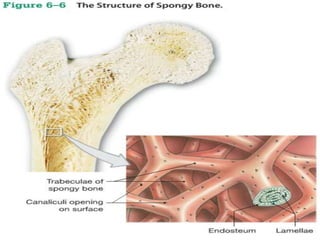
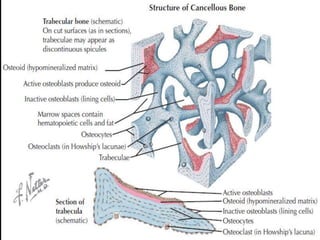
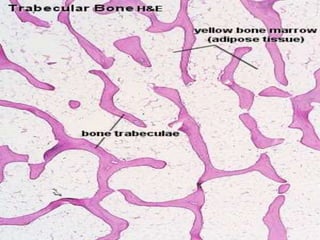
Spongy Bone : (Cancellous bone)
• A large number of very small bony plates
(trabeculae) unite irregularly enclosing small
marrow spaces between them and form a hard
structure of spongy appearance, known as spongy
substance which make the bulk of small and
irregular bones as well as the ends of long bones
• There is no Haversian system of arrangement in the
spongy substance
• The bony trabeculae are arranged along the line of
maximal internal stress in such a way that the bone
can resist stress and strain to which it is subjected
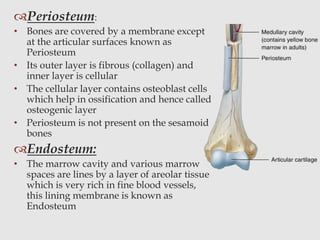
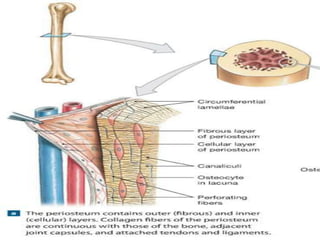
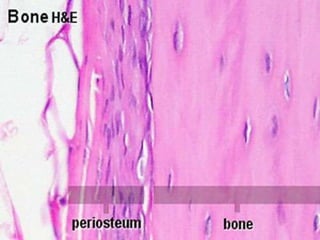
Periosteum:
• Bones are covered by a membrane except
at the articular surfaces known as
Periosteum
• Its outer layer is fibrous (collagen) and
inner layer is cellular
• The cellular layer contains osteoblast cells
which help in ossification and hence called
osteogenic layer
• Periosteum is not present on the sesamoid
bones
Endosteum:
• The marrow cavity and various marrow
spaces are lines by a layer of areolar tissue
which is very rich in fine blood vessels,
this lining membrane is known as
Endosteum
Articular cartilage:
• Most of the articular cartilages are hyaline in nature
• Cells of these cartilages are almost round or
elongated and are arranged singly or in groups of
even number of cells
• The ground substance is either transparent or
granular in appearance
• This cartilage normally does not ossify
• It derives nutrition from synovial fluid and
surrounding cells
Bone Marrow:
• The medullary cavity of long bones and marrow spaces of
all the bones are occupied by a soft and pulpy tissue,
known as bone marrow
• There are two types of bone marrow – yellow and red. At
birth and in the prenatal life most of the marrow is red
and with the advance of age, yellow marrow replaces the
red marrow
• Red marrow consists of reticular connective tissue,
various blood cells at their different stages of
development, megakaryocytes, fat cells, lymphoid cells
and blood vessels
• Yellow marrow consists of connective tissue, blood
vessels, fat cells and also some mature and immature red
blood cells

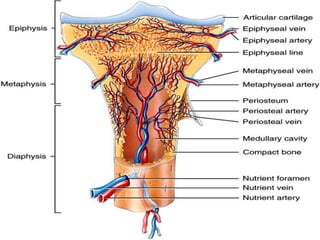
1. Nutrient artery
2. Periosteal artery
3. Epiphysial artery
4. Metaphysial artery
Blood Supply
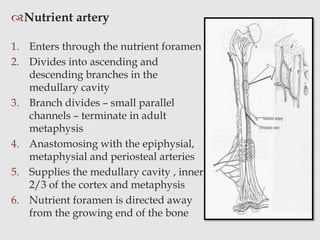
Nutrient artery
1. Enters through the nutrient foramen
2. Divides into ascending and
descending branches in the
medullary cavity
3. Branch divides – small parallel
channels – terminate in adult
metaphysis
4. Anastomosing with the epiphysial,
metaphysial and periosteal arteries
5. Supplies the medullary cavity , inner
2/3 of the cortex and metaphysis
6. Nutrient foramen is directed away
from the growing end of the bone
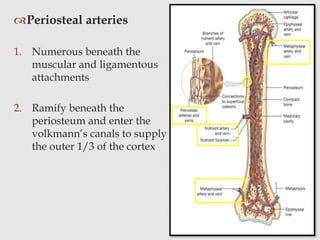
Periosteal arteries
1. Numerous beneath the
muscular and ligamentous
attachments
2. Ramify beneath the
periosteum and enter the
volkmann’s canals to supply
the outer 1/3 of the cortex
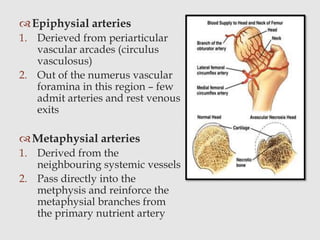
Epiphysial arteries
1. Derieved from periarticular
vascular arcades (circulus
vasculosus)
2. Out of the numerus vascular
foramina in this region – few
admit arteries and rest venous
exits
Metaphysial arteries
1. Derived from the
neighbouring systemic vessels
2. Pass directly into the
metphysis and reinforce the
metaphysial branches from
the primary nutrient artery

 These are most numerous in articular extremities of
long bones, vertebrae and larger flat bones
 Nerves occur widely in periosteum, fine myelinated
and non-myelinated fibres accompany nutrient
vessels into bone marrow and lie in perivascular
spaces of Haversian canals
Nerve Supply
Bone

Bone

  • 1.
    Dr. Urfeya Mirza Departmentof Veterinary Surgery & Radiology
  • 2.
      Bone isa highly vascular, living, constantly changing mineralized connective tissue  It is provided with vessels and nerves  Consists of bone cells (osteocytes), embedded in a matrix of calcified intercelluar substance  Bone matrix composed of organic materials,mainly collagen fibres & inorganic salts rich in calcium & phosphate Introduction
  • 3.
    Long bones Short bones Flatbones Irregular bones Sesamoid bones Sutural bones
  • 5.
  • 6.
  • 7.
     1. Osteocytes ("bonecells") – mature cells separated by intercellular substance 2. Osteoblasts ("bone makers") – bone producing cells 3. Osteoclasts (“bone breakers”) – bone removing cells 4. Osteoproginator cells (Pleuripotent stem cells) – from which osteoblasts and osteoclasts derived Bone Cells
  • 11.
     Shaft –Thick compact bone+ medullary cavity  Ends - Cancellous bone + thin compact layer  Articular cartilage – No periosteum, avascular  Periosteum – Fibrous + cellular (Shape, nutrition, attachment, fracture repair, sensitive)  Endosteum – Cellular -Repair and remodelling  Nutrient foramen – mid shaft  Bone marrow – Red, Yellow
  • 12.
    Parts of agrowing bone  Epiphysis (Secondary)  Epiphyseal plate  Metaphysis  Diaphysis (Primary)
  • 13.
     Epiphysis • Areexpanded articular ends • Separated from the shaft by the epiphyseal plate during bone growth • Composed of a spongy bone surrounded by a thin layer of compact bone.  Proximal epiphysis  Enlarged terminal part of the bone,  Nearest the center of the body  Distal epiphysis  Enlarged terminal part of the bone,  Farthest from the center of the body
  • 14.
     Metaphysis  Partof the bone between the epiphysis and the diaphysis  It contains the connecting cartilage enabling the bone to grow  Disappears at adulthood  Diaphysis  Elongated hollow central portion of the bone located between the methaphyses  Made of compact tissue  Encloses the medullary cavity.
  • 15.
  • 16.
     The outersurface of the bone is covered by a membrane except at the cartilage known as Periosteum and a thin membrane invests the medullary cavity known as Endosteum  Bones are composed of two types of substances – compact and spongy • Compact(Lamellar)bone: Outer cortical part of long bones, which is hard & homogeneous in appearance. • Spongy(Cancellous) bone: The inner part of long bones, less hard & presents a spongy appearance.
  • 19.
    Compact Bone (Lamellarbone): The basic structural unit of compact Bone is Haversian system or Osteon, named after Clopton Havers(1691). It contains following structures: • Haversian canal • Lamellae • Lacunae • Canaliculi • Volkamann's canal
  • 20.
     A bonytissue arranged in a definite pattern is known as Haversian System or Osteons  Numerous very narrow canals pass through the compact substance along the length of the bone are known as Haversian canals, which carry blood vessels and nerves  Around these canals bone matrix is present in the form of several concentric lamellae  In between the lamellae there are minute spaces known as Lacunae which give accommodation to the bone cells – the osteocytes  Very minute canals radiate from these lacunae to accommodate the processes of bone cells. These are called Canaliculi
  • 21.
     In betweenHaversian Systems the triangular areas are filled up by irregular bony deposits called interstitial lamellae  The Haversian canals communicate with the spongy bones, marrow cavity and with surface of the bones by some transverse canals which are not surrounded by bony lamella which are known as Volkmann’s canals
  • 26.
    Spongy Bone :(Cancellous bone) • A large number of very small bony plates (trabeculae) unite irregularly enclosing small marrow spaces between them and form a hard structure of spongy appearance, known as spongy substance which make the bulk of small and irregular bones as well as the ends of long bones • There is no Haversian system of arrangement in the spongy substance • The bony trabeculae are arranged along the line of maximal internal stress in such a way that the bone can resist stress and strain to which it is subjected
  • 30.
    Periosteum: • Bones arecovered by a membrane except at the articular surfaces known as Periosteum • Its outer layer is fibrous (collagen) and inner layer is cellular • The cellular layer contains osteoblast cells which help in ossification and hence called osteogenic layer • Periosteum is not present on the sesamoid bones Endosteum: • The marrow cavity and various marrow spaces are lines by a layer of areolar tissue which is very rich in fine blood vessels, this lining membrane is known as Endosteum
  • 34.
    Articular cartilage: • Mostof the articular cartilages are hyaline in nature • Cells of these cartilages are almost round or elongated and are arranged singly or in groups of even number of cells • The ground substance is either transparent or granular in appearance • This cartilage normally does not ossify • It derives nutrition from synovial fluid and surrounding cells
  • 35.
    Bone Marrow: • Themedullary cavity of long bones and marrow spaces of all the bones are occupied by a soft and pulpy tissue, known as bone marrow • There are two types of bone marrow – yellow and red. At birth and in the prenatal life most of the marrow is red and with the advance of age, yellow marrow replaces the red marrow • Red marrow consists of reticular connective tissue, various blood cells at their different stages of development, megakaryocytes, fat cells, lymphoid cells and blood vessels • Yellow marrow consists of connective tissue, blood vessels, fat cells and also some mature and immature red blood cells
  • 37.
     1. Nutrient artery 2.Periosteal artery 3. Epiphysial artery 4. Metaphysial artery Blood Supply
  • 38.
    Nutrient artery 1. Entersthrough the nutrient foramen 2. Divides into ascending and descending branches in the medullary cavity 3. Branch divides – small parallel channels – terminate in adult metaphysis 4. Anastomosing with the epiphysial, metaphysial and periosteal arteries 5. Supplies the medullary cavity , inner 2/3 of the cortex and metaphysis 6. Nutrient foramen is directed away from the growing end of the bone
  • 39.
    Periosteal arteries 1. Numerousbeneath the muscular and ligamentous attachments 2. Ramify beneath the periosteum and enter the volkmann’s canals to supply the outer 1/3 of the cortex
  • 40.
    Epiphysial arteries 1. Derievedfrom periarticular vascular arcades (circulus vasculosus) 2. Out of the numerus vascular foramina in this region – few admit arteries and rest venous exits Metaphysial arteries 1. Derived from the neighbouring systemic vessels 2. Pass directly into the metphysis and reinforce the metaphysial branches from the primary nutrient artery
  • 42.
      These aremost numerous in articular extremities of long bones, vertebrae and larger flat bones  Nerves occur widely in periosteum, fine myelinated and non-myelinated fibres accompany nutrient vessels into bone marrow and lie in perivascular spaces of Haversian canals Nerve Supply