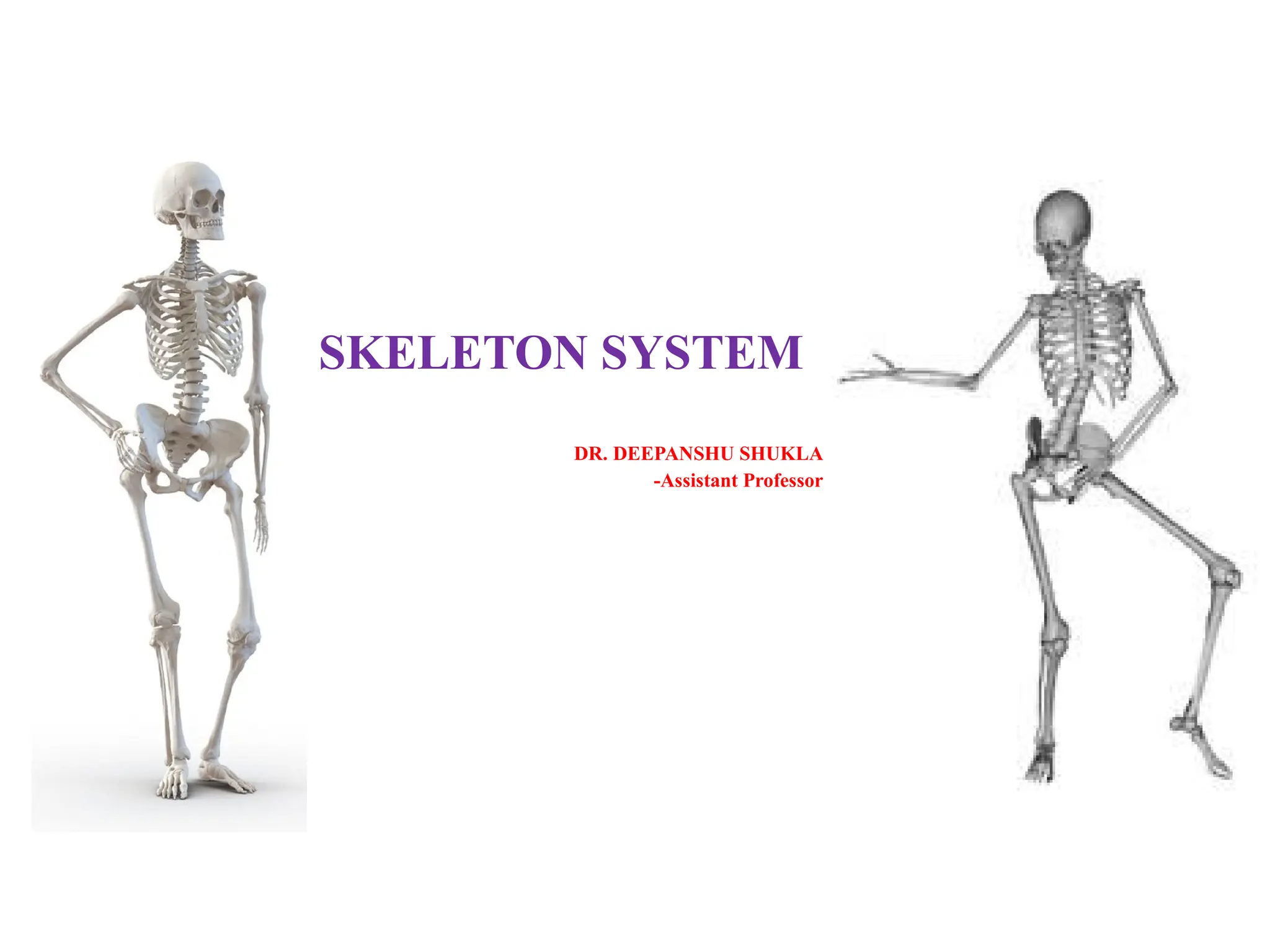
SKELETON SYSTEM
DR. DEEPANSHU SHUKLA
-Assistant Professor
LEARNING OBJECTIVES=
1. Introduction
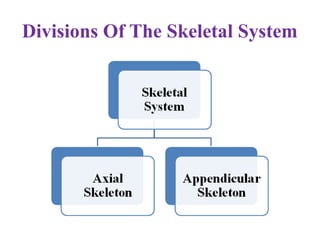
2. Divisions of the skeletal system
3. Definition and composition of bones
4. Functions of bones
5. Classification of bones
6. Gross structure of an adult long bone
7. Parts of a young growing bone
8. Blood supply of bones
9. Nerve supply of bones
10.Development and ossification of bones
INTRODUCTION
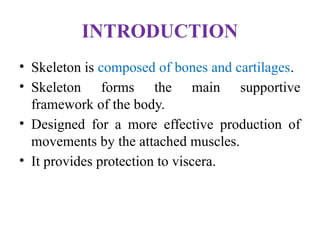
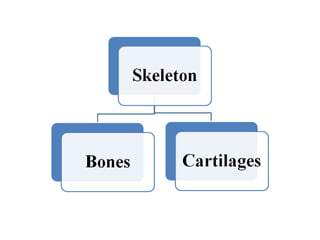
• Skeleton is composed of bones and cartilages.
• Skeleton forms the main supportive
framework of the body.
• Designed for a more effective production of
movements by the attached muscles.
• It provides protection to viscera.
Divisions Of The Skeletal System
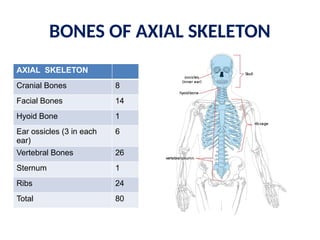
BONES OF AXIAL SKELETON
AXIAL SKELETON
Cranial Bones 8
Facial Bones 14
Hyoid Bone 1
Ear ossicles (3 in each
ear)
6
Vertebral Bones 26
Sternum 1
Ribs 24
Total 80
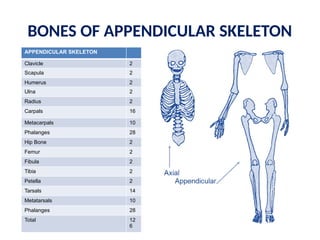
BONES OF APPENDICULAR SKELETON
APPENDICULAR SKELETON
Clavicle 2
Scapula 2
Humerus 2
Ulna 2
Radius 2
Carpals 16
Metacarpals 10
Phalanges 28
Hip Bone 2
Femur 2
Fibula 2
Tibia 2
Petella 2
Tarsals 14
Metatarsals 10
Phalanges 28
Total 12
6
Definition of Bone
• Synonyms- 1. Os (L), 2. Osteon (G).
• Bones are the hard structures, which forms the rigid
framework of the body.
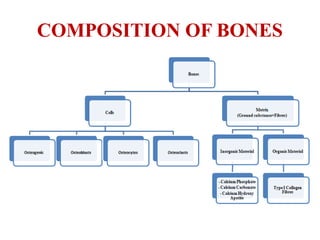
• Bone is a highly vascular mineralized connective tissue.
• Composed of organic and inorganic materials.
• The inorganic salt calcium hydroxy apatite is removed
by putting the bone in acid, it becomes flexible and can
be tied as a “knot”.
• If organic tissue is removed by burning, the bone
crumples into small pieces.
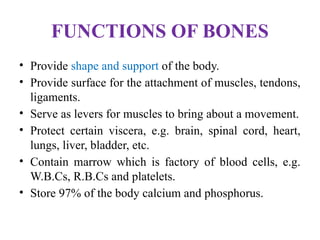
FUNCTIONS OF BONES
• Provide shape and support of the body.
• Provide surface for the attachment of muscles, tendons,
ligaments.
• Serve as levers for muscles to bring about a movement.
• Protect certain viscera, e.g. brain, spinal cord, heart,
lungs, liver, bladder, etc.
• Contain marrow which is factory of blood cells, e.g.
W.B.Cs, R.B.Cs and platelets.
• Store 97% of the body calcium and phosphorus.
COMPOSITION OF BONES
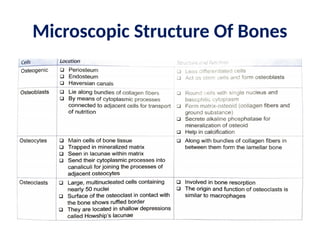
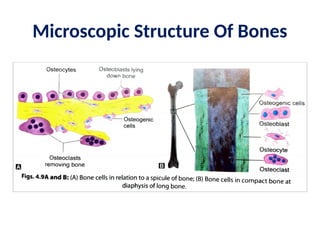
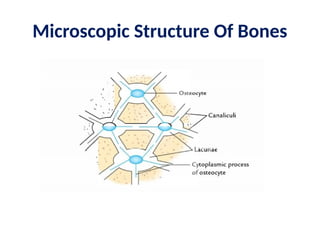
Microscopic Structure Of Bones
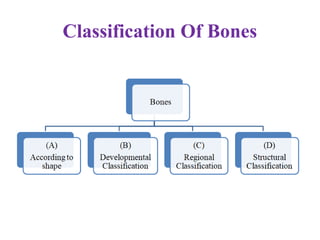
Classification Of Bones
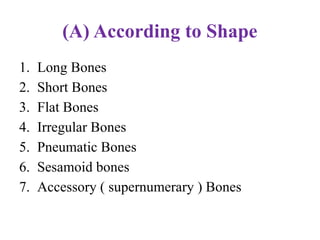
(A) According to Shape
1. Long Bones
2. Short Bones
3. Flat Bones
4. Irregular Bones
5. Pneumatic Bones
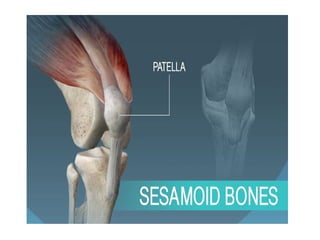
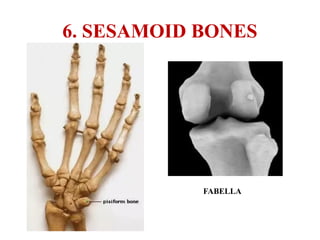
6. Sesamoid bones
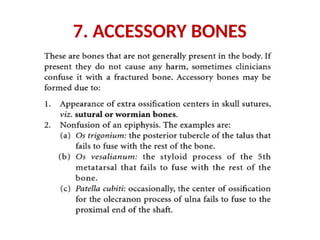
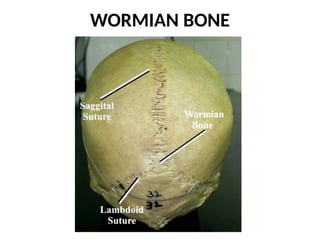
7. Accessory ( supernumerary ) Bones
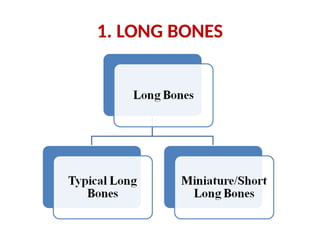
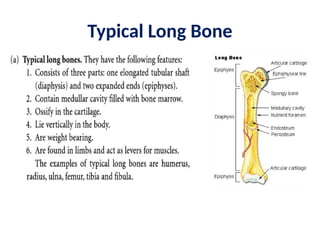
1. LONG BONES
Typical Long Bone
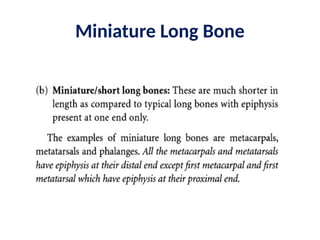
Miniature Long Bone
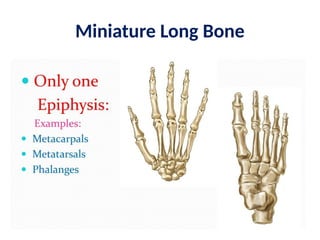
Miniature Long Bone
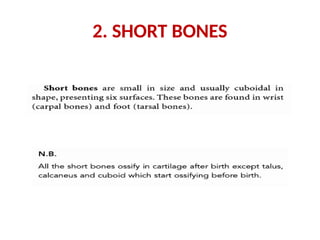
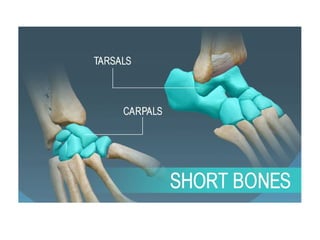
2. SHORT BONES
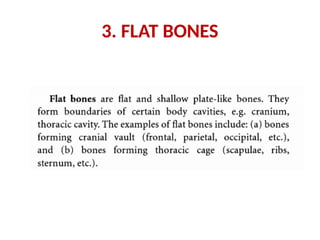
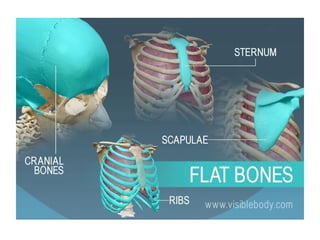
3. FLAT BONES
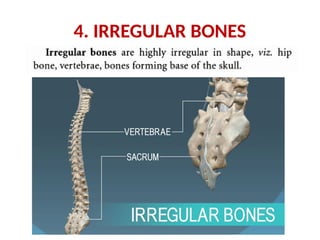
4. IRREGULAR BONES
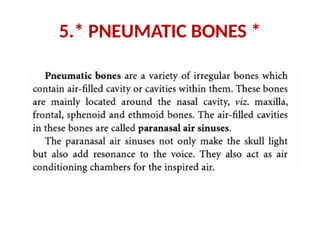
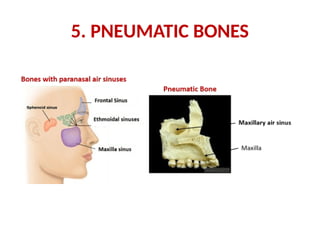
5.* PNEUMATIC BONES *
5. PNEUMATIC BONES
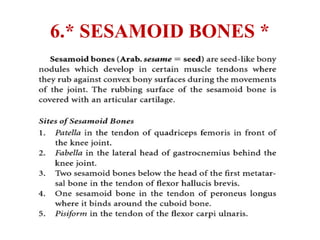
6.* SESAMOID BONES *
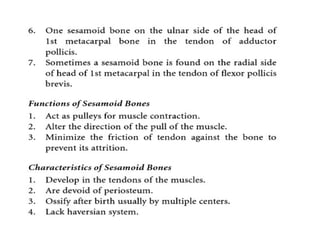
6. SESAMOID BONES
FABELLA
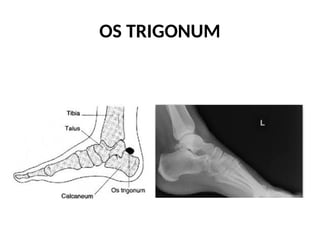
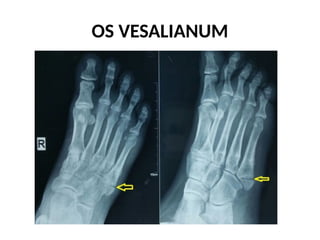
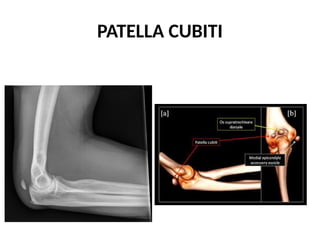
7. ACCESSORY BONES
WORMIAN BONE
OS TRIGONUM
OS VESALIANUM
PATELLA CUBITI
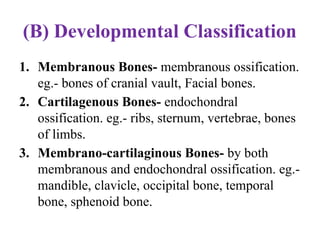
(B) Developmental Classification
1. Membranous Bones- membranous ossification.
eg.- bones of cranial vault, Facial bones.
2. Cartilagenous Bones- endochondral
ossification. eg.- ribs, sternum, vertebrae, bones
of limbs.
3. Membrano-cartilaginous Bones- by both
membranous and endochondral ossification. eg.-
mandible, clavicle, occipital bone, temporal
bone, sphenoid bone.
(C) Regional Classification
1. Axial Skeleton
2. Appendicular Skeleton
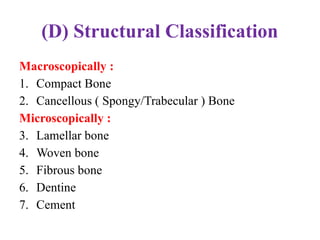
(D) Structural Classification
Macroscopically :
1. Compact Bone
2. Cancellous ( Spongy/Trabecular ) Bone
Microscopically :
3. Lamellar bone
4. Woven bone
5. Fibrous bone
6. Dentine
7. Cement
MACROSCOPICALLY
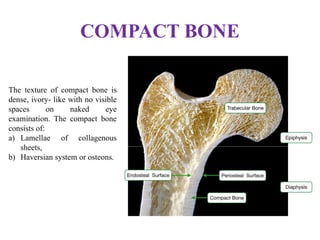
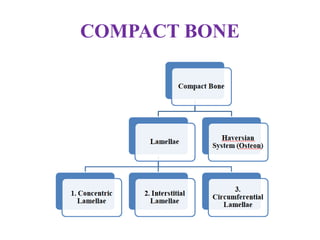
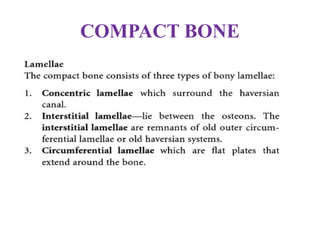
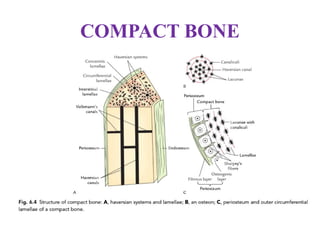
COMPACT BONE
The texture of compact bone is
dense, ivory- like with no visible
spaces on naked eye
examination. The compact bone
consists of:
a) Lamellae of collagenous
sheets,
b) Haversian system or osteons.
COMPACT BONE
COMPACT BONE
COMPACT BONE
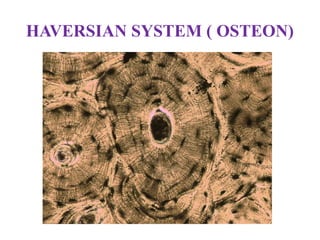
HAVERSIAN SYSTEM ( OSTEON)
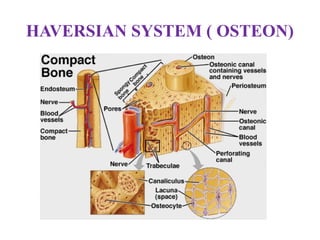
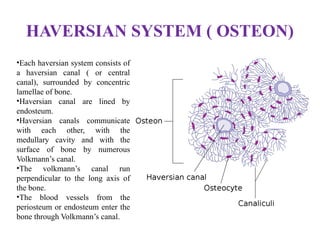
•Each haversian system consists of
a haversian canal ( or central
canal), surrounded by concentric
lamellae of bone.
•Haversian canal are lined by
endosteum.
•Haversian canals communicate
with each other, with the
medullary cavity and with the
surface of bone by numerous
Volkmann’s canal.
•The volkmann’s canal run
perpendicular to the long axis of
the bone.
•The blood vessels from the
periosteum or endosteum enter the
bone through Volkmann’s canal.
HAVERSIAN SYSTEM ( OSTEON)
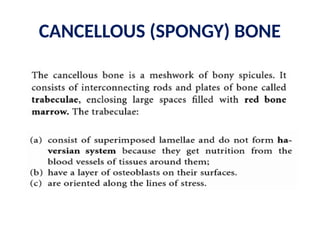
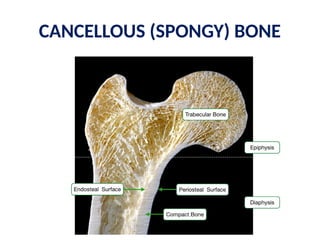
CANCELLOUS (SPONGY) BONE
MICROSCOPICALLY
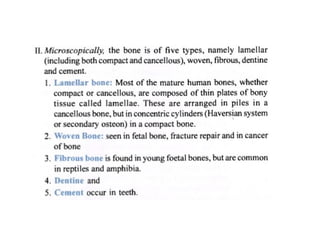
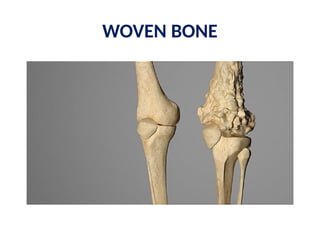
WOVEN BONE
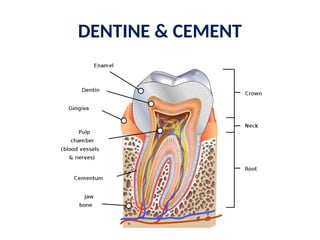
DENTINE & CEMENT
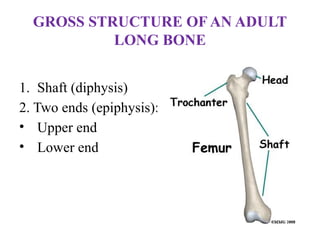
GROSS STRUCTURE OF AN ADULT
LONG BONE
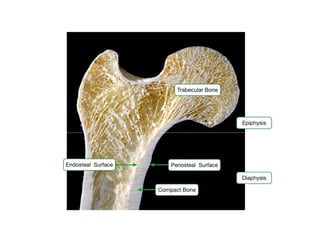
1. Shaft (diphysis)
2. Two ends (epiphysis):
• Upper end
• Lower end
Shaft:
•It is elongated part between the two expanded ends.
•It is made of an outer thick shell of compact bone enclosing a
cavity called medullary cavity.
Ends:
•The ends are knobby (expanded) and largely made up of
cancellous bone covered by a thin shell of a compact bone.
•The ends of long bone are covered by an articular hyline
cartilage and take part in the formation of joints.
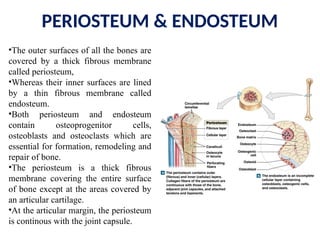
PERIOSTEUM & ENDOSTEUM
•The outer surfaces of all the bones are
covered by a thick fibrous membrane
called periosteum,
•Whereas their inner surfaces are lined
by a thin fibrous membrane called
endosteum.
•Both periosteum and endosteum
contain osteoprogenitor cells,
osteoblasts and osteoclasts which are
essential for formation, remodeling and
repair of bone.
•The periosteum is a thick fibrous
membrane covering the entire surface
of bone except at the areas covered by
an articular cartilage.
•At the articular margin, the periosteum
is continous with the joint capsule.
FUNCTIONS OF PERIOSTEUM
• Protects and maintains the shape of the
bone.
• Provides attachment to ligaments, tendon,
muscles and intermuscular septa.
• Provides regenerative capability to the bone.
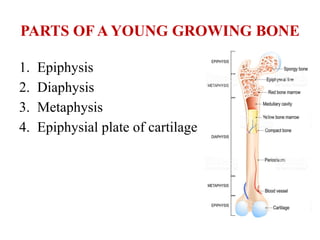
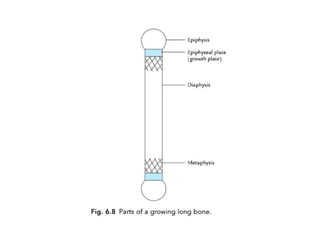
PARTS OF A YOUNG GROWING BONE
1. Epiphysis
2. Diaphysis
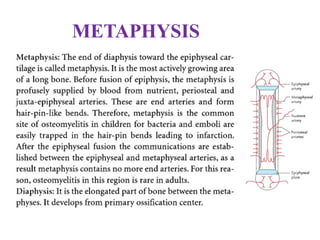
3. Metaphysis
4. Epiphysial plate of cartilage
EPIPHYSIS
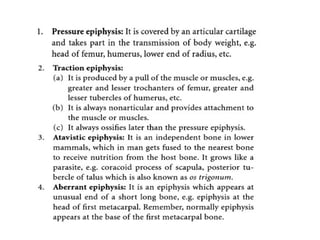
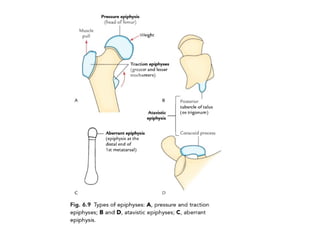
Types of Epiphysis:
a. Pressure epiphysis
b. Traction epiphysis
c. Atavistic epiphysis
d. Aberrant epiphysis
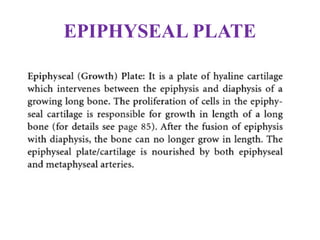
EPIPHYSEAL PLATE
METAPHYSIS
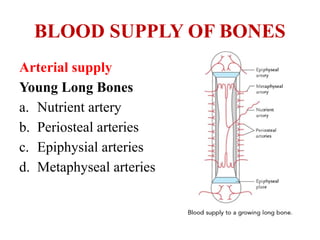
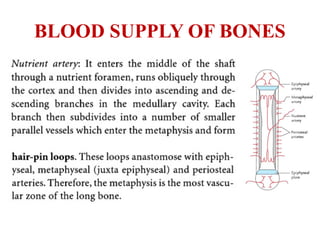
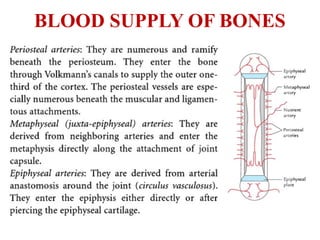
BLOOD SUPPLY OF BONES
Arterial supply
Young Long Bones
a. Nutrient artery
b. Periosteal arteries
c. Epiphysial arteries
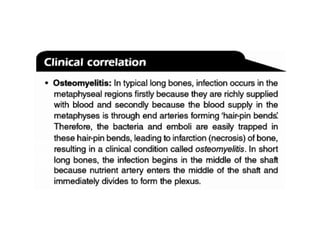
d. Metaphyseal arteries
BLOOD SUPPLY OF BONES
DEVELOPMENT AND OSSIFICATION
OF BONES
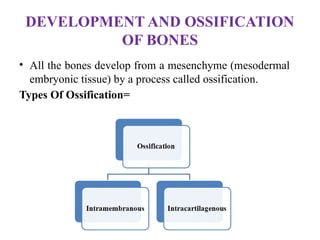
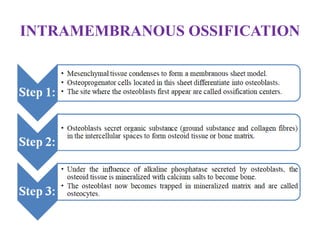
• All the bones develop from a mesenchyme (mesodermal
embryonic tissue) by a process called ossification.
Types Of Ossification=
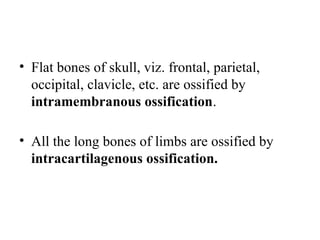
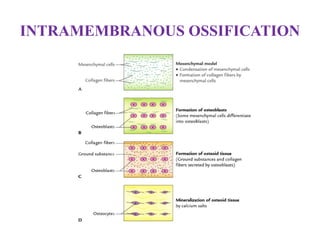
• Flat bones of skull, viz. frontal, parietal,
occipital, clavicle, etc. are ossified by
intramembranous ossification.
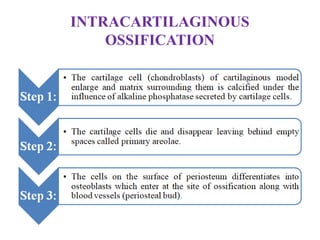
• All the long bones of limbs are ossified by
intracartilagenous ossification.
INTRAMEMBRANOUS OSSIFICATION
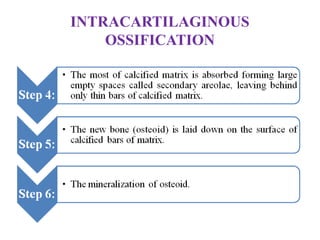
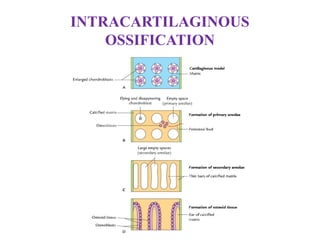
INTRACARTILAGINOUS
OSSIFICATION
INTRACARTILAGINOUS
OSSIFICATION
INTRACARTILAGINOUS
OSSIFICATION
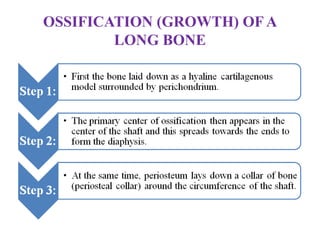
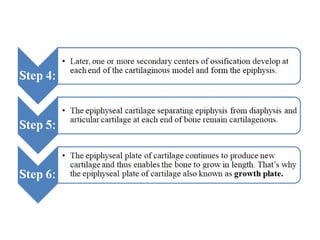
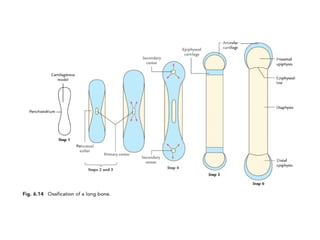
OSSIFICATION (GROWTH) OF A
LONG BONE
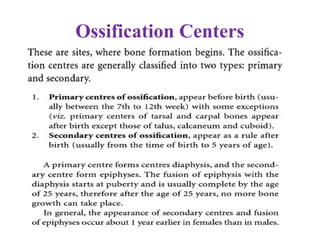
Ossification Centers
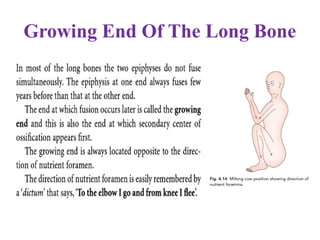
Growing End Of The Long Bone
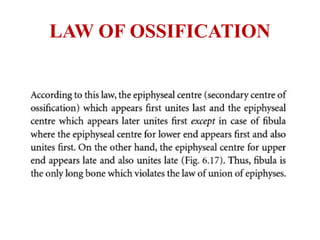
LAW OF OSSIFICATION
• Write short notes on
1. Ossification.
2. Pneumatic bone.
3. Cartilage.
4. Epiphysis.
5. Sesamoid bone.
6. Haversian system or osteon
QUESTIONS

Skeleton system types of bones in human system