Anatomy of bone and
its functions
Dr.Navaneesh
Moderator:Dr.Anna mohan
ď‚— Contents
ď‚— Formation of bone
ď‚— Classification of bones
ď‚— Structure of bone
ď‚— Blood supply
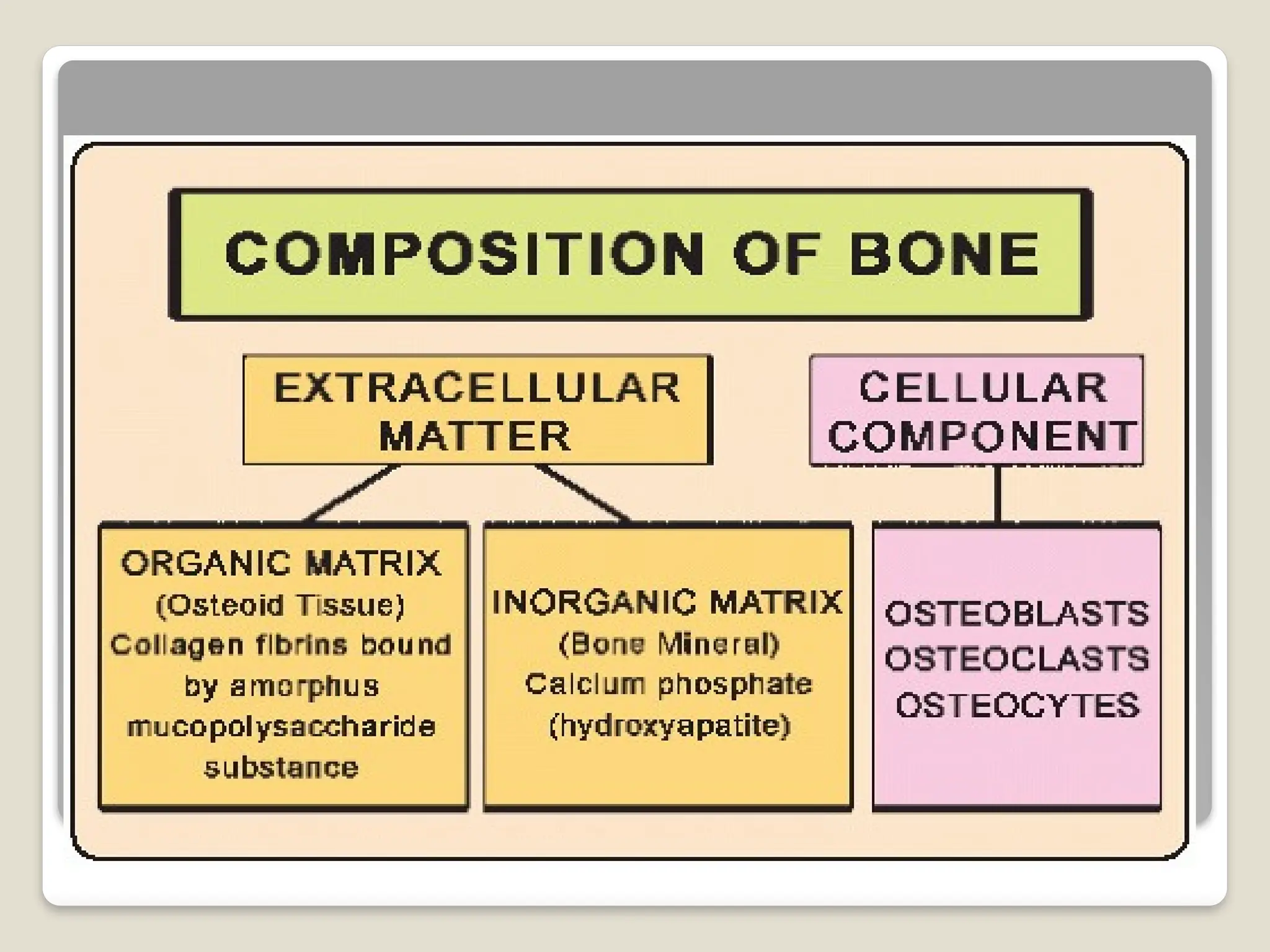
ď‚— Composition of bone
ď‚— Bone(syn os-osteon)
ď‚— Osseous tissue,a specialized form of
dense connective tissue consisting of bone
cells(osteocytes)
ď‚— Embedded in a matrix of calcified
intercellular substance
ď‚— Bone matrix contains collagen
fibers,minerals like calcium phosphate and
calcium carbonate
Formation of bone
ď‚— All bone is of mesodermal origin
ď‚— Two types of ossification
ď‚— Intramembranous ossification
ď‚— Endochondral ossification
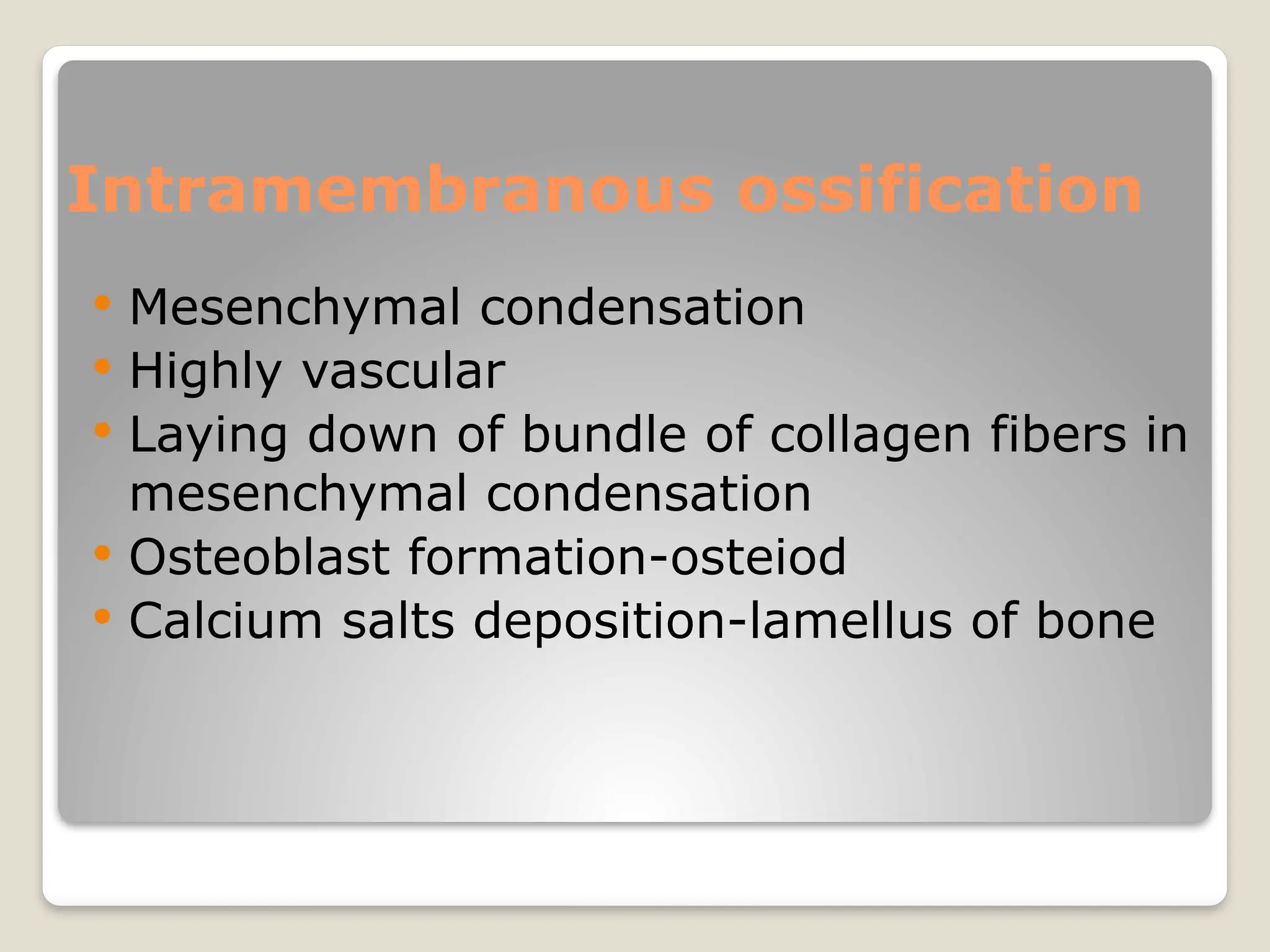
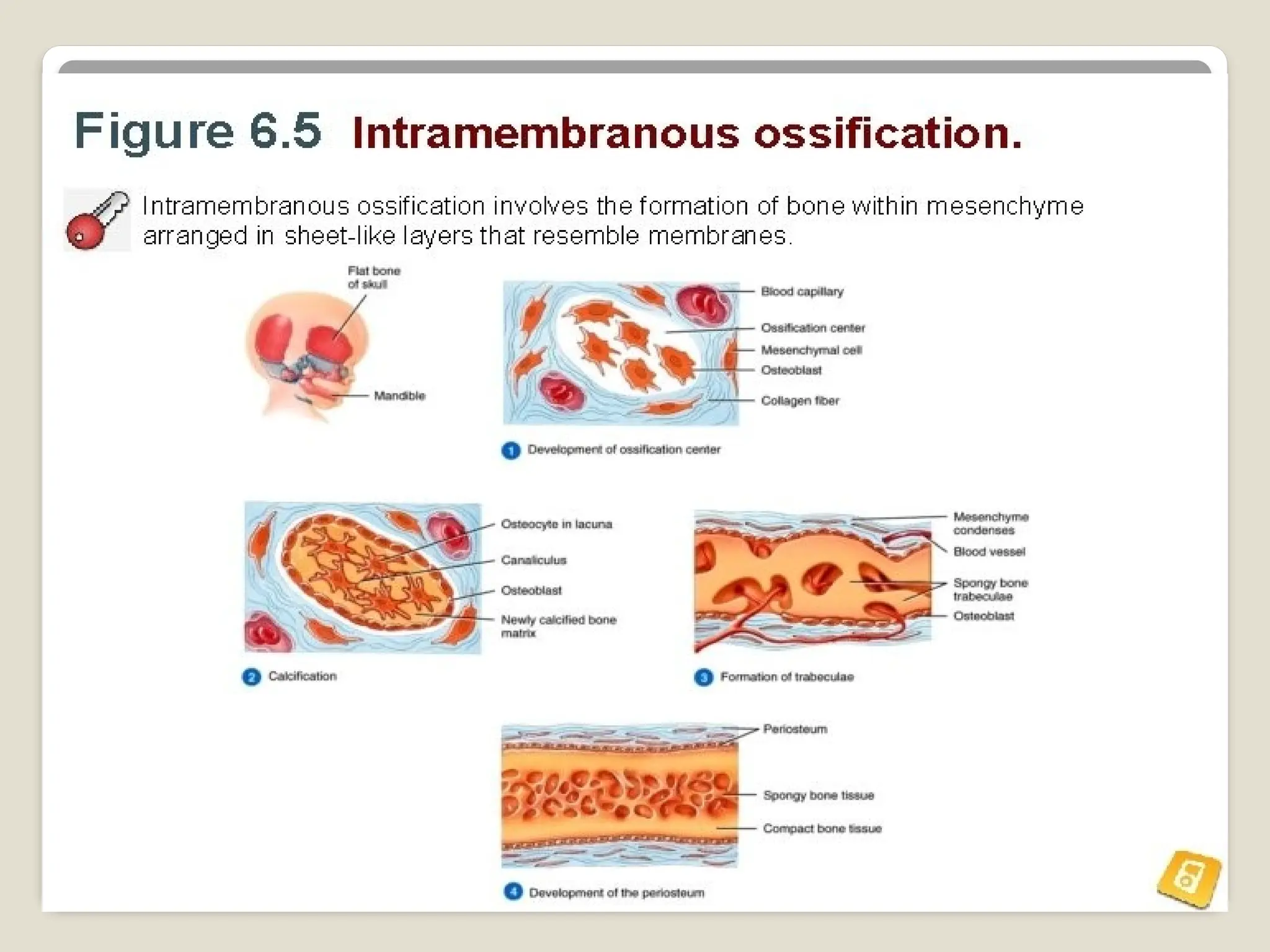
Intramembranous ossification
ď‚— Mesenchymal condensation
ď‚— Highly vascular
ď‚— Laying down of bundle of collagen fibers in
mesenchymal condensation
ď‚— Osteoblast formation-osteiod
ď‚— Calcium salts deposition-lamellus of bone
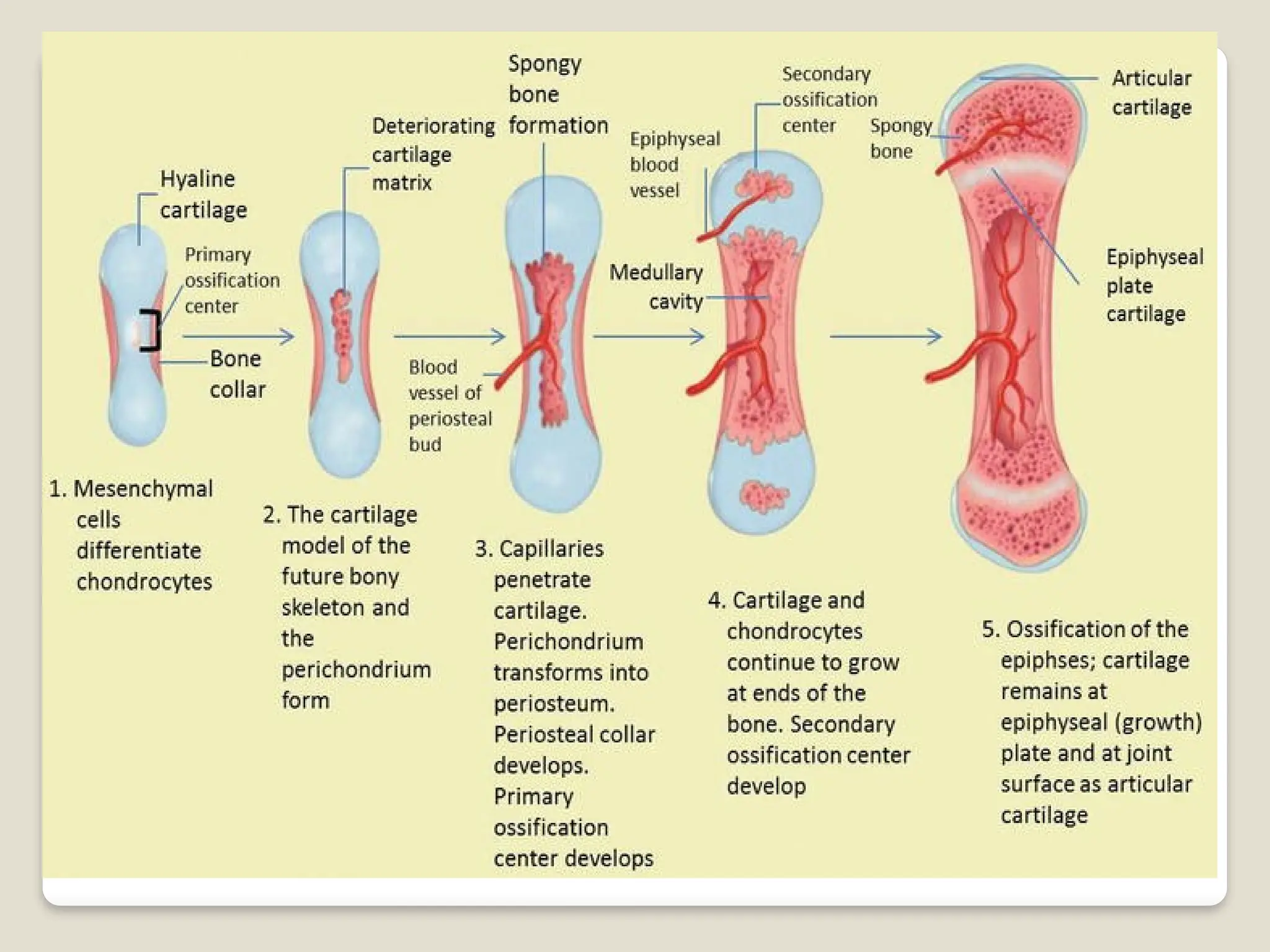
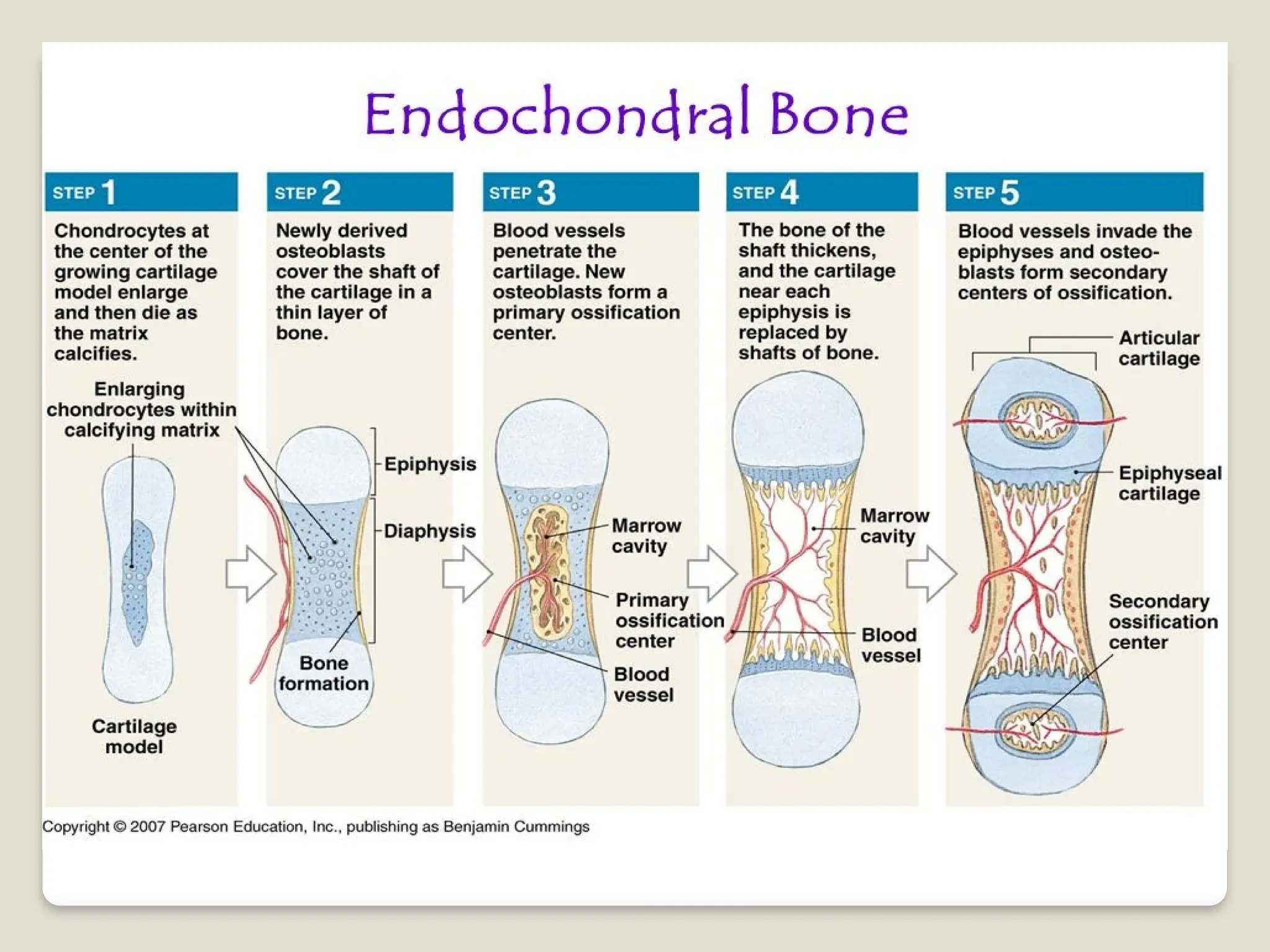
Enchondral ossification
ď‚— Ossifies bone that originate as hyaline
cartilage
ď‚— Most bones originate as hyaline cartilage
ď‚— Growth and ossification of long bones
occur in 6 steps
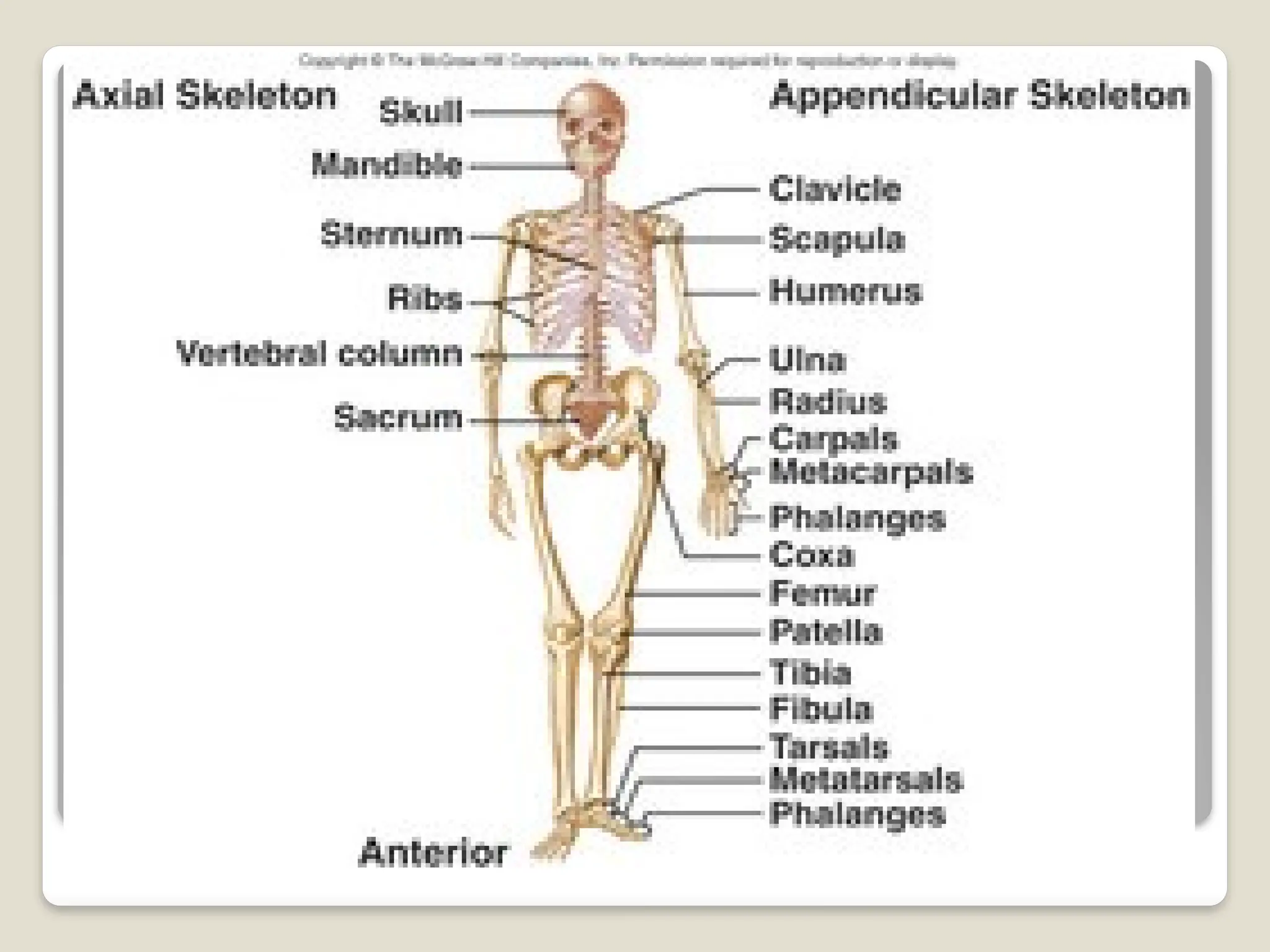
Skeletal organization
ď‚— The actual number of bones in human
skeleton varies from person to person
ď‚— Typically there are about 206 bones
ď‚— For convenience the skeleton is divided
into the
ď‚— Axial skeleton
ď‚— Appendicular skeleton
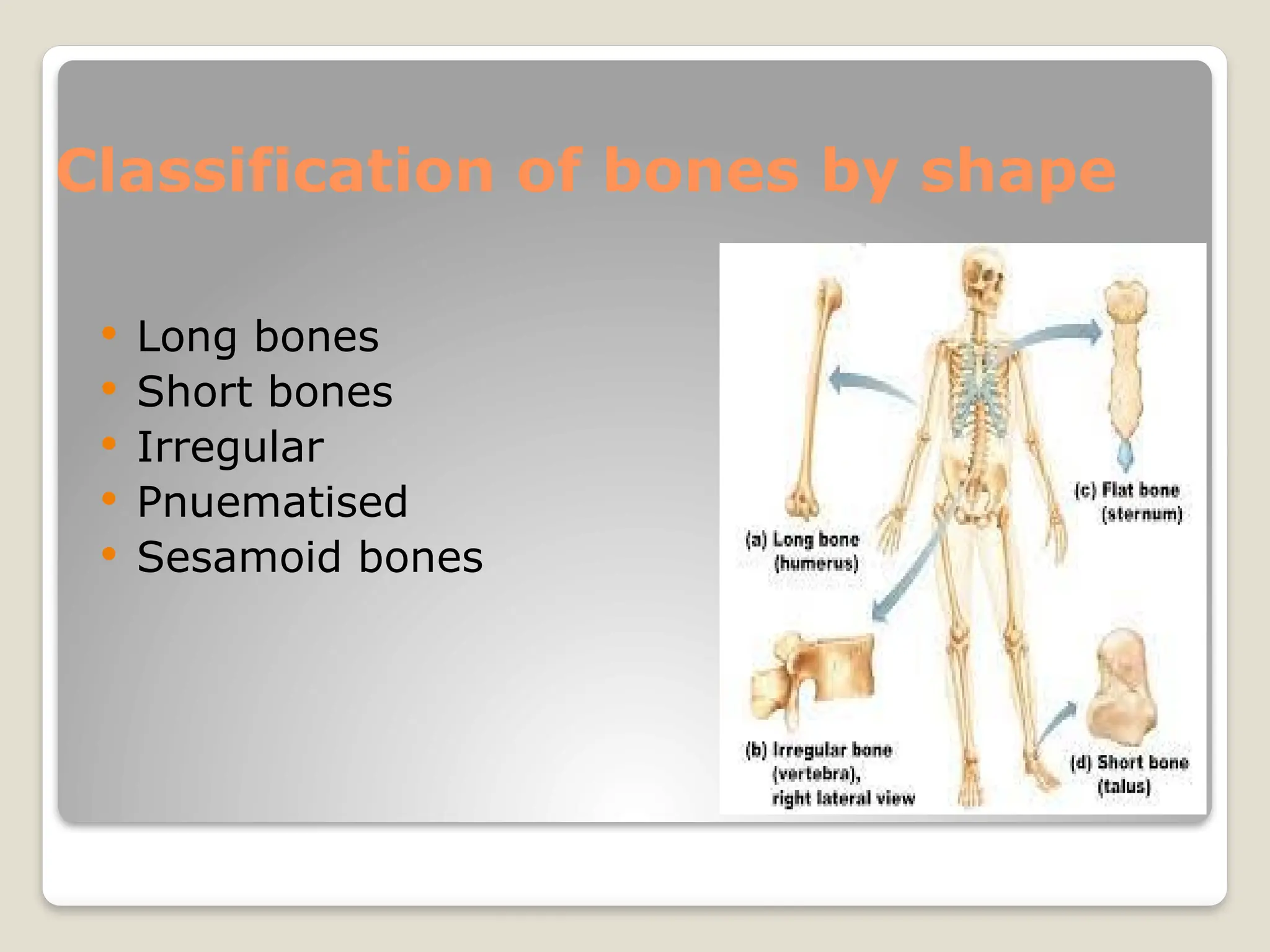
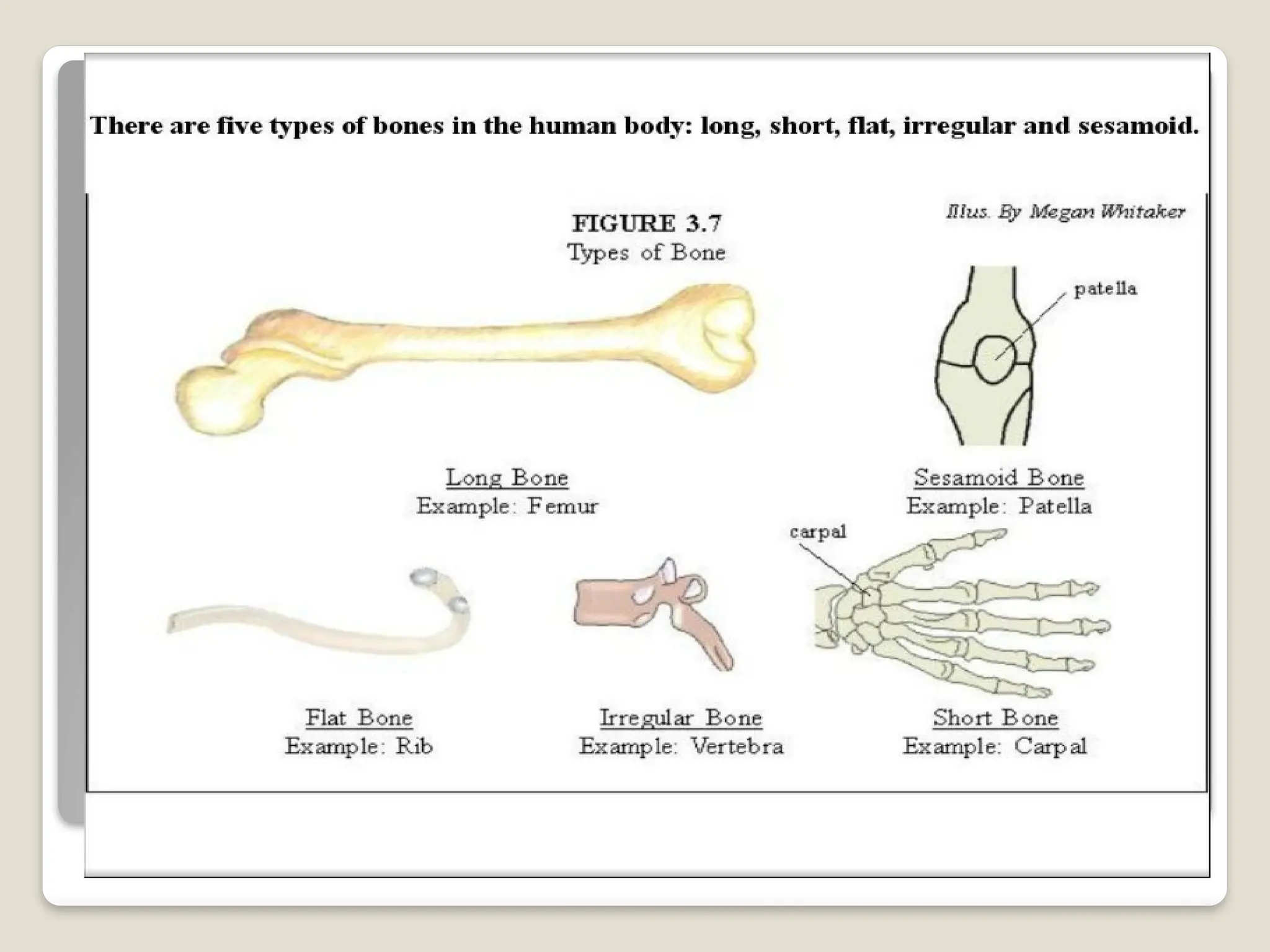
Classification of bones by shape
ď‚— Long bones
ď‚— Short bones
ď‚— Irregular
ď‚— Pnuematised
ď‚— Sesamoid bones
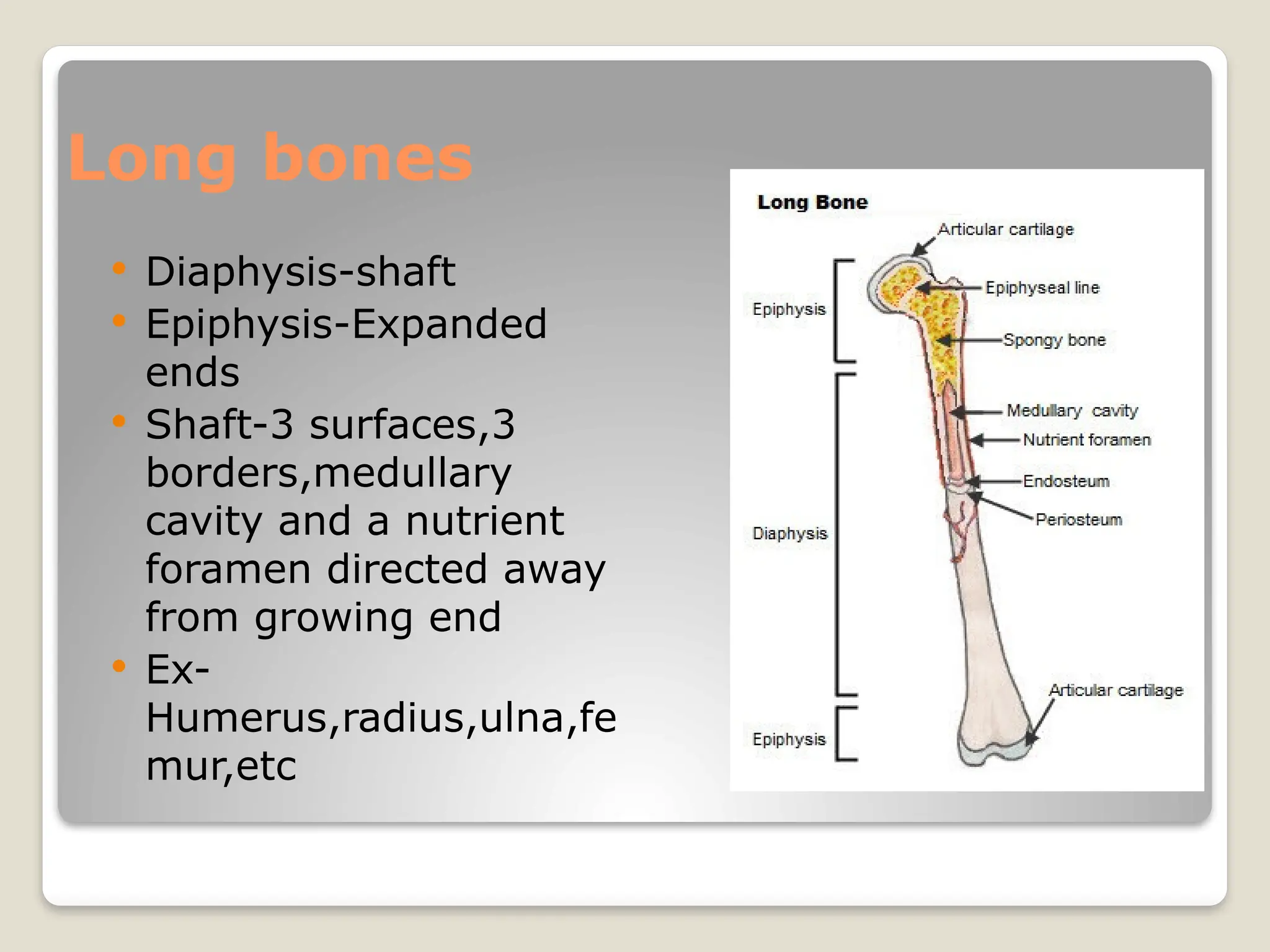
Long bones
ď‚— Diaphysis-shaft
ď‚— Epiphysis-Expanded
ends
ď‚— Shaft-3 surfaces,3
borders,medullary
cavity and a nutrient
foramen directed away
from growing end
ď‚— Ex-
Humerus,radius,ulna,fe
mur,etc
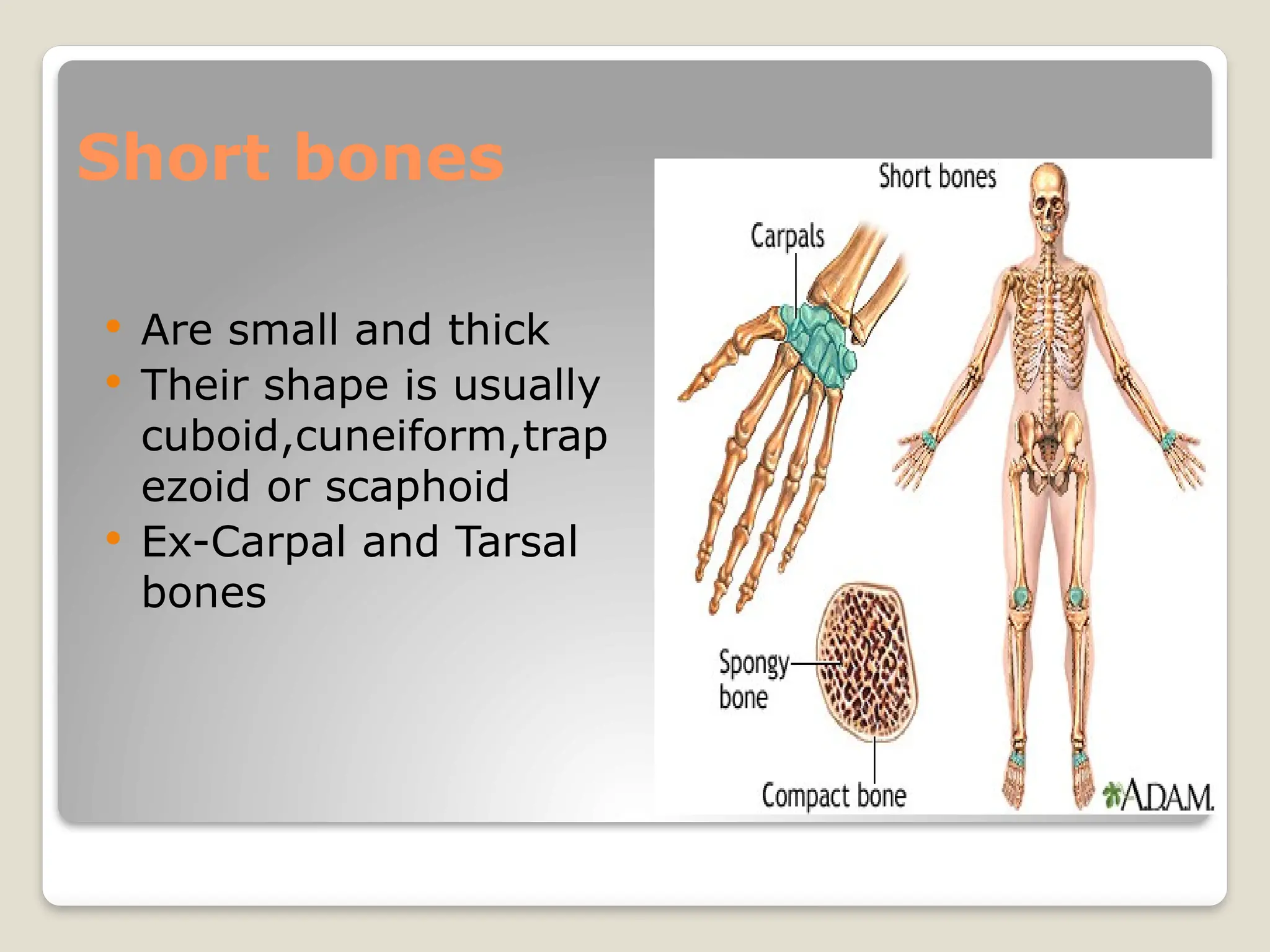
Short bones
ď‚— Are small and thick
ď‚— Their shape is usually
cuboid,cuneiform,trap
ezoid or scaphoid
ď‚— Ex-Carpal and Tarsal
bones
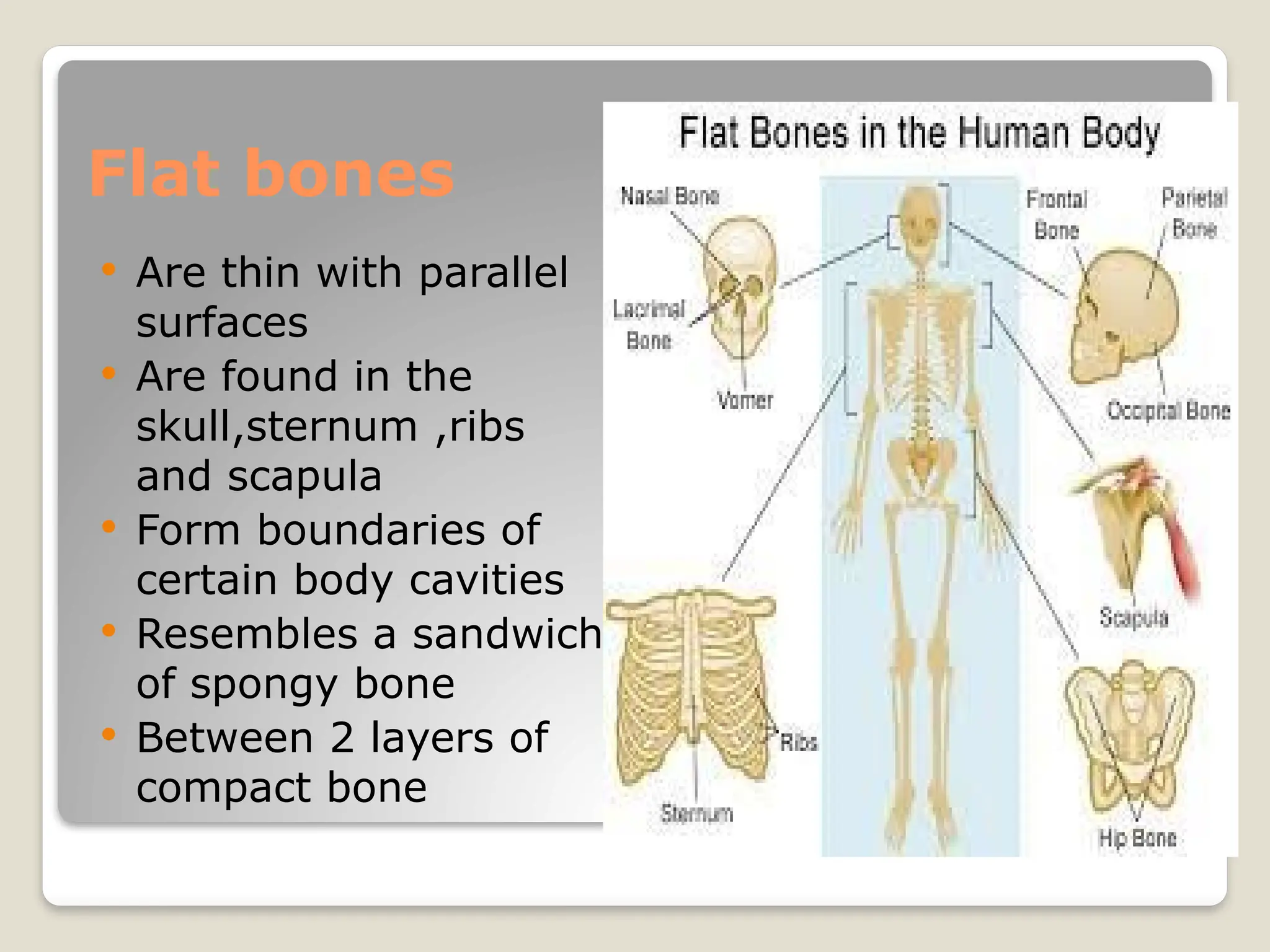
Flat bones
ď‚— Are thin with parallel
surfaces
ď‚— Are found in the
skull,sternum ,ribs
and scapula
ď‚— Form boundaries of
certain body cavities
ď‚— Resembles a sandwich
of spongy bone
ď‚— Between 2 layers of
compact bone
Pnuematic bones
ď‚— Certain irregular bones contain large air
spaces lined by epithelium
ď‚— Make the skull light in weight ,help in
resonance of voice and act as air
conditioning chambers for inspired air.
 Ex –Maxilla,Sphenoid,Ethmoid,etc
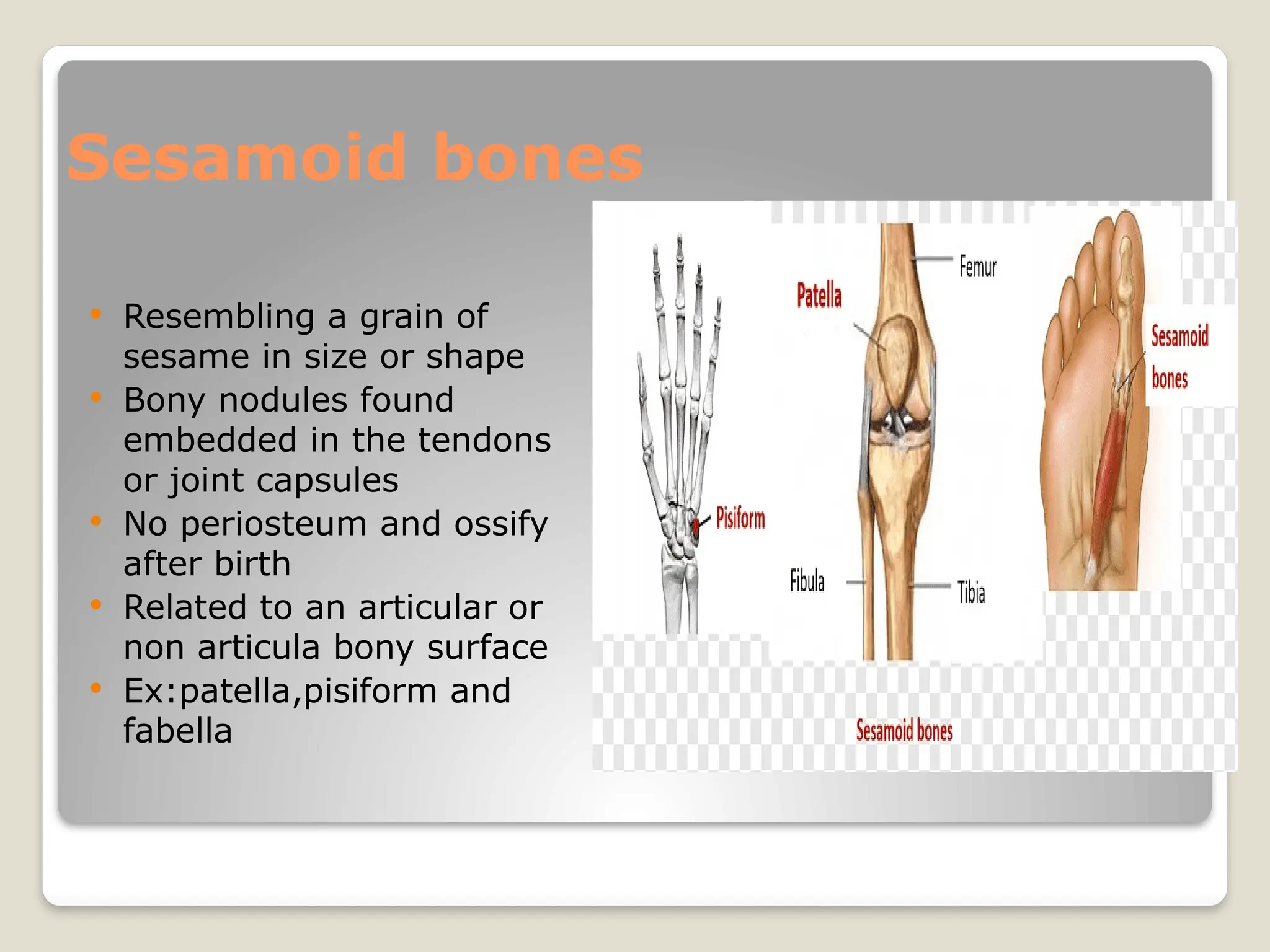
Sesamoid bones
ď‚— Resembling a grain of
sesame in size or shape
ď‚— Bony nodules found
embedded in the tendons
or joint capsules
ď‚— No periosteum and ossify
after birth
ď‚— Related to an articular or
non articula bony surface
ď‚— Ex:patella,pisiform and
fabella
Irregular bones
ď‚— Have complex shapes
ď‚— Examples:
ď‚— Spinal vertebrae
ď‚— Pelvic bones
Developmental classification
ď‚— Membrane (dermal ) bones
ď‚— Cartilaginous bones
ď‚— Membrano-cartilaginous bones
ď‚— Membrane(dermal )bones
ď‚— Ossify in membrane(intramembranous of
mesenchymal.
ď‚— Derived from mesenchymal condensations
ď‚— Ex-bones of the vault of skull and facial
bones
ď‚— Defect-Cleidocranial dysostosis
Cartilaginous bones
ď‚— Ossify in cartilage(intracartilagenous or
endochondral)
ď‚— Derived from preformed cartilaginous
models
ď‚— Ex-Bone of limbs,Vertebral column and
thoracic cage
ď‚— Defect-Common type of dwarfism called
achondroplasia.
Membrano-cartilaginous bones
ď‚— Ossify partly in cartilage and partly in
membrane
ď‚— Ex-clavicle,mandible,Occipital etc
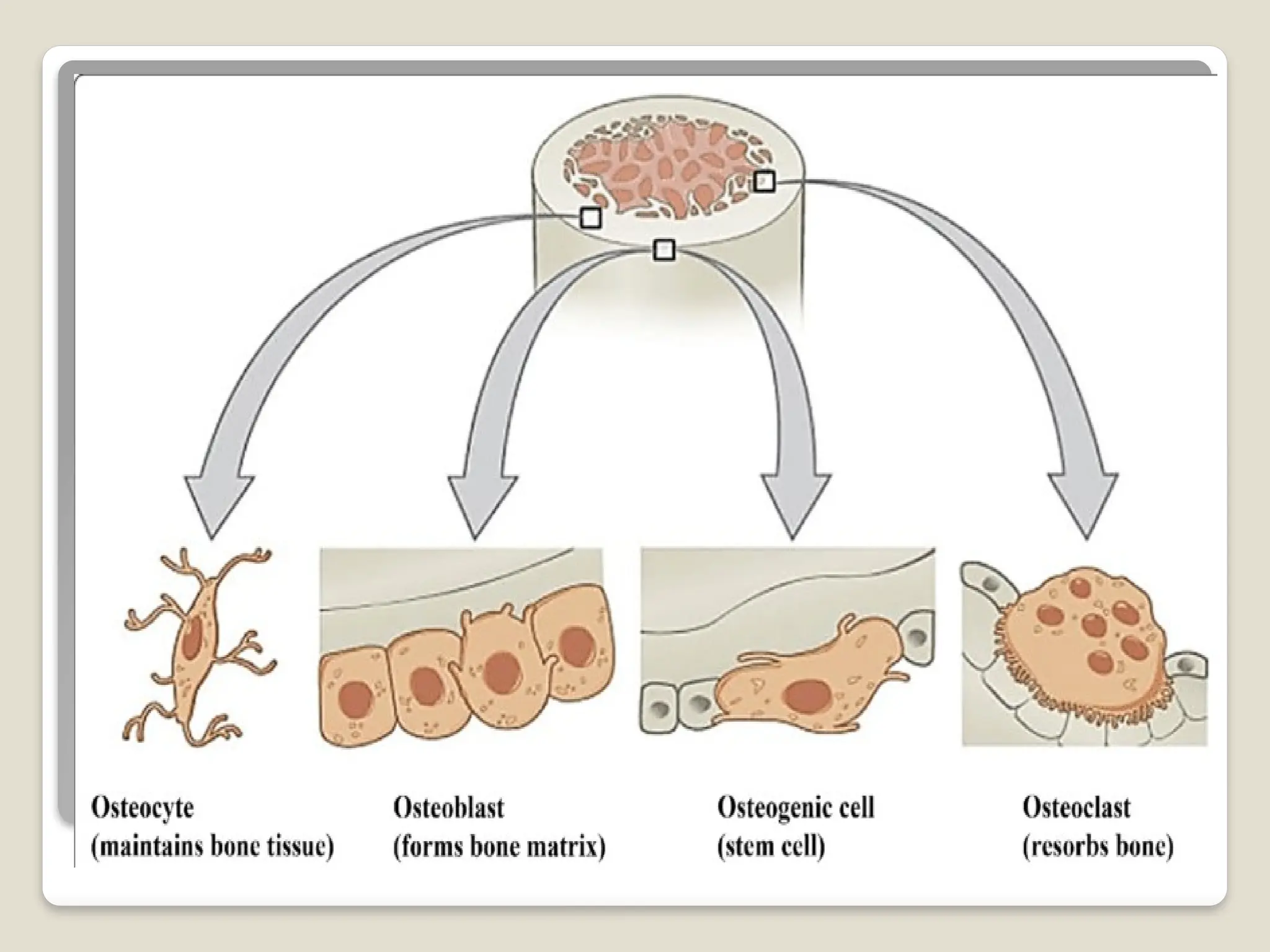
Structure of bone
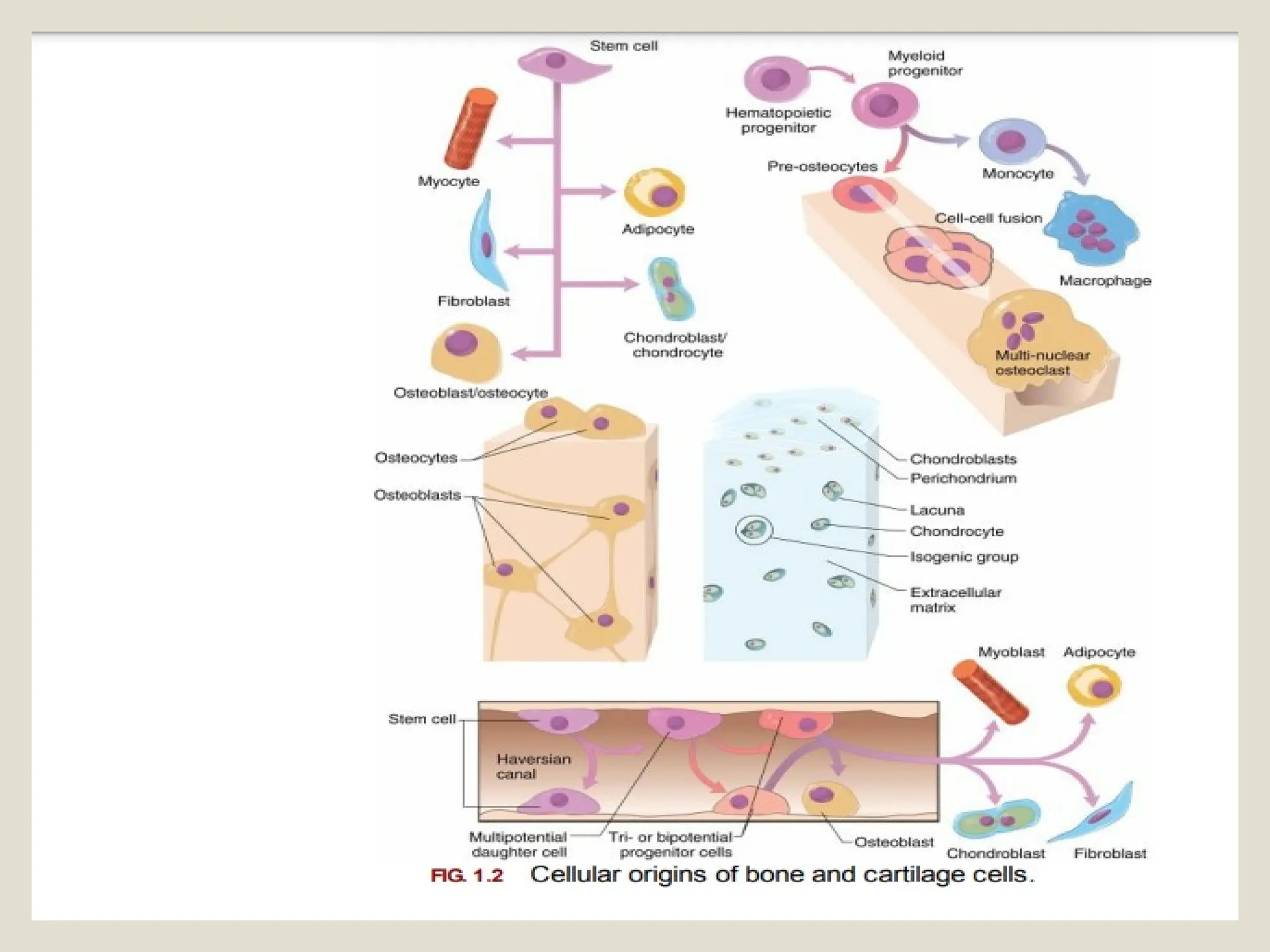
â—¦ It consists of bone cells or osteocytes
seperated by intercellular substance
â—¦ 1.Osteoblast-Bone producing cells
â—¦ 2.Osteoclasts-Bone removing cells
â—¦ 3.Osteoprogenitor cells-From which osteoblasts
and osteoclasts derived
Osteoprogenitor cells
ď‚— Mesenchymal stem cells that divide to
produce osteoblasts
ď‚— Are located in inner,cellular layer of
periosteum(endosteum)
ď‚— Assist in fracture repair
Osteoblasts
ď‚— Immature bone cells that secrete matrix
compounds(osteogenesis)
ď‚— Matrix produced by osteoblasts,but not yet
calcified to form bone
ď‚— Osteoblasts surrounded by bone become
osteocytes
Osteocytes
ď‚— Mature bone cells that maintain the bone
matrix
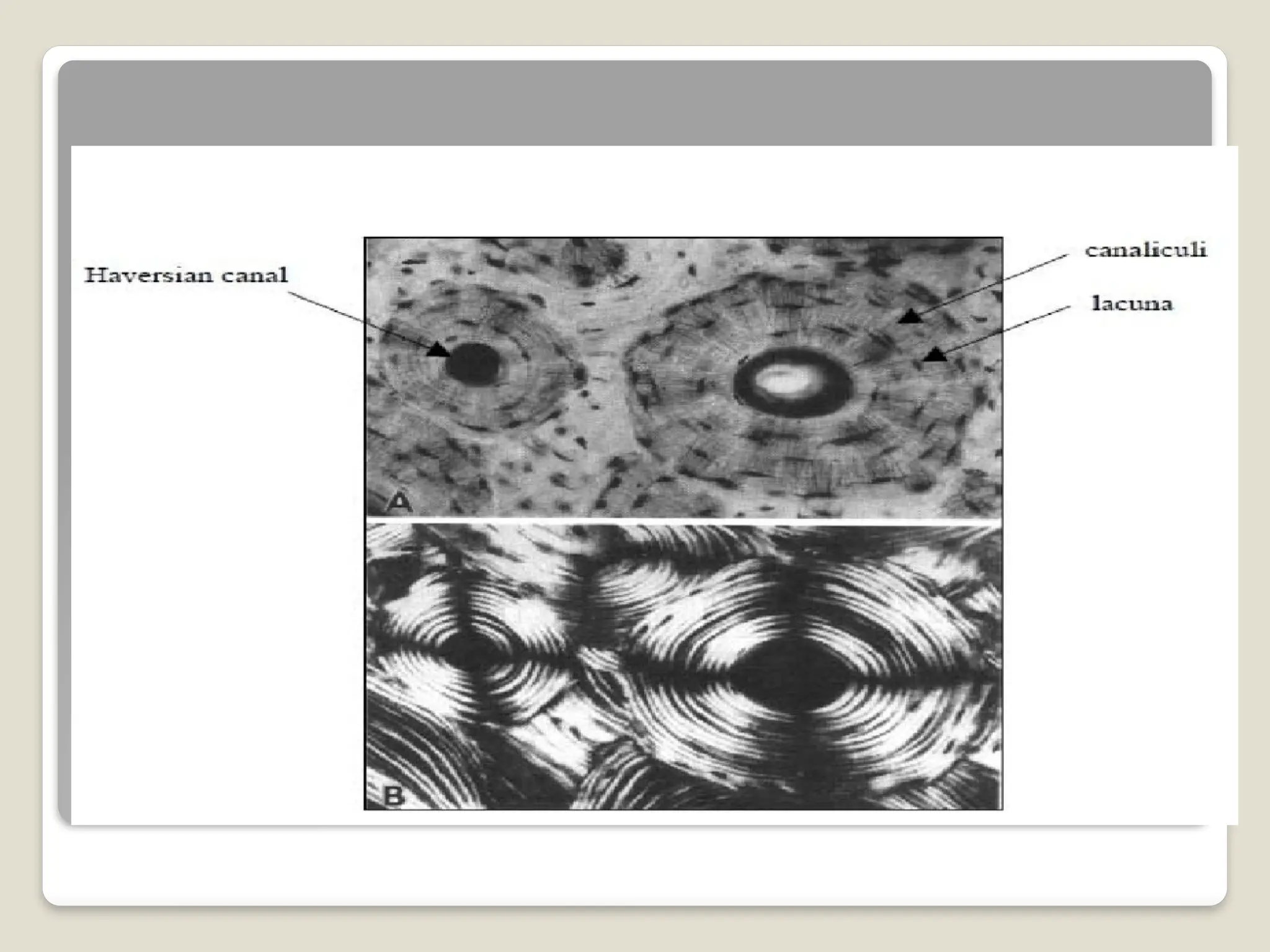
ď‚— Live in lacunae
ď‚— Are between layers (lamellae)of matrix
ď‚— Connect by cytoplasmic extensions
through canaliculi in lamellae
ď‚— Do not divide
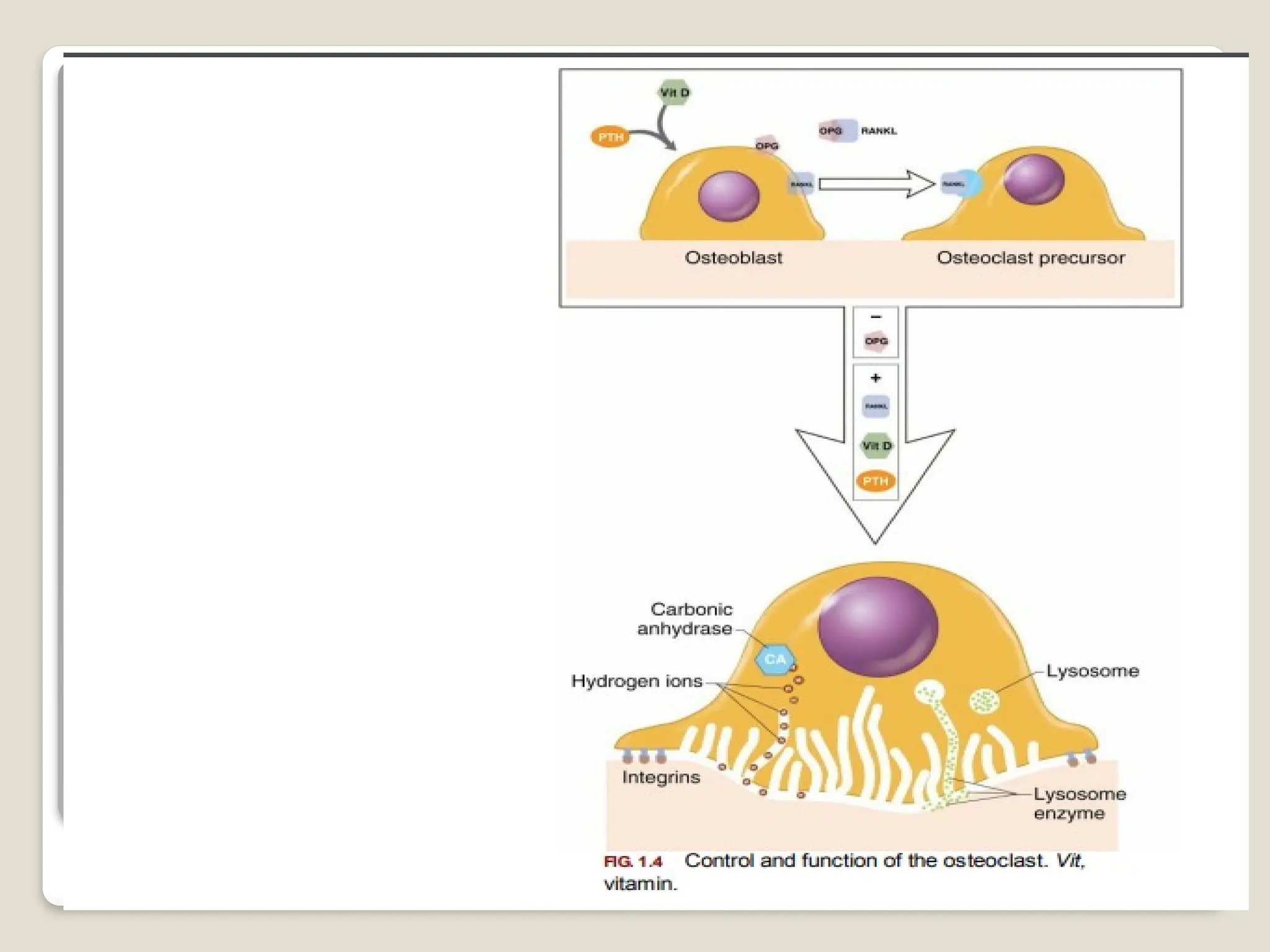
Osteoclast
ď‚— Secrete acids and protein digesting
enzymes
ď‚— Giant,multinucleate cells
ď‚— Dissolve bone matrix and release stored
minerals(osteolysis)
ď‚— Are derived from stem cells that produce
macrophages
Structural classification
ď‚— Macroscopically
ď‚— 1.Compact bone
ď‚— 2.Cancellous bone
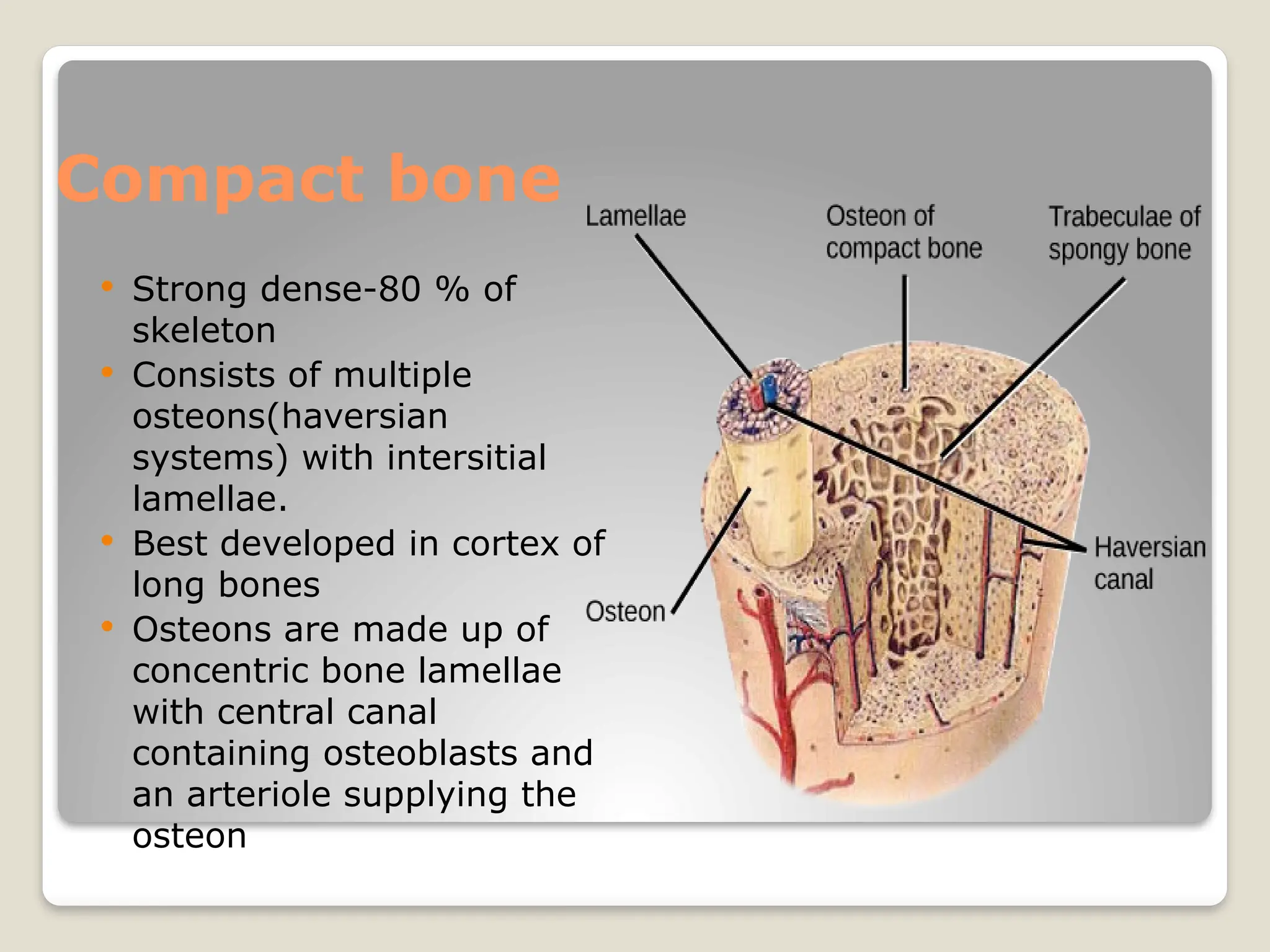
Compact bone
ď‚— Strong dense-80 % of
skeleton
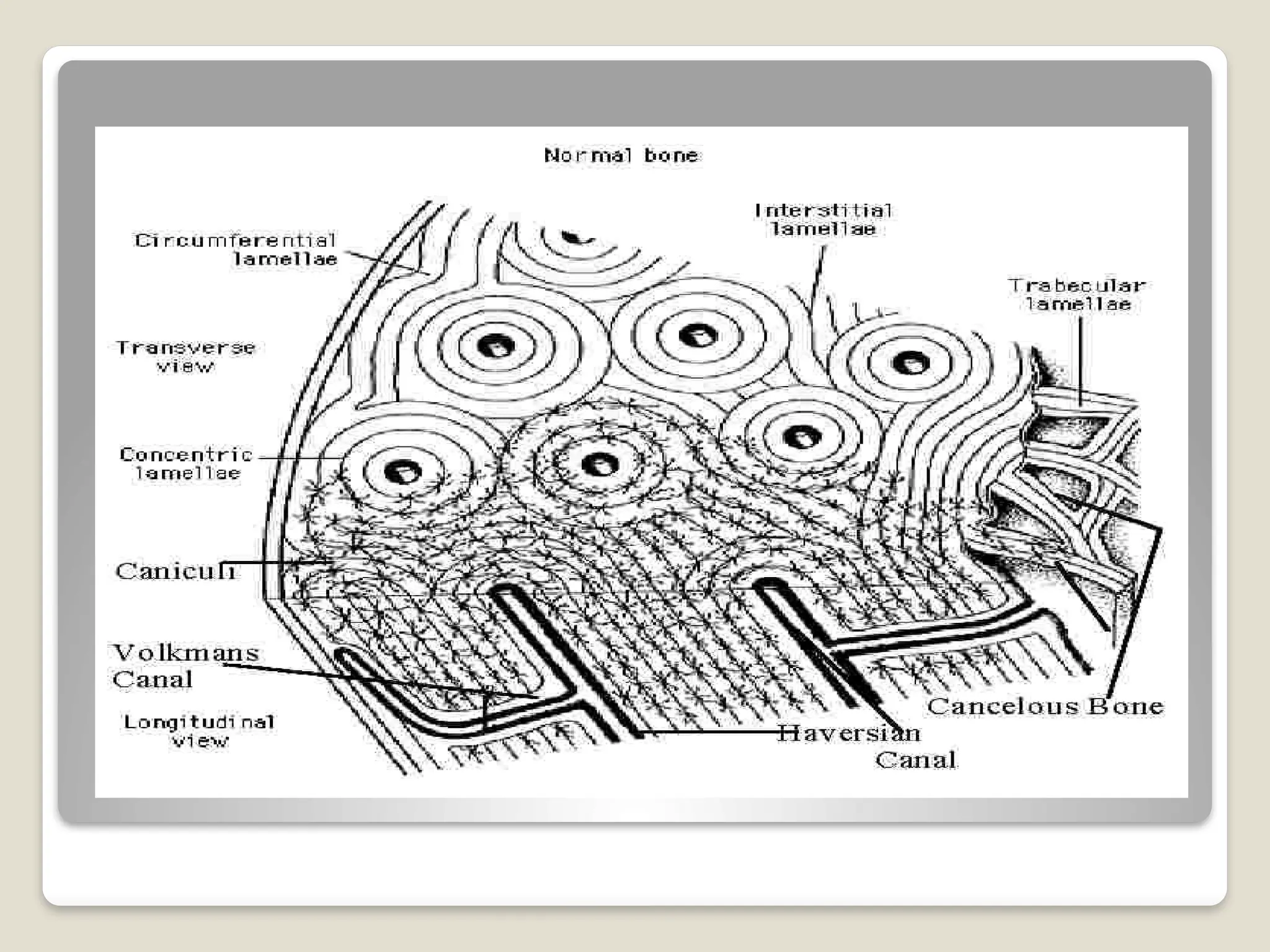
ď‚— Consists of multiple
osteons(haversian
systems) with intersitial
lamellae.
ď‚— Best developed in cortex of
long bones
ď‚— Osteons are made up of
concentric bone lamellae
with central canal
containing osteoblasts and
an arteriole supplying the
osteon
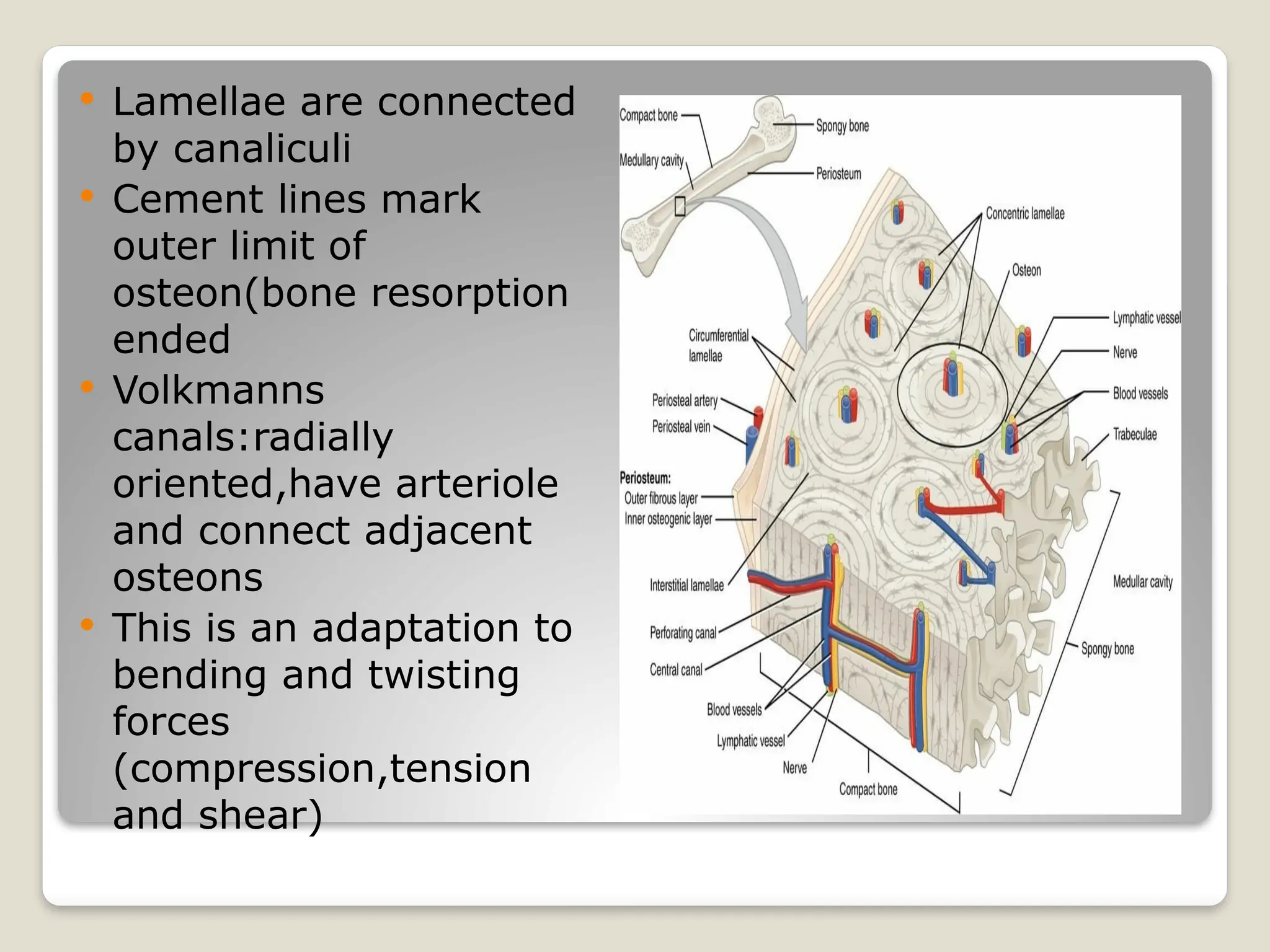
ď‚— Lamellae are connected
by canaliculi
ď‚— Cement lines mark
outer limit of
osteon(bone resorption
ended
ď‚— Volkmanns
canals:radially
oriented,have arteriole
and connect adjacent
osteons
ď‚— This is an adaptation to
bending and twisting
forces
(compression,tension
and shear)
Osteon
ď‚— The basic unit of mature compact bone
ď‚— Osteocytes are arranged in concentric
lamellae
ď‚— Around a central canal containing blood
vessels
Cancellous bone(spongy or
trabecular)
ď‚— Open in texture-Meshwork of trabeculae(rods
and plates)
ď‚— Crossed lattice structure ,makes up 20% of
skeleton
ď‚— High bone turnover rate
ď‚— Bone is resorbed by osteoclasts in howship
lacunae and formed on the opposite side of
trabeculae by osteoblasts
ď‚— Osteoporosis is common in cancellous
bones,making it susceptible to fracture.
ď‚— Commonly found in the metaphysis and
epiphysis of long bones
ď‚— Adaptation to compressive forces.
ď‚— Does not have osteons
ď‚— The matrix forms an open network of
trabeculae
ď‚— Trabeculae have no blood vessels
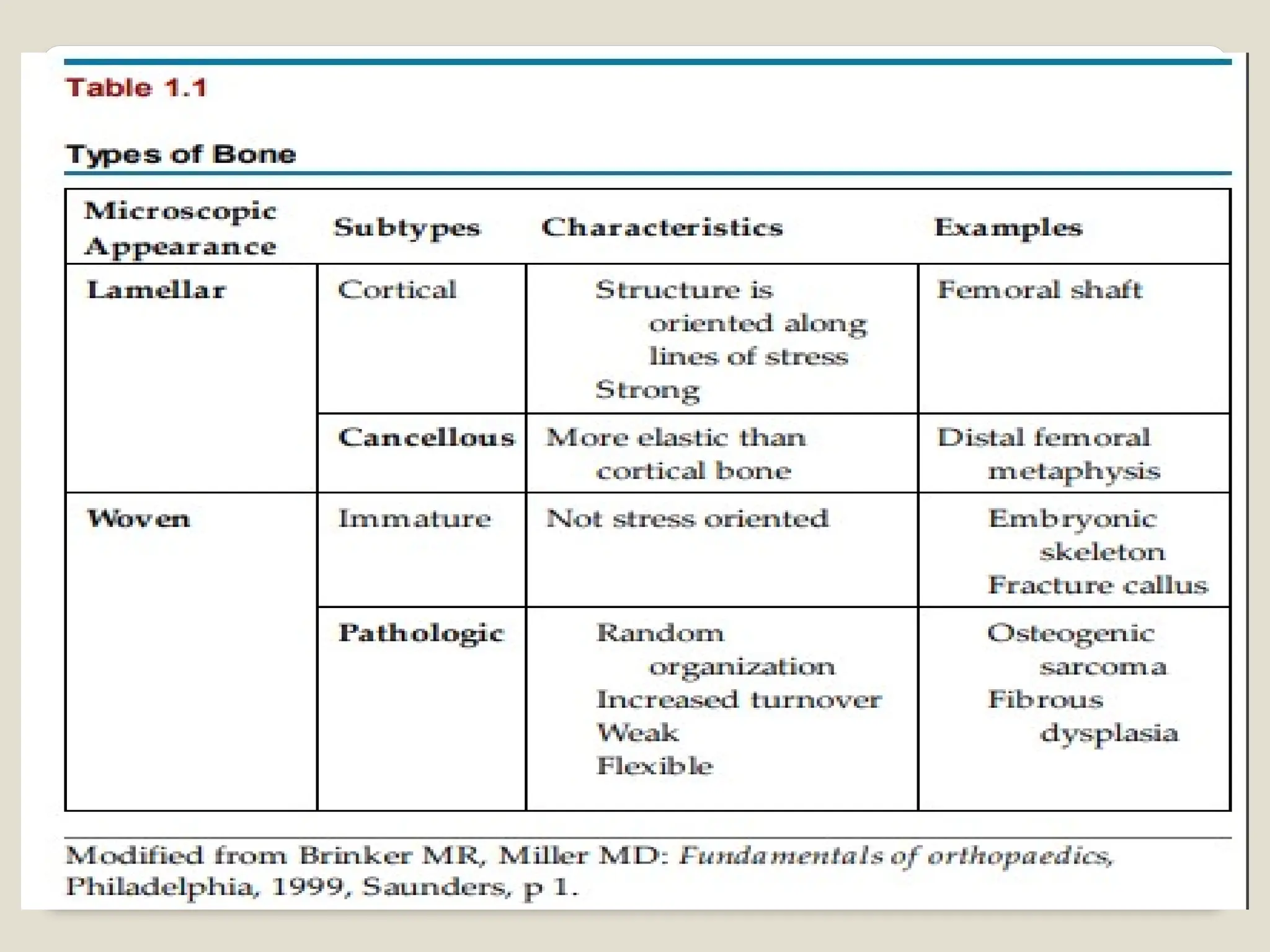
ď‚— Microscopically
ď‚— 1.Lamellar bone
ď‚— 2.woven bone
LAMELLAR BONE
ď‚— Bone is made up of layers or lamellae
ď‚— Lamellae is a thin plate of bone consisting
of collagen fibers and mineral
salts,deposited in gelatinous ground
substance
ď‚— Between adjoining lamellae we see small
flattened spaces-lacunae
ď‚— Lacunae
ď‚— contains one osteocyte
ď‚— Have fine canals or canaliculi that
communicate with those from other
lacunae
ď‚— Fibers of one lamellus run parallel to each
other ,but those of adjoining lamellae run
at varying angles to each other
Woven bone
 Found in all newly formed bone –later
replaced by lamellar bone
 Collagen fibers are present in bundles –
run randomly –interlacing with each other
ď‚— Abnormal persistence-pagets disease
ď‚— Shaft
ď‚— Composed of
ď‚— 1.periosteum
ď‚— 2.cortex
ď‚— 3.medullary cavity
periosteum
ď‚— External surface of any bone covered by a
membrane –periosteum
ď‚— Two layer
 Outer-fibrous membrane,inner –cellular
ď‚— In young bones-inner layer-numerous
osteoblasts-osteogenitic layer
ď‚— In adults-osteoblasts are not
conspicuous,but osteoprogenitor cells
present here can form osteoblasts when
need arises
functions
ď‚— Medium through which muscles,tendons
and ligaments attached
ď‚— Forms a nutritive function
ď‚— Can form bone when required
ď‚— Forms a limiting membrane that prevents
bone tissue from spilling out into
neighbouring tissues
cortex
ď‚— Is made up of a compact bone which gives
the desired strength
ď‚— Can withstand all possible mechanical
strains
ENDOSTEUM
ď‚— An incomplete cellular layer
ď‚— Lines the marrow cavity
ď‚— Covers trabeculae of spongy bone and lines
central canals
ď‚— Contains osteoblasts,osteoprogenitor cells
and osteoclasts
ď‚— Is active in bone growth and repair
Medullary cavity
ď‚— Filled with red or yellow bone marrow
ď‚— Red-at birth-heamopoiesis
ď‚— Yellow-as age advance-atrophies-fatty
ď‚— Red marrow persists in the cancellous
ends of long bones
Parts of young bone
ď‚— It ossifies in 3 parts
ď‚— The two ends from the secondary centers
ď‚— Intervening shaft from a primary center
EPIPHYSIS
ď‚— The ends of a bone which ossify from
secondary centers
ď‚— Types
ď‚— 1.Pressure epiphysis-Transmission of
weight .Ex:head of femur
ď‚— 2.Traction epiphysis-Provide attachment
to one or more tendons which exerts a
traction on the epiphysis.Ex-Tronchanters
of femur
ď‚— Atavistic epiphysis-phylogenitically an
independent bone,which fuses to another
bone.Ex-corocoid process of scapula.
ď‚— Aberrant epiphysis-not always
present .Ex-head of 1 st metacarpal and
base of other metacarpal
DIAPHYSIS
ď‚— It is the elongated shaft of a long bone
which ossifies from a primary center
ď‚— Made of thick cortical bone
ď‚— Filled with bone marrow
Metaphysis
ď‚— Epiphysial ends of a diaphysis
ď‚— Zone of active growth
ď‚— Typically made up of cancellous bone
ď‚— Hair pin bends of end arteries
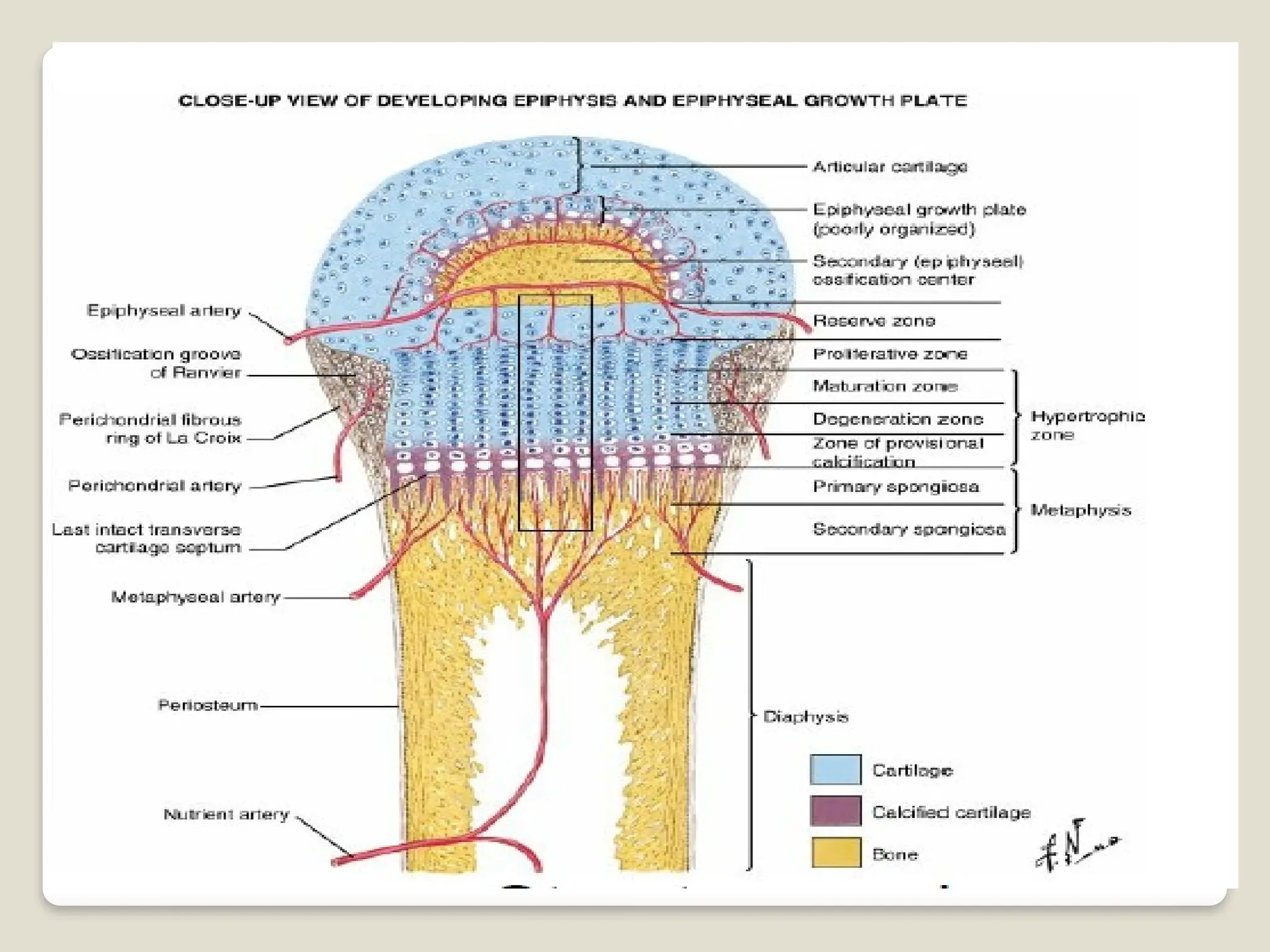
Epiphysial plate of cartilage
ď‚— It seperates epiphysis from metaphysis
ď‚— Proliferation-Responsible for length wise
growth of long bone.
ď‚— Epiphysial fusion-Can no longer grow
ď‚— Nourished by both epiphysial and
metaphysial arteries.
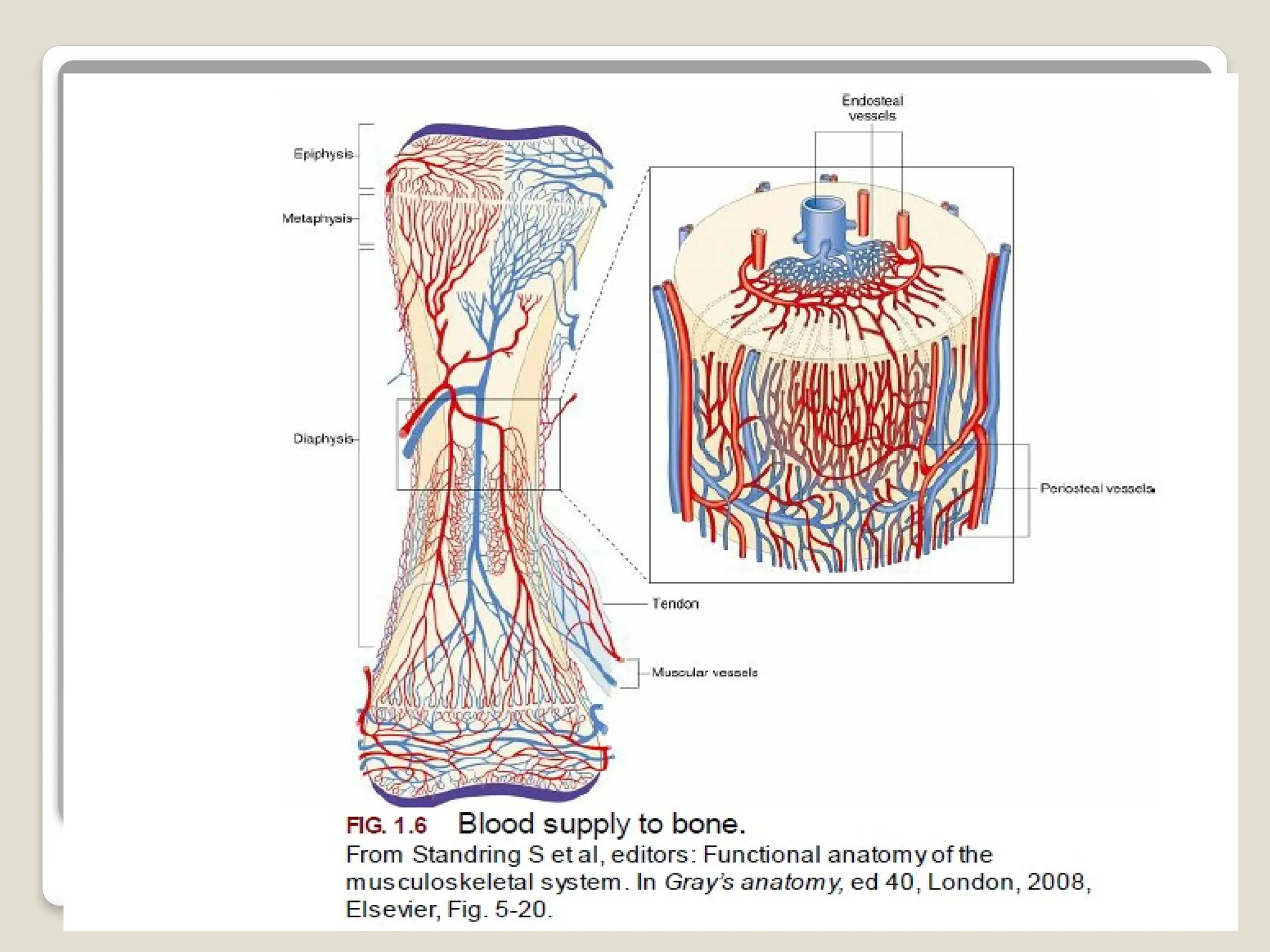
Blood supply of bones
ď‚— Long bones-derived from
ď‚— 1.Nutrient artery
ď‚— 2.Periosteal artery
ď‚— 3.Epiphysial artery
ď‚— 4.Metaphysial artery
Nutrient artery
ď‚— Enters through nutrient foramen
ď‚— Divides into ascending and descending branches in
medullary cavity
 Brach divides –small parallel channels-terminate in
adult metaphysis
ď‚— Anatomosing with the epiphysial,metaphysial and
periosteal arteries
ď‚— Supplies the medullary cavity,inner 2/3 rd of the
cortex and metaphysis
ď‚— Nutrient foramen is directed away from the
growing end of the bone
Periosteal artery
ď‚— Numerous beneath the muscular and
ligamentous attachments
ď‚— Ramify beneath the periosteum and enter
the volkmanns canals to supply the outer
1/3 rd of the cortex
Epiphyseal artery
ď‚— Derived from periarticular vascular
arcades(circulus vasculosus)
ď‚— Out of the numerus vascular foramina in
this region –few admit arteries and rest
venous exits
ď‚— Number size-idea of the relative
vascularity of two ends of the long bone.
Metaphysial artery
ď‚— Derived from the neighbouring systemic
vessels
ď‚— Pass directly into the metaphysis and
reinforce the metaphysial branches from
the primary nutrient artery
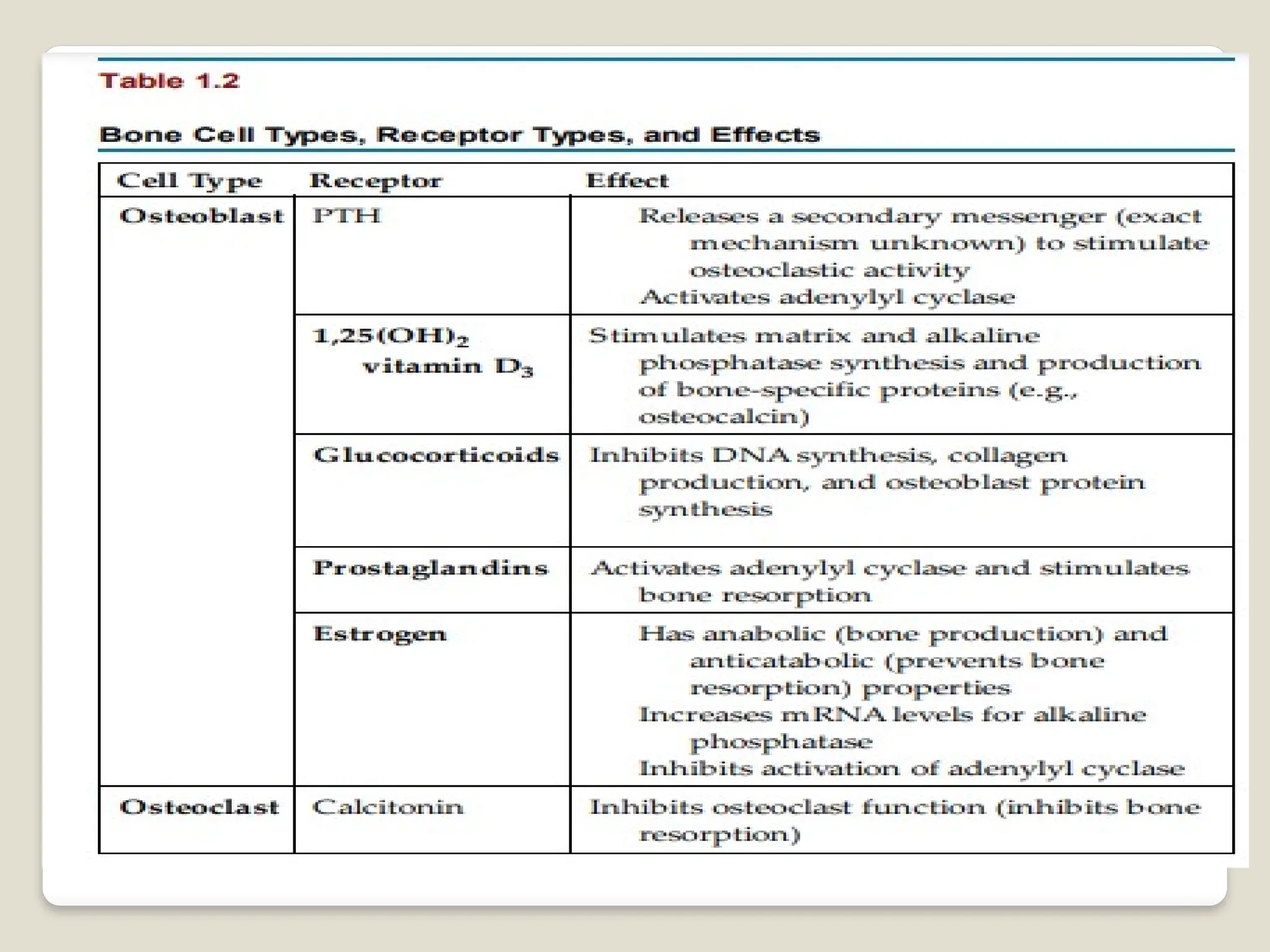
Homeostasis of bone tissue
 Bone resorption –action of osteoclasts and
parathyroid hormone aka PTH
ď‚— Bone deposition-Action of osteoblasts and
calcitonin
ď‚— Occurs by direction of the thyroid and
parathyroid glands
Factors affecting bone tissue
 Deficiency of vitamin a –retards bone development
ď‚— Deficiency of vitamin c-results in fragile bones
ď‚— Deficiency of vitamin D-Rickets,osteomalacia
ď‚— Insufficient growth hormone-dwarfism
 Excessive growth hormone –gigantism,acromegaly
ď‚— Insufficient thyroid hormone-delays bone growth
ď‚— Sex hormones-promote bone formation,stimulate
ossification of epiphyseal plates
ď‚— Physical stress-stimulates bone growth
References
 Miller’s review of orthopaedics-seventh
edition
 Netter’s atlas
Thank you

Anatomy of bone and its function adults.ppt

  • 1.
    Anatomy of boneand its functions Dr.Navaneesh Moderator:Dr.Anna mohan
  • 2.
    ď‚— Contents ď‚— Formationof bone ď‚— Classification of bones ď‚— Structure of bone ď‚— Blood supply ď‚— Composition of bone
  • 3.
    ď‚— Bone(syn os-osteon) ď‚—Osseous tissue,a specialized form of dense connective tissue consisting of bone cells(osteocytes) ď‚— Embedded in a matrix of calcified intercellular substance ď‚— Bone matrix contains collagen fibers,minerals like calcium phosphate and calcium carbonate
  • 4.
    Formation of bone ď‚—All bone is of mesodermal origin ď‚— Two types of ossification ď‚— Intramembranous ossification ď‚— Endochondral ossification
  • 7.
    Intramembranous ossification ď‚— Mesenchymalcondensation ď‚— Highly vascular ď‚— Laying down of bundle of collagen fibers in mesenchymal condensation ď‚— Osteoblast formation-osteiod ď‚— Calcium salts deposition-lamellus of bone
  • 9.
    Enchondral ossification ď‚— Ossifiesbone that originate as hyaline cartilage ď‚— Most bones originate as hyaline cartilage ď‚— Growth and ossification of long bones occur in 6 steps
  • 11.
    Skeletal organization ď‚— Theactual number of bones in human skeleton varies from person to person ď‚— Typically there are about 206 bones ď‚— For convenience the skeleton is divided into the ď‚— Axial skeleton ď‚— Appendicular skeleton
  • 13.
    Classification of bonesby shape ď‚— Long bones ď‚— Short bones ď‚— Irregular ď‚— Pnuematised ď‚— Sesamoid bones
  • 14.
    Long bones ď‚— Diaphysis-shaft ď‚—Epiphysis-Expanded ends ď‚— Shaft-3 surfaces,3 borders,medullary cavity and a nutrient foramen directed away from growing end ď‚— Ex- Humerus,radius,ulna,fe mur,etc
  • 15.
    Short bones ď‚— Aresmall and thick ď‚— Their shape is usually cuboid,cuneiform,trap ezoid or scaphoid ď‚— Ex-Carpal and Tarsal bones
  • 16.
    Flat bones ď‚— Arethin with parallel surfaces ď‚— Are found in the skull,sternum ,ribs and scapula ď‚— Form boundaries of certain body cavities ď‚— Resembles a sandwich of spongy bone ď‚— Between 2 layers of compact bone
  • 17.
    Pnuematic bones  Certainirregular bones contain large air spaces lined by epithelium  Make the skull light in weight ,help in resonance of voice and act as air conditioning chambers for inspired air.  Ex –Maxilla,Sphenoid,Ethmoid,etc
  • 18.
    Sesamoid bones ď‚— Resemblinga grain of sesame in size or shape ď‚— Bony nodules found embedded in the tendons or joint capsules ď‚— No periosteum and ossify after birth ď‚— Related to an articular or non articula bony surface ď‚— Ex:patella,pisiform and fabella
  • 19.
    Irregular bones ď‚— Havecomplex shapes ď‚— Examples: ď‚— Spinal vertebrae ď‚— Pelvic bones
  • 21.
    Developmental classification ď‚— Membrane(dermal ) bones ď‚— Cartilaginous bones ď‚— Membrano-cartilaginous bones
  • 22.
    ď‚— Membrane(dermal )bones ď‚—Ossify in membrane(intramembranous of mesenchymal. ď‚— Derived from mesenchymal condensations ď‚— Ex-bones of the vault of skull and facial bones ď‚— Defect-Cleidocranial dysostosis
  • 23.
    Cartilaginous bones ď‚— Ossifyin cartilage(intracartilagenous or endochondral) ď‚— Derived from preformed cartilaginous models ď‚— Ex-Bone of limbs,Vertebral column and thoracic cage ď‚— Defect-Common type of dwarfism called achondroplasia.
  • 24.
    Membrano-cartilaginous bones ď‚— Ossifypartly in cartilage and partly in membrane ď‚— Ex-clavicle,mandible,Occipital etc
  • 25.
    Structure of bone â—¦It consists of bone cells or osteocytes seperated by intercellular substance â—¦ 1.Osteoblast-Bone producing cells â—¦ 2.Osteoclasts-Bone removing cells â—¦ 3.Osteoprogenitor cells-From which osteoblasts and osteoclasts derived
  • 27.
    Osteoprogenitor cells ď‚— Mesenchymalstem cells that divide to produce osteoblasts ď‚— Are located in inner,cellular layer of periosteum(endosteum) ď‚— Assist in fracture repair
  • 28.
    Osteoblasts ď‚— Immature bonecells that secrete matrix compounds(osteogenesis) ď‚— Matrix produced by osteoblasts,but not yet calcified to form bone ď‚— Osteoblasts surrounded by bone become osteocytes
  • 29.
    Osteocytes ď‚— Mature bonecells that maintain the bone matrix ď‚— Live in lacunae ď‚— Are between layers (lamellae)of matrix ď‚— Connect by cytoplasmic extensions through canaliculi in lamellae ď‚— Do not divide
  • 30.
    Osteoclast ď‚— Secrete acidsand protein digesting enzymes ď‚— Giant,multinucleate cells ď‚— Dissolve bone matrix and release stored minerals(osteolysis) ď‚— Are derived from stem cells that produce macrophages
  • 32.
    Structural classification ď‚— Macroscopically ď‚—1.Compact bone ď‚— 2.Cancellous bone
  • 33.
    Compact bone ď‚— Strongdense-80 % of skeleton ď‚— Consists of multiple osteons(haversian systems) with intersitial lamellae. ď‚— Best developed in cortex of long bones ď‚— Osteons are made up of concentric bone lamellae with central canal containing osteoblasts and an arteriole supplying the osteon
  • 34.
    ď‚— Lamellae areconnected by canaliculi ď‚— Cement lines mark outer limit of osteon(bone resorption ended ď‚— Volkmanns canals:radially oriented,have arteriole and connect adjacent osteons ď‚— This is an adaptation to bending and twisting forces (compression,tension and shear)
  • 35.
    Osteon ď‚— The basicunit of mature compact bone ď‚— Osteocytes are arranged in concentric lamellae ď‚— Around a central canal containing blood vessels
  • 38.
    Cancellous bone(spongy or trabecular) ď‚—Open in texture-Meshwork of trabeculae(rods and plates) ď‚— Crossed lattice structure ,makes up 20% of skeleton ď‚— High bone turnover rate ď‚— Bone is resorbed by osteoclasts in howship lacunae and formed on the opposite side of trabeculae by osteoblasts ď‚— Osteoporosis is common in cancellous bones,making it susceptible to fracture.
  • 39.
    ď‚— Commonly foundin the metaphysis and epiphysis of long bones ď‚— Adaptation to compressive forces. ď‚— Does not have osteons ď‚— The matrix forms an open network of trabeculae ď‚— Trabeculae have no blood vessels
  • 40.
  • 42.
    LAMELLAR BONE ď‚— Boneis made up of layers or lamellae ď‚— Lamellae is a thin plate of bone consisting of collagen fibers and mineral salts,deposited in gelatinous ground substance ď‚— Between adjoining lamellae we see small flattened spaces-lacunae
  • 43.
    ď‚— Lacunae ď‚— containsone osteocyte ď‚— Have fine canals or canaliculi that communicate with those from other lacunae ď‚— Fibers of one lamellus run parallel to each other ,but those of adjoining lamellae run at varying angles to each other
  • 44.
    Woven bone  Foundin all newly formed bone –later replaced by lamellar bone  Collagen fibers are present in bundles – run randomly –interlacing with each other  Abnormal persistence-pagets disease
  • 45.
    ď‚— Shaft ď‚— Composedof ď‚— 1.periosteum ď‚— 2.cortex ď‚— 3.medullary cavity
  • 46.
    periosteum  External surfaceof any bone covered by a membrane –periosteum  Two layer  Outer-fibrous membrane,inner –cellular  In young bones-inner layer-numerous osteoblasts-osteogenitic layer  In adults-osteoblasts are not conspicuous,but osteoprogenitor cells present here can form osteoblasts when need arises
  • 47.
    functions ď‚— Medium throughwhich muscles,tendons and ligaments attached ď‚— Forms a nutritive function ď‚— Can form bone when required ď‚— Forms a limiting membrane that prevents bone tissue from spilling out into neighbouring tissues
  • 48.
    cortex ď‚— Is madeup of a compact bone which gives the desired strength ď‚— Can withstand all possible mechanical strains
  • 49.
    ENDOSTEUM ď‚— An incompletecellular layer ď‚— Lines the marrow cavity ď‚— Covers trabeculae of spongy bone and lines central canals ď‚— Contains osteoblasts,osteoprogenitor cells and osteoclasts ď‚— Is active in bone growth and repair
  • 50.
    Medullary cavity ď‚— Filledwith red or yellow bone marrow ď‚— Red-at birth-heamopoiesis ď‚— Yellow-as age advance-atrophies-fatty ď‚— Red marrow persists in the cancellous ends of long bones
  • 51.
    Parts of youngbone ď‚— It ossifies in 3 parts ď‚— The two ends from the secondary centers ď‚— Intervening shaft from a primary center
  • 52.
    EPIPHYSIS ď‚— The endsof a bone which ossify from secondary centers ď‚— Types ď‚— 1.Pressure epiphysis-Transmission of weight .Ex:head of femur ď‚— 2.Traction epiphysis-Provide attachment to one or more tendons which exerts a traction on the epiphysis.Ex-Tronchanters of femur
  • 53.
    ď‚— Atavistic epiphysis-phylogeniticallyan independent bone,which fuses to another bone.Ex-corocoid process of scapula. ď‚— Aberrant epiphysis-not always present .Ex-head of 1 st metacarpal and base of other metacarpal
  • 54.
    DIAPHYSIS ď‚— It isthe elongated shaft of a long bone which ossifies from a primary center ď‚— Made of thick cortical bone ď‚— Filled with bone marrow
  • 55.
    Metaphysis ď‚— Epiphysial endsof a diaphysis ď‚— Zone of active growth ď‚— Typically made up of cancellous bone ď‚— Hair pin bends of end arteries
  • 56.
    Epiphysial plate ofcartilage ď‚— It seperates epiphysis from metaphysis ď‚— Proliferation-Responsible for length wise growth of long bone. ď‚— Epiphysial fusion-Can no longer grow ď‚— Nourished by both epiphysial and metaphysial arteries.
  • 58.
    Blood supply ofbones ď‚— Long bones-derived from ď‚— 1.Nutrient artery ď‚— 2.Periosteal artery ď‚— 3.Epiphysial artery ď‚— 4.Metaphysial artery
  • 60.
    Nutrient artery  Entersthrough nutrient foramen  Divides into ascending and descending branches in medullary cavity  Brach divides –small parallel channels-terminate in adult metaphysis  Anatomosing with the epiphysial,metaphysial and periosteal arteries  Supplies the medullary cavity,inner 2/3 rd of the cortex and metaphysis  Nutrient foramen is directed away from the growing end of the bone
  • 61.
    Periosteal artery ď‚— Numerousbeneath the muscular and ligamentous attachments ď‚— Ramify beneath the periosteum and enter the volkmanns canals to supply the outer 1/3 rd of the cortex
  • 62.
    Epiphyseal artery  Derivedfrom periarticular vascular arcades(circulus vasculosus)  Out of the numerus vascular foramina in this region –few admit arteries and rest venous exits  Number size-idea of the relative vascularity of two ends of the long bone.
  • 63.
    Metaphysial artery ď‚— Derivedfrom the neighbouring systemic vessels ď‚— Pass directly into the metaphysis and reinforce the metaphysial branches from the primary nutrient artery
  • 64.
    Homeostasis of bonetissue  Bone resorption –action of osteoclasts and parathyroid hormone aka PTH  Bone deposition-Action of osteoblasts and calcitonin  Occurs by direction of the thyroid and parathyroid glands
  • 67.
    Factors affecting bonetissue  Deficiency of vitamin a –retards bone development  Deficiency of vitamin c-results in fragile bones  Deficiency of vitamin D-Rickets,osteomalacia  Insufficient growth hormone-dwarfism  Excessive growth hormone –gigantism,acromegaly  Insufficient thyroid hormone-delays bone growth  Sex hormones-promote bone formation,stimulate ossification of epiphyseal plates  Physical stress-stimulates bone growth
  • 68.
    References  Miller’s reviewof orthopaedics-seventh edition  Netter’s atlas
  • 69.