Joints of Lower Limb
Tibio-Fibular Joint & Ankle Joint
Dr Mathew Joseph
MBBS, MD(AIIMS), BCC(Palliative Medicine)
Assistant Professor
Department of Anatomy
Amala Institute of Medical Sciences, Thrissur
Ankle
Ankle Joint
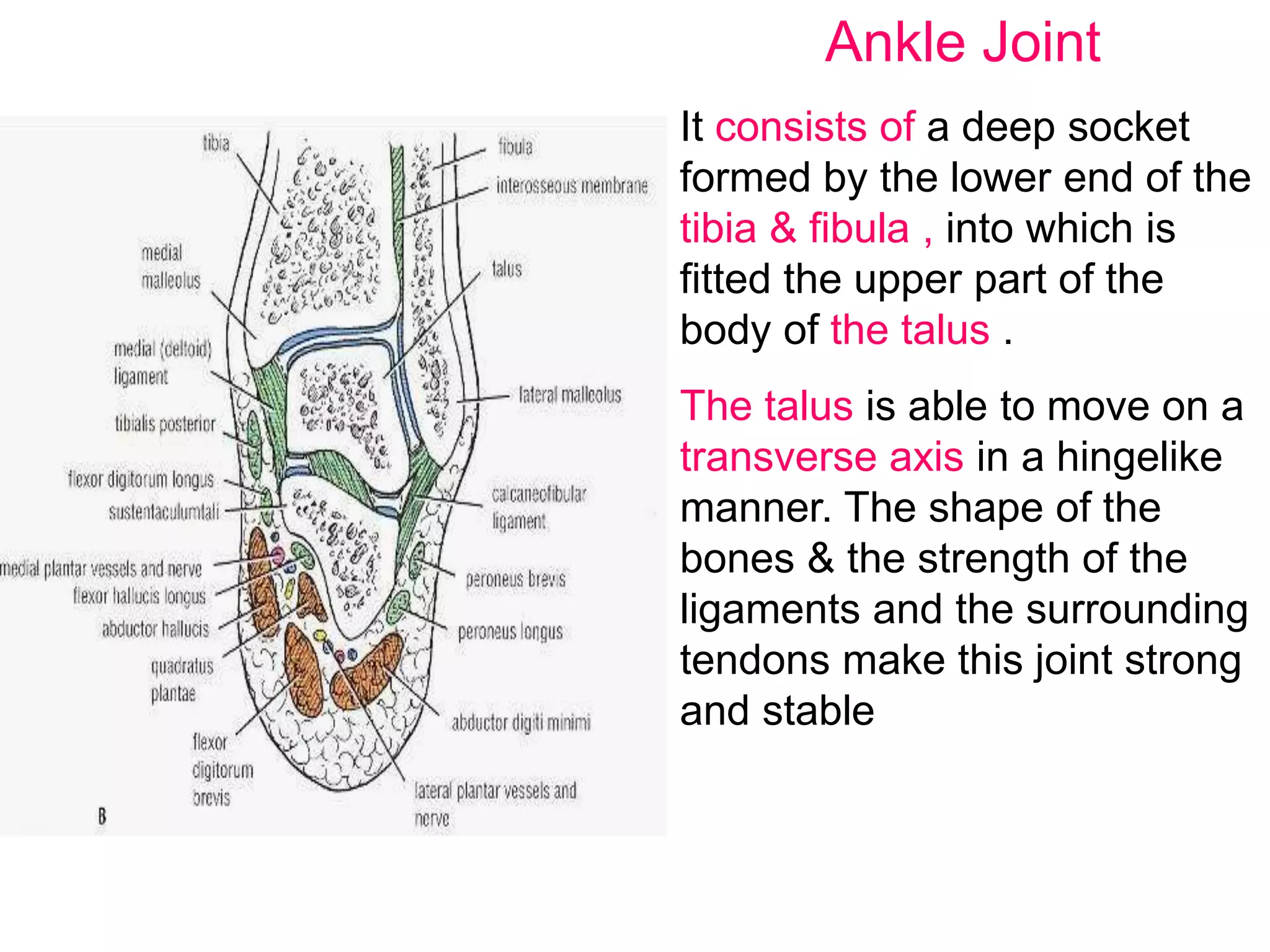
It consists of a deep socket
formed by the lower end of the
tibia & fibula , into which is
fitted the upper part of the
body of the talus .
The talus is able to move on a
transverse axis in a hingelike
manner. The shape of the
bones & the strength of the
ligaments and the surrounding
tendons make this joint strong
and stable
Ankle Joint
•
Articulation
•
It is between the lower end of the tibia & the 2
malleoli and the body of the talus.
•
The articular surfaces are covered by hyaline
cartilage.
•
The inferior transverse tibiofibular ligament ,
which runs between the lateral malleolus and
the posterior border of the lower end of the tibia
,deepens the socket into which the body of the
talus fits.
Ankle Joint
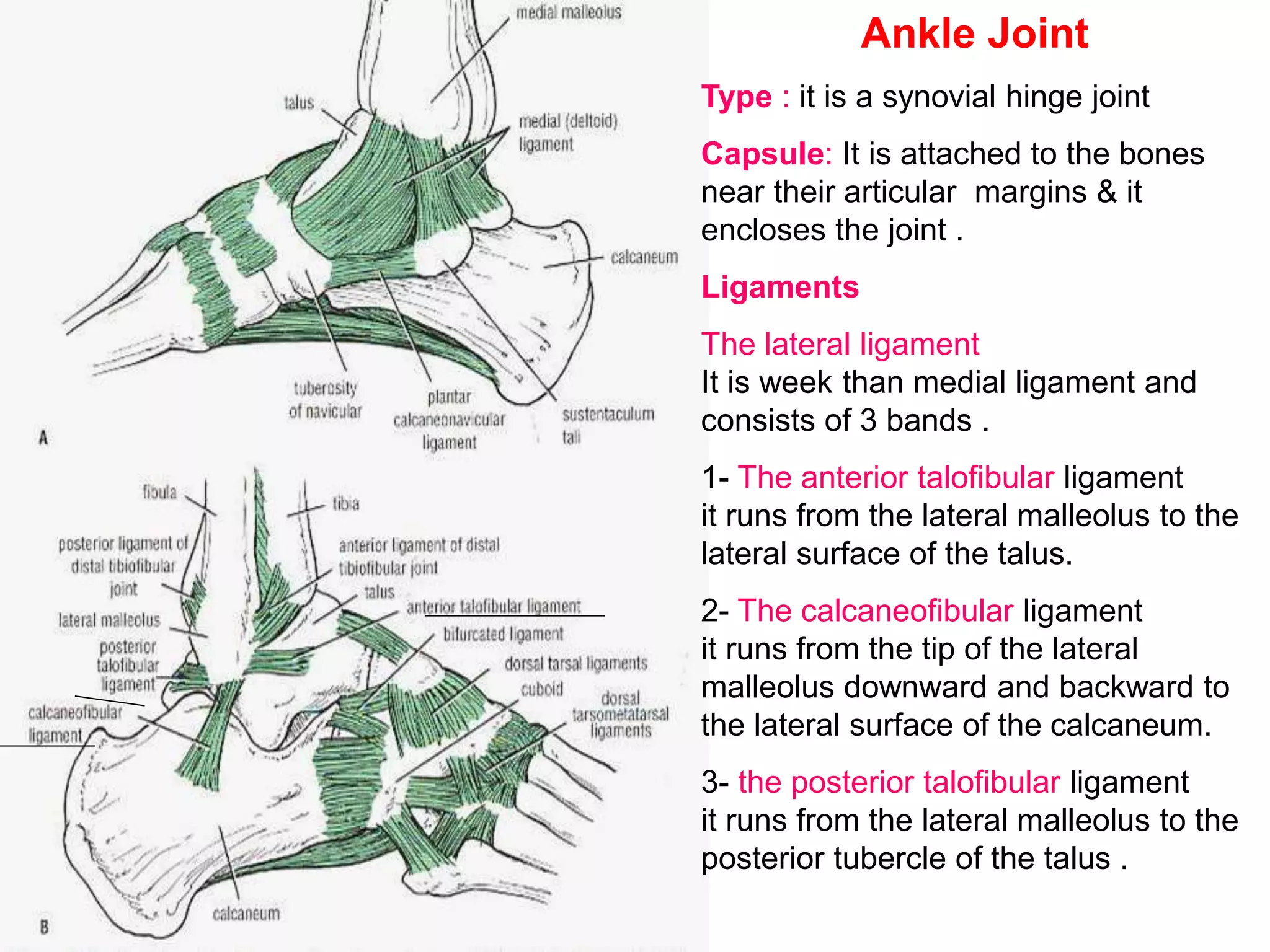
Type : it is a synovial hinge joint
Capsule: It is attached to the bones
near their articular margins & it
encloses the joint .
Ligaments
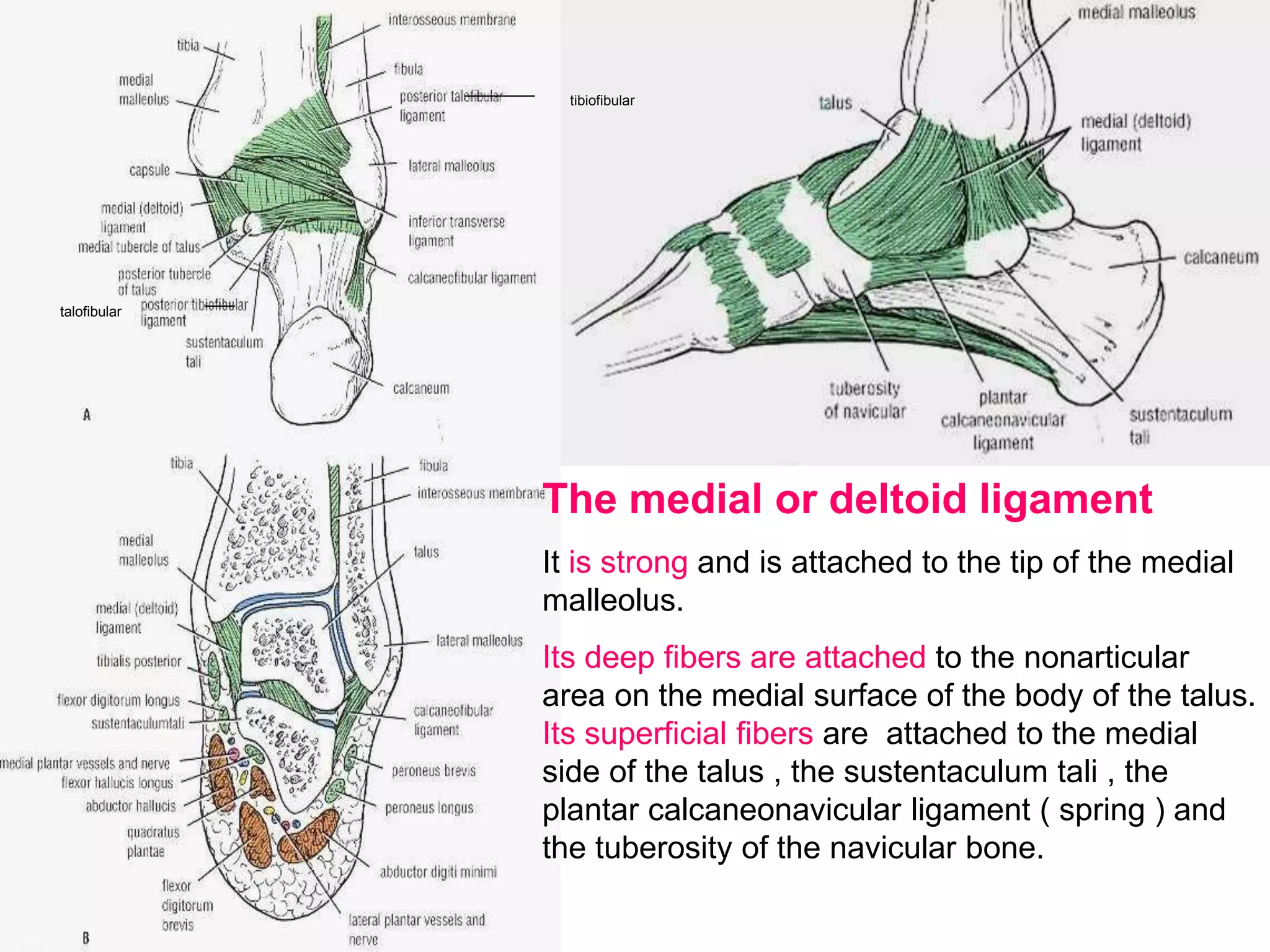
The lateral ligament
It is week than medial ligament and
consists of 3 bands .
1- The anterior talofibular ligament
it runs from the lateral malleolus to the
lateral surface of the talus.
2- The calcaneofibular ligament
it runs from the tip of the lateral
malleolus downward and backward to
the lateral surface of the calcaneum.
3- the posterior talofibular ligament
it runs from the lateral malleolus to the
posterior tubercle of the talus .
The medial or deltoid ligament
It is strong and is attached to the tip of the medial
malleolus.
Its deep fibers are attached to the nonarticular
area on the medial surface of the body of the talus.
Its superficial fibers are attached to the medial
side of the talus , the sustentaculum tali , the
plantar calcaneonavicular ligament ( spring ) and
the tuberosity of the navicular bone.
tibiofibular
talofibular
Ankle Joint
Synovial Membrane : It lines the capsule.
Nerve Supply : Deep peroneal & tibial nerves
Movements: Dorsiflexion & plantar flexion .
N. B. inversion & eversion tack place at the
tarsal joints .
Dorsiflexion is performed by the tibialis
anterior , extensor hallucis longus, extensor
digitorum longus, and peroneus tertius.
It is limited by the tension of the
tendocalcaneus , the posterior fibers of the
medial ligament and the calcaneofibular
ligament.
During dorsiflexion the wider anterior part of
the articular surface of the talus is forced
between the medial & lateral malleolus,
causing them to separate slightly & tighten
the ligaments of the distal tibiofibular joint.
This arrangement increases the stability of
the ankle joint when the foot is in the initial
position for major thrusting movements in
running , jumping and walk .
Plantar flexion is performed by the
gastrocnemius, soleus,plantaris, peroneus
longus & brevis , tibialis posterior, flexor
digitorum longus and flexor hallucis longus
It is limited by the tension of the opposing
muscles , the anterior fibers of the medial
ligament and the anterior talofibular
ligament .
When the ankle is fully plantar flexed, the
ligaments of the distal tibiofibular joint are
less taut and small amounts of rotation ,
abduction & adduction are possible.
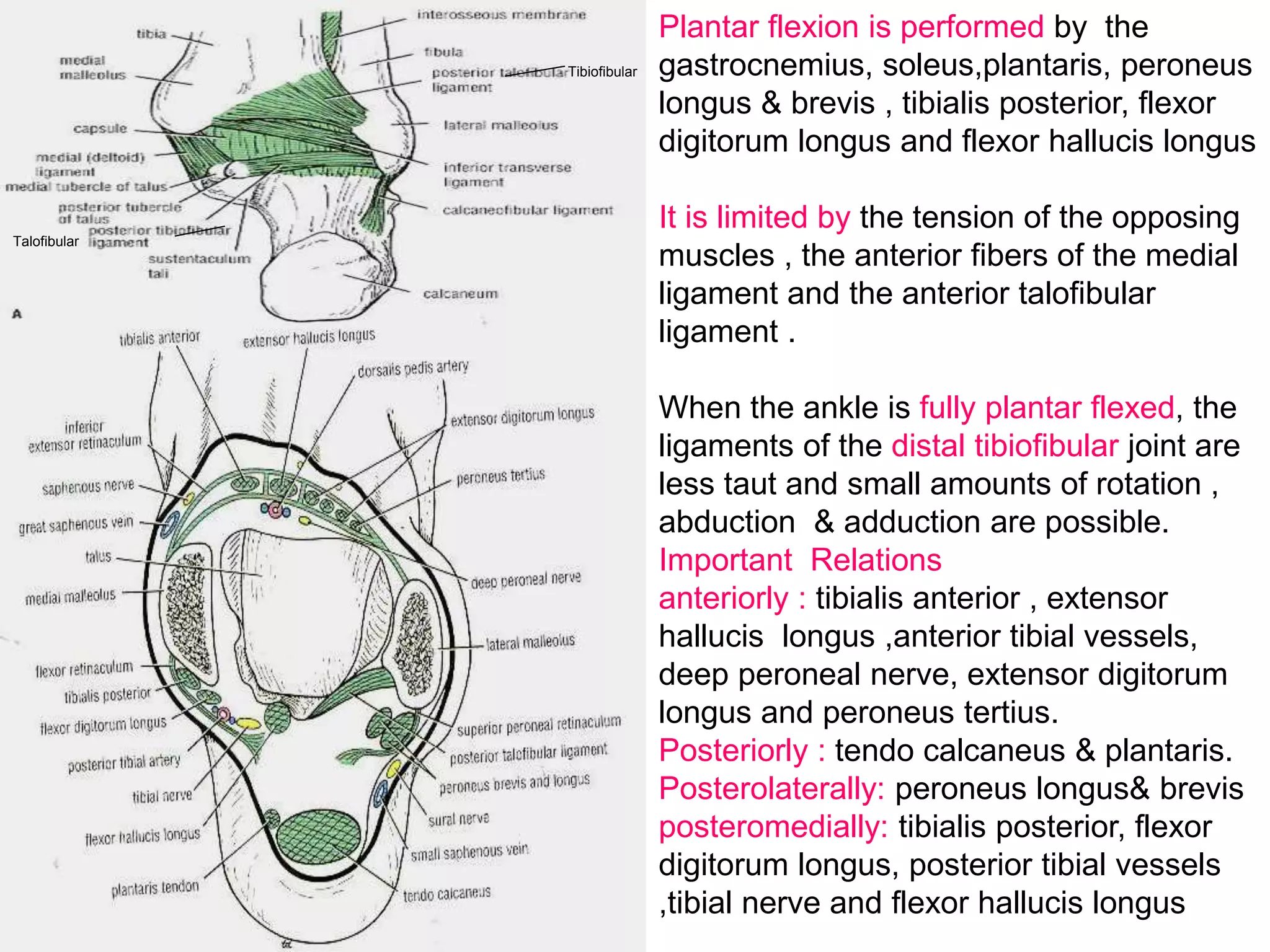
Important Relations
anteriorly : tibialis anterior , extensor
hallucis longus ,anterior tibial vessels,
deep peroneal nerve, extensor digitorum
longus and peroneus tertius.
Posteriorly : tendo calcaneus & plantaris.
Posterolaterally: peroneus longus& brevis
posteromedially: tibialis posterior, flexor
digitorum longus, posterior tibial vessels
,tibial nerve and flexor hallucis longus
Tibiofibular
Talofibular
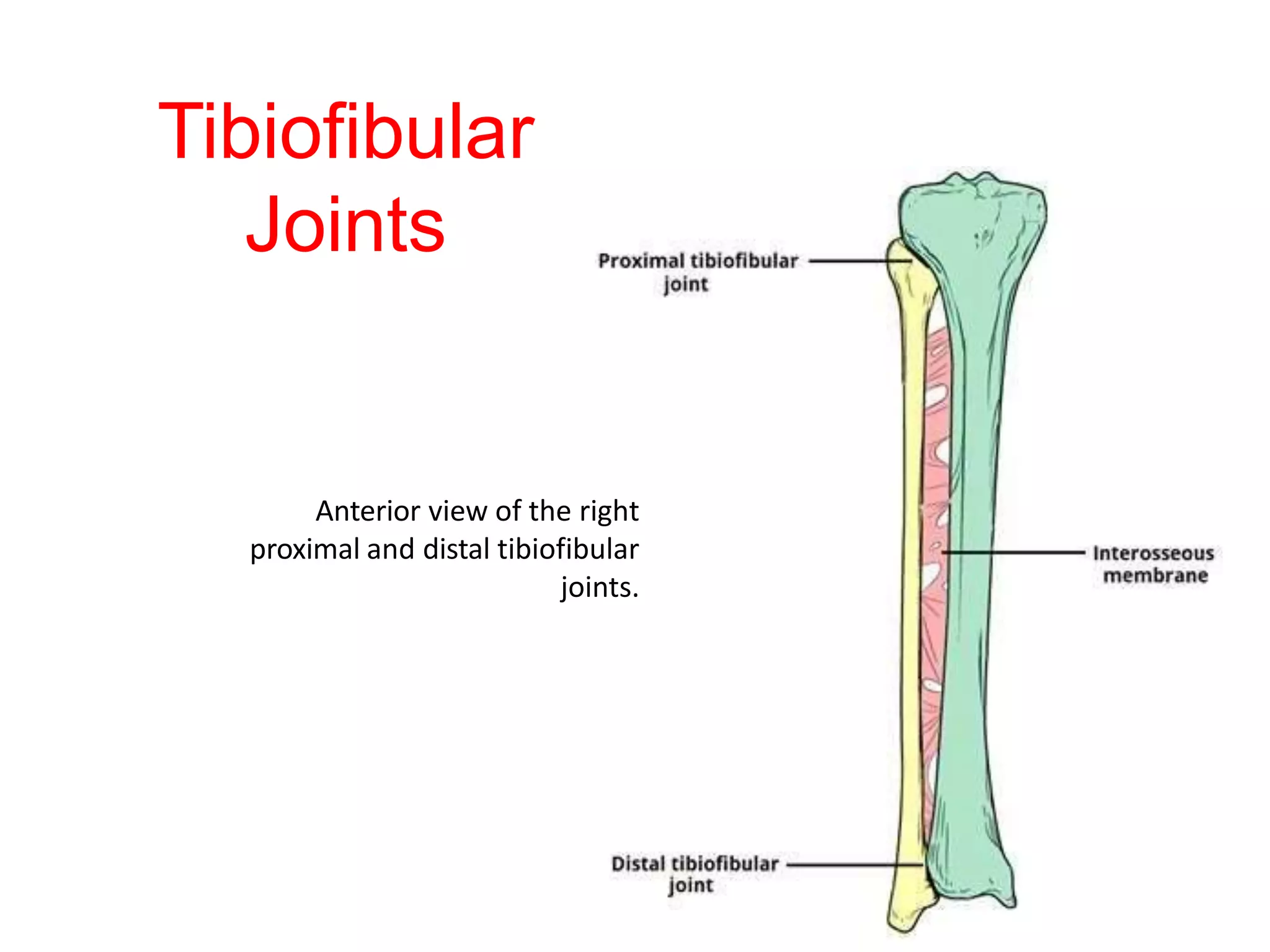
The Tibiofibular Joints
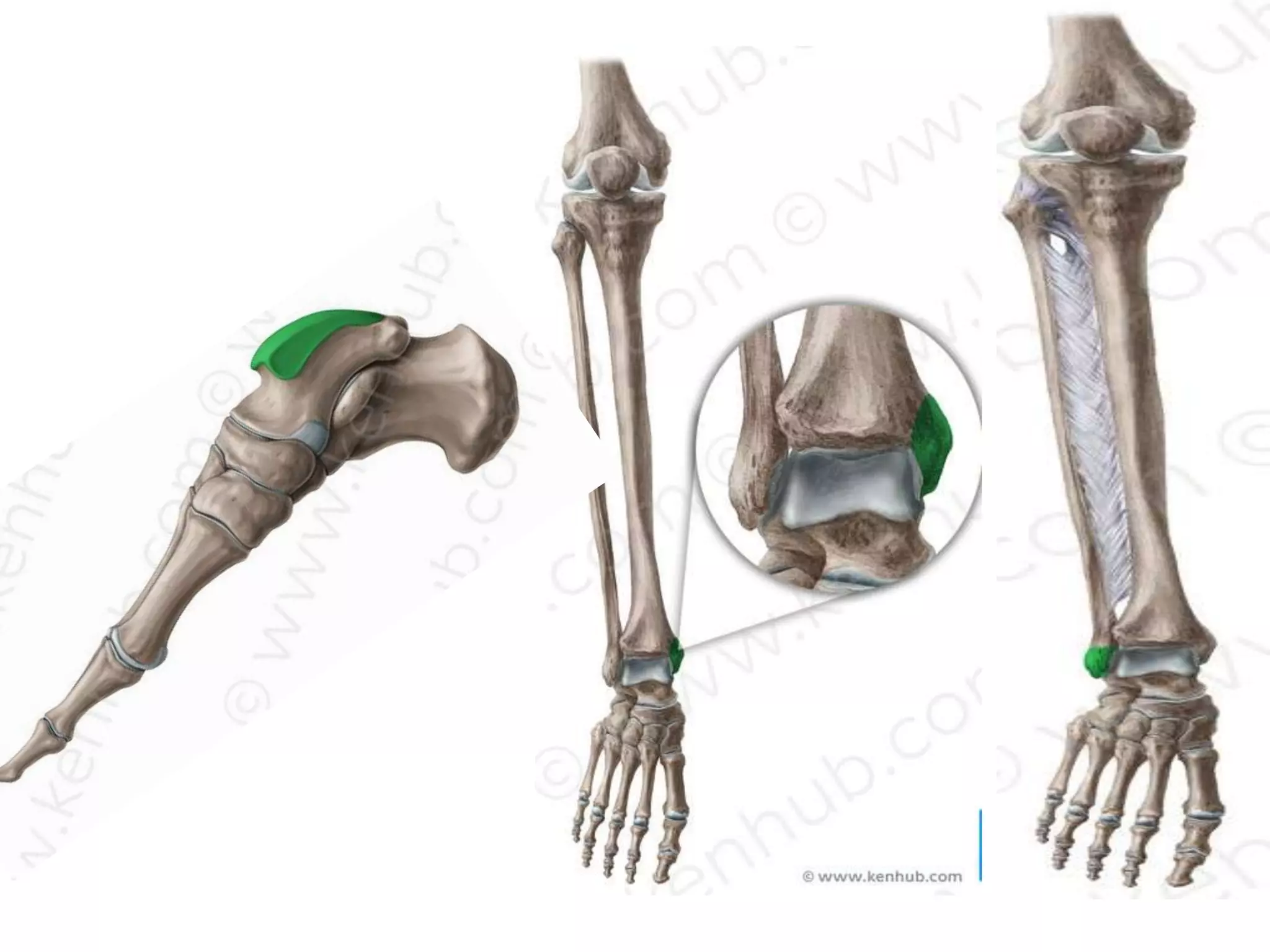
TFJs are a set of articulations that unite tibia and fibula.
These two bones of the leg are connected via three junctions;
The superior (proximal) tibiofibular joint - between the superior
ends of tibia and fibula
The inferior (distal) tibiofibular joint - between their inferior
ends
The interosseous membrane of leg (middle) - connects their
shafts
Tibiofibular Joints
The proximal and distal tibiofibular joints
refer to two articulations between the tibia
and fibula of the leg.
These joints have minimal function in terms
of movement but play a greater role in
stability and weight-bearing.
Tibiofibular
Joints
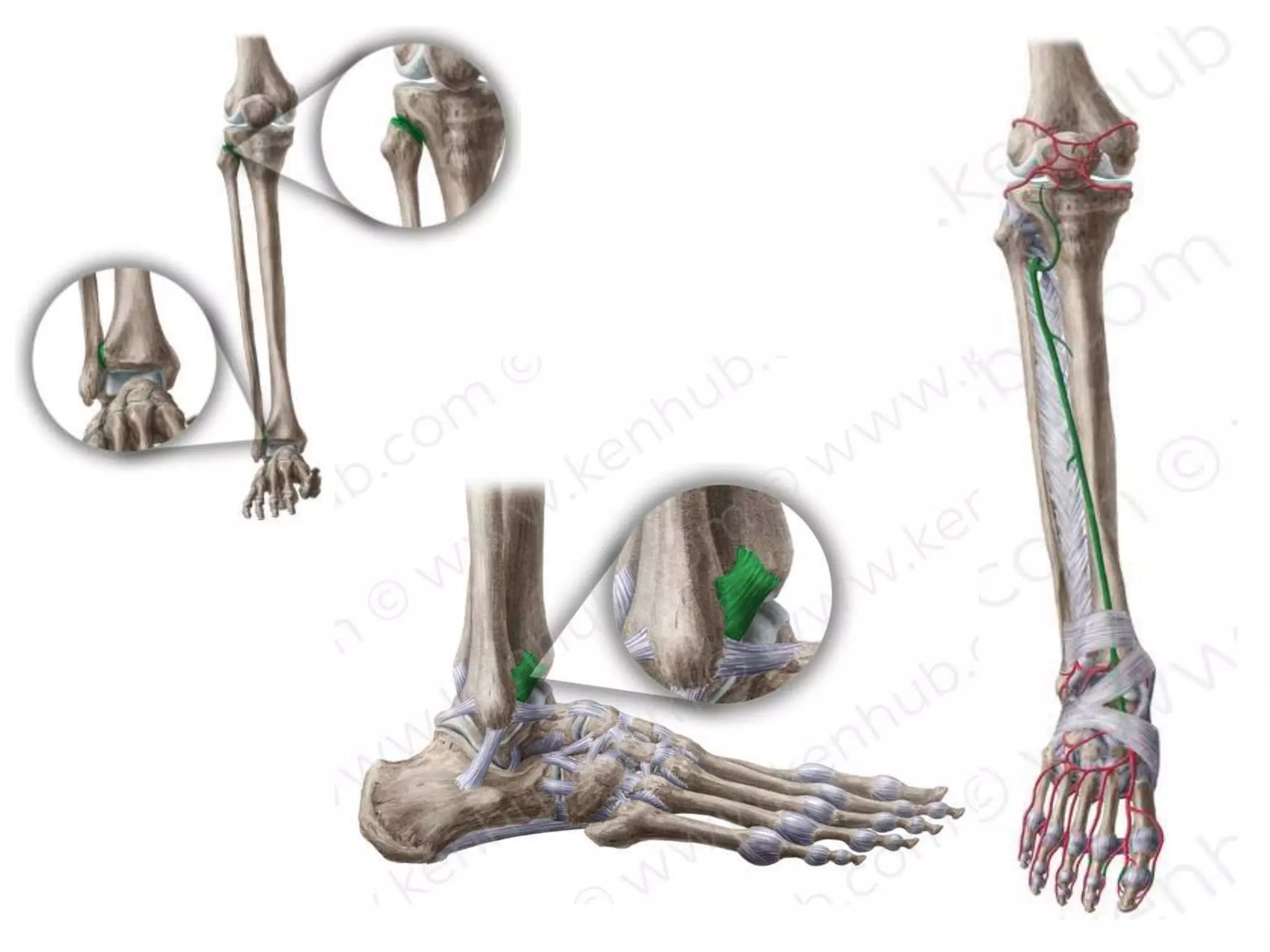
Anterior view of the right
proximal and distal tibiofibular
joints.
Proximal Tibiofibular Joint
Articulating Surfaces:
The proximal tibiofibular joint is formed by an
articulation between the head of the fibula
and the lateral condyle of the tibia.
It is a plane type synovial joint; where the
bones to glide over one another to create
movement.
Proximal Tibiofibular
Joint
Supporting Structures:
The articular surfaces of the proximal
tibiofibular joint are lined with hyaline
cartilage and contained within a joint
capsule.
Proximal Tibiofibular Joint
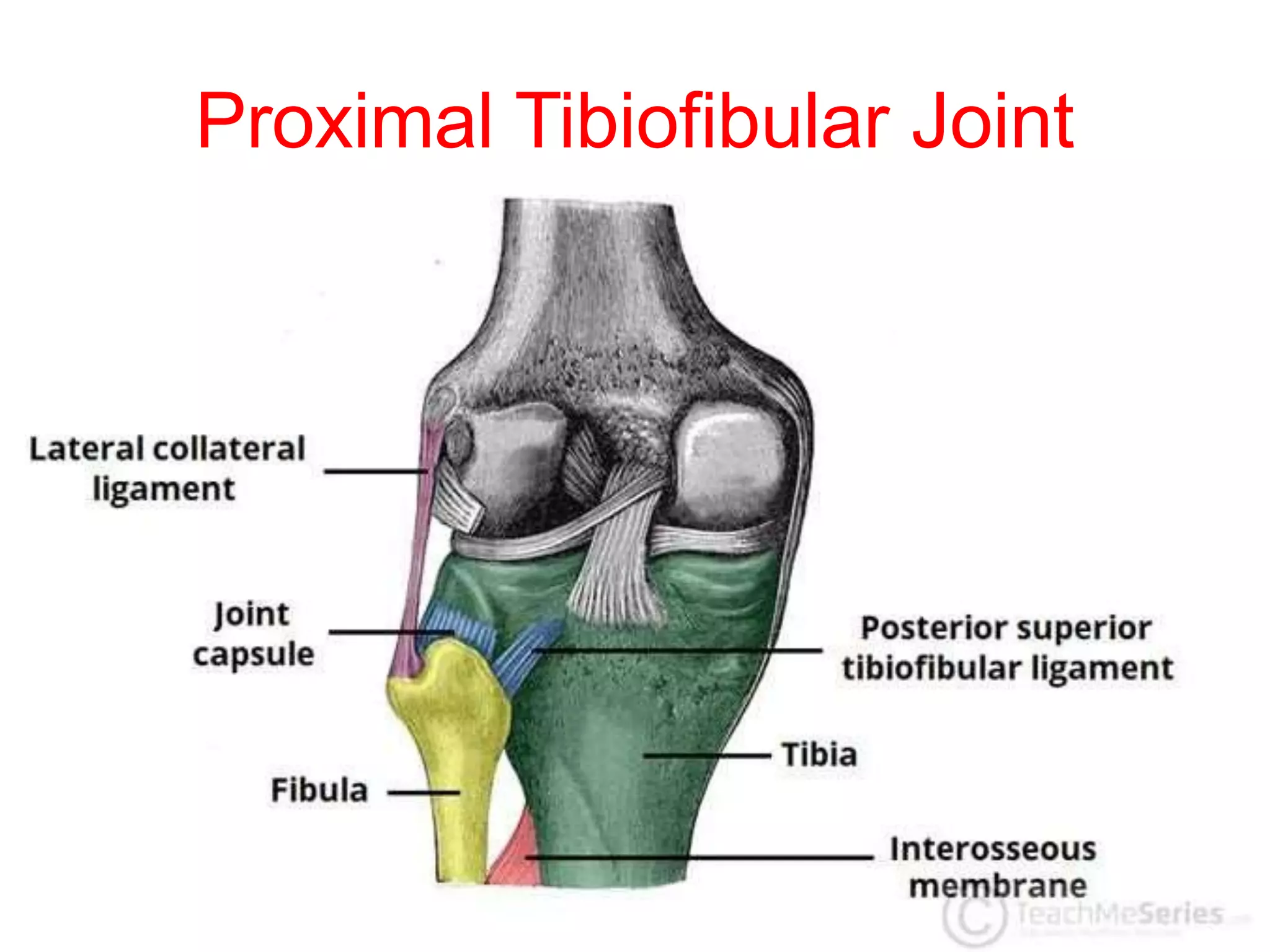
The joint capsule receives additional support from:
Anterior and posterior superior tibiofibular
ligaments – span between the fibular head and
lateral tibial condyle
Lateral collateral ligament of the knee joint
–
Biceps femoris – provides reinforcement as
it inserts onto the fibular head.
Proximal Tibiofibular
Joint
Neurovascular Supply:
The arterial supply to the proximal tibiofibular joint is
via the inferior genicular arteries and the anterior
tibial recurrent arteries.
The joint is innervated by branches of
the common fibular nerve and the nerve to the
popliteus (a branch of the tibial nerve).
Proximal Tibiofibular Joint
Distal Tibiofibular
joint
Articulating Surfaces:
The distal (inferior) tibiofibular joint consists of
an articulation between the fibular notch of the
distal tibia and the fibula.
It is an example of a fibrous joint, where the
joint surfaces are by bound by tough, fibrous
tissue.
Distal Tibiofibular
joint
Supporting Structures:
–
The distal tibiofibular joint is supported by:
Interosseous membrane – a fibrous structure
spanning the length of the tibia and fibula.
Anterior and posterior inferior tibiofibular
ligaments
Inferior transverse tibiofibular ligament – a
continuation of the posterior inferior tibiofibular
ligament.
– As it is a fibrous joint, the distal tibiofibular joint does not
have a joint capsule (only synovial joints have a joint
capsule).
Distal Tibiofibular
joint
A syndesmosis is a fibrous joint between two bones
and linked by ligaments and a strong membrane. [
The distal tibiofibular syndesmosis is a syndesmotic
joint.
It is formed between the distal tibia and fibula and it
is attached by
interosseous ligament (IOL),
anterior-inferior tibiofibular ligament (AITFL),
posterior-inferior tibiofibular ligament
The (PITFL)the transverse tibiofibular ligament (TTFL).
Distal Tibiofibular
joint
The left distal tibiofibular joint, supported by
the interosseous membrane and the anterior
inferior tibiofibular ligament. The posterior
ligaments are not visible in this illustration.
Distal Tibiofibular
joint
Neurovascular Supply:
Arterial supply to the distal tibiofibular joint
is via branches of the fibular artery and the
anterior and posterior tibial arteries.
The nerve supply is derived from
the deep peroneal and tibial nerves.
INTEROSSEUS MEMBRANE
OF LEG
(middle tibiofibular ligament)
This ligament extends through the fibula and tibia's
interosseous borders and separates the muscles in
the back of the leg from the muscles located in the
front of the leg.
It is made of an aponeurotic lamina, which is a thin
layer of oblique, tendon-like fibers.
Most of the fibers run laterally and
downwards while the others run in an
opposite direction.
INTEROSSEUS MEMBRANE of leg
(middle tibiofibular ligament)
The ligament thins out at the lower portion, but is
broader in the upper half.
The upper portion of the interosseous membrane of leg does
not reach the tibiofibular joint, but does create a large
concave border that allows the anterior tibial vessels to pass
through to the front of the leg.
The
lower part of the interosseous membrane of leg there
is an opening so that the anterior peroneal vessels can
pass through.
In addition to the two main openings for the passage of
vessels, there are also numerous openings so that small
vessels can pass through.
INTEROSSEUS MEMBRANE of leg
(middle tibiofibular ligament)
Function:
The inferior segment assists in
stabilising the tibiofibular syndesmosis.
LIGAMENTS DESCRIPTION PROXIMAL
ATTACHMENT
DISTAL ATTACHMENT ROLE / FUNCTION
Anterior-inferior
tibiofibular ligament
(AITFL)
Trapezoid shape (the
tibial insertion is
wider)
The ligament runs
obliquely
Weaker than the
PITFL
20% intra-articular
Anterior tubercle of the
distal tibia
Anterior surface of the
distal fibula at the
lateral malleolus
One of the primary
stabilisers
Limits excessive:

external rotation of
the foot on the leg

distal fibular motion
on the tibia
Posterior or posterior-
inferior tibiofibular
ligament
(PITFL)
Strong compact
ligament
Known as the
Superficial
component of the
PITFL
Posterior edge of the
lateral malleolus
Posterior tibial
tubercle
One of the primary
stabilisers Limits
excessive:

external rotation of
the foot on the leg

distal fibular motion
on the tibia
Transverse ligament
or the Transverse
tibiofibular ligament
(TTFL)
Cone shaped
Also known as the
Deep component of
the PTIFL
Proximal area of the
malleolar fossa
Posterior edge of the
tibia -- directly posterior
to the cartilaginous
covering of the inferior
tibial articular surface
and may extent up to
the medial malleolus
Forms a true labrum
Provides talocrural joint
stability.
Prevents Posterior
translation
Interosseus ligament
or the interosseous
tibiofibular ligament
(IOL)
Thickened portion of
the distal
interosseous
membrane
Dense mass of short
fibers with adipose
tissue and small
branching vessels
from the peroneal
artery
Span between the tibia
and fibula
The most proximal
fibres attach to the
apex of the incisura
tibialis on the tibia
Most distal fibres attach
to the anterior tubercle
of the tibia and
descends straight to the
talocrural joint of the
fibula
The length of the fibres
increase from proximal
to distal
One of the primary
stabilisers
Buffer to neutralise forces
during weight bearing as it
transfers some of the axial
compressive load to the
fibula
'Spring' action - allowing
for minor separation
between the distal tibia
and fibula during
dorsiflexion. Allowing
slight wedging of the talus
in the mortise
Tarsal joints
1- Subtalar joint
It is between the inferior surface of the body
of the talus and the facet on the middle of
the upper surface of the calcaneum.
2- Talocalcaneonavicular joint
It is between the rounded head of the talus ,
the upper surface of the sustentaculum tali
and the posterior concave surface of the
navicular bone.
3- Calcaneocuboid joint
It is between the anterior end of the
calcaneum & the posterior surface of the
cuboid .
The talocalcaneonavicular & calcaneo-
cuboid joints are together referred as
midtarsal or transverse tarsal joints .
N.B. The inversion & eversion movements
take place at the 3 previous joints .

Ankle and Tibiofibular Joint.pptx

  • 1.
    Joints of LowerLimb Tibio-Fibular Joint & Ankle Joint Dr Mathew Joseph MBBS, MD(AIIMS), BCC(Palliative Medicine) Assistant Professor Department of Anatomy Amala Institute of Medical Sciences, Thrissur
  • 2.
  • 6.
    Ankle Joint It consistsof a deep socket formed by the lower end of the tibia & fibula , into which is fitted the upper part of the body of the talus . The talus is able to move on a transverse axis in a hingelike manner. The shape of the bones & the strength of the ligaments and the surrounding tendons make this joint strong and stable
  • 7.
    Ankle Joint • Articulation • It isbetween the lower end of the tibia & the 2 malleoli and the body of the talus. • The articular surfaces are covered by hyaline cartilage. • The inferior transverse tibiofibular ligament , which runs between the lateral malleolus and the posterior border of the lower end of the tibia ,deepens the socket into which the body of the talus fits.
  • 8.
    Ankle Joint Type :it is a synovial hinge joint Capsule: It is attached to the bones near their articular margins & it encloses the joint . Ligaments The lateral ligament It is week than medial ligament and consists of 3 bands . 1- The anterior talofibular ligament it runs from the lateral malleolus to the lateral surface of the talus. 2- The calcaneofibular ligament it runs from the tip of the lateral malleolus downward and backward to the lateral surface of the calcaneum. 3- the posterior talofibular ligament it runs from the lateral malleolus to the posterior tubercle of the talus .
  • 10.
    The medial ordeltoid ligament It is strong and is attached to the tip of the medial malleolus. Its deep fibers are attached to the nonarticular area on the medial surface of the body of the talus. Its superficial fibers are attached to the medial side of the talus , the sustentaculum tali , the plantar calcaneonavicular ligament ( spring ) and the tuberosity of the navicular bone. tibiofibular talofibular
  • 14.
    Ankle Joint Synovial Membrane: It lines the capsule. Nerve Supply : Deep peroneal & tibial nerves Movements: Dorsiflexion & plantar flexion . N. B. inversion & eversion tack place at the tarsal joints . Dorsiflexion is performed by the tibialis anterior , extensor hallucis longus, extensor digitorum longus, and peroneus tertius. It is limited by the tension of the tendocalcaneus , the posterior fibers of the medial ligament and the calcaneofibular ligament. During dorsiflexion the wider anterior part of the articular surface of the talus is forced between the medial & lateral malleolus, causing them to separate slightly & tighten the ligaments of the distal tibiofibular joint. This arrangement increases the stability of the ankle joint when the foot is in the initial position for major thrusting movements in running , jumping and walk .
  • 15.
    Plantar flexion isperformed by the gastrocnemius, soleus,plantaris, peroneus longus & brevis , tibialis posterior, flexor digitorum longus and flexor hallucis longus It is limited by the tension of the opposing muscles , the anterior fibers of the medial ligament and the anterior talofibular ligament . When the ankle is fully plantar flexed, the ligaments of the distal tibiofibular joint are less taut and small amounts of rotation , abduction & adduction are possible. Important Relations anteriorly : tibialis anterior , extensor hallucis longus ,anterior tibial vessels, deep peroneal nerve, extensor digitorum longus and peroneus tertius. Posteriorly : tendo calcaneus & plantaris. Posterolaterally: peroneus longus& brevis posteromedially: tibialis posterior, flexor digitorum longus, posterior tibial vessels ,tibial nerve and flexor hallucis longus Tibiofibular Talofibular
  • 17.
    The Tibiofibular Joints TFJsare a set of articulations that unite tibia and fibula. These two bones of the leg are connected via three junctions; The superior (proximal) tibiofibular joint - between the superior ends of tibia and fibula The inferior (distal) tibiofibular joint - between their inferior ends The interosseous membrane of leg (middle) - connects their shafts
  • 19.
    Tibiofibular Joints The proximaland distal tibiofibular joints refer to two articulations between the tibia and fibula of the leg. These joints have minimal function in terms of movement but play a greater role in stability and weight-bearing.
  • 20.
    Tibiofibular Joints Anterior view ofthe right proximal and distal tibiofibular joints.
  • 21.
    Proximal Tibiofibular Joint ArticulatingSurfaces: The proximal tibiofibular joint is formed by an articulation between the head of the fibula and the lateral condyle of the tibia. It is a plane type synovial joint; where the bones to glide over one another to create movement.
  • 22.
    Proximal Tibiofibular Joint Supporting Structures: Thearticular surfaces of the proximal tibiofibular joint are lined with hyaline cartilage and contained within a joint capsule.
  • 23.
    Proximal Tibiofibular Joint Thejoint capsule receives additional support from: Anterior and posterior superior tibiofibular ligaments – span between the fibular head and lateral tibial condyle Lateral collateral ligament of the knee joint – Biceps femoris – provides reinforcement as it inserts onto the fibular head.
  • 24.
    Proximal Tibiofibular Joint Neurovascular Supply: Thearterial supply to the proximal tibiofibular joint is via the inferior genicular arteries and the anterior tibial recurrent arteries. The joint is innervated by branches of the common fibular nerve and the nerve to the popliteus (a branch of the tibial nerve).
  • 25.
  • 26.
    Distal Tibiofibular joint Articulating Surfaces: Thedistal (inferior) tibiofibular joint consists of an articulation between the fibular notch of the distal tibia and the fibula. It is an example of a fibrous joint, where the joint surfaces are by bound by tough, fibrous tissue.
  • 27.
    Distal Tibiofibular joint Supporting Structures: – Thedistal tibiofibular joint is supported by: Interosseous membrane – a fibrous structure spanning the length of the tibia and fibula. Anterior and posterior inferior tibiofibular ligaments Inferior transverse tibiofibular ligament – a continuation of the posterior inferior tibiofibular ligament. – As it is a fibrous joint, the distal tibiofibular joint does not have a joint capsule (only synovial joints have a joint capsule).
  • 28.
    Distal Tibiofibular joint A syndesmosisis a fibrous joint between two bones and linked by ligaments and a strong membrane. [ The distal tibiofibular syndesmosis is a syndesmotic joint. It is formed between the distal tibia and fibula and it is attached by interosseous ligament (IOL), anterior-inferior tibiofibular ligament (AITFL), posterior-inferior tibiofibular ligament The (PITFL)the transverse tibiofibular ligament (TTFL).
  • 29.
    Distal Tibiofibular joint The leftdistal tibiofibular joint, supported by the interosseous membrane and the anterior inferior tibiofibular ligament. The posterior ligaments are not visible in this illustration.
  • 30.
    Distal Tibiofibular joint Neurovascular Supply: Arterialsupply to the distal tibiofibular joint is via branches of the fibular artery and the anterior and posterior tibial arteries. The nerve supply is derived from the deep peroneal and tibial nerves.
  • 31.
    INTEROSSEUS MEMBRANE OF LEG (middletibiofibular ligament) This ligament extends through the fibula and tibia's interosseous borders and separates the muscles in the back of the leg from the muscles located in the front of the leg. It is made of an aponeurotic lamina, which is a thin layer of oblique, tendon-like fibers. Most of the fibers run laterally and downwards while the others run in an opposite direction.
  • 32.
    INTEROSSEUS MEMBRANE ofleg (middle tibiofibular ligament) The ligament thins out at the lower portion, but is broader in the upper half. The upper portion of the interosseous membrane of leg does not reach the tibiofibular joint, but does create a large concave border that allows the anterior tibial vessels to pass through to the front of the leg. The lower part of the interosseous membrane of leg there is an opening so that the anterior peroneal vessels can pass through. In addition to the two main openings for the passage of vessels, there are also numerous openings so that small vessels can pass through.
  • 33.
    INTEROSSEUS MEMBRANE ofleg (middle tibiofibular ligament) Function: The inferior segment assists in stabilising the tibiofibular syndesmosis.
  • 34.
    LIGAMENTS DESCRIPTION PROXIMAL ATTACHMENT DISTALATTACHMENT ROLE / FUNCTION Anterior-inferior tibiofibular ligament (AITFL) Trapezoid shape (the tibial insertion is wider) The ligament runs obliquely Weaker than the PITFL 20% intra-articular Anterior tubercle of the distal tibia Anterior surface of the distal fibula at the lateral malleolus One of the primary stabilisers Limits excessive:  external rotation of the foot on the leg  distal fibular motion on the tibia Posterior or posterior- inferior tibiofibular ligament (PITFL) Strong compact ligament Known as the Superficial component of the PITFL Posterior edge of the lateral malleolus Posterior tibial tubercle One of the primary stabilisers Limits excessive:  external rotation of the foot on the leg  distal fibular motion on the tibia Transverse ligament or the Transverse tibiofibular ligament (TTFL) Cone shaped Also known as the Deep component of the PTIFL Proximal area of the malleolar fossa Posterior edge of the tibia -- directly posterior to the cartilaginous covering of the inferior tibial articular surface and may extent up to the medial malleolus Forms a true labrum Provides talocrural joint stability. Prevents Posterior translation Interosseus ligament or the interosseous tibiofibular ligament (IOL) Thickened portion of the distal interosseous membrane Dense mass of short fibers with adipose tissue and small branching vessels from the peroneal artery Span between the tibia and fibula The most proximal fibres attach to the apex of the incisura tibialis on the tibia Most distal fibres attach to the anterior tubercle of the tibia and descends straight to the talocrural joint of the fibula The length of the fibres increase from proximal to distal One of the primary stabilisers Buffer to neutralise forces during weight bearing as it transfers some of the axial compressive load to the fibula 'Spring' action - allowing for minor separation between the distal tibia and fibula during dorsiflexion. Allowing slight wedging of the talus in the mortise
  • 38.
    Tarsal joints 1- Subtalarjoint It is between the inferior surface of the body of the talus and the facet on the middle of the upper surface of the calcaneum. 2- Talocalcaneonavicular joint It is between the rounded head of the talus , the upper surface of the sustentaculum tali and the posterior concave surface of the navicular bone. 3- Calcaneocuboid joint It is between the anterior end of the calcaneum & the posterior surface of the cuboid . The talocalcaneonavicular & calcaneo- cuboid joints are together referred as midtarsal or transverse tarsal joints . N.B. The inversion & eversion movements take place at the 3 previous joints .