1.1 Explain the occurrence of carbon
compounds with straight chains,
branched chains and rings.
MODULE 1. THE CHEMISTRY OF
CARBON COMPOUNDS
Learning Outcomes
TOPIC: BONDING IN CARBON
COMPOUNDS
Carbon forms many more compounds than any
other element. This is partly because, once formed,
the carbon to carbon (C- C) single covalent bonds are
very strong in comparison to other single covalent
bonds.
It takes a lot of energy to break these strong bonds,
so the compounds form are stable.
The ability of carbon atoms to form chains or rings
compounds by joining together is called
CATENATION.
Carbon-carbon bonds are also non-polar, and this
helps to reduce their vulnerability by other
chemicals.
BONDING IN CARBON COMPOUNDS
Carbon atom:
 is tetravalenttetravalent
 has the ability to bond with other carbon atoms
to form straight chains, branches and ring
compounds. This is known as catenation.catenation.
 has the ability to mix and rearrange the four
orbitals in the outer shell (hybridizationhybridization) e.g. sp3
,
sp2
, sp.
has resonance (delocalized electrons)
WHY CARBON IS THE UNIQUE THAT ITWHY CARBON IS THE UNIQUE THAT IT
FORMS A LARGE VARIETY OF COMPOUNDS?FORMS A LARGE VARIETY OF COMPOUNDS?
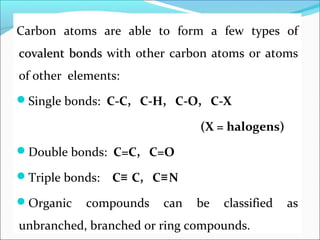
Carbon atoms are able to form a few types of
covalent bondscovalent bonds with other carbon atoms or atoms
of other elements:
Single bonds: C-C, C-H, C-O, C-X
(X = halogens)
Double bonds: C=C, C=O
Triple bonds: C C, C N≡ ≡
Organic compounds can be classified as
unbranched, branched or ring compounds.
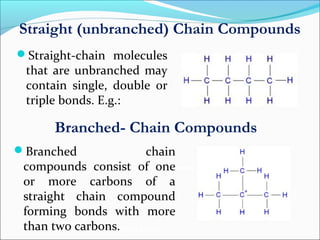
Straight-chain molecules
that are unbranched may
contain single, double or
triple bonds. E.g.:
Straight (unbranched) Chain Compounds
Single bond Double bonds
Triple bonds
Branched- Chain Compounds
Branched chain
compounds consist of one
or more carbons of a
straight chain compound
forming bonds with more
than two carbons.
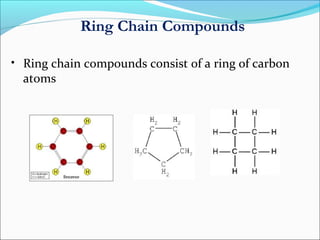
Ring Chain Compounds
• Ring chain compounds consist of a ring of carbon
atoms
There are five types of formulae which can be
used to describe and identify organic
compounds:
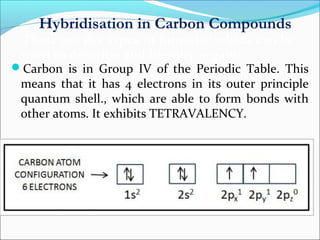
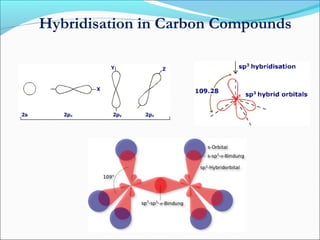
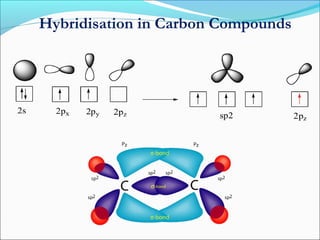
Hybridisation in Carbon Compounds
Carbon is in Group IV of the Periodic Table. This
means that it has 4 electrons in its outer principle
quantum shell., which are able to form bonds with
other atoms. It exhibits TETRAVALENCY.
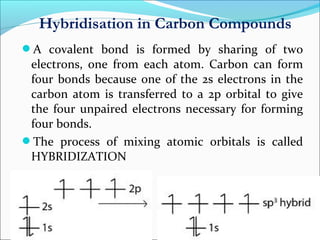
A covalent bond is formed by sharing of two
electrons, one from each atom. Carbon can form
four bonds because one of the 2s electrons in the
carbon atom is transferred to a 2p orbital to give
the four unpaired electrons necessary for forming
four bonds.
The process of mixing atomic orbitals is called
HYBRIDIZATION
Hybridisation in Carbon Compounds
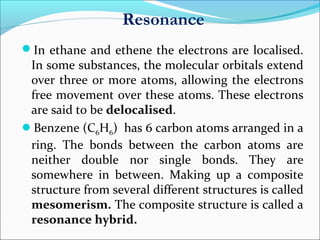
Resonance
In ethane and ethene the electrons are localised.
In some substances, the molecular orbitals extend
over three or more atoms, allowing the electrons
free movement over these atoms. These electrons
are said to be delocalised.
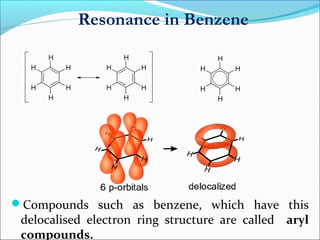
Benzene (C6H6) has 6 carbon atoms arranged in a
ring. The bonds between the carbon atoms are
neither double nor single bonds. They are
somewhere in between. Making up a composite
structure from several different structures is called
mesomerism. The composite structure is called a
resonance hybrid.
Resonance
Resonance arises whenever we can write two or more
structures for a molecule with different arrangements
of the electrons but identical arrangements of atoms.
When resonance is possible, the substance that is a
resonance is said to have a structure that is a
resonance hybrid of the various contributing
structures.
Resonance in Benzene
Compounds such as benzene, which have this
delocalised electron ring structure are called aryl
compounds.
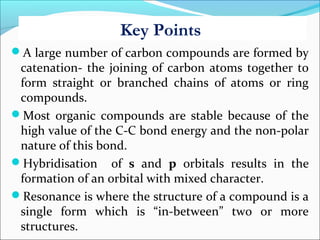
Key Points
A large number of carbon compounds are formed by
catenation- the joining of carbon atoms together to
form straight or branched chains of atoms or ring
compounds.
Most organic compounds are stable because of the
high value of the C-C bond energy and the non-polar
nature of this bond.
Hybridisation of s and p orbitals results in the
formation of an orbital with mixed character.
Resonance is where the structure of a compound is a
single form which is “in-between” two or more
structures.
Explain the characteristic of compounds
which belongs to the same homologous
series.
Homework

bonding in carbon compounds

  • 1.
    1.1 Explain theoccurrence of carbon compounds with straight chains, branched chains and rings. MODULE 1. THE CHEMISTRY OF CARBON COMPOUNDS Learning Outcomes TOPIC: BONDING IN CARBON COMPOUNDS
  • 2.
    Carbon forms manymore compounds than any other element. This is partly because, once formed, the carbon to carbon (C- C) single covalent bonds are very strong in comparison to other single covalent bonds. It takes a lot of energy to break these strong bonds, so the compounds form are stable. The ability of carbon atoms to form chains or rings compounds by joining together is called CATENATION. Carbon-carbon bonds are also non-polar, and this helps to reduce their vulnerability by other chemicals. BONDING IN CARBON COMPOUNDS
  • 3.
    Carbon atom:  istetravalenttetravalent  has the ability to bond with other carbon atoms to form straight chains, branches and ring compounds. This is known as catenation.catenation.  has the ability to mix and rearrange the four orbitals in the outer shell (hybridizationhybridization) e.g. sp3 , sp2 , sp. has resonance (delocalized electrons) WHY CARBON IS THE UNIQUE THAT ITWHY CARBON IS THE UNIQUE THAT IT FORMS A LARGE VARIETY OF COMPOUNDS?FORMS A LARGE VARIETY OF COMPOUNDS?
  • 4.
    Carbon atoms areable to form a few types of covalent bondscovalent bonds with other carbon atoms or atoms of other elements: Single bonds: C-C, C-H, C-O, C-X (X = halogens) Double bonds: C=C, C=O Triple bonds: C C, C N≡ ≡ Organic compounds can be classified as unbranched, branched or ring compounds.
  • 5.
    Straight-chain molecules that areunbranched may contain single, double or triple bonds. E.g.: Straight (unbranched) Chain Compounds Single bond Double bonds Triple bonds Branched- Chain Compounds Branched chain compounds consist of one or more carbons of a straight chain compound forming bonds with more than two carbons.
  • 6.
    Ring Chain Compounds •Ring chain compounds consist of a ring of carbon atoms
  • 7.
    There are fivetypes of formulae which can be used to describe and identify organic compounds: Hybridisation in Carbon Compounds Carbon is in Group IV of the Periodic Table. This means that it has 4 electrons in its outer principle quantum shell., which are able to form bonds with other atoms. It exhibits TETRAVALENCY.
  • 8.
    A covalent bondis formed by sharing of two electrons, one from each atom. Carbon can form four bonds because one of the 2s electrons in the carbon atom is transferred to a 2p orbital to give the four unpaired electrons necessary for forming four bonds. The process of mixing atomic orbitals is called HYBRIDIZATION Hybridisation in Carbon Compounds
  • 9.
  • 10.
  • 11.
    Resonance In ethane andethene the electrons are localised. In some substances, the molecular orbitals extend over three or more atoms, allowing the electrons free movement over these atoms. These electrons are said to be delocalised. Benzene (C6H6) has 6 carbon atoms arranged in a ring. The bonds between the carbon atoms are neither double nor single bonds. They are somewhere in between. Making up a composite structure from several different structures is called mesomerism. The composite structure is called a resonance hybrid.
  • 12.
    Resonance Resonance arises wheneverwe can write two or more structures for a molecule with different arrangements of the electrons but identical arrangements of atoms. When resonance is possible, the substance that is a resonance is said to have a structure that is a resonance hybrid of the various contributing structures.
  • 13.
    Resonance in Benzene Compoundssuch as benzene, which have this delocalised electron ring structure are called aryl compounds.
  • 14.
    Key Points A largenumber of carbon compounds are formed by catenation- the joining of carbon atoms together to form straight or branched chains of atoms or ring compounds. Most organic compounds are stable because of the high value of the C-C bond energy and the non-polar nature of this bond. Hybridisation of s and p orbitals results in the formation of an orbital with mixed character. Resonance is where the structure of a compound is a single form which is “in-between” two or more structures.
  • 15.
    Explain the characteristicof compounds which belongs to the same homologous series. Homework