Carbon is the 4th most abundant substance in
universe and 15th most abundant substance in the
earth’s crust.
Compounds having carbon atoms among the
components are known as carbon compounds.
Previously, carbon compounds could only be obtained
from a living source; hence they are also known as
organic compounds.
Bond formed by sharing of electrons is called covalent
bond. Two of more atoms share electrons to make
their configuration stable. In this type of bond, all the
atoms have similar rights over shared electrons.
Compounds which are formed because of covalent
bond are called COVALNET COMPOUNDS.
Covalent bonds are of three types: Single, double and
triple covalent bond.
Single covalent bond is formed because of sharing of two electrons, one
from each of the two atoms.
Example – ** Formation of hydrogen molecule (H2)
Atomic Number of H = 1
Electronic configuration of H = 1
Valence electron of H = 1
Since, hydrogen has one electron in its valence shell, so it requires one more
electron to form a duet. So, in the formation of hydrogen molecule; one electron
from each of the hydrogen atoms is shared.
Double bond is formed by sharing of four electrons, two from each of the two
atoms.
Example - ** Formation of oxygen molecule (O2):
Valence electron of oxygen = 2
In the formation of oxygen molecule, two electrons are shared by each of the two
oxygen atoms to complete their stable configuration.
In oxygen, the total number of shared electrons is four, two from each of the oxygen
atoms. So a double covalent bond is formed.
Triple covalent bond is formed because of the sharing of six electrons, three
from each of the two atoms.
Example - **Formation of Nitrogen (N2):
Atomic number of nitrogen = 7
Electronic configuration of nitrogen = 2, 5
Valence electron = 5
In the formation of nitrogen, three electrons are shared by each of the
nitrogen atoms. Thus one triple bond is formed because of the sharing of
total six electrons.
**Intermolecular force is smaller.
**Covalent bonds are weaker than ionic bond. As a result,
covalent compounds have low melting and boiling points.
**Covalent compounds are poor conductor of electricity as no
charged particles are formed in covalent bond.
**Since, carbon compounds are formed by the formation of
covalent bond, so carbon compounds generally have low melting
and boiling points and are poor conductor of electricity.
Initially, compounds of carbon could only be
obtained from living sources and there was
no way of synthesizing them. Hence, carbon
compounds are also known as organic
compounds. Carbon forms a large number of
compounds. So far, formulae of about 3
million carbon compounds are known.
1. Carbon can form bonds with other carbon atoms. This property of carbon is
known as CATENATION. Because of catenation, carbon can form a long chain;
while making bond with other carbon atoms. Carbon can make single, double
and triple bonds by catenation.
2. Carbon can form bonds with other carbon atoms. This property of carbon is
known as CATENATION. Because of catenation, carbon can form a long chain;
while making bond with other carbon atoms. Carbon can make single, double
and triple bonds by catenation.
3. Carbon can form branched chain; along with straight chain; while combining
with carbon atoms, i.e. because of the property of catenation.
(Hydrogen + Carbon = Hydrocarbon) Compounds formed because of the
combination of hydrogen and carbon are known as hydrocarbons. There are
two types of hydrocarbon, viz. saturated hydrocarbon and unsaturated
hydrocarbon.
Saturated hydrocarbons:
Hydrocarbons having single bonds are known as SATURATED HYDROCARBONS. Saturated
hydrocarbons are known as ALKANE. These are also known as paraffin. Example:
Methane, Ethane, Propane, etc.
Unsaturated hydrocarbon:
Unsaturated hydrocarbons are of two types – Hydrocarbon with double bond and
hydrocarbon with triple bond.
Hydrocarbon with double bond: Hydrocarbons having at least one double bond are
known as ALKENE. Example: Ethene, Propene, Butene, etc.
Hydrocarbon with triple bond: Hydrocarbons having at least one triple bond are known as
ALKYNE. Example: Ethyne, Propyne, Butyne, etc.
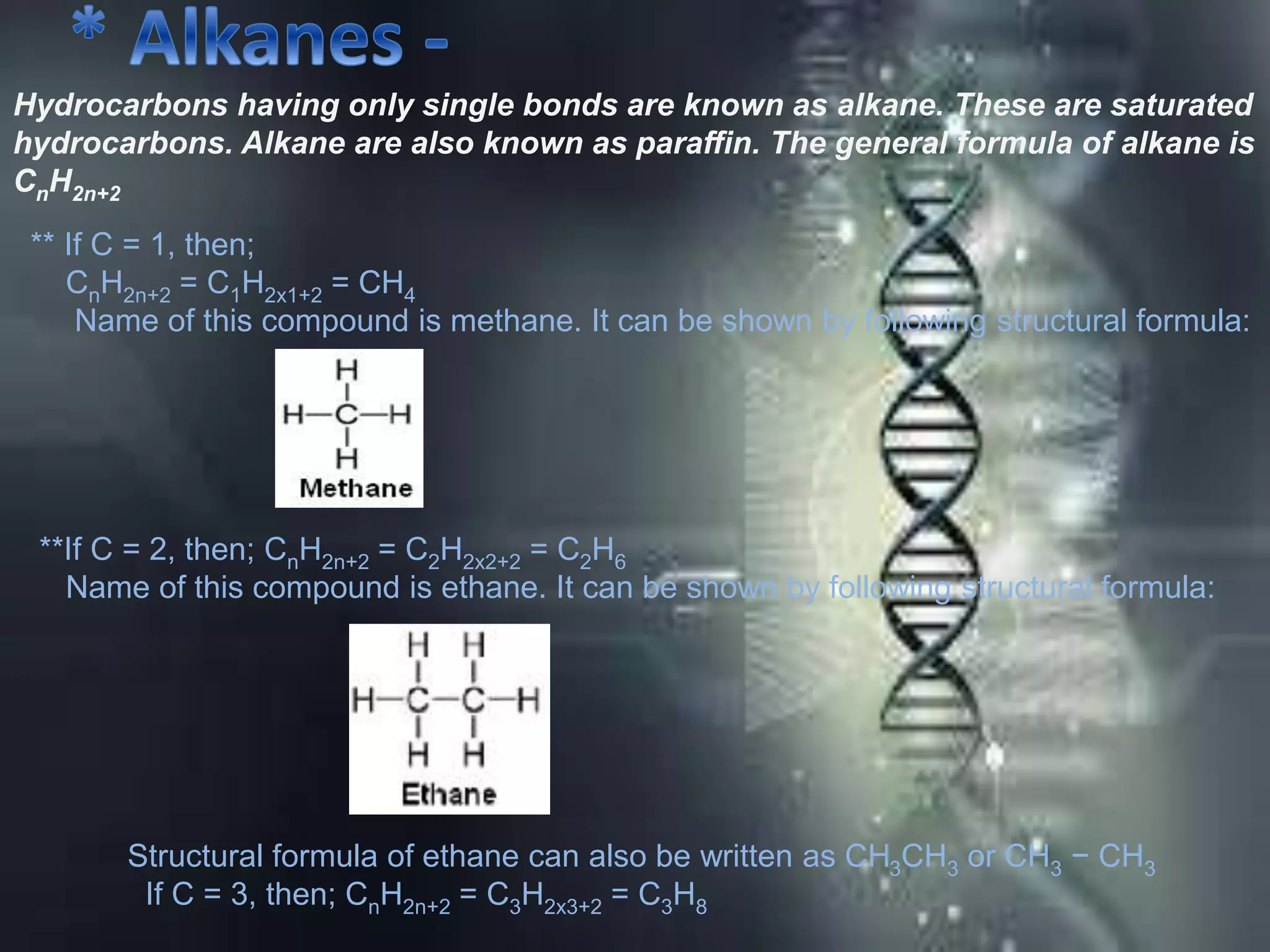
Hydrocarbons having only single bonds are known as alkane. These are saturated
hydrocarbons. Alkane are also known as paraffin. The general formula of alkane is
CnH2n+2
** If C = 1, then;
CnH2n+2 = C1H2x1+2 = CH4
Name of this compound is methane. It can be shown by following structural formula:
**If C = 2, then; CnH2n+2 = C2H2x2+2 = C2H6
Name of this compound is ethane. It can be shown by following structural formula:
Structural formula of ethane can also be written as CH3CH3 or CH3 − CH3
If C = 3, then; CnH2n+2 = C3H2x3+2 = C3H8
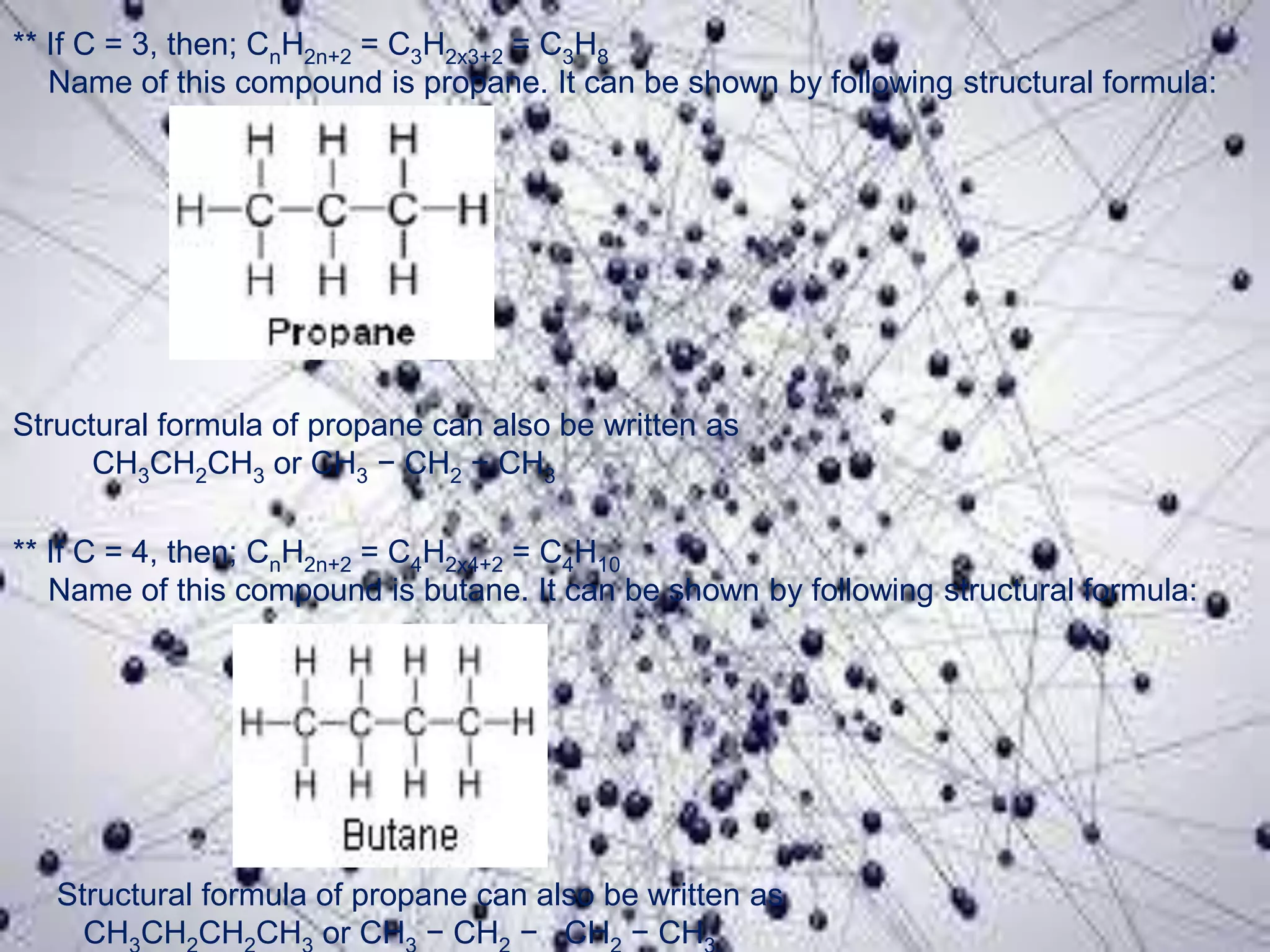
** If C = 3, then; CnH2n+2 = C3H2x3+2 = C3H8
Name of this compound is propane. It can be shown by following structural formula:
Structural formula of propane can also be written as
CH3CH2CH3 or CH3 − CH2 − CH3
** If C = 4, then; CnH2n+2 = C4H2x4+2 = C4H10
Name of this compound is butane. It can be shown by following structural formula:
Structural formula of propane can also be written as
CH CH CH CH or CH − CH − CH − CH
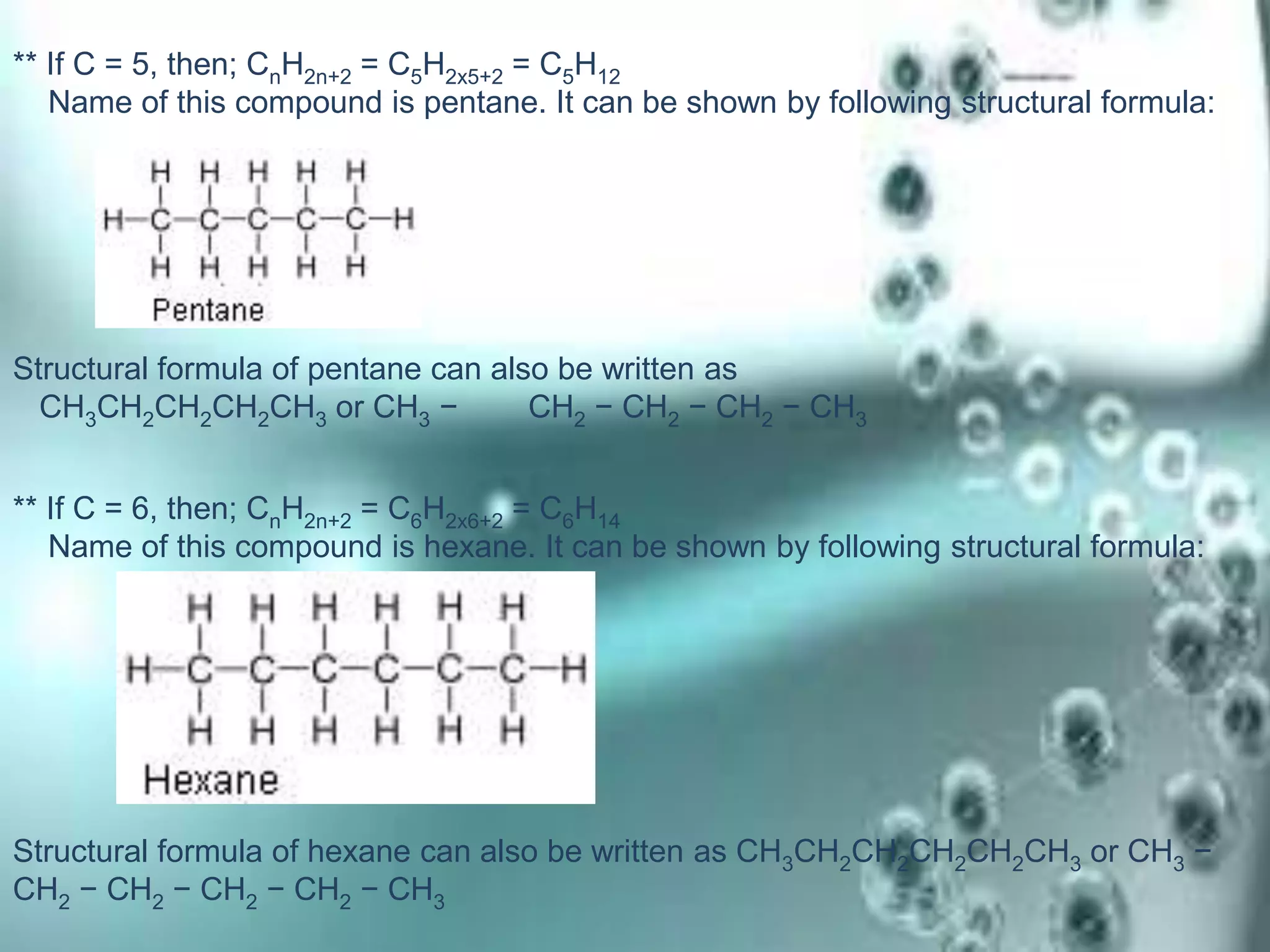
** If C = 5, then; CnH2n+2 = C5H2x5+2 = C5H12
Name of this compound is pentane. It can be shown by following structural formula:
Structural formula of pentane can also be written as
CH3CH2CH2CH2CH3 or CH3 − CH2 − CH2 − CH2 − CH3
** If C = 6, then; CnH2n+2 = C6H2x6+2 = C6H14
Name of this compound is hexane. It can be shown by following structural formula:
Structural formula of hexane can also be written as CH3CH2CH2CH2CH2CH3 or CH3 −
CH2 − CH2 − CH2 − CH2 − CH3
Hydrocarbons having at least one double bond between two carbon atoms are
known as ALKENE. General formula of alkene is CnH2n; where n is number of carbon atoms.
** If C = 1 then CnH2n = C1H2x1 = CH2
Name of this compound: Since, hydrocarbon having one carbon atom is known as
Methane. Thus, Methane – ane + ene = Methene. But, alkene does not exist with one
carbon atom, thus, methene does not exist.
** If C = 2 then CnH2n = C2H2x2 = C2H4
Name of this compound is: ethane − ane + ene = ethene. This molecule can be shown
by following structural formula
Other alkenes are formed in similar ways.
Hydrocarbons having at least one triple bond between two carbon atoms are known
as alkyne. (Alkane – ane + yne = Alkyne).
Similarly;
Ethane – ane + yne = Ethyne
Propane – ane + yne = Propyne
Butane – ane + yne = Butyne
Pentane – ane + yne = Pentyne
General formula of alkyne is CnH2n − 2. As in case of alkene, minimum two carbon
atoms are required to form alkyne.
**If C = 2, then; CnH2n − 2 = C2H2x2 − 2 = C2H2
The name of this compound is ethyne. This can be shown by following structural
formula.
Other Alkynes are formed in similar manners.
Carbon can form cyclic structure combining with carbon atoms. Such
hydrocarbons are known as cyclic hydrocarbon. Structural formulae of
some of the cyclic hydrocarbons are as follows:
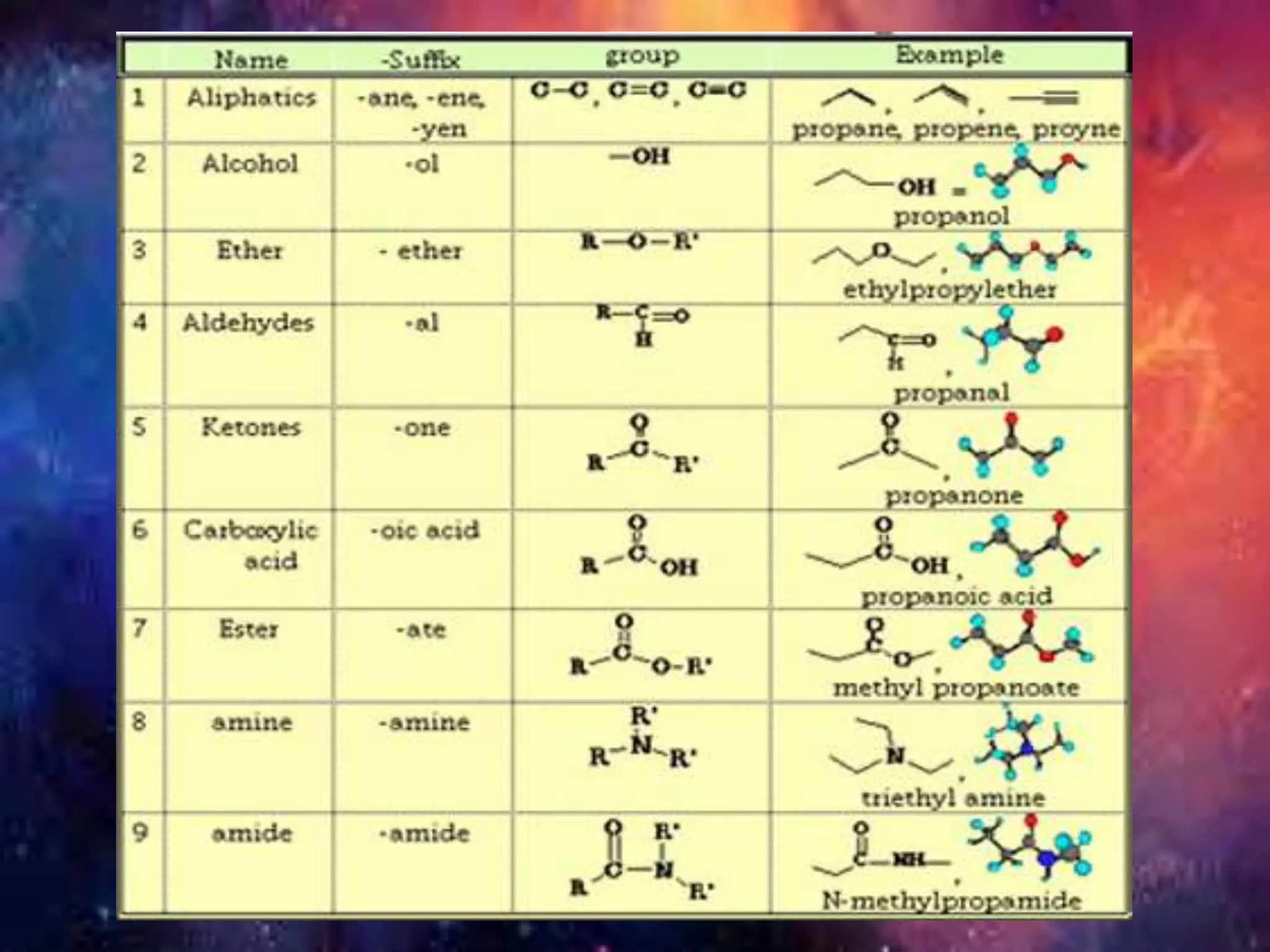
Single atom or group of atoms, that have similar chemical properties are called
functional group. For example: Halogen group, Carboxyl group, Aldehyde group,
etc.
Halogen group: Halogen group is also known as halo group. −Cl
(Chloro),−Br(Bromo),−I(Iodo) are halogen or halo group.
Alcohol: −OH is known as alcohol group.
Aldehyde: −CHO is known as aldehyde group. Its structural formula is as
follows:
Ketone Group: −CO− is known as ketone group. This is also known as
carbonic group. Its structural formula is as follows:
Carboxylic Acid Group: −COOH is known as carboxylic acid group; or simply
as acid group. Its structural formula is as follows:
International Union of Pure and Applied Chemistry (IUPAC)
decided some rules to name the carbon compounds. This was
done to maintain the uniformity throughout the world. Names
which are given on this basis are popularly known as IUPAC
name. The rules for nomenclature are as follows:
**Identify the number of carbon atoms in carbon compound.
Name the carbon compounds according to the number of
carbon atoms.
**If the structure has branched chain, identify the longest
chain and then identify the number of carbon atoms.
**In case of a functional group present, write the prefix or
suffix of the functional. Then write the name of the parent
compound.
Series of compounds with same general formula and functional group is
known as homologous series. Compounds belonging to the same
homologous series show similar properties. Compounds of homologous
series differ by CH2 from their consecutive members. Each subsequent
compound in a homologous series differs by 14 au. Example: Alkanes; such
as, Methane, Ethane, Propane, Butane, etc. belong to same homologous
series.
Properties of Compounds of Same Homologous Series
1. Compounds of same homologous series have same general formula.
2. Compounds of same homologous series differ from their consecutive
members by one carbon atom and two hydrogen atoms, homologous series
differ from their consecutive members by one carbon atom and two
hydrogen atoms, i.e. by CH2
3. Compounds of same homologous series have same chemical properties.
4. Compounds of same homologous series differ by physical properties with
increase or decrease in molecular mass.
Carbon and Its compounds. [ Class- X ]

Carbon and Its compounds. [ Class- X ]

  • 2.
    Carbon is the4th most abundant substance in universe and 15th most abundant substance in the earth’s crust. Compounds having carbon atoms among the components are known as carbon compounds. Previously, carbon compounds could only be obtained from a living source; hence they are also known as organic compounds.
  • 3.
    Bond formed bysharing of electrons is called covalent bond. Two of more atoms share electrons to make their configuration stable. In this type of bond, all the atoms have similar rights over shared electrons. Compounds which are formed because of covalent bond are called COVALNET COMPOUNDS. Covalent bonds are of three types: Single, double and triple covalent bond.
  • 4.
    Single covalent bondis formed because of sharing of two electrons, one from each of the two atoms. Example – ** Formation of hydrogen molecule (H2) Atomic Number of H = 1 Electronic configuration of H = 1 Valence electron of H = 1 Since, hydrogen has one electron in its valence shell, so it requires one more electron to form a duet. So, in the formation of hydrogen molecule; one electron from each of the hydrogen atoms is shared.
  • 5.
    Double bond isformed by sharing of four electrons, two from each of the two atoms. Example - ** Formation of oxygen molecule (O2): Valence electron of oxygen = 2 In the formation of oxygen molecule, two electrons are shared by each of the two oxygen atoms to complete their stable configuration. In oxygen, the total number of shared electrons is four, two from each of the oxygen atoms. So a double covalent bond is formed.
  • 6.
    Triple covalent bondis formed because of the sharing of six electrons, three from each of the two atoms. Example - **Formation of Nitrogen (N2): Atomic number of nitrogen = 7 Electronic configuration of nitrogen = 2, 5 Valence electron = 5 In the formation of nitrogen, three electrons are shared by each of the nitrogen atoms. Thus one triple bond is formed because of the sharing of total six electrons.
  • 7.
    **Intermolecular force issmaller. **Covalent bonds are weaker than ionic bond. As a result, covalent compounds have low melting and boiling points. **Covalent compounds are poor conductor of electricity as no charged particles are formed in covalent bond. **Since, carbon compounds are formed by the formation of covalent bond, so carbon compounds generally have low melting and boiling points and are poor conductor of electricity.
  • 8.
    Initially, compounds ofcarbon could only be obtained from living sources and there was no way of synthesizing them. Hence, carbon compounds are also known as organic compounds. Carbon forms a large number of compounds. So far, formulae of about 3 million carbon compounds are known.
  • 9.
    1. Carbon canform bonds with other carbon atoms. This property of carbon is known as CATENATION. Because of catenation, carbon can form a long chain; while making bond with other carbon atoms. Carbon can make single, double and triple bonds by catenation. 2. Carbon can form bonds with other carbon atoms. This property of carbon is known as CATENATION. Because of catenation, carbon can form a long chain; while making bond with other carbon atoms. Carbon can make single, double and triple bonds by catenation. 3. Carbon can form branched chain; along with straight chain; while combining with carbon atoms, i.e. because of the property of catenation.
  • 10.
    (Hydrogen + Carbon= Hydrocarbon) Compounds formed because of the combination of hydrogen and carbon are known as hydrocarbons. There are two types of hydrocarbon, viz. saturated hydrocarbon and unsaturated hydrocarbon. Saturated hydrocarbons: Hydrocarbons having single bonds are known as SATURATED HYDROCARBONS. Saturated hydrocarbons are known as ALKANE. These are also known as paraffin. Example: Methane, Ethane, Propane, etc. Unsaturated hydrocarbon: Unsaturated hydrocarbons are of two types – Hydrocarbon with double bond and hydrocarbon with triple bond. Hydrocarbon with double bond: Hydrocarbons having at least one double bond are known as ALKENE. Example: Ethene, Propene, Butene, etc. Hydrocarbon with triple bond: Hydrocarbons having at least one triple bond are known as ALKYNE. Example: Ethyne, Propyne, Butyne, etc.
  • 11.
    Hydrocarbons having onlysingle bonds are known as alkane. These are saturated hydrocarbons. Alkane are also known as paraffin. The general formula of alkane is CnH2n+2 ** If C = 1, then; CnH2n+2 = C1H2x1+2 = CH4 Name of this compound is methane. It can be shown by following structural formula: **If C = 2, then; CnH2n+2 = C2H2x2+2 = C2H6 Name of this compound is ethane. It can be shown by following structural formula: Structural formula of ethane can also be written as CH3CH3 or CH3 − CH3 If C = 3, then; CnH2n+2 = C3H2x3+2 = C3H8
  • 12.
    ** If C= 3, then; CnH2n+2 = C3H2x3+2 = C3H8 Name of this compound is propane. It can be shown by following structural formula: Structural formula of propane can also be written as CH3CH2CH3 or CH3 − CH2 − CH3 ** If C = 4, then; CnH2n+2 = C4H2x4+2 = C4H10 Name of this compound is butane. It can be shown by following structural formula: Structural formula of propane can also be written as CH CH CH CH or CH − CH − CH − CH
  • 13.
    ** If C= 5, then; CnH2n+2 = C5H2x5+2 = C5H12 Name of this compound is pentane. It can be shown by following structural formula: Structural formula of pentane can also be written as CH3CH2CH2CH2CH3 or CH3 − CH2 − CH2 − CH2 − CH3 ** If C = 6, then; CnH2n+2 = C6H2x6+2 = C6H14 Name of this compound is hexane. It can be shown by following structural formula: Structural formula of hexane can also be written as CH3CH2CH2CH2CH2CH3 or CH3 − CH2 − CH2 − CH2 − CH2 − CH3
  • 14.
    Hydrocarbons having atleast one double bond between two carbon atoms are known as ALKENE. General formula of alkene is CnH2n; where n is number of carbon atoms. ** If C = 1 then CnH2n = C1H2x1 = CH2 Name of this compound: Since, hydrocarbon having one carbon atom is known as Methane. Thus, Methane – ane + ene = Methene. But, alkene does not exist with one carbon atom, thus, methene does not exist. ** If C = 2 then CnH2n = C2H2x2 = C2H4 Name of this compound is: ethane − ane + ene = ethene. This molecule can be shown by following structural formula Other alkenes are formed in similar ways.
  • 15.
    Hydrocarbons having atleast one triple bond between two carbon atoms are known as alkyne. (Alkane – ane + yne = Alkyne). Similarly; Ethane – ane + yne = Ethyne Propane – ane + yne = Propyne Butane – ane + yne = Butyne Pentane – ane + yne = Pentyne General formula of alkyne is CnH2n − 2. As in case of alkene, minimum two carbon atoms are required to form alkyne. **If C = 2, then; CnH2n − 2 = C2H2x2 − 2 = C2H2 The name of this compound is ethyne. This can be shown by following structural formula. Other Alkynes are formed in similar manners.
  • 16.
    Carbon can formcyclic structure combining with carbon atoms. Such hydrocarbons are known as cyclic hydrocarbon. Structural formulae of some of the cyclic hydrocarbons are as follows:
  • 17.
    Single atom orgroup of atoms, that have similar chemical properties are called functional group. For example: Halogen group, Carboxyl group, Aldehyde group, etc. Halogen group: Halogen group is also known as halo group. −Cl (Chloro),−Br(Bromo),−I(Iodo) are halogen or halo group. Alcohol: −OH is known as alcohol group. Aldehyde: −CHO is known as aldehyde group. Its structural formula is as follows: Ketone Group: −CO− is known as ketone group. This is also known as carbonic group. Its structural formula is as follows: Carboxylic Acid Group: −COOH is known as carboxylic acid group; or simply as acid group. Its structural formula is as follows:
  • 18.
    International Union ofPure and Applied Chemistry (IUPAC) decided some rules to name the carbon compounds. This was done to maintain the uniformity throughout the world. Names which are given on this basis are popularly known as IUPAC name. The rules for nomenclature are as follows: **Identify the number of carbon atoms in carbon compound. Name the carbon compounds according to the number of carbon atoms. **If the structure has branched chain, identify the longest chain and then identify the number of carbon atoms. **In case of a functional group present, write the prefix or suffix of the functional. Then write the name of the parent compound.
  • 20.
    Series of compoundswith same general formula and functional group is known as homologous series. Compounds belonging to the same homologous series show similar properties. Compounds of homologous series differ by CH2 from their consecutive members. Each subsequent compound in a homologous series differs by 14 au. Example: Alkanes; such as, Methane, Ethane, Propane, Butane, etc. belong to same homologous series. Properties of Compounds of Same Homologous Series 1. Compounds of same homologous series have same general formula. 2. Compounds of same homologous series differ from their consecutive members by one carbon atom and two hydrogen atoms, homologous series differ from their consecutive members by one carbon atom and two hydrogen atoms, i.e. by CH2 3. Compounds of same homologous series have same chemical properties. 4. Compounds of same homologous series differ by physical properties with increase or decrease in molecular mass.