CLASS-10
CARBON AND
ITS COMPOUNDS
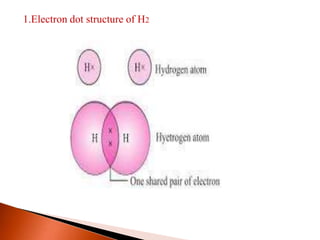
1.Electron dot structure of H2
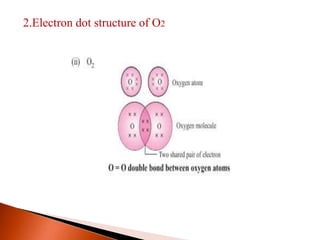
2.Electron dot structure of O2
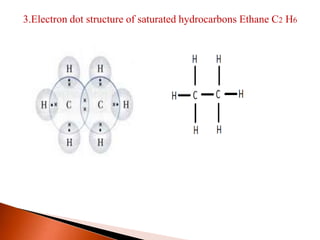
3.Electron dot structure of saturated hydrocarbons Ethane C2 H6
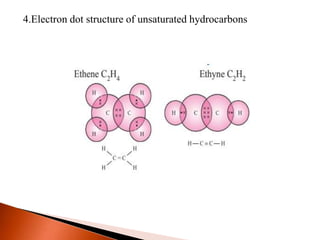
4.Electron dot structure of unsaturated hydrocarbons
5.Cyclic or closed chain Hydrocarbons:
These are the hydrocarbons which have carbon carbon closed
chain.
They are classified as:
i) Alicyclic hydrocarbons: These are the hydrocarbons which
do not have benzene ring in their structures.
ii) Aromatic hydrocarbons: These are the hydrocarbon which
have benzene ring in their structure. When hydrogen bonded
to carbon of benzene is substituted with halogens, radicals or
other functional groups, the derivatives are called aromatic
compounds.
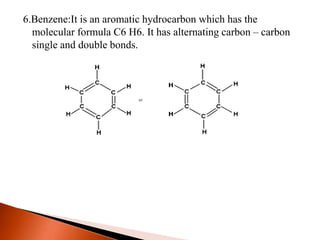
6.Benzene:It is an aromatic hydrocarbon which has the molecular
formula C6 H6. It has alternating carbon – carbon single and
double bonds.
6.Benzene:It is an aromatic hydrocarbon which has the
molecular formula C6 H6. It has alternating carbon – carbon
single and double bonds.
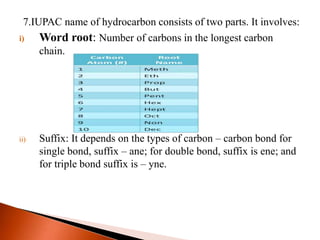
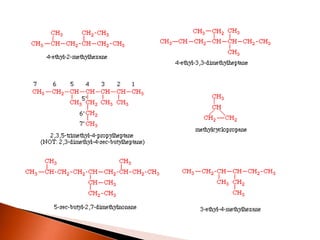
7.IUPAC name of hydrocarbon consists of two parts. It involves:
i) Word root: Number of carbons in the longest carbon
chain.
ii) Suffix: It depends on the types of carbon – carbon bond for
single bond, suffix – ane; for double bond, suffix is ene; and
for triple bond suffix is – yne.
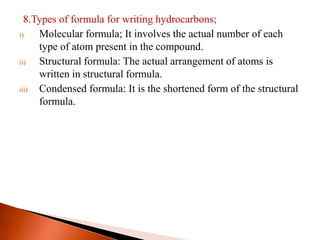
8.Types of formula for writing hydrocarbons;
i) Molecular formula; It involves the actual number of each
type of atom present in the compound.
ii) Structural formula: The actual arrangement of atoms is
written in structural formula.
iii) Condensed formula: It is the shortened form of the structural
formula.
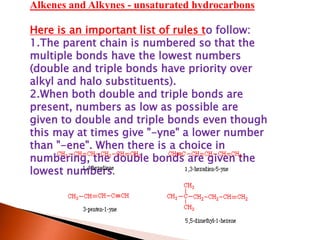
Alkenes and Alkynes - unsaturated hydrocarbons
Here is an important list of rules to follow:
1.The parent chain is numbered so that the
multiple bonds have the lowest numbers
(double and triple bonds have priority over
alkyl and halo substituents).
2.When both double and triple bonds are
present, numbers as low as possible are
given to double and triple bonds even though
this may at times give "-yne" a lower number
than "-ene". When there is a choice in
numbering, the double bonds are given the
lowest numbers.
F fluoro-
Cl chloro-
Br bromo-
I iodo-
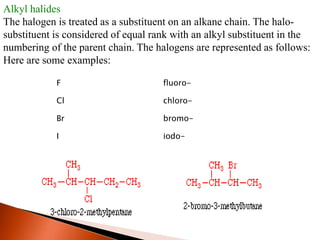
Alkyl halides
The halogen is treated as a substituent on an alkane chain. The halo-
substituent is considered of equal rank with an alkyl substituent in the
numbering of the parent chain. The halogens are represented as follows:
Here are some examples:
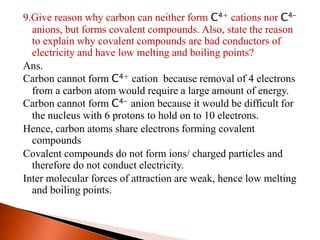
9.Give reason why carbon can neither form C4+ cations nor C4-
anions, but forms covalent compounds. Also, state the reason
to explain why covalent compounds are bad conductors of
electricity and have low melting and boiling points?
Ans.
Carbon cannot form C4+ cation because removal of 4 electrons
from a carbon atom would require a large amount of energy.
Carbon cannot form C4- anion because it would be difficult for
the nucleus with 6 protons to hold on to 10 electrons.
Hence, carbon atoms share electrons forming covalent
compounds
Covalent compounds do not form ions/ charged particles and
therefore do not conduct electricity.
Inter molecular forces of attraction are weak, hence low melting
and boiling points.
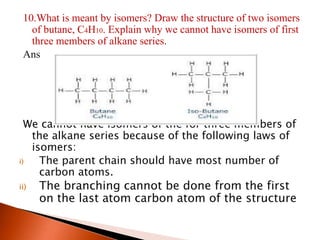
10.What is meant by isomers? Draw the structure of two isomers
of butane, C4H10. Explain why we cannot have isomers of first
three members of alkane series.
Ans
We cannot have isomers of the for three members of
the alkane series because of the following laws of
isomers:
i) The parent chain should have most number of
carbon atoms.
ii) The branching cannot be done from the first
on the last atom carbon atom of the structure
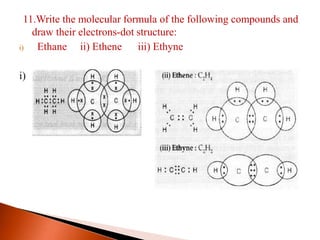
11.Write the molecular formula of the following compounds and
draw their electrons-dot structure:
i) Ethane ii) Ethene iii) Ethyne
i)
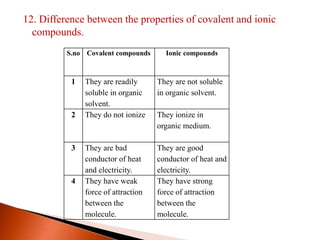
12. Difference between the properties of covalent and ionic
compounds.
S.no Covalent compounds Ionic compounds
1 They are readily
soluble in organic
solvent.
They are not soluble
in organic solvent.
2 They do not ionize They ionize in
organic medium.
3 They are bad
conductor of heat
and electricity.
They are good
conductor of heat and
electricity.
4 They have weak
force of attraction
between the
molecule.
They have strong
force of attraction
between the
molecule.
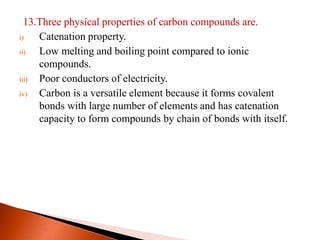
13.Three physical properties of carbon compounds are.
i) Catenation property.
ii) Low melting and boiling point compared to ionic
compounds.
iii) Poor conductors of electricity.
iv) Carbon is a versatile element because it forms covalent
bonds with large number of elements and has catenation
capacity to form compounds by chain of bonds with itself.
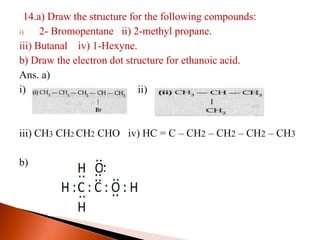
14.a) Draw the structure for the following compounds:
i) 2- Bromopentane ii) 2-methyl propane.
iii) Butanal iv) 1-Hexyne.
b) Draw the electron dot structure for ethanoic acid.
Ans. a)
i) ii)
iii) CH3 CH2 CH2 CHO iv) HC = C – CH2 – CH2 – CH2 – CH3
b)
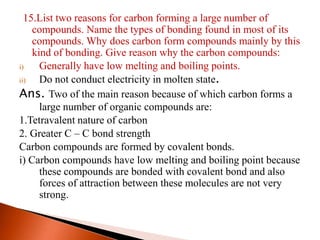
15.List two reasons for carbon forming a large number of
compounds. Name the types of bonding found in most of its
compounds. Why does carbon form compounds mainly by this
kind of bonding. Give reason why the carbon compounds:
i) Generally have low melting and boiling points.
ii) Do not conduct electricity in molten state.
Ans. Two of the main reason because of which carbon forms a
large number of organic compounds are:
1.Tetravalent nature of carbon
2. Greater C – C bond strength
Carbon compounds are formed by covalent bonds.
i) Carbon compounds have low melting and boiling point because
these compounds are bonded with covalent bond and also
forces of attraction between these molecules are not very
strong.
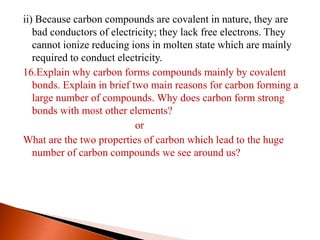
ii) Because carbon compounds are covalent in nature, they are
bad conductors of electricity; they lack free electrons. They
cannot ionize reducing ions in molten state which are mainly
required to conduct electricity.
16.Explain why carbon forms compounds mainly by covalent
bonds. Explain in brief two main reasons for carbon forming a
large number of compounds. Why does carbon form strong
bonds with most other elements?
or
What are the two properties of carbon which lead to the huge
number of carbon compounds we see around us?
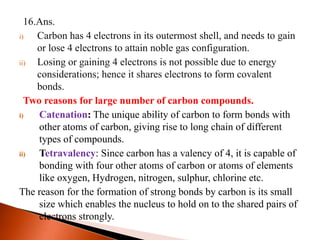
16.Ans.
i) Carbon has 4 electrons in its outermost shell, and needs to gain
or lose 4 electrons to attain noble gas configuration.
ii) Losing or gaining 4 electrons is not possible due to energy
considerations; hence it shares electrons to form covalent
bonds.
Two reasons for large number of carbon compounds.
i) Catenation: The unique ability of carbon to form bonds with
other atoms of carbon, giving rise to long chain of different
types of compounds.
ii) Tetravalency: Since carbon has a valency of 4, it is capable of
bonding with four other atoms of carbon or atoms of elements
like oxygen, Hydrogen, nitrogen, sulphur, chlorine etc.
The reason for the formation of strong bonds by carbon is its small
size which enables the nucleus to hold on to the shared pairs of
electrons strongly.
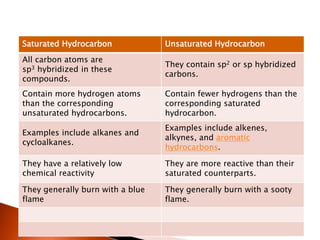
Saturated Hydrocarbon Unsaturated Hydrocarbon
All carbon atoms are
sp3 hybridized in these
compounds.
They contain sp2 or sp hybridized
carbons.
Contain more hydrogen atoms
than the corresponding
unsaturated hydrocarbons.
Contain fewer hydrogens than the
corresponding saturated
hydrocarbon.
Examples include alkanes and
cycloalkanes.
Examples include alkenes,
alkynes, and aromatic
hydrocarbons.
They have a relatively low
chemical reactivity
They are more reactive than their
saturated counterparts.
They generally burn with a blue
flame
They generally burn with a sooty
flame.

Carbon and its compounds

  • 1.
  • 2.
  • 3.
  • 4.
    3.Electron dot structureof saturated hydrocarbons Ethane C2 H6
  • 5.
    4.Electron dot structureof unsaturated hydrocarbons
  • 6.
    5.Cyclic or closedchain Hydrocarbons: These are the hydrocarbons which have carbon carbon closed chain. They are classified as: i) Alicyclic hydrocarbons: These are the hydrocarbons which do not have benzene ring in their structures. ii) Aromatic hydrocarbons: These are the hydrocarbon which have benzene ring in their structure. When hydrogen bonded to carbon of benzene is substituted with halogens, radicals or other functional groups, the derivatives are called aromatic compounds. 6.Benzene:It is an aromatic hydrocarbon which has the molecular formula C6 H6. It has alternating carbon – carbon single and double bonds.
  • 7.
    6.Benzene:It is anaromatic hydrocarbon which has the molecular formula C6 H6. It has alternating carbon – carbon single and double bonds.
  • 8.
    7.IUPAC name ofhydrocarbon consists of two parts. It involves: i) Word root: Number of carbons in the longest carbon chain. ii) Suffix: It depends on the types of carbon – carbon bond for single bond, suffix – ane; for double bond, suffix is ene; and for triple bond suffix is – yne.
  • 9.
    8.Types of formulafor writing hydrocarbons; i) Molecular formula; It involves the actual number of each type of atom present in the compound. ii) Structural formula: The actual arrangement of atoms is written in structural formula. iii) Condensed formula: It is the shortened form of the structural formula.
  • 11.
    Alkenes and Alkynes- unsaturated hydrocarbons Here is an important list of rules to follow: 1.The parent chain is numbered so that the multiple bonds have the lowest numbers (double and triple bonds have priority over alkyl and halo substituents). 2.When both double and triple bonds are present, numbers as low as possible are given to double and triple bonds even though this may at times give "-yne" a lower number than "-ene". When there is a choice in numbering, the double bonds are given the lowest numbers.
  • 12.
    F fluoro- Cl chloro- Brbromo- I iodo- Alkyl halides The halogen is treated as a substituent on an alkane chain. The halo- substituent is considered of equal rank with an alkyl substituent in the numbering of the parent chain. The halogens are represented as follows: Here are some examples:
  • 13.
    9.Give reason whycarbon can neither form C4+ cations nor C4- anions, but forms covalent compounds. Also, state the reason to explain why covalent compounds are bad conductors of electricity and have low melting and boiling points? Ans. Carbon cannot form C4+ cation because removal of 4 electrons from a carbon atom would require a large amount of energy. Carbon cannot form C4- anion because it would be difficult for the nucleus with 6 protons to hold on to 10 electrons. Hence, carbon atoms share electrons forming covalent compounds Covalent compounds do not form ions/ charged particles and therefore do not conduct electricity. Inter molecular forces of attraction are weak, hence low melting and boiling points.
  • 14.
    10.What is meantby isomers? Draw the structure of two isomers of butane, C4H10. Explain why we cannot have isomers of first three members of alkane series. Ans We cannot have isomers of the for three members of the alkane series because of the following laws of isomers: i) The parent chain should have most number of carbon atoms. ii) The branching cannot be done from the first on the last atom carbon atom of the structure
  • 15.
    11.Write the molecularformula of the following compounds and draw their electrons-dot structure: i) Ethane ii) Ethene iii) Ethyne i)
  • 16.
    12. Difference betweenthe properties of covalent and ionic compounds. S.no Covalent compounds Ionic compounds 1 They are readily soluble in organic solvent. They are not soluble in organic solvent. 2 They do not ionize They ionize in organic medium. 3 They are bad conductor of heat and electricity. They are good conductor of heat and electricity. 4 They have weak force of attraction between the molecule. They have strong force of attraction between the molecule.
  • 17.
    13.Three physical propertiesof carbon compounds are. i) Catenation property. ii) Low melting and boiling point compared to ionic compounds. iii) Poor conductors of electricity. iv) Carbon is a versatile element because it forms covalent bonds with large number of elements and has catenation capacity to form compounds by chain of bonds with itself.
  • 18.
    14.a) Draw thestructure for the following compounds: i) 2- Bromopentane ii) 2-methyl propane. iii) Butanal iv) 1-Hexyne. b) Draw the electron dot structure for ethanoic acid. Ans. a) i) ii) iii) CH3 CH2 CH2 CHO iv) HC = C – CH2 – CH2 – CH2 – CH3 b)
  • 19.
    15.List two reasonsfor carbon forming a large number of compounds. Name the types of bonding found in most of its compounds. Why does carbon form compounds mainly by this kind of bonding. Give reason why the carbon compounds: i) Generally have low melting and boiling points. ii) Do not conduct electricity in molten state. Ans. Two of the main reason because of which carbon forms a large number of organic compounds are: 1.Tetravalent nature of carbon 2. Greater C – C bond strength Carbon compounds are formed by covalent bonds. i) Carbon compounds have low melting and boiling point because these compounds are bonded with covalent bond and also forces of attraction between these molecules are not very strong.
  • 20.
    ii) Because carboncompounds are covalent in nature, they are bad conductors of electricity; they lack free electrons. They cannot ionize reducing ions in molten state which are mainly required to conduct electricity. 16.Explain why carbon forms compounds mainly by covalent bonds. Explain in brief two main reasons for carbon forming a large number of compounds. Why does carbon form strong bonds with most other elements? or What are the two properties of carbon which lead to the huge number of carbon compounds we see around us?
  • 21.
    16.Ans. i) Carbon has4 electrons in its outermost shell, and needs to gain or lose 4 electrons to attain noble gas configuration. ii) Losing or gaining 4 electrons is not possible due to energy considerations; hence it shares electrons to form covalent bonds. Two reasons for large number of carbon compounds. i) Catenation: The unique ability of carbon to form bonds with other atoms of carbon, giving rise to long chain of different types of compounds. ii) Tetravalency: Since carbon has a valency of 4, it is capable of bonding with four other atoms of carbon or atoms of elements like oxygen, Hydrogen, nitrogen, sulphur, chlorine etc. The reason for the formation of strong bonds by carbon is its small size which enables the nucleus to hold on to the shared pairs of electrons strongly.
  • 22.
    Saturated Hydrocarbon UnsaturatedHydrocarbon All carbon atoms are sp3 hybridized in these compounds. They contain sp2 or sp hybridized carbons. Contain more hydrogen atoms than the corresponding unsaturated hydrocarbons. Contain fewer hydrogens than the corresponding saturated hydrocarbon. Examples include alkanes and cycloalkanes. Examples include alkenes, alkynes, and aromatic hydrocarbons. They have a relatively low chemical reactivity They are more reactive than their saturated counterparts. They generally burn with a blue flame They generally burn with a sooty flame.