CARBON: INTRODUCTION
Carbon is the fourth most abundant element in the universe by mass. It is also
the second most abundant element in the human body after oxygen.
It is the 15th most common element in the Earth’s crust. Carbon was
discovered in prehistory and it was known to the ancients. They used to
manufacture charcoal by burning organic material.
• Carbon is a non-metal. It belongs to the fourteenth group or IV A group in the
modern periodical table. The elements of this group have four electrons in
the valence shell.
• Compounds having carbon atoms among the components are known as
carbon compounds.
• Previously, carbon compounds could only be obtained from a living source;
hence they are also known as organic compounds.
BONDING IN CARBON: COVALENT BOND
• Bond formed by sharing of electrons is called covalent bond.
• Two of more atoms share electrons to make their configuration stable.
• In this type of bond, all the atoms have similar rights over shared
electrons.
• Compounds which are formed because of covalent bond are called
COVALENT COMPOUNDS.
FORMATION OF COVALENT BONDS
1.Covalent band is the chemical bond formed through the sharing of electrons
between two non-metal atoms.
2.Compounds which have covalent bonds are called covalent compounds.
3.Examples of covalent compounds or molecules are chlorine, Cl2, carbon
dioxide, CO2, ammonia, NH3, water, H2O, and tetrachloromethane (carbon
tetrachloride), CCl4.
4.During the formation of covalent molecules, each non-metal covalent atom
provides one, two or three electrons to be shared with other atoms. The bond
formed is called a covalent bond.
5.Through this process, each non-metal atom in covalent molecules will achieve
stable electron arrangement.
6.The type of covalent bond formed in a covalent compound depends on the
number of electron pairs shared between non-metal atoms.
Covalent bonds are of three types: Single, double and triple covalent bond.
SINGLE COVALENT BOND
1. A single covalent bond is the covalent bond formed through the sharing of
a pair of electrons between two non-metal atoms.
• Each non-metal atom contributes one electron for sharing to achieve a
stable electron arrangement.
• Example of single covalent compound are chlorine gas, Cl2, hydrogen
chloride, HCl, water, H2O, methane, CH4, ammonia, NH3, and
tetrachloromethane, CCl4.
• Single covalent bonds can also be formed between different non-metal
atoms
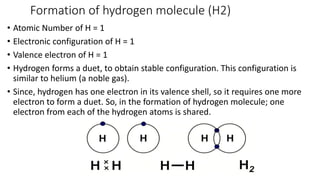
Formation of hydrogen molecule (H2)
• Atomic Number of H = 1
• Electronic configuration of H = 1
• Valence electron of H = 1
• Hydrogen forms a duet, to obtain stable configuration. This configuration is
similar to helium (a noble gas).
• Since, hydrogen has one electron in its valence shell, so it requires one more
electron to form a duet. So, in the formation of hydrogen molecule; one
electron from each of the hydrogen atoms is shared.
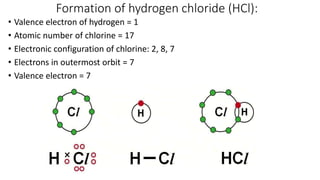
Formation of hydrogen chloride (HCl):
• Valence electron of hydrogen = 1
• Atomic number of chlorine = 17
• Electronic configuration of chlorine: 2, 8, 7
• Electrons in outermost orbit = 7
• Valence electron = 7
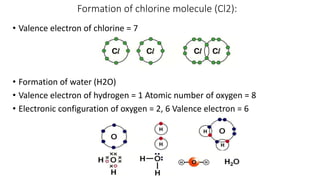
Formation of chlorine molecule (Cl2):
• Valence electron of chlorine = 7
• Formation of water (H2O)
• Valence electron of hydrogen = 1 Atomic number of oxygen = 8
• Electronic configuration of oxygen = 2, 6 Valence electron = 6
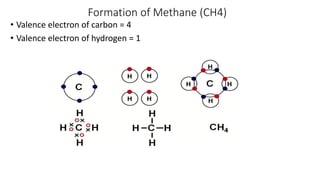
Formation of Methane (CH4)
• Valence electron of carbon = 4
• Valence electron of hydrogen = 1
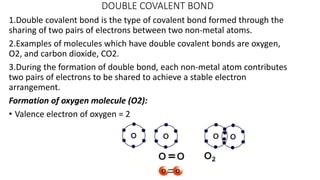
DOUBLE COVALENT BOND
1.Double covalent bond is the type of covalent bond formed through the
sharing of two pairs of electrons between two non-metal atoms.
2.Examples of molecules which have double covalent bonds are oxygen,
O2, and carbon dioxide, CO2.
3.During the formation of double bond, each non-metal atom contributes
two pairs of electrons to be shared to achieve a stable electron
arrangement.
Formation of oxygen molecule (O2):
• Valence electron of oxygen = 2
• In the formation of oxygen molecule, two electrons are shared by each of the
two oxygen atoms to complete their stable configuration.
In oxygen, the total number of shared electrons is four, two from each of the
oxygen atoms. So a double covalent bond is formed.
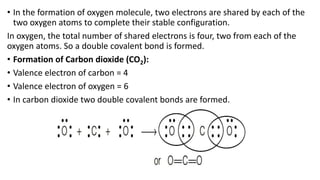
• Formation of Carbon dioxide (CO2):
• Valence electron of carbon = 4
• Valence electron of oxygen = 6
• In carbon dioxide two double covalent bonds are formed.
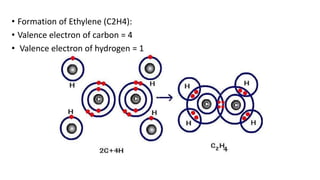
• Formation of Ethylene (C2H4):
• Valence electron of carbon = 4
• Valence electron of hydrogen = 1
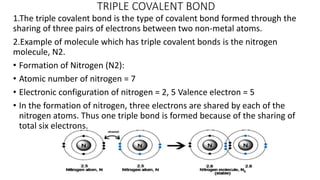
TRIPLE COVALENT BOND
1.The triple covalent bond is the type of covalent bond formed through the
sharing of three pairs of electrons between two non-metal atoms.
2.Example of molecule which has triple covalent bonds is the nitrogen
molecule, N2.
• Formation of Nitrogen (N2):
• Atomic number of nitrogen = 7
• Electronic configuration of nitrogen = 2, 5 Valence electron = 5
• In the formation of nitrogen, three electrons are shared by each of the
nitrogen atoms. Thus one triple bond is formed because of the sharing of
total six electrons.
Properties of Covalent Bond:
• Intermolecular force is smaller.
• Covalent bonds are weaker than ionic bond. As a result, covalent
compounds have low melting and boiling points.
• Covalent compounds are poor conductor of electricity as no charged
particles are formed in covalent bond.
• Since, carbon compounds are formed by the formation of covalent bond,
so carbon compounds generally have low melting and boiling points and
are poor conductor of electricity.
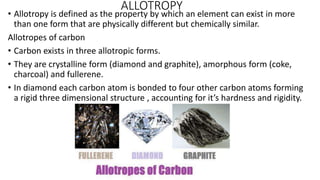
ALLOTROPY
• Allotropy is defined as the property by which an element can exist in more
than one form that are physically different but chemically similar.
Allotropes of carbon
• Carbon exists in three allotropic forms.
• They are crystalline form (diamond and graphite), amorphous form (coke,
charcoal) and fullerene.
• In diamond each carbon atom is bonded to four other carbon atoms forming
a rigid three dimensional structure , accounting for it’s hardness and rigidity.
General properties of diamond
• It is a colourless transparent substance with extraordinary brilliance due to its
high refractive index.
• It is quite heavy.
• It is extremely hard (hardest natural substance known).
• It does not conduct electricity (because of the absence of free electrons).
• It has high thermal conductivity and high melting point.
• It burns on strong heating to form carbon dioxide.
• In graphite each carbon atom is bonded to three other carbon atoms in the
same plane giving hexagonal layers held together by weak vander Waals
forces accounting for softness.
• General properties of graphite
• It is a greyish black opaque substance.
• It is lighter than diamond, feels soft and slippery to touch.
• It is a good conductor of electricity (due to the presence of free electrons)
but bad conductor of heat.
• It burns on strong heating to form carbon dioxide.
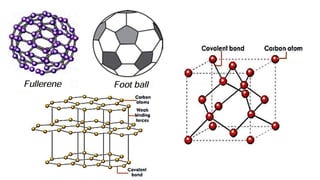
• Fullerenes form another type of carbon allotropes. The first one was
identified to contain 60 carbon atoms
• in the shape of a football. (C-60). Since this looks like the geodesic dome
designed by the US architect
• Buck Minster Fuller, it is named as Buck Minster Fullerene.
• General Properties of fullerenes are
• These are dark solids at room temperature.
• These are neither too hard nor too soft.
• These are the purest allotrophic forms of carbon because of the absence of
free valencies or surface bonds.
• On burning, these produce only carbon dioxide gas.
VERSATILE NATURE OF CARBON
• Initially, compounds of carbon could only be obtained from living sources
and there was no way of synthesizing them.
• Hence, carbon compounds are also known as organic compounds. Carbon
forms a large number of compounds. So far, formulae of about 3 million
carbon compounds are known.
• Cause of formation of such a large number of compounds by carbon:
• Carbon can form bonds with other carbon atoms. This property of carbon is
known as CATENATION.
• Because of catenation, carbon can form a long chain; while making bond
with other carbon atoms. Carbon can make single, double and triple bonds
by catenation.
• Carbon can form branched chain; along with straight chain; while
combining with carbon atoms, i.e. because of the property of catenation.
• Due to the valency of four, carbon is capable of bonding or pairing with
four other carbon atoms or with the atoms of some other monovalent
elements. It also forms compounds with oxygen, nitrogen, sulphur,
hydrogen and many other elements. This gives rise to compounds with
specific properties which depend on the element other than carbon
present in the molecule.
• Bonds which carbon forms with other elements are very strong thus,
making these compounds very stable. The main reason for such strong
bond formation is the small size of carbon. As a result, the shared pair of
electrons are tightly held by the nucleus.
ORGANIC COMPOUNDS
• The compounds of carbon except its oxides, carbonates and hydrogen
carbonate salts, are known as organic compounds. These compounds were
initially extracted from natural substances and was believed that some vital
force was necessary for the synthesis of these compounds (vital force theory).
• HYDROCARBONS
• (Hydrogen + Carbon = Hydrocarbon) Compounds formed because of the
combination of hydrogen and carbon are known as hydrocarbons.
• These are regarded as the parent organic compounds and all other
compounds are considered to be derived from them by the replacement of
one or more hydrogen atoms by other atoms or groups of atoms.
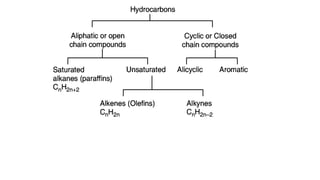
• Hydrocarbons can be divided into various classes as shown in below:
ALIPHATIC HYDROCARBONS
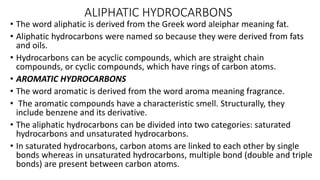
• The word aliphatic is derived from the Greek word aleiphar meaning fat.
• Aliphatic hydrocarbons were named so because they were derived from fats
and oils.
• Hydrocarbons can be acyclic compounds, which are straight chain
compounds, or cyclic compounds, which have rings of carbon atoms.
• AROMATIC HYDROCARBONS
• The word aromatic is derived from the word aroma meaning fragrance.
• The aromatic compounds have a characteristic smell. Structurally, they
include benzene and its derivative.
• The aliphatic hydrocarbons can be divided into two categories: saturated
hydrocarbons and unsaturated hydrocarbons.
• In saturated hydrocarbons, carbon atoms are linked to each other by single
bonds whereas in unsaturated hydrocarbons, multiple bond (double and triple
bonds) are present between carbon atoms.
AROMATIC HYDROCARBONS
• The word aromatic is derived from the word aroma meaning fragrance.
• The aromatic compounds have a characteristic smell. Structurally, they
include benzene and its derivative.
• The aliphatic hydrocarbons can be divided into two categories: saturated
hydrocarbons and unsaturated hydrocarbons.
• In saturated hydrocarbons, carbon atoms are linked to each other by single
bonds whereas in unsaturated hydrocarbons, multiple bond (double and
triple bonds) are present between carbon atoms.
SATURATED HYDROCARBONS
• Alkanes
• General formula = CnH2n+2 Suffix : ane
• These are the organic compounds which contain carbon – carbon
single bond.
• These were earlier named as paraffins(Latin : meaning little affinity)
due to their least chemical reactivity.
• According to IUPAC system, these are named as alkanes (ane is suffix
with root word).
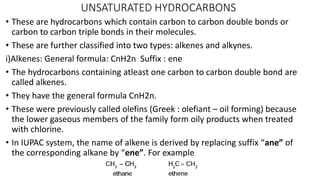
UNSATURATED HYDROCARBONS
• These are hydrocarbons which contain carbon to carbon double bonds or
carbon to carbon triple bonds in their molecules.
• These are further classified into two types: alkenes and alkynes.
i)Alkenes: General formula: CnH2n Suffix : ene
• The hydrocarbons containing atleast one carbon to carbon double bond are
called alkenes.
• They have the general formula CnH2n.
• These were previously called olefins (Greek : olefiant – oil forming) because
the lower gaseous members of the family form oily products when treated
with chlorine.
• In IUPAC system, the name of alkene is derived by replacing suffix “ane” of
the corresponding alkane by “ene”. For example
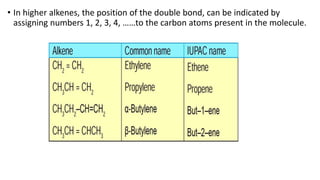
• In higher alkenes, the position of the double bond, can be indicated by
assigning numbers 1, 2, 3, 4, ……to the carbon atoms present in the molecule.
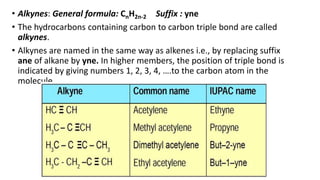
• Alkynes: General formula: CnH2n-2 Suffix : yne
• The hydrocarbons containing carbon to carbon triple bond are called
alkynes.
• Alkynes are named in the same way as alkenes i.e., by replacing suffix
ane of alkane by yne. In higher members, the position of triple bond is
indicated by giving numbers 1, 2, 3, 4, ….to the carbon atom in the
molecule.
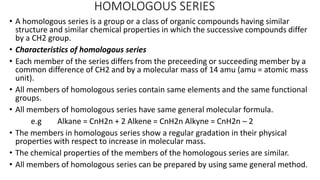
HOMOLOGOUS SERIES
• A homologous series is a group or a class of organic compounds having similar
structure and similar chemical properties in which the successive compounds differ
by a CH2 group.
• Characteristics of homologous series
• Each member of the series differs from the preceeding or succeeding member by a
common difference of CH2 and by a molecular mass of 14 amu (amu = atomic mass
unit).
• All members of homologous series contain same elements and the same functional
groups.
• All members of homologous series have same general molecular formula.
e.g Alkane = CnH2n + 2 Alkene = CnH2n Alkyne = CnH2n – 2
• The members in homologous series show a regular gradation in their physical
properties with respect to increase in molecular mass.
• The chemical properties of the members of the homologous series are similar.
• All members of homologous series can be prepared by using same general method.
IMPORTANCE OF HOMOLOGOUS SERIES
• It helps to predict the properties of the members of the series that are yet to
be prepared.
• Knowledge of homologous series gives a systematic study of the members.
• The nature of any member of the family can be ascertained if the properties
of the first member are known.
• FUNCTIONAL GROUP
• Functional group may be defined as an atom or group of atoms or reactive
part which is responsible for the characteristic properties of the
compounds.
• The chemical properties of organic compounds are determined by the
functional groups while their physical properties are determined by the
remaining part of the molecule.
CLASSIFICATION OF ORGANIC COMPOUNDS BASED ON
FUNCTIONAL GROUP
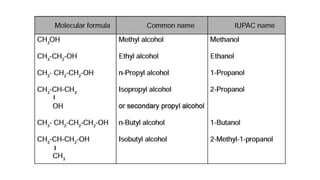
1.ALCOHOLS
• Alcohols are carbon compounds containing –OH group attached to alkyl
group.
• The general formula of alcohol is R-OH where ‘R’ is an alkyl group and –OH is
the functional group.
• The IUPAC name of alcohol is derived by replacing –e, in the word alkane, by
the suffix –ol.
• Hence we get the name alkanol.
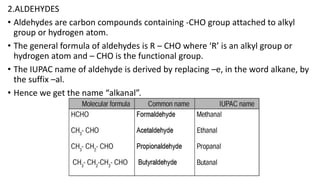
2.ALDEHYDES
• Aldehydes are carbon compounds containing -CHO group attached to alkyl
group or hydrogen atom.
• The general formula of aldehydes is R – CHO where ‘R’ is an alkyl group or
hydrogen atom and – CHO is the functional group.
• The IUPAC name of aldehyde is derived by replacing –e, in the word alkane, by
the suffix –al.
• Hence we get the name “alkanal”.
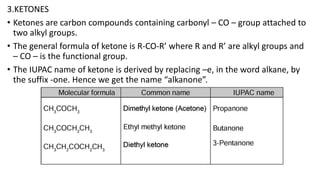
3.KETONES
• Ketones are carbon compounds containing carbonyl – CO – group attached to
two alkyl groups.
• The general formula of ketone is R-CO-R’ where R and R’ are alkyl groups and
– CO – is the functional group.
• The IUPAC name of ketone is derived by replacing –e, in the word alkane, by
the suffix -one. Hence we get the name “alkanone”.
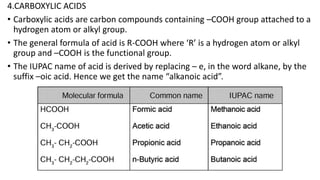
4.CARBOXYLIC ACIDS
• Carboxylic acids are carbon compounds containing –COOH group attached to a
hydrogen atom or alkyl group.
• The general formula of acid is R-COOH where ‘R’ is a hydrogen atom or alkyl
group and –COOH is the functional group.
• The IUPAC name of acid is derived by replacing – e, in the word alkane, by the
suffix –oic acid. Hence we get the name “alkanoic acid”.
ISOMERISM
• Carbon compounds or organic compounds with same molecular formula
can show different structures and hence, different properties.
• This phenomenon is called isomerism and compounds are called isomers.
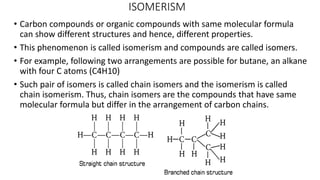
• For example, following two arrangements are possible for butane, an alkane
with four C atoms (C4H10)
• Such pair of isomers is called chain isomers and the isomerism is called
chain isomerism. Thus, chain isomers are the compounds that have same
molecular formula but differ in the arrangement of carbon chains.
NOMENCLATURE OF CARBON COMPOUNDS
In general, the names of organic compounds are based on the name of basic
carbon chain modified by a prefix (phrase before) or suffix (phrase after)
showing the name of the functional group.
• Following steps are used to write the name of an organic compound
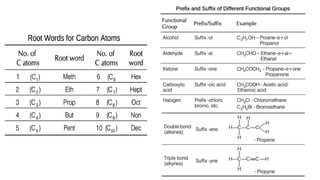
• Step 1 Count the number of carbon atoms in the given compound and write
the root word for it (Root word upto 10 carbon atoms are tabulated below.)
• Step 2 If the compound is saturated, add suffix ‘ane’ to the root word, but if is
unsaturated, add suffix ‘ene’ and ‘yne’ for double and triple bonds
respectively.
• For example,CH3CH2CH3 contains three C atoms so root word is ‘prop’ and it
contains only single
• bonds, so suffix used is ‘ane’. Hence, the name of this compound is propane.
• Similarly, the compound CH3CH == CH2 is named as propene as here suffix
‘ene’ is used for double bond.
• Step 3
• If functional group is present in the compound, it is indicated by adding
its suffix (which are given in the table above).
• Prefix ‘iso’ and ‘neo’ represent the presence of one or two carbon atoms
respectively as side chain.
• If the functional group is named as a suffix, the final ‘e’ of alkane (or
alkene or alkyne) is substituted by appropriate suffix.
• If the functional group and substituents are not present at first carbon,
then their location is indicated by digits 1,2,3... .
CHEMICAL PROPERTIES OF CARBON COMPOUNDS
• COMBUSTION
• All the carbon compounds burn in oxygen and yield carbon dioxide and water
vapour.
• Heat and light are also released during this process. This reaction is called
combustion.
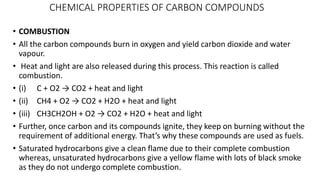
• (i) C + O2 → CO2 + heat and light
• (ii) CH4 + O2 → CO2 + H2O + heat and light
• (iii) CH3CH2OH + O2 → CO2 + H2O + heat and light
• Further, once carbon and its compounds ignite, they keep on burning without the
requirement of additional energy. That’s why these compounds are used as fuels.
• Saturated hydrocarbons give a clean flame due to their complete combustion
whereas, unsaturated hydrocarbons give a yellow flame with lots of black smoke
as they do not undergo complete combustion.
• OXIDATION
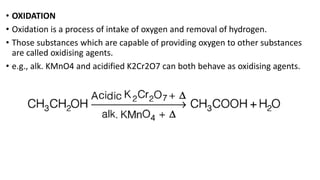
• Oxidation is a process of intake of oxygen and removal of hydrogen.
• Those substances which are capable of providing oxygen to other substances
are called oxidising agents.
• e.g., alk. KMnO4 and acidified K2Cr2O7 can both behave as oxidising agents.
• ADDITION REACTION
• The reaction in which a reagent adds completely on a substance without the
removal of small molecules are called addition reactions.
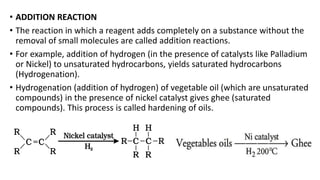
• For example, addition of hydrogen (in the presence of catalysts like Palladium
or Nickel) to unsaturated hydrocarbons, yields saturated hydrocarbons
(Hydrogenation).
• Hydrogenation (addition of hydrogen) of vegetable oil (which are unsaturated
compounds) in the presence of nickel catalyst gives ghee (saturated
compounds). This process is called hardening of oils.
• SUBSTITUTION REACTION
• The reactions in which a reagent substitutes (replaces) an atom or a group of
atoms from the reactant (substrate) are called substitution reactions.
• These are generally shown by saturated compounds and benzene.
• Most of the saturated hydrocarbons are fairly inert and unreactive in the
presence of most reagents. So, presence of sunlight is necessary for their
substitution reactions.
• When chlorine is added to hydrocarbons at a rapid rate, in the presence of
sunlight, Cl replaces H atom one by one.
FUELS AND FLAMES
• FUELS
• Those carbon compounds which have stored energy in them and burn
with heat and light are called fuels.
• The released energy (heat or light) is utilised for various purposes like for
cooking food, running machines in factories, etc.
• In fuels, the carbon can be in free state as present in coal, coke and
charcoal or in combined state as present in petrol, LPG, kerosene,
petroleum, natural gas, etc.
• Those fuels which were formed by the decomposition of the remains of
the pre-historic plants and animals (fossils) burried under the earth long
ago, are called fossils fuels.
• For example, coal, petroleum and natural gas.
• COAL
• It is a complex mixture of compounds of carbon, hydrogen and oxygen
and some free carbon alongwith traces of nitrogen and sulphur.
• It was formed by the decomposition of plants and trees buried under the
earth millions of years ago.
• PETROLEUM
• It is a dark viscous foul smelling oil and is also known as rock oil or black
gold. It was formed by the decomposition of the remains of extremely
small plants and animals buried under the sea millions of years ago.
• FLAME
• A flame is the region where combustion (or burning) of gaseous substances takes
place.
• Depending upon the amount of oxygen available and burning of fuels, flames are of
following two types
• (i)Blue or Non-luminous Flame
• When the oxygen supply is sufficient, the fuels burn completely producing a blue
flame.
• Since, light is not produced during this type of combustion, so the flame is called
non-luminous (non- light giving flame), e.g., burning of LPG in gas stove.
• (ii)Yellow or Luminous Flame
• In the insufficient supply of air, the fuels burn incompletely and produce yellow
flame. The colour of the flame is yellow because of the presence of unburnt carbon
particles.
• This flame produces light so also known as luminous flame. e.g., burning of wax
vapours.
SOME IMPORTANT CARBON COMPOUNDS – ETHANOL
AND ETHANOIC ACID
• Almost all the compounds are useful to us in a number of ways. Most of the
fuels, medicines, paints, explosives, synthetic polymers, perfumes and
detergents are basically organic compounds. In fact, organic chemistry has
made our life colourful and also comfortable.
• Two commercially important compounds are ethanol and ethanoic acid.
• ETHANOL (C2H5OH)
• Ethanol or ethyl alcohol or simply alcohol is one of the most important
members of the family of alcohols.
• (1) Manufacture of ethanol from molasses
• Molasses is a dark coloured syrupy liquid left after the crystallization of sugar
from the concentrated sugar cane juice.
• Molasses still contain about 30% of sucrose which can not be separated by
crystallization. It is converted into ethanol by the following steps:
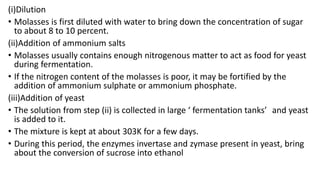
(i)Dilution
• Molasses is first diluted with water to bring down the concentration of sugar
to about 8 to 10 percent.
(ii)Addition of ammonium salts
• Molasses usually contains enough nitrogenous matter to act as food for yeast
during fermentation.
• If the nitrogen content of the molasses is poor, it may be fortified by the
addition of ammonium sulphate or ammonium phosphate.
(iii)Addition of yeast
• The solution from step (ii) is collected in large ‘ fermentation tanks’ and yeast
is added to it.
• The mixture is kept at about 303K for a few days.
• During this period, the enzymes invertase and zymase present in yeast, bring
about the conversion of sucrose into ethanol
The fermented liquid is technically called wash.
FERMENTATION is the slow chemical change taking place in an organic compound by the
action of enzymes leading to the formation of smaller molecules.
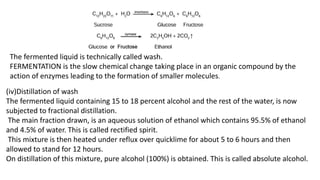
(iv)Distillation of wash
The fermented liquid containing 15 to 18 percent alcohol and the rest of the water, is now
subjected to fractional distillation.
The main fraction drawn, is an aqueous solution of ethanol which contains 95.5% of ethanol
and 4.5% of water. This is called rectified spirit.
This mixture is then heated under reflux over quicklime for about 5 to 6 hours and then
allowed to stand for 12 hours.
On distillation of this mixture, pure alcohol (100%) is obtained. This is called absolute alcohol.
PHYSICAL PROPERTIES
(i)Ethanol is a clear liquid with burning taste.
(ii)Its boiling point is 351K which is higher than corresponding alkane.
(iii)It is completely miscible with water in all proportions.
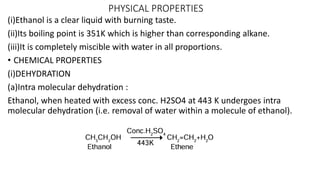
• CHEMICAL PROPERTIES
(i)DEHYDRATION
(a)Intra molecular dehydration :
Ethanol, when heated with excess conc. H2SO4 at 443 K undergoes intra
molecular dehydration (i.e. removal of water within a molecule of ethanol).
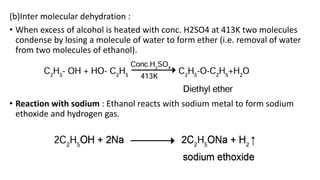
(b)Inter molecular dehydration :
• When excess of alcohol is heated with conc. H2SO4 at 413K two molecules
condense by losing a molecule of water to form ether (i.e. removal of water
from two molecules of ethanol).
• Reaction with sodium : Ethanol reacts with sodium metal to form sodium
ethoxide and hydrogen gas.
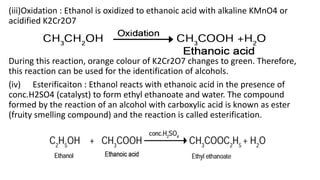
(iii)Oxidation : Ethanol is oxidized to ethanoic acid with alkaline KMnO4 or
acidified K2Cr2O7
During this reaction, orange colour of K2Cr2O7 changes to green. Therefore,
this reaction can be used for the identification of alcohols.
(iv) Esterificaiton : Ethanol reacts with ethanoic acid in the presence of
conc.H2SO4 (catalyst) to form ethyl ethanoate and water. The compound
formed by the reaction of an alcohol with carboxylic acid is known as ester
(fruity smelling compound) and the reaction is called esterification.
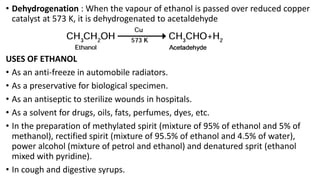
• Dehydrogenation : When the vapour of ethanol is passed over reduced copper
catalyst at 573 K, it is dehydrogenated to acetaldehyde
USES OF ETHANOL
• As an anti-freeze in automobile radiators.
• As a preservative for biological specimen.
• As an antiseptic to sterilize wounds in hospitals.
• As a solvent for drugs, oils, fats, perfumes, dyes, etc.
• In the preparation of methylated spirit (mixture of 95% of ethanol and 5% of
methanol), rectified spirit (mixture of 95.5% of ethanol and 4.5% of water),
power alcohol (mixture of petrol and ethanol) and denatured sprit (ethanol
mixed with pyridine).
• In cough and digestive syrups.
EVIL EFFECTS OF CONSUMING ALCOHOL
• If ethanol is consumed, it tends to slow down metabolism of our body and
depresses the central nervous system.
• It causes mental depression and emotional disorder.
• It affects our health by causing ulcer, high blood pressure, cancer, brain
and liver damage.
• Nearly 40% accidents are due to drunken drive.
• Unlike ethanol, intake of methanol in very small quantities can cause
death.
• Methanol is oxidized to methanal (formaldehyde) in the liver and
methanal reacts rapidly with the components of cells.
• Methanal causes the protoplasm to get coagulated, in the same way an
egg is coagulated by cooking. Methanol also affects the optic nerve,
causing blindness
ETHANOIC ACID (CH3COOH)
• Ethanoic acid is most commonly known as acetic acid and belongs to a group
of acids called carboxylic acids. Acetic acid is present in many fruits and sour
taste of fruits is because of this acid.
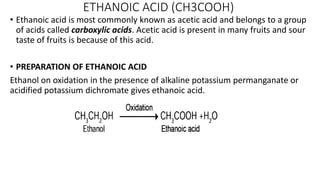
• PREPARATION OF ETHANOIC ACID
Ethanol on oxidation in the presence of alkaline potassium permanganate or
acidified potassium dichromate gives ethanoic acid.
PROPERTIES OF ETHANOIC ACID PHYSICAL PROPERTIES
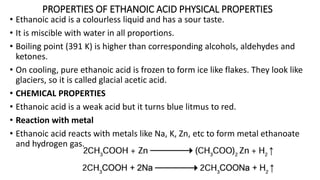
• Ethanoic acid is a colourless liquid and has a sour taste.
• It is miscible with water in all proportions.
• Boiling point (391 K) is higher than corresponding alcohols, aldehydes and
ketones.
• On cooling, pure ethanoic acid is frozen to form ice like flakes. They look like
glaciers, so it is called glacial acetic acid.
• CHEMICAL PROPERTIES
• Ethanoic acid is a weak acid but it turns blue litmus to red.
• Reaction with metal
• Ethanoic acid reacts with metals like Na, K, Zn, etc to form metal ethanoate
and hydrogen gas.
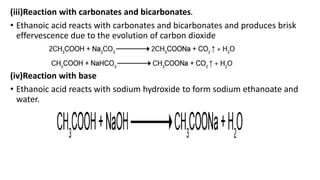
(iii)Reaction with carbonates and bicarbonates.
• Ethanoic acid reacts with carbonates and bicarbonates and produces brisk
effervescence due to the evolution of carbon dioxide
(iv)Reaction with base
• Ethanoic acid reacts with sodium hydroxide to form sodium ethanoate and
water.
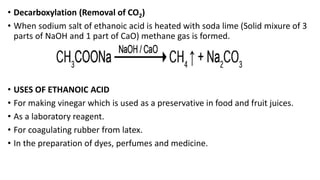
• Decarboxylation (Removal of CO2)
• When sodium salt of ethanoic acid is heated with soda lime (Solid mixure of 3
parts of NaOH and 1 part of CaO) methane gas is formed.
• USES OF ETHANOIC ACID
• For making vinegar which is used as a preservative in food and fruit juices.
• As a laboratory reagent.
• For coagulating rubber from latex.
• In the preparation of dyes, perfumes and medicine.
SOAPS AND DETERGENTS
• Most dirt is oily in nature and as you know, oil does not dissolve in water.
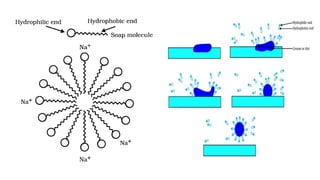
• The molecules of soap are sodium or potassium salts of long-chain
carboxylic acids.
• The ionic-end of soap dissolves in water while the carbon chain dissolves
in oil.
• The soap molecules, thus form structures called micelles (see the below
figure) where one end of the molecules is towards the oil droplet while
the ionic-end faces outside. This forms an emulsion in water.
• The soap micelle thus helps in dissolving the dirt in water and we can
wash our clothes clean.
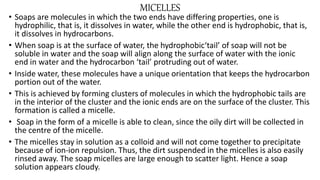
MICELLES
• Soaps are molecules in which the two ends have differing properties, one is
hydrophilic, that is, it dissolves in water, while the other end is hydrophobic, that is,
it dissolves in hydrocarbons.
• When soap is at the surface of water, the hydrophobic‘tail’ of soap will not be
soluble in water and the soap will align along the surface of water with the ionic
end in water and the hydrocarbon ‘tail’ protruding out of water.
• Inside water, these molecules have a unique orientation that keeps the hydrocarbon
portion out of the water.
• This is achieved by forming clusters of molecules in which the hydrophobic tails are
in the interior of the cluster and the ionic ends are on the surface of the cluster. This
formation is called a micelle.
• Soap in the form of a micelle is able to clean, since the oily dirt will be collected in
the centre of the micelle.
• The micelles stay in solution as a colloid and will not come together to precipitate
because of ion-ion repulsion. Thus, the dirt suspended in the micelles is also easily
rinsed away. The soap micelles are large enough to scatter light. Hence a soap
solution appears cloudy.
Class 4 - Carbon and its compounds (Chemistry)

Class 4 - Carbon and its compounds (Chemistry)

  • 2.
    CARBON: INTRODUCTION Carbon isthe fourth most abundant element in the universe by mass. It is also the second most abundant element in the human body after oxygen. It is the 15th most common element in the Earth’s crust. Carbon was discovered in prehistory and it was known to the ancients. They used to manufacture charcoal by burning organic material. • Carbon is a non-metal. It belongs to the fourteenth group or IV A group in the modern periodical table. The elements of this group have four electrons in the valence shell. • Compounds having carbon atoms among the components are known as carbon compounds. • Previously, carbon compounds could only be obtained from a living source; hence they are also known as organic compounds.
  • 3.
    BONDING IN CARBON:COVALENT BOND • Bond formed by sharing of electrons is called covalent bond. • Two of more atoms share electrons to make their configuration stable. • In this type of bond, all the atoms have similar rights over shared electrons. • Compounds which are formed because of covalent bond are called COVALENT COMPOUNDS.
  • 4.
    FORMATION OF COVALENTBONDS 1.Covalent band is the chemical bond formed through the sharing of electrons between two non-metal atoms. 2.Compounds which have covalent bonds are called covalent compounds. 3.Examples of covalent compounds or molecules are chlorine, Cl2, carbon dioxide, CO2, ammonia, NH3, water, H2O, and tetrachloromethane (carbon tetrachloride), CCl4. 4.During the formation of covalent molecules, each non-metal covalent atom provides one, two or three electrons to be shared with other atoms. The bond formed is called a covalent bond. 5.Through this process, each non-metal atom in covalent molecules will achieve stable electron arrangement. 6.The type of covalent bond formed in a covalent compound depends on the number of electron pairs shared between non-metal atoms. Covalent bonds are of three types: Single, double and triple covalent bond.
  • 5.
    SINGLE COVALENT BOND 1.A single covalent bond is the covalent bond formed through the sharing of a pair of electrons between two non-metal atoms. • Each non-metal atom contributes one electron for sharing to achieve a stable electron arrangement. • Example of single covalent compound are chlorine gas, Cl2, hydrogen chloride, HCl, water, H2O, methane, CH4, ammonia, NH3, and tetrachloromethane, CCl4. • Single covalent bonds can also be formed between different non-metal atoms
  • 6.
    Formation of hydrogenmolecule (H2) • Atomic Number of H = 1 • Electronic configuration of H = 1 • Valence electron of H = 1 • Hydrogen forms a duet, to obtain stable configuration. This configuration is similar to helium (a noble gas). • Since, hydrogen has one electron in its valence shell, so it requires one more electron to form a duet. So, in the formation of hydrogen molecule; one electron from each of the hydrogen atoms is shared.
  • 7.
    Formation of hydrogenchloride (HCl): • Valence electron of hydrogen = 1 • Atomic number of chlorine = 17 • Electronic configuration of chlorine: 2, 8, 7 • Electrons in outermost orbit = 7 • Valence electron = 7
  • 8.
    Formation of chlorinemolecule (Cl2): • Valence electron of chlorine = 7 • Formation of water (H2O) • Valence electron of hydrogen = 1 Atomic number of oxygen = 8 • Electronic configuration of oxygen = 2, 6 Valence electron = 6
  • 9.
    Formation of Methane(CH4) • Valence electron of carbon = 4 • Valence electron of hydrogen = 1
  • 10.
    DOUBLE COVALENT BOND 1.Doublecovalent bond is the type of covalent bond formed through the sharing of two pairs of electrons between two non-metal atoms. 2.Examples of molecules which have double covalent bonds are oxygen, O2, and carbon dioxide, CO2. 3.During the formation of double bond, each non-metal atom contributes two pairs of electrons to be shared to achieve a stable electron arrangement. Formation of oxygen molecule (O2): • Valence electron of oxygen = 2
  • 11.
    • In theformation of oxygen molecule, two electrons are shared by each of the two oxygen atoms to complete their stable configuration. In oxygen, the total number of shared electrons is four, two from each of the oxygen atoms. So a double covalent bond is formed. • Formation of Carbon dioxide (CO2): • Valence electron of carbon = 4 • Valence electron of oxygen = 6 • In carbon dioxide two double covalent bonds are formed.
  • 12.
    • Formation ofEthylene (C2H4): • Valence electron of carbon = 4 • Valence electron of hydrogen = 1
  • 13.
    TRIPLE COVALENT BOND 1.Thetriple covalent bond is the type of covalent bond formed through the sharing of three pairs of electrons between two non-metal atoms. 2.Example of molecule which has triple covalent bonds is the nitrogen molecule, N2. • Formation of Nitrogen (N2): • Atomic number of nitrogen = 7 • Electronic configuration of nitrogen = 2, 5 Valence electron = 5 • In the formation of nitrogen, three electrons are shared by each of the nitrogen atoms. Thus one triple bond is formed because of the sharing of total six electrons.
  • 14.
    Properties of CovalentBond: • Intermolecular force is smaller. • Covalent bonds are weaker than ionic bond. As a result, covalent compounds have low melting and boiling points. • Covalent compounds are poor conductor of electricity as no charged particles are formed in covalent bond. • Since, carbon compounds are formed by the formation of covalent bond, so carbon compounds generally have low melting and boiling points and are poor conductor of electricity.
  • 15.
    ALLOTROPY • Allotropy isdefined as the property by which an element can exist in more than one form that are physically different but chemically similar. Allotropes of carbon • Carbon exists in three allotropic forms. • They are crystalline form (diamond and graphite), amorphous form (coke, charcoal) and fullerene. • In diamond each carbon atom is bonded to four other carbon atoms forming a rigid three dimensional structure , accounting for it’s hardness and rigidity.
  • 16.
    General properties ofdiamond • It is a colourless transparent substance with extraordinary brilliance due to its high refractive index. • It is quite heavy. • It is extremely hard (hardest natural substance known). • It does not conduct electricity (because of the absence of free electrons). • It has high thermal conductivity and high melting point. • It burns on strong heating to form carbon dioxide.
  • 17.
    • In graphiteeach carbon atom is bonded to three other carbon atoms in the same plane giving hexagonal layers held together by weak vander Waals forces accounting for softness. • General properties of graphite • It is a greyish black opaque substance. • It is lighter than diamond, feels soft and slippery to touch. • It is a good conductor of electricity (due to the presence of free electrons) but bad conductor of heat. • It burns on strong heating to form carbon dioxide.
  • 18.
    • Fullerenes formanother type of carbon allotropes. The first one was identified to contain 60 carbon atoms • in the shape of a football. (C-60). Since this looks like the geodesic dome designed by the US architect • Buck Minster Fuller, it is named as Buck Minster Fullerene. • General Properties of fullerenes are • These are dark solids at room temperature. • These are neither too hard nor too soft. • These are the purest allotrophic forms of carbon because of the absence of free valencies or surface bonds. • On burning, these produce only carbon dioxide gas.
  • 20.
    VERSATILE NATURE OFCARBON • Initially, compounds of carbon could only be obtained from living sources and there was no way of synthesizing them. • Hence, carbon compounds are also known as organic compounds. Carbon forms a large number of compounds. So far, formulae of about 3 million carbon compounds are known. • Cause of formation of such a large number of compounds by carbon: • Carbon can form bonds with other carbon atoms. This property of carbon is known as CATENATION. • Because of catenation, carbon can form a long chain; while making bond with other carbon atoms. Carbon can make single, double and triple bonds by catenation. • Carbon can form branched chain; along with straight chain; while combining with carbon atoms, i.e. because of the property of catenation.
  • 21.
    • Due tothe valency of four, carbon is capable of bonding or pairing with four other carbon atoms or with the atoms of some other monovalent elements. It also forms compounds with oxygen, nitrogen, sulphur, hydrogen and many other elements. This gives rise to compounds with specific properties which depend on the element other than carbon present in the molecule. • Bonds which carbon forms with other elements are very strong thus, making these compounds very stable. The main reason for such strong bond formation is the small size of carbon. As a result, the shared pair of electrons are tightly held by the nucleus.
  • 22.
    ORGANIC COMPOUNDS • Thecompounds of carbon except its oxides, carbonates and hydrogen carbonate salts, are known as organic compounds. These compounds were initially extracted from natural substances and was believed that some vital force was necessary for the synthesis of these compounds (vital force theory). • HYDROCARBONS • (Hydrogen + Carbon = Hydrocarbon) Compounds formed because of the combination of hydrogen and carbon are known as hydrocarbons. • These are regarded as the parent organic compounds and all other compounds are considered to be derived from them by the replacement of one or more hydrogen atoms by other atoms or groups of atoms. • Hydrocarbons can be divided into various classes as shown in below:
  • 24.
    ALIPHATIC HYDROCARBONS • Theword aliphatic is derived from the Greek word aleiphar meaning fat. • Aliphatic hydrocarbons were named so because they were derived from fats and oils. • Hydrocarbons can be acyclic compounds, which are straight chain compounds, or cyclic compounds, which have rings of carbon atoms. • AROMATIC HYDROCARBONS • The word aromatic is derived from the word aroma meaning fragrance. • The aromatic compounds have a characteristic smell. Structurally, they include benzene and its derivative. • The aliphatic hydrocarbons can be divided into two categories: saturated hydrocarbons and unsaturated hydrocarbons. • In saturated hydrocarbons, carbon atoms are linked to each other by single bonds whereas in unsaturated hydrocarbons, multiple bond (double and triple bonds) are present between carbon atoms.
  • 25.
    AROMATIC HYDROCARBONS • Theword aromatic is derived from the word aroma meaning fragrance. • The aromatic compounds have a characteristic smell. Structurally, they include benzene and its derivative. • The aliphatic hydrocarbons can be divided into two categories: saturated hydrocarbons and unsaturated hydrocarbons. • In saturated hydrocarbons, carbon atoms are linked to each other by single bonds whereas in unsaturated hydrocarbons, multiple bond (double and triple bonds) are present between carbon atoms.
  • 26.
    SATURATED HYDROCARBONS • Alkanes •General formula = CnH2n+2 Suffix : ane • These are the organic compounds which contain carbon – carbon single bond. • These were earlier named as paraffins(Latin : meaning little affinity) due to their least chemical reactivity. • According to IUPAC system, these are named as alkanes (ane is suffix with root word).
  • 27.
    UNSATURATED HYDROCARBONS • Theseare hydrocarbons which contain carbon to carbon double bonds or carbon to carbon triple bonds in their molecules. • These are further classified into two types: alkenes and alkynes. i)Alkenes: General formula: CnH2n Suffix : ene • The hydrocarbons containing atleast one carbon to carbon double bond are called alkenes. • They have the general formula CnH2n. • These were previously called olefins (Greek : olefiant – oil forming) because the lower gaseous members of the family form oily products when treated with chlorine. • In IUPAC system, the name of alkene is derived by replacing suffix “ane” of the corresponding alkane by “ene”. For example
  • 28.
    • In higheralkenes, the position of the double bond, can be indicated by assigning numbers 1, 2, 3, 4, ……to the carbon atoms present in the molecule.
  • 29.
    • Alkynes: Generalformula: CnH2n-2 Suffix : yne • The hydrocarbons containing carbon to carbon triple bond are called alkynes. • Alkynes are named in the same way as alkenes i.e., by replacing suffix ane of alkane by yne. In higher members, the position of triple bond is indicated by giving numbers 1, 2, 3, 4, ….to the carbon atom in the molecule.
  • 30.
    HOMOLOGOUS SERIES • Ahomologous series is a group or a class of organic compounds having similar structure and similar chemical properties in which the successive compounds differ by a CH2 group. • Characteristics of homologous series • Each member of the series differs from the preceeding or succeeding member by a common difference of CH2 and by a molecular mass of 14 amu (amu = atomic mass unit). • All members of homologous series contain same elements and the same functional groups. • All members of homologous series have same general molecular formula. e.g Alkane = CnH2n + 2 Alkene = CnH2n Alkyne = CnH2n – 2 • The members in homologous series show a regular gradation in their physical properties with respect to increase in molecular mass. • The chemical properties of the members of the homologous series are similar. • All members of homologous series can be prepared by using same general method.
  • 31.
    IMPORTANCE OF HOMOLOGOUSSERIES • It helps to predict the properties of the members of the series that are yet to be prepared. • Knowledge of homologous series gives a systematic study of the members. • The nature of any member of the family can be ascertained if the properties of the first member are known. • FUNCTIONAL GROUP • Functional group may be defined as an atom or group of atoms or reactive part which is responsible for the characteristic properties of the compounds. • The chemical properties of organic compounds are determined by the functional groups while their physical properties are determined by the remaining part of the molecule.
  • 32.
    CLASSIFICATION OF ORGANICCOMPOUNDS BASED ON FUNCTIONAL GROUP 1.ALCOHOLS • Alcohols are carbon compounds containing –OH group attached to alkyl group. • The general formula of alcohol is R-OH where ‘R’ is an alkyl group and –OH is the functional group. • The IUPAC name of alcohol is derived by replacing –e, in the word alkane, by the suffix –ol. • Hence we get the name alkanol.
  • 34.
    2.ALDEHYDES • Aldehydes arecarbon compounds containing -CHO group attached to alkyl group or hydrogen atom. • The general formula of aldehydes is R – CHO where ‘R’ is an alkyl group or hydrogen atom and – CHO is the functional group. • The IUPAC name of aldehyde is derived by replacing –e, in the word alkane, by the suffix –al. • Hence we get the name “alkanal”.
  • 35.
    3.KETONES • Ketones arecarbon compounds containing carbonyl – CO – group attached to two alkyl groups. • The general formula of ketone is R-CO-R’ where R and R’ are alkyl groups and – CO – is the functional group. • The IUPAC name of ketone is derived by replacing –e, in the word alkane, by the suffix -one. Hence we get the name “alkanone”.
  • 36.
    4.CARBOXYLIC ACIDS • Carboxylicacids are carbon compounds containing –COOH group attached to a hydrogen atom or alkyl group. • The general formula of acid is R-COOH where ‘R’ is a hydrogen atom or alkyl group and –COOH is the functional group. • The IUPAC name of acid is derived by replacing – e, in the word alkane, by the suffix –oic acid. Hence we get the name “alkanoic acid”.
  • 37.
    ISOMERISM • Carbon compoundsor organic compounds with same molecular formula can show different structures and hence, different properties. • This phenomenon is called isomerism and compounds are called isomers. • For example, following two arrangements are possible for butane, an alkane with four C atoms (C4H10) • Such pair of isomers is called chain isomers and the isomerism is called chain isomerism. Thus, chain isomers are the compounds that have same molecular formula but differ in the arrangement of carbon chains.
  • 38.
    NOMENCLATURE OF CARBONCOMPOUNDS In general, the names of organic compounds are based on the name of basic carbon chain modified by a prefix (phrase before) or suffix (phrase after) showing the name of the functional group. • Following steps are used to write the name of an organic compound • Step 1 Count the number of carbon atoms in the given compound and write the root word for it (Root word upto 10 carbon atoms are tabulated below.) • Step 2 If the compound is saturated, add suffix ‘ane’ to the root word, but if is unsaturated, add suffix ‘ene’ and ‘yne’ for double and triple bonds respectively. • For example,CH3CH2CH3 contains three C atoms so root word is ‘prop’ and it contains only single • bonds, so suffix used is ‘ane’. Hence, the name of this compound is propane. • Similarly, the compound CH3CH == CH2 is named as propene as here suffix ‘ene’ is used for double bond.
  • 39.
    • Step 3 •If functional group is present in the compound, it is indicated by adding its suffix (which are given in the table above). • Prefix ‘iso’ and ‘neo’ represent the presence of one or two carbon atoms respectively as side chain. • If the functional group is named as a suffix, the final ‘e’ of alkane (or alkene or alkyne) is substituted by appropriate suffix. • If the functional group and substituents are not present at first carbon, then their location is indicated by digits 1,2,3... .
  • 41.
    CHEMICAL PROPERTIES OFCARBON COMPOUNDS • COMBUSTION • All the carbon compounds burn in oxygen and yield carbon dioxide and water vapour. • Heat and light are also released during this process. This reaction is called combustion. • (i) C + O2 → CO2 + heat and light • (ii) CH4 + O2 → CO2 + H2O + heat and light • (iii) CH3CH2OH + O2 → CO2 + H2O + heat and light • Further, once carbon and its compounds ignite, they keep on burning without the requirement of additional energy. That’s why these compounds are used as fuels. • Saturated hydrocarbons give a clean flame due to their complete combustion whereas, unsaturated hydrocarbons give a yellow flame with lots of black smoke as they do not undergo complete combustion.
  • 42.
    • OXIDATION • Oxidationis a process of intake of oxygen and removal of hydrogen. • Those substances which are capable of providing oxygen to other substances are called oxidising agents. • e.g., alk. KMnO4 and acidified K2Cr2O7 can both behave as oxidising agents.
  • 43.
    • ADDITION REACTION •The reaction in which a reagent adds completely on a substance without the removal of small molecules are called addition reactions. • For example, addition of hydrogen (in the presence of catalysts like Palladium or Nickel) to unsaturated hydrocarbons, yields saturated hydrocarbons (Hydrogenation). • Hydrogenation (addition of hydrogen) of vegetable oil (which are unsaturated compounds) in the presence of nickel catalyst gives ghee (saturated compounds). This process is called hardening of oils.
  • 44.
    • SUBSTITUTION REACTION •The reactions in which a reagent substitutes (replaces) an atom or a group of atoms from the reactant (substrate) are called substitution reactions. • These are generally shown by saturated compounds and benzene. • Most of the saturated hydrocarbons are fairly inert and unreactive in the presence of most reagents. So, presence of sunlight is necessary for their substitution reactions. • When chlorine is added to hydrocarbons at a rapid rate, in the presence of sunlight, Cl replaces H atom one by one.
  • 45.
    FUELS AND FLAMES •FUELS • Those carbon compounds which have stored energy in them and burn with heat and light are called fuels. • The released energy (heat or light) is utilised for various purposes like for cooking food, running machines in factories, etc. • In fuels, the carbon can be in free state as present in coal, coke and charcoal or in combined state as present in petrol, LPG, kerosene, petroleum, natural gas, etc. • Those fuels which were formed by the decomposition of the remains of the pre-historic plants and animals (fossils) burried under the earth long ago, are called fossils fuels. • For example, coal, petroleum and natural gas.
  • 46.
    • COAL • Itis a complex mixture of compounds of carbon, hydrogen and oxygen and some free carbon alongwith traces of nitrogen and sulphur. • It was formed by the decomposition of plants and trees buried under the earth millions of years ago. • PETROLEUM • It is a dark viscous foul smelling oil and is also known as rock oil or black gold. It was formed by the decomposition of the remains of extremely small plants and animals buried under the sea millions of years ago.
  • 47.
    • FLAME • Aflame is the region where combustion (or burning) of gaseous substances takes place. • Depending upon the amount of oxygen available and burning of fuels, flames are of following two types • (i)Blue or Non-luminous Flame • When the oxygen supply is sufficient, the fuels burn completely producing a blue flame. • Since, light is not produced during this type of combustion, so the flame is called non-luminous (non- light giving flame), e.g., burning of LPG in gas stove. • (ii)Yellow or Luminous Flame • In the insufficient supply of air, the fuels burn incompletely and produce yellow flame. The colour of the flame is yellow because of the presence of unburnt carbon particles. • This flame produces light so also known as luminous flame. e.g., burning of wax vapours.
  • 48.
    SOME IMPORTANT CARBONCOMPOUNDS – ETHANOL AND ETHANOIC ACID • Almost all the compounds are useful to us in a number of ways. Most of the fuels, medicines, paints, explosives, synthetic polymers, perfumes and detergents are basically organic compounds. In fact, organic chemistry has made our life colourful and also comfortable. • Two commercially important compounds are ethanol and ethanoic acid. • ETHANOL (C2H5OH) • Ethanol or ethyl alcohol or simply alcohol is one of the most important members of the family of alcohols. • (1) Manufacture of ethanol from molasses • Molasses is a dark coloured syrupy liquid left after the crystallization of sugar from the concentrated sugar cane juice. • Molasses still contain about 30% of sucrose which can not be separated by crystallization. It is converted into ethanol by the following steps:
  • 49.
    (i)Dilution • Molasses isfirst diluted with water to bring down the concentration of sugar to about 8 to 10 percent. (ii)Addition of ammonium salts • Molasses usually contains enough nitrogenous matter to act as food for yeast during fermentation. • If the nitrogen content of the molasses is poor, it may be fortified by the addition of ammonium sulphate or ammonium phosphate. (iii)Addition of yeast • The solution from step (ii) is collected in large ‘ fermentation tanks’ and yeast is added to it. • The mixture is kept at about 303K for a few days. • During this period, the enzymes invertase and zymase present in yeast, bring about the conversion of sucrose into ethanol
  • 50.
    The fermented liquidis technically called wash. FERMENTATION is the slow chemical change taking place in an organic compound by the action of enzymes leading to the formation of smaller molecules. (iv)Distillation of wash The fermented liquid containing 15 to 18 percent alcohol and the rest of the water, is now subjected to fractional distillation. The main fraction drawn, is an aqueous solution of ethanol which contains 95.5% of ethanol and 4.5% of water. This is called rectified spirit. This mixture is then heated under reflux over quicklime for about 5 to 6 hours and then allowed to stand for 12 hours. On distillation of this mixture, pure alcohol (100%) is obtained. This is called absolute alcohol.
  • 51.
    PHYSICAL PROPERTIES (i)Ethanol isa clear liquid with burning taste. (ii)Its boiling point is 351K which is higher than corresponding alkane. (iii)It is completely miscible with water in all proportions. • CHEMICAL PROPERTIES (i)DEHYDRATION (a)Intra molecular dehydration : Ethanol, when heated with excess conc. H2SO4 at 443 K undergoes intra molecular dehydration (i.e. removal of water within a molecule of ethanol).
  • 52.
    (b)Inter molecular dehydration: • When excess of alcohol is heated with conc. H2SO4 at 413K two molecules condense by losing a molecule of water to form ether (i.e. removal of water from two molecules of ethanol). • Reaction with sodium : Ethanol reacts with sodium metal to form sodium ethoxide and hydrogen gas.
  • 53.
    (iii)Oxidation : Ethanolis oxidized to ethanoic acid with alkaline KMnO4 or acidified K2Cr2O7 During this reaction, orange colour of K2Cr2O7 changes to green. Therefore, this reaction can be used for the identification of alcohols. (iv) Esterificaiton : Ethanol reacts with ethanoic acid in the presence of conc.H2SO4 (catalyst) to form ethyl ethanoate and water. The compound formed by the reaction of an alcohol with carboxylic acid is known as ester (fruity smelling compound) and the reaction is called esterification.
  • 54.
    • Dehydrogenation :When the vapour of ethanol is passed over reduced copper catalyst at 573 K, it is dehydrogenated to acetaldehyde USES OF ETHANOL • As an anti-freeze in automobile radiators. • As a preservative for biological specimen. • As an antiseptic to sterilize wounds in hospitals. • As a solvent for drugs, oils, fats, perfumes, dyes, etc. • In the preparation of methylated spirit (mixture of 95% of ethanol and 5% of methanol), rectified spirit (mixture of 95.5% of ethanol and 4.5% of water), power alcohol (mixture of petrol and ethanol) and denatured sprit (ethanol mixed with pyridine). • In cough and digestive syrups.
  • 55.
    EVIL EFFECTS OFCONSUMING ALCOHOL • If ethanol is consumed, it tends to slow down metabolism of our body and depresses the central nervous system. • It causes mental depression and emotional disorder. • It affects our health by causing ulcer, high blood pressure, cancer, brain and liver damage. • Nearly 40% accidents are due to drunken drive. • Unlike ethanol, intake of methanol in very small quantities can cause death. • Methanol is oxidized to methanal (formaldehyde) in the liver and methanal reacts rapidly with the components of cells. • Methanal causes the protoplasm to get coagulated, in the same way an egg is coagulated by cooking. Methanol also affects the optic nerve, causing blindness
  • 56.
    ETHANOIC ACID (CH3COOH) •Ethanoic acid is most commonly known as acetic acid and belongs to a group of acids called carboxylic acids. Acetic acid is present in many fruits and sour taste of fruits is because of this acid. • PREPARATION OF ETHANOIC ACID Ethanol on oxidation in the presence of alkaline potassium permanganate or acidified potassium dichromate gives ethanoic acid.
  • 57.
    PROPERTIES OF ETHANOICACID PHYSICAL PROPERTIES • Ethanoic acid is a colourless liquid and has a sour taste. • It is miscible with water in all proportions. • Boiling point (391 K) is higher than corresponding alcohols, aldehydes and ketones. • On cooling, pure ethanoic acid is frozen to form ice like flakes. They look like glaciers, so it is called glacial acetic acid. • CHEMICAL PROPERTIES • Ethanoic acid is a weak acid but it turns blue litmus to red. • Reaction with metal • Ethanoic acid reacts with metals like Na, K, Zn, etc to form metal ethanoate and hydrogen gas.
  • 58.
    (iii)Reaction with carbonatesand bicarbonates. • Ethanoic acid reacts with carbonates and bicarbonates and produces brisk effervescence due to the evolution of carbon dioxide (iv)Reaction with base • Ethanoic acid reacts with sodium hydroxide to form sodium ethanoate and water.
  • 59.
    • Decarboxylation (Removalof CO2) • When sodium salt of ethanoic acid is heated with soda lime (Solid mixure of 3 parts of NaOH and 1 part of CaO) methane gas is formed. • USES OF ETHANOIC ACID • For making vinegar which is used as a preservative in food and fruit juices. • As a laboratory reagent. • For coagulating rubber from latex. • In the preparation of dyes, perfumes and medicine.
  • 60.
    SOAPS AND DETERGENTS •Most dirt is oily in nature and as you know, oil does not dissolve in water. • The molecules of soap are sodium or potassium salts of long-chain carboxylic acids. • The ionic-end of soap dissolves in water while the carbon chain dissolves in oil. • The soap molecules, thus form structures called micelles (see the below figure) where one end of the molecules is towards the oil droplet while the ionic-end faces outside. This forms an emulsion in water. • The soap micelle thus helps in dissolving the dirt in water and we can wash our clothes clean.
  • 61.
    MICELLES • Soaps aremolecules in which the two ends have differing properties, one is hydrophilic, that is, it dissolves in water, while the other end is hydrophobic, that is, it dissolves in hydrocarbons. • When soap is at the surface of water, the hydrophobic‘tail’ of soap will not be soluble in water and the soap will align along the surface of water with the ionic end in water and the hydrocarbon ‘tail’ protruding out of water. • Inside water, these molecules have a unique orientation that keeps the hydrocarbon portion out of the water. • This is achieved by forming clusters of molecules in which the hydrophobic tails are in the interior of the cluster and the ionic ends are on the surface of the cluster. This formation is called a micelle. • Soap in the form of a micelle is able to clean, since the oily dirt will be collected in the centre of the micelle. • The micelles stay in solution as a colloid and will not come together to precipitate because of ion-ion repulsion. Thus, the dirt suspended in the micelles is also easily rinsed away. The soap micelles are large enough to scatter light. Hence a soap solution appears cloudy.