Microbiology   Introduction. Morphology and structure of microorganisms
 
Protozoa  Amoeba  Paramecium
Fungi (mycota)  Aspergillus
Viruses Adenovirus  Bacteriophage
Medical, Pharmaceutical and Biotechnological Applications   A variety of fermented foods produced by microbes
Medical, Pharmaceutical and Biotechnological Applications Antibiotics, vaccines
Medical, Pharmaceutical and Biotechnological Applications Human insulin. Made by recombinant DNA technology
Microbes Cause Food Spoilage and Decomposition   Penicillium  mold growth on orange  Soft rot on peaches caused by the fungus  Monilia
Aspergillus  mold on shower curtain. Mold growth in the home, work environment can lead to respiratory infections and allergies
Antony van Leeuwenhoek Leeuwenhoek was a tailor in Delft, Holland. As a draper, he used magnifying glasses to examine fabrics. He made simple microscopes with which he magnified objects too small to be seen with the naked eye.  Leeuwenhoek`s investigations included observations of tiny organisms he called  animalcules  (little animals), blood, and other human tissues (including his own tooth scrapings), insects, other.  Leeuwenhoek transmitted his findings in a series of letters, from 1674 to 1723, to the Royal Society in London, though which his observations were dissemenated. The first microorganisms  were observed at 1676  by   Antony van Leeuwenhoek  Antony van Leeuwenhoek is known as the father of bacteriology and protozoology.
A brass replica of a Leeuwenhoek`s microscope  Leeuwenhoek  constructed more than 250 small, powerful microscopes that could magnify up to 300 times. Lens Specimen holder Focus screw Handle
Using of Leeuwenhoek`s microscope If you can get the lighting just right, it works
Examples of bacteria drawn by Leeuwenhoek Leeuwenhoek`s letters, which he transmitted  to the Royal Society,  contained detailed drawings, some of which clearly show microorganisms. “ I discovered living creatures in rain water which had stood but a few days in a new earthen pot. This invited me to view this water with great attention, especially those little animals appearing to me ten thousand times less than those which may be perceived in the water with the naked eye”. This is probably the first observation of bacteria.
General properties of microorganisms Microscopic size Comparative simplicity of organization  High rate of reproduction High biochemical activity Capacity for rapid adaptability  Widely distribution in world Possibility of pathogenic properties
MICROBIOLOGY   is the science, which studies representative of microbe world, their interaction with environment, using of microorganisms for human profit.
Branches of microbiology  The microflora of the seas, rivers and others Oceanic microbiology The role of microorganisms in agriculture. It deals with maintenance of soil fertility, the role of microorganisms in causing plant disease   Agricultural microbiology The pathogenic microorganisms causing infectious diseases in animals. Veterinary microbiology Interrelationships between microbes and the environ-ment; the role of microorganisms in the nutrient cycles of soil, water, and other natural communities Microbial ecology  Microbial function (metabolism) at the cellular and molecular levels Microbial physiology Studies the detailed structure of microorganisms  Microbial morphology Area of study  Science
MEDICAL  MICROBIOLOGY is the branch of science, which studies characteristics of pathogenic representative of microbe world, their interaction with human organism, mechanism of infectious disease development, methods its diagnostics, treatment and prophylaxis.
Branches of medical microbiology Microflora of ground, water, air, environment object, food stuffs and other objects for the hygienic characteristic and their estimation as probable sources of pathogenic microorganisms transfer.   Sanitary microbiology The fungi, a grope of organisms that includes microscopic forms molds and yeasts Mycology  Area of study  Science  Study immune response of human to microorganisms. An understanding of the causative agents of diseases and the body’s defenses against infectious agents has led to preventive and treatment methods that have reduced morbidity and mortality arising from many infectious diseases Immunology  The protozoa – animal-like and mostly single-celled organisms  Protozoology  Rickettsiae – the celled procariotic organisms which are obligate intracellular parasite  Rickettsiology Viruses – minute, noncellular particles that are  obligate intracellular genetic parasite  living only in cells of host Virology  The bacteria –  the smallest, simplest single-celled procariotic organisms Bacteriology
Original methods of microbiological investigation  Microscopy  Staining  Cultivation  Obtaining of pure culture Immunology methods Modelling using animals  Virology methods Biotechnology and gene-ingenering methods
Morphology and structure of microorganisms
The size of microorganisms
Bacterial shapes and arrangements
Micrococci Single cocci not joint with each other cell
Arrangements of cocci resulting from different planes of cell division Division in one plane produce diplococci and streptococci Division in two planes produces tetrads and packets Division in several planes produces irregular clusters
Diplococci These are cocci with  couple arrangement
Tetracocc i are cocci, duplicating alternately in 2 mutually perpendicular planes with tetrad formation
Streptococci Spherical bacteria that form chains, they duplicate in 1 plane and in 1 direction without the subsequent branching of affiliated individuals.
Staphylococci Cocci , which duplicating in various planes with formation clusters resembling bunches of grapes.
Sarcines cocci, duplicating in 3 mutually perpendicular planes and forming cubic packages from 8, 16, 32, 64 or more cells.
Rod-shaped bacteria
Spiral-shaped bacteria Spirochetes
Pleomorphic shape  Mycoplasma pneumoniae
Structure of procariotic and eucariotic cells
Bacterial structure
Comparison of prokaryotic and eukaryotic cells Yes No Mitotic division Yes No Golgi apparatus Yes No Endoplasmic reticulum  Yes No Membrane-bound organelles (mitochondria, lysosomes)  No Yes Cell wall containing of peptidoglican  80S 70S Ribosomes More then 1  1 Chromosome number  Histone proteins  Polyamines  DNA associated with Yes  No  Nucleus containing a nuclear membrane surrounding DNA Yes Yes Cytoplasmic membrane EUKARYOTIC PROKARYOTIC FEATURES OF CELLS
Essential structures of bacteria Contain many hydrolytic enzymes Periplasm  Participates in cell division and secretion Mesosome  Contain genetic material  Nucleoid  Protein synthesis Ribosome  Motionless colloid system bounding all structures Cytoplasm Site of oxidative and transport enzymes Cytoplasmic membrane Gives rigid support, protect against osmotic pressure Cell wall with peptidoglycan
Ribosomes Bacteria ribosomes are the site of protein synthesis, but they differ from eudaryotic cells ribosomes in size and chemical composition.  Bacteria ribosomes are 70S in size, with 50S and 30S subunits
Function of cytoplasmic membrane   (plasma membrane)   Enclosing bacteria cytoplasm from cell wall and internal periplasmatic space   Active transport of molecules into the cell Energy generation by oxidative phosphorylation Synthesis of precursors of the cell wall Secretion of enzymes and toxins
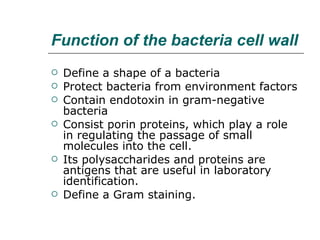
Function of the bacteria cell wall   Define a shape of a bacteria  Protect bacteria from environment factors Contain endotoxin in  gram-negative bacteria Consist porin proteins, which play a role in regulating the passage of small molecules into the cell. Its polysaccharides and proteins are antigens that are useful in laboratory identification. Define a Gram staining.
Gram-positive bacterial cell wall
Gram-negative bacterial cell wall
Gram-stained bacterial mix Purple  Staphylococci are gram positive Red   rods are gram negative
Scanning electron micrograph of Mycoplasma pneumoniae Cells like these that naturally lack a cell wall exhibit extreme pleomorphism
Nonessential structures of bacteria  Contains a variety of genes for antibiotic resistance, toxins Plasmid Storage sites of food Granule  Provides resistance to unfavourable   conditions Spore  Motility  Flagellum  Common pilus - attachment to cell surfaces  sex pilus – attachment of two bacteria during conjugation Pilus or fimbria Protects against phagocytosis Capsule
Bacterial flagella Flagella are organelles of movement  Flagella consist protein those are antigens, and this properties may be used for identification of bacteria species.
Arrangements of flagella   on surface of bacterial cell
Colorized electron micrograph of Vibrios’s monotrichous (polar) flagellum
Colorized electron micrograph of Salmonella’s peretrichous flagella
Structure of bacterial flagellum
Colorized electron micrograph of E.coli pili Sex-pili (F-pili)  Take part in conjugation process. They join bacteria together prior to the transfer of DNA from on cell (donor) to the other (recipient) Common-pili  It is a factor of virulence.  Its proteins (adhesins) attach bacteria to cells in the urinary of intestinal tracts of the host as the first step in infection.
Flagellum and pili of E.coli
Bacteria’s spores  Spore conditions resistance of the bacterium to heat, dehydration, freezing, and toxic chemicals This resistance is mediated by thick, keratinlike coat and dipicolinic acid Vegetative cells develop endospores in unfavourable conditions Only gram-positive bacteria can form endospore, they called bacilli The sporogenesis is not bacterial reproduction   Spores are located at characteristic positions inside the cell of different kinds of bacteria, their location can be helpful in identifying the particular species
Clostridium botulinum These are  bacillus that forms subterminal endospores
C lostridium  difficile   These bacilli form terminally located endospores
Bacillus anthracis The endospores are located centrally.
Spore structure
Formation of a bacterial spore
Spores. Acid-fast stain  For visualization of spores may be used special methods of stain, for instance,  acid-fast stain
Gram stained bacilli
The capsule or slime layer   mediates adherence of bacteria to human tissue  determines virulence of many bacteria   protecting bacterial cells from engulfment by phagocytes protect cells from perennial effects of desiccation  determines antigen properties of bacterium and can be used for serologic identification
Capsule  For observing of capsule special staining may be used. Capsules are most easily seen by negative staining, outlined as a light area against a darkened background
Inclusion (granules)   Composition: glycogen  polyphosphate (volutin granules)  protein granules fat drops   Function: reserve carbon,  phosphate   and energy source
Volutin granules in cells of Corynebacterium diphtheria  Granules can be seen with special stains Volutin granules are characterized by metachromasia. Upon staining with special method color of granules is differ from sytoplasm color

Bohomolets Microbiology Lecture#1

  • 1.
    Microbiology Introduction. Morphology and structure of microorganisms
  • 2.
  • 3.
    Protozoa Amoeba Paramecium
  • 4.
    Fungi (mycota) Aspergillus
  • 5.
    Viruses Adenovirus Bacteriophage
  • 6.
    Medical, Pharmaceutical andBiotechnological Applications A variety of fermented foods produced by microbes
  • 7.
    Medical, Pharmaceutical andBiotechnological Applications Antibiotics, vaccines
  • 8.
    Medical, Pharmaceutical andBiotechnological Applications Human insulin. Made by recombinant DNA technology
  • 9.
    Microbes Cause FoodSpoilage and Decomposition Penicillium mold growth on orange Soft rot on peaches caused by the fungus Monilia
  • 10.
    Aspergillus moldon shower curtain. Mold growth in the home, work environment can lead to respiratory infections and allergies
  • 11.
    Antony van LeeuwenhoekLeeuwenhoek was a tailor in Delft, Holland. As a draper, he used magnifying glasses to examine fabrics. He made simple microscopes with which he magnified objects too small to be seen with the naked eye. Leeuwenhoek`s investigations included observations of tiny organisms he called animalcules (little animals), blood, and other human tissues (including his own tooth scrapings), insects, other. Leeuwenhoek transmitted his findings in a series of letters, from 1674 to 1723, to the Royal Society in London, though which his observations were dissemenated. The first microorganisms were observed at 1676 by Antony van Leeuwenhoek Antony van Leeuwenhoek is known as the father of bacteriology and protozoology.
  • 12.
    A brass replicaof a Leeuwenhoek`s microscope Leeuwenhoek constructed more than 250 small, powerful microscopes that could magnify up to 300 times. Lens Specimen holder Focus screw Handle
  • 13.
    Using of Leeuwenhoek`smicroscope If you can get the lighting just right, it works
  • 14.
    Examples of bacteriadrawn by Leeuwenhoek Leeuwenhoek`s letters, which he transmitted to the Royal Society, contained detailed drawings, some of which clearly show microorganisms. “ I discovered living creatures in rain water which had stood but a few days in a new earthen pot. This invited me to view this water with great attention, especially those little animals appearing to me ten thousand times less than those which may be perceived in the water with the naked eye”. This is probably the first observation of bacteria.
  • 15.
    General properties ofmicroorganisms Microscopic size Comparative simplicity of organization High rate of reproduction High biochemical activity Capacity for rapid adaptability Widely distribution in world Possibility of pathogenic properties
  • 16.
    MICROBIOLOGY is the science, which studies representative of microbe world, their interaction with environment, using of microorganisms for human profit.
  • 17.
    Branches of microbiology The microflora of the seas, rivers and others Oceanic microbiology The role of microorganisms in agriculture. It deals with maintenance of soil fertility, the role of microorganisms in causing plant disease Agricultural microbiology The pathogenic microorganisms causing infectious diseases in animals. Veterinary microbiology Interrelationships between microbes and the environ-ment; the role of microorganisms in the nutrient cycles of soil, water, and other natural communities Microbial ecology Microbial function (metabolism) at the cellular and molecular levels Microbial physiology Studies the detailed structure of microorganisms Microbial morphology Area of study Science
  • 18.
    MEDICAL MICROBIOLOGYis the branch of science, which studies characteristics of pathogenic representative of microbe world, their interaction with human organism, mechanism of infectious disease development, methods its diagnostics, treatment and prophylaxis.
  • 19.
    Branches of medicalmicrobiology Microflora of ground, water, air, environment object, food stuffs and other objects for the hygienic characteristic and their estimation as probable sources of pathogenic microorganisms transfer. Sanitary microbiology The fungi, a grope of organisms that includes microscopic forms molds and yeasts Mycology Area of study Science Study immune response of human to microorganisms. An understanding of the causative agents of diseases and the body’s defenses against infectious agents has led to preventive and treatment methods that have reduced morbidity and mortality arising from many infectious diseases Immunology The protozoa – animal-like and mostly single-celled organisms Protozoology Rickettsiae – the celled procariotic organisms which are obligate intracellular parasite Rickettsiology Viruses – minute, noncellular particles that are obligate intracellular genetic parasite living only in cells of host Virology The bacteria – the smallest, simplest single-celled procariotic organisms Bacteriology
  • 20.
    Original methods ofmicrobiological investigation Microscopy Staining Cultivation Obtaining of pure culture Immunology methods Modelling using animals Virology methods Biotechnology and gene-ingenering methods
  • 21.
    Morphology and structureof microorganisms
  • 22.
    The size ofmicroorganisms
  • 23.
  • 24.
    Micrococci Single coccinot joint with each other cell
  • 25.
    Arrangements of cocciresulting from different planes of cell division Division in one plane produce diplococci and streptococci Division in two planes produces tetrads and packets Division in several planes produces irregular clusters
  • 26.
    Diplococci These arecocci with couple arrangement
  • 27.
    Tetracocc i arecocci, duplicating alternately in 2 mutually perpendicular planes with tetrad formation
  • 28.
    Streptococci Spherical bacteriathat form chains, they duplicate in 1 plane and in 1 direction without the subsequent branching of affiliated individuals.
  • 29.
    Staphylococci Cocci ,which duplicating in various planes with formation clusters resembling bunches of grapes.
  • 30.
    Sarcines cocci, duplicatingin 3 mutually perpendicular planes and forming cubic packages from 8, 16, 32, 64 or more cells.
  • 31.
  • 32.
  • 33.
    Pleomorphic shape Mycoplasma pneumoniae
  • 34.
    Structure of procarioticand eucariotic cells
  • 35.
  • 36.
    Comparison of prokaryoticand eukaryotic cells Yes No Mitotic division Yes No Golgi apparatus Yes No Endoplasmic reticulum Yes No Membrane-bound organelles (mitochondria, lysosomes) No Yes Cell wall containing of peptidoglican 80S 70S Ribosomes More then 1 1 Chromosome number Histone proteins Polyamines DNA associated with Yes No Nucleus containing a nuclear membrane surrounding DNA Yes Yes Cytoplasmic membrane EUKARYOTIC PROKARYOTIC FEATURES OF CELLS
  • 37.
    Essential structures ofbacteria Contain many hydrolytic enzymes Periplasm Participates in cell division and secretion Mesosome Contain genetic material Nucleoid Protein synthesis Ribosome Motionless colloid system bounding all structures Cytoplasm Site of oxidative and transport enzymes Cytoplasmic membrane Gives rigid support, protect against osmotic pressure Cell wall with peptidoglycan
  • 38.
    Ribosomes Bacteria ribosomesare the site of protein synthesis, but they differ from eudaryotic cells ribosomes in size and chemical composition. Bacteria ribosomes are 70S in size, with 50S and 30S subunits
  • 39.
    Function of cytoplasmicmembrane (plasma membrane) Enclosing bacteria cytoplasm from cell wall and internal periplasmatic space Active transport of molecules into the cell Energy generation by oxidative phosphorylation Synthesis of precursors of the cell wall Secretion of enzymes and toxins
  • 40.
    Function of thebacteria cell wall Define a shape of a bacteria Protect bacteria from environment factors Contain endotoxin in gram-negative bacteria Consist porin proteins, which play a role in regulating the passage of small molecules into the cell. Its polysaccharides and proteins are antigens that are useful in laboratory identification. Define a Gram staining.
  • 41.
  • 42.
  • 43.
    Gram-stained bacterial mixPurple Staphylococci are gram positive Red rods are gram negative
  • 44.
    Scanning electron micrographof Mycoplasma pneumoniae Cells like these that naturally lack a cell wall exhibit extreme pleomorphism
  • 45.
    Nonessential structures ofbacteria Contains a variety of genes for antibiotic resistance, toxins Plasmid Storage sites of food Granule Provides resistance to unfavourable conditions Spore Motility Flagellum Common pilus - attachment to cell surfaces sex pilus – attachment of two bacteria during conjugation Pilus or fimbria Protects against phagocytosis Capsule
  • 46.
    Bacterial flagella Flagellaare organelles of movement Flagella consist protein those are antigens, and this properties may be used for identification of bacteria species.
  • 47.
    Arrangements of flagella on surface of bacterial cell
  • 48.
    Colorized electron micrographof Vibrios’s monotrichous (polar) flagellum
  • 49.
    Colorized electron micrographof Salmonella’s peretrichous flagella
  • 50.
  • 51.
    Colorized electron micrographof E.coli pili Sex-pili (F-pili) Take part in conjugation process. They join bacteria together prior to the transfer of DNA from on cell (donor) to the other (recipient) Common-pili It is a factor of virulence. Its proteins (adhesins) attach bacteria to cells in the urinary of intestinal tracts of the host as the first step in infection.
  • 52.
  • 53.
    Bacteria’s spores Spore conditions resistance of the bacterium to heat, dehydration, freezing, and toxic chemicals This resistance is mediated by thick, keratinlike coat and dipicolinic acid Vegetative cells develop endospores in unfavourable conditions Only gram-positive bacteria can form endospore, they called bacilli The sporogenesis is not bacterial reproduction Spores are located at characteristic positions inside the cell of different kinds of bacteria, their location can be helpful in identifying the particular species
  • 54.
    Clostridium botulinum Theseare bacillus that forms subterminal endospores
  • 55.
    C lostridium difficile These bacilli form terminally located endospores
  • 56.
    Bacillus anthracis Theendospores are located centrally.
  • 57.
  • 58.
    Formation of abacterial spore
  • 59.
    Spores. Acid-fast stain For visualization of spores may be used special methods of stain, for instance, acid-fast stain
  • 60.
  • 61.
    The capsule orslime layer mediates adherence of bacteria to human tissue determines virulence of many bacteria protecting bacterial cells from engulfment by phagocytes protect cells from perennial effects of desiccation determines antigen properties of bacterium and can be used for serologic identification
  • 62.
    Capsule Forobserving of capsule special staining may be used. Capsules are most easily seen by negative staining, outlined as a light area against a darkened background
  • 63.
    Inclusion (granules) Composition: glycogen polyphosphate (volutin granules) protein granules fat drops Function: reserve carbon, phosphate and energy source
  • 64.
    Volutin granules incells of Corynebacterium diphtheria Granules can be seen with special stains Volutin granules are characterized by metachromasia. Upon staining with special method color of granules is differ from sytoplasm color