

Medical Microbiology:
Introduction
Dr. Md. Abdullah Yusuf
Assistant Professor, Dept. of Microbiology
National Institute of Neurosciences & Hospital
Dhaka, Bangladesh
Email: ayusuf75@yahoo.com
Learning Objectives
Introduction and history of Microbiology
• Important events of history
• Koch’s postulates
• Branches of Medical Microbiology
• Role of Microbes in environment & medical
science
Important events of history
• Dutch Biologist “Anton Van Leeuwenhock”
discovered “animicules” in a drop of water by his
simple microscope in 1674
• Otto Muller (Danish biologist) organized
bacteria into genus and species in1774
• In 1840, Friedrich Henle (German pathologist)
proposed germ theory of disease
Conti…
• Robert Koch
– Father of medical Microbiology
• Luis Pasteur (Father of Modern Microbiology)
– identified causative agent of anthrax, rabies,
plague, cholera and tuberculosis
• Discovery of penicillin
– 1928 (Alexander Flemming)
• Discovery of sulphanilamide
– 1935 (Gerhard Domagk’s)
• Discovery of streptomycin
– 1928 (Selman Waksman)
Koch’s postulates
1. The causative (etiological) agent must be
present in all affected organisms
– but absent in healthy individuals
1. The agent must be capable of being isolated
and cultured in pure form
2. When the cultured agent is introduced to a
healthy organism,
– the same disease must occur
1. The same causative agent must be isolated
again from the affected host
Limitation of Koch’s Postulate
• Genetic Diseases
• Auto-immune Diseases
• Non-culturable microbial diseases
Branches of Medical Microbiology
• Bacteriology
– General
– Systemic
• Virology
– General
– Systemic
• Parasitology
– Protogoology
– Helminthiology
• Mycology
• Immunology
Difference between Virus And Bactria
• Structure
• Nucleic Acid
• Type of Nucleus
• Ribosomes
• Nature of Outer Surface
• Motility
• Method of Replication
Eukaryotes and Prokaryotes
• Properties
• Differences
• examples
What is bacterium?
• Prokaryotic cells
– Pro means primitive
– Karyote means nuceus
• Multiply by binary fission
– 1divide to 2
• Devoid of chlorophil
• ** single cell, living being, microscopic entity but
fantastic in structural organization, reproduction,
metabolism and function
Eukaryotes
• Eu means True (normal)
• Karyote means nucleus
• Much larger than most prokaryotes
• Have subcellular, membrane-bound organelles
• Includes all “higher" plants and animals
• Microbiology includes
– Fungi
– Protozoa
– Algae
– Multicellular Organisms (helminthes)
Fungus
• Eukaryotic organism
• cell walls contains Chitin
• Molds are multicellular
– masses of mycelia
– composed of filaments called hyphae
• Yeasts are unicellular
Protozoa
• Eukaryotes
• No Cell Wall
• Surround and absorb food
• May be motile via
– Pseudopods
– cilia, or
– flagella
Algae
• Eukaryotes
• Cellulose cell walls
• Use photosynthesis for energy
• Produce molecular oxygen and organic
compounds
Virus
• Acellular
• Consist of DNA or RNA
• Core is surrounded by a protein coat
• Coat may be enclosed in a lipid envelope
• Viruses are replicated only when they are in a
living host cell
• Living
Multicellular- helminthes
• Eukaryote
• Multicellular animals
• Parasitic flatworms and round worms are called
helminths
• Microscopic stages in life cycles
Characteristics of Prokaryotes
Nuclear level
• Absence of
– nuclear membrane
– Nucleolie
– Nucleoplasm
– paired multiple chromosome
– centriole
Conti..
Cytoplasmic level
• Absence of membrane bound organelles
– Mitochondria
– endoplasmic reticulum
– golgi complex
– Microtubules
– Microfilaments
Conti..
• Presence of
– Ribosome
– Plasmid
• No protoplasmic streamming in the form of
Brownian movement and Tyndall phenomena
• No change in definite shape and formation of
pseudopodia
Characteristics of prokaryotes (Structural)
Cell coverings (cell envelope)
• Innermost layer
– bilaminar phospholipid + Lipoprotein
– cytoplasmic membrane (fluid stage) without
any sterol
• Two membrane in Gram negative bacteria
• Condensation at some points forming
mesosome
Conti…
2) Outer to Cell Membrane
– cell wall containing specialized unique
chemicals called peptidoglycan
3) Outer to Cell Wall
– investing layer either capsule/glycocalyx/slime
layer
4) S layer
– Single type protein lattice outer to CW
Characteristics of Prokaryotes
• No genetic exchange during chromosome
replication
• Show secretory and excretory activities
• Show chemical selectivity, motility and alteration
of life stage (spore)
• Wide range of temperature and pH tolerance
• Heterogenous nutritional requirements and host
specificity
• Can produce self protective molecule bacteriocin
• Become infected by particular virus
• Can acquire extrachromosomal DNA (plasmid)
Difference Between Eukaryotes and
Prokaryotes
• Nature of Nucleus
• Mitotic Division
• Presence of histones in DNA
• Membrane bound Organelles
• Size of Ribosomes
• Peptidoglycan in Cell Wall
Bacterial cells
Bacterial cells
• essential structures
– chemical composition
– Organization
– Functions
• non-essential structures
– chemical composition
– Organization
– Functions
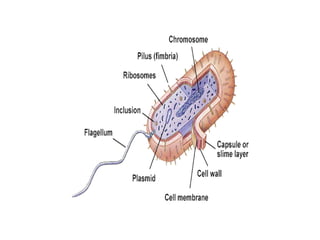
Structures of bacteria
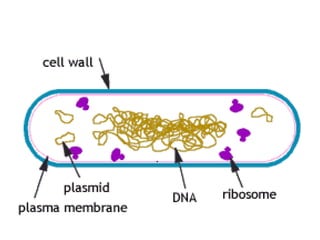
• Essential Structures (maintain viability)
– Cell Wall
– Cell Membrane
– Mesosome
– Ribosome
– Nucleoid
– Periplasm
Structures of bacteria
• Non-essential Structures (viability is not affected
in their absence)
– Flagella
– fimbria (pili)
– Capsule
– Glycocalyx
– slime layer
– Plasmid
– spore
Cell wall
• Component
– peptidoglycan (PG)
– Teichoic acid
– teichorunic acid
– Polysaccharides
– LPS
– Lipoproteins
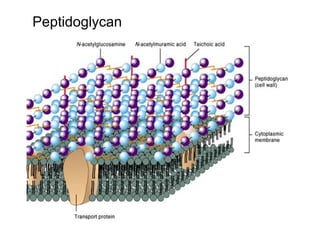
• PG backbone: NAG and NAM
• Tetrapeptide side chains attached to NAM
• Interpeptide bridge
Conti…
• Function
– osmotic protection
– integrity of cellular structures
– virulence factors
– Fully permeable to ions, aminoacids and sugars
– makes it rigid
– determines shape
– Acts as antigen
– Used as serological diagnosis
Peptidoglycan
Gram positive cell envelope
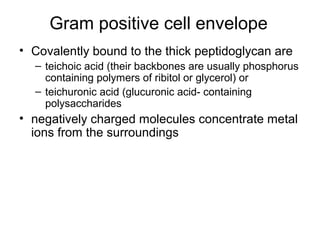
• Covalently bound to the thick peptidoglycan are
– teichoic acid (their backbones are usually phosphorus
containing polymers of ribitol or glycerol) or
– teichuronic acid (glucuronic acid- containing
polysaccharides
• negatively charged molecules concentrate metal
ions from the surroundings
Conti…
• Teichoic acids can also direct autolytic enzymes
to sites of peptidoglycan digestion (autolysis).
• This is needed to insert sections of cell wall for
growth and division.
• Lipoteichoic acid is primarily associated with the
cell membrane.
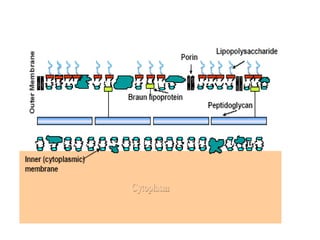
The Gram negative cell envelope
• Covalently linked to the thin peptidoglycan is the
Braun lipoprotein which binds the outer
membrane to the cell wall.
• Like other membranes it contains proteins and
phospholipids.
• Unlike other membranes it contains
lipopolysaccharide
Conti…
• Lipopolysaccharide
– helps to provide a permeability barrier
• LPS consists of three regions
– an outer O antigen
– a middle core
– an inner lipid A region
• core contains several sugars
– lipid A contains β hydroxyfatty acids
(uncommon in nature)
– The molecule displays endotoxin activity
Conti…
• Porins in the outer membrane form channels to
allow passage of small hydrophilic nutrients
(such as sugars) through the outer membrane.
Cell membrane
• Phospholipid bilayer
– Except triple layer in Mycoplasma
• Interspersed with lipoprotein
• Selectively permeable
Cell Membrane
• Functions
– Transport
– Synthesis
– Excretion
– Secretion
– Metabolism
– division by mesosome
Nucleoid
• Double stranded coiled helical DNA molecule
– remain in a single chromosome
• no introns
• no non-coding sequences
• no regulatory sequence
• no long terminal repeats (LTRs)
• Operon present
Nucleoid
• Function
– bears genes and genetic characters
– maintain metabolism
Ribosome
• 70 s in sedimentation co-efficient
• Aggregated
• Function
– Protein Synthesis
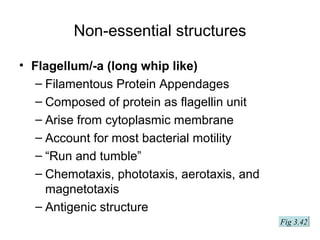
Non-essential structures
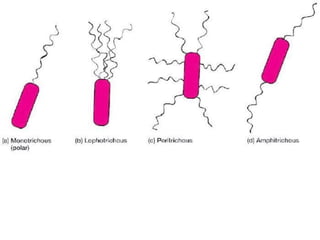
• Flagellum/-a (long whip like)
– Filamentous Protein Appendages
– Composed of protein as flagellin unit
– Arise from cytoplasmic membrane
– Account for most bacterial motility
– “Run and tumble”
– Chemotaxis, phototaxis, aerotaxis, and
magnetotaxis
– Antigenic structure
Fig 3.42
Non-essential structures
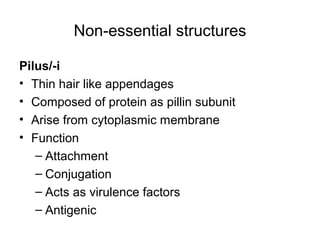
Pilus/-i
• Thin hair like appendages
• Composed of protein as pillin subunit
• Arise from cytoplasmic membrane
• Function
– Attachment
– Conjugation
– Acts as virulence factors
– Antigenic
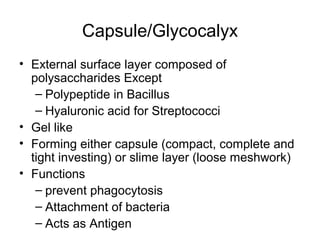
Capsule/Glycocalyx
• External surface layer composed of
polysaccharides Except
– Polypeptide in Bacillus
– Hyaluronic acid for Streptococci
• Gel like
• Forming either capsule (compact, complete and
tight investing) or slime layer (loose meshwork)
• Functions
– prevent phagocytosis
– Attachment of bacteria
– Acts as Antigen
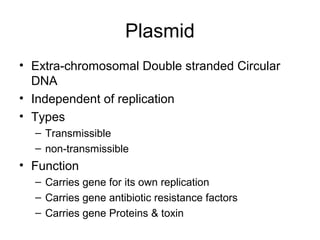
Plasmid
• Extra-chromosomal Double stranded Circular
DNA
• Independent of replication
• Types
– Transmissible
– non-transmissible
• Function
– Carries gene for its own replication
– Carries gene antibiotic resistance factors
– Carries gene Proteins & toxin
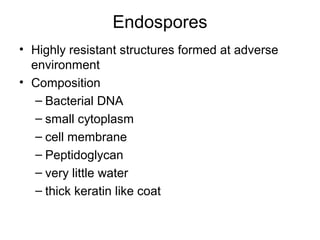
Endospores
• Highly resistant structures formed at adverse
environment
• Composition
– Bacterial DNA
– small cytoplasm
– cell membrane
– Peptidoglycan
– very little water
– thick keratin like coat
Endospores
• Highly resistant to
– heat, moisture, chemicals, radiation and
antibiotics
• Special component
– calcium salt of Dipicolinic acid
• No metabolic activities, remain dormant for
many years
• Two events: sporulation and germination
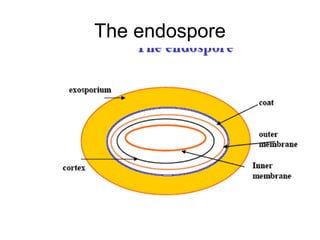
The endospore
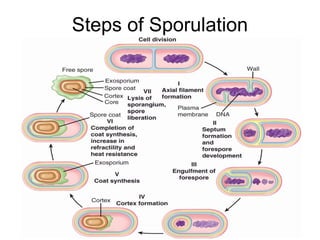
Steps of Sporulation
Classification of bacteria
• Basis of Classification
• differences between Gram positive and Gram
negative bacteria
• atypical characters of bacteria in relation to
staining
Basis of Classification
• Morphological Classification
• Staining Properties
• Thickness of Wall
• According to Motility
Morphological Classification
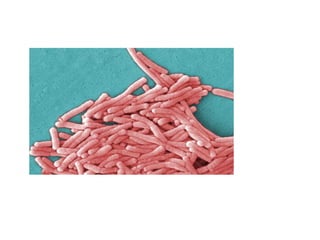
Morphology of Bacteria
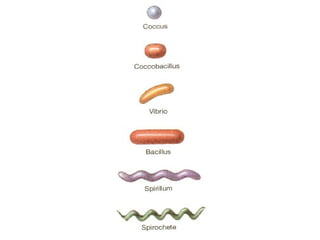
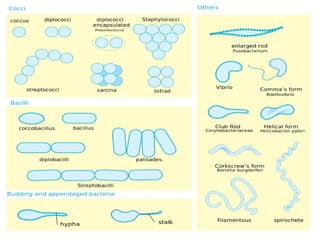
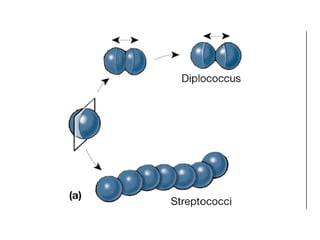
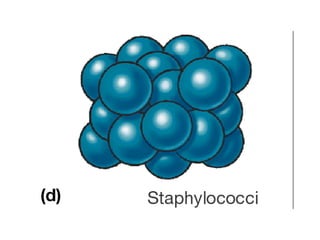
• Cocci
– rounded or oval (Staphylococcus)
• Bacilli
– elongated rod like (Esch.coli)
• Vibrio (from vibration)
– coma shaped (Vibrio cholerae)
• Spiral bacteria
– long slender curved body with wave like spiral
(Spirillum minus, Helicobacter pylori)
Others Shapes
• Cocco-bacillus
– longer than coccus, shorter than bacillus
(Bordetella, Brucella)
• Filamentous
– long curved body like ribbon with branching
(Actinomycetes, Nocardia)
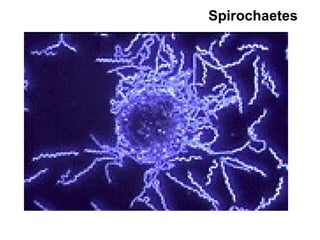
Spirochaetes
Thickness of Wall
• Rigid thick wall Bacteria
– Free-Living (Extracellular)
– Non-Free Living (Obligate Intracellular)
• Flexible thin walled Bacteria
– Treponema
– Borrela
– Leptospira
• Wall-less Bacteria
– Mycoplasma
– Ureaplasma
Rigid thick wall Bacteria
• Free-Living (Extracellular)
– Gram Positive
– Gram Negative
– Acid-Fast
• Non-Free Living (Obligate Intracellular)
– Rickettsia
– Chlamydia
Staining Properties
• Gram Positive
• Gram Negative
• Acid-Fast Bacteria
Gram Positive Bacteria
• Cocci
– Streptococcus
– Staphylococcus
• Bacilli
– Spore Forming
• Bacillus
– Non-spore forming
• Clostridium
• Corynebacterium
• Listeria
Gram Negative Bacteria
• Cocci
– Neisseria gonorrhoae
– Neisseria meningitidis
• Bacilli
– Enterobacteriaceae
– Non-Enterobacteriaceae
According to Motility
• Motile
– Flagellated Bacteria
– Non-Flagellated Bacteria
• Non-Motile
– All Cocci
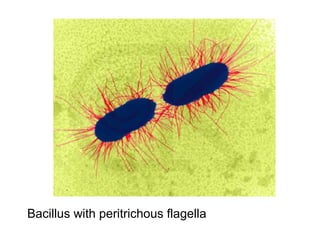
Bacillus with peritrichous flagella
Morphological study of bacteria
• Staining
• Motility test
Staining
Theoretical approach
• Types
• Laboratory procedures
• findings of
– Gram’s
– Zeihl-neelsen (Z-N)
– Albert’s staining
Types of Staining
• Simple Staining
• Differential Staining
• Special Staining
Types of Staining
Simple Staining
• using a single dye
– methylene blue
– Leishman
Types of Staining
Differential Staining
• using primary and counter dye
• performing a step of decolourisation
• to see differential characters of bacteria
– Gram’s stain
– Ziehl-Neelsen stain
– Albert stain
Types of Staining
Special Staining
• to see unique property of particular
bacteria
– Fluorescense stain
Gram’s staining
• Named according to inventor Christian Gram
• Based on the property of bacterial cell envelope
• stained at first by a primary dye & mordanted
• Decolorized by acetone or alcohol
• Counter stain is added
• Gram positive bacteria
– can resist decolourisation and retain the primary dye
• Gram negative bacteria
– can not resist decolourisation and take the counter
dye
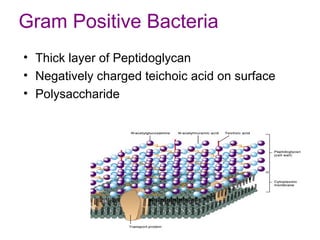
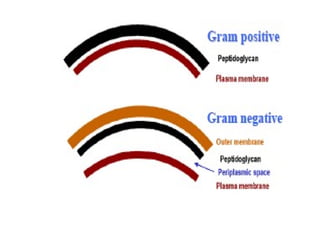
Gram Positive Bacteria
• Thick layer of Peptidoglycan
• Negatively charged teichoic acid on surface
• Polysaccharide
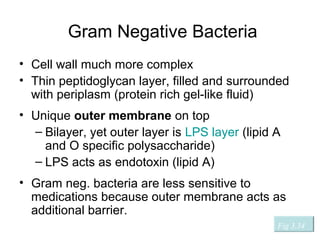
Gram Negative Bacteria
• Cell wall much more complex
• Thin peptidoglycan layer, filled and surrounded
with periplasm (protein rich gel-like fluid)
• Unique outer membrane on top
– Bilayer, yet outer layer is LPS layer (lipid A
and O specific polysaccharide)
– LPS acts as endotoxin (lipid A)
• Gram neg. bacteria are less sensitive to
medications because outer membrane acts as
additional barrier.
Fig 3.34
Atypical cell envelope
• Acid-fast and related bacteria
– Mycobacteria
– Nocardia
• Presence of Mycolic acids
– long, branch chained fatty acids
Gram un-stainable cell wall
• Atypical peptidoglycan
• Spirochaetes, Mycobacterium,
– High lipid content
– Tight fluid mosaic
Thank You

1 introduction bacterial cells

  • 1.
    Medical Microbiology: Introduction Dr. Md.Abdullah Yusuf Assistant Professor, Dept. of Microbiology National Institute of Neurosciences & Hospital Dhaka, Bangladesh Email: ayusuf75@yahoo.com
  • 2.
    Learning Objectives Introduction andhistory of Microbiology • Important events of history • Koch’s postulates • Branches of Medical Microbiology • Role of Microbes in environment & medical science
  • 3.
    Important events ofhistory • Dutch Biologist “Anton Van Leeuwenhock” discovered “animicules” in a drop of water by his simple microscope in 1674 • Otto Muller (Danish biologist) organized bacteria into genus and species in1774 • In 1840, Friedrich Henle (German pathologist) proposed germ theory of disease
  • 4.
    Conti… • Robert Koch –Father of medical Microbiology • Luis Pasteur (Father of Modern Microbiology) – identified causative agent of anthrax, rabies, plague, cholera and tuberculosis • Discovery of penicillin – 1928 (Alexander Flemming) • Discovery of sulphanilamide – 1935 (Gerhard Domagk’s) • Discovery of streptomycin – 1928 (Selman Waksman)
  • 5.
    Koch’s postulates 1. Thecausative (etiological) agent must be present in all affected organisms – but absent in healthy individuals 1. The agent must be capable of being isolated and cultured in pure form 2. When the cultured agent is introduced to a healthy organism, – the same disease must occur 1. The same causative agent must be isolated again from the affected host
  • 6.
    Limitation of Koch’sPostulate • Genetic Diseases • Auto-immune Diseases • Non-culturable microbial diseases
  • 7.
    Branches of MedicalMicrobiology • Bacteriology – General – Systemic • Virology – General – Systemic • Parasitology – Protogoology – Helminthiology • Mycology • Immunology
  • 8.
    Difference between VirusAnd Bactria • Structure • Nucleic Acid • Type of Nucleus • Ribosomes • Nature of Outer Surface • Motility • Method of Replication
  • 9.
    Eukaryotes and Prokaryotes •Properties • Differences • examples
  • 10.
    What is bacterium? •Prokaryotic cells – Pro means primitive – Karyote means nuceus • Multiply by binary fission – 1divide to 2 • Devoid of chlorophil • ** single cell, living being, microscopic entity but fantastic in structural organization, reproduction, metabolism and function
  • 11.
    Eukaryotes • Eu meansTrue (normal) • Karyote means nucleus • Much larger than most prokaryotes • Have subcellular, membrane-bound organelles • Includes all “higher" plants and animals • Microbiology includes – Fungi – Protozoa – Algae – Multicellular Organisms (helminthes)
  • 12.
    Fungus • Eukaryotic organism •cell walls contains Chitin • Molds are multicellular – masses of mycelia – composed of filaments called hyphae • Yeasts are unicellular
  • 13.
    Protozoa • Eukaryotes • NoCell Wall • Surround and absorb food • May be motile via – Pseudopods – cilia, or – flagella
  • 14.
    Algae • Eukaryotes • Cellulosecell walls • Use photosynthesis for energy • Produce molecular oxygen and organic compounds
  • 15.
    Virus • Acellular • Consistof DNA or RNA • Core is surrounded by a protein coat • Coat may be enclosed in a lipid envelope • Viruses are replicated only when they are in a living host cell • Living
  • 16.
    Multicellular- helminthes • Eukaryote •Multicellular animals • Parasitic flatworms and round worms are called helminths • Microscopic stages in life cycles
  • 17.
    Characteristics of Prokaryotes Nuclearlevel • Absence of – nuclear membrane – Nucleolie – Nucleoplasm – paired multiple chromosome – centriole
  • 18.
    Conti.. Cytoplasmic level • Absenceof membrane bound organelles – Mitochondria – endoplasmic reticulum – golgi complex – Microtubules – Microfilaments
  • 19.
    Conti.. • Presence of –Ribosome – Plasmid • No protoplasmic streamming in the form of Brownian movement and Tyndall phenomena • No change in definite shape and formation of pseudopodia
  • 20.
    Characteristics of prokaryotes(Structural) Cell coverings (cell envelope) • Innermost layer – bilaminar phospholipid + Lipoprotein – cytoplasmic membrane (fluid stage) without any sterol • Two membrane in Gram negative bacteria • Condensation at some points forming mesosome
  • 21.
    Conti… 2) Outer toCell Membrane – cell wall containing specialized unique chemicals called peptidoglycan 3) Outer to Cell Wall – investing layer either capsule/glycocalyx/slime layer 4) S layer – Single type protein lattice outer to CW
  • 22.
    Characteristics of Prokaryotes •No genetic exchange during chromosome replication • Show secretory and excretory activities • Show chemical selectivity, motility and alteration of life stage (spore) • Wide range of temperature and pH tolerance • Heterogenous nutritional requirements and host specificity • Can produce self protective molecule bacteriocin • Become infected by particular virus • Can acquire extrachromosomal DNA (plasmid)
  • 23.
    Difference Between Eukaryotesand Prokaryotes • Nature of Nucleus • Mitotic Division • Presence of histones in DNA • Membrane bound Organelles • Size of Ribosomes • Peptidoglycan in Cell Wall
  • 24.
  • 25.
    Bacterial cells • essentialstructures – chemical composition – Organization – Functions • non-essential structures – chemical composition – Organization – Functions
  • 26.
    Structures of bacteria •Essential Structures (maintain viability) – Cell Wall – Cell Membrane – Mesosome – Ribosome – Nucleoid – Periplasm
  • 27.
    Structures of bacteria •Non-essential Structures (viability is not affected in their absence) – Flagella – fimbria (pili) – Capsule – Glycocalyx – slime layer – Plasmid – spore
  • 29.
    Cell wall • Component –peptidoglycan (PG) – Teichoic acid – teichorunic acid – Polysaccharides – LPS – Lipoproteins • PG backbone: NAG and NAM • Tetrapeptide side chains attached to NAM • Interpeptide bridge
  • 30.
    Conti… • Function – osmoticprotection – integrity of cellular structures – virulence factors – Fully permeable to ions, aminoacids and sugars – makes it rigid – determines shape – Acts as antigen – Used as serological diagnosis
  • 31.
  • 32.
    Gram positive cellenvelope • Covalently bound to the thick peptidoglycan are – teichoic acid (their backbones are usually phosphorus containing polymers of ribitol or glycerol) or – teichuronic acid (glucuronic acid- containing polysaccharides • negatively charged molecules concentrate metal ions from the surroundings
  • 33.
    Conti… • Teichoic acidscan also direct autolytic enzymes to sites of peptidoglycan digestion (autolysis). • This is needed to insert sections of cell wall for growth and division. • Lipoteichoic acid is primarily associated with the cell membrane.
  • 34.
    The Gram negativecell envelope • Covalently linked to the thin peptidoglycan is the Braun lipoprotein which binds the outer membrane to the cell wall. • Like other membranes it contains proteins and phospholipids. • Unlike other membranes it contains lipopolysaccharide
  • 35.
    Conti… • Lipopolysaccharide – helpsto provide a permeability barrier • LPS consists of three regions – an outer O antigen – a middle core – an inner lipid A region • core contains several sugars – lipid A contains β hydroxyfatty acids (uncommon in nature) – The molecule displays endotoxin activity
  • 36.
    Conti… • Porins inthe outer membrane form channels to allow passage of small hydrophilic nutrients (such as sugars) through the outer membrane.
  • 37.
    Cell membrane • Phospholipidbilayer – Except triple layer in Mycoplasma • Interspersed with lipoprotein • Selectively permeable
  • 38.
    Cell Membrane • Functions –Transport – Synthesis – Excretion – Secretion – Metabolism – division by mesosome
  • 39.
    Nucleoid • Double strandedcoiled helical DNA molecule – remain in a single chromosome • no introns • no non-coding sequences • no regulatory sequence • no long terminal repeats (LTRs) • Operon present
  • 40.
    Nucleoid • Function – bearsgenes and genetic characters – maintain metabolism
  • 41.
    Ribosome • 70 sin sedimentation co-efficient • Aggregated • Function – Protein Synthesis
  • 42.
    Non-essential structures • Flagellum/-a(long whip like) – Filamentous Protein Appendages – Composed of protein as flagellin unit – Arise from cytoplasmic membrane – Account for most bacterial motility – “Run and tumble” – Chemotaxis, phototaxis, aerotaxis, and magnetotaxis – Antigenic structure Fig 3.42
  • 44.
    Non-essential structures Pilus/-i • Thinhair like appendages • Composed of protein as pillin subunit • Arise from cytoplasmic membrane • Function – Attachment – Conjugation – Acts as virulence factors – Antigenic
  • 45.
    Capsule/Glycocalyx • External surfacelayer composed of polysaccharides Except – Polypeptide in Bacillus – Hyaluronic acid for Streptococci • Gel like • Forming either capsule (compact, complete and tight investing) or slime layer (loose meshwork) • Functions – prevent phagocytosis – Attachment of bacteria – Acts as Antigen
  • 46.
    Plasmid • Extra-chromosomal Doublestranded Circular DNA • Independent of replication • Types – Transmissible – non-transmissible • Function – Carries gene for its own replication – Carries gene antibiotic resistance factors – Carries gene Proteins & toxin
  • 48.
    Endospores • Highly resistantstructures formed at adverse environment • Composition – Bacterial DNA – small cytoplasm – cell membrane – Peptidoglycan – very little water – thick keratin like coat
  • 49.
    Endospores • Highly resistantto – heat, moisture, chemicals, radiation and antibiotics • Special component – calcium salt of Dipicolinic acid • No metabolic activities, remain dormant for many years • Two events: sporulation and germination
  • 50.
  • 51.
  • 53.
    Classification of bacteria •Basis of Classification • differences between Gram positive and Gram negative bacteria • atypical characters of bacteria in relation to staining
  • 54.
    Basis of Classification •Morphological Classification • Staining Properties • Thickness of Wall • According to Motility
  • 55.
    Morphological Classification Morphology ofBacteria • Cocci – rounded or oval (Staphylococcus) • Bacilli – elongated rod like (Esch.coli) • Vibrio (from vibration) – coma shaped (Vibrio cholerae) • Spiral bacteria – long slender curved body with wave like spiral (Spirillum minus, Helicobacter pylori)
  • 56.
    Others Shapes • Cocco-bacillus –longer than coccus, shorter than bacillus (Bordetella, Brucella) • Filamentous – long curved body like ribbon with branching (Actinomycetes, Nocardia)
  • 62.
  • 63.
    Thickness of Wall •Rigid thick wall Bacteria – Free-Living (Extracellular) – Non-Free Living (Obligate Intracellular) • Flexible thin walled Bacteria – Treponema – Borrela – Leptospira • Wall-less Bacteria – Mycoplasma – Ureaplasma
  • 64.
    Rigid thick wallBacteria • Free-Living (Extracellular) – Gram Positive – Gram Negative – Acid-Fast • Non-Free Living (Obligate Intracellular) – Rickettsia – Chlamydia
  • 65.
    Staining Properties • GramPositive • Gram Negative • Acid-Fast Bacteria
  • 66.
    Gram Positive Bacteria •Cocci – Streptococcus – Staphylococcus • Bacilli – Spore Forming • Bacillus – Non-spore forming • Clostridium • Corynebacterium • Listeria
  • 67.
    Gram Negative Bacteria •Cocci – Neisseria gonorrhoae – Neisseria meningitidis • Bacilli – Enterobacteriaceae – Non-Enterobacteriaceae
  • 68.
    According to Motility •Motile – Flagellated Bacteria – Non-Flagellated Bacteria • Non-Motile – All Cocci
  • 69.
  • 70.
    Morphological study ofbacteria • Staining • Motility test
  • 71.
    Staining Theoretical approach • Types •Laboratory procedures • findings of – Gram’s – Zeihl-neelsen (Z-N) – Albert’s staining
  • 72.
    Types of Staining •Simple Staining • Differential Staining • Special Staining
  • 73.
    Types of Staining SimpleStaining • using a single dye – methylene blue – Leishman
  • 74.
    Types of Staining DifferentialStaining • using primary and counter dye • performing a step of decolourisation • to see differential characters of bacteria – Gram’s stain – Ziehl-Neelsen stain – Albert stain
  • 75.
    Types of Staining SpecialStaining • to see unique property of particular bacteria – Fluorescense stain
  • 76.
    Gram’s staining • Namedaccording to inventor Christian Gram • Based on the property of bacterial cell envelope • stained at first by a primary dye & mordanted • Decolorized by acetone or alcohol • Counter stain is added • Gram positive bacteria – can resist decolourisation and retain the primary dye • Gram negative bacteria – can not resist decolourisation and take the counter dye
  • 77.
    Gram Positive Bacteria •Thick layer of Peptidoglycan • Negatively charged teichoic acid on surface • Polysaccharide
  • 78.
    Gram Negative Bacteria •Cell wall much more complex • Thin peptidoglycan layer, filled and surrounded with periplasm (protein rich gel-like fluid) • Unique outer membrane on top – Bilayer, yet outer layer is LPS layer (lipid A and O specific polysaccharide) – LPS acts as endotoxin (lipid A) • Gram neg. bacteria are less sensitive to medications because outer membrane acts as additional barrier. Fig 3.34
  • 79.
    Atypical cell envelope •Acid-fast and related bacteria – Mycobacteria – Nocardia • Presence of Mycolic acids – long, branch chained fatty acids
  • 80.
    Gram un-stainable cellwall • Atypical peptidoglycan • Spirochaetes, Mycobacterium, – High lipid content – Tight fluid mosaic
  • 83.

Editor's Notes

  • #46 Acinetobacter negative stain showing capsules
  • #78 Gram stain: Thin, gram positive rods in chains: Nocardia asteroides in microabscess in lungs.