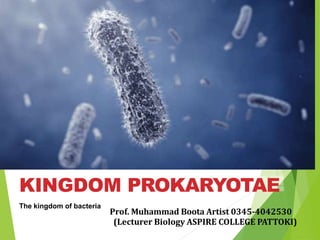
The kingdom of bacteria
KINGDOM PROKARYOTAE
Prof. Muhammad Boota Artist 0345-4042530
(Lecturer Biology ASPIRE COLLEGE PATTOKI)
KINGDOM PROKARYOTAE
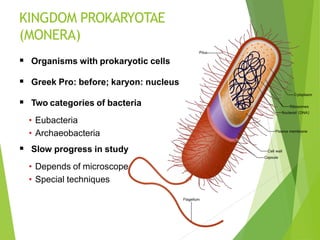
(MONERA)
 Organisms with prokaryotic cells
 Greek Pro: before; karyon: nucleus
 Two categories of bacteria
• Eubacteria
• Archaeobacteria
 Slow progress in study
• Depends of microscope
• Special techniques
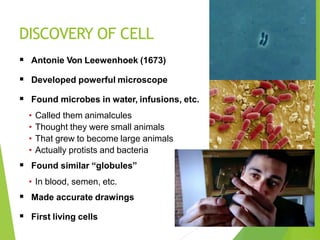
DISCOVERY OF CELL
 Antonie Von Leewenhoek (1673)
 Developed powerful microscope
 Found microbes in water, infusions, etc.
• Called them animalcules
• Thought they were small animals
• That grew to become large animals
• Actually protists and bacteria
 Found similar “globules”
• In blood, semen, etc.
 Made accurate drawings
 First living cells
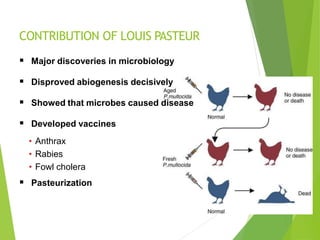
CONTRIBUTION OF LOUIS PASTEUR
 Major discoveries in microbiology
 Disproved abiogenesis decisively
 Showed that microbes caused disease
 Developed vaccines
• Anthrax
• Rabies
• Fowl cholera
 Pasteurization
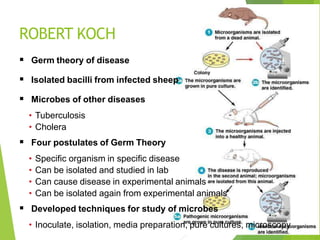
ROBERT KOCH
 Germ theory of disease
 Isolated bacilli from infected sheep
 Microbes of other diseases
• Tuberculosis
• Cholera
 Four postulates of Germ Theory
• Specific organism in specific disease
• Can be isolated and studied in lab
• Can cause disease in experimental animals
• Can be isolated again from experimental animals
 Developed techniques for study of microbes
• Inoculate, isolation, media preparation, pure cultures, microscopy
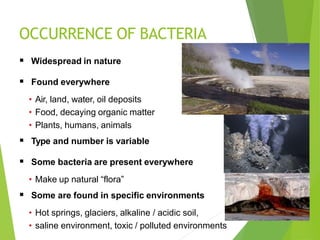
OCCURRENCE OF BACTERIA
 Widespread in nature
 Found everywhere
• Air, land, water, oil deposits
• Food, decaying organic matter
• Plants, humans, animals
 Type and number is variable
 Some bacteria are present everywhere
• Make up natural “flora”
 Some are found in specific environments
• Hot springs, glaciers, alkaline / acidic soil,
• saline environment, toxic / polluted environments
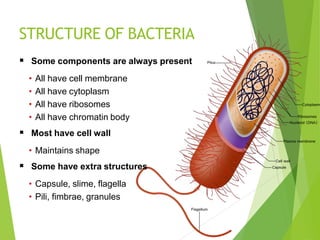
STRUCTURE OF BACTERIA
 Some components are always present
• All have cell membrane
• All have cytoplasm
• All have ribosomes
• All have chromatin body
 Most have cell wall
• Maintains shape
 Some have extra structures
• Capsule, slime, flagella
• Pili, fimbrae, granules
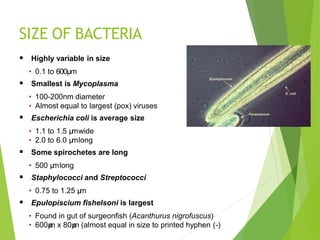
SIZE OF BACTERIA
 Highly variable in size
• 0.1 to 600μm
 Smallest is Mycoplasma
• 100-200nm diameter
• Almost equal to largest (pox) viruses
 Escherichia coli is average size
• 1.1 to 1.5 μ
mwide
• 2.0 to 6.0 μ
mlong
 Some spirochetes are long
• 500 μ
mlong
 Staphylococci and Streptococci
• 0.75 to 1.25 μ
m
 Epulopiscium fishelsoni is largest
• Found in gut of surgeonfish (Acanthurus nigrofuscus)
• 600μ
m x 80μ
m (almost equal in size to printed hyphen (-)
SHAPE OF BACTERIA
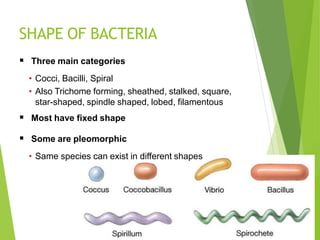
 Three main categories
• Cocci, Bacilli, Spiral
• Also Trichome forming, sheathed, stalked, square,
star-shaped, spindle shaped, lobed, filamentous
 Most have fixed shape
 Some are pleomorphic
• Same species can exist in different shapes
SHAPE OF BACTERIA
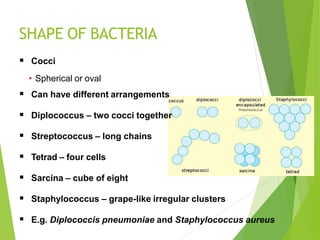
 Cocci
• Spherical or oval
 Can have different arrangements
 Diplococcus – two cocci together
 Streptococcus – long chains
 Tetrad – four cells
 Sarcina – cube of eight
 Staphylococcus – grape-like irregular clusters
 E.g. Diplococcis pneumoniae and Staphylococcus aureus
SHAPE OF BACTERIA
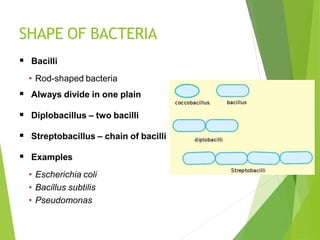
 Bacilli
• Rod-shaped bacteria
 Always divide in one plain
 Diplobacillus – two bacilli
 Streptobacillus – chain of bacilli
 Examples
• Escherichia coli
• Bacillus subtilis
• Pseudomonas
SHAPE OF BACTERIA
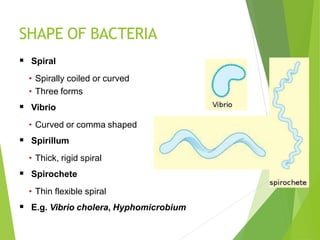
 Spiral
• Spirally coiled or curved
• Three forms
 Vibrio
• Curved or comma shaped
 Spirillum
• Thick, rigid spiral
 Spirochete
• Thin flexible spiral
 E.g. Vibrio cholera, Hyphomicrobium
STRUCTURE OF BACTERIAL CELL
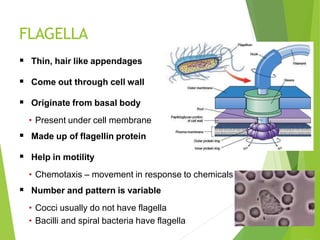
FLAGELLA
 Thin, hair like appendages
 Come out through cell wall
 Originate from basal body
• Present under cell membrane
 Made up of flagellin protein
 Help in motility
• Chemotaxis – movement in response to chemicals
 Number and pattern is variable
• Cocci usually do not have flagella
• Bacilli and spiral bacteria have flagella
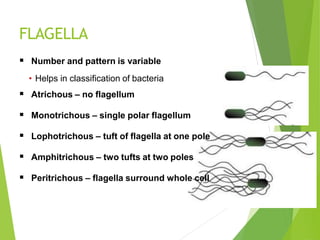
FLAGELLA
 Number and pattern is variable
• Helps in classification of bacteria
 Atrichous – no flagellum
 Monotrichous – single polar flagellum
 Lophotrichous – tuft of flagella at one pole
 Amphitrichous – two tufts at two poles
 Peritrichous – flagella surround whole cell
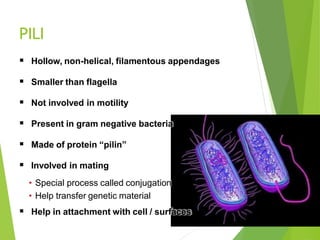
PILI
 Hollow, non-helical, filamentous appendages
 Smaller than flagella
 Not involved in motility
 Present in gram negative bacteria
 Made of protein “pilin”
 Involved in mating
• Special process called conjugation
• Help transfer genetic material
 Help in attachment with cell / surfaces
CELL ENVELOPE
 Extra covers outside membrane
 Diverse surface
• Capsule
• Slime
• Cell wall
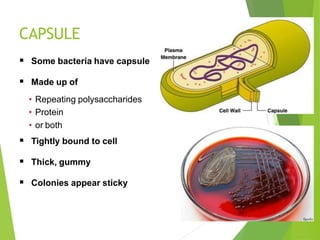
CAPSULE
 Some bacteria have capsule
 Made up of
• Repeating polysaccharides
• Protein
• or both
 Tightly bound to cell
 Thick, gummy
 Colonies appear sticky
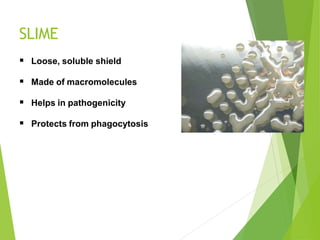
SLIME
 Loose, soluble shield
 Made of macromolecules
 Helps in pathogenicity
 Protects from phagocytosis
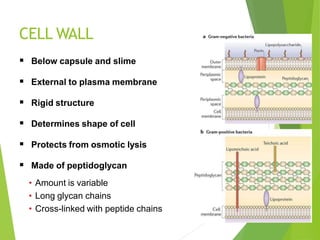
CELL WALL
 Below capsule and slime
 External to plasma membrane
 Rigid structure
 Determines shape of cell
 Protects from osmotic lysis
 Made of peptidoglycan
• Amount is variable
• Long glycan chains
• Cross-linked with peptide chains
CELL WALL
 Also contain
• Sugar, teichoic acid, lipoproteins and lipopolysaccharides
• Linked to peptidoglycan
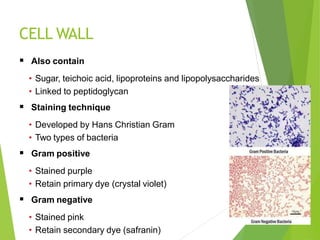
 Staining technique
• Developed by Hans Christian Gram
• Two types of bacteria
 Gram positive
• Stained purple
• Retain primary dye (crystal violet)
 Gram negative
• Stained pink
• Retain secondary dye (safranin)
CELL WALL
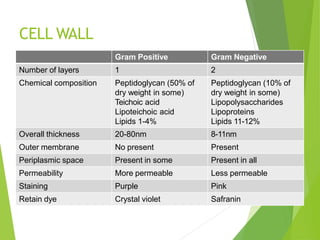
Gram Positive Gram Negative
Number of layers 1 2
Chemical composition Peptidoglycan (50% of
dry weight in some)
Teichoic acid
Lipoteichoic acid
Lipids 1-4%
Peptidoglycan (10% of
dry weight in some)
Lipopolysaccharides
Lipoproteins
Lipids 11-12%
Overall thickness 20-80nm 8-11nm
Outer membrane No present Present
Periplasmic space Present in some Present in all
Permeability More permeable Less permeable
Staining Purple Pink
Retain dye Crystal violet Safranin
CELL WALL
 Some bacteria have different cell wall
• Neither gram negative nor gram positive
 Cell wall of archeobacteria
• Very different from eubacteria
• No peptidoglycan
• Made of protein, glycoprotein, polysaccharides
 Absent in Mycoplasma
CELL MEMBRANE
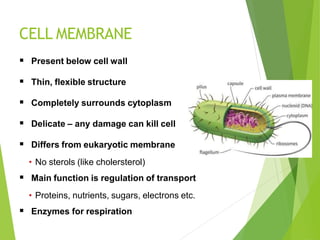
 Present below cell wall
 Thin, flexible structure
 Completely surrounds cytoplasm
 Delicate – any damage can kill cell
 Differs from eukaryotic membrane
• No sterols (like cholersterol)
 Main function is regulation of transport
• Proteins, nutrients, sugars, electrons etc.
 Enzymes for respiration
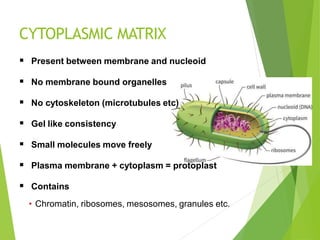
CYTOPLASMIC MATRIX
 Present between membrane and nucleoid
 No membrane bound organelles
 No cytoskeleton (microtubules etc)
 Gel like consistency
 Small molecules move freely
 Plasma membrane + cytoplasm = protoplast
 Contains
• Chromatin, ribosomes, mesosomes, granules etc.
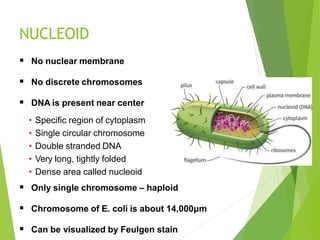
NUCLEOID
 No nuclear membrane
 No discrete chromosomes
 DNA is present near center
• Specific region of cytoplasm
• Single circular chromosome
• Double stranded DNA
• Very long, tightly folded
• Dense area called nucleoid
 Only single chromosome – haploid
 Chromosome of E. coli is about 14,000μm
 Can be visualized by Feulgen stain
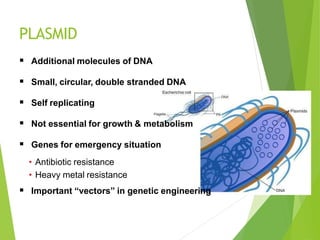
PLASMID
 Additional molecules of DNA
 Small, circular, double stranded DNA
 Self replicating
 Not essential for growth & metabolism
 Genes for emergency situation
• Antibiotic resistance
• Heavy metal resistance
 Important “vectors” in genetic engineering
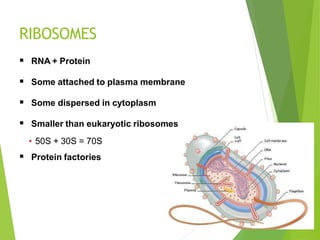
RIBOSOMES
 RNA + Protein
 Some attached to plasma membrane
 Some dispersed in cytoplasm
 Smaller than eukaryotic ribosomes
• 50S + 30S = 70S
 Protein factories
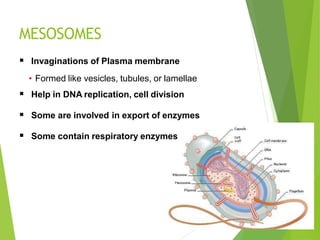
MESOSOMES
 Invaginations of Plasma membrane
• Formed like vesicles, tubules, or lamellae
 Help in DNA replication, cell division
 Some are involved in export of enzymes
 Some contain respiratory enzymes
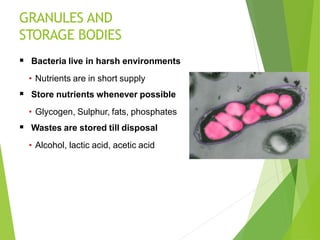
GRANULES AND
STORAGE BODIES
 Bacteria live in harsh environments
• Nutrients are in short supply
 Store nutrients whenever possible
• Glycogen, Sulphur, fats, phosphates
 Wastes are stored till disposal
• Alcohol, lactic acid, acetic acid
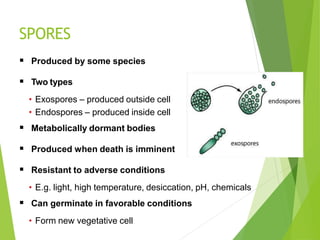
SPORES
 Produced by some species
 Two types
• Exospores – produced outside cell
• Endospores – produced inside cell
 Metabolically dormant bodies
 Produced when death is imminent
 Resistant to adverse conditions
• E.g. light, high temperature, desiccation, pH, chemicals
 Can germinate in favorable conditions
• Form new vegetative cell
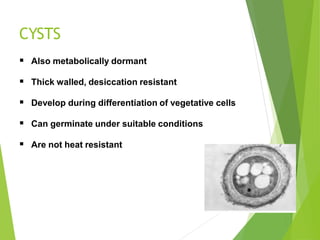
CYSTS
 Also metabolically dormant
 Thick walled, desiccation resistant
 Develop during differentiation of vegetative cells
 Can germinate under suitable conditions
 Are not heat resistant
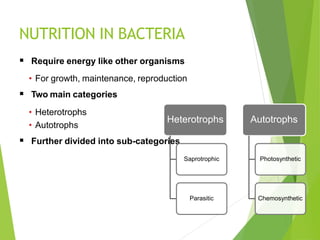
NUTRITION IN BACTERIA
 Require energy like other organisms
• For growth, maintenance, reproduction
 Two main categories
• Heterotrophs
• Autotrophs
 Further divided into sub-categories
Heterotrophs
Saprotrophic
Parasitic
Autotrophs
Photosynthetic
Chemosynthetic
HETEROTROPHIC BACTERIA
 Cannot synthesize their own food
 Depend on others for nutrition
 Two types
 Saprotrophs
• Nutrition from dead organic matter
• From Humus (partially decayed matter) in soil
• Enzyme systems for breakdown
• Absorbs simple substance
 Parasites
• Obtain nutrition from host, cause disease
AUTOTROPHIC BACTERIA
 Can synthesize organic compounds
• From simple inorganic substances
 Photosynthetic autotrophs
• Have chlorophyll for photosynthesis
• Differs from green plants
• Not present within chloroplasts
• Dispersed in cytoplasm
• Utilize H2S instead of H2O, release S
 Chemosynthetic autotrophs
• Oxidize inorganic substances
• Like ammonia, nitrate, nitrite, Sulphur, ferrous ions
• Trap released energy for own reactions
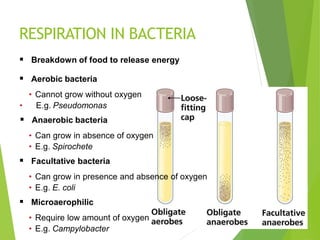
RESPIRATION IN BACTERIA
 Breakdown of food to release energy
 Aerobic bacteria
• Cannot grow without oxygen
• E.g. Pseudomonas
 Anaerobic bacteria
• Can grow in absence of oxygen
• E.g. Spirochete
 Facultative bacteria
• Can grow in presence and absence of oxygen
• E.g. E. coli
 Microaerophilic
• Require low amount of oxygen
• E.g. Campylobacter
GROWTH AND REPRODUCTION
BACTERIAL GROWTH
 Increase in number of cells
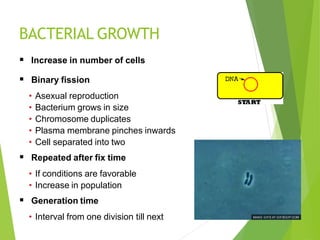
 Binary fission
• Asexual reproduction
• Bacterium grows in size
• Chromosome duplicates
• Plasma membrane pinches inwards
• Cell separated into two
 Repeated after fix time
• If conditions are favorable
• Increase in population
 Generation time
• Interval from one division till next
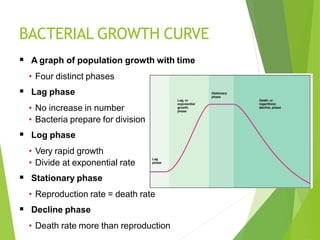
BACTERIAL GROWTH CURVE
 A graph of population growth with time
• Four distinct phases
 Lag phase
• No increase in number
• Bacteria prepare for division
 Log phase
• Very rapid growth
• Divide at exponential rate
 Stationary phase
• Reproduction rate = death rate
 Decline phase
• Death rate more than reproduction
SEXUAL REPRODUCTION
 Traditional sexual reproduction is absent
 Special type of genetic mixing
 Transfer of genetic material
 From donor to recipient
 Through sex pili
 Called conjugation
 Produces new genetic combinations
 Help in survival
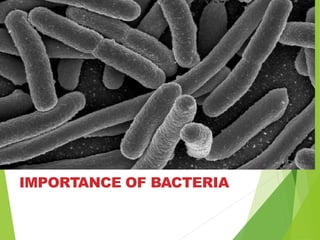
IMPORTANCE OF BACTERIA
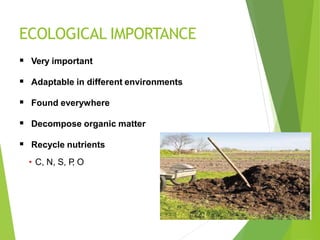
ECOLOGICAL IMPORTANCE
 Very important
 Adaptable in different environments
 Found everywhere
 Decompose organic matter
 Recycle nutrients
• C, N, S, P
, O
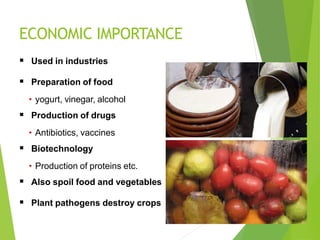
ECONOMIC IMPORTANCE
 Used in industries
 Preparation of food
• yogurt, vinegar, alcohol
 Production of drugs
• Antibiotics, vaccines
 Biotechnology
• Production of proteins etc.
 Also spoil food and vegetables
 Plant pathogens destroy crops
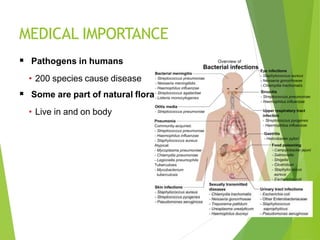
MEDICAL IMPORTANCE
 Pathogens in humans
• 200 species cause disease
 Some are part of natural flora
• Live in and on body
CONTROL OF BACTERIA
CONTROL OF BACTERIA
 Essential in certain conditions
• Home, industry, medical fields
 Prevention and treatment of disease
 Prevention of spoilage of food
 Various methods of control
• Physical methods
• Chemical methods
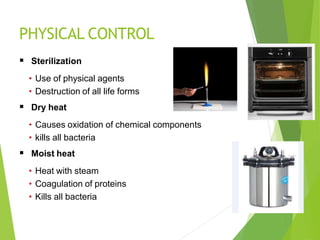
PHYSICAL CONTROL
 Sterilization
• Use of physical agents
• Destruction of all life forms
 Dry heat
• Causes oxidation of chemical components
• kills all bacteria
 Moist heat
• Heat with steam
• Coagulation of proteins
• Kills all bacteria
PHYSICAL CONTROL
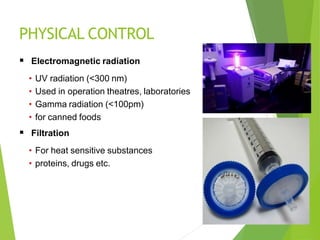
 Electromagnetic radiation
• UV radiation (<300 nm)
• Used in operation theatres, laboratories
• Gamma radiation (<100pm)
• for canned foods
 Filtration
• For heat sensitive substances
• proteins, drugs etc.
CHEMICAL CONTROL
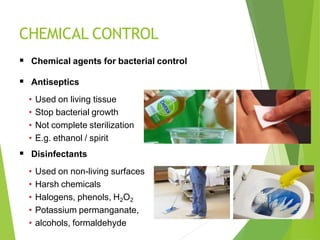
 Chemical agents for bacterial control
 Antiseptics
• Used on living tissue
• Stop bacterial growth
• Not complete sterilization
• E.g. ethanol / spirit
 Disinfectants
• Used on non-living surfaces
• Harsh chemicals
• Halogens, phenols, H2O2
• Potassium permanganate,
• alcohols, formaldehyde
CHEMICAL CONTROL
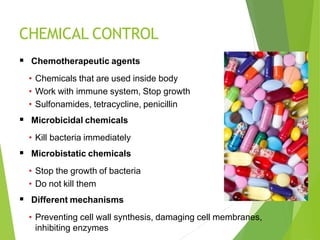
 Chemotherapeutic agents
• Chemicals that are used inside body
• Work with immune system, Stop growth
• Sulfonamides, tetracycline, penicillin
 Microbicidal chemicals
• Kill bacteria immediately
 Microbistatic chemicals
• Stop the growth of bacteria
• Do not kill them
 Different mechanisms
• Preventing cell wall synthesis, damaging cell membranes,
inhibiting enzymes
IMMUNIZATION & VACCINATION
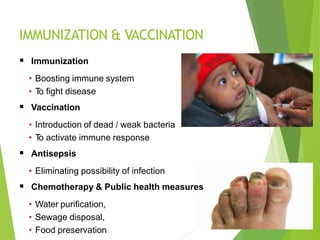
 Immunization
• Boosting immune system
• T
o fight disease
 Vaccination
• Introduction of dead / weak bacteria
• T
o activate immune response
 Antisepsis
• Eliminating possibility of infection
 Chemotherapy & Public health measures
• Water purification,
• Sewage disposal,
• Food preservation
VACCINATION
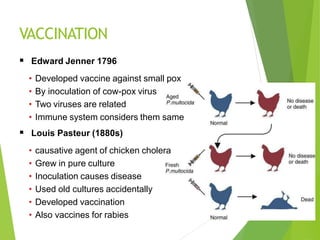
 Edward Jenner 1796
• Developed vaccine against small pox
• By inoculation of cow-pox virus
• Two viruses are related
• Immune system considers them same
 Louis Pasteur (1880s)
• causative agent of chicken cholera
• Grew in pure culture
• Inoculation causes disease
• Used old cultures accidentally
• Developed vaccination
• Also vaccines for rabies
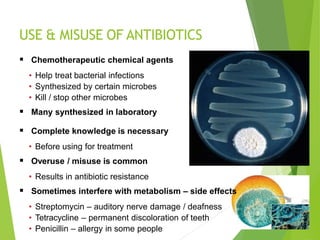
USE & MISUSE OF ANTIBIOTICS
 Chemotherapeutic chemical agents
• Help treat bacterial infections
• Synthesized by certain microbes
• Kill / stop other microbes
 Many synthesized in laboratory
 Complete knowledge is necessary
• Before using for treatment
 Overuse / misuse is common
• Results in antibiotic resistance
 Sometimes interfere with metabolism – side effects
• Streptomycin – auditory nerve damage / deafness
• Tetracycline – permanent discoloration of teeth
• Penicillin – allergy in some people
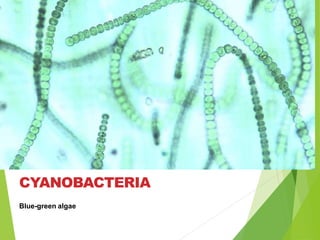
Blue-green algae
CYANOBACTERIA
CYANOBACTERIA
 Largest group of bacteria
 Most diverse group of photosynthetic bacteria
 Previously called blue-green algae
 Prokaryotes (not algae)
 Variable in size, shape, appearance
 Diameter 1 – 10 μm
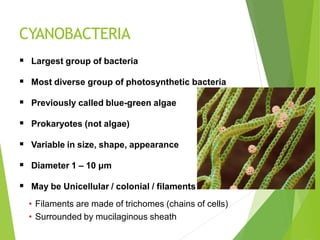
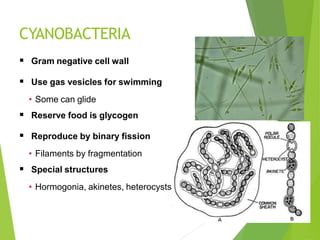
 May be Unicellular / colonial / filaments
• Filaments are made of trichomes (chains of cells)
• Surrounded by mucilaginous sheath
CYANOBACTERIA
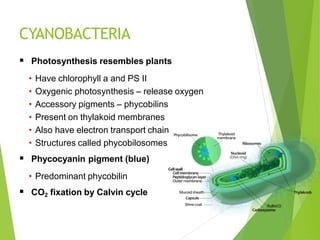
 Photosynthesis resembles plants
• Have chlorophyll a and PS II
• Oxygenic photosynthesis – release oxygen
• Accessory pigments – phycobilins
• Present on thylakoid membranes
• Also have electron transport chain
• Structures called phycobilosomes
 Phycocyanin pigment (blue)
• Predominant phycobilin
 CO2 fixation by Calvin cycle
CYANOBACTERIA
 Gram negative cell wall
 Use gas vesicles for swimming
• Some can glide
 Reserve food is glycogen
 Reproduce by binary fission
• Filaments by fragmentation
 Special structures
• Hormogonia, akinetes, heterocysts
ECONOMIC IMPORTANCE
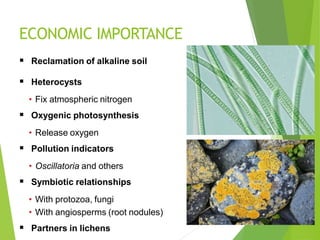
 Reclamation of alkaline soil
 Heterocysts
• Fix atmospheric nitrogen
 Oxygenic photosynthesis
• Release oxygen
 Pollution indicators
• Oscillatoria and others
 Symbiotic relationships
• With protozoa, fungi
• With angiosperms (root nodules)
 Partners in lichens
ECONOMIC IMPORTANCE
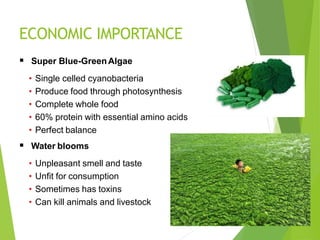
 Super Blue-GreenAlgae
• Single celled cyanobacteria
• Produce food through photosynthesis
• Complete whole food
• 60% protein with essential amino acids
• Perfect balance
 Water blooms
• Unpleasant smell and taste
• Unfit for consumption
• Sometimes has toxins
• Can kill animals and livestock
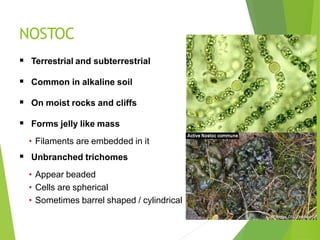
NOSTOC
 Terrestrial and subterrestrial
 Common in alkaline soil
 On moist rocks and cliffs
 Forms jelly like mass
• Filaments are embedded in it
 Unbranched trichomes
• Appear beaded
• Cells are spherical
• Sometimes barrel shaped / cylindrical
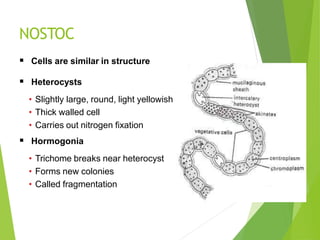
NOSTOC
 Cells are similar in structure
 Heterocysts
• Slightly large, round, light yellowish
• Thick walled cell
• Carries out nitrogen fixation
 Hormogonia
• Trichome breaks near heterocyst
• Forms new colonies
• Called fragmentation
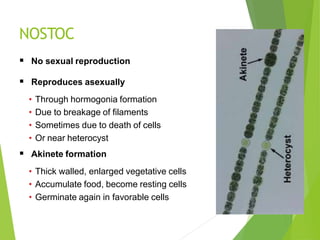
NOSTOC
 No sexual reproduction
 Reproduces asexually
• Through hormogonia formation
• Due to breakage of filaments
• Sometimes due to death of cells
• Or near heterocyst
 Akinete formation
• Thick walled, enlarged vegetative cells
• Accumulate food, become resting cells
• Germinate again in favorable cells

06_Kingdom_Prokaryotae769[1].pptx

  • 1.
    The kingdom ofbacteria KINGDOM PROKARYOTAE Prof. Muhammad Boota Artist 0345-4042530 (Lecturer Biology ASPIRE COLLEGE PATTOKI)
  • 2.
    KINGDOM PROKARYOTAE (MONERA)  Organismswith prokaryotic cells  Greek Pro: before; karyon: nucleus  Two categories of bacteria • Eubacteria • Archaeobacteria  Slow progress in study • Depends of microscope • Special techniques
  • 3.
    DISCOVERY OF CELL Antonie Von Leewenhoek (1673)  Developed powerful microscope  Found microbes in water, infusions, etc. • Called them animalcules • Thought they were small animals • That grew to become large animals • Actually protists and bacteria  Found similar “globules” • In blood, semen, etc.  Made accurate drawings  First living cells
  • 4.
    CONTRIBUTION OF LOUISPASTEUR  Major discoveries in microbiology  Disproved abiogenesis decisively  Showed that microbes caused disease  Developed vaccines • Anthrax • Rabies • Fowl cholera  Pasteurization
  • 5.
    ROBERT KOCH  Germtheory of disease  Isolated bacilli from infected sheep  Microbes of other diseases • Tuberculosis • Cholera  Four postulates of Germ Theory • Specific organism in specific disease • Can be isolated and studied in lab • Can cause disease in experimental animals • Can be isolated again from experimental animals  Developed techniques for study of microbes • Inoculate, isolation, media preparation, pure cultures, microscopy
  • 6.
    OCCURRENCE OF BACTERIA Widespread in nature  Found everywhere • Air, land, water, oil deposits • Food, decaying organic matter • Plants, humans, animals  Type and number is variable  Some bacteria are present everywhere • Make up natural “flora”  Some are found in specific environments • Hot springs, glaciers, alkaline / acidic soil, • saline environment, toxic / polluted environments
  • 7.
    STRUCTURE OF BACTERIA Some components are always present • All have cell membrane • All have cytoplasm • All have ribosomes • All have chromatin body  Most have cell wall • Maintains shape  Some have extra structures • Capsule, slime, flagella • Pili, fimbrae, granules
  • 8.
    SIZE OF BACTERIA Highly variable in size • 0.1 to 600μm  Smallest is Mycoplasma • 100-200nm diameter • Almost equal to largest (pox) viruses  Escherichia coli is average size • 1.1 to 1.5 μ mwide • 2.0 to 6.0 μ mlong  Some spirochetes are long • 500 μ mlong  Staphylococci and Streptococci • 0.75 to 1.25 μ m  Epulopiscium fishelsoni is largest • Found in gut of surgeonfish (Acanthurus nigrofuscus) • 600μ m x 80μ m (almost equal in size to printed hyphen (-)
  • 9.
    SHAPE OF BACTERIA Three main categories • Cocci, Bacilli, Spiral • Also Trichome forming, sheathed, stalked, square, star-shaped, spindle shaped, lobed, filamentous  Most have fixed shape  Some are pleomorphic • Same species can exist in different shapes
  • 10.
    SHAPE OF BACTERIA Cocci • Spherical or oval  Can have different arrangements  Diplococcus – two cocci together  Streptococcus – long chains  Tetrad – four cells  Sarcina – cube of eight  Staphylococcus – grape-like irregular clusters  E.g. Diplococcis pneumoniae and Staphylococcus aureus
  • 11.
    SHAPE OF BACTERIA Bacilli • Rod-shaped bacteria  Always divide in one plain  Diplobacillus – two bacilli  Streptobacillus – chain of bacilli  Examples • Escherichia coli • Bacillus subtilis • Pseudomonas
  • 12.
    SHAPE OF BACTERIA Spiral • Spirally coiled or curved • Three forms  Vibrio • Curved or comma shaped  Spirillum • Thick, rigid spiral  Spirochete • Thin flexible spiral  E.g. Vibrio cholera, Hyphomicrobium
  • 13.
  • 14.
    FLAGELLA  Thin, hairlike appendages  Come out through cell wall  Originate from basal body • Present under cell membrane  Made up of flagellin protein  Help in motility • Chemotaxis – movement in response to chemicals  Number and pattern is variable • Cocci usually do not have flagella • Bacilli and spiral bacteria have flagella
  • 15.
    FLAGELLA  Number andpattern is variable • Helps in classification of bacteria  Atrichous – no flagellum  Monotrichous – single polar flagellum  Lophotrichous – tuft of flagella at one pole  Amphitrichous – two tufts at two poles  Peritrichous – flagella surround whole cell
  • 16.
    PILI  Hollow, non-helical,filamentous appendages  Smaller than flagella  Not involved in motility  Present in gram negative bacteria  Made of protein “pilin”  Involved in mating • Special process called conjugation • Help transfer genetic material  Help in attachment with cell / surfaces
  • 17.
    CELL ENVELOPE  Extracovers outside membrane  Diverse surface • Capsule • Slime • Cell wall
  • 18.
    CAPSULE  Some bacteriahave capsule  Made up of • Repeating polysaccharides • Protein • or both  Tightly bound to cell  Thick, gummy  Colonies appear sticky
  • 19.
    SLIME  Loose, solubleshield  Made of macromolecules  Helps in pathogenicity  Protects from phagocytosis
  • 20.
    CELL WALL  Belowcapsule and slime  External to plasma membrane  Rigid structure  Determines shape of cell  Protects from osmotic lysis  Made of peptidoglycan • Amount is variable • Long glycan chains • Cross-linked with peptide chains
  • 21.
    CELL WALL  Alsocontain • Sugar, teichoic acid, lipoproteins and lipopolysaccharides • Linked to peptidoglycan  Staining technique • Developed by Hans Christian Gram • Two types of bacteria  Gram positive • Stained purple • Retain primary dye (crystal violet)  Gram negative • Stained pink • Retain secondary dye (safranin)
  • 22.
    CELL WALL Gram PositiveGram Negative Number of layers 1 2 Chemical composition Peptidoglycan (50% of dry weight in some) Teichoic acid Lipoteichoic acid Lipids 1-4% Peptidoglycan (10% of dry weight in some) Lipopolysaccharides Lipoproteins Lipids 11-12% Overall thickness 20-80nm 8-11nm Outer membrane No present Present Periplasmic space Present in some Present in all Permeability More permeable Less permeable Staining Purple Pink Retain dye Crystal violet Safranin
  • 23.
    CELL WALL  Somebacteria have different cell wall • Neither gram negative nor gram positive  Cell wall of archeobacteria • Very different from eubacteria • No peptidoglycan • Made of protein, glycoprotein, polysaccharides  Absent in Mycoplasma
  • 24.
    CELL MEMBRANE  Presentbelow cell wall  Thin, flexible structure  Completely surrounds cytoplasm  Delicate – any damage can kill cell  Differs from eukaryotic membrane • No sterols (like cholersterol)  Main function is regulation of transport • Proteins, nutrients, sugars, electrons etc.  Enzymes for respiration
  • 25.
    CYTOPLASMIC MATRIX  Presentbetween membrane and nucleoid  No membrane bound organelles  No cytoskeleton (microtubules etc)  Gel like consistency  Small molecules move freely  Plasma membrane + cytoplasm = protoplast  Contains • Chromatin, ribosomes, mesosomes, granules etc.
  • 26.
    NUCLEOID  No nuclearmembrane  No discrete chromosomes  DNA is present near center • Specific region of cytoplasm • Single circular chromosome • Double stranded DNA • Very long, tightly folded • Dense area called nucleoid  Only single chromosome – haploid  Chromosome of E. coli is about 14,000μm  Can be visualized by Feulgen stain
  • 27.
    PLASMID  Additional moleculesof DNA  Small, circular, double stranded DNA  Self replicating  Not essential for growth & metabolism  Genes for emergency situation • Antibiotic resistance • Heavy metal resistance  Important “vectors” in genetic engineering
  • 28.
    RIBOSOMES  RNA +Protein  Some attached to plasma membrane  Some dispersed in cytoplasm  Smaller than eukaryotic ribosomes • 50S + 30S = 70S  Protein factories
  • 29.
    MESOSOMES  Invaginations ofPlasma membrane • Formed like vesicles, tubules, or lamellae  Help in DNA replication, cell division  Some are involved in export of enzymes  Some contain respiratory enzymes
  • 30.
    GRANULES AND STORAGE BODIES Bacteria live in harsh environments • Nutrients are in short supply  Store nutrients whenever possible • Glycogen, Sulphur, fats, phosphates  Wastes are stored till disposal • Alcohol, lactic acid, acetic acid
  • 31.
    SPORES  Produced bysome species  Two types • Exospores – produced outside cell • Endospores – produced inside cell  Metabolically dormant bodies  Produced when death is imminent  Resistant to adverse conditions • E.g. light, high temperature, desiccation, pH, chemicals  Can germinate in favorable conditions • Form new vegetative cell
  • 32.
    CYSTS  Also metabolicallydormant  Thick walled, desiccation resistant  Develop during differentiation of vegetative cells  Can germinate under suitable conditions  Are not heat resistant
  • 33.
  • 34.
    NUTRITION IN BACTERIA Require energy like other organisms • For growth, maintenance, reproduction  Two main categories • Heterotrophs • Autotrophs  Further divided into sub-categories Heterotrophs Saprotrophic Parasitic Autotrophs Photosynthetic Chemosynthetic
  • 35.
    HETEROTROPHIC BACTERIA  Cannotsynthesize their own food  Depend on others for nutrition  Two types  Saprotrophs • Nutrition from dead organic matter • From Humus (partially decayed matter) in soil • Enzyme systems for breakdown • Absorbs simple substance  Parasites • Obtain nutrition from host, cause disease
  • 36.
    AUTOTROPHIC BACTERIA  Cansynthesize organic compounds • From simple inorganic substances  Photosynthetic autotrophs • Have chlorophyll for photosynthesis • Differs from green plants • Not present within chloroplasts • Dispersed in cytoplasm • Utilize H2S instead of H2O, release S  Chemosynthetic autotrophs • Oxidize inorganic substances • Like ammonia, nitrate, nitrite, Sulphur, ferrous ions • Trap released energy for own reactions
  • 37.
  • 38.
    RESPIRATION IN BACTERIA Breakdown of food to release energy  Aerobic bacteria • Cannot grow without oxygen • E.g. Pseudomonas  Anaerobic bacteria • Can grow in absence of oxygen • E.g. Spirochete  Facultative bacteria • Can grow in presence and absence of oxygen • E.g. E. coli  Microaerophilic • Require low amount of oxygen • E.g. Campylobacter
  • 39.
  • 40.
    BACTERIAL GROWTH  Increasein number of cells  Binary fission • Asexual reproduction • Bacterium grows in size • Chromosome duplicates • Plasma membrane pinches inwards • Cell separated into two  Repeated after fix time • If conditions are favorable • Increase in population  Generation time • Interval from one division till next
  • 41.
    BACTERIAL GROWTH CURVE A graph of population growth with time • Four distinct phases  Lag phase • No increase in number • Bacteria prepare for division  Log phase • Very rapid growth • Divide at exponential rate  Stationary phase • Reproduction rate = death rate  Decline phase • Death rate more than reproduction
  • 42.
    SEXUAL REPRODUCTION  Traditionalsexual reproduction is absent  Special type of genetic mixing  Transfer of genetic material  From donor to recipient  Through sex pili  Called conjugation  Produces new genetic combinations  Help in survival
  • 43.
  • 44.
    ECOLOGICAL IMPORTANCE  Veryimportant  Adaptable in different environments  Found everywhere  Decompose organic matter  Recycle nutrients • C, N, S, P , O
  • 45.
    ECONOMIC IMPORTANCE  Usedin industries  Preparation of food • yogurt, vinegar, alcohol  Production of drugs • Antibiotics, vaccines  Biotechnology • Production of proteins etc.  Also spoil food and vegetables  Plant pathogens destroy crops
  • 46.
    MEDICAL IMPORTANCE  Pathogensin humans • 200 species cause disease  Some are part of natural flora • Live in and on body
  • 47.
  • 48.
    CONTROL OF BACTERIA Essential in certain conditions • Home, industry, medical fields  Prevention and treatment of disease  Prevention of spoilage of food  Various methods of control • Physical methods • Chemical methods
  • 49.
    PHYSICAL CONTROL  Sterilization •Use of physical agents • Destruction of all life forms  Dry heat • Causes oxidation of chemical components • kills all bacteria  Moist heat • Heat with steam • Coagulation of proteins • Kills all bacteria
  • 50.
    PHYSICAL CONTROL  Electromagneticradiation • UV radiation (<300 nm) • Used in operation theatres, laboratories • Gamma radiation (<100pm) • for canned foods  Filtration • For heat sensitive substances • proteins, drugs etc.
  • 51.
    CHEMICAL CONTROL  Chemicalagents for bacterial control  Antiseptics • Used on living tissue • Stop bacterial growth • Not complete sterilization • E.g. ethanol / spirit  Disinfectants • Used on non-living surfaces • Harsh chemicals • Halogens, phenols, H2O2 • Potassium permanganate, • alcohols, formaldehyde
  • 52.
    CHEMICAL CONTROL  Chemotherapeuticagents • Chemicals that are used inside body • Work with immune system, Stop growth • Sulfonamides, tetracycline, penicillin  Microbicidal chemicals • Kill bacteria immediately  Microbistatic chemicals • Stop the growth of bacteria • Do not kill them  Different mechanisms • Preventing cell wall synthesis, damaging cell membranes, inhibiting enzymes
  • 53.
  • 54.
    IMMUNIZATION & VACCINATION Immunization • Boosting immune system • T o fight disease  Vaccination • Introduction of dead / weak bacteria • T o activate immune response  Antisepsis • Eliminating possibility of infection  Chemotherapy & Public health measures • Water purification, • Sewage disposal, • Food preservation
  • 55.
    VACCINATION  Edward Jenner1796 • Developed vaccine against small pox • By inoculation of cow-pox virus • Two viruses are related • Immune system considers them same  Louis Pasteur (1880s) • causative agent of chicken cholera • Grew in pure culture • Inoculation causes disease • Used old cultures accidentally • Developed vaccination • Also vaccines for rabies
  • 56.
    USE & MISUSEOF ANTIBIOTICS  Chemotherapeutic chemical agents • Help treat bacterial infections • Synthesized by certain microbes • Kill / stop other microbes  Many synthesized in laboratory  Complete knowledge is necessary • Before using for treatment  Overuse / misuse is common • Results in antibiotic resistance  Sometimes interfere with metabolism – side effects • Streptomycin – auditory nerve damage / deafness • Tetracycline – permanent discoloration of teeth • Penicillin – allergy in some people
  • 57.
  • 58.
    CYANOBACTERIA  Largest groupof bacteria  Most diverse group of photosynthetic bacteria  Previously called blue-green algae  Prokaryotes (not algae)  Variable in size, shape, appearance  Diameter 1 – 10 μm  May be Unicellular / colonial / filaments • Filaments are made of trichomes (chains of cells) • Surrounded by mucilaginous sheath
  • 59.
    CYANOBACTERIA  Photosynthesis resemblesplants • Have chlorophyll a and PS II • Oxygenic photosynthesis – release oxygen • Accessory pigments – phycobilins • Present on thylakoid membranes • Also have electron transport chain • Structures called phycobilosomes  Phycocyanin pigment (blue) • Predominant phycobilin  CO2 fixation by Calvin cycle
  • 60.
    CYANOBACTERIA  Gram negativecell wall  Use gas vesicles for swimming • Some can glide  Reserve food is glycogen  Reproduce by binary fission • Filaments by fragmentation  Special structures • Hormogonia, akinetes, heterocysts
  • 61.
    ECONOMIC IMPORTANCE  Reclamationof alkaline soil  Heterocysts • Fix atmospheric nitrogen  Oxygenic photosynthesis • Release oxygen  Pollution indicators • Oscillatoria and others  Symbiotic relationships • With protozoa, fungi • With angiosperms (root nodules)  Partners in lichens
  • 62.
    ECONOMIC IMPORTANCE  SuperBlue-GreenAlgae • Single celled cyanobacteria • Produce food through photosynthesis • Complete whole food • 60% protein with essential amino acids • Perfect balance  Water blooms • Unpleasant smell and taste • Unfit for consumption • Sometimes has toxins • Can kill animals and livestock
  • 63.
    NOSTOC  Terrestrial andsubterrestrial  Common in alkaline soil  On moist rocks and cliffs  Forms jelly like mass • Filaments are embedded in it  Unbranched trichomes • Appear beaded • Cells are spherical • Sometimes barrel shaped / cylindrical
  • 64.
    NOSTOC  Cells aresimilar in structure  Heterocysts • Slightly large, round, light yellowish • Thick walled cell • Carries out nitrogen fixation  Hormogonia • Trichome breaks near heterocyst • Forms new colonies • Called fragmentation
  • 65.
    NOSTOC  No sexualreproduction  Reproduces asexually • Through hormogonia formation • Due to breakage of filaments • Sometimes due to death of cells • Or near heterocyst  Akinete formation • Thick walled, enlarged vegetative cells • Accumulate food, become resting cells • Germinate again in favorable cells